Theology

Good Thoughts in Bad Times

Thomas Fuller was a seventeenth-century pastor and, in the judgment of Samuel Taylor Coleridge, the “most sensible … great man of an age that boasted a galaxy of great men.” Fuller took the royalist side in England’s civil war and yet maintained wide popularity. His witty preaching in London on the Strand at the Chapel of Saint Mary drew overflow audiences. A selection of Fuller’s writings are included in Sherwood Wirt’s Spiritual Disciplines (Crossway, 1983). Most of the following are taken from Fuller’s Good Thoughts in Bad Times, published during England’s “bloodiest era.” (Archaisms have been altered or deleted.)

A Harsh Voice

Lord, my voice by nature is harsh and out of tune, and it is hopeless to lavish any art on it to make it better. Can my singing of psalms be pleasing to your ears when it is so unpleasant to my own? Yet though I cannot sing with the nightingale, or chirp with the blackbird, I would rather chatter with the swallow—even croak with the raven—than be altogether silent. Had you given me a better voice, I would have praised you with a better voice. Now what my music lacks in sweetness, let it have in sense, singing praises with understanding. Create in me a new heart in which to make melody, and I will be contented with my old voice, until in due time, being admitted into the choir of heaven, I have another more harmonious voice given to me.

Good Divinity

Lord, I confess that when in my writing I have occasion to insert the phrase “God willing,” I can barely prevent myself from putting it in a parenthesis, as if it may as well be left out as put in. But indeed, without these words all the rest is nothing. From now on, then, I will write those words fully and fairly, without any parenthesis. Let critics censure it for bad grammar: I am sure it is good divinity.

Fathers And Sons

Lord, I find the genealogy of my Savior strangely checkered with four remarkable changes in four immediate generations.

1. Rehoboam begat Abia; that is, a bad father begat a bad son.

2. Abia begat Asa; that is, a bad father a good son.

3. Asa begat Jehosophat; that is, a good father a good son.

4. Jehosophat begat Joram; that is, a good father a bad son.

I see, Lord, from this, that my father’s piety cannot be handed on; that is bad news for me. But I also see that actual impiety is not always hereditary; that is good news for my son.

The Best Chapter In The Bible

Lord, I discover a laziness in my soul. When I am to read a chapter in the Bible, before I begin, I look where it ends. And if it does not end on the same side, I cannot keep my hands from turning over the page, to measure the length of the text on the other side. If it swells to many verses, I begin to grudge. Surely my heart is not right. Were I truly hungry for heavenly food, I would not complain of more meat. Scourge, Lord, this laziness from my soul, make the reading of your Word not a penance, but a pleasure to me. Teach me that as among many heaps of gold, all being equally pure, that one that is biggest is the best, and so I may esteem as the best chapter in the Bible the one that is longest.

A False Witch

King James desired to discover those who falsely pretended to be possessed with a devil. A maid pretended such a possession, and for more color, when the first verses of the Gospel of Saint John were read in her hearing, she would fall into strange fits of fuming and foaming, to the amazement of the beholders. But the king ordered one of his chaplains to read the same in the original, and the same maid (apparently possessed with an English devil who understood not a word of Greek) was tame and quiet. I know a quarrelsome parish in which, if the minister in his pulpit had but spoken the word “kingdom,” the people would have been ready to throw him out. But as for “realm,” the same word in French, he might safely use it in his sermons as often as he pleased. Ignorance generally inflames, but sometimes by happenstance it abates men’s malice.

Pronouncing The Prayer

I saw a mother threatening to punish her little child for not pronouncing correctly the petition in the Lord’s Prayer, “And forgive us our trespasses, as we forgive them that trespass against us.” The child tried as much as it could to utter it, trying to change its “tepasses” to “trespasses.” Alas! The confluence of the hard consonants were a block to the child’s tongue. Therefore if the mother had punished defect in the child for default, she deserved to have been punished herself; and deserved it even more than the child, because what the child could not pronounce the parents do not practice. Oh, how lispingly and imperfectly we perform the close of this petition: “As we forgive them that trespass against us.” It is well if, like the child, we try our hardest, though falling short in the exact observance.

Theology

Born Again—And Beyond

God’s Revolution: The Witness of Eberhard Arnold, edited by the Hutterian Society of Brothers and John Howard Yoder (Paulist Press, 1984, 224 pp.; $8.95, pb)

Occasionally we are confronted by saints who challenge us to an uncompromising spirituality. The founders of the great monastic orders during the late Roman Empire and throughout the Middle Ages were Christians of this sort. So were many of the Anabaptists of the Reformation era.

These heroic Christians took seriously the New Testament suggestions that the Christian life is one of war with the world, the flesh, and the Devil. Accordingly, they formed communities in which they renounced the world, denied the flesh, and sought a communal spirituality against which the gates of hell could not prevail.

God’s Revolution is a collection of fragments from the messages of one twentieth-century adherent to this age-old call to kingdom living, Eberhard Arnold (1883–1935), who in 1920 founded the Bruderhof community in Germany. And it is a labor of love. Indeed, a preface by Malcolm Muggeridge and an introduction by John Howard Yoder indicate the respect that the spirituality of Arnold and his communities attract to this day.

Arnold became convinced by the necessity of a radically antiworldly Christianity and eventually affiliated his community with the Hutterian brethren, a historic Anabaptist group. As John Howard Yoder’s introduction indicates, Arnold’s piety grew out of pietist roots similar to those that fostered much of American fundamentalism and its evangelical successors. In fact, Arnold’s early spiritual heritage was shaped by the Student Christian Movement (SCM) that originated in Dwight L. Moody’s revivals. The SCM called for a “deepening Christian life”—a theme that Arnold took as a central goal in his own life.

As did the turn-of-the-century holiness and Keswick movements in America and England, Arnold emphasized that being born again was not enough, but only a first step toward giving oneself entirely to Christ and to living in his kingdom. And again like these movements and the related dispensationalism of the times, Arnold viewed the so-called Christian nations as serving Satan. He carried these themes further, however, than did most of his English-speaking counterparts. Living with Christ as king at the center of our lives, he insisted, should be done by the church communally. The gathered church was thus the manifestation of the kingdom on earth. This view necessitated separation from conventional churches.

This radical view of Christ’s kingdom as truly alien from the kingdoms of the world also involved a condemnation of all political involvement. Arnold condemned all violence—whether wars, exploitation of the poor, abortion, concentration camps, or driving cars at agreeable (but deadly) speeds. And since Arnold and his community condemned all governments as agencies of “the Beast” of Revelation, his was among the earliest of Christian groups prophetically to identify the true character of Hitler’s Germany and also one of the first groups to suffer for noncooperation with the Nazis. “We need suffering,” Arnold wrote, however. “The more we suffer and become aware of our own wretchedness, the more we realize that Jesus is our only foothold.”

An Excerpt

“The theological nonsense that came out of there [at Tübingen University] was almost unbearable. A pious young woman (a theology student) stood up and said, ‘Jesus said, I have not come to bring peace, but the sword’ (Matt. 10:34). I answered, ‘I am very much surprised to hear these words in this context. I don’t understand what you mean. Jesus is talking about the relationship between a daughter-in-law who wants to follow Him and her mother-in-law who has not chosen the way of discipleship. Are you trying to say that Jesus meant the daughter-in-law should kill her mother-in-law?’ ”

—Report about lecture at Tübingen; Rhön Bruderhof, February 22, 1933

In answer to the accusation that withdrawing from the world was not socially responsible, Arnold stressed that the central calling of the church is to be a model community—a light for the world to see. “The communal church,” he said, “has to represent here and now the charter of the Kingdom to come.” Arnold’s views are not presented in this collection as sustained arguments, but rather as a series of excerpts from his homilies. They are not likely, therefore, by themselves to win over persons from other traditions who do not think that Scriptures demand that the church should separate itself so radically from the world or who stress doctrines of grace more than Arnold does here. Readers from such traditions should nonetheless be challenged by Arnold’s rigorous biblical piety. Those convinced that churches should be full-fledged separated communities will find him inspiring.

Reviewed by George M. Marsden, professor of history at Calvin College in Grand Rapids, Michigan.

Tracking God In His Cosmos

The Cosmic Adventure, by John F. Haught (Paulist Press, 1984, 224 pp.; $6.95, pb)

According to Catholic theologian John Haught, the apparent chasm between faith and reason would not seem so great if the proponents of scientific materialism—the belief in a spiritless, mindless universe—would but pay attention to recent discoveries in their own disciplines. Thus the premise of his new book, The Cosmic Adventure: Science, Religion, and the Quest for Purpose.

Mingling Roman Catholicism and process theology with an engaging use of illustrations, Haught aptly brings his complex thesis to life—while tackling the scientific community head-on.

High on Haught’s list of insistent materialists are biologists and others in related life sciences (the very fields of inquiry in which Christian values are increasingly challenged by genetic engineering and “quality of life” considerations). In their efforts to reduce life to random chemical reactions, these scientists, Haught believes, look to the genetic encoding of DNA molecules in every human cell. But, he says, their discoveries are their undoing. What matters about DNA molecules is the sequence in which the code appears, and that is extraneous to the chemistry of life. “ ‘Chance’ appears to be the scribbler, eraser, and communicator,” he writes, and as a result biologists risk “trailing off into mystification.”

To make his point, Haught compares DNA encoding to letters on a printed page. Something apart from the chemical interaction of ink and paper causes meaning to emerge from a book’s pages, he says. An author depends on the chemistry of ink and paper to get his message across, but he would rightly feel insulted if the reader believed a chemical analysis would yield all that there was to learn from his book.

Haught, 41, teaches theology at Georgetown University in Washington, D.C. He wrote Adventure out of a concern for people caught between world views—uncomfortable with the rigid dogmatism that prevails in scientific circles yet dissatisfied with religion that oversimplifies and minimizes the evidence science has amassed. “There are a lot of intelligent people out there looking for an alternative,” he told CHRISTIANITY TODAY.

Haught is not completely comfortable with process theology as a bridge between scientific and religious thought, but he defends it nevertheless as a philosophical framework ideally suited to the modern mind. “If a person hasn’t been caught by the spirit of evolutionary theory or modern physics, that person will be less likely to understand process theology. So in many respects it’s a theology that is oriented toward a specific type of intellectual mind—a consciousness steeped in modern scientific theory.”

Process theology took shape when Alfred North Whitehead came to the United States from England at age 63. His father was an Anglican pastor, but Whitehead counted himself an agnostic. When he lost a son in World War I, tragedy forced him to consider matters of life and death. Haught says Whitehead “tried to conceive of the cosmos in such a way that there’s no absolute perishing. He began to see the necessity of positing the existence of God to explain very basic things—creation, the creative lure for humans. Little by little, the idea of God came back as an indispensable ingredient in his philosophy.” Thus, to the process theologian, God is intimately involved with every occurrence in the universe, and that alone gives it meaning. He becomes a “universal recipient”—different in nature from the changeless God of historic Christian understanding. Instead of “I Am Who I Am,” God “will be who he will be.”

Haught defines God as “the source of order and novelty” and says sin is “unnecessary disorder or unnecessary monotony.” Man is separated from God to the extent to which he fails to maximize God-given opportunities and becomes “converted” by “opening out to a wider vision.” Process theology does not personify evil because, Haught says, “trying to condense the world’s evil is a trivialization.”

From Whitehead, Haught borrows an argument that reduces scientific materialism to an absurd conundrum. Materialists believe evolution occurred at random, resulting in man and his advanced capacity to think. Therefore, man is “continuous with nature.” Yet, at the same time, scientific materialism separates mind from nature, saying the human mind is the highest form of consciousness, capable of independently and objectively perceiving the world around it.

This is dualism, and Haught terms it “incoherent” as well as arrogant. The materialist view depends on faith of a different stripe, because there is no evidence that the human mind occupies the most sophisticated level of intelligence the universe can muster.

Haught points out that hierarchies of intelligence abound—from petunias to puppies to people—and there is reason to suspect a still higher level that can “get its mind around us” while remaining imperceptible to our senses.

This is where religious faith enters in, which Haught defines as “the kind of knowing whereby we … leave ourselves open to being grasped by a more encompassing field of influence.” The Christian version of faith, Haught says, offers the believer a means of knowing about, and basking in, the sustaining care of God. Jesus Christ models a harmonizing, aesthetic approach to life, rather than a dry ethic. Haught speculates about whether the church’s job of building the body of Christ might lead the way for “a deeper incarnation of God in the cosmos.”

Despite its significant differences with historic Christianity (among other things, its undeniable universalism), Cosmic Adventure reaches out in a direction many evangelicals fear to tread. Namely, it takes on secularist thought at its highest intellectual levels. Indeed, Haught beams his message toward a questioning, often hostile, community of scientists. He tries to explain the reality of God in the midst of scientific theory and discovery.

That the secular press has given Haught’s effort more than passing attention should act as a call to evangelical intellectuals to address more critically and astutely the questions of the cosmos from their unique vantage point of knowing its Creator. As it has from the beginning, the world wants an answer.

BETH SPRING

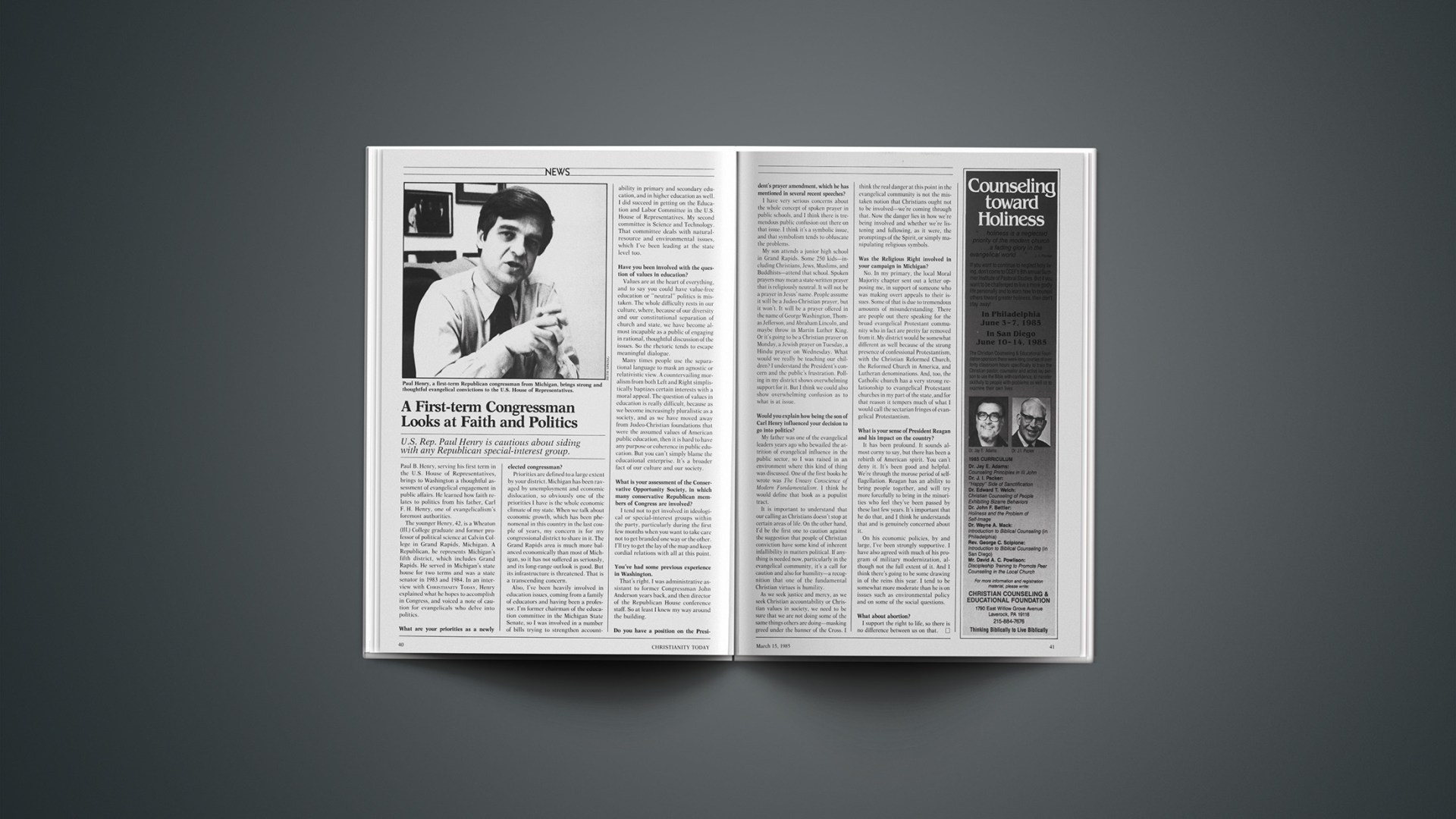
A First-Term Congressman Looks at Faith and Politics

U.S. Rep. Paul Henry is cautious about siding with any Republican special-interest group.

Paul B. Henry, serving his first term in the U.S. House of Representatives, brings to Washington a thoughtful assessment of evangelical engagement in public affairs. He learned how faith relates to politics from his father, Carl F. H. Henry, one of evangelicalism’s foremost authorities.

The younger Henry, 42, is a Wheaton (Ill.) College graduate and former professor of political science at Calvin College in Grand Rapids, Michigan. A Republican, he represents Michigan’s fifth district, which includes Grand Rapids. He served in Michigan’s state house for two terms and was a state senator in 1983 and 1984. In an interview with CHRISTIANITY TODAY, Henry explained what he hopes to accomplish in Congress, and voiced a note of caution for evangelicals who delve into politics.

What are your priorities as a newly elected congressman?

Priorities are defined to a large extent by your district. Michigan has been ravaged by unemployment and economic dislocation, so obviously one of the priorities I have is the whole economic climate of my state. When we talk about economic growth, which has been phenomenal in this country in the last couple of years, my concern is for my congressional district to share in it. The Grand Rapids area is much more balanced economically than most of Michigan, so it has not suffered as seriously, and its long-range outlook is good. But its infrastructure is threatened. That is a transcending concern.

Also, I’ve been heavily involved in education issues, coming from a family of educators and having been a professor. I’m former chairman of the education committee in the Michigan State Senate, so I was involved in a number of bills trying to strengthen accountability in primary and secondary education, and in higher education as well. I did succeed in getting on the Education and Labor Committee in the U.S. House of Representatives. My second committee is Science and Technology. That committee deals with natural-resource and environmental issues, which I’ve been leading at the state level too.

Have you been involved with the question of values in education?

Values are at the heart of everything, and to say you could have value-free education or “neutral” politics is mistaken. The whole difficulty rests in our culture, where, because of our diversity and our constitutional separation of church and state, we have become almost incapable as a public of engaging in rational, thoughtful discussion of the issues. So the rhetoric tends to escape meaningful dialogue.

Many times people use the separational language to mask an agnostic or relativistic view. A countervailing moralism from both Left and Right simplistically baptizes certain interests with a moral appeal. The question of values in education is really difficult, because as we become increasingly pluralistic as a society, and as we have moved away from Judeo-Christian foundations that were the assumed values of American public education, then it is hard to have any purpose or coherence in public education. But you can’t simply blame the educational enterprise. It’s a broader fact of our culture and our society.

What is your assessment of the Conservative Opportunity Society, in which many conservative Republican members of Congress are involved?

I tend not to get involved in ideological or special-interest groups within the party, particularly during the first few months when you want to take care not to get branded one way or the other. I’ll try to get the lay of the map and keep cordial relations with all at this point.

You’ve had some previous experience in Washington.

That’s right. I was administrative assistant to former Congressman John Anderson years back, and then director of the Republican House conference staff. So at least I knew my way around the building.

Do you have a position on the President’sprayer amendment, which he has mentioned in several recent speeches?

I have very serious concerns about the whole concept of spoken prayer in public schools, and I think there is tremendous public confusion out there on that issue. I think it’s a symbolic issue, and that symbolism tends to obfuscate the problems.

My son attends a junior high school in Grand Rapids. Some 250 kids—including Christians, Jews, Muslims, and Buddhists—attend that school. Spoken prayers may mean a state-written prayer that is religiously neutral. It will not be a prayer in Jesus’ name. People assume it will be a Judeo-Christian prayer, but it won’t. It will be a prayer offered in the name of George Washington, Thomas Jefferson, and Abraham Lincoln, and maybe throw in Martin Luther King. Or it’s going to be a Christian prayer on Monday, a Jewish prayer on Tuesday, a Hindu prayer on Wednesday. What would we really be teaching our children? I understand the President’s concern and the public’s frustration. Polling in my district shows overwhelming support for it. But I think we could also show overwhelming confusion as to what is at issue.

Would you explain how being the son of Carl Henry influenced your decision to go into politics?

My father was one of the evangelical leaders years ago who bewailed the attrition of evangelical influence in the public sector, so I was raised in an environment where this kind of thing was discussed. One of the first books he wrote was The Uneasy Conscience of Modern Fundamentalism. I think he would define that book as a populist tract.

It is important to understand that our calling as Christians doesn’t stop at certain areas of life. On the other hand, I’d be the first one to caution against the suggestion that people of Christian conviction have some kind of inherent infallibility in matters political. If anything is needed now, particularly in the evangelical community, it’s a call for caution and also for humility—a recognition that one of the fundamental Christian virtues is humility.

As we seek justice and mercy, as we seek Christian accountability or Christian values in society, we need to be sure that we are not doing some of the same things others are doing—masking greed under the banner of the Cross. I think the real danger at this point in the evangelical community is not the mistaken notion that Christians ought not to be involved—we’re coming through that. Now the danger lies in how we’re being involved and whether we’re listening and following, as it were, the promptings of the Spirit, or simply manipulating religious symbols.

Was the Religious Right involved in your campaign in Michigan?

No. In my primary, the local Moral Majority chapter sent out a letter opposing me, in support of someone who was making overt appeals to their issues. Some of that is due to tremendous amounts of misunderstanding. There are people out there speaking for the broad evangelical Protestant community who in fact are pretty far removed from it. My district would be somewhat different as well because of the strong presence of confessional Protestantism, with the Christian Reformed Church, the Reformed Church in America, and Lutheran denominations. And, too, the Catholic church has a very strong relationship to evangelical Protestant churches in my part of the state, and for that reason it tempers much of what I would call the sectarian fringes of evangelical Protestantism.

What is your sense of President Reagan and his impact on the country?

It has been profound. It sounds almost corny to say, but there has been a rebirth of American spirit. You can’t deny it. It’s been good and helpful. We’re through the morose period of self-flagellation. Reagan has an ability to bring people together, and will try more forcefully to bring in the minorities who feel they’ve been passed by these last few years. It’s important that he do that, and I think he understands that and is genuinely concerned about it.

On his economic policies, by and large, I’ve been strongly supportive. I have also agreed with much of his program of military modernization, although not the full extent of it. And I think there’s going to be some drawing in of the reins this year. I tend to be somewhat more moderate than he is on issues such as environmental policy and on some of the social questions.

What about abortion?

I support the right to life, so there is no difference between us on that.

A Conservative Jewish Group Opposes A Baptist Congregation In West Jerusalem

The Narkis Street Baptist Church, a Southern Baptist congregation in west Jerusalem, has been the target of ongoing extremist opposition in Israel.

A grenade explosion damaged the church seven years ago. In 1982, a fire that authorities suspect was set intentionally destroyed the church’s meeting place. Since then, the congregation has been worshiping in a tentlike structure. Windows in the church office frequently are broken, and slogans have been spray painted on the property several times.

Earlier this year, a conservative Jewish organization called Yad Lachim organized a protest against the Narkis Street church. The demonstration was prompted by the church’s plans to rebuild its meeting place; a regional planning and development council is considering final approval of the plans. The rebuilding plans prompted one unnamed ultraconservative Orthodox Jewish leader to tell the Jerusalem Post that his political party will withdraw from the municipal coalition if approval is granted.

Extremist activity against Christians in Israel “seems to be increasing,” said Isam Ballenger, Southern Baptist Foreign Mission Board director for Europe and the Middle East. “And their influence over others in Israel may be increasing, and this is alarming.”

Ballenger said the recent demonstration against the Narkis Street church was promoted throughout Jerusalem with posters that misrepresented the church’s pastor, Robert Lindsey, a Southern Baptist representative in Israel since 1944. Approximately 100 people, including women and children, participated in the protest.

One demonstrator was quoted as declaring over a loudspeaker, “This is just the beginning of making trouble in this area.” Among the slogans on the protesters’ signs were “Get Out, Get Out” and “There is no room in this neighborhood for a congregational church and center which is missionary.”

Lindsey said Yad Lachim is not representative of all Israelis. “We have had opposition expressed against us by ultraconservative religious people from time to time,” he said. “But we also have had many expressions of encouragement by neighbors and friends who consider our church to be a very positive part of the neighborhood.”

Ballenger said he believes Yad Lachim was involved in generating negative press accounts last fall against other congregations in Israel, including one in Ashkelon with which Southern Baptist representatives James and Elizabeth Smith work. The Smiths said they were accused of “poisoning innocent young people with our religious beliefs and baptizing them into Gentile Christianity.”

BAPTIST PRESS

U.S. Government Sets Guidelines For Gene Therapy On Humans

The National Institutes of Health (NIH) recently issued the first national guidelines for genetic therapy on human beings. The rules set forth ethical and scientific criteria for medical experimentation involving the transplanting of human genes for the purpose of curing conditions caused by genetic defects.

A 15-member team of scientists, lawyers, ethicists, and public policy specialists contributed to the guidelines. After public comment is incorporated and the rules are finalized, they will constitute the government’s most explicit policy statement on this controversial issue.

Several research teams are known to be considering gene therapy. The NIH guidelines are intended to ensure that the possible benefits of such therapy outweigh the potential dangers. In its document, NIH addresses only somatic (as opposed to reproductive) cell therapy. Somatic cell therapy, in theory, affects only the body cells.

It is generally conceded, however, that such therapy could inadvertently affect reproductive cells, or the human “germline.” That would result in the passing of altered genetic information to future generations.

Jeremy Rifkin, of the Foundation for Economic Trends, says there are too many unknowns to justify any type of genetic therapy. It was Rifkin who in 1983 organized a diverse coalition of religious leaders to oppose germline genetic therapy.

“My concern is that we haven’t taken a searching look at whether somatic therapy might have some impact on the germline of future generations,” Rifkin said. “There is the possibility of many tremendous benefits. That’s pretty well established. But I’ve seen very little talk about potential problems. That makes me nervous, because it suggests we’re going into this with rose-colored glasses.”

The NIH guidelines generally ask for documentation that proposed treatment will be efficient and safe for everyone involved. NIH encourages experimentation on primates, and asks for proof that the treatment is not likely to affect the germline of the patient.

NORTH AMERICAN SCENE

A dozen antiabortion protesters who kneeled in prayer on the steps of the U.S. Supreme Court building have been sentenced to a day in jail and fined $ 10. The U.S. attorney who arranged the plea-bargained sentence has not prosecuted any of the nearly 500 demonstrators who have engaged in civil disobedience at the South African Embassy in Washington, D.C. Both groups have protested the U.S. attorney’s “double standard.”

A Pennsylvania obstetrician who aborted a 32-week-old fetus is facing charges of infanticide and abortion after viability. Testimony given during a preliminary hearing failed to convince a Philadelphia municipal court judge that the fetus was live-born. As a result, murder and involuntary manslaughter charges against Dr. Joseph Melnick were dropped. Prosecutors say they believe Melnick is the first Pennsylvania physician to face a criminal trial in connection with an abortion.

Five men who invaded a Lutheran church in McCandless, Pennsylvania, over a labor dispute have been sentenced to six months in jail. The jailed men join nine others, including the church’s pastor and his wife, who are serving jail terms in a fight involving labor activists and rebel clergy against Pittsburgh’s major corporations and the district Lutheran synod. As part of a group called Denominational Ministry Strategy, the activists have used confrontational tactics to attract attention to the area’s unemployed.

The U.S. Department of Health and Human Services (HHS) has urged the states to pass stricter laws and regulations for day-care centers to help prevent child abuse.HHS offered guidelines and urged states to coordinate regulations with parents and local communities. The guidelines call for unannounced visits by parents to day-care centers, intensive screening of day-care center employees, and stricter rules on reporting cases of suspected abuse.

The J. Howard Pew Freedom Trust has given nearly $1 million to four organizations to help relieve hunger in Ethiopia. Grants totaling $935,000 have been awarded to Africare, Catholic Relief Services, Lutheran World Relief, and Oxfam America. The grants will provide food supplements, blankets, cooking utensils, emergency shelter, medicine, and grain storage facilities, among other famine relief aid. More than 25 percent of the grant monies will be used for follow-up development activities in Ethiopia.

The Virginia Supreme Court has ordered a homosexual man to surrender custody of his 10-year-old daughter. The court ruled that the man had continuously exposed the child to an “immoral and illicit relationship” with his partner. The court gave the girl’s mother sole custody of her daughter and directed the father not to visit the girl with his partner present. This decision reversed an earlier ruling. In 1983, a county circuit court judge decided to allow the 33-year-old man to retain custody of his daughter.

Personalia

The Southern Baptist Radio and Television Commission has given its Christian Service Award to U.S. Sen. Mark O. Hatfield (R-Oreg.). The award recognizes the senator’s “commitment to peace and humanitarian causes.” In 1982, Hatfield helped lead a campaign in Congress for a nuclear weapons freeze. He also has led congressional battles against world hunger, and repeatedly stresses the importance of human rights in American foreign policy.

John O. Humbert has been nominated to succeed Kenneth L. Teegarden as chief executive of the 1.1-million-member Christian Church (Disciples of Christ). If elected this August by the Disciples’ General Assembly, Humbert will become general minister and president of the denomination. He has 28 years of pastoral experience and served as Teegarden’s deputy for the past eight years. Teegarden will retire in August.

Senior Citizens Chide Oral Roberts Over His Fund Appeals

Oral Roberts is not the first, but he is the latest American evangelist to encounter friction for fund-raising tactics in Canada. Bernard Richard, executive director of the New Brunswick Senior Citizens Federation, has charged that Roberts’s appeals for money “take advantage of the sensitivity of seniors and prey on them at a time in their lives when they are most susceptible.”

On behalf of the federation, Richard filed a complaint with local and provincial police and with the Better Business Bureau in Moncton, where his organization is based. Richard cited a letter signed by the Tulsa-based evangelist Roberts and received in January by an elderly resident of St. Stephen, New Brunswick. A handwritten heading across the top of the letter read “33 predictions for you in 1985.”

In the three-page, mass-produced appeal, Roberts stated that through “the gift of prophecy,” he had been told that recipients could expect “creative miracles for things seemingly dead in your body, your spirit, your mind, and your finances to come alive again.”

Then came a warning: “If you neglect to pay attention to what He [God] is especially saying to you, then Satan will take advantage and hit you with bad things and you will wish that 1985 had never come.”

In the letter, Roberts urged recipients to write for a printed copy of the 33 predictions and to send along a “seed faith gift,” which, he said, would help them get a “hundred-fold return.” He said the predictions would reveal, among other things, “how to avoid terrible new diseases that are coming upon people because of stress over world conditions.”

Susan Edgett, general manager of the Moncton Better Business Bureau, said her office had received several complaints about letters from American evangelists, most of them involving Roberts or Rex Humbard. Edgett said the bureau’s role is limited to alerting people to pressure tactics and advising them not to feel intimidated.

One woman who received a letter from Roberts contacted the St. Croix Courier, a weekly newspaper in St. Stephen. According to Kay Fischer of the newspaper’s staff, the woman had hurt her back in a fall and was concerned that her accident was one of the “bad things” forecast by Roberts.

A spokesperson at the national office of the Oral Roberts Evangelistic Association of Canada said she was aware of the New Brunswick complaint and of press reports about it. She said, however, that the Toronto office had received no direct complaints from those who had received the appeal letters.

Canadian media reports in recent months have also cited public complaints regarding the fund-raising tactics of TV evangelist Humbard (CT, Sept. 21, 1984, p.70) and International Christian Aid president Joe Bass.

LESLIE K. TARR

Federal Agencies Criticized For Producing And Distributing Sermons

Two federal agencies have come under fire after government employees distributed at public expense a speech and two sermons containing references to Christian beliefs and the United States as a “Christian nation.”

Civil liberties groups and various religious leaders condemned the actions of the U.S. Department of Health and Human Services (HHS) and the U.S. Department of Education (DOE). Some of the government officials involved conceded that the mailings were inappropriate, but they defended the sermons as being merely informational.

A speech sent out by a DOE official in Denver contained a controversial paragraph asking, “How can these things be happening in America—this land of freedom, this Christian nation? What has happened to our Christian system of values? The change from ‘one nation under God’ to a nation without God didn’t happen overnight. But Christians are just now waking up to the fact that godlessness is controlling every aspect of our so-called ‘democratic and free’ society—it controls our entertainment, our news, and even the education of our children.”

In letters to the postmaster general and to an education department official in Washington, D.C., U.S. Rep. Patricia Schroeder (D-Colo.) questioned the intent of the speech, originally intended for Christian school administrators. “Is it official policy of DOE to promote or establish a Christian nation?…” Schroeder wrote. “[The speech] calls for the reestablishment of a ‘Christian nation’ and notes, with some nostalgia, that several states used to have ‘actual state religions.’ ”

The author of the speech, Robert Billings, a former Moral Majority official who works for DOE in Washington, defended the speech. “The problem is that the people who are complaining have never read the speech and are basing their judgments on inaccurate news stories,” he said. Billings said he wrote the speech before he joined the Reagan administration in 1981. He added that he has not delivered it since then, and has not encouraged other government officials to use it.

The 12-page speech was mailed out by Thomas G. Tancredo, DOE’s liaison for a six-state region headquartered in Denver. The speech was accompanied by a cover letter that began, “We see more and more signs of governmental intervention into the areas of parental responsibility which have, for centuries, been held inviolate.”

An aide to Schroeder called such language the “grossest form of hypocrisy.” He said the “essential point [of the speech] was that we ought to have a state religion,” which the aide said would mean complete usurpation of parental responsibility in education.

Thomas G. Moore, DOE’s public affairs director, said education department lawyers are investigating whether the mailing violated any laws. He conceded that the mailing showed a “lack of discretion.” However, he added, since Christian schools are DOE’s “fastest-growing educational constituency,” it was legitimate for the Denver official to want to provide them with information of interest.

“I’m afraid the intention of the militant secularists who have turned this minor event into a major story is to pit Christian against Jew to further their own agenda …,” Moore said. “[The speech] was appealing for a return to traditional Judeo-Christian values in public life and in the schools.” However, he conceded that use of the term ‘Christian nation’ “perhaps showed insensitivity to the Jewish community.”

In a separate incident, a division of HHS was criticized for producing and distributing two sermons, written for use by ministers to promote adoption. One of the sermons read: “Let us open our minds and hearts to our Christian and community responsibility and restore these children to their rightful place within the family.”

“We had the best of intentions, but it was an inappropriate vehicle to use,” said Enid Borden, public affairs director for the Office of Human Development Services, the division of HHS responsible for the unusual project. Borden said the agency was “overzealous” in its effort to place children with special needs for adoption.

Bill Acosta, a Human Development Services regional representative in Dallas, wrote the sermons. Some 500 copies were sent to child welfare agencies, accompanying a regular informational memorandum.

JARYL STRONG

Committee Says Two Churches Should Suspend Merger Talks

After six years of preliminary church-union talks, ecumenists in two mainline Protestant denominations say their members are not ready for “a binding commitment to become one church.”

A joint committee of the Christian Church (Disciples of Christ) and the United Church of Christ (UCC) has dropped the idea of union negotiations for the foreseeable future. Instead, the committee called for a less rigorous “ecumenical partnership” that would provide opportunities for joint worship, mission, and theological study.

The 1.7 million-member UCC, headquartered in New York City, was formed in 1957 by a union of the Congregational Christian Churches and the Evangelical and Reformed Church. The 1.1 million-member Disciples of Christ, based in Indianapolis, started on the American frontier in the early nineteenth century as a movement opposed to denominational sectarianism. Both the Disciples and the UCC have been strong advocates of Christian unity.

The 20-member joint committee’s final report and recommendations, issued earlier this year, will go to the top governing bodies of the two denominations for adoption this summer. Major elements of the recommendation for ecumenical partnership include:

• Asking all institutions and units of the two denominations to begin coordinated planning and, when possible, joint staffing in various areas of ministry.

• Encouraging all decision-making bodies in both churches to add representatives from the partner church.

• Making proposals for achieving “full communion” between the two churches, including “mutual recognition of baptism, full eucharistic fellowship, the mutual recognition of members and ordained ministers” and “common decision-making.”

Robert Welsh, deputy ecumenical officer for the Disciples of Christ, said the proposal “struck a good middle ground” between discontinuing conversations between the two churches and entering formal union negotiations. “The UCC wouldn’t buy more, but the Disciples wouldn’t buy less,” he said.

Though some in both denominations have opposed formal union talks, the most vigorous and organized opposition has been mounted in the UCC. James Gilliom, a UCC representative on the joint committee, said the panel discovered “that the majority of people were looking for some other form of unity than the merger model, which is perceived to be too costly.”

The committee report said some of the obstacles to union “related to structural, bureaucratic and personal issues as well as polity and power concerns internal to both denominations.”

RELIGIOUS NEWS SERVICE

New U.S. Education Secretary Favors Traditional Values In Public Schools

Debate about the scope and content of public education has intensified in recent years. Christian parents and educators are alarmed about lax discipline, “values-free” curriculum, and marginal—if any—emphasis on national and personal ideals that shape students’ notions of their identity and worth. The recent appointment of William J. Bennett as secretary of the U.S. Department of Education promises to invigorate national discussion and involve Christians more deeply in public education.

Bennett is a Catholic who attended a Jesuit high school in Washington, D.C. Since 1981 he has chaired the National Endowment for the Humanities, a grant-giving, independent federal agency. The favored choice of conservative leaders in Washington, Bennett was unanimously confirmed last month by the Senate. He supports parental involvement in local school matters and tuition tax credits for parents of private school students. In addition, he wants to see the classics of history and literature, including the Bible, restored to prominence in the classroom.

At a news conference outlining his goals for the department, Bennett cited Gallup poll findings that indicate what parents expect from schools. “We Americans in overwhelming numbers said, ‘teach our children math and English and history; teach them how to speak and write and count correctly; and help them develop a reliable standard of right and wrong.’ ” Bennett drew the ire of some prominent members of the education establishment by criticizing innovations in public schools. If his son were of school age, he said, “I would take a very close look at what my son was being asked to study, because there are a lot of things in schools that in my judgment don’t belong there.”

Spokesmen for the National Education Association (NEA) and the American Association of School Administrators responded, saying Bennett should not “impose his views” on parents or on local school boards. The NEA opposes merit pay and competency tests for teachers, while Bennett supports them. They are at odds as well over affirmative action, with Bennett refusing to grant special treatment to anyone based on race.

Bennett’s major statement of educational philosophy was published in November. “The time is right for constructive reform of American education,” he wrote. “Most of our college graduates remain shortchanged in the humanities—history, literature, philosophy, and the ideals and practices of the past that have shaped the society they enter.”

The big questions, in other words, are not being answered and may cease to be asked if education takes on an ideological cast or becomes thoroughly career oriented. “The humanities tell us how men and women of our own and other civilizations have grappled with life’s enduring, fundamental questions.…” Bennett wrote. “As a result of the ways in which these questions have been answered, civilizations have emerged, nations have developed, wars have been fought, and people have lived contentedly or miserably.”

How Bennett and the department he heads will translate those convictions into federal policy remains to be seen. Some initiatives already are in the works, according to deputy undersecretary Gary Bauer. “We want to have some influence on the decision-making process that goes on in the corporate headquarters of textbook publishers,” Bauer said. “Publishers have been very responsive in the last 10 years to a variety of special-interest groups, except those that embrace traditional values.”

In a speech to textbook publishers last fall, Bauer emphasized the importance of conveying “values that sustain a free democratic society.” He said curriculum based on “values clarification” teaches young people that “nothing is good or bad, nothing right or wrong, nothing better or worse, all only different and equally valid. That’s not what most parents mean when they say values. I believe there are few issues that play a bigger role in undermining public support for education than parents’ shocked realization that many textbooks used in our schools undermine the values parents are trying to teach at home.”

However, Bauer said he recognizes that the U.S. Department of Education must proceed with caution. “With the President’s philosophy being what it is, we don’t want to develop curriculum here in Washington. Someday the other guys are going to come back in, and we would all shudder at what they develop.”

Bennett’s leadership is likely to take shape in terms of emphasis and tone, rather than a specific agenda designed to reorder public schools. At his first news conference, he said reform and renewal in education “is principally the American people’s work, not the federal government’s. We in Washington can comment, provide intellectual resources, and, when appropriate, limited fiscal resources.… The moral environment of the school is more important than new buildings, equipment, class size, or expenditures.”

That approach is welcomed by Forrest Turpen, executive director of the Christian Educators Association International. “We want excellence in education, and obviously that starts with values,” Turpen said. “Bennett is on target with his concern for moral values. When they come first, academics will fall into place.”

Turpen’s organization includes 2,000 parents, public school teachers, and public school administrators who are Christians. He said Gallup polls show there are 500,000 Christian public school teachers in America.

The Christian Educators Association International is helping to organize a Christian Congress on Excellence in Public Education, scheduled for August in Kansas City, Missouri. The congress is designed to explore ways to influence public education. It will train Christian public school teachers to work with school administrators on issues involving values. In addition, it will urge pastors and other church leaders to support Christians who work in public education.

Of the approximately 55 million school-age children in America, Turpen said 90 percent attend public schools. The remaining 5 million attend private schools, including 2 million in evangelical Christian schools. Turpen said his chief goal is to provide alternatives to parents who do not opt for private education. Misdirected aspects of public education can be redeemed, he said, and the presence of sympathetic leadership in Washington will help.

BETH SPRING

WORLD SCENE

A 50-percent increase in the Christian population of the Nonkon district of Mali last year may be attributed to the Christian witness of famine relief workers. According to the Gospel Missionary Union (GMU), recipients of aid in the drought-plagued region were impressed by the distribution of food to both Christians and non-Christians by GMU, World Vision, and the Southern Baptist Convention.

An $18 million Scripture distribution campaign in Brazil has helped encourage a government official to approve a similar effort in Ecuador. The country’s vice-president has agreed to allow 2.5 million New Testaments to be distributed in public schools and universities across the nation during the next two years. The project will involve representatives of several Christian denominations in South America, and the World Home Bible League of South Holland, Illinois.

A Swedish government agency has recommended maximum two-year prison sentences for victims of Acquired Immune Deficiency Syndrome (AIDS) who have sexual relations with nonsufferers. Sweden’s National Public Safety Board said prevention by law is the only effective way to stop the disease from spreading. Eight Swedish citizens have died of the disease, thought to be spread through sexual contact and blood transfusions.

Resettlement Program Could Pave the Way for Outreach among Indonesian Muslims

A multi-billion-dollar government program to relocate millions of people to Indonesia’s less-populated islands could give Christians on the island of Irian Jaya a major opportunity for outreach among Muslims.

The resettlement project gained impetus last year with the Indonesian government’s announcement of a stepped-up, five-year program. Families willing to leave their overcrowded homelands for the rugged frontiers of the nation’s less-developed islands receive about five acres of land, a house, seed, and enough food to last until their first harvest. The resulting influx of homesteaders is forcing changes on Indonesia’s frontier areas. Perhaps nowhere do those changes promise to be more radical than in predominantly Christian Irian Jaya, a jungle-covered province three times the size of the densely populated Indonesian island of Java.

“Prior to last April, they were bringing them [homesteaders] in only a few at a time,” said Ronald Hill, chairman of the Irian Jaya field of The Evangelical Alliance Mission (TEAM). “Now they are bringing in 250 Javanese people at a time on three or four flights per week.”

Some observers say the transmigration project is an attempt to Islamize Irian Jaya and other islands that have substantial Christian or animist populations. While many Christians in Irian Jaya view the influx of settlers with trepidation, others say it is a rare opportunity to evangelize a group that otherwise would be difficult to reach.

“We are seeing this as one of the greatest challenges of the Christian church, because the church had not been able to go before to minister in Java …,” Hill said. “Now the Lord is bringing … two million Muslim people into an area where we can minister to them. We want to prepare the church in Irian Jaya in every way, helping them to know how to work with these people.”

The Irian church already has begun to minister among the transmigrants, Hill said, experiencing “response greater than we had anticipated.” Many of the transmigrants are nominal Muslims. In the midst of uprooting their lives from all that is familiar and stable, they are more open to the gospel than they might be otherwise, Hill said.

A group of missionaries and national leaders has formed a committee to develop strategies for outreach and to prepare Christians to take advantage of ministry opportunities among their new neighbors. More than 53,000 people are living in transmigrant villages in Irian Jaya, according to figures released by Indonesia’s Provincial Transmigration Office. Another 700,000 are expected to be placed in seven coastal counties of Irian Jaya within the next five years. In addition to the transmigrants, business people, opportunists, farmers, and traders are pouring into the province. Eventually, the settlers are expected to outnumber the native Irian population.

For the Irianese, many of whom have hoped to gain independence from Indonesia, the prospect of having their homelands “taken over” by outsiders is not a pleasant one. The black-skinned Melanesian Irianese often have been looked down upon as uncivilized savages by the lighter-skinned Javanese, who are of predominantly Malay ancestry. Many Irianese say they could become second-class citizens in their own country.

The Indonesian government is trying to encourage the intermarriage of the two groups in order eventually to form a homogeneous Indonesian population. Some observers say the government encourages intermarriage in the hope that Christianity will be absorbed into the Muslim faith. About 85 percent of Irian Jaya’s population claim to be Christian, making it Indonesia’s most Christianized province. Only a few of the native Irians are Muslims.

Nationwide, Indonesia boasts the largest Muslim population in the world. The country’s constitution guarantees freedom of religion, but the government is under pressure from Muslim fundamentalists in Indonesia and from Muslim countries in the Middle East. Both groups would like to see Indonesia become a Muslim state governed by Islamic law.

Although only 5 percent of Indonesia’s population are Christian, Christianity is spreading in nearly every province. In animist North Sumatra, 10,000 members of the Karos tribe have turned to Christianity in the last few years. The Methodist Church of Indonesia has been at the center of this revival, which has seen mass baptisms, including the baptism of 3,000 last month. Even in Jakarta, Indonesia’s capital and an Islamic stronghold, Christianity is growing through a house-church movement.

Said Don Richardson, director of the Institute of Tribal Peoples Studies, “More Muslims have turned to Christ in Indonesia since 1965 than in all other Muslim countries since Islam began.”

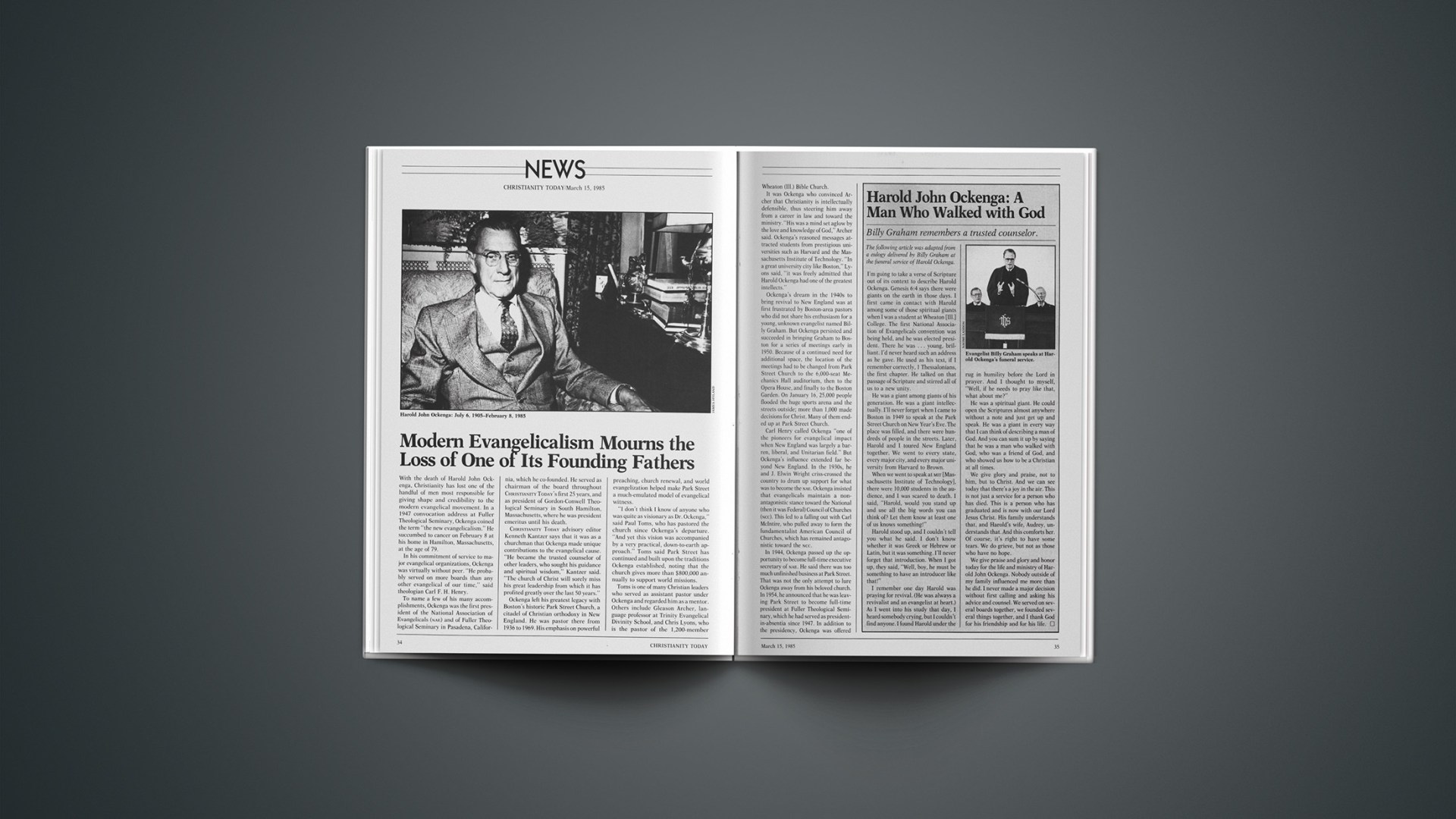
Modern Evangelicalism Mourns the Loss of One of Its Founding Fathers

With the death of Harold John Ockenga, Christianity has lost one of the handful of men most responsible for giving shape and credibility to the modern evangelical movement. In a 1947 convocation address at Fuller Theological Seminary, Ockenga coined the term “the new evangelicalism.” He succumbed to cancer on February 8 at his home in Hamilton, Massachusetts, at the age of 79.

In his commitment of service to major evangelical organizations, Ockenga was virtually without peer. “He probably served on more boards than any other evangelical of our time,” said theologian Carl F. H. Henry.

To name a few of his many accomplishments, Ockenga was the first president of the National Association of Evangelicals (NAE) and of Fuller Theological Seminary in Pasadena, California, which he co-founded. He served as chairman of the board throughout CHRISTIANITY TODAY’s first 25 years, and as president of Gordon-Conwell Theological Seminary in South Hamilton, Massachusetts, where he was president emeritus until his death.

CHRISTIANITY TODAY advisory editor Kenneth Kantzer says that it was as a churchman that Ockenga made unique contributions to the evangelical cause. “He became the trusted counselor of other leaders, who sought his guidance and spiritual wisdom,” Kantzer said. “The church of Christ will sorely miss his great leadership from which it has profited greatly over the last 50 years.”

Ockenga left his greatest legacy with Boston’s historic Park Street Church, a citadel of Christian orthodoxy in New England. He was pastor there from 1936 to 1969. His emphasis on powerful preaching, church renewal, and world evangelization helped make Park Street a much-emulated model of evangelical witness.

“I don’t think I know of anyone who was quite as visionary as Dr. Ockenga,” said Paul Toms, who has pastored the church since Ockenga’s departure. “And yet this vision was accompanied by a very practical, down-to-earth approach.” Toms said Park Street has continued and built upon the traditions Ockenga established, noting that the church gives more than $800,000 annually to support world missions.

Toms is one of many Christian leaders who served as assistant pastor under Ockenga and regarded him as a mentor. Others include Gleason Archer, language professor at Trinity Evangelical Divinity School, and Chris Lyons, who is the pastor of the 1,200-member Wheaton (Ill.) Bible Church.

It was Ockenga who convinced Archer that Christianity is intellectually defensible, thus steering him away from a career in law and toward the ministry. “His was a mind set aglow by the love and knowledge of God,” Archer said. Ockenga’s reasoned messages attracted students from prestigious universities such as Harvard and the Massachusetts Institute of Technology. “In a great university city like Boston,” Lyons said, “it was freely admitted that Harold Ockenga had one of the greatest intellects.”

Ockenga’s dream in the 1940s to bring revival to New England was at first frustrated by Boston-area pastors who did not share his enthusiasm for a young, unknown evangelist named Billy Graham. But Ockenga persisted and succeeded in bringing Graham to Boston for a series of meetings early in 1950. Because of a continued need for additional space, the location of the meetings had to be changed from Park Street Church to the 6,000-seat Mechanics Hall auditorium, then to the Opera House, and finally to the Boston Garden. On January 16, 25,000 people flooded the huge sports arena and the streets outside; more than 1,000 made decisions for Christ. Many of them ended up at Park Street Church.

Carl Henry called Ockenga “one of the pioneers for evangelical impact when New England was largely a barren, liberal, and Unitarian field.” But Ockenga’s influence extended far beyond New England. In the 1930s, he and J. Elwin Wright criss-crossed the country to drum up support for what was to become the NAE. Ockenga insisted that evangelicals maintain a non-antagonistic stance toward the National (then it was Federal) Council of Churches (NCC). This led to a falling out with Carl McIntire, who pulled away to form the fundamentalist American Council of Churches, which has remained antagonistic toward the NCC.

In 1944, Ockenga passed up the opportunity to become full-time executive secretary of NAE. He said there was too much unfinished business at Park Street. That was not the only attempt to lure Ockenga away from his beloved church. In 1954, he announced that he was leaving Park Street to become full-time president at Fuller Theological Seminary, which he had served as president-in-absentia since 1947. In addition to the presidency, Ockenga was offered the chance to begin a television ministry with the seminary’s backing.

But parishioners at Park Street called a special meeting and voted that his resignation be reconsidered. That expression of loyalty and love sent Ockenga into a period of prayer and fasting, and he eventually changed his mind. Had he accepted Fuller’s offer, Carl Henry assures that “Ockenga would have become the ‘Fulton Sheen’ of American Prostestantism.”

Ockenga was a superb administrator and fund raiser. (Park Street donated more than $260,000 in three years to help get CHRISTIANITY TODAY off the ground.) But he always maintained that preaching was the heart and soul of his success in the ministry.

“The sermon is a message from God,” he wrote in a 1958 article in CHRISTIANITY TODAY. “It should be born in prayer, or devotion, or Bible study, or in the fire of human experience.”

During his 33 years at Park Street Church, Ockenga delivered an average of four sermons per week. He appealed primarily to the intellect, not to emotions. He had a thorough command of biblical themes and was a brilliant apologist. All of his sermons were carefully written out, but he never used notes. He typically spent hours memorizing sermon outlines and texts.

Clyde Taylor, NAE secretary of public affairs from 1944 to 1974, said Ockenga was at his best when he was in the pulpit or at the podium. Taylor recalled a conference on church-and-state affairs held 35 years ago at Metropolitan Baptist Church in Washington, D.C. “One of the principal speakers had to cancel,” Taylor remembers. “I knew Harold John was in town. I called him, and with less than two hours’ notice he gave one of the most terrific addresses I’ve ever heard on church and state. He used the Reformation as an illustration and reeled off facts like he’d just finished reading the textbook yesterday.”

Taylor credited Ockenga with giving “the whole evangelical movement respectability and intellectual credibility.” Current NAE executive director Billy Melvin crystallized the sentiments of the many who knew Harold Ockenga: “To Audrey [Ockenga’s wife], the family and friends, we send our deepest sympathy and Christian love, rejoicing in the confidence that ‘to be absent from the body is to be present with the Lord.’ ”

Harold John Ockenga: A Man Who Walked with God

Billy Graham remembers a trusted counselor.

The following article was adapted from a eulogy delivered by Billy Graham at the funeral service of Harold Ockenga.

I’m going to take a verse of Scripture out of its context to describe Harold Ockenga. Genesis 6:4 says there were giants on the earth in those days. I first came in contact with Harold among some of those spiritual giants when I was a student at Wheaton [Ill.] College. The first National Association of Evangelicals convention was being held, and he was elected president. There he was … young, brilliant. I’d never heard such an address as he gave. He used as his text, if I remember correctly, 1 Thessalonians, the first chapter. He talked on that passage of Scripture and stirred all of us to a new unity.

He was a giant among giants of his generation. He was a giant intellectually. I’ll never forget when I came to Boston in 1949 to speak at the Park Street Church on New Year’s Eve. The place was filled, and there were hundreds of people in the streets. Later, Harold and I toured New England together. We went to every state, every major city, and every major university from Harvard to Brown.

When we went to speak at MIT [Massachusetts Institute of Technology], there were 10,000 students in the audience, and I was scared to death. I said, “Harold, would you stand up and use all the big words you can think of? Let them know at least one of us knows something!”

Harold stood up, and I couldn’t tell you what he said. I don’t know whether it was Greek or Hebrew or Latin, but it was something. I’ll never forget that introduction. When I got up, they said, “Well, boy, he must be something to have an introducer like that!”

I remember one day Harold was praying for revival. (He was always a revivalist and an evangelist at heart.) As I went into his study that day, I heard somebody crying, but I couldn’t find anyone. I found Harold under the rug in humility before the Lord in prayer. And I thought to myself, “Well, if he needs to pray like that, what about me?”

He was a spiritual giant. He could open the Scriptures almost anywhere without a note and just get up and speak. He was a giant in every way that I can think of describing a man of God. And you can sum it up by saying that he was a man who walked with God, who was a friend of God, and who showed us how to be a Christian at all times.

We give glory and praise, not to him, but to Christ. And we can see today that there’s a joy in the air. This is not just a service for a person who has died. This is a person who has graduated and is now with our Lord Jesus Christ. His family understands that, and Harold’s wife, Audrey, understands that. And this comforts her. Of course, it’s right to have some tears. We do grieve, but not as those who have no hope.

We give praise and glory and honor today for the life and ministry of Harold John Ockenga. Nobody outside of my family influenced me more than he did. I never made a major decision without first calling and asking his advice and counsel. We served on several boards together, we founded several things together, and I thank God for his friendship and for his life.

Harold John Ockenga: The Park Street Prophet

Former CHRISTIANITY TODAY editor Harold Lindsell remembers a fellow pilgrim.

Harold John Ockenga and I co-la-bored in significant endeavors that marked what I like to call the golden age of evangelicalism in the United States.

Harold was an unusual and attractive person whose mystique and charisma were obvious from the moment anyone met him. Many people regarded him with a sense of awe, for he seemed to reign from Olympian heights. But once his reserve was penetrated, one found him to be a congenial, down-to-earth, delightful man who was warm and tenderhearted. The students in the first class at Fuller Theological Seminary passed along an apocryphal story about how they rose at six in the morning, turned to the East where Harold lived as in-absentia president of the institution, and bowed down three times.

He was a man without guile. He was open, forthright, and sensitive, yet commanding. He was a puritan whose life was blameless. He and his wife, Audrey, formed a united team. Their loyalty and devotion to each other stood the test of time.

Harold was the co-founder (with Charles E. Fuller) of Fuller Theological Seminary. I was his first lieutenant for most of the 17 years I spent at the seminary. Later, I was editor of CHRISTIANITY TODAY; Harold was the magazine’s chairman of the board.

In 1969 Gordon-Conwell Theological Seminary came into being as a result of the combined labors of Harold, Billy Graham, J. Howard Pew, and others. Harold assumed the presidency of the school from its inception until he retired in 1979. I was chairman of the board of the institution and worked closely with him during that period. His monumental contribution to the work of the seminary cannot be overestimated.

Harold was an extraordinary churchman. His beloved Park Street Church was the focus of some of the finest years of his ministry. For more than three decades, he proclaimed the gospel there in the power of the Holy Spirit. His annual missionary conferences were known around the world.

As a pulpiteer, Harold had no peer. He never used notes. He had instant recall and was able to command an array of factual knowledge that staggered my imagination. His sermons and addresses were meaty, organized, and moving. His audiences hung on to every word. At a time when other downtown churches were closing their doors, his church on Brimstone Corner prospered.

The resurgence of evangelical faith in New England was in a large measure due to the work and ministry of Harold and Billy Graham, who came to Boston for evangelistic outreach that began at Park Street. The outreach eventually made a lasting impact on all of New England. When the Billy Graham Evangelistic Association was formed, Harold became a board member and remained on the board until his death.

I saw Harold a week before he died. He was lying in bed at home, attended by his wife. When I entered his room, I realized this dear friend was close to death. He had been operated on for cancer 18 months earlier.

He had suffered a stroke, which made it difficult for him to speak. His body was shrunken, but his eyes were alert. We prayed together for the last time. We had prayed together many times before, but this was the most precious prayer time of them all. I knew I would see him no more in this life—but I will see him again in a resurrection body. How do I know this? I know it because the Word of God says so, and this is the sure Word Harold believed without mental reservation. It is the sure Word he preached all the days of his pilgrim journey.

“We Are Turning the Public Schools Around”

An interview with NEA president Mary Futrell.

An interview with NEA president Mary Futrell.

A personable, articulate spokesperson for the nation’s largest teachers’ union, Mary Futrell was elected to her two-year term as NEA president in 1983. She recently consented to discuss NEA policy and procedure with CHRISTIANITY TODAY. Her edited remarks follow.

You once said, “Let us hear our adversaries, but let us not be deflected by their hollow words as we pursue excellence for all.” Many of your adversaries, however, are saying that the poor quality of education in America, confirmed by the 1983 Report on Education, is at least partially due to the lack of direction and overpoliticizing of your organization. How do you respond to that?

I would respond by saying that the National Education Association has been a leading advocate for quality education in this country since its founding in 1857. And while we do indeed support political action and collective bargaining, we have never lost sight of our primary objective: quality education for all children regardless of economic, religious, or ethnic background.

Yet the NEA has been widely criticized for its involvement in such decidedly noneducational issues as abortion and a verifiable nuclear freeze. Why does NEA feel compelled to address such explosive issues at the risk of weakening its overriding objective of quality education?

Schools are not isolated from the rest of society. And those issues just mentioned impact students and teachers. We are, therefore, very concerned about reproductive freedom. We are very concerned about peace and war; about equal rights, civil rights, human rights. The young people in our classrooms will eventually have to deal with these issues whether they want to or not.

Would you say the positions taken by the NEA on these issues are representative of the feelings of its constituency generally?

Yes. Our positions are drawn up and voted upon by the 7,000 delegates who attend the annual NEA representative assembly. It is the largest democratic body in the world. Delegates are elected by the members back home. They come to the assembly and deliberate the issues.

Obviously, we don’t have 100 percent agreement on each and every issue. But that’s what a democratic process is all about. You hear the pros and cons, but the majority rules.

But is there room and respect for political pluralism in the NEA? Some conservatives would say there isn’t.

And I would disagree. There is plenty of room for the pluralism you refer to, for that minority voice to be heard. But in a democratic society, the minority is not the group that rules. They do, however, have a voice; and I, for one, would stand up and fight for them to keep that voice. I would never support a position that would deny them the right to be heard or their right to bring issues forward.

But how strong or effective is that voice?

It’s very effective. Let me give you an example. When the issue of reproductive freedom was first brought to the floor, it came out as outright support of abortion. Many of our delegates didn’t like that. They wanted people to respect the rights of individuals to have reproductive freedom, but they did not want the NEA to be on record supporting abortion unequivocally. And so the wording of our resolution was changed—all because a small group of people got up and made themselves heard. I don’t know if they were moderates or conservatives, but they made themselves known.

That’s interesting. But isn’t reproductive freedom a euphemism for abortion on demand?

That’s not the way we perceive it. It’s up to the individual. If they want to have an abortion, that is their right. If they don’t want one, that is also their right. We’re not saying we support abortion. People interpret it that way, but that is not our interpretation.

What effect has your unabashed identification with the Democratic party had on the NEA?

We believe very strongly that education is a bipartisan issue and have worked very hard to make sure that the NEA is a bipartisan organization. I must confess, though, it has been difficult keeping the Republican avenue open. Many of our members report having a great deal of difficulty getting involved in their local or state Republican party and being accepted as active members.

Are there programs like tuition tax credits where the NEA would be willing to compromise its opposition in order to gain the ear of the current administration?

I must honestly say that we would not be willing to compromise our opposition to tuition tax credits. We believe, number one, that the public schools are already underfunded, especially at the federal level, where this administration has cut funding by 25 percent. We are told there is a rising tide of mediocrity in the classroom and yet are also told not to expect any more assistance from the federal government. It is ironic that at a time when we are told there are no new dollars to be had, the administration is trying to set up a program advocating tuition tax credits or vouchers for private and/or parochial schools.

But as I have listened to this administration, I have heard many areas where we, in fact, agree. They talk about improving discipline in the schools, more emphasis on the basics, more homework, better training for teachers. They talk about getting rid of drug abuse in the schools. So do we. Therefore, I think we can work with the administration in these areas.

How would you assess your relationship with the religious community?

The relationship between the NEA and the religious community is not as hostile as many people would like to think it is. We work together in many instances, and we will continue to work together whenever we can.

I would venture to say that the overwhelming majority of our members are not only religious, but practice their religion. They are in the choir, on the board of trustees, teach Sunday school, and so on. I am a practicing Baptist and have been all my life. But I work with the Jewish community. I work with the fundamental Baptist community. I work with the Methodists. In short, I work with whomever is willing to work with me.

There are, of course, areas of disagreement—school prayer for one. But let me say that the NEA is not opposed to individual prayer in school. What we oppose is group-led prayer in the school, which is unconstitutional. Can Johnny say a prayer before a test? Absolutely. Can Jane say grace before eating lunch? Absolutely. Do we ever try to stop the basketball team or the football team from saying a prayer before a game? No, we don’t.

But you have to realize that when we look at the makeup of our individual classrooms, we see different nationalities and different religions. There is, therefore, no one religion that should be imposed on such a captive audience.

And yet you stood up against nearly all religious groups in your opposition to equal access legislation.

Our concern with the original bill was that it would open up schools not only to religious groups but to all groups. Once you say equal access, you have to make provisions for all groups. Our children, then, would have been exposed to all kinds of groups, extremists at both ends of the spectrum.

But I do believe that we worked with the legislators and were able to modify, with the formation of guidelines, the final bill to our satisfaction.

Is there any way the NEA can build a better bridge between itself and the religious community?

As I said, we do work very closely with the religious community on a variety of issues, especially those dealing with civil rights. We don’t ask people to endorse our entire agenda. Where we can work together, we need to work together. Where we disagree, we disagree. But we will do so in such a way that we don’t simply split and never work together again.

Why do you think private education is on the upswing?

According to all the information I have seen, private and/or parochial schools have not achieved any more support than they have had all along, which is about 10, maybe 11, percent of the student population. As a matter of fact, back in the late sixties, I believe it was up to about 13 to 15 percent.

There will always be parents who send their children to private schools regardless of the condition of public schools. But I think those parents who do this on the assumption that all public schools are bad are often basing their decision on what they have seen, read, or heard second- or thirdhand. That is not to say the schools are perfect; but I believe we are turning the public schools around. I think they are better than they have been in a long time, and I think they will be better than they have ever been because of the efforts of a large group of people.

Does competition from private schools force public schools to improve their quality of education?

No. I think a lot Americans fail to realize that when the educational system started in this country it started as a private school system. And to a large degree, that school system was a religious one. Yet the general public moved away from private to public education to insure that each and every child in this country could, in fact, get an education. The public schools have to open their doors to everyone. We cannot turn away any child. If there is competition, it’s between public schools in the same school system.

Many people send their children to private schools because they feel that those in the public schools are prejudiced against their particular religious viewpoint. Do you see the public schools as being secular to the point where teachers are prejudiced against Christian viewpoints?

That’s a tough question. My personal answer would be no. And one of the resolutions we have is to teach children to respect all kinds of religions, cultures, and points of view. But I also have to admit that the public schools are not sectarian, and that was the way they were established. Moreover, I look at the Constitution, which says we shall not have group-led prayer. So, based upon the way that the schools have always been structured, and based on the way that the Supreme Court has dealt with the public schools, we are not advocates of sectarian religion in the schools.

Extra-Curricular Activities

Is the NEA forfeiting classroom excellence for its own political agenda?

Is the NEA forfeiting classroom excellence for its own political agenda?

It was supposed to be just another question-and-answer period with just another special interest group. And so as the congressional candidate returned from this hundredth “give and take,” his staff members at campaign headquarters hardly noticed—that is, until Tom began shaking his head and repeating the frustrated refrain of “boy oh boy.”

I looked up (as would any good press secretary) and asked the obvious, “What’s wrong?”

“Those teachers!” he said incredulously, reviewing first in his own mind, and then with me, the interrogation of the night.

He had been seated in a chair facing a semicircle of 10 or 12 other chairs, in which sat his questioners—members of the Illinois Education Association, the statewide clone of the larger National Education Association (NEA). The arrangement worked for both intimacy and intimidation. After the usual amenities, the political inquisition began.

“Where do you stand on abortion?” asked the first questioner. Tom, seeking the Republican congressional nomination in his district, was an outspoken proponent of life and responded with his unabashedly prolife logic. It was the first of an evening of “wrong answers.”

As the questioning progressed, it became readily apparent to Tom that the real concerns of his questioners were more social and political than educational. And with that realization, and the distinct sense that he was the proverbial sheep among some very hungry wolves, he challenged the group’s sense of political pluralism, begged their apologies, and returned to friendlier territory.

Teacher Power

I later learned that Tom’s experience was probably more the rule than the exception. And that what he had participated in is repeated across the United States by local and statewide affiliates of what many observers call the strongest lobby and special interest group in American politics today: the 1.7 million-member National Education Association.

Organized in 1857 “to elevate the character and advance the interests of the profession of teaching, and to promote the cause of public education in the United States,” the NEA, whose membership includes four out of every five public school teachers in the country, has long since added extracurricular political activities to its school-house agenda. “We feel we have a professional responsibility, as well as a responsibility as citizens, to make sure that those candidates seeking office deal with education,” NEA president Mary Futrell told CHRISTIANITY TODAY in an exclusive interview. “And we feel an obligation to work for those candidates as well.”

And work they do. Their first presidential endorsement resulted, they say, in the election of Jimmy Carter in 1976. Their victory percentage in congressional races since 1972 is truly impressive, union hype notwithstanding. In 1984 alone, NEA-endorsed congressional candidates won 237 out of the 330 races in which the association was directly involved.

Complementing the work of these ready-made election “foot soldiers” are the ongoing NEA lobbying efforts. The association has legislative “contact teams” in every congressional district, quickly reachable through a network of 14,000 local affiliates. Lawmakers tend to listen to these lobbying teams because they are the very same committees that, every two years, interview candidates like Tom for the union’s endorsements and campaign contributions.

According to the Congressional Quarterly,NEA lobbying efforts have prevented the Reagan administration from cutting federal aid to education as sharply as it wanted and dismantling the NEA’s highly prized Department of Education. Moreover, NEA lobbyists helped make the proposed tuition tax credits for parents of private school students an issue too hot for many in Congress to touch—at least during an election year.

Instruction Or Indoctrination?

But NEA’s political muscle has not been flexed in educational areas alone. Indeed, it has made its presence felt in a number of decidedly noneducational, or marginally educational, issues. The implications of this expanding involvement make the NEA something other than the usual single-issue special interest group and, therefore, of unusual concern to liberals and conservatives alike. Writes Chester Finn, a professor of education and public policy at Vanderbilt University: “It [NEA] becomes infinitely more consequential when we consider that their members also wield what is left of the moral power and intellectual authority that virtually all the world’s civilizations have ceded to those in whose trust they place the education of the young.”

Politically speaking, the NEA opposes U.S. involvement in Central America, actively supports passage of the Equal Rights Amendment (it temporarily banned its decision-making assembly from meeting in states where ERA had not passed), and supports a complete and immediate halt in the nuclear arms race.

The union has become especially outspoken on this latter point since the defeat of ERA in 1982. Among its efforts on behalf of the nuclear freeze was the formation in that year of a group called Citizens Against Nuclear War. Promising “educational and advocacy materials,” and attempting to put arms control high on the agendas of groups that have not traditionally made it a strong concern, Citizens is currently under the direction of Karen Mulhauser, the former head of the Abortion Rights Action League.

More laden with controversy was the publication in 1983 of junior-high curriculum designed to acquaint students with the “power of nuclear weapons, the consequences of their use, and most importantly, the options available to resolve conflicts among nations by means other than nuclear war.” According to the curriculum introduction, it was not “intended to advance specific political positions.” However, critics on both the Left and the Right saw the profreeze arguments otherwise. Stated a Washington Post editorial: “[It] is not teaching in any normally accepted—or acceptable—sense. It is political indoctrination.” Said a piqued Ronald Reagan: the curriculum seems “to be more aimed at frightening and brainwashing American schoolchildren than … stimulating balanced, intelligent debate.”

Showing its political hand has not exactly helped NEA in its pronouncements that quality education is its number one priority. Scott Thompson of the National Association of Secondary Schools was quoted by Newsweek as saying that “the NEA has misused its charter, its position, and its place to become a boisterous, partisan advocacy group” that has “damaged public education.”

Of a more immediate concern is how NEA’s all-out support of Walter Mondale will be (to the tune of nearly one million volunteers) will affect public education in the early days of a second Reagan administration. “We are willing to sit down and work with this administration,” Futrell said. “I just hope the administration willing to be as open as we are.”

Political maneuverings notwithstanding, however, the real bone of contention for a growing number of individuals—including large numbers of Christians—is the way NEA policy deals with moral and values-laden issues from a decidedly secularist framework. The result has been a firestorm of criticism and counterattack that may be just the opening act of a morality play destined for a long “in-class” run.

Whose Morality?

On close inspection it becomes readily apparent that NEA’s philosophical moorings are set deep into the shifting sands of secular relativism. The disturbing effects of such a foundation can be seen in the association’s positions regarding both homosexuality and abortion.

While not having an official statement regarding homosexuality, the NEA has resolutions decrying the loss of an individual’s civil rights based on “sexual orientation.” Specifically, a 1983 resolution states: “The [NEA] is committed to the achievement of a totally integrated society and calls upon Americans to eliminate by statute and practice barriers of race, color, national origin, religion, sex, sexual orientation, age, handicap, marital status, and economic status.…”

More enlightening, perhaps, is a criticism of preteen romance novels under joint study by the NEA and the Council on Interracial Books for Children. The overall objective of the study was to “eliminate bias” from children’s books. Interesting, however, was a bias seemingly against the portrayal of heterosexual love. As reported upon by Commentary in one of the briefer articles in the final report, a self-professed lesbian observed that “No romance novel ever gave me the slightest hint that girls (and women) could, and did, stay together.… Fortunately, I eventually escaped from the entrapment of these novels. I am concerned that the adolescent years of those who may be gay or lesbian and are now reading these ‘happiness package’ novels will be made far more difficult than necessary.”

Less subtle is NEA’s support of abortion on demand and its insistence upon teachers and students alike having access to family planning programs and facilities. While insisting that it does not support abortion (see accompanying interview) but “reproductive freedom” (the terminology used in NEA resolutions on this subject), such subtleties are apparently lost on members and parents alike.

As of this writing, three public school teachers are taking NEA to task for its prochoice stand by refusing to pay their union dues. They eventually hope to set a national precedent and force the NEA out of politics completely. “We’re not so foolish to believe that somewhere along the line this is going to have an impact on other teachers,” one of the litigants said. “We just want to see the NEA get back into the union business.”

Indeed, the dichotomy between NEA’s leftist political orientation and the more centrist leanings of its constituency seem destined for a showdown. “The internal structure of the association is very fragile,” says Connaught Marshner, executive vice-president of the Washington-based Free Congress Foundation. “Confrontation from within would most definitely bring significant—and much-needed—changes.”

According to the Commentary article quoted earlier, upward of 70 percent of NEA members claim to be outright conservatives or leaning that way. Such a statistic alone verifies the conclusion of Vanderbilt’s Finn that the NEA has “lost (or jettisoned) its anchor and is drifting rapidly into some well-charted but exceedingly dangerous waters. And probably carrying more than a few teachers and pupils with it.”

Future Lesson Plans

That the NEA must come to grips with its self-professed nonsectarianism seems a foregone conclusion. The moral and ethical makeup of generations to come may truly be at stake. Such was the warning of a Thanksgiving Statement issued last year and signed by 27 prominent scholars, educators, and citizens, including Urie Bronfenbrenner of Cornell University, who said: “Apart from the family, the school is the fundamental institution where our children learn to be human and acquire the unique values of our democratic society. The evidence indicates that schools are now doing a poor job of transmitting such skills and values to our children and adolescents.”

Just how effective Christians from within the NEA can be in reinstilling traditional attitudes into its hierarchy remains to be seen. President Futrell believes unequivocally that so-called traditionalists do indeed have a voice to be reckoned with. When asked by CT about the impact of that voice, she responded that “they [conservatives] can send me personal letters, they can write to the board, and they can lobby our board, our executive committee, or our representative assembly. The minority has a right to be heard—but it is the majority which prevails.”

Of course, most are less than content with their minority status. Out of frustration, some are taking up the offensive by heading for (or starting) private schools. Still others are intent on digging in and fighting.

“The NEA benefits from the public’s perception that it is little more than a quiet collection of teachers with no agenda save better schools,” the Free Congress’s Marshner says. “If Christians would just challenge the decision-making body during its annual assembly and wage a few floor fights, the media would pick it up and the perception would begin to change.

“The key, however, is organization—and persistence.”

Another key to any long-term change may ultimately rest—not surprisingly—with the parents of children in public schools. Consensus on this fact is nearly unanimous, even within the NEA. “We strongly encourage parents to be actively involved in the support of their children,” Futrell told CHRISTIANITY TODAY, “and I think that support is stronger at the local level where parents know the schools, know the teachers, and know the administrators. You need to see what’s going on in the schools, you need to work with the teachers and then school boards in order to make sure the schools are reflecting and doing the kinds of things you believe need to be done.”

Perhaps ironically, Futrell’s statement may be the one solution offering any immediate or future hope for reclaiming the moral void created by her association in the name of nonsectarian education. For the Christian who feels caught in the crossfire, it offers the one sure call to action—a call once again to be salt in a situation desperately in need of flavoring.

The Challenge of True Brotherhood

These Anabaptist Christians are less concerned with changing socie ty than seeking the lowest place.

These Anabaptist Christians are less concerned with changing society than seeking the lowest place.

The first major presentation of the Christianity Today Institute will appear in the April 19 issue on the subject “The Christian As Citizen.” It includes the thinking of some of evangelicalism’s most insightful theologians and practitioners on a subject of critical importance to the church.

In anticipation, we are featuring two articles on the relationship of faith to public life: the first, presented here, explores a unique example of a classic Anabaptist position; the second, an article by Stephen Monsma in the next issue, deals with the direct involvement of Christians in the political process.

The year was 1933, and Germany was a country eagerly looking to the future. Adolf Hitler and the National Socialists had pushed aside the shaky Weimar Republic, and the dark days of great poverty and lost national honor that followed World War I seemed already to be fading into the past. Even the churches were swept up in the enthusiasm of a new beginning. “Our national leaders now explicitly confess their loyalty to Christianity and Church …,” rejoiced the Federation of Protestant Churches. The defeat of communism appeared decisive, and church leaders praised the rebirth of “patriotic awareness, true national community, and religious revival.” All of Germany could now look to the future with confidence and a renewed sense of divine mission.

Even as the church fanned the flames of nationalism, a small community of Christian believers living in the Rhön mountains began to raise their solitary voice against the Third Reich. On November 12, 1933, members of the Bruderhof movement, led by founder Eberhard Arnold, refused to vote yes in a carefully watched Nazi plebiscite. (For a review of Arnold’s writings, see p. 48.) On signed ballots, every Bruderhof adult explained that their allegiance was to Jesus Christ, whose kingdom was the standard by which all governments were judged. Four days later, over 100 Nazi storm troopers surrounded the tiny community and ransacked their buildings in search of nonexistent weapons. It was the first of many head-on confrontations with the Gestapo, but the members of the Bruderhof were determined to remain in Germany as long as the government allowed. “It will depend on who holds out the longest,” said Arnold. Amid daily hardship and the constant threat of exile to concentration camps, the 150 members of the Bruderhof carried on their mission of living in Christian unity and providing shelter for people seeking a deeper spirituality than that offered by German state churches.

From the very beginning, the Bruderhof had faced overwhelming obstacles. In the year of its origin, 1920, all of Germany was on the edge of economic and political collapse. Lost national honor, high unemployment, staggering inflation (by late 1923, it took billions of German marks to buy one American dollar), and widespread hunger had crushed the German people. The credibility of the Christian church was seriously undermined by its wholehearted support of the war, and young and old alike were crippled by disillusionment.

In the midst of this devastation, Eberhard Arnold, his family, and a small band of friends sought to witness to the unquenched power of Jesus Christ by following the communal path of the early Christian church. Arnold’s own spiritual roots were in the Student Christian Movement, a mission arm of Dwight L. Moody’s revivalism, and in the nineteenth-century “religious-social” movement, a Protestant renewal combining personal piety with social concern. By mutual agreement, members of Arnold’s new community held all property in common, dressed modestly, upheld the sanctity of marriage and family life, educated their own children, and followed the example of the early Christians by refusing to participate in military service. The atmosphere of the Bruderhof was one of joyful simplicity; its members combined a love of nature and four-part singing with a firm commitment to following the radical precepts of the Sermon on the Mount. Shelter was given to numerous underprivileged and orphaned children, and a cheerful welcome was extended to thousands of guests. Financial support for the community came from small-scale publishing and farming, and from donations.

Despite severe poverty, constant hunger, and a period of serious internal disunity, the Bruderhof survived and increased in number. Eberhard Arnold died in 1935, and in 1937 the Gestapo ordered all members of the Bruderhof to leave Germany. In the years to come the winds of war blew the tightly knit community from Liechtenstein to England, and—at the height of U-boat activity—across the Atlantic Ocean to Paraguay. At every step of the way, the Bruderhof grew in size, although several adults and 20 infants died in the harsh tropical climate of Paraguay. Finally, in 1961, the entire community immigrated to the United States.

Today, the Bruderhof has over 1,200 members in four communities in the eastern United States and England. Many of their original members are still alive, and the present-day Bruderhof follows much the same path as the early Rhön community. Property is held in common, dress is modest, men do not participate in military service, and children are taught in community schools until the eighth grade, when they enter public schools. The Bruderhof is self-supporting through the production of children’s toys (Community Playthings) and Rifton equipment for the handicapped, and members work at a variety of community jobs, including shop work, child care, kitchen service, and gardening. Housing is provided in large buildings with individual family units, and most meals are taken communally in a central dining hall.

The early education of Bruderhof children is of particular interest. Classrooms are brightly colored and festive, and instruction includes not only basic skills, but pottery, singing, painting, woodworking, and foreign language training. Children learn to work and play together at an early age, and their self-discipline and love of life is apparent even to the casual visitor. “The children of the Brothers give special delight,” said Malcolm Muggeridge, a neighbor of the Darvell Bruderhof in England. “Their eyes express the wonder of life rather than the fantasies of a TV screen, and their voices, when they sing, harmonize with the birds. In our village we rejoice that they should be with us.”

Membership in the Bruderhof requires a lifetime commitment, and young people who grow up in the community are encouraged to spend one or two years outside the Bruderhof (often in job training) before choosing community life. The hospitality of the Bruderhof is warm and genuine, but no effort is made to recruit new members. “We do not want to persuade people with smooth words or build a big church,” says one Bruderhof elder. “Our task is not to call people to the Bruderhof, but to follow Christ more completely. If, in this effort, it is given to us to challenge others to live a more radical discipleship, then that is a great joy.”

In keeping with the early vision of Eberhard Arnold, the community is formally united with the Hutterites, and their outward mission is determined not by political inclinations (members of the Bruderhof do not vote), but by their commitment to take the Bible seriously in every area of life. Currently, the Bruderhof operates a temporary shelter for the homeless, and is involved in local prison ministry as well as overseas missions. A small magazine, The Plough, expresses Bruderhof views on issues as diverse as abortion, prostitution, divorce, and the nuclear arms race.

In the following interview, members of the Bruderhof in three communities in the United States (Rifton, N.Y.; Farmington, Pa.; Norfolk, Conn.) speak to many of the issues facing them as an “early church” community seeking to live faithfully in the twentieth century. The interview was conducted both in small discussion groups, and in large meetings, where members of all three communities participated via telephone hookup.

The Bruderhof was born in war-tom Germany, and much of your early lifetogether was shaped by a sense of impending crises. How do you perceive the current situation in the United States, and what role do you see for yourselves?

For every generation of Christian believers, the task is always the same: to hear the call of God and answer the challenge of the time in which we live. In Germany, there was a hard struggle with the spirit of hate and destruction, and we felt a call to maintain a witness for peace as long as we could. We built houses and a print shop, and worked in our fields with real jubilation, as if we were going to change the world. We did not speak words of hate against Hitler or the Nazis, but we tried to witness by our daily life that we were going a different direction, the way of Jesus and brotherly love.

Today, as then, we believe our task is to live in a way that is completely opposed to the spirit of the age. And once again we are standing in the hour of decision, before questions of life and death. Mankind has the armaments and the hatred to destroy all of God’s earthly creation. The spirit of nationalism has been revived, and many people, including well-meaning Christians, are thinking only of themselves and the political and economic interests of their country. We have lived through one renewal of “religious feeling and patriotism,” and we know that it can be a very dangerous time.

In this climate, we believe our daily life together is still the best witness we can make. For each one personally, the challenge is to fight against those things in the human heart which make for immorality and a lack of brotherliness. For us as community, the challenge is to live in true brotherhood. We are seeking to follow the example of the early Christian church and witness by our communal life to the imminent coming of a different order—the kingdom of God.

As an isolated community, distinct in dress and culture, what impact do you hope to make on society?

Our task isn’t to make an impact on society. Perhaps Jesus himself could have made a greater impact, humanly speaking, if he had given in to Satan’s temptation to become ruler of the kingdoms of the world. Instead, he went the lowly way, the way of the cross. It is this path we are seeking to follow.

Jesus prayed, “Thy kingdom come on earth as it is in heaven.” What we long for is that God’s kingdom breaks in somewhere on this earth. It is our task as Christians to work and pray for this coming, and that is why we live together. We want to witness to the kingdom in every relationship between husband and wife, parents and children, brothers and sisters. But our communities are not so important; they will pass away. What is important is that God’s kingdom breaks in, which Jesus promised. If we can be used as a tool for this, we are grateful, and don’t want to stand in the way.

How have you experienced God’s kingdom in your life together?

This is a deep matter, and we tremble to speak of it. God’s kingdom is not so small that we can define it in human words, and we do not want to seem as if we have all the answers, or that our life in Christ can be put down on paper. We are only fellow seekers of the kingdom.

Yet we believe, and have experienced, that God’s kingdom has to do with the unity of hearts and the love with which Christ loved his disciples. To experience something of this unity and love, we must in repentance go very, very low, because the Holy Spirit seeks the lowest place, like water running down. When in repentance we seek God’s kingdom, then Christ himself is present and our life together becomes an atmosphere where a deeply wounded soul can find rebirth. But the unity and love which Christ willed for his followers are never something we possess. We experience them in spite of ourselves and only to the degree that we are willing to stay in the place of repentance.

As Christians living in the world, we are citizens of two kingdoms, one of human origin and one established by God. What relationship do you see between the two kingdoms?

We don’t want to get lost in an ethereal, other-worldly kind of thinking, but the reality is that God’s kingdom breaks in upon us from outside of the present order. This kingdom has an embassy on earth now, and as Christians, our task is to live in the embassy as ambassadors in a strange land. The laws that operate in the embassy are the laws of God’s kingdom, and the loyalties we are struggling to establish are kingdom loyalties.

As ambassadors, we are called to witness by our daily life together that it is possible for human beings here on Earth to follow completely the way of Jesus. Through repentance and the forgiveness of sins, and by the power of the Holy Spirit, we are commissioned to dwell in peace with one another, to love our neighbors as ourselves, to love our enemies, and to pray for those who spitefully use us.

There is an increasing movement, both on the political Left and the political Right, to identify the interests of the kingdom of God with the interests of a particular country or political party. How do you view this trend?

From our own history, we know that this politicization of the gospel can be a very serious matter. When the Bruderhof began in 1920, there was a wind of revival blowing through Europe. The suffering of World War I led to a deep movement of the heart, and a call to repentance was given to the church by the Spirit of God. One has to say that Germany, at least, missed that call. Our churches began to align themselves with political parties, and the old spirit of nationalism returned. The welfare of the kingdom of God was identified with the welfare of the nation, and then came Hitler. By that time, the Christian church was so deeply involved with politics that it was unable to see the storm clouds coming.

Whenever society is crumbling, as it is today, the church is tempted to align itself with political parties and national interests. In the beginning, this alignment seems to be a good thing, and it is justified on the grounds that the government will keep its Christian base if it is influenced by followers of Jesus. But the end reality is that the state corrupts the church. The church can no longer hear clearly the call of Christ because it is deafened by its own political interests.

To what extent do you yourselves participate in the political process?

Although we are grateful for the witness of some Christian leaders in government, we believe the teaching of the early church clearly forbade followers of Jesus to hold political office. If a man was a judge, a soldier, or a policeman, he had to choose between his profession and following Christ. The way of Jesus was not the way of human power; from the beginning to the end, from his birth in a manger to his death on a cross, Jesus went the lowly way. The only power he served was God.

In politics, it seems easy to think that human power can be used as a means to good ends. Sometimes the end is used to justify means that aren’t quite right or may even be evil. But as you continue on, often your means becomes your end, or perhaps your good end becomes something evil as you yourself are perverted by ungodly methods.

That is part of the reason why at the present time we choose not to vote. Perhaps in the future we will see things differently, but now it seems to us that voting is an act of bestowing human power on a person and thereby becoming coresponsible for his actions. We had a close call during the election of ’64. Johnson was the dove, Goldwater was the hawk; and our sympathy for Johnson was so strong we nearly voted for him. Finally, we felt together that as people who were trying to follow the way of Jesus completely, we shouldn’t vote. As it was, Johnson did exactly the same things Goldwater threatened, only much worse.

Do you see any positive role that the church can play in politics?

It is not a matter of playing a role, but of being faithful to the gospel. We believe that, as Christians, we must respect the government of any country in which we live. We need to pay our taxes (except in cases of an isolated war tax), pray for our leaders that they may be protected in the awesome responsibility given them by God, and refrain from speaking words of ridicule or disrespect about anyone in power. From the early years of our community, we also have made it a practice to visit our government leaders, even the Gestapo, and tell them in a respectful manner what we believe.

At the same time, we believe that the church cannot remain silent when governments begin to go in dangerous directions. That was the great sin under Hitler. After the war, it came out that many Germans were killed because of their resistance, so there wasn’t complete silence. But there should have been much more of an outcry in the late ’20s and ’30s when Hitler was slowly consolidating his power.

In the current situation, we face many hard decisions. We are deeply thankful for the democracy in the United States; we know what it means to live in a totalitarian society, and we are grateful that here we have been able to live out our beliefs in peace, and teach our children. Yet we are increasingly alarmed by the direction the government is taking. We are seeking how to respond, and the questions are very difficult. What should be our reaction to all that is done in Nicaragua and Central America? How shall we respond to the continual build-up of the nuclear arsenal? Soon we may stand before the question of having to go into the army, and there are hundreds of things about which we must ask, “What shall we do?” Not just how to say no, but what must we do?

Many Christians are taking part in organized resistance to government policies, such as civil disobedience directed at the nuclear arms industry and the giving of “sanctuary” to Central American refugees. How do you view this development?

We are thankful that an increasing number of people see these concerns not just as intellectual issues, but as matters of life and death. It is a sign of an awakening, and we must respect people when they are ready to give their lives for what they believe. Surely this is better than apathy, when the world can come to an end, and people don’t care.

At the same time, we are sensitive to what actually is our calling. To participate in violence, such as pouring blood on files or hammering nuclear warheads, is not our way. And whether or not we would break the law to give sanctuary to a refugee is not something we can decide ahead of time. If someone came asking our help, we would call the Brotherhood together and seek the way of Jesus. We cannot say in advance how the Holy Spirit would lead, but somehow our decision would not be a general flouting of the law, but an answer to a specific need. And we would act in unity, with everyone agreeing, and everyone prepared to pay the consequences.

When making community decisions of this magnitude, how do you avoid the endless debate and paralysis that frequently accompany group decisions?

It is a struggle. We are all human beings, we all love to hear our own voice sometimes, and that is not helpful in community. When there are endless debates, when everyone has to say his piece, even if it has been said before, then we stop and become quiet. We believe the Holy Spirit gives unity, and speaks the same truth to all; so if there are many opinions, and every opinion is different from the others, it is time to quit our meeting. We go our separate ways, to be alone before God, and then meet again the next day.

At the same time, the people whom we ask to take responsibility for community meetings have the task to listen to every voice that speaks. It might be someone who seldom offers an opinion, but he or she is given careful attention. It has happened on some issues; 20 or 30 people in our big circle will all speak in the same direction. We think everyone feels the same, and then suddenly someone says, “I’m not so sure.” We listen and hear something that no one else thought of, and we realize we were going in a wrong direction. This speaking up is harder for some than others, but it is a responsibility we accept when we commit ourselves to the community.

What checks and balances operate within your leadership, and how do you allow leaders to emerge without allowing them to dominate?

The authority of the community lies in the Brotherhood, the circle of baptized believers. Each one is given a specific task, but at any time the Brotherhood can tell someone that he or she has served long enough as a kitchen worker or a shop manager, or in the role that we call “Servant of the Word.” The task given to the Servants, whose name comes from an old Hutterian term, is not to manage or direct the community, but to serve the Word, to listen carefully to the Spirit as it is given to the Brotherhood. It can happen in a meeting that the Servant or person in charge will not feel the same as several voices raised; however, his job is not to answer back, but to wait and hear what is said. He was chosen for his task not because he has the gift to be chairman, but because he knows how to listen. And actually every person in the Brotherhood has this same responsibility.

From our own experience we know that it is pure devastation when power over people comes into play. Our life is based on trust; we have given our lives to Christ and each other, and we are vulnerable. If the Brotherhood shows someone trust, and he misuses it to take power over others, it undermines our whole way of life. That is why when we are choosing a Servant, if one or two brethren say we are afraid of that brother, then he is not given the task.

This is an area in which we must all exercise great care. Jesus warned that false prophets would come from the company of believers to use human power and crush souls by misrepresenting the gospel. In such situations, both the one who dominates and those who are dominated can be destroyed. That is why we are a bit allergic to human charisma; we know that it is potentially a very dangerous quality.

What steps do you take to encourage the development of individual gifts and talents within your community?

We rejoice in the gifts that are given to our brothers and sisters, and we are grateful for all that God gives to enable us to bring his kingdom to others. But it is not healthy when individuals begin to see their gifts as the chief object of their lives. So we try to help each other use our talents as a means of service, not as a way to feel proud or set apart from others.

One thinks of the millions of people who feel they have a gift in poetry or the arts, or any field, and certainly they do have these gifts. But often they cannot bring them to fruit because there is no working together, or because self-seeking stands in the way of a deeper vision of God’s kingdom and a healthy, sane life. We long to represent with our life together a sanity that enables each one to truly give themselves and all that they have to others. Then whatever way God wants to use us, we leave it to him to judge the fruits.

It is important to understand that we do not share the world’s values about who or what is important. In the world, the people who command respect are those who are highly gifted and perhaps start off with many advantages. Here, any work that contributes to the community is of equal value, and even if one is not able to work, he is appreciated for what he is. There is no need to try for human approval, and we would hope that everyone is free to be who God created him or her to be.

At the same time, we believe that self-fulfillment is a false hope that disappoints all those who seek it. The emphasis in the teachings of Jesus and the apostles was not on fulfilling our personalities, but on what happens among us and between us. What was important was justice and love and compassion, all those things that are so terribly missing in our world because we look at our brothers and sisters through our own eyes, and not through the eyes of God.

How do you guard against the dangers of “group think”?

Our life is built on the premise that Jesus uses us, and only by complete surrender can he take control. In this surrender, we trust that everything won’t come out gray or colorless. And in fact, we find that our relationship to Christ finds its expression in many different ways, depending on our personalities and cultural backgrounds. Uniformity only comes in when the individual heart strays from the Spirit.

We think of a recent experience with a sister who joined us in the early years, and lived among us all this time with no close relatives. In her last months, she became quite sick. Because she had no family, all the sisters took turns in her care, to cool her fever, or sometimes just to speak a few words. When she died, it was as if she was in the middle of a rainbow of many colors, where from all around her people expressed their love in many different ways. Somehow it helps us to think of our community this way; we are all the wrong color to begin with, but in our commitment to Jesus, we trust that we become the many colors of the rainbow through which he shines.

Baptism at the Bruderhof includes a lifetime commitment to the community. Why do you make this identification between commitment to Christ and commitment to your specific community?

This is a deep question, and it has cost many struggles in our lives. We never say that a person cannot follow Christ unless he lives in community, and we urge everyone joining the Bruderhof to hold on to their relationship with God as the center of their lives.

At the same time, we look at community life as being very much like marriage. Wedding vows are down-to-earth; they apply to a specific wife or husband. You promise to remain faithful unto death to a particular man or woman, and you can’t say later (although some now do) that you made a mistake, that God has shown you the marriage wasn’t from him and you are marrying someone else.

In the same way, we believe the commitment to Christ includes commitment to specific brothers and sisters, for whom we must be ready to lay down our lives. Our first call is to Christ, but it cannot be separated from the brothers and sisters to whom we are bound. We feel it is this brotherly commitment to which John speaks when he says, “For anyone who does not love his brother, whom he has seen, cannot love God, whom he has not seen” (1 John 4:20).

This conviction has proved very important in our history. In Paraguay, a time came when the whole community turned away from the gospel. We had the outward form and still said the right words, but the light of the Holy Spirit had left. The community became the center of our life together, and there was a great deal of legalism. Despite our failings, a handful of brothers and sisters held to the way of Jesus. They were excluded and abused by the others, but slowly they were able to call the whole community back to Christ. If instead they had decided to leave because we had strayed so far from the truth, where would the rest of us be today?

Isn’t this part of the problem that the whole church now faces? Many people commit themselves to the Lord and to a community of believers, but when things start going against their ideas of how it should be, they suddenly receive a call somewhere else. Or if they hear a call to be a missionary, they run off to start their own project. This is very dangerous. We do not want to speak too much of the Devil, but Satan comes in shining armor; and how is a person to distinguish between God’s voice and his own self-will? Perhaps the blindness of the present day is a result of the cult of the individual and self-expression, where the only thing that matters is my reaction to what I think God is telling me.

In our community life, it does happen that one person feels a strong leading for a certain matter, and brings it to the Brotherhood, where he finds a strong echo in others. And then the important thing is that the individual who first had the burden doesn’t feel he necessarily has to be the one to carry it out. He can leave it in the hands of the community.

Emmy Arnold, wife of Bruderhof founder Eberhard, once wrote, “A life shared in common is a miracle. People cannot remain together for the sake of traditions. Community must be given again and again as a new birth.” In what ways are you experiencing this new birth today?

We know from our own history that Christian community is a miracle; it is not something we do, but something we receive. And while we want to witness by our lives to the importance of listening to the elders and learning from what has gone before, we realize that in the long run dead traditions will not sustain a living community.

In recent years, it is true, we became too concerned with our own internal problems, and lately we have been led to reach out more to others. One new beginning came when a brother realized that we were not fulfilling Jesus’ command to visit those in prison. We have been helped a great deal in this area by Charles Colson and members of the Prison Fellowship. Another beginning came when we discovered that there are a growing number of homeless people in our neighborhoods. We have also been moved to action by the problem of world hunger, and while we are still very much burdened by material goods, one of the joys of the last years is that our life is becoming simpler.

But we still have a long way to go, and it wouldn’t be right for us to say, “Now we aren’t putting ourselves at the center; we are reaching out.” We actually can’t explain how it is given, but it is a renewal from God, which we must accept in a childlike way, as a gift from him. We are still on the same bench of repentance, seeking together the kingdom of God.

Culture

J. S. Bach: God’s Master Musician

He expressed a profound theology in music better than anyone has ever done.

He expressed a profound theology in music better than anyone has ever done.

Johann Sebastian Bach has long been recognized as one of the greatest evangelists in history. He has, in fact, often been called the “Fifth Evangelist.” In this three-hundredth anniversary year of his birth, he speaks with special clarity, eloquence, and frequency.

The real source of the power of this “minstrel of God” was his intimate devotion to his Savior. He based his music on a solid foundation of theological orthodoxy and consistent personal piety. It is precisely this total dedication to Christ that causes so many unbelievers to miss completely the essence of Bach’s music. Though compelled to admire his unchallenged genius, they do not often comprehend—and even are manifestly uncomfortable with—the intensity of his vital faith. They often prefer the music of Beethoven and Mozart—not because it is better, but because it does not make such personally spiritual demands upon them. A striking example is the recent Newsweek cover article that failed utterly to explain Bach’s greatness, making no reference to his all-encompassing spiritual commitment.

The great musicians themselves have uniformly recognized Bach’s supremacy as a composer. Beethoven described Bach as an ocean of creativity compared to whom all other composers were mere brooks. Brahms would let his meals wait so he could study a newly published volume of Bach’s music. Igor Stravinsky said Bach’s cantatas should be at the heart of every musician’s study.

But music lovers who approach Bach’s music primarily as great art, without understanding his spiritual priorities, miss its most important dimension. A university faculty colleague of mine, herself a native German, once said to me unhappily, “Bach wrote such great music, it’s a shame he chose such unworthy, sentimental texts.”

The Approachable Bach

Many people who sincerely wish they could enjoy Bach’s music have unfortunately been intimidated by music lovers or anti-intellectuals. Too often we have preferred lesser musicians because we have been deceived into thinking Bach makes too many demands upon the listener. Yet the virtuosic “Toccata in D Minor” (usually played on the organ in movies by mad scientists!) is known to almost everyone. Often, with disturbing frequency, the people who make decisions concerning sacred music in church, school, and on religious radio seem to seek primarily the popular paths of mediocrity. The result is that the evangelical community has denied itself its rightful and richest musical heritage.

“We must go through Bach’s head to get to his heart,” Donald Hustad once observed. The unbeliever, unfortunately, rarely gets to Bach’s heart, but the believer rarely even gets to his head. Yet the multitudes who enjoy “Jesu, Joy of Man’s Desiring,” “Sheep May Safely Graze,” and the exquisite “Air On the G String” know that Bach is very accessible, not “heavy,” “dull,” or “complicated.” The truth is, no matter what kind of music we enjoy, Bach’s genius has in some way touched it all. His two-volume keyboard work, The Well-Tempered Clavier, for instance, established our modern scale and keyboard tuning, affecting all the music we hear today. His music has become the very touchstone of theory and composition.

A Man Of Faith

Johann Sebastian Bach was more than a musician; he was a competent theologian. He expressed his theology in music probably better than anyone has ever done. Raised as an orthodox Lutheran, his study of the leading theological writings of his day helped lay principles for the Christian life that he adhered to all his life.

Bach’s library—to which he added regularly—was filled with theological works, including two sets of the writings of Luther. His remarkable theological balance is revealed by the many pietistic works he also possessed. To Bach, Luther’s concept of salvation sola fide (“by faith alone”) was absolutely essential. He also followed Luther’s views on music.

When he was 48, Bach acquired Luther’s monumental three-volume translation of the Bible, which he studied intensively. He corrected errors in the text and commentary, inserted missing words, underlined passages, glossed Johann Colov’s accompanying commentary, and made numerous personal annotations that not only reveal his personal spiritual concern, but also his attitude toward Scripture and how it should be set to music. Christoph Trautmann, after examining those remarkable annotations, concluded that Bach was “a Christian who lived with the Bible.”

Believing he was called to be a minister of music, Bach sought for direction in his ministry in the Scriptures. One of his marginal annotations is at 1 Chronicles 25, a classic passage in the theology of church music: “NB This chapter is the true foundation of all God-pleasing music.”

At 1 Chronicles 29 he commented: “… music too was instituted by the Spirit of God through David.”

He also recognized how necessary is a right attitude of the heart in offering acceptable musical sacrifices to God, commenting at 2 Chronicles 5:13: “NB At a reverent performance of music, God is always at hand with his gracious presence.”

Bach made many changes in the texts he set to music, carefully aligning them with his theology, so that the texts express what he personally believed. For instance, he adapted a text by one of his librettists—Christian Friedrich Henrici, a local postman known as Picander—which may sum up his personal devotion to Christ:

Mouth and heart are open to Thee,

All highest, sink therein!

I in thee, and Thou in me;

Faith, love, endurance, hope

Shall be my bed of rest. (#148)

His theology was immensely practical. As Alfred Einstein has written, “It can fairly be said that no composer thought more about death or stood in greater awe of it than Bach. Bach welcomed death, although he feared it; and between his fear and his longing stood only an indomitable and rocklike faith.” Such famous chorales as his “Come, Sweet Death” are eloquent witnesses to this fact.

Bach saw no conflict between “sacred” and “secular” music. The title page to his “Little Book for Organ” (Orgelbüchlein) reads, “To the glory of God alone in the highest and to further the learning of everyone.”

He is well known for having initialed his compositions, sacred or secular, “S.D.G.”—Soli Deo gloria—“To God alone be the glory.” He occasionally would inscribe “J.J.”—Jesu juva—“Jesus, help me.” Such ascriptions of praise were not the empty religious formulas of a professional churchman but the heartfelt prayers of a man who deeply loved the Master Artist.

The Man And The Musician

Bach was born in Eisenach on March 21, 1685, just a month after his greatest counterpart, George Frideric Handel, and only about 30 miles away. (Though Bach twice initiated attempts to meet Handel, whom he greatly admired, Handel never showed any interest.)

He was a member of history’s most important musical family. In fact, around 1700, any musicians in Thuringia were known as “the Bachs.” About 40 of his ancestors were practicing musicians. His forebears were deeply committed believers, having left Hungary during the Thirty Years War rather than give up their faith.

Male members of the Bach family had their profession laid out for them, and training was taken largely within the family circle. The young Sebastian studied first with his father, Johann Ambrosius Bach, who was a court trumpeter, and with his uncle.

Bach faced great adversity throughout his life, yet each event seemed to advance his personal and musical development. His mother died when he was nine, and his father a year later. This forced him to leave Eisenach for Ohrdruf to live and study with his older and newly married brother, Johann Christoph, court harpsichordist and organist at Saint Georg. There the youth was exposed to some of the finest music of the day.

It was not an easy life. There is an often-told legend about a volume of contemporary music belonging to Christoph that he would not let Sebastian use. (Printed music was scarce; until the nineteenth century, students who wanted to study a piece of music first had to copy it out by hand.) For six months, the youth copied at night—probably starting his eyesight on the road to eventual ruin. Tragically, Christoph is said to have confiscated the manuscript when he discovered what the boy had done.

As an orphan, he was dependent on a scholarship for his schooling at Ohrdruf. But the scholarship went into default, and when Christoph could barely support his rapidly growing family, Sebastian had to leave. That hardship proved to be providential, however, for Ohrdruf was decimated by an epidemic soon afterward. He walked 200 miles to Lüneburg to continue his schooling. An outstanding boy soprano (women were not allowed to perform in church), he helped support himself by singing. By age 18 he was an accomplished violinist, violist, a master clavichordist and organist, and a promising composer.

He completed his education in 1703, the best in his class; well educated, he knew Latin, French, and Greek. He then took his first church position as the organist at the New Church in Arnstadt. It was the least important church in town, so he had available only the least competent talent. Discipline often was a serious problem, for some of his singers were older than Bach. When a frustrated Sebastian once called an incompetent instrumentalist a “nanny-goat bassoonist,” the player hit Bach and called him a “dirty dog.” Bach drew his sword and, in the ensuing fight, made several cuts in his opponent’s cloak before the two were separated. He also got into trouble for “going into the wine-cellar during the sermon,” and for allowing a “strange maiden” (probably his cousin Barbara, whom he later married) to solo in church.

Bach incurred further trouble for staying far beyond the four weeks leave he had been granted to journey to Lübeck to hear the great organist Dietrich Buxtehude, also a Christian. Reportedly he walked the 200 miles each way. So impressed was Bach with Buxtehude’s music that he stayed four months. When he returned to Arnstadt, he improvised on the congregational hymns as he had heard Buxtehude do, and was reprimanded for “having hitherto made many curious variations in the chorale, mingling in it many strange notes, thereby confusing the congregation.”

He refused to play political games. Offered the prestigious position held by Buxtehude, he objected to one condition: that he marry Buxtehude’s daughter. (Handel earlier had refused the same offer.) He did not receive appointment to the important post of organist at the Saint Jakobi Church in Hamburg when someone else was willing to pay a contribution of 4,000 marks—the equivalent of several years’ salary.

After a one-year stay at Saint Balthius Church in Mühlhausen, he went in 1708 to Weimar as court organist to Duke Wilhelm Ernst. The duke personally supervised daily devotions at court, and required his servants each to take a turn reading from the Bible. Some years later, when Bach wanted to accept another position, the duke put him in jail for a month in an attempt to prevent his leaving. Bach made the best use of his enforced time. Just as Luther, in hiding at Wartburg Castle, had spent his time translating the Bible into German, so Bach used his time to work on the Orgelbüchlein, now a standard pedagogical work for all organ students.

He left Weimar in 1717 to become court conductor to the Prince of Cothen. Since Bach believed God was at the center of everything, he saw his service at court also as spiritual calling. He identified with the Calvinist Reformed church there, which believed artistic music had no place in the church and that an artist should not depict biblical scenes. It made life difficult not only for Bach, but also for his contemporary Rembrandt.

Another of the tragedies of Bach’s lifetime occurred in Cöthen in 1720 when he left to accompany the prince on a musical tour. Upon his return, he learned that his wife Maria Barbara, whom he had married in 1707, was not only dead, but already buried.

In 1721 he married Anna Magdalena, a soprano and “singer to the Prince’s Court” of Cöthen. Aged 20, and 16 years his junior, she was the daughter of the court trumpeter of Weissenfels. The pair made several concert tours together, and Bach wrote many arias for her, as well as the Anna Magdalena Notebook.

“Children arrived regularly,” observes Karl Geiringer in a classic understatement. Indeed they did. Bach fathered 20 children—7 with Maria Barbara, and 13 with Anna Magdalena. But the mortality rate was extremely high, and ten of the children died in childhood, including twins at birth.

He was “temperate, industrious, devout, a home lover and a family man; genuine, hospitable, and jovial. Frugality and discipline ruled in the Bach home, also unity, laughter, loyalty, and love.” Anna Magdalena and the children assisted him by copying out many of his manuscripts.

He referred to all his children as “born musicians.” In 1730 he wrote that he was able “to put on a vocal and instrumental concert with my own family.” Four sons did have considerable talent and, in the public estimate of the day, overshadowed their father. He even helped his sons get their music printed and sold; but none really could equal him, either musically or personally.

The Leipzig Years

Bach finally left the court at Cothen in 1723 to accept the post of cantor at the Saint Thomas church in Leipzig, a position of significantly lower social status. He was required to take a theological as well as a musical exam. The church at Leipzig never realized what they were getting, nor appreciated what they had. Bach was actually their third choice. One town councilor unhappily commented, “If we can’t have the best, we must make do with what there is.” Bach wrote his Saint John Passion to demonstrate his ability to write good sacred music, but the church was not satisfied.

He suffered a 75 percent cut in salary when he went to Leipzig, a city he described as having an “excessively high cost of living.” Furthermore, since women were not allowed to perform in church, Anna was forced to give up her career and income—which had been half of Sebastian’s. The total salary reduction, therefore, was a staggering 83 percent. Even so, the authorities were stingy in remunerating Bach for his phenomenal work. In fact, when he died, the church officials contrived to defraud his widow of as much of his salary as possible; she died ten years later an “almswife,” in poverty and neglect.

During his first years in Leipzig, Bach wrote a cantata for nearly every Sunday and every church holiday. In addition to major works such as the Saint John and Saint Matthew Passions, he eventually composed five complete cantata cycles, or nearly 300 cantatas. (A composer today who writes even one cantata a year is considered very productive.)

The main service at Saint Thomas normally ran from 7 to 12 o’clock. The cantata, an essential ingredient of the liturgy, was placed next to the sermon. It followed the pattern of the sermon, being divided into four sections: (1) the introductory text—a quotation from the Bible or a hymn; (2) a poetic exegesis; (3) exhortation in living, usually through a solo; and (4) the chorale as “closing prayer.” For his first Christmas in Leipzig, Bach wrote cantatas for Sundays, three feast days, a Magnificat, and a cantata for New Year’s Day.

His duties as cantor at Saint Thomas included supervision of the music of the other three principal churches of Leipzig as well. In addition, he taught music and Latin at the Thomasschule (he later managed to be relieved of the Latin duties), where he was third in command. He had a long-running dispute with the prefects over who would appoint the leader of the school music group. From 1734 until his death, he was locked in a bitter struggle with Johann August Ernesti, the new, young rector. It was a conflict that persists to the present for many school teachers: Bach wanted to retain music as a central emphasis in the school’s curriculum; Ernesti, reflecting the philosophy of the Enlightenment, wanted to abandon Lutheran orthodoxy with its emphasis on the role of music and place more emphasis on natural sciences and classical languages.

His students had to sing at all funerals, regardless of the weather, and were often forced to go out into the streets to beg. He had to teach three classes at once in a single classroom that also had to function as a dining room. His private study was separated from his sixth-form students by nothing more than a plaster wall, which must have made composing difficult. It was under such conditions that he wrote the Saint Matthew Passion.

Bach preferred to be known in Leipzig by his title as senior musician of the city—director musices—rather than as cantor, for it was closer to his former title of Capellmeister. He was conductor at all municipal events for which music was required, especially the renowned Leipzig trade fair.

In 1730 Bach experienced a real “low,” and wrote his now-famous “Outline for a Well-Appointed Church Music.” He begged the Leipzig town council for a modest contingent of adequate musicians to perform his music: “The state of music is quite different from what it was, since our artistry has very much increased, and taste has changed astonishingly; accordingly the former style of music no longer pleases our ears, and considerable help is therefore all the more needed.” He requested a total of three singers to a part—a total of 12 in the choir—so that he could still perform double choir music if one singer were sick. He evaluated the forces he had available to him: “17 serviceable, 20 not yet serviceable, 17 useless.” The council, however, did not understand or heed his request—and probably regarded his remarks as impertinent. They responded by giving him only seven musicians, the fixed number since the seventeenth century when that number had been sufficient. Bach’s evaluation was plain: “Discretion forbids me from speaking truth about their qualities and musical knowledge.” Fortunately, university students enthusiastically volunteered their services.

Subsequently, Bach wrote a letter to his old friend Georg Erdmann, by then the Imperial Russian ambassador at the court in Danzig. All but disillusioned with church music, he told Erdmann that the change from court conductor to church cantor had seemed wrong to him to start with, and that he had intended to remain in his former position at Cöthen for the rest of his life if it had been possible.

In retrospect, it seems apparent that God had moved him out. While he was still at Cöthen the prince had remarried, to a princess with no musical inclination. Bach feared for his security and his ability to care for his ever-growing family. Indeed, soon after his departure, the splendid music program at the Cöthen court was totally wiped out.

Bach’s adversities continued to the end. His eyesight began to fail, and from the summer of 1749 on, he was in a weakened condition and seemingly had little activity. In June of that year, the Leipzig Council approved an especially ungracious resolution that provided for “a test for a future Cantor of St. Thomas’s, in case the Capellmeister and Cantor Herr Sebast: Bach should die.”

In early 1750, the English oculist who had operated unsuccessfully on Handel happened to be in Leipzig. He operated twice on Bach, but both operations went badly and he was further weakened. On July 18, his sight was suddenly restored, but a few hours later he suffered a stroke. After a second stroke, followed by a raging fever, he died on the evening of July 28, 1750. His final work, dictated from his deathbed, was the uncompleted chorale, “Before Thy Throne I Now Approach.”

Surprisingly, Bach left no will, and after his death the sons of Barbara wrangled with the sons of Anna Magdalena over their father’s estate. His musical legacy was divided up, fragmented, and much of it lost. Some was sold at a fraction of its value to buy food; some, reportedly, was even used to wrap garbage.

Unappreciated In His Own Time

All too often, men of Bach’s stature are scorned and quickly forgotten in their own time. Though he created and immortalized certain church music programs, the church consistory—then, as now—“wished to make the greatest possible use with the smallest possible means.” Bach had unending difficulties with the church authorities, who continually carped at the man we recognize today as the world’s greatest musical genius. Constantly ungrateful, they could never appreciate the glories he created. During his tenure in Leipzig, over a 25-year period, he created his greatest theological testament, the nonliturgical Mass in B Minor. Shortly after he presented his Saint Matthew Passion—which is now considered to be Western civilization’s supreme musical achievement—the church reduced his salary and complained, “Not only does the cantor do nothing, but he is not holding singing lessons.”

He was known as the greatest keyboard virtuoso of his day; still, the church authorities griped. “If Bach continues to play in this way,” they said, “the organ will be ruined in two years or most of the congregation will be deaf.” He was savaged outside the church as well, viciously attacked by exponents of the new Enlightenment as being hopelessly conservative and out of date. Nominated court composer to the King of Poland and Elector of Saxony in 1736, only his position improved, not his problems.

After his death, his works were not considered fit for publication. Felix Mendelssohn finally gave Bach his rightful place. In March 1829, exactly one century after it was first performed, the 20-year-old Mendelssohn gave Bach’s Saint Matthew Passion its second performance, and in the process himself became a Christian. The performance started the Bach revival, culminating in 1850 with the founding of the Bach-Gesellschaft, which included among its members Liszt, Schumann, and, later, Brahms.

Bach’s Monumental Legacy

During his earliest years, Bach had no particular desire to write music for the choir. His interest in choral music developed while in Mühlhausen, and when he left there, he saw the cultivation of “formal church music” as the “ultimate purpose” of his professional life.

From beginning to end of his career, Bach harmonized the Lutheran chorale; it was foundational to his output. Bach was concerned with the hearers of the Word, and he frequently challenged the listener to respond to God in faith. He recognized the primacy of congregational participation, giving the people a chance to sing their own music at the end of each cantata, and during his Passions. He considered the organist’s chief duty to be to accompany the congregation.

Bach used the same musical style for all his works, sacred or secular. I once asked students in a church music class to listen to a Bach cantata—in German, of course—and asked for their reaction. Conditioned to the concept of a “church sound,” they responded with insightful statements describing spiritual blessing. They were shocked to discover they had been listening to Bach’s cantata extolling the delights of drinking coffee!

Nearly three-fourths of the more than 1,000 compositions Bach is known to have written were intended for use at Christian worship services. He wrote all of his cantatas, motets, and Passions for single performances that he himself conducted. He would be astounded at today’s exhaustive repetitions of infinitely inferior materials.

Almost all of two of the yearly cycles have been lost, as well as two additional Passion settings and most of one more, and there are likely many other works of which we know nothing—as, for example, the 33 previously unknown early compositions discovered at the end of last year.

Bach stands as the great divide of music history. Because he so majestically brought together and transcended what had preceded him, those who followed could only strike off in new directions. “He blended all the elements of the past into a perfect whole and opened the way for later developments.”

Of all people, Bach himself would be the most surprised to learn that he has given to the church the greatest legacy in music history. During his lifetime he was known more as an incomparable organist than a composer. If he had thought any music would survive, he would have expected it to be some of his instrumental works.

Johann Sebastian Bach, God’s greatest musical servant since King David, consistently lived by his musical-theological credo, which he so articulately stated not only for himself, but for generations of Christian musicians who have attempted to follow in his giant footsteps:

The aim and fundamental reason of all music is none other than to be to the glory of God and the recreation of the spirit.

Bach’s Saint Matthew Passion: An Incomparable Proclamation of the Gospel

The “Fifth Evangelist” still sings today.

“The supreme cultural achievement of all Western civilization”: such is a common estimation by cultural authorities of J. S. Bach’s The Passion of Our Lord Jesus Christ According to Saint Matthew. It has never been equalled as a musical expression of the Christian faith. On hearing it in 1870, Nietzsche said, “One who has completely forgotten Christianity truly hears it here as gospel.”

Bach intended his Saint Matthew to be a sermon set to music, a service of worship in which all participate, experiencing emotions ranging from sorrow and meditation to quiet joy and reflection. Bach himself selected the 141 Scripture verses from Matthew 26 and 27, and from the Song of Solomon. At strategic points, he interpolated other texts, including 24 chorale stanzas from German Protestant hymnody.

The Passion makes the greatest use of dramatic possibilities. Part One is a lyric prologue to the dramatic crisis of Part Two. The sequence generally moves from narration of Scripture to action to reflection upon the meaning of the action.

Two choirs are used, representing the Old Testament and New Testament believers, and two orchestras. Performers and listeners function equally both as spectators and as participants, and Bach avoids “spectator worship” by having the congregation join in singing the chorales.

Bach had only about 30 singers at his disposal. The total number of performers did not exceed 50 to 60—a reminder that, like Messiah, this is a chamber work. The composer conducted the first performance at Good Friday Vespers on April 15, 1729. The next performance was conducted on March 11, 1829—after nearly a century of neglect—by Felix Mendelssohn, then only 21 years old, with the Berlin Singakademie. The event was a phenomenal success, and began the revival of interest in Bach. Until this time, he had not been considered a master of religious music!

Part I: Conspiracy to Arrest

No. 1 Prologue

This is a call to meditate upon the events and meaning of Christ’s suffering and death. The words, drawn from Song of Solomon, create an immediate sense of intense love and devotion, heightening the expression of anguish and sorrow over the supreme expression of Divine Love—the Bridegroom giving his life for his bride. It invites us to join in the mourning, a reflection of the old German custom of relatives who “help” wail over the body of the loved one.

Nos. 2–3 Introduction

Traditionally, Passions began with the text following our Lord’s Olivet Discourse, “And when Jesus had finished all these sayings.”

Nos. 4–12 Conspiracy and Anointing

Bach portrays the fear of the conspirators (Luke 22:2), the anointing of Jesus (6–8), and our responses (9–10). In “Bleed and Break” (12), Bach displays heart-rending emotion for the betrayed Savior.

Nos. 13–19 The Last Supper

In a classic example of musical symbolism (15), Bach represents the faithful disciples by stating their question, “Lord, is’t I?,” only 11 times: three times in each voice part except for only two in the bass—for Judas is a bass. The chorale (16) “O Welt, sieh hier dein Leben” (O world, see here thy life), by Paul Gerhardt, reminds us it is each of us who is actually guilty. Christ explains the meaning of the Communion table (17), and statements of personal trust in him follow (18–19).

Nos. 20–34 The Garden of Gethsemane

Jesus and his disciples ascend the Mount of Olives where he is violently arrested, and the disciples dispersed (20). Then follows the “Passion Chorale,” Paul Gerhardt’s great hymn “O Sacred Head, Now Wounded” (21), in the first of five appearances (the others are 23, 63, 72, and 53).

Nos. 25 and 26 portray the anguish of our Lord’s sorrow in the garden, Then the arrest is dramatized in 32–34. In 33, the section beginning “Have lightning and thunder from heaven all vanished?” is one of the most dramatic moments in baroque literature, a desperate cry to heaven to strike down Judas and the soldiers. The silence from heaven is represented by a dramatic pause. An impassioned appeal is then made for hell to open up and swallow these fiends into the fiery abysses.

No. 35 Call to Repentance

The invitation chorale, “O Mensch, bewein dein Sünde gross” (O man, bewail thy grievous sin), is a powerful, emotional close to Part I.

Part II: Trial to Burial

No. 36 Prologue

This text, from Song of Solomon 6:1, contrasts the end of Part I, when all the disciples fled: now the believer seeks Christ.

Nos. 37–48 The Trial Before the High Priest

Bach imitates the crowing of the cock and represents Peter’s bitter weeping as he contemplates his three denials of Jesus (46). In the elaborate weeping in the aria (47), the believer identifies with Peter. The chorale (48) relates Christ’s denial, and his mercy to every individual.

Nos. 49–63 Trial Before Pilate

Bach set the cry “Let Him be crucified” in a manner both rhythmically and harmonically violent. Graphically representing the whipping (60) and the soldiers’ mocking (62), Bach then expresses the depth of our awareness of personal responsibility (63). The Passion Chorale’s title words, “O Sacred Head, Now Wounded,” appear here.

Nos. 64–75 Crucifixion

Vividly, Bach portrays the rending of the temple veil, the earthquake, and the opening of the graves (73). The phrase “Truly, this was the Son of God” stands as the climax of the Passion—perhaps the two greatest measures in all of Bach’s music. He then extends another of his many invitations (75).

Nos. 76–78 Burial and Consecration

The burial accomplished (76), we bid the Savior a temporary farewell (77). There is then a supremely sublime love lullaby (78)—a burial custom of Bach’s time—that looks forward to Christ’s awakening on Easter morning.

The Passion concludes without a sense of finality—a reminder that the Resurrection is soon.

Ideas

Why We Need Christian Think Tanks

Carl F. H. Henry talks about the challenge of critical thinking.

In our last issue we announced the formation of the Christianity Today Institute. We have sensed the need for mature, scholarly thought applied to critical issues; the April 19 issue will include a major supplement from the institute’s first meeting on “The Christian As Citizen.”

Contributing to that meeting and the April supplement was Carl F. H. Henry. In light of his present and past experience with think tanks and their relationship to CT and the leadership community, we have interviewed him on the general subject of the need for broadly disseminated Christian thought.

How are the values and national goals of American society becoming restructured?

All the struts of civilized society seem to be giving way today, and the ferment in America is an aspect of that turmoil. The overarching question concerns the meaning and worth of human existence and survival; this embraces all the dilemmas of contemporary life, from the breakup of the family to abuse of drugs.

The church is affected because its families are affected. Humanism has penetrated education, the mass media, and politics, and it has debased God by insisting that he is irrelevant to the public realm. Further, much as it may at times be concerned to advance democracy, it has tended to underestimate the threat of totalitarian atheism.

Is the church providing an adequate response?

If by adequacy we mean effective confrontation, the evangelical community tends to reduce its task in society to negation rather than recognizing the need to construct a full-orbed Christian alternative.

How should evangelical thought leaders begin to shape an adequate response?

There are really three aspects to that: the place of evangelical thought leaders, the nature of a critical response, and the ways to affect society. At the outset, it should be said that conservative Christians have not esteemed their thinkers very highly. While we should honor those whose ministry is to put ideas into action, we must not devalue the intellectuals in the evangelical movement. Leadership is now too often identified with public activism, or entrepreneurial bigness, or mass media personality appeal.

Next, we must understand the nature of critical response. This is something more than hot rhetoric or the simplistic one-liner. We must honestly assess the alternatives being posed, identifying their weaknesses and inconsistencies, and also fairly representing their undesirable consequences. Beyond that, it is just as important to stipulate a clear and reasoned statement of a superior alternative that is obviously evangelical.

Finally, we must deal with two crucial aspects of how we can affect society. First, whatever needs to be said, we must say well. It is one thing to frame the problem and its answer correctly, but another to say it well. We must do this to gain a hearing. But, further, what we say needs to be heard where it most needs to be heard. Evangelicals tend to speak mostly to evangelicals rather than to the larger world.

How can something like that be generated? Are action-oriented Christian groups filling the gap?

Lobbies are important, but they are weak apart from a comprehensive philosophy and strategy. The independent lobbies are mainly one-issue efforts that tend to exalt political clout above all other referents; sooner or later, political clout can be exercised by people on contrary sides of every subject. The answer needs to include the more reasoned efforts that address the issues; that means literature—books, journals, and articles that reach a secular audience.

Many think tanks in Washington, D.C., analyze issues reflectively and suggest policy-setting priorities. Have evangelicals overlooked this possibility?

Evangelical think tanks have great potential if they are wisely conceived. Their agenda ought primarily to be set by the Bible. This means that a think tank aiming to serve the church will function Christianly if it presses the church to conform her agenda to the biblical mandate, and to rearrange her priorities properly. A competent think tank can raise the right questions and identify and reinforce right answers, but it will always be answerable to Holy Writ.

A secular think tank is answerable mainly to the intellects involved in it. How would a Christian institute remain accountable to Scripture?

It will need theologians, philosophers, ethicists, lawyers, and politicians who seek above all else to be guided by scriptural concerns.

So you think the term “think tank” suggests a useful approach in developing an evangelical response?

Yes, because the term “think tank,” or perhaps “institute,” is so broad it is very adaptable. On the scientific front, consider the Pasteur Institute formed in Paris almost a century ago. It produced magnificent results. Speaking generally, an institute exists for distinctive principles, and for either research, or study, or teaching, or communication associated with them. Many are identified with universities.

I have been related to three very different kinds. One is the Institute for Advanced Christian Studies. This was originally a fallback from hopes for a Christian university. It is now in the midst of producing a dozen books on issues relating Christianity to various disciplines.

A different type of institute is the Ethics and Public Policy Center in Washington. It has inner-city office space and workrooms, and a very competent intellectual at its helm. It has able research scholars and a highly trained office staff that produces books and pamphlets at the frontiers of contemporary social and political issues.

Another is the Institute for Religion and Democracy, also with a Washington base but much more modest quarters and limited staff. It functions well in dealing with issues of religious freedom, and with anxieties about Marxist penetration into Latin America.

You participated in the first session of the Christianity Today Institute, which brought together J. I. Packer, Vernon Grounds, Nathan Hatch, Steven Monsma, David McKenna, and Myron Augsburger. When you were editor of CHRISTIANITY TODAY, did you use the institute idea to bring together disparate points of view?

Yes and no. Years ago the Lilly Endowment gave CHRISTIANITY TODAY $10,000 to gather about 20 outstanding evangelical scholars from secular universities. For three days we discussed the hindrances to evangelical faith on the secular campuses and how to address these in an intellectual and literary way. This significantly influenced the content of the magazine in the years that followed.

In the church we have “practicing” leaders and “thought” leaders, though the two categories are not mutually exclusive. How do they need to inform one another?

Truth is Christianity’s most enduring asset. When all other things—the picketing and the protesting—pass away, it is the question of the truth of Christianity that will ultimately determine its endurance. There are times indeed when Christians properly take to the streets. But the demand for political justice and social righteousness must not displace the mandate to evangelize, or the need for righteousness in personal or public life. Ideally, the life of every believer would be a blend of all the concerns of thought and action. Practicing leaders and thought leaders must work together to discover and proclaim that blend in light of today’s particular pressures.

In a sense, you and Billy Graham represent the “thought leader” and “practical leader” types. What would you say about the purpose and potential of the Christianity Today Institute?

In the last analysis, an evangelical institute will be known for some point of view that it thinks can give direction in the whole Christian mainstream. No institute is greater than the competence of its members to elaborate its principles. Also, granting that competence, its success will ultimately depend on how effectively it infuses its convictions throughout the social order.

Yet the reflective Christian will be especially aware that “we wrestle not against flesh and blood,” but against the maddening misconceptions of a spiritually warped and morally malformed humanity. The apostle Paul, that great theologian—evangelist—social critic, reminds generation after generation that we contend against powers that require supernatural rebuttal, and without the Divine Superpower and our own comprehension of who the enemy truly is, all our efforts will be in vain.

The evangelists will have a way of keeping the institute on its knees and reminding those who participate in it of the indispensable mission to evangelize. The intellectuals can remind the evangelists that the task of the church is not one that neglects the course and fate of civilization.

Apple PodcastsDown ArrowDown ArrowDown Arrowarrow_left_altLeft ArrowLeft ArrowRight ArrowRight ArrowRight Arrowarrow_up_altUp ArrowUp ArrowAvailable at Amazoncaret-downCloseCloseEmailEmailExpandExpandExternalExternalFacebookfacebook-squareGiftGiftGooglegoogleGoogle KeephamburgerInstagraminstagram-squareLinkLinklinkedin-squareListenListenListenChristianity TodayCT Creative Studio Logologo_orgMegaphoneMenuMenupausePinterestPlayPlayPocketPodcastRSSRSSSaveSaveSaveSearchSearchsearchSpotifyStitcherTelegramTable of ContentsTable of Contentstwitter-squareWhatsAppXYouTubeYouTube