Books

Unexpected Allies

I get my best help from writers who did not set out to help me.

Pastoral work is demanding, and I need lots of help. Fortunately, a lot is offered, much of it in the form of books. Theologians and counselors, scholars and consultants write for me. I am informed by their knowledge, guided by their counsel.

But I get my best help from writers who did not set out to help me. My most valued allies in ministry are those who write novels and poems. I think I know why. The act of creation is at the heart of life, whether in biology or in faith.

Pastors wake up in the middle of this creative work every morning. We also wake up amid many uncreative, behind-the-scenes responsibilities. These routines are the most visible parts of my life. I prepare sermons, visit people, administer programs.

Most books directed my way try to help me in these visible areas. But I also need help in the invisible parts—the creative center. Creation and re-creation—making lives to the glory of God—is the core of the gospel, of the Spirit’s work, of pastoral work.

Often, however, this center is moved to the periphery, and “creative” means nothing more than “interesting” or “innovative.” Who is there to keep me aware of the very nature of creation, the work that goes into it, the way it feels?

My allies are the novelists and poets, writers who are not telling me something, but making something.

Novelists take the raw data of existence and make a world of meaning. I am in the story-making business, too. God is drawing the people around me into the plot of salvation; every word, gesture, and action has a significant place in the story. Being involved in the creation of reality like this takes endless patience and attentiveness, and I am forever taking shortcuts. Instead of assisting in the development of a character, I hurriedly categorize: active or inactive, saved or unsaved, disciple or backslider, key leader or dependable follower, leadership material or pew fodder. Instead of seeing each person in my life as unique, a splendid never-to-be-duplicated story of grace, unprecedented in the particular ways grace and sin are in dramatic tension, I slap on a label so I can efficiently get through my routines. Once the label is in place I don’t have to look at him and her any more; I know how to use them.

Then I read Fyodor Dostoevsky, William Faulkner, Ann Tyler, or Walker Percy and see how an artist committed to creative work approaches the most ordinary and least promising human: the unexpected depths in the ordinary, the capacities for good and evil in the apparently conventional!

Rebuked in my shallow efficiency, I return to the person that I in disgust or boredom had dismissed from my prayers and preaching, ready again to be witness and servant in the messy, unmanageable world of the Spirit’s creation.

Poets are caretakers of language, the shepherds of words, keeping them from harm, exploitation, misuse. Words not only mean something; they are something, each with a sound and rhythm all its own.

Poets are not primarily trying to tell us, or get us, to do something. By attending to words with playful discipline (or disciplined playfulness), they draw us into deeper respect both for words and the reality they set before us.

I also am in the word business. I preach, I teach, I counsel using words. People often pay particular attention on the chance that God may be using my words to speak to them. I have a responsibility to use words accurately and well. But it isn’t easy. I live in a world where words are used carelessly by some, cunningly by others.

It is easy to say whatever comes to mind, my role as pastor compensating for my inane speech. It is easy to say what either flatters or manipulates and so acquire power over others. In subtle ways, being a pastor subjects my words to corruption. That is why I frequently spend a few hours with a poet friend—Gerard Manley Hopkins or George Herbert, Emily Dickenson or Luci Shaw—people who care about words, are honest with them, respect and honor their sheer overwhelming power. I leave such meetings less careless, my reverence for words and the Word restored.

How significant that the biblical prophets and psalmists were poets. It is a continuing curiosity that so many pastors, whose work integrates the prophetic and psalmic (preaching and praying), are indifferent to poets.

I don’t read novels to get sermon illustrations. I don’t read poems for quotable lines. I read them to feel the act of creation, to associate with those doing with words what the Spirit is doing with lives.

This world of making is the pastor’s essential home. But it is a difficult and sometimes lonely habitation. There is so much more backslapping camaraderie among the explainers and exhorters.

I am saddened when friends tell me, “I’m swamped with must reading; I don’t have time for novels or poetry.” What they are saying is that they choose to attend to the routines and not to the creative center.

There is no “must” reading; we choose what we read. What is not fed does not grow; what is not supported does not stand; what is not nurtured does not develop. Artists are not the only people who keep us open and involved in this essential but easily slighted center of creation, but they are too valuable to be slighted.

1 Eugene Peterson is pastor of Christ Our King United Presbyterian Church, Bel Air, Maryland.

Culture

Refiner’s Fire: Troubador of the Kingdom

John Michael Talbot’s music sometimes communicates better than the prose of theologians.

For a number of years I found myself giving my friends and acquaintances one book or another on the topic of the kingdom of God. I had come to the conclusion that the kingdom is the controlling vision of the New Testament but that we twentieth-century Christians had only a faint glimpse of that vision. I no longer give away books. Instead, I pass on the records of John Michael Talbot. His music conveys the vision of the kingdom of God better than some of the best prose of the theologians.

Talbot is a lay brother in the Order of Secular Franciscans. He became a Christian in his teens while he was a member of a rather good country-rock band. His first Christian compositions anticipated themes that he would later develop in more depth. The relationship between Talbot’s early music and his later is like the relationship between the Books of the Prophets and those of the Evangelists, or like the relationship between John the Baptist and Jesus. In his Beginnings album we hear indictments of the church, “Would You Crucify Him?”; a call to repentance, “Prepare Ye the Way”; and a promise of the coming salvation, “New Earth.”

On his way toward opening the kingdom of God to a fuller view, Talbot put together an arrangement of the traditional liturgy of the church and offered it in the form of an album entitled The Lord’s Supper. In his arrangement, the reality of the kingdom of God is so palpable that it remains indelibly imprinted on the listener’s mind. His rendition of the Apostles’ Creed is one of the strongest affirmations of faith set to music—some would say it rivals even the conviction and power of the “Credo” in Beethoven’s Missa Solemnis.

In the albums that followed, the gospel of Jesus Christ and the kingdom of God emerged as the dominant themes. Talbot was teaching his listeners what he himself had learned, both from his study of Scripture and his chosen teacher, Francis of Assisi.

In my favorite album, The Painter, the theme of the kingdom opens up to show its many facets. It is a gift, a paradox, a mystery. The kingdom of God comes upon us, but unless we have eyes to see it, we may not know of its presence. To our secular eyes it seems full of strange values and paradoxes. Life comes by dying. Weakness is rewarded with strength. Servants come to be kings. Like the kingdom itself, the music is rich, powerful, incisive, and full of hope. The album is enhanced by the vocal talents of John’s brother, Terry, and the instruments of the London Chamber Orchestra.

Many of Talbot’s songs reflect very clearly the eschatological perspective of the New Testament. The kingdom of God has come and the kingdom of God is coming. It is here and now, and it is just ahead. If we humble ourselves and receive the King, we can walk in its power. Yet we still look expectantly for its fullness.

If one immerses himself in Talbot’s music, it is quite difficult for him to lose hope, for his eyes are constantly focused on the presence of the kingdom while they are also straining to see its continual unfolding.

For this Franciscan troubadour, life in the kingdom is not merely the lives of individuals touched by the presence of God. Life in the kingdom is life in the church—a corporate life. The church is the Bride of Christ. Her marriage is celebrated in the album For the Bride. In this marriage celebration we come to see the consistent vision that the Old and New Testaments have for a holy union between God and his people. The imagery of the wedding feast calls us into a new vision for the church—a vision that has us celebrating our union with Christ with song, dance, and inextinguishable enthusiasm:

Then we shall be the bride,

Then we shall be the brothers,

Then we shall be the mothers,

Of our Lord, born without guile.

(From “Troubadour of the Great King”)

1 Mr. Smith is a writer and editor living in Abington, Pennsylvania.

Books

Book Briefs: February 1, 1985

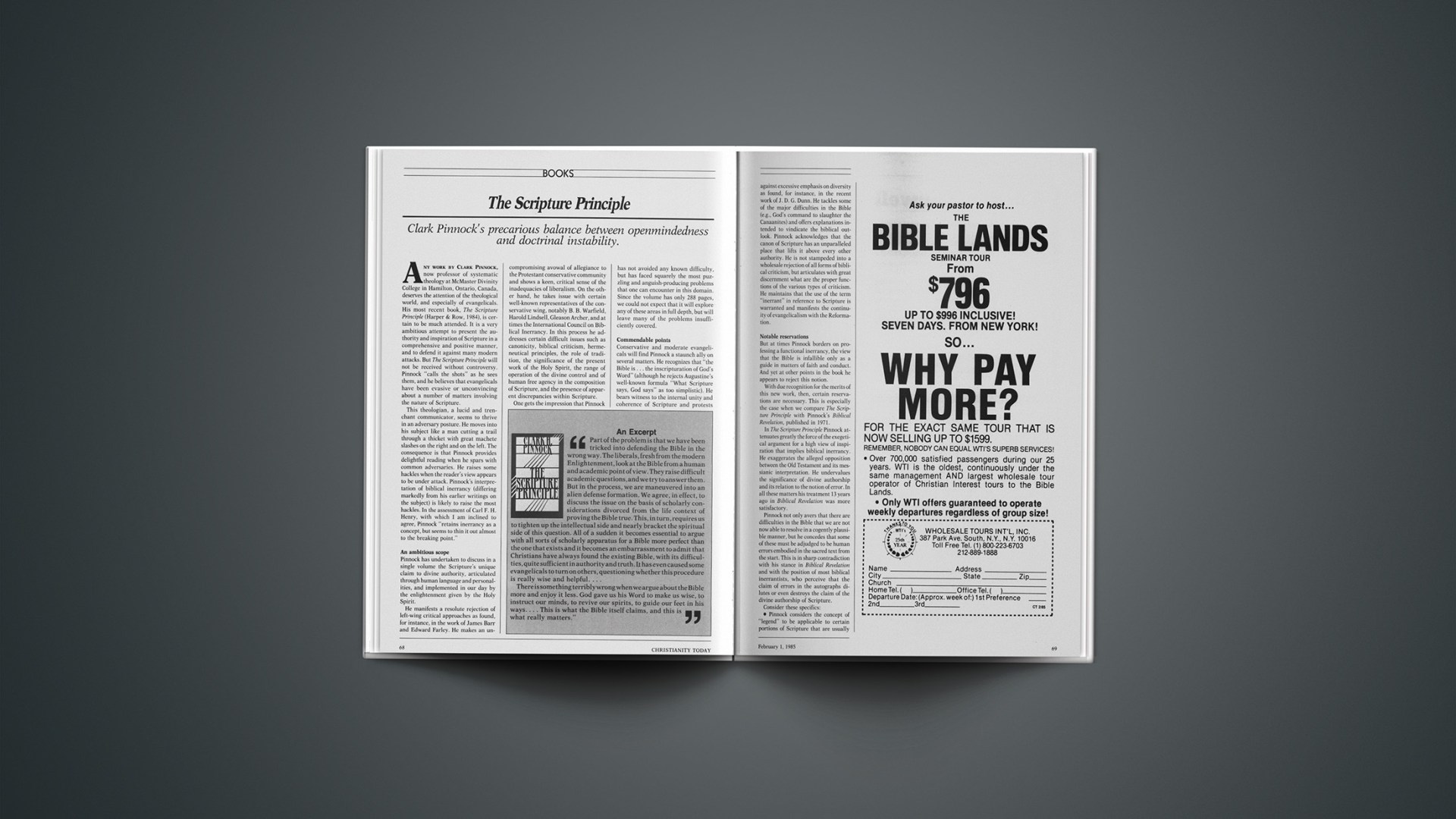
The Scripture Principle

Clark Pinnock’s precarious balance between openmindedness and doctrinal instability.

Any work by Clark Pinnock, now professor of systematic theology at McMaster Divinity College in Hamilton, Ontario, Canada, deserves the attention of the theological world, and especially of evangelicals. His most recent book, The Scripture Principle (Harper & Row, 1984), is certain to be much attended. It is a very ambitious attempt to present the authority and inspiration of Scripture in a comprehensive and positive manner, and to defend it against many modern attacks. But The Scripture Principle will not be received without controversy. Pinnock “calls the shots” as he sees them, and he believes that evangelicals have been evasive or unconvincing about a number of matters involving the nature of Scripture.

This theologian, a lucid and trenchant communicator, seems to thrive in an adversary posture. He moves into his subject like a man cutting a trail through a thicket with great machete slashes on the right and on the left. The consequence is that Pinnock provides delightful reading when he spars with common adversaries. He raises some hackles when the reader’s view appears to be under attack. Pinnock’s interpretation of biblical inerrancy (differing markedly from his earlier writings on the subject) is likely to raise the most hackles. In the assessment of Carl F. H. Henry, with which I am inclined to agree, Pinnock “retains inerrancy as a concept, but seems to thin it out almost to the breaking point.”

An Ambitious Scope

Pinnock has undertaken to discuss in a single volume the Scripture’s unique claim to divine authority, articulated through human language and personalities, and implemented in our day by the enlightenment given by the Holy Spirit.

He manifests a resolute rejection of left-wing critical approaches as found, for instance, in the work of James Barr and Edward Farley. He makes an uncompromising avowal of allegiance to the Protestant conservative community and shows a keen, critical sense of the inadequacies of liberalism. On the other hand, he takes issue with certain well-known representatives of the conservative wing, notably B. B. Warfield, Harold Lindsell, Gleason Archer, and at times the International Council on Biblical Inerrancy. In this process he addresses certain difficult issues such as canonicity, biblical criticism, hermeneutical principles, the role of tradition, the significance of the present work of the Holy Spirit, the range of operation of the divine control and of human free agency in the composition of Scripture, and the presence of apparent discrepancies within Scripture.

One gets the impression that Pinnock has not avoided any known difficulty, but has faced squarely the most puzzling and anguish-producing problems that one can encounter in this domain. Since the volume has only 288 pages, we could not expect that it will explore any of these areas in full depth, but will leave many of the problems insufficiently covered.

An Excerpt

“Part of the problem is that we have been tricked into defending the Bible in the wrong way. The liberals, fresh from the modern Enlightenment, look at the Bible from a human and academic point of view. They raise difficult academic questions, and we try to answer them. But in the process, we are maneuvered into an alien defense formation. We agree, in effect, to discuss the issue on the basis of scholarly considerations divorced from the life context of proving the Bible true. This, in turn, requires us to tighten up the intellectual side and nearly bracket the spiritual side of this question. All of a sudden it becomes essential to argue with all sorts of scholarly apparatus for a Bible more perfect than the one that exists and it becomes an embarrassment to admit that Christians have always found the existing Bible, with its difficulties, quite sufficient in authority and truth. It has even caused some evangelicals to turn on others, questioning whether this procedure is really wise and helpful.…

There is something terribly wrong when we argue about the Bible more and enjoy it less. God gave us his Word to make us wise, to instruct our minds, to revive our spirits, to guide our feet in his ways.… This is what the Bible itself claims, and this is what really matters.”

Commendable Points

Conservative and moderate evangelicals will find Pinnock a staunch ally on several matters. He recognizes that “the Bible is … the inscripturation of God’s Word” (although he rejects Augustine’s well-known formula “What Scripture says, God says” as too simplistic). He bears witness to the internal unity and coherence of Scripture and protests against excessive emphasis on diversity as found, for instance, in the recent work of J. D. G. Dunn. He tackles some of the major difficulties in the Bible (e.g., God’s command to slaughter the Canaanites) and offers explanations intended to vindicate the biblical outlook. Pinnock acknowledges that the canon of Scripture has an unparalleled place that lifts it above every other authority. He is not stampeded into a wholesale rejection of all forms of biblical criticism, but articulates with great discernment what are the proper functions of the various types of criticism. He maintains that the use of the term “inerrant” in reference to Scripture is warranted and manifests the continuity of evangelicalism with the Reformation.

Notable Reservations

But at times Pinnock borders on professing a functional inerrancy, the view that the Bible is infallible only as a guide in matters of faith and conduct. And yet at other points in the book he appears to reject this notion.

With due recognition for the merits of this new work, then, certain reservations are necessary. This is especially the case when we compare The Scripture Principle with Pinnock’s Biblical Revelation, published in 1971.

In The Scripture Principle Pinnock attenuates greatly the force of the exegetical argument for a high view of inspiration that implies biblical inerrancy. He exaggerates the alleged opposition between the Old Testament and its messianic interpretation. He undervalues the significance of divine authorship and its relation to the notion of error. In all these matters his treatment 13 years ago in Biblical Revelation was more satisfactory.

Pinnock not only avers that there are difficulties in the Bible that we are not now able to resolve in a cogently plausible manner, but he concedes that some of these must be adjudged to be human errors embodied in the sacred text from the start. This is in sharp contradiction with his stance in Biblical Revelation and with the position of most biblical inerrantists, who perceive that the claim of errors in the autographs dilutes or even destroys the claim of the divine authorship of Scripture.

Consider these specifics:

• Pinnock considers the concept of “legend” to be applicable to certain portions of Scripture that are usually interpreted as historical in evangelical circles. Jonah is called “a didactic fiction.” The narratives of Genesis 1–3 fall in this category, as do certain events of the life of Christ (Matt. 17:24–27; 27:52) and of Paul (Acts 19:11–12; 27:1–6). If these events were actually historical—as indeed they were—it is difficult to see how the biblical language would be changed in order to reflect that more clearly.

• The distinction evangelicals make between autographs and copies or translations, so well articulated by Pinnock in his Biblical Revelation, is now dismissed as trivial or even mischievous.

• Because the biblical books reflect a variety of literary genres and a diversity of purpose, Pinnock is led to posit different degrees of inspiration. It is the melancholy verdict of history that those who advocated this kind of distinction appear invariably to have weakened the doctrine of inspiration, since such a view inevitably leads to a downgrading of those passages or books that are viewed as given under a “low” degree of inspiration.

• Pinnock lays great stress on the function of Christian tradition and of the ever-present illumination of the Holy Spirit in our perception, understanding, and transculturation of the Word of God. Surely an evangelical should be careful to acknowledge the importance of the guidance of God’s Spirit over these nineteen centuries and of his present witness in the hearts of believers. But Pinnock appears here to be insufficiently guarded against the twin dangers of a tradition-bound approach that creates a rival to canonical Scripture and of illuminism in which the properly exegeted Scripture is not the only infallible norm.

• Pinnock has also abandoned the concept of “confluence” in the relationship between divine and human activity. Stated succinctly, this abandonment means that the divine activity and the human activity do not overlap, but that God’s activity terminates where human activity starts.

This, of course, dispels on a rationalistic basis the mystery of providence and of inspiration. Room is secured for a rationally demonstrable place for human free will at the frightful loss of divine sovereignty. The impact of this approach, if carried consistently into Christology, will lead to sheer Nestorianism.

Pinnock’s Changing Mind

In all of this one may well regret that Pinnock has not allowed the influence of both the Jewish and the Christian traditions to have a greater place in his formulation of the doctrine of inspiration. What he gives us here is hardly what has always been held in the Christian community!

As J. I. Packer observed upon perusing a manuscript of The Scripture Principle, Professor Pinnock, in spite of his considerable knowledge of the relevant literature, has a tendency to “walk by himself,” which is really disconcerting.

Open-mindedness and stability are two great qualities that theologians must hold in tension: open-mindedness so that they continue to remain subject to correction where they may be wrong; stability so that some real confidence may be placed in their conclusions. Clark Pinnock has certainly shown considerable open-mindedness through the years, but this is flawed by the instability that has led him to shift his stance repeatedly, even long after he began teaching theology.

Reviewed by Roger Nicole, Andrew Murtch Professor of Theology at Gordon-Conwell Theological Seminary, South Hamilton, Massachusetts. Dr. Nicole edited Inerrancy and Common Sense (Baker, 1980).

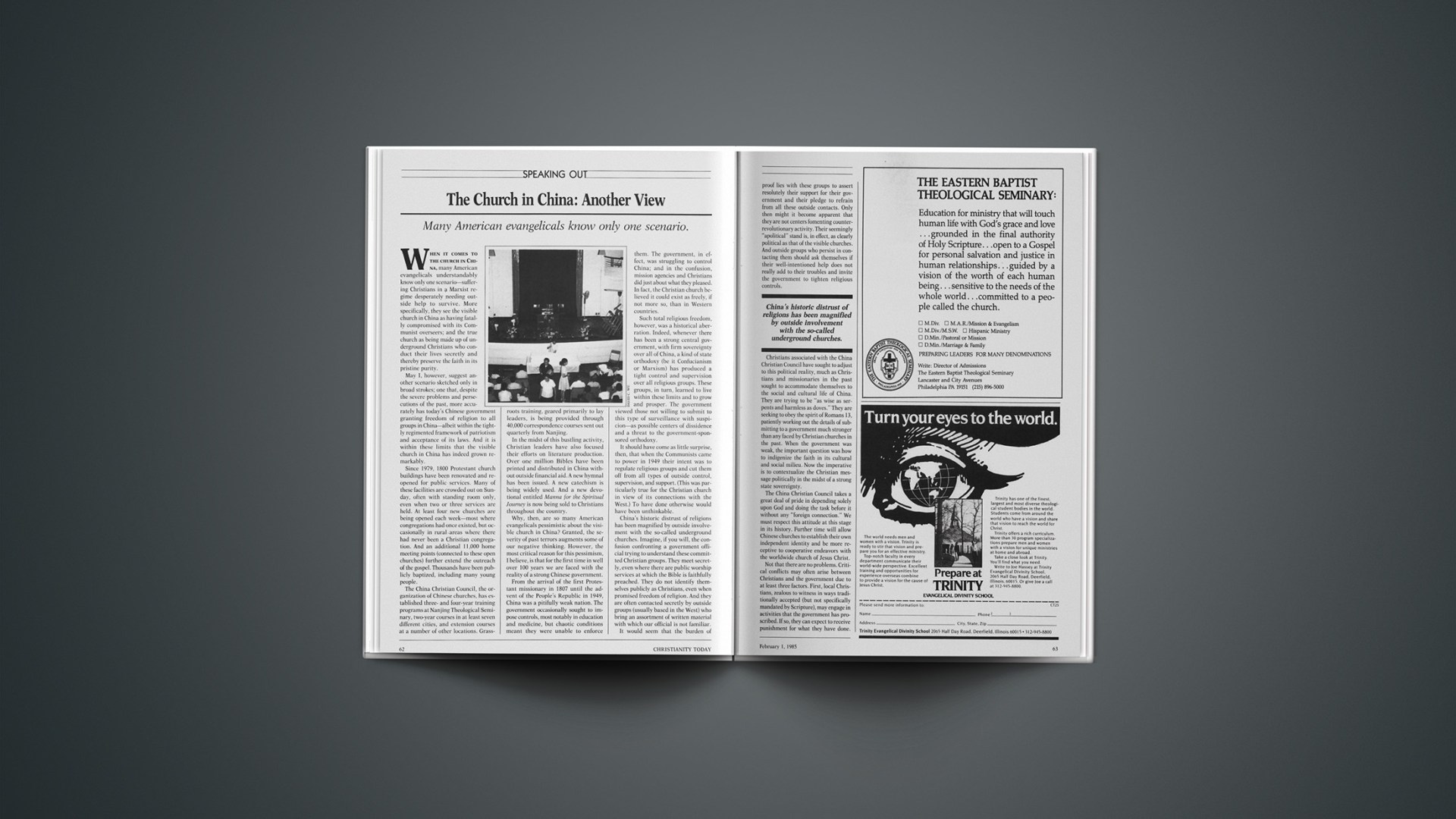
The Church in China: Another View

Many American evangelicals know only one scenario.

When it comes to the church in china, many American evangelicals understandably know only one scenario—suffering Christians in a Marxist regime desperately needing outside help to survive. More specifically, they see the visible church in China as having fatally compromised with its Communist overseers; and the true church as being made up of underground Christians who conduct their lives secretly and thereby preserve the faith in its pristine purity.

May I, however, suggest another scenario sketched only in broad strokes; one that, despite the severe problems and persecutions of the past, more accurately has today’s Chinese government granting freedom of religion to all groups in China—albeit within the tightly regimented framework of patriotism and acceptance of its laws. And it is within these limits that the visible church in China has indeed grown remarkably.

Since 1979, 1800 Protestant church buildings have been renovated and reopened for public services. Many of these facilities are crowded out on Sunday, often with standing room only, even when two or three services are held. At least four new churches are being opened each week—most where congregations had once existed, but occasionally in rural areas where there had never been a Christian congregation. And an additional 11,000 home meeting points (connected to these open churches) further extend the outreach of the gospel. Thousands have been publicly baptized, including many young people.

The China Christian Council, the organization of Chinese churches, has established three- and four-year training programs at Nanjing Theological Seminary, two-year courses in at least seven different cities, and extension courses at a number of other locations. Grassroots training, geared primarily to lay leaders, is being provided through 40,000 correspondence courses sent out quarterly from Nanjing.

In the midst of this bustling activity, Christian leaders have also focused their efforts on literature production. Over one million Bibles have been printed and distributed in China without outside financial aid. A new hymnal has been issued. A new catechism is being widely used. And a new devotional entitled Manna for the Spiritual Journey is now being sold to Christians throughout the country.

Why, then, are so many American evangelicals pessimistic about the visible church in China? Granted, the severity of past terrors augments some of our negative thinking. However, the most critical reason for this pessimism, I believe, is that for the first time in well over 100 years we are faced with the reality of a strong Chinese government.

From the arrival of the first Protestant missionary in 1807 until the advent of the People’s Republic in 1949, China was a pitifully weak nation. The government occasionally sought to impose controls, most notably in education and medicine, but chaotic conditions meant they were unable to enforce them. The government, in effect, was struggling to control China; and in the confusion, mission agencies and Christians did just about what they pleased. In fact, the Christian church believed it could exist as freely, if not more so, than in Western countries.

Such total religious freedom, however, was a historical aberration. Indeed, whenever there has been a strong central government, with firm sovereignty over all of China, a kind of state orthodoxy (be it Confucianism or Marxism) has produced a tight control and supervision over all religious groups. These groups, in turn, learned to live e within these limits and to grow 3 and prosper. The government viewed those not willing to submit to this type of surveillance with suspicion—as possible centers of dissidence and a threat to the government-sponsored orthodoxy.

It should have come as little surprise, then, that when the Communists came to power in 1949 their intent was to regulate religious groups and cut them off from all types of outside control, supervision, and support. (This was particularly true for the Christian church in view of its connections with the West.) To have done otherwise would have been unthinkable.

China’s historic distrust of religions has been magnified by outside involvement with the so-called underground churches. Imagine, if you will, the confusion confronting a government official trying to understand these committed Christian groups. They meet secretly, even where there are public worship services at which the Bible is faithfully preached. They do not identify themselves publicly as Christians, even when promised freedom of religion. And they are often contacted secretly by outside groups (usually based in the West) who bring an assortment of written material with which our official is not familiar.

It would seem that the burden of proof lies with these groups to assert resolutely their support for their government and their pledge to refrain from all these outside contacts. Only then might it become apparent that they are not centers fomenting counter-revolutionary activity. Their seemingly “apolitical” stand is, in effect, as clearly political as that of the visible churches. And outside groups who persist in contacting them should ask themselves if their well-intentioned help does not really add to their troubles and invite the government to tighten religious controls.

Christians associated with the China Christian Council have sought to adjust to this political reality, much as Christians and missionaries in the past sought to accommodate themselves to the social and cultural life of China. They are trying to be “as wise as serpents and harmless as doves.” They are seeking to obey the spirit of Romans 13, patiently working out the details of submitting to a government much stronger than any faced by Christian churches in the past. When the government was weak, the important question was how to indigenize the faith in its cultural and social milieu. Now the imperative is to contextualize the Christian message politically in the midst of a strong state sovereignty.

The China Christian Council takes a great deal of pride in depending solely upon God and doing the task before it without any “foreign connection.” We must respect this attitude at this stage in its history. Further time will allow Chinese churches to establish their own independent identity and be more receptive to cooperative endeavors with the worldwide church of Jesus Christ.

Not that there are no problems. Critical conflicts may often arise between Christians and the government due to at least three factors. First, local Christians, zealous to witness in ways traditionally accepted (but not specifically mandated by Scripture), may engage in activities that the government has proscribed. If so, they can expect to receive punishment for what they have done. We may or may not agree with the government attitude. But the political reality is still there; and it will not be changed by outside appeal and harangue. Chinese Christians, given the wide latitude of freedom they currently enjoy, will need to choose their battlegrounds with care.

Second, most of these conflicts are purely local—the overzealous activities of pockets of leftist-leaning cadres who have never been able to understand or adopt their government’s attitude granting freedom of religion. (Some of the apostle Paul’s biggest problems were with local officials.) Within the hierarchy of Chinese local officials, it will be difficult to seek immediate redress in Beijing of alleged violations of religious rights. Church leaders, therefore, have adopted a patient attitude. They are confident that, in time, the policy of religious freedom will be implemented uniformly throughout the country. Where true injustices have been perpetrated, they are prepared to make proper representation through the prescribed channels.

Third, the official distinction between permitted religious activities and proscribed “superstition” is a very fine one. Zealous cadres and officials, not familiar with these technicalities, may easily confuse the two and make mistakes. With patience and grace these difficulties, too, can be resolved.

Christians outside of China do well to think of using their professional gifts in helping in the development of this vast country. If done conscientiously, their activities will promote friendly relations with the Chinese people and make an excellent contribution to China’s modernization. And by the distinctive Christian testimony they give in and through their work, they will undoubtedly influence many Chinese to investigate and follow Jesus Christ.

But the current task of evangelizing China rests not with these “outsiders” but with the body of Christ miraculously raised up within China’s own borders. Even without all the baggage of Western gimmickry, literature, and “know-how,” these believers can evangelize China as well as that small band of disciples whom Jesus sent forth into a hostile Roman empire.

Let us therefore support this church and pray for it. Not forgetting the sins of the past, but thankful to God for a new day in which his Word is being heard across the great land of China.

1 A former missionary to China (1946–51) and Taiwan (1952–66), Ralph Covell is currently the dean of faculty at Denver Conservative Baptist Seminary.

Gallup Poll Shows Anglican Clergy More Orthodox than the Laity

Two polls conducted by the Gallup organization indicate that the Church of England clergy adhere more closely to orthodox Christian beliefs than the church’s laity.

Among Anglican clergy, including several bishops who participated, two out of three believe in the Virgin Birth as historical fact. Sixty-two percent accept New Testament miracles as historical fact, while 32 percent consider them to be the interpretation of the gospel writers. Seventy-seven percent believe in Christ’s bodily resurrection.

In contrast, a nearly identical Gallup poll of Church of England parishioners indicates that 52 percent of the laity believe in the bodily resurrection. Only 31 percent regard New Testament miracles as fact, while 45 percent say they are interpretations.

Correction

An article in the December 14, 1984, issue misrepresented a statement by Abe Funk, executive director of the Baptist General Conference (BGC) of Canada. Funk was paraphrased as saying the Canadian BGC would reflect a slightly more conservative stance than its American counterpart in the area of biblical inerrancy. The article should have reported that the Canadian BGC statement on inerrancy is “more definitive” than that of its American counterpart. “The Canadian statement on Scripture—which varies slightly from the U.S. statement—is an attempt only to speak to issues of the day,” Funk said, “and is in no way to reflect our unhappiness with the U.S. statement.”

Three More Evangelicals in Greece Receive Jail Terms for Proselytizing

Three evangelical leaders in Greece have been sentenced to three-and-one-half years in prison for proselytism. The sentence was handed down less than two weeks after a Greek court upheld the conviction of an evangelical lay pastor named in a separate lawsuit (CT, Jan. 18, 1985, p. 50).

The defendants in both cases are free pending an appeal of their convictions. In the more recent trial, Costas Macris, director of the Hellenic Missionary Union (HMU); Don Stephens, director of Youth With a Mission (YWAM); and Allan Williams, captain of a ship owned by YWAM, were fined $900 each in addition to their jail terms.

The suit against them was filed by the mother of Kostas Kotopoulos, a young man who came into contact with YWAM and HMU when he was 16. Kotopoulos spent time practicing English with YWAM staff members. He also had contact with staff members from HMU. When the youth later began attending a Pentecostal church, his mother accused the evangelical leaders of brainwashing and bribing her son to induce him to change his religion. A three-judge panel found the men guilty on December 22.

Earlier in December, a circuit court upheld a four-month jail sentence against Eleftherios Salonikas, an evangelical lay pastor. The court also fined his congregation 200,000 drachmas, plus court costs of about 70,000 drachmas, a total penalty of about $1,728 U.S.

Salonikas had appealed an earlier ruling against his congregation for registering and meeting as an association. The HMU’s Macris said the circuit court ruling did not deal with the validity of a church registering as an association. Instead, he said, the judges found the church guilty of proselytizing. Salonikas and his church plan to appeal the circuit court decision to the Greek supreme court.

Greek Protestants view such court cases as a threat to basic religious freedom and human rights. Though Greece’s new constitution guarantees freedom of religion, laws against proselytism remain in force. The laws are designed to protect the 97 percent of Greek citizens who are members of the Greek Orthodox Church, the country’s state church.

Does the Constitution Allow Private-School Students to Receive Public Assistance?

Whether public and private schools may collaborate to assure all students a quality education is at issue before the U.S. Supreme Court. The cases involve federal funds for private schools in New York City and state assistance in Grand Rapids, Michigan.

For six years, the Grand Rapids School District operated programs called Shared Time and Cooperative Education. They were devised to supplement private school curricula with remedial classes, physical education, and art instruction, among other subjects. Public school teachers with expertise in those fields were sent to private schools, where they taught in classroom space leased by the state. Private school students who participated in the special classes were designated “part-time public school students.”

All but one of Grand Rapids’ 43 private schools are church related, operated by Christian Reformed, Lutheran, Baptist, Catholic, and Seventh-day Adventist churches. The programs at issue were operating in 41 of them, with 470 teachers and 11,000 students participating each year. In 1982—when a U.S. District Court judge put a stop to them—the programs cost Michigan taxpayers $3 million.

A group of taxpayers, backed by Americans United for Separation of Church and State, filed suit against the school district, claiming that the programs trespassed the constitutional boundary between church and state. Tax money should not assist religiously oriented schools, they said, because the state would appear to be endorsing, promoting, or entangling itself with the beliefs of particular religious groups.

Grand Rapids school officials tried to circumvent the constitutional prohibition by taking scrupulous precautions. They paid rent to the private schools, posted signs that read “Grand Rapids Public Schools Classroom,” and removed crucifixes and all other religious symbols from the rooms used for instruction by public school teachers.

Supporters of the program point out that it operated without a ripple of dissent or divisiveness, and none of the teachers involved taught or promoted religion. In the brief it filed with the Supreme Court, the school district said, “Relationships between state education policy and nonpublic school patrons is inevitable. In that context, it is for the states to determine what form those relationships will take under state law.… In Michigan, the legislature has made a conscious policy choice to authorize and fund the instructional services here at issue.”

That choice, the brief points out, reflects the state’s “legitimate concern about the quality of the education the child receives in nonpublic schools.” Earlier court rulings have allowed state assistance to private schools in the form of transportation, textbooks, lunches, and health services. These services are tolerated, courts have said, because they benefit individual students.

Opponents of the Grand Rapids program say its promoters are aiding religious institutions, not students. Lawyers representing the taxpayers who brought suit say the program’s “end result is to subsidize with tax dollars the teaching of important parts of the curriculum of sectarian schools.” In their response to the school district’s brief, they assert that the Grand Rapids experiment “left a trail of entanglement which threatened to bring about a virtual merger of the public and nonpublic school systems.”

Three cases from New York City—to be decided by the high court with one ruling—are less sweeping than the Grand Rapids dispute. They involve the constitutionality of Chapter One, a program administered by the federal government to provide funds for remedial education at church-related schools. Opponents say this could lead to all manner of private-school instruction by teachers on public payrolls.

These cases come at a time when the Supreme Court is considering numerous church-and-state issues and could redirect legal trends substantially. In recent terms, the Court has upheld the constitutionality of publicly sponsored nativity displays, chaplains in state legislatures, and tuition tax deductions for parents of private-school children. The high court’s ruling on the Grand Rapids case, in particular, is awaited as a bellwether on the permissible levels of interaction between church and state.

The nine justices are expected to split down the middle on both the New York City and the Michigan cases, with Justice Lewis F. Powell providing the swing vote. The Court’s decision is due in the spring.

Mainline Protestants Organize to Challenge Their Churches’ Positions on Public Policy

The Institute on Religion and Democracy (IRD) is helping to organize mainline Protestants who are disturbed by the public policy positions of their denominations. During two days of meetings in Washington, D.C., Episcopalians, Presbyterians, and United Methodists explored ways to introduce different points of view to church officials on positions regarding Central America, U.S.-Soviet relations, and political choices facing Third World governments.

There is a strong evangelical component in each of the caucus groups, but they differ from theologically based movements, such as Good News within the United Methodist Church. By concentrating on issues of human rights, democratic values, and religious liberty, IRD spokesmen say, caucus members may attract a broad following within their churches and press ahead for discussion about what their churches stand for and how corporate witness should be carried out.

IRD is a Washington-based nonprofit research and education organization that has vigorously challenged the foreign affairs initiatives of the National Council of Churches (NCC) and the World Council of Churches (WCC). It attracted national news media attention in 1983 when Reader’s Digest and “60 Minutes” reported on links between the ecumenical movement and left-wing political causes abroad.

The recent meeting with mainline Protestants indicates a shift in focus for IRD, said program director Diane Knippers. “We want to be more than just a gadfly, critic, think tank, or publisher. We want to change our churches, and that calls for efforts by church activists.” The only way ecumenical councils will change, she said, is through pressure from within their member denominations.

United Methodists make up the single largest block of IRD’s 2,000 members. A caucus called United Methodists for Religious Liberty and Human Rights took shape in that denomination under IRD sponsorship in late 1983. At the United Methodist general conference last May, the caucus surprised everyone with its determination and success. A denominational magazine, engage/social action, reflected an official hats-off attitude:

“With sophisticated aplomb, this tiny group went about herding its agenda through the conference. With a visibility and influence that seemed far out of proportion to the strength of its parent body, members passed out press kits, held press conferences and briefings, and diligently tracked its resolutions through legislative committees. Its efforts paid off with the passage of a statement on religious freedom, amendments to the Central America resolution, and a minor addition to the Social Creed.”

IRD board member David Jessup, head of United Methodists for Religious Liberty and Human Rights, urged Episcopalians and Presbyterians at the IRD meeting to pursue a similar track. He encouraged them to “begin to organize an alternative—a set of structures, activities, materials, and channels of giving that will appeal to significant numbers of our fellow Christians.”

Mainline church bureaucracies are designed to effect social change in the world, he pointed out. “One cannot walk through the corridors of the great church bureaucracies, read the bulletin boards, and observe the staff activity without sensing the overwhelming importance of this political aspect of church life.”

Jessup said protests raised by U.S. church officials in the wake of President Reagan’s order to invade Grenada illustrate his point. Church spokesmen “duly amplified the howls of outrage of their Caribbean counterparts,” he said. “Somehow they never got around to letting their constituents know that the Grenadian Council of Churches approved of U.S. actions.”

IRD aspires to outdo mainline denominations and the NCC at their own task of educating church members. The institute provides research reports and evidence to bolster its claims of religious liberty abuses abroad. Beyond Soviet oppression and Central American conflict, IRD will broaden its focus to include critiques of right-wing regimes such as those ruling the Philippines and South Africa. In a letter to South African Ambassador Bernardus Fourie, IRD’s board of directors called on that government to “take immediate steps toward racial integration, full political democracy, and elementary economic justice.”

The success in May of the Methodist caucus provided ample encouragement for Episcopalians and Presbyterians at the recent IRD meeting. Episcopalian Barbara Denluck, assistant to the president of CREED, a group assisting persecuted Christians behind the Iron Curtain, said the Episcopal effort is designed to be nonconfrontational and not divisive. It arose among parishioners who felt alienated because they disagreed with official church policies on foreign affairs, she said.

The 37 Presbyterians in attendance decided to form a caucus within the Presbyterian Church (USA) to draw attention to violations of religious freedom and ways in which undemocratic forms of government oppress the faithful. Similar lay-led groups within the denomination advocate prolife policies and respect for the integrity of Scripture. Pressuring denominational officials to hear another political viewpoint is considered particularly crucial among Presbyterians because of their deep involvement in lobbying efforts on behalf of Nicaragua’s revolutionary government and in ecumenical exchange programs with the Soviet Union.

“I’m not sure the leadership of the church is so far gone that we can’t engage in dialogue,” said Terry Eastland, a member of National Presbyterian Church in Washington, D.C. “But the point is that God has not always resurrected the same entity to carry on his work. I don’t know how long mainline denominations will be vessels for living truth.”

Presbyterian officials will fight caucus efforts “tooth and nail” because “the problem is that church elites of mainline denominations are even more removed from political reality than other kinds of elites,” predicted Mark Amstutz, a Presbyterian layman and chairman of the political science department at Wheaton (Ill.) College. “When people join the name of the Lord with their particular predispositions, it can really be problematical.”

Frank Watson, who heads a steering committee of Episcopalians within IRD, said the problem goes beyond specific foreign affairs positions. “It’s an attitude toward what freedom is all about and toward democracy itself,” he said. “When you listen to Alexander Solzhenitsyn or Malcolm Muggeridge, you realize that democracy will not exist without a moral dimension to it that the church must assume.”

Visits to the Soviet Union by mainline church officials have the effect of suggesting that church life there is not so bad, Watson said. “Those of us who know better than that want to point out that there is persecution there.”

Such criticism of mainline denominations is not appreciated at the Episcopal Church’s Washington, D.C., office. “The devious tactics of IRD are not conducive to dialogue,” said William L. Weiler, the office’s director. “They are not offering an invitation to open dialogue but laying hold of a springboard to promote their own views.

“The Episcopal Church, along with believers of other traditions, have found ways of working together very effectively,” he said. “I regret [that] an aberration like this diverts us from everyday witness and ecumenical endeavor.”

In New York, however, Episcopal Church presiding bishop John M. Allin has commissioned a study of church membership in the NCC and the WCC. Noting that Episcopal participation in the ecumenical councils has been taken for granted, Allin said it may be better to “start afresh, rather than to struggle in a disjointed organization wherein participation is difficult and not accurately representative of the churches’ membership.”

A similar study is under way in the Presbyterian Church (USA). A committee is expected to present its final report at a general assembly meeting in May. Indications of sensitivity to members who question official church policy already are evident. Those sensitivities may encourage these caucus groups to press more insistently for an end to political polarization within mainline denominations.

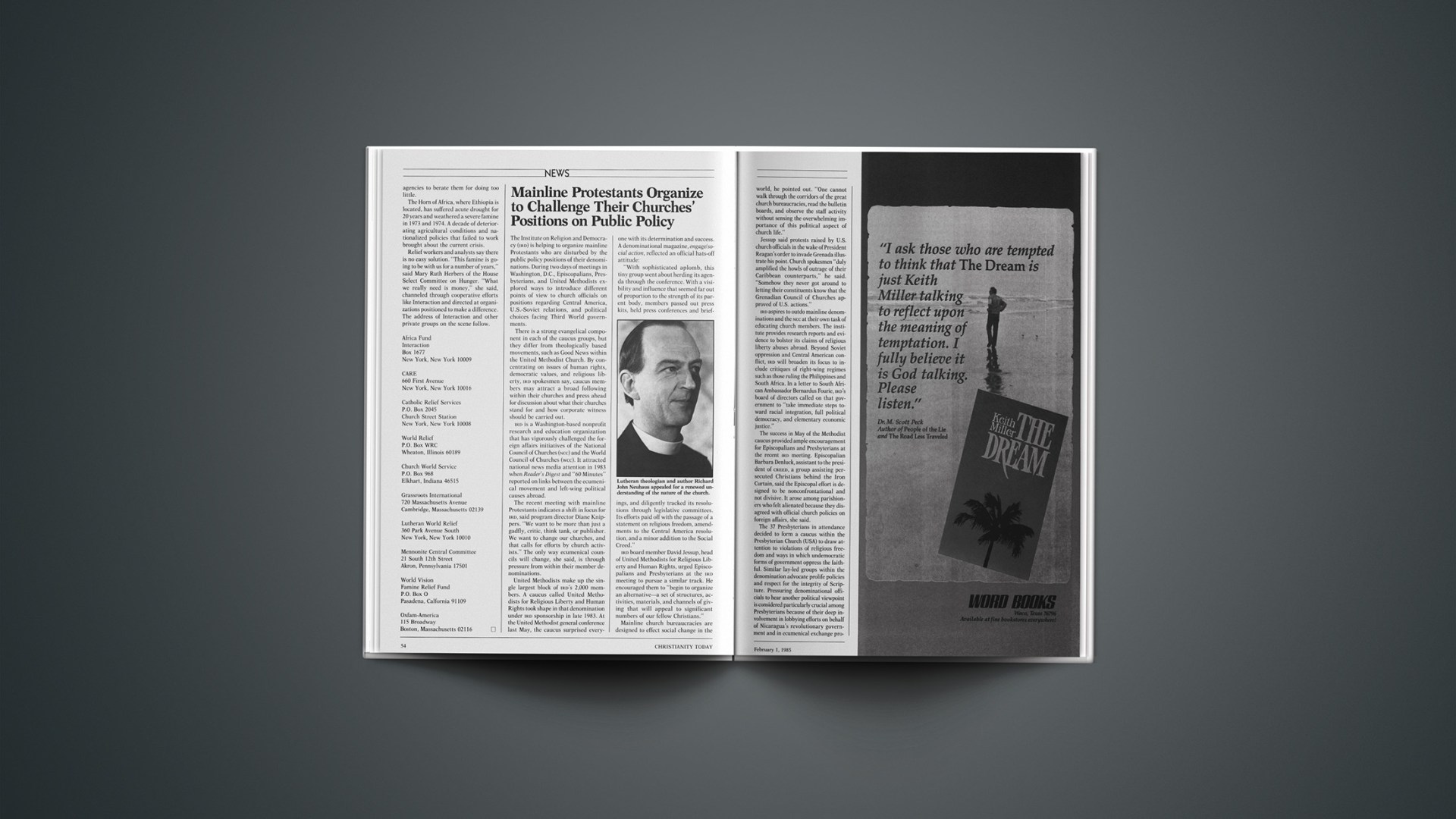
Lutheran theologian and author Richard John Neuhaus, addressing the IRD gathering, appealed for a renewed understanding of the nature of the church. “The church is nothing less than the bride of Christ,” he said. “It should be neither of the left nor of the right nor of the spineless middle. We must work toward the time when people don’t have to feel they must choose their church on the basis of its politics.”

North American Scene

The U.S. Supreme Court has declined to review a lower court ruling leaving church property under the control of a local Presbyterian church. In 1977, a congregation in Schenectady, New York, voted to sever relations with the Presbyterian Church (USA) over doctrinal differences. The Presbytery of Albany then appointed an administrative commission to replace the church’s governing board, saying the congregation’s action violated church law. By declining to review the case, the Supreme Court upheld a lower court ruling that the congregation is not subject to the jurisdiction of the presbytery or of the Presbyterian Church (USA).

America’s Catholic bishops have offered guidelines to influence future laws concerning medical treatment of terminally ill patients. In a three-page document, the bishops criticized many existing statutes as a violation of a patient’s right to life. The document suggested that future laws recognize that the patient’s right to refuse medical treatment is not absolute.

A federal judge has ruled that allowing federally financed teachers to conduct classes in Missouri’s parochial schools violates the U.S. Constitution. U.S. District Judge Joseph Stevens, Jr., ruled that the practice runs the risk of excessively entangling church and state. He stayed the injunction against the practice, however, until the U.S. Supreme Court rules on a similar case.

A Gallup poll indicates that the percentage of churchgoing Americans remained unchanged in 1984, with 4 out of every 10 adults attending a church or synagogue. Attendance has varied within a range of only two percentage points since 1969. However, the proportion of Catholics attending mass fell 23 percentage points from 1958 until 1982, while Protestant church attendance remained steady. Catholics still lead Protestants in attendance—by 51 percent to 39. Twenty-two percent of Jews said they attend synagogue.

A judge in Virginia has found two men guilty of shouting anti-Catholic slogans. Ronnie McRae and Timothy Schuller were fined $100 for making excessive noise outside a Catholic church. A priest testified that the men stood across the street from the church and yelled “violently anti-Catholic” slogans at parishioners arriving for mass.

The U.S. Agency for International Development will discontinue funding for the International Planned Parenthood Federation (IPPF). Funding will not be renewed because the group finances abortion-related services in other countries. Federal funding for fiscal 1984 was about $14 million and was expected to be around $17 million for 1985, approximately 30 percent of IPPF’s proposed budget. An IPPF spokeswoman said less than 1 percent of its budget is used to finance abortion-related activities.

A Catholic study is calling for the immediate training of lay people as “professional ministers” to fill certain pastoral roles. Theologically trained laymen would help offset the declining numbers of priests and nuns. A task force—commissioned by the National Conference of Catholic Bishops, the Conference of Major Superiors of Men, and the Leadership Conference of Women Religious—reported that the number of American Catholics rose from 45 million in 1970 to 52 million in 1983. During that same period, the number of priests and nuns dropped from 194,000 to 151,000.

Lutheran church membership in North America remained steady in 1983, according to the Lutheran Council in the U.S.A. In 1983, total membership was 8,826,832, about 6 percent of the world Lutheran population. The Lutheran Church in America is the largest Lutheran group, with more than three million members.

The National Coalition on Television Violence (NCTV) reports that 46 percent of the 900 rock music videos it studied contained violence or suggestions of violence. An NCTV study indicates that 13 percent of the violent vidoes contain sadism, with an attacker deriving pleasure from committing a violent act. The study reported that Michael and Jermaine Jackson appear in some of the most violent music videos.

Minnesota’s Catholic bishops have blocked a proposed ecumenical lobbying effort to support legislation that would give protected status to homosexuals. The bishops opposed the recommendation of the Joint Religious Legislative Coalition, saying the proposed legislation would legitimize homosexuality and could affect the hiring practices of church schools and other religious agencies. The Joint Religious Legislative Coalition is made up of the Minnesota Catholic Conference, the Minnesota Council of Churches, and the Jewish Community Relations Council.

Personalia

Evon Hedley has been named chairman of the Slavic Gospel Association’s (SGA) executive committee, SGA’s vice-chairman for 20 years, Hedley replaces Warren Wiersbe as chairman. Wiersbe, director of the Back to the Bible radio broadcast, becomes SGA’s vice-chairman.

Gordon Loux has been named president and chief executive officer of Prison Fellowship Ministries, Inc. (PFM). PFM is a newly established umbrella organization that will provide senior management and staff support for three ministry subsidiaries. Prison Fellowship USA will become the organization’s U.S. ministry arm; Justice Fellowship will continue its prison reform work; and Fellowship Communications will provide ministry materials. Prison Fellowship founder Charles Colson will serve as chairman of PFM.

J. Robert Nelson has been named director of the Institute of Religion at Texas Medical Center in Houston. An ordained United Methodist minister, he will direct the institute’s program in relating concerns of health, medical care, religious faith, and ethics. Nelson is professor of systematic theology at the Boston University School of Theology.

Guy Bon Giovanni has been elected general overseer of the Christian Church of North America. He has served as a pastor, as director of the denomination’s missions department, as assistant general overseer, and as immediate past vice-president.

James M. Dunn, executive director of the Baptist Joint Committee on Public Affairs, has been elected president of Bread for the World. Dunn has served on the organization’s board of directors for six years. Bread for the World is a Christian organization that advocates public policies that help feed the hungry.

Africa’s Need for Food Tests Limits of U.S. Emergency Aid

A bill in Congress seeks slightly more than $1 billion to help prevent further starvation.

Efforts to aid Africa’s famine victims may tax U.S. private and public sources to their limits and still fall short of the overwhelming need for food. The virtual absence of food production in drought-stricken areas is matched by intractable transportation problems and poor government relations between Western nations and Marxist states such as Ethiopia.

Demand already has outstripped the U.S. government’s budgeted cash supply for natural disaster relief. “All available worldwide emergency funds for fiscal 1985 have been spent,” said Corinne Whitaker of Bread for the World (BFW), a Washington-based lobby. “It is critical that more resources be made available, both in food aid and non-food aid such as transportation, medicine, and agricultural recovery projects.”

Drawing on the surplus grain it buys from American farmers, the government has pledged 50,000 metric tons to Ethiopia alone, where the largest mass of starving people live. Half of the $200 million spent by the U.S. government for emergency aid has gone to Ethiopia, where an estimated 7.75 million people survive on the brink of starvation.

Another 550,000 tons are pledged for distribution by private organizations, in an agreement negotiated with the Ethiopian government by World Vision International president Tom Houston and representatives of Catholic and Lutheran relief agencies. Private initiatives are coordinated by Interaction, a coalition of some 120 agencies, many of which are church related.

Finding new sources of money is an urgent task facing both the government and private-sector groups involved in famine relief. A bill requesting slightly more than $1 billion has been introduced in the U.S. House of Representatives, and newly elected Illinois Democratic Senator Paul Simon is pressing for a similar measure in the Senate.

Arthur Simon, brother of the new senator and head of BFW, called on the Reagan administration to take “extraordinary means” before Christmas to ship food abroad much more quickly than the three to four months usually required for delivery. Arthur Simon, and relief workers in Africa, feared that 200,000 people would die without stepped-up aid initiatives. A group of 150 religious leaders endorsed the call for extra efforts, which include:

• An airlift to deliver food and equipment to remote areas with poor, or nonexistent, road networks, such as the interior of Chad, where half the population of 4.6 million risk starvation.

• Helicopters to transport food to refugees in Sudan, where they have fled from famine conditions in Chad and Ethiopia.

• Redirecting of nonemergency grain shipments headed for other destinations to the hardest-hit regions.

• Development of an internationally coordinated plan to reduce the number of deaths—estimated in some areas at 6,400 every day.

In response to the call, 300,000 tons of grain from the U.S. emergency grain reserve were earmarked for Africa. The government has leased commercial airplanes patterned after military cargo planes to ease transportation dilemmas. The government holds four million tons of grain in reserve, and agriculture experts say there is substantially more than that in private reserves held by farmers. No reliable accounting of all privately held grain is kept. A group of Iowa farmers contributed 2,000 metric tons, and farm organizations in European Economic Community nations continue to offer grain.

Oklahoma evangelist Larry Jones, president of Feed the Children, is leading an effort to tap into privately held grain reserves. With the support of Oklahoma’s U.S. senators, David Boren, a Democrat, and Don Nickles, a Republican, Jones is appealing to U.S. churches and synagogues to purchase surplus grain from farmers and send it to Africa.

At a Washington, D.C., press conference, Jones reported on a week-long visit he made to Ethiopian villages. “I have never witnessed suffering and death on such a magnitude as I saw it in Ethiopia,” he said. Also, because surplus amounts of grain keep prices artificially low and endanger the average farmer’s economic stability, Jones said churches should step into the gap. “I know of no greater obscenity in the world than for us to sit on this huge surplus while little children across the sea die by the thousands.”

Working in cooperation with 500 churches, Feed the Children supplies food, clothing, and medicine primarily to needy countries in Latin America. Jones said his group can arrange for grain to be shipped and distributed. “We can’t expect our farmers to feed the world for free, and I am pleased that your proposal recognizes this important fact that so many fail to acknowledge,” Boren wrote to Jones.

However, others in Washington question whether Jones’s plan will work. Ray Waggoner, of the U.S. Department of Agriculture’s stabilization and conservation service, said he doubts whether one person could overcome the logistic and political obstacles. “He would need to make arrangements with entities in charge of moving the grain. That is feasible, but it is not something that is done every day. He would have to deal with governments, and that would be the most difficult part. It might be best to coordinate with groups already negotiating with those governments.”

The Ethiopian government, for example, continues to wage a propaganda war against the United States and does not acknowledge that America is providing far more grain and supplies than any other nation. Ethiopia allies itself closely with the Soviet Union, which pledged 10,000 tons of food aid last year—a fraction of the U.S. pledge.

Western relief workers there are chagrined by government relocation policies that force severely malnourished people out of mountainous regions and into central Ethiopia where new feeding centers will have to be established. Meanwhile, the Ethiopian government convened a meeting of representatives from 19 donor nations and 30 voluntary agencies to berate them for doing too little.

The Horn of Africa, where Ethiopia is located, has suffered acute drought for 20 years and weathered a severe famine in 1973 and 1974. A decade of deteriorating agricultural conditions and nationalized policies that failed to work brought about the current crisis.

Relief workers and analysts say there is no easy solution. “This famine is going to be with us for a number of years,” said Mary Ruth Herbers of the House Select Committee on Hunger. “What we really need is money,” she said, channeled through cooperative efforts like Interaction and directed at organizations positioned to make a difference. The address of Interaction and other private groups on the scene follow.

Africa Fund

Interaction

Box 1677

New York, New York 10009

CARE

660 First Avenue

New York, New York 10016

Catholic Relief Services

P.O. Box 2045

Church Street Station

New York, New York 10008

World Relief

P.O. Box WRC

Wheaton, Illinois 60189

Church World Service

P.O. Box 968

Elkhart, Indiana 46515

Grassroots International

720 Massachusetts Avenue

Cambridge, Massachusetts 02139

Lutheran World Relief

360 Park Avenue South

New York, New York 10010

Mennonite Central Committee

21 South 12th Street

Akron, Pennsylvania 17501

World Vision

Famine Relief Fund

P.O. Box O

Pasadena, Calfornia 91109

Oxfam-America

115 Broadway

Boston, Massachusetts 02116

Protests Lead to Removal of Pornographic Magazines from More than 5,000 Stores

Twelve months ago, the Mississippi-based National Federation for Decency (NFD) called for a nationwide boycott of 7-Eleven stores. As a result, more than 5,000 convenience stores nationwide have stopped selling pornographic magazines, according to NFD president Donald Wildmon.

With nearly 7,400 stores, 7-Eleven is the largest retailer of pornography in the country, said Steve Hallman, NFD associate director. “We thought we could have some leverage in … dealing with pornography by attacking it in the family market place,” he said.

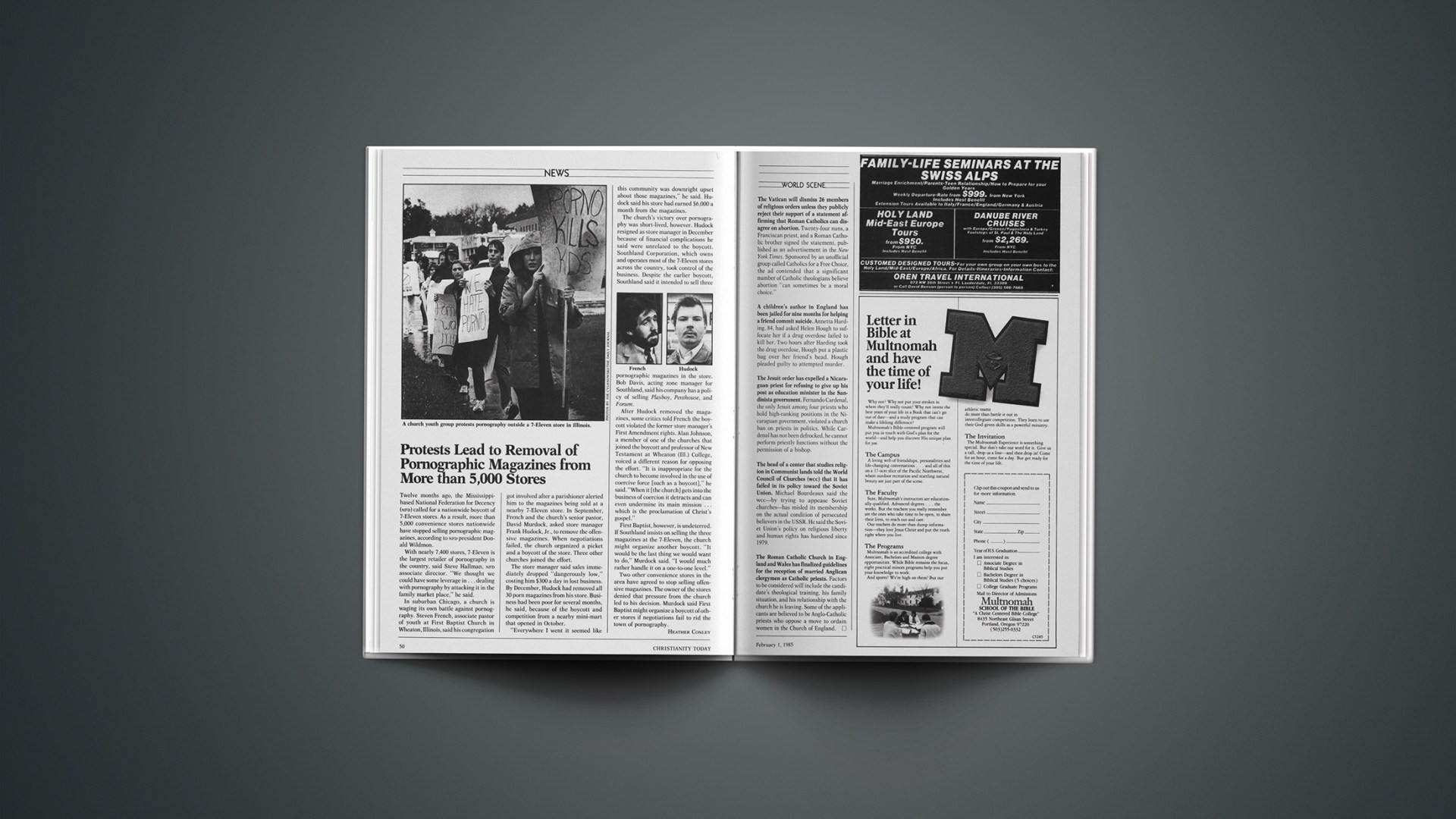
In suburban Chicago, a church is waging its own battle against pornography. Steven French, associate pastor of youth at First Baptist Church in Wheaton, Illinois, said his congregation got involved after a parishioner alerted him to the magazines being sold at a nearby 7-Eleven store. In September, French and the church’s senior pastor, David Murdock, asked store manager Frank Hudock, Jr., to remove the offensive magazines. When negotiations failed, the church organized a picket and a boycott of the store. Three other churches joined the effort.

The store manager said sales immediately dropped “dangerously low,” costing him $300 a day in lost business. By December, Hudock had removed all 30 porn magazines from his store. Business had been poor for several months, he said, because of the boycott and competition from a nearby mini-mart that opened in October.

“Everywhere I went it seemed like this community was downright upset about those magazines,” he said. Hudock said his store had earned $6,000 a month from the magazines.

The church’s victory over pornography was short-lived, however. Hudock resigned as store manager in December because of financial complications he said were unrelated to the boycott. Southland Corporation, which owns and operates most of the 7-Eleven stores across the country, took control of the business. Despite the earlier boycott, Southland said it intended to sell three pornographic magazines in the store. Bob Davis, acting zone manager for Southland, said his company has a policy of selling Playboy, Penthouse, and Forum.

After Hudock removed the magazines, some critics told French the boycott violated the former store manager’s First Amendment rights. Alan Johnson, a member of one of the churches that joined the boycott and professor of New Testament at Wheaton (Ill.) College, voiced a different reason for opposing the effort. “It is inappropriate for the church to become involved in the use of coercive force [such as a boycott],” he said. “When it [the church] gets into the business of coercion it detracts and can even undermine its main mission … which is the proclamation of Christ’s gospel.”

First Baptist, however, is undeterred. If Southland insists on selling the three magazines at the 7-Eleven, the church might organize another boycott. “It would be the last thing we would want to do,” Murdock said. “I would much rather handle it on a one-to-one level.”

Two other convenience stores in the area have agreed to stop selling offensive magazines. The owner of the stores denied that pressure from the church led to his decision. Murdock said First Baptist might organize a boycott of other stores if negotiations fail to rid the town of pornography.

World Scene

The Vatican will dismiss 26 members of religious orders unless they publicly reject their support of a statement affirming that Roman Catholics can disagree on abortion. Twenty-four nuns, a Franciscan priest, and a Roman Catholic brother signed the statement, published as an advertisement in the New York Times. Sponsored by an unofficial group called Catholics for a Free Choice, the ad contended that a significant number of Catholic theologians believe abortion “can sometimes be a moral choice.”

A children’s author in England has been jailed for nine months for helping a friend commit suicide. Annetta Harding, 84, had asked Helen Hough to suffocate her if a drug overdose failed to kill her. Two hours after Harding took the drug overdose, Hough put a plastic bag over her friend’s head. Hough pleaded guilty to attempted murder.

The Jesuit order has expelled a Nicaraguan priest for refusing to give up his post as education minister in the Sandinista government. Fernando Cardenal, the only Jesuit among four priests who hold high-ranking positions in the Nicaraguan government, violated a church ban on priests in politics. While Cardenal has not been defrocked, he cannot perform priestly functions without the permission of a bishop.

The head of a center that studies religion in Communist lands told the World Council of Churches (WCC) that it has failed in its policy toward the Soviet Union. Michael Bourdeaux said the WCC—by trying to appease Soviet churches—has misled its membership on the actual condition of persecuted believers in the USSR. He said the Soviet Union’s policy on religious liberty and human rights has hardened since 1979.

The Roman Catholic Church in England and Wales has finalized guidelines for the reception of married Anglican clergymen as Catholic priests. Factors to be considered will include the candidate’s theological training, his family situation, and his relationship with the church he is leaving. Some of the applicants are believed to be Anglo-Catholic priests who oppose a move to ordain women in the Church of England.

Apple PodcastsDown ArrowDown ArrowDown Arrowarrow_left_altLeft ArrowLeft ArrowRight ArrowRight ArrowRight Arrowarrow_up_altUp ArrowUp ArrowAvailable at Amazoncaret-downCloseCloseEmailEmailExpandExpandExternalExternalFacebookfacebook-squareGiftGiftGooglegoogleGoogle KeephamburgerInstagraminstagram-squareLinkLinklinkedin-squareListenListenListenChristianity TodayCT Creative Studio Logologo_orgMegaphoneMenuMenupausePinterestPlayPlayPocketPodcastRSSRSSSaveSaveSaveSearchSearchsearchSpotifyStitcherTelegramTable of ContentsTable of Contentstwitter-squareWhatsAppXYouTubeYouTube