School Board Bans Open Forums to Prohibit a Student Prayer Group

Reacting against the intent of the federal Equal Access Act, the Boulder, Colorado, school board has banned open forums in local public high schools. The school board prohibited any student-initiated group from meeting on school grounds unless it is school-sponsored and directly related to curriculum offerings.

When the Boulder school board unanimously approved the new policy, it found itself opposing two unlikely allies: a group of students who desired to meet for prayer before school twice a week, and the American Civil Liberties Union (ACLU). A Boulder spokesman for the ACLU defended the Equal Access Act as being constitutional, emphasizing that it should be exercised with care.

Congress passed the equal-access legislation last year to assure high school students the right to assemble on school property—during designated times for extracurricular pursuits—without regard for their reason for meeting. By having an “activities period,” Congress reasoned, the school created a “limited open forum” and could not discriminate against students desiring to meet for prayer or Bible study.

In December, the Boulder school board carried this aspect of the act to its logical extreme. The board declared that it would not permit any sort of “open forum.” The school board said it would countenance only curriculum-related groups whose “function is to enhance the participants’ educational experience and supplement the course materials [at school].” Thus, a foreign-language club would be protected, while a chess club would not.

Board members acted on the advice of attorney Gerald Caplan, who says the Equal Access Act is unconstitutional. The law has not yet been tested in court, but the U.S. Supreme Court was expected to decide in mid-January whether to review a similar case from Williamsport, Pennsylvania. Meanwhile, the law is in effect. Guidelines to help school officials interpret it were developed by a wide-ranging coalition of equal-access friends and foes, including the ACLU.

The Boulder controversy began when high-school senior Greg Ballou, a member of a Presbyterian youth group, organized a prayer group. When his request for meeting space was denied, he launched a petition drive that gathered 400 signatures—nearly one-quarter of the student body. Another Boulder student, Josh Friedman, organized a counter-petition drive, and a series of emotionally charged public forums convened to consider the issue.

An unequivocal editorial in the Denver Post boosted Ballou’s cause, calling the school board rule extreme, “possibly illegal,” and counterproductive. It cites Chief Justice Warren Burger, who wrote in a recent opinion that the U.S. Constitution “affirmatively mandates accommodation, not merely tolerance, of all religions, and forbids hostility toward any.”

The Denver newspaper concluded: “Public schools should embrace this concept by encouraging a diversity of interests, rather than stifling all opinions for fear of endorsing the beliefs of a few.”

The Christian Legal Society (CLS), representing students in the Williamsport appeal, sees the Boulder policy as an unreasonable extension of the Equal Access Act’s deliberately broad construction. The law does allow a school board to shut down its “open forum,” CLS attorney Kimberlee Colby said, “but the understanding was that equal access should not be used as a loophole.”

CLS will watch the Boulder situation intently, Colby said. “And the minute the ski club meets, we’ll consider taking action.”
Urbana ’84 Painted an Optimistic Picture of the Future of World Missions

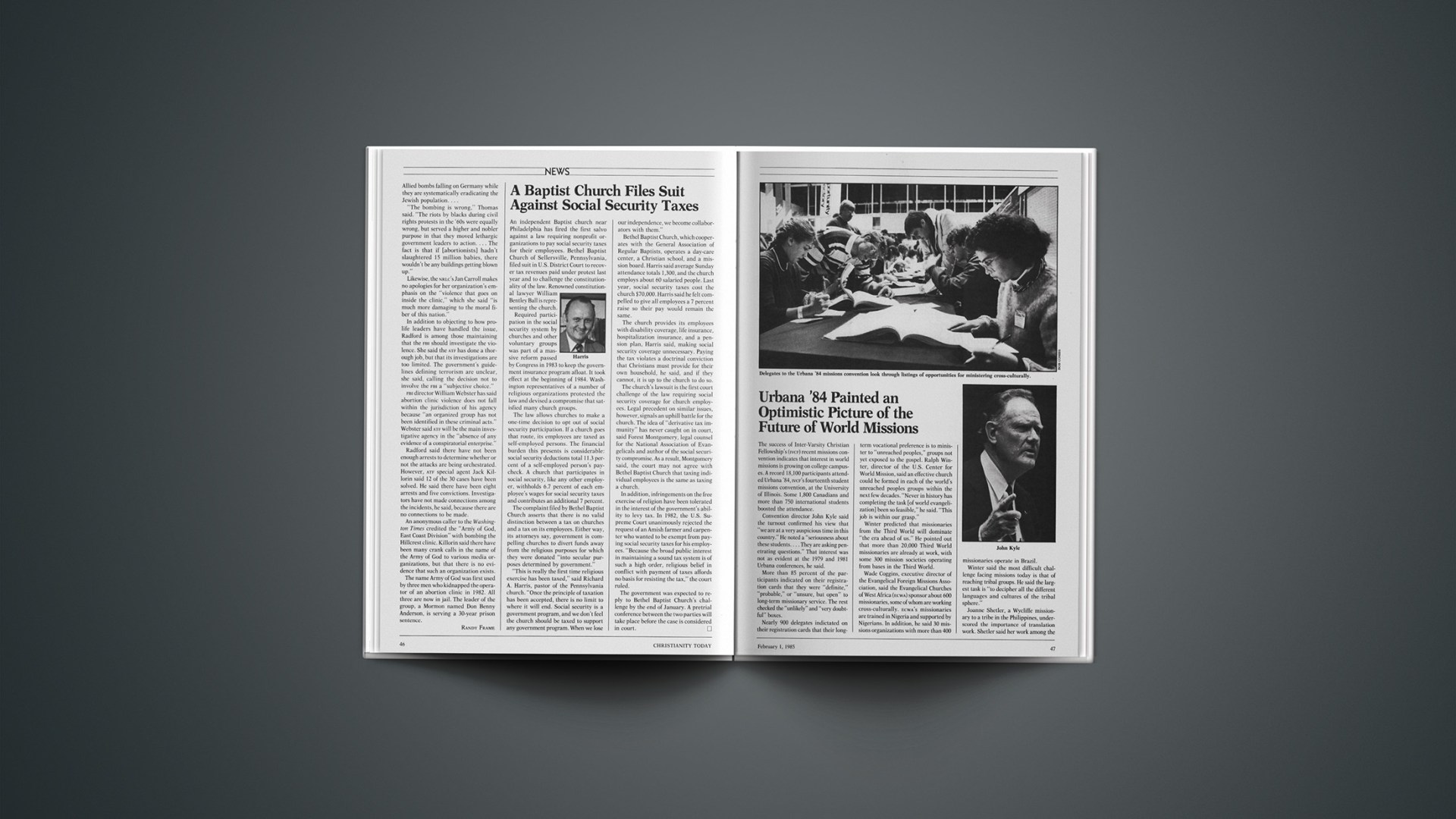
The success of Inter-Varsity Christian Fellowship’s (IVCF) recent missions convention indicates that interest in world missions is growing on college campuses. A record 18,100 participants attended Urbana ’84, IVCF’s fourteenth student missions convention, at the University of Illinois. Some 1,800 Canadians and more than 750 international students boosted the attendance.

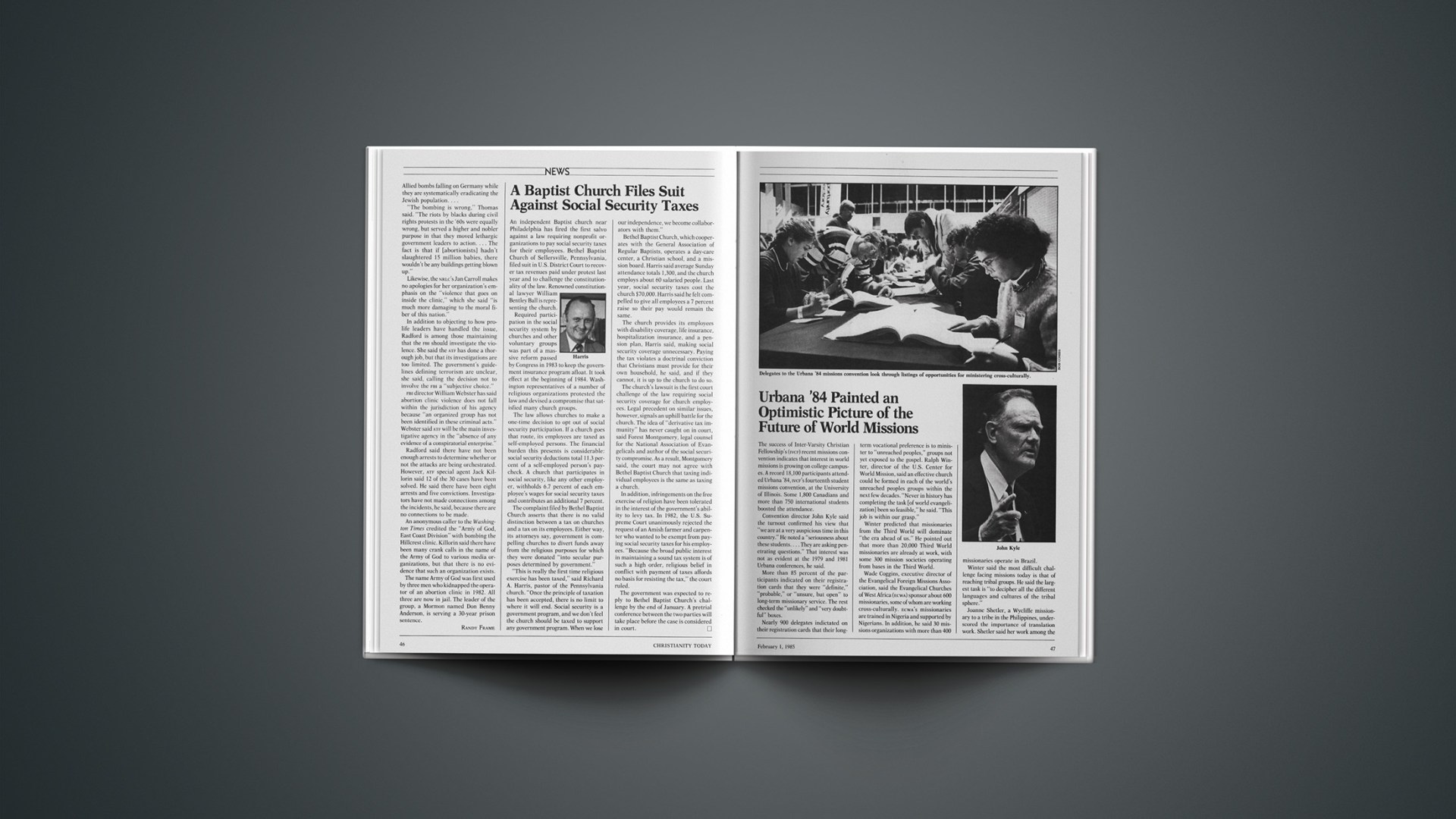
Convention director John Kyle said the turnout confirmed his view that “we are at a very auspicious time in this country.” He noted a “seriousness about these students.… They are asking penetrating questions.” That interest was not as evident at the 1979 and 1981 Urbana conferences, he said.

More than 85 percent of the participants indicated on their registration cards that they were “definite,” “probable,” or “unsure, but open” to long-term missionary service. The rest checked the “unlikely” and “very doubtful” boxes.

Nearly 900 delegates indictated on their registration cards that their long-term vocational preference is to minister to “unreached peoples,” groups not yet exposed to the gospel. Ralph Winter, director of the U.S. Center for World Mission, said an effective church could be formed in each of the world’s unreached peoples groups within the next few decades. “Never in history has completing the task [of world evangelization] been so feasible,” he said. “This job is within our grasp.”

Winter predicted that missionaries from the Third World will dominate “the era ahead of us.” He pointed out that more than 20,000 Third World missionaries are already at work, with some 300 mission societies operating from bases in the Third World.

Wade Coggins, executive director of the Evangelical Foreign Missions Association, said the Evangelical Churches of West Africa (ECWA) sponsor about 600 missionaries, some of whom are working cross-culturally. ECWA’s missionaries are trained in Nigeria and supported by Nigerians. In addition, he said 30 missions organizations with more than 400 missionaries operate in Brazil.

Winter said the most difficult challenge facing missions today is that of reaching tribal groups. He said the largest task is “to decipher all the different languages and cultures of the tribal sphere.”

Joanne Shetler, a Wycliffe missionary to a tribe in the Philippines, underscored the importance of translation work. Shetler said her work among the primitive Balangao tribe and her battle with the evil spirits that controlled their lives made significant strides only when Scripture was made available in the tribe’s language.

Unreached peoples groups include more than 350,000 international students studying in the United States, said Arthur Everett, director of the Association of Christian Ministries to Internationals. “While Christian ministry to internationals has expanded tremendously, there’s still a great deal to be done.” He said some 80 American cities with 500 or more international students have no viable, ongoing ministry.

Internationals sometimes take the initiative to meet their own spiritual needs. Urbana ’76 saw the formation of the African Christian Fellowship in the United States. At Urbana ’84, Tokunboh Adeyemo, executive council chairman of the World Evangelical Fellowship, said Africa is preparing for its own student missions convention in 1986. Adeyemo said organizers hope to attract 10,000 university students from across the African continent.

In contrast to the generally upbeat spirit at the convention, one seminar leader criticized Urbana ’84 for a lack of attention to social issues. Harvie Conn, director of the urban missions program at Westminster Theological Seminary, said there was less emphasis on social action at Urbana ’84 than at any of IVCF’s three previous missions conventions. Among the plenary speakers, Conn said, only Adeyemo spoke about social justice.

He noted, however, that the conventions’s elective seminars “continue to be very wholistic.” Conn’s seminar, Evangelism and Social Justice, drew capacity crowds totaling about 600 participants.

Conn’s concern was not new to convention director Kyle. “I have been listening to him for two Urbana conventions,” Kyle said. “You have got to trust your [plenary] speakers.” The speakers would have addressed social justice questions “if they felt led,” he said. What was missing from the plenary addresses was balanced by the elective seminars, Kyle said.

A Baptist Church Files Suit against Social Security Taxes

An independent Baptist church near Philadelphia has fired the first salvo against a law requiring nonprofit organizations to pay social security taxes for their employees. Bethel Baptist Church of Sellersville, Pennsylvania, filed suit in U.S. District Court to recover tax revenues paid under protest last year and to challenge the constitutionality of the law. Renowned constitutional lawyer William Bentley Ball is representing the church.

Required participation in the social security system by churches and other voluntary groups was part of a massive reform passed by Congress in 1983 to keep the government insurance program afloat. It took effect at the beginning of 1984. Washington representatives of a number of religious organizations protested the law and devised a compromise that satisfied many church groups.

The law allows churches to make a one-time decision to opt out of social security participation. If a church goes that route, its employees are taxed as self-employed persons. The financial burden this presents is considerable: social security deductions total 11.3 percent of a self-employed person’s paycheck. A church that participates in social security, like any other employer, withholds 6.7 percent of each employee’s wages for social security taxes and contributes an additional 7 percent.

The complaint filed by Bethel Baptist Church asserts that there is no valid distinction between a tax on churches and a tax on its employees. Either way, its attorneys say, government is compelling churches to divert funds away from the religious purposes for which they were donated “into secular purposes determined by government.”

“This is really the first time religious exercise has been taxed,” said Richard A. Harris, pastor of the Pennsylvania church. “Once the principle of taxation has been accepted, there is no limit to where it will end. Social security is a government program, and we don’t feel the church should be taxed to support any government program. When we lose our independence, we become collaborators with them.”

Bethel Baptist Church, which cooperates with the General Association of Regular Baptists, operates a day-care center, a Christian school, and a mission board. Harris said average Sunday attendance totals 1,300, and the church employs about 60 salaried people. Last year, social security taxes cost the church $70,000. Harris said he felt compelled to give all employees a 7 percent raise so their pay would remain the same.

The church provides its employees with disability coverage, life insurance, hospitalization insurance, and a pension plan, Harris said, making social security coverage unnecessary. Paying the tax violates a doctrinal conviction that Christians must provide for their own household, he said, and if they cannot, it is up to the church to do so.

The church’s lawsuit is the first court challenge of the law requiring social security coverage for church employees. Legal precedent on similar issues, however, signals an uphill battle for the church. The idea of “derivative tax immunity” has never caught on in court, said Forest Montgomery, legal counsel for the National Association of Evangelicals and author of the social security compromise. As a result, Montgomery said, the court may not agree with Bethel Baptist Church that taxing individual employees is the same as taxing a church.

In addition, infringements on the free exercise of religion have been tolerated in the interest of the government’s ability to levy tax. In 1982, the U.S. Supreme Court unanimously rejected the request of an Amish farmer and carpenter who wanted to be exempt from paying social security taxes for his employees. “Because the broad public interest in maintaining a sound tax system is of such a high order, religious belief in conflict with payment of taxes affords no basis for resisting the tax,” the court ruled.

The government was expected to reply to Bethel Baptist Church’s challenge by the end of January. A pretrial conference between the two parties will take place before the case is considered in court.

Violence against Abortion Clinics Escalates despite the Opposition of Prolife Leaders

After fire-bombings on Christmas and New Year’s Day, the number of attacks since 1982 reached 30.

The epidemic of abortion clinic vandalism that began in 1982 picked up steam throughout 1984. On Christmas Day, three abortion facilities in Pensacola, Florida, were fire-bombed, causing some $375,000 worth of damage.

One week later, on New Year’s Day, the violence resumed as a bomb exploded outside the Hillcrest Women’s Surgi-Center in Washington, D.C. There were no deaths or injuries, but the blast caused extensive damage to the clinic and shattered windows in nearby apartment buildings.

The Washington, D.C., attack brought to 30 the number of cases of abortion clinic violence since May 1982, when the U.S. Treasury Department’s Bureau of Alcohol, Tobacco and Firearms (ATF) began investigating. Twenty-four of the incidents took place in 1984.

To date, no one has been hurt or killed in the violence. Authorities have arrested four people in connection with the Florida bombings. By press time there had been no arrests in the New Year’s Day bombing.

Early last month, President Reagan condemned the attacks as “violent, anarchist activities.” But prochoice groups have criticized the President for his refusal to label the incidents as terrorism. Such a classification would be necessary before the incidents would fall within the jurisdiction of the Federal Bureau of Investigation (FBI).

Some also have criticized prolife leaders for not taking an active enough role to stop the violence. Prolife organizations regularly denounce bombings and arson attacks on abortion clinics. But they have not always distanced the prolife movement from the fringe benefits the violence brings. Those benefits include the temporary closing of some clinics and the focusing of national attention on the abortion issue.

Speaking at the site of the damaged Washington, D.C., abortion clinic, Mayor or Marion Barry called on the “Jerry Falwells of the world” to speak out against the violence. Moral Majority leader Falwell responded to Barry in a telegram. “I am personally offended by your sarcastic and uninformed appeal to prolife leaders to condemn [violence against abortion clinics],” he wrote.

Falwell said in the telegram that all reputable prolife leaders have denounced the bombings. “Such violent and inhumane acts” do “great damage to the anti-abortion cause,” Falwell wrote. He added that perpetrators should be treated like “common criminals.”

In a statement issued by the National Right to Life Committee (NRLC), president John Willke said his organization has “consistently denounced this violence and will continue to do so.… The total thrust of our movement is to stop violence, such as that which takes the life of almost every third baby conceived in America—abortion.

“If we are to adopt the evil tactics of those who promote abortion by using violence ourselves, we would destroy the very ethic that is the foundation of our pro-life commitment,” Willke added.

Barbara Radford, executive director of the National Abortion Federation (NAF), said too few prolife leaders have made unqualified statements denouncing violence against abortion facilities. She said she resents the efforts to link the fire-bombings to the issue of abortion, as exemplified by the NRLC statement.

“Anti-abortion leaders have the responsibility to come out and say, ‘This [violence] is wrong, period, and we don’t believe that this is the way to go about changing the laws of this country,’ ” Radford said. She noted that Falwell handled the matter well, but singled out Moral Majority’s Cal Thomas as having made some “frightening” statements on the issue.

Thomas addressed the issue on ABC’s “Nightline” program. He began with the statement, “I’m personally opposed to the bombings, but I wouldn’t want to impose my morality on others.” Thomas later said the statement was tongue-in-cheek. However, he said he sees nothing wrong with using the bombing incidents to focus on what he feels is the greater violence—abortion. Thomas said that for NAF to object to the violence is “like the Nazi SS complaining about Allied bombs falling on Germany while they are systematically eradicating the Jewish population.…

“The bombing is wrong,” Thomas said. “The riots by blacks during civil rights protests in the ’60s were equally wrong, but served a higher and nobler purpose in that they moved lethargic government leaders to action.… The fact is that if [abortionists] hadn’t slaughtered 15 million babies, there wouldn’t be any buildings getting blown up.”

Likewise, the NRLC’s Jan Carroll makes no apologies for her organization’s emphasis on the “violence that goes on inside the clinic,” which she said “is much more damaging to the moral fiber of this nation.”

In addition to objecting to how prolife leaders have handled the issue, Radford is among those maintaining that the FBI should investigate the violence. She said the ATF has done a thorough job, but that its investigations are too limited. The government’s guidelines defining terrorism are unclear, she said, calling the decision not to involve the FBI a “subjective choice.”

FBI director William Webster has said abortion clinic violence does not fall within the jurisdiction of his agency because “an organized group has not been identified in these criminal acts.” Webster said ATF will be the main investigative agency in the “absence of any evidence of a conspiratorial enterprise.”

Radford said there have not been enough arrests to determine whether or not the attacks are being orchestrated. However, ATF special agent Jack Killorin said 12 of the 30 cases have been solved. He said there have been eight arrests and five convictions. Investigators have not made connections among the incidents, he said, because there are no connections to be made.

An anonymous caller to the Washington Times credited the “Army of God, East Coast Division” with bombing the Hillcrest clinic. Killorin said there have been many crank calls in the name of the Army of God to various media organizations, but that there is no evidence that such an organization exists.

The name Army of God was first used by three men who kidnapped the operator of an abortion clinic in 1982. All three are now in jail. The leader of the group, a Mormon named Don Benny Anderson, is serving a 30-year prison sentence.

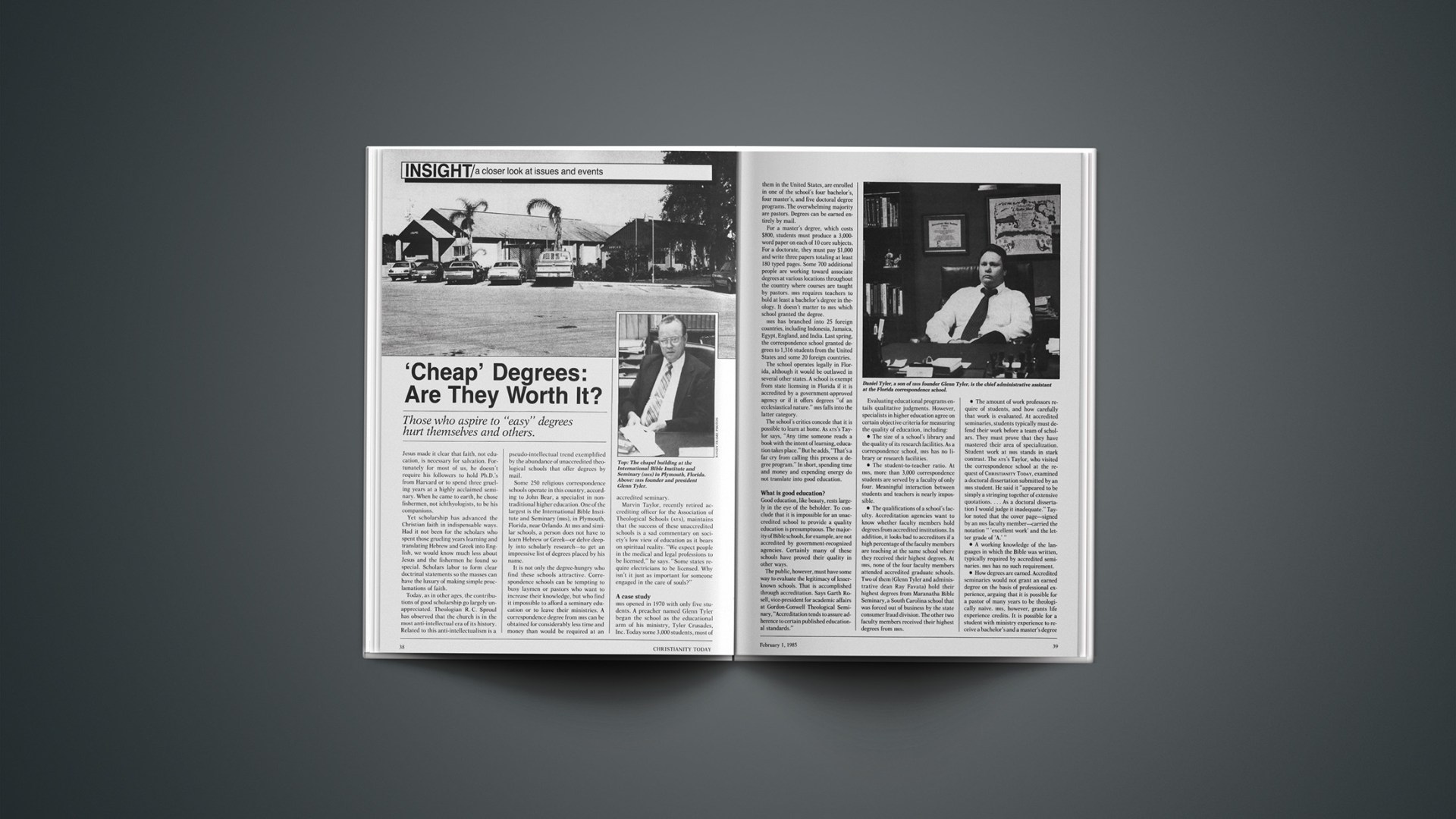
‘Cheap’ Degrees: Are They Worth It?

Those who aspire to “easy” degrees hurt themselves and others.

Those who aspire to “easy” degrees hurt themselves and others.

Jesus made it clear that faith, not education, is necessary for salvation. Fortunately for most of us, he doesn’t require his followers to hold Ph.D.’s from Harvard or to spend three grueling years at a highly acclaimed seminary. When he came to earth, he chose fishermen, not ichthyologists, to be his companions.

Yet scholarship has advanced the Christian faith in indispensable ways. Had it not been for the scholars who spent those grueling years learning and translating Hebrew and Greek into English, we would know much less about Jesus and the fishermen he found so special. Scholars labor to form clear doctrinal statements so the masses can have the luxury of making simple proclamations of faith.

Today, as in other ages, the contributions of good scholarship go largely unappreciated. Theologian R. C. Sproul has observed that the church is in the most anti-intellectual era of its history. Related to this anti-intellectualism is a pseudo-intellectual trend exemplified by the abundance of unaccredited theological schools that offer degrees by mail.

Some 250 religious correspondence schools operate in this country, according to John Bear, a specialist in nontraditional higher education. One of the largest is the International Bible Institute and Seminary (IBIS), in Plymouth, Florida, near Orlando. At IBIS and similar schools, a person does not have to learn Hebrew or Greek—or delve deeply into scholarly research—to get an impressive list of degrees placed by his name.

It is not only the degree-hungry who find these schools attractive. Correspondence schools can be tempting to busy laymen or pastors who want to increase their knowledge, but who find it impossible to afford a seminary education or to leave their ministries. A correspondence degree from IBIS can be obtained for considerably less time and money than would be required at an accredited seminary.

Marvin Taylor, recently retired accrediting officer for the Association of Theological Schools (ATS), maintains that the success of these unaccredited schools is a sad commentary on society’s low view of education as it bears on spiritual reality. “We expect people in the medical and legal professions to be licensed,” he says. “Some states require electricians to be licensed. Why isn’t it just as important for someone engaged in the care of souls?”

A Case Study

IBIS opened in 1970 with only five students. A preacher named Glenn Tyler began the school as the educational arm of his ministry, Tyler Crusades, Inc. Today some 3,000 students, most of them in the United States, are enrolled in one of the school’s four bachelor’s, four master’s, and five doctoral degree programs. The overwhelming majority are pastors. Degrees can be earned entirely by mail.

For a master’s degree, which costs $800, students must produce a 3,000-word paper on each of 10 core subjects. For a doctorate, they must pay $1,000 and write three papers totaling at least 180 typed pages. Some 700 additional people are working toward associate degrees at various locations throughout the country where courses are taught by pastors. IBIS requires teachers to hold at least a bachelor’s degree in theology. It doesn’t matter to IBIS which school granted the degree.

IBIS has branched into 25 foreign countries, including Indonesia, Jamaica, Egypt, England, and India. Last spring, the correspondence school granted degrees to 1,316 students from the United States and some 20 foreign countries.

The school operates legally in Florida, although it would be outlawed in several other states. A school is exempt from state licensing in Florida if it is accredited by a government-approved agency or if it offers degrees “of an ecclesiastical nature.” IBIS falls into the latter category.

The school’s critics concede that it is possible to learn at home. As ATS’s Taylor says, “Any time someone reads a book with the intent of learning, education takes place.” But he adds, “That’s a far cry from calling this process a degree program.” In short, spending time and money and expending energy do not translate into good education.

What Is Good Education?

Good education, like beauty, rests largely in the eye of the beholder. To conclude that it is impossible for an unaccredited school to provide a quality education is presumptuous. The majority of Bible schools, for example, are not accredited by government-recognized agencies. Certainly many of these schools have proved their quality in other ways.

The public, however, must have some way to evaluate the legitimacy of lesser-known schools. That is accomplished through accreditation. Says Garth Rosell, vice-president for academic affairs at Gordon-Conwell Theological Seminary, “Accreditation tends to assure adherence to certain published educational standards.”

Evaluating educational programs entails qualitative judgments. However, specialists in higher education agree on certain objective criteria for measuring the quality of education, including:

• The size of a school’s library and the quality of its research facilities. As a correspondence school, IBIS has no library or research facilities.

• The student-to-teacher ratio. At IBIS, more than 3,000 correspondence students are served by a faculty of only four. Meaningful interaction between students and teachers is nearly impossible.

• The qualifications of a school’s faculty. Accreditation agencies want to know whether faculty members hold degrees from accredited institutions. In addition, it looks bad to accreditors if a high percentage of the faculty members are teaching at the same school where they received their highest degrees. At IBIS, none of the four faculty members attended accredited graduate schools. Two of them (Glenn Tyler and administrative dean Ray Favata) hold their highest degrees from Maranatha Bible Seminary, a South Carolina school that was forced out of business by the state consumer fraud division. The other two faculty members received their highest degrees from IBIS.

• The amount of work professors require of students, and how carefully that work is evaluated. At accredited seminaries, students typically must defend their work before a team of scholars. They must prove that they have mastered their area of specialization. Student work at IBIS stands in stark contrast. The ATS’s Taylor, who visited the correspondence school at the request of CHRISTIANITY TODAY, examined a doctoral dissertation submitted by an IBIS student. He said it “appeared to be simply a stringing together of extensive quotations.… As a doctoral dissertation I would judge it inadequate.” Taylor noted that the cover page—signed by an IBIS faculty member—carried the notation “ ‘excellent work’ and the letter grade of ‘A.’ ”

• A working knowledge of the languages in which the Bible was written, typically required by accredited seminaries. IBIS has no such requirement.

• How degrees are earned. Accredited seminaries would not grant an earned degree on the basis of professional experience, arguing that it is possible for a pastor of many years to be theologically nave. IBIS, however, grants life experience credits. It is possible for a student with ministry experience to receive a bachelor’s and a master’s degree without completing any course work.

Such commonly accepted academic standards mean little to the Tylers or to others at IBIS. They maintain that they are providing quality education, and they say they feel no need to defend their educational credentials. IBIS students report that their ministries have improved, the Tylers say, and that’s all the accreditation they need. “Our programs are enriching ministers’ lives,” said Glenn Tyler. “They’re bringing new life to their ministries. What do I care what accrediting associations want or believe when I know I’m doing what God wants me to do?”

The Meaning Of Accreditation

Prevailing notions about the meaning of church-and-state separation have shielded religious schools from state scrutiny. There is some question, however, about whether IBIS is misleading students and prospective students about its accreditation status. In recent months, Florida’s Board of Independent Colleges and Universities has pressed IBIS either to substantiate or discontinue its claims of accreditation.

For many, the word “accreditation” implies legitimacy. In higher education, however, the significance of accreditation depends on the agency that granted it. IBIS is accredited by the Missouri-based International Accrediting Commission for Schools, Colleges, and Theological Seminaries, an agency the government does not recognize. In some states anyone can establish an accrediting agency. The task of overseeing accrediting agencies belongs to the U.S. Department of Education.

To achieve government-approved accreditation, a school has three options. The first is to meet the standards of one of six regional accrediting associations that grant approval to entire schools. Second, a school can seek recognition from one of about 80 specialized accrediting bodies. Those agencies typically accredit particular programs as opposed to entire schools, (ATS, based in Vandalia, Ohio, is the only generally recognized accrediting agency for theological graduate schools.) The final option is to meet the standards of the Council on Post-Secondary Education (COPA), an independent agency highly regarded by the U.S. Department of Education.

Florida’s Board of Independent Colleges and Universities says IBIS has not made clear in its promotional materials that the school is not accredited by a government-recognized agency. In its brochures, for example, the fact that the school is authorized to operate through a state exemption for religious schools appears under the category “Accreditation.” That implies that Florida’s education department has examined and approved IBIS’s programs, which is not the case.

At one time, IBIS claimed to be accredited by the Accrediting Association of Christian Colleges and Seminaries in Sarasota, Florida, which was not a government-recognized agency. Sandra Knight, assistant director of Florida’s Board of Independent Colleges and Universities, discovered that one of the schools accredited by the agency, Maranatha Bible Seminary in Union, South Carolina, was forced out of business by the consumer fraud division of that state’s attorney general’s office. Knight notified IBIS of the problems she discovered with the Sarasota accrediting agency. Dan Tyler, Glenn Tyler’s son and an administrative assistant at IBIS, later told Knight that his school had dropped all association with the Sarasota accrediting agency.

IBIS is accredited by another agency, the International Accrediting Commission for Schools, Colleges, and Theological Seminaries—operated by a husband-and-wife team in Holden, Missouri. Bear, an expert in nontraditional education, said accreditation from that agency is virtually meaningless.

Florida education authorities are pressing IBIS to state specifically in its promotional material that its accreditation is not recognized by the government. “We have what we believe is enough evidence that people are being misled by [IBIS’s] claims to accreditation,” Knight said, IBIS has said it will comply with the state’s request, but has yet to offer proof.

Philosophical Differences

The Tylers’ concept of Christian education is colored by their world view. When it comes to the distinction between the secular and the religious, Glenn Tyler and the ATS’s Taylor are at a philosophical impasse. Taylor operates with the understanding that the standards by which good education is measured exist independently of religious belief.

In contrast, the Tylers do not subscribe to the view that all truth is God’s truth. They have drawn sharp and impenetrable lines between the religious and the secular, between God’s truth and the world’s truth. “As far as I’m concerned,” says Glenn Tyler, “all education begins with the Bible.”

Those convictions lead IBIS to hold secular accreditors and their motives suspect. They regard any attempt of government-related organizations to regulate education as a violation of the principle of church-and-state separation. Says Glenn Tyler, “We’re not going to allow this heathenistic society to dictate to us. Or liberalism. Or secular humanism. Or any of these things in the world.”

In contrast, the ATS’s Taylor emphasizes that a school need not give up its theological distinctives to be accredited. “Accrediting agencies are neither established nor controlled by the government,” he says. “They are just recognized by the government.”

But to IBIS, government-recognized accreditation is a giant step into the swamp of liberal theology. Dan Tyler observes that “many of the accredited Bible colleges and seminaries no longer hold true to the basic fundamentals of Christianity,” including the Virgin Birth and the infallibility of Scripture. “I’d rather have no accreditation than to join one of the secular accrediting associations,” Glenn Tyler adds.

IBIS’s views about recognized accreditation, however, have not always meshed with its actions. Despite the claims of mistrust, the school has regularly attempted to obtain government-approved accreditation. But most government-recognized accrediting agencies, including ATS, won’t evaluate a school that grants degrees entirely by correspondence.

The only government-recognized agency that will look at correspondence schools is the National Home Study Council, which is recognized by COPA. Recently IBIS sought accreditation by the council. But the council accredits only through the master’s degree level. To be considered, the school would have to drop its doctoral programs.

IBIS maintains that it is unfair to be rejected out of hand simply because the school is nontraditional. Many, including nontraditional education specialist Bear, say that on this count the school has a legitimate complaint. Bear says the insistence on resident education as an absolute principle is unreasonable. He notes that the North Central Accrediting Association may soon appove Union Graduate School in Cincinnati, which offers doctorates almost exclusively by correspondence.

Recently, some highly respected seminaries have made theological education more accessible to those who cannot spend years away from home. Students pursuing a master’s degree at any of the six Southern Baptist seminaries, for example, can complete up to two-thirds of their course work locally if they live near one of seven extension locations. Still, the problem of how to educate people who find it difficult to attend seminary remains largely unaddressed by Christian institutions of higher learning, IBIS attracts students because it has identified a need and has taken steps to meet it.

Sincere, But Misguided?

While it is true that many enter the correspondence school business simply to make a profit, it would be wrong to question the purity of IBIS’s motives. There is little reason to doubt Glenn Tyler’s sincerity when he proclaims, “We’re not bothering anybody, [or] violating any laws. We’re simply propagating the gospel like God told us to do.”

Though few would criticize IBIS for seeking to provide education, the problem comes when the school awards degrees without communicating, objectively and precisely, the value of those degrees. IBIS would have a lot more friends if it did not grant degrees at all.

Exposing schools like IBIS in a case study such as this is likely to have little impact. Many students do not care whether their degrees come from legitimately accredited institutions. IBIS’s credentials are valid to those who subscribe to the Tylers’ view of education and who trust such agencies as the International Accrediting Commission for Schools, Colleges, and Theological Seminaries.

The ATS’s Taylor, however, says it is important to make clear to Christians the difference between accredited and unaccredited education. When that distinction is not made clear, students can waste considerable time and money for a degree they later find is worthless.

Books

The Year of Living Dangerously

The plight of the Third World poor.

“Sometimes it just isn’t bearable to be fully awake.”

Paul Brand, the noted missionary physician to India, observes of Nobel Peace Prize-winner Mother Teresa: “She cannot save all India, so she seeks the least redeemable, the dying.” Brand also recalls the words of Malcolm Muggeridge: that statistically, Mother Teresa does not accomplish much by rescuing a few stragglers from a cesspool of human need. “But then Christianity,” Muggeridge clarifies, “is not a statistical view of life.”

Rumors of this same theme echo throughout the pages of a significant novel, The Year of Living Dangerously. The people of Indonesia remember 1965 as “the year of living dangerously.” So named by Sukarno, the late Indonesian president and deity figure, 1965 brought violence, political upheaval, and continued mass starvation to this equatorially inflamed arc of islands in Southeast Asia. Fifteen years later, Sukarno’s title would attach itself to a novel, and then to a motion picture, each sharply depicting Indonesia’s internal chaos. The novel, especially, goes well beyond its own title, speaking about a Third World plight that, when focused on, makes the senses sting. But for anyone interested in increasing his or her sensitivity to problems in the Third World, The Year of Living Dangerously is invaluable.

Written by Australian journalist and novelist C. J. Koch, the book looks starkly at Third World poverty. Picture the story as a stage play in which all the actors are journalists. Through the eyes of Billy Kwan, a dwarf cameraman, we tour a tunnel of poverty in the hot slums of Jakarta, Java. People bathing in sewage, scrounging for rice and scraps of meat, sleeping in huts the size and shape of cardboard boxes—each is shown through Kwan’s compassionate conciousness. We are moved to consider: What can be done about this mass of starvation?

Introducing troubled Jakarta to a newly assigned foreign reporter one evening, Kwan says: “ ‘This amuses you, doesn’t it? But doesn’t it make you want to do something for them?’

“Hamilton was taken aback. ‘Yes, I suppose it does,’ he said. ‘But what can you do? Give money away? What would that solve? It’s up to Sukarno, don’t you think? He could spread some of the money here, instead of spending it on women and monuments.

“ ‘What then must we do?’ Kwan murmured in a tone of litany.’

“ ‘Pardon?’ Hamilton asked.

“ ‘And the people asked him, saying, “What shall we do then?” ’ Luke, chapter three, verse ten. The people were talking to John the Baptist—the ones he called a generation of vipers. They were asking him how they could flee the wrath to come. And he told them, if a man had two coats, he should give one to a man who had none. ‘What then must we do?’ Tolstoy asked the same question. One cold night he went into the poorest section of Moscow—where the poor were hanging about the doss houses, starving.… So he bought them hot drinks, and then he began to give them money. He gave until he had nothing left, and still they came.…”

The question—What to do?—becomes an obsession with Kwan; it becomes a nasty, vexatious question that is threaded throughout the rest of the book. What then must we do? Political solutions have failed. Sukarno has wasted his country’s wealth by building structures and monuments to himself—ornaments to give Indonesia an apparent facelift, while the inner decay grows steadily worse. He tours the country, gives speeches, and governs without a stab of conscience. Thus, Kwan is moved to suggest, “Political solutions are for those with no hearts, only consciences—and consciences go rotten.”

Casting away any hopes of seeing help come from politics and government, Kwan announces one day that “the Christian point of view” is what must be adopted even to begin to deal with Indonesia’s poverty. “I mean,” he says, “the view that you don’t think about the so-called big issues, or changing the system, but you deal with whatever misery is in front of you—and the little bit of good you do adds its light to the sum of light.”

Thus, a new perspective emerges. As mass evangelism might be defined as many Christians doing one-on-one witnessing and shepherding, so the approach to dealing with mass poverty might take a similar tack. Any alleviation of pain, any increase of light in a world of darkness, will come only through each individual’s conviction to act—even in the face of hopelessness.

With this theme in mind, Kwan attempts to put his Christian beliefs into practice. He travels to the deepest slums of Jakarta, locates a destitute peasant woman and her dying son, and begins to help. He writes: “The task may be hopeless, but we must still attempt it. We must give with love to whomever God has placed in our path. So I give to Ibu. I can’t take her out of the hut—but I will transform it. If money is all I can give, then I’ll give it on the spot, and change her life where she sits: a bed, chairs, medicine for little Udin, clothes.”

Through Kwan’s compassion we see dignity in the woman he helps; and in a transcendent way, we see the dignity of the poor everywhere. “I can’t make her understand that the canal which she and the child bathe in and drink from carries disease.… In another country she would be a decent woman. Here, she begs, and perhaps sells herself. She is a nullity, a vacuum. But with what dignity she holds herself together around that vacuum, as her shabby national dress holds her body. Her tragedy is repeated a million times in this city.”

It is a tragedy to which Kwan eventually succumbs. He is slowly destroyed by frustration over those around him who callously watch Java sink deeper into the stagnant juices of its own despair. Commenting on his studio wall of contrasting photographs—a mosaic of Indonesia’s poverty—to a fellow journalist, he charges, “These pictures tell a story about the people here that you don’t tell in your reports—that no one’s telling. Who really cares about these people?” He continues, “Journalists have a standard set of phrases for dismissing pain … put a label on it and somehow it doesn’t exist anymore—it just becomes a problem.”

To Sukarno, Kwan begs: “Why can you no longer see the danger you are courting? Unless we love God and reverence life, we are bound for extinction.” Even Christians and the church are not excluded from the chastisement: “I don’t think the faith is much good unless it’s passionate. Lately I have a feeling the Church has spent its passion. If it has, it’s no place for me. There’s something fine about Islam, don’t you think? The passion’s still there.”

As might be expected, the book portrays this little man as eventually going out of control. He has truly cared and acted, but he has done so alone. In the narrator’s words, “He had set himself on the sort of path that can isolate a man utterly.”

Yet the heartlessness of those who have remained uncaring—the foreign journalists who stay forever as nothing more than “Peeping Toms on life”—is viewed in a far more revealing light. They are pictured as self-gratifying clowns, living life half-asleep. “Sometimes it just isn’t bearable to be fully awake,” the narrator asserts.

The Year of Living Dangerously is perhaps more a book of questions than one of answers. But the questions seem important: the one, for instance, that asks why communism looks so appealing to struggling Third World nations. Says a troubled Indonesian: “You [the West] are told by your leaders you must be anti-Communist. I understand. But—forgive me for saying this—you people do not care about us, you only pretend to. The Communists do care about us.”

It is the subject of compassion that this book addresses. Perhaps it is compassion, true and in action, that keeps people such as Mother Teresa “fully awake” even amid the suffering that surrounds daily. Henri Nouwen, in his book titled Compassion, suggests that to be compassionate on a one-on-one basis with those who suffer is the one true way to understanding the condition of being human. He adds, “Compassion asks us to go where it hurts, to enter places of pain, to share in brokenness, fear, confusion, and anguish. Compasssion challenges us to cry out with those in misery, to mourn with those who are lonely, to weep with those in tears.”

Theology

Must Ordinary People Know Theology?

The Christian army is the only one that trains just its chaplains and band directors.

The Christian army is the only one that trains just its chaplains and band directors

Few schools of theology have ever taken the laity seriously. Certainly the one I was studying at 20 years ago didn’t. There, one of my senior professors complained that some of his students were not planning to go into the ministry after graduation, and suggested they should be charged a higher rate of tuition. Still another professor objected to the fact that the school had women students (all of whom were laypersons in those days), and refused to acknowledge their presence in his classroom.

And so it went. A few crumbs were allowed to fall from the seminarian’s table for the occasional benefit of the laity—but then only rarely.

Today, the situation is radically different. Nearly every seminary in America offers special courses and degree programs for those not planning to go into the ordained ministry. But generally speaking, these are little more than appendices to programs developed for the clergy. Their focus is seldom on the distinctive needs of the laity; and few schools have developed programs that aim to equip the laity for the ministry. In fact, the majority of laymen and women have not yet had the opportunity of serious theological education.

Although the church generally seems to agree that “the ministry” belongs to the whole people of God and not just a special caste of professional Christian workers, it is apparent we still have a long way to go in the implementation of this essential theological conviction.

Lay Theology: Its Importance

The profound need for a vital theology in the life of today’s church is reflected in the following comment by William Diehl, recently retired from a top management position with Bethlehem Steel and a committed Christian layperson:

“As long as I can remember, my church has been proclaiming that all believers—as a holy priesthood—are called to be ministers; that if the congregation of believers comes together for worship, study, and fellowship, then the laity will go into the world to minister to others with the love and acceptance which God has given them.

“But what has my church been doing to support me in this ministry? Very little.

“In the almost 30 years of my professional career, my church has never once offered to improve those skills which could make me a better minister; nor has it ever bothered to ask if I needed any kind of support in what I was doing. There has never been an inquiry into the types of ethical decisions I must face; or whether I am even seeking to communicate the faith to my co-workers.

“In short, I must conclude that my church really doesn’t have the least interest in whether—or how—I minister in my daily work.”

I am sure Mr. Diehl’s frustration is more the rule than the exception. As someone once said, the Christian army is the one army in the world that trains only its chaplains and band directors. And yet God has called all of his people, the laos of God, to serve as his ministers in the world. It is, therefore, the responsibility of the leadership of the church to equip the laity for ministry

What, for example, does it mean to be a Christian in the Monday through Friday workaday world of Bethlehem Steel? What does it mean to be a business person? A doctor or nurse? A lawyer? An educator? A banker? A journalist? An actor? A homemaker?

What does it mean to be “salt” and “light”? One of the distressing aspects of the “born-again boom” is that it makes so little impact on American society. Crime is up. Marriages are breaking down at an ever-increasing rate. Secularism is growing. Yet, with each passing day, more and more people profess to be born again.

We Christians tend to blame others for the problems of our society. We blame the pornographers, the corrupt politicians, the multinational corporations, the secular humanists, and so on. But if the world in which we live is getting morally darker, maybe we who profess Christ are failing to carry out our divinely mandated roles. Perhaps we are the major source of this deterioration with our inadequate theology, our superficial Christianity, our withdrawal from society, our conforming to the spirit of this age.

Lay Theology: Its Practice

Part of the church’s ambivalence over implementing a lay-oriented theology has been the persistent school of thought suggesting that theology is irrelevant to the life of the church. The argument goes something like this: “Don’t talk to me about theology; talk to me about something practical. I’m interested in action—in what works. I don’t need to know more about God, I need to know God better.”

This commonly held view has an initial appearance of piety until you begin to reflect upon its implications. As C. S. Lewis points out, the assumption that one can be a Christian without theology is both arrogant and dangerous. It may be possible to get to heaven without much theology, just as it may be possible to cross the Pacific Ocean without a map—but in both cases it is a lot more difficult.

A good map represents the experience of others. You are not the first person to sail the Pacific; neither are you the first person to experience Christ. A good map also enables you to travel the safest route, and lets you know there are dangers to be avoided along the way. So it is with good theology.

Today, it is not a question of theology versus experience, but good theology versus bad theology. And if the church is to be healthy, it must have good, biblical theology. Good theology and authentic Christian experience go hand in hand.

A passage like 1 Peter 2:4–12 makes it clear that both priesthood and ministry belong to the whole church, not merely the clergy. All God’s people have a churchly calling; and we are called to worship God. (This is what is meant by the doctrine of “priesthood of all believers.”) And all God’s people have a worldly calling; we are called to serve the world. (This is what is meant by the New Testament doctrines of “ministry” and “vocation.”)

I think we are doing a great job with the churchly aspect of our calling. In contrast to the situation of even a generation ago, lay people are vitally involved in worship. However, the old view that some Christians are “called” to “ministry” or “full-time Christian service” dies hard. And it is here where we still have room for considerable growth.

In my view, if we are to fulfill our mission as God’s people in today’s world, we need to rediscover three important Christian doctrines: the doctrine of Creation (telling us that God has a plan for the world as well as the church); the doctrine of Covenant (opposing the extreme individualism of our society); and the doctrine of Service (giving a positive value to our work).

Lay Theology: Its Study

What, then, does all of this have to say to our theological seminaries? How should lay education shape—perhaps reshape—the structures and curricula of these institutions?

My primary concern here is the theological seminary and not the Bible school or Christian liberal arts college. Different situations regarding the laity exist in each of these academic settings. The Bible school/college movement, for example, began as an educational venture for the laity. It was a natural outgrowth of the calling and ministry of the whole people of God by nineteenth-century evangelicalism, particularly as it was practiced in the United States. Thus, the Bible school movement developed its curriculum around the task of training lay men and women to serve the Lord in such nonprofessional ministries as Sunday school teachers, youth workers, inner-city missioners, and the like. It took a generation or more for these particular institutions to develop into lower-level seminaries.

Perhaps ironically, both Bible colleges and seminaries find themselves in the same position, educationally speaking, today. That is, they orient their curricula primarily toward the training of future clergy, the one percent of God’s people who are able to devote themselves full-time to the work of the ministry and be supported by the rest of the church.

On the other hand, Christian liberal arts colleges have, in my opinion, probably contributed the most to lay leadership in the life of the church. Here, lay men and women are given a broad-based education and, consequently, the ability to see all of life in the context of a vital Christian faith. The “great gulf fixed” between Sunday and Monday is not really so great for graduates of Christian liberal arts colleges.

It is still, however, a sizable chasm in today’s burgeoning seminaries. Evangelical seminaries are booming and are frequently inhabited by lay people not planning to be ordained. But precious little has been changed in the curriculum to accommodate this new clientele.

What, then, should happen here if we really began to take the importance of educating a lay witness seriously? (I am indebted to Mark Gibbs for many of the suggestions that follow, and I recommend his essay, “The Signs that They Take the Laity Seriously: Seminaries and Theological Colleges and the Laity,” Audenshaw Documents 102, May 1982, for further consideration.)

First, a fundamental commitment to a biblical theology of the laity should be included in the seminary’s mission statement; and all fundamental institutional documents, beginning with the course catalog, should be rewritten in light of what we now believe about the ministry of the whole people of God. It should be made clear that not only are lay people welcome to study, but that the seminary is committed to equipping them for the high calling of life and witness in the world. Moreover, it should be made clear from the start that those who are not called to be “professional” Christian workers will not be regarded as second-class citizens.

Second, a biblical theology of the laity should be emphasized from the beginning of any introductory course or orientation program designed to initiate new students into the study of theology. Furthermore, all courses should be reexamined in light of the need to: (1) equip pastors and missionaries to work hand in hand with lay men and women; and (2) equip the laity for service in the world as well as the church.

Third, biblical studies should be taught in a manner that excites people about the Bible itself, and equips them to be teachers of the Word. They should be concerned with what the text means as well as what it meant two or three thousand years ago. Exegesis should focus on texts that have to do with the church’s witness in the world. And the professor of Old or New Testament should not be embarrassed to pause and answer questions about how the teaching of Scripture is applied to life in the world today.

Fourth, a theological seminary committed to the laity should place a strong emphasis on the teaching of Christian ethics. When I was in seminary, there was only one course on ethics listed in the catalog. There was no professor of Christian ethics, nor was there anything approaching a discussion of the crucial ethical issues facing most lay people in their discipleship in the world. There should be several people teaching Christian ethics in all but the smallest of theological seminaries; and courses in Christian professional and social ethics, as well as theological ethics, should be offered.

Today the great issues facing the church are ethical ones. I was in Edmonton recently and had a challenging conversation with a Christian friend of mine who is a doctor. “What,” he asked, “are you doing at Regent College to help people in the health care professions deal with the urgent ethical issues facing them today?” He had been appointed chairman of a committee by the medical society to draw up guidelines concerning children who are born with severe birth defects. What steps, if any, should be taken in the interest of keeping them alive? Where do you draw the line? Or do you? Who makes those decisions? What ethical guidelines do they follow?

Are we training pastors to help lay people deal with these issues? Are we providing adequate training for the laity who are studying in our schools to deal with these pressing concerns—concerns that touch the sciences and technology, politics and government, business, and the arts? We may be avoiding them in our curriculum, but I assure you that the dedicated Christian lay person in the health care professions cannot. Whether or not someone is spiritually or theologically equipped, he or she is making decisions every day that assume certain ethical conclusions. How wonderful it would be if they were doing so on the basis of an adequate Christian foundation.

Fifth, all the disciplines of the theological curriculum should be revised with a view to incorporating insights from the recovery of a more biblical view of the laity. Church history, for example, should become the history of the whole people of God, laity and clergy alike, and not just a history of clerical infighting down through the ages. Christian education should focus on the whole enterprise of Christian education rather than solely on Sunday school and youth ministries. Pastoral theology should be brought into the twentieth century and deal with structures that characterize our contemporary society rather than late-nineteenth-century America. Field education should be broadened to include lay ministries as well as church-related ministries. And lay people should always be dominant in any advisory groups for pastoral interns.

Sixth, courses focusing on the theology and ministry of the laity should be added to the curriculum. These should not just be a generic course or two on “the ministry of the laity” or “the theology of the laity,” but “the history of lay ministry” and courses dealing with the ministry of the laity in the world. What I am concerned about here is preparation for “Monday ministries.”

Seventh, a theological school that is dedicated to the implementation of an authentically biblical theology of the laity should have a significant number of lay people on its faculty. When traditional theological educators think of “lay training,” they think of pop lectures on biblical and theological themes formated something like an adult Sunday school class. The only way for this to change radically is for a growing number of bona fide lay men and women to be added to the faculties of theological schools.

Lay Theology: Its Execution

Theology is too important to be left to the professional theologians. It belongs to the whole church and not just the academically inclined.

An ever-present danger facing professional theologians is that they will regard themselves primarily as members of the “Academy” rather than members of the body of Christ. When this happens, they often isolate themselves from the ongoing life of the church. The result is that while what is said and done may be of interest to fellow academic theologians, it is often of little significance or relevance to the life and witness of fellow lay Christians. At worst, what the isolated academic theologian does is positively harmful to the life of the church!

We need to be reminded that the historic creeds and confessions of the church did not come out of the studies and lecture halls of Christendom, but out of the normal life of the Christian community. Theologians and bishops may have been instrumental in having them committed to writing and adopted by church councils, but they did not create them.

If we are to meet the needs of men and women in the twenty-first century, then it is essential that we enlist a host of Christian lay people from every profession to be involved in the theological task of the church. And this task will, in turn, move forward only to the degree that clergy and laity, professional theologian and lay Christian alike, join hands to reflect together upon what it means to confess Christ in the world.

Theology

Claiming the Molten Moment

The Spirit presents opportunities for growth in character. It is crucial not to miss them .

The Spirit presents opportunities for growth in character. It is crucial not to miss them.

During the troubled years of the Second World War the Italian forces were driven out of Eritrea in North Africa. In an effort to make the harbor unusable to the Allies, the Italians filled great barges with concrete, and then sank them across the entrance to the harbor. When the Allies entered, their problem was to remove the barges to make use of the harbor.

They did this in a very ingenious way. They sealed great empty gas tanks of the sort oil refineries use in storing fuel, and then they floated them in the sea above the sunken barges. When the tide was out, they chained the floating tanks to the barges. When the tide came in, the tanks exerted their tremendous buoyancy to tug the barges free from the bay’s sucking sand. It was then relatively easy to clear the harbor for Allied shipping.

Think of the power in that! The barges were chained to the tanks. The tanks were dependent upon the tides. The tides were pulled by the gravitational attraction of the moon, and the moon was moving in accord with the whole cosmos. The tides exercise tremendous, unimaginable, dynamic power.

Shakespeare emphasizes this in the fourth act of Julius Caesar. Brutus, trying to enlist Cassius in his aid, refers to the power of the tides, and then adds another serious consideration concerning them:

There is a tide in the affairs of men

Which, taken at the flood, leads on to fortune;

Omitted, all the voyage of their life

Is bound in shallows and in miseries.

On such a full sea are we now afloat;

And we must take the current when it serves

Or lose our ventures.

Shakespeare is saying that the tides not only have great power, but that they also cannot be stopped or retrieved. Their lifting strength comes for but a few hours and then is gone. And if we miss the flood, then we will be left in shallows and in miseries, having lost our ventures.

Let us now go to a place that is 35 miles inland. It is a garden called Gethsemane. Jesus has come there on the same night in which he was betrayed, for prayer. Judas has already gone to betray him. Jesus leaves eight of the disciples at the gate of the garden, and three (those closest to him: Peter, James, and John) join him in a kind of inner glade. And Jesus urges them to pray with him.

Then he goes apart, throws himself out flat upon the earth, and prays that the cup of a whole world’s sin might not be forced upon him. He is in a tremendous agony of spirit. All the hideous hurt of the world’s history is flowing through the single channel of his great heart. Having so prayed, he goes back to the disciples for some word of encouragement, and finds them asleep. “Could you not watch,” he asks, “even for an hour? Watch and pray, lest you yourselves enter into temptation; your spirit is willing but your flesh is weak.”

And again he goes apart to pray. This time, the Scriptures say, his prayer was so intense that his sweat came as it were like great drops of blood falling in a kind of crystalline rosary at his feet. And once again he goes back to the disciples, seeking some word of support, but once again he finds them asleep. This time he permits them to remain asleep (that’s a very significant detail in the story), and goes back to pray alone.

A few minutes later he sees torches flickering through the branches of the olive trees. The soldiers of the high priest have come. He goes back to his disciples and says, “Arise. My betrayer is at hand.” He is led off to the house of Caiaphas, the high priest, and the disciples are left hiding among Gethsemane’s bushes. They are left in the shallows and they are left in miseries, because they have missed the tide.

Growth In Character

First, they missed the tide of opportunity to grow in character.

Not long ago a young man asked me why so little thought is given to character today. Probably there are several factors: one concerns the dominance of behavioral psychology—which says that character is nothing more than the influence of our environment. Then, too, moral relativism has settled across the land like some thick, stinking fog so that there are no absolutes recognized as being right or wrong. And those who are psuedo-sophisticated laugh at the very notion of character. So it should not surprise us that there is so little serious talk of character, let alone focus on its growth.

But we all need to grow in character, and we need also to recognize that such growth cannot occur at every moment and under every circumstance. There are tides in the development of character. Catch them and growth is yours; miss them and you are left in shallows and in miseries.

My first pastorate was in McKeesport, Pennsylvania, a city famous at that time for the world’s largest steel tube-rolling mills. They created a seamless tube that was unparalleled. Often I stood in the command module of one of those great machines (called a pulpit, incidentally) with the machine operator. I would see a great serpent of molten metal come slithering down into the machine, where it would be chopped off. Then the machine would grasp it by its ends and begin to spin it; by centrifugal force that bar of molten metal would open from the inside out, forming a perfect tube of steel, without seam or blemish.

“What is the most important ingredient in the process?” I occasionally asked those directing the machines. The answer was always the same: “It’s the temperature of the metal. If it is too hot, it will fly apart. If it is too cold, it will not open as it ought. Unless you catch the molten moment, you cannot make the perfect tube.”

Just so. Unless we catch those molten moments when character can develop, we miss our opportunity. The disciples missed such an opportunity in Gethsemane. They could have seen how Jesus handled suffering and hurt. They had the chance to see him face ugliness straight on—not run away from it, or attempt to deny it, but to confront it and so to defeat it. In observing him they could have learned about courage, and patience, and hope, and endurance, and pity, and mercy, and fortitude. But they slept, and so missed the tide.

I do not know what would constitute a molten moment for you. It might be your own suffering, or the death of someone you very much love. Perhaps it is some inner urge you cannot explain—the voice of conscience. Maybe it is the example of someone you admire; a bit of Scripture; a piece of lace you find, which once belonged to your mother; a letter from an old friend; the words of a sermon. It is whatever suddenly causes within you some desire to expand your character beyond what you have known before. Claim that moment. Don’t sleep through it.

Growth As Children Of God

The disciples in Gethsemane also missed the opportunity to grow as the children of God. Any one of us can strike a match. Any one of us can light a candle. Any one of us can ignite a bonfire. But no one of us and no group of us, and not all of us together, can at will command the flaming power of the Holy Spirit of God. Jesus says that the Holy Spirit comes and goes like the wind, utterly outside any direction or control from us. And there in Gethsemane, that night, the Holy Spirit was moving. His hot breath filled that place. And the disciples slept through it. Notice that while Jesus wakened the disciples the first time, he did not waken them the second time. In Matthew 26:44 we are told that, finding them sleeping again, he went away. In other words, one cannot depend on the Holy Spirit of God to interrupt in such dramatic fashion each and every time. If we turn away from the kindling power of the Spirit, we may never know that power again.

Think of this in terms of that great space shot when, a few years ago, we sent a sophisticated space vehicle out to take pictures of the planet Jupiter. For more than two years it moved toward its objective. Then came a time of closest approximation. In those moments the cameras on board the vehicle took and sent back to us remarkable pictures of Jupiter. Afterward, having completed its task, the vehicle continued on out into space, and it continues so until this very minute. Never again will it come close to Jupiter.

Just so there are times when we come very close to God, and the hot breath of his Holy Spirit is all about us. And in that time of closest approximation, let us claim what it is to be a child of God, for if we miss that moment, it may never come for us again.

David Brainerd, the great missionary to the American Indians, was on one occasion witnessing to a chief who was very close to deciding for Christ. But he held back. Brainerd got up, took a stick, drew a circle in the soft earth around the chief, and said, “Decide before you cross that line.”

Why this urgency? Because Brainerd recognized that at that moment that chief was close to God. If he missed that moment he might never be so close again.

Every Sunday I witness in a church whose congregation is 217 years old. We are now worshiping in our fourth building, which is 85 years old: white marble floors, gray granite stone, Tiffany windows all about, every inch of woodwork mahogany—architecture rooted in craftsmanship. That sanctuary has heard a thousand million prayers. If somehow the great beams that span the life of that building could chorus together, they might well speak of countless people who sat there not far from the kingdom, because the Spirit of God was moving. But many did not claim that molten moment. They missed the tide, and they have never been so close again.

It is said that Satan once called together the emissaries of hell, and told them he wanted to send one to earth to aid women and men in the ruination of their souls. He asked who would volunteer. One creature came forward and said, “I will go.”

And Satan said, “If I send you, what will you tell the children of men?”

He said, “I will tell the children of men that there is no heaven.”

And Satan said, “They will not believe you, for there is a bit of heaven in every human heart. And in the end, everyone knows that right and good must have the victory. You may not go.”

Then another came forward, darker and more foul than the first. And Satan said, “If I send you, what will you tell the children of men?”

And he said, “I will tell them that there is no hell.”

And Satan looked at him and said, “Oh, no; they will not believe you. For in every human heart is a conscience—an inner voice that testifies that not only will good be triumphant, but that evil will be defeated. You may not go.”

Then one last creature came forward, this one from the darkest place of all. And Satan said to him, “And if I send you, what will you say to women and men to aid them in the destruction of their souls?”

And he said, “I will tell them that there is no hurry.”

And Satan said, “Go!”

That spirit is still abroad on the face of the earth. “There is a tide in the affairs of men which, taken at the flood, leads on to fortune.” Missed, and we are left “in shallows and in miseries.” The spirit is willing but the flesh is weak. Awake, because the tides may be running for you at this very moment. Don’t miss riding those tides.

Growth In Serving Jesus

Those disciples in Gethsemane also missed the opportunity to grow in friendship with Jesus. It is wonderful to have friends, especially in time of trouble. When we are battered by the hammer of hardship, we need our loved ones close. That’s the reason Jesus (who is most often recorded in the Scriptures as going off to pray alone) on this occasion took his disciples with him. He knew the deep agony of spirit that was going to be his, and he wanted their comfort close; he wanted to feel their shoulders beside his own. But they slept.

When he came back the first time from his prayer, his robe was dirty. He had thrown himself out upon the ground. But there was no one there to brush him off or to give him words of love. When he came back the second time, his sweat was like great drops of blood, but there was no one awake to wipe away that perspiration or to give him a word of encouragement. To all his other burdens was added the burden of loneliness.

It is a tragic irony that this Christ who was filled with compassion—this one who looked upon the multitudes and saw them as sheep without a shepherd, this one who took the separated and united them, who healed the sick, who uplifted the broken, who gave himself in the service of others—in the moment when he needed service, found none. Those disciples never had such an opportunity again.

Don’t miss the tide that gives you the opportunity to serve the Jesus in others. On this same date next year, some whom we know will no longer be with us. They will have either gone from this earth or moved far beyond our reach. Perhaps there is on your mind right now someone to whom you ought to speak: a word of encouragement, a word of reproof, a word of witness, a word of apology. Don’t miss the opportunity when it is yours. Don’t forsake the tide that might be flowing in your heart of hearts at this very moment. Claim this day, for in very truth, there will never be another like it again.

Two summers ago I received a telephone call from my physician, who also happened to be the physician of my most beloved seminary professor. He called to tell me that my old prof, who had been retired many years (he was then in his eighty-fourth year), had been taken to the hospital, and that he would not be coming home. I asked the doctor, “Is Prof’s death imminent? Will it be today?”

“Oh,” he said, “I doubt it. But it won’t be too long, and he won’t be coming home.”

I had a commitment for that night, one I had scheduled almost two years in advance. But I broke it to go to the hospital. When I walked into the room, I found another of Prof’s former students whom I knew well sitting beside him. As I came to the door Prof looked at me and said, “Thielemann, you’ve come to help me die.”

I said, “No, Prof, I’m sure you can do that by yourself.” We began to talk and to share; he decided he wanted to confess his sins. He said things like, “I taught you boys too much theology. I should have taught you more about Jesus. I’m taking my final examinations and find I wouldn’t even be able to write my name on the paper if it weren’t for my Savior.” And he talked about his love for his wife.

There was little of his body left, and yet that great spirit was still sparkling. At last he said, “Boys, I think I’m going to go to sleep now. And I don’t think you should wait because it may be a very, very long sleep.” And as he said that, he reached out and took the nurse’s hand. And I said to him, “Prof, I don’t think you ought to hold that nurse’s hand.”

He said, “Why?”

I said, “Because, if you are going to go now, I have a feeling you are going to go like Elijah in a fiery chariot and I don’t want her to be singed.”

He said, “If I’m going to go that way, then I’m going to take her with me.” And he fell asleep holding her hand, and the tides came and took him away. But I was there. And no one will ever be able to take that from me. I was there.

We have been considering a message that addresses the human soul. We have looked at growth in character, growth as a child of God, and growth in the service of Jesus.

Please don’t respond by thinking about tomorrow. “Tomorrow” is the word the Bible does not know. The Holy Spirit’s word is today. “Now is the accepted time.” “Now is the day of salvation.” “Today, if you will harden not your hearts and hear my voice.” Don’t say tomorrow!

Tomorrow, and tomorrow, and tomorrow,

Creeps in this petty pace from day to day,

To the last syllable of recorded time;

And all our yesterdays have lighted fools

The way to dusty death.

(—Macbeth, Act V)

The word is today. Serve in the name and the spirit of Christ today. Ride the tides while they are yours.

Theology

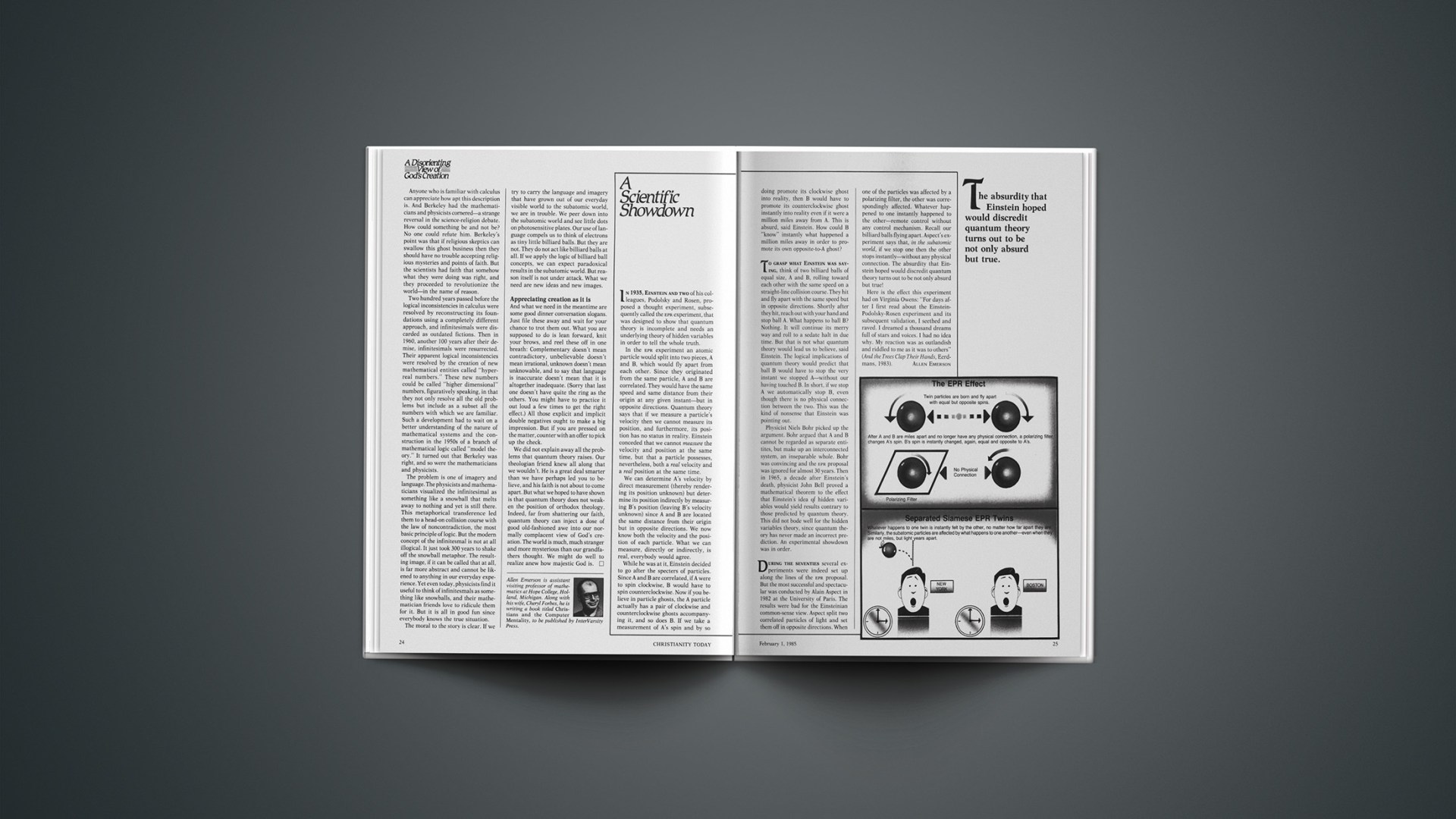
A Conversation with Carl Henry about the New Physics

CHRISTIANITY TODAY Washington Correspondent Beth Spring visited Carl F. H. Henry’s home to discuss the theological implications of the new physics. The following is an edited transcript of Dr. Henry’s remarks.

Human experience is always incomplete and never exhaustive. So, using only the observational [scientific] method, one can never arrive at any significant verdict about God and the good—that is, about the supernatural—since the method is by definition limited to what is empirically perceptible, and God is spirit. “The good” and values are not empirically identifiable.

Instead of approaching the question by asking whether theology depends on an ordered universe, we ought to invert that and say an ordered universe depends upon God. Only if we begin with God can we derive an ordered universe. The Bible doesn’t set out from the argument of an ordered universe, but it sets out from God to Creation and an ordered universe.

If you begin with an ordered universe, the God of the Bible is not uniformly related to the universe. He is related to it in routine ways (that is, its regularities) and in special ways (in other words, the miraculous). Any dependence solely upon the identifiable order of the universe to establish the nature of God would tend to view the miraculous with suspicion and emphasize only the continuities.

One big problem that quantum theory has left us with is the question whether any universe exists objectively to the knower. No one has actually seen subatomic particles. All the subatomic particles are inferred from hydrogen bubbles that scientists can see. But the subatomic particles that physicists postulate today have no more basis in direct empirical observation than do the Homeric gods in ancient Greek civilizations.

Quantum theory may be seen as being based on a very tenuous kind of belief system. As a society, we are shackled to contemporary gurus of science who occupy our moment of history. Yet they speak neither with divine authority nor with unrevisable accuracy.

The question whether a universe truly exists independently of the observer is fueled by the flux of scientific opinion, because scientists keep telling you what the system of nature is supposed to be like, then revising it, and nature simply can’t be all those ways.

All this considered, I don’t see anything in quantum theory that really throws down an ultimatum to biblical theism. As a matter of fact, quantum theory has been correlated with a variety of world views and a variety of opinions on the unresolved questions. This is confirmed by many scholars. Stephen Toulmin, an internationally known philosopher of science, has written that, “Scientifically there is never sufficient reason for choosing one worldview rather than another.… We are … at liberty to view the cosmic-process-as-a-whole in whatever light we please.” And philosopher Dallas Willard writes, “The current state of the physical sciences, in opposition to the crudely mechanical view which was dominant for several centuries past, is very congenial to the view of God’s presence in the world that we find in the New Testament.”

The evangelical ought not to live in fear of any of these scientific theories. If the science of a particular age comes down on the side of absolute, mechanical determinism or, in another period, absolute indeterminacy, the evangelical should greet any such absolute claims with a polite smile. Scientists themselves emphasize that when you’re dealing with the minute subatomic particles, you are faced by Heisenberg’s Indeterminacy Principle; that is, that we can know either position or momentum, but not both at the same time. But when you deal with large aggregates of scientific data, that dilemma isn’t present. The larger aggregates, over a period of time, tend to be orderly. So they are capable of assimilation to some regularity.

The Bible affirms that nature has a divinely given and perpetuated reality, independent of man. We dimly know its inner secrets, and only what is grounded in revelation is unrevisable. God is not boxed into nature, but is related to it in both repetitive and special ways. He is not uniformly related to nature, but neither is his relationship to nature erratic. He does not play roulette with the cosmos. Neither a mechanically deterministic nor an indeterministic scientific view undermines Christian theism. What it undermines is scientific humility.

A Scientific Showdown

In 1935, Einstein and two of his colleagues, Podolsky and Rosen, proposed a thought experiment, subsequently called the EPR experiment, that was designed to show that quantum theory is incomplete and needs an underlying theory of hidden variables in order to tell the whole truth.

In the EPR experiment an atomic particle would split into two pieces, A and B, which would fly apart from each other. Since they originated from the same particle, A and B are correlated. They would have the same speed and same distance from their origin at any given instant—but in opposite directions. Quantum theory says that if we measure a particle’s velocity then we cannot measure its position, and furthermore, its position has no status in reality. Einstein conceded that we cannot measure the velocity and position at the same time, but that a particle possesses, nevertheless, both a real velocity and a real position at the same time.

We can determine A’s velocity by direct measurement (thereby rendering its position unknown) but determine its position indirectly by measuring B’s position (leaving B’s velocity unknown) since A and B are located the same distance from their origin but in opposite directions. We now know both the velocity and the position of each particle. What we can measure, directly or indirectly, is real, everybody would agree.

While he was at it, Einstein decided to go after the specters of particles. Since A and B are correlated, if A were to spin clockwise, B would have to spin counterclockwise. Now if you believe in particle ghosts, the A particle actually has a pair of clockwise and counterclockwise ghosts accompanying it, and so does B. If we take a measurement of A’s spin and by so doing promote its clockwise ghost into reality, then B would have to promote its counterclockwise ghost instantly into reality even if it were a million miles away from A. This is absurd, said Einstein. How could B “know” instantly what happened a million miles away in order to promote its own opposite-to-A ghost?

To grasp what Einstein was saying, think of two billiard balls of equal size, A and B, rolling toward each other with the same speed on a straight-line collision course. They hit and fly apart with the same speed but in opposite directions. Shortly after they hit, reach out with your hand and stop ball A. What happens to ball B? Nothing. It will continue its merry way and roll to a sedate halt in due time. But that is not what quantum theory would lead us to believe, said Einstein. The logical implications of quantum theory would predict that ball B would have to stop the very instant we stopped A—without our having touched B. In short, if we stop A we automatically stop B, even though there is no physical connection between the two. This was the kind of nonsense that Einstein was pointing out.

Physicist Niels Bohr picked up the argument. Bohr argued that A and B cannot be regarded as separate entitites, but make up an interconnected system, an inseparable whole. Bohr was convincing and the EPR proposal was ignored for almost 30 years. Then in 1965, a decade after Einstein’s death, physicist John Bell proved a mathematical theorem to the effect that Einstein’s idea of hidden variables would yield results contrary to those predicted by quantum theory. This did not bode well for the hidden variables theory, since quantum theory has never made an incorrect prediction. An experimental showdown was in order

During the seventies several experiments were indeed set up along the lines of the EPR proposal. But the most successful and spectacular was conducted by Alain Aspect in 1982 at the University of Paris. The results were bad for the Einsteinian common-sense view. Aspect split two correlated particles of light and set them off in opposite directions. When one of the particles was affected by a polarizing filter, the other was correspondingly affected. Whatever happened to one instantly happened to the other—remote control without any control mechanism. Recall our billiard balls flying apart. Aspect’s experiment says that, in the subatomic world, if we stop one then the other stops instantly—without any physical connection. The absurdity that Einstein hoped would discredit quantum theory turns out to be not only absurd but true!

Here is the effect this experiment had on Virginia Owens: “For days after I first read about the Einstein-Podolsky-Rosen experiment and its subsequent validation, I seethed and raved. I dreamed a thousand dreams full of stars and voices. I had no idea why. My reaction was as outlandish and riddled to me as it was to others” (And the Trees Clap Their Hands, Eerdmans, 1983).

Apple PodcastsDown ArrowDown ArrowDown Arrowarrow_left_altLeft ArrowLeft ArrowRight ArrowRight ArrowRight Arrowarrow_up_altUp ArrowUp ArrowAvailable at Amazoncaret-downCloseCloseEmailEmailExpandExpandExternalExternalFacebookfacebook-squareGiftGiftGooglegoogleGoogle KeephamburgerInstagraminstagram-squareLinkLinklinkedin-squareListenListenListenChristianity TodayCT Creative Studio Logologo_orgMegaphoneMenuMenupausePinterestPlayPlayPocketPodcastRSSRSSSaveSaveSaveSearchSearchsearchSpotifyStitcherTelegramTable of ContentsTable of Contentstwitter-squareWhatsAppXYouTubeYouTube