

Pastors

LEADERSHIP BIBLIOGRAPHY

These resources help church leaders understand the roles and expectations that accompany their positions. (* identifies resources not listed in Books in Print.)

Bailey, Robert W. Coping with Stress in the Minister’s Home. Nashville: Broadman, 1979.* Identifies stresses produced by the pastoral role/image.

Baxter, Richard. The Reformed Pastor. London: Banner of Truth, 1974. Puritan classic on pastoral roles.

Brister, C. W., James L. Cooper, and J. David Fite. Beginning Your Ministry. Nashville: Abingdon, 1981. The expectations, adjustments, and tensions involved in starting out.

Campbell, David. If I’m in Charge Here, Why Is Everybody Laughing? Niles, Ill.: Argus, 1980. Good instruction on negotiation for pastors who feel responsible for church leadership yet powerless to execute authority.

Campolo, Anthony. The Success Fantasy. Wheaton, Ill.: Victor, 1980. Understanding the self-inflicted expectations to be successful by our culture’s definition.

Dayton, Edward R., and Ted W. Engstrom. Strategy for Living. Glendale, Calif.: Regal, 1976. How to define personal goals before they’re defined by others’ expectations.

Dittes, James E. When the People Say No. San Francisco: Harper & Row, 1979. How to respond to disappointment and frustration in the ministry without losing self-esteem.

Foster, Richard J. Celebration of Discipline. San Francisco: Harper & Row, 1978. A guide to the spiritual disciplines that helps the reader understand the expectations of God.

Getz, Gene. The Measure of a Church. Glendale: Regal, 1975. Defines the pastor’s role according to biblical measures of success for the church.

Glen, J. Stanley. Justification by Success. Atlanta: Knox, 1979.* The effects of business and politics on the way churches define success.

Grider, Edgar M. Can I Make It One More Year? Atlanta: Knox, 1980. Conflicts that drive ministers to change churches or leave the ministry.

Hummel, Charles E. Tyranny of the Urgent. Downers Grove, Ill.: InterVarsity, 1967. Defines priorities by what’s important, not urgent.

Kemper, Robert G. Beginning a New Pastorate. Nashville: Abingdon, 1978. Helpful in determining the expectations of a congregation during the interviewing process.

Kittlaus, Paul, and Speed B. Leas. Church Fights. Philadelphia: Westminster, 1973. The role of the pastor amid conflict and opposition.

Larson, Bruce. The One and Only You. Waco, Tex.: Word, 1976. Learning to be at peace with the person God made you to be.

LeFevre, Perry D., ed. Conflict in a Voluntary Association. Chicago: Exploration, 1975. Useful in resolving problems resulting from ill-defined roles or unrealistic demands.

Lewis, Douglass. Resolving Church Conflicts. San Francisco: Harper & Row, 1981. A case study approach that can help when church leaders clash over goals or expectations of the pastor.

MacDonald, Gail. High Call, High Privilege. Wheaton: Tyndale: 1981. Helps pastors’ wives stay spiritually healthy in their key role.

Minirth, Frank. The Workaholic and His Family. Grand Rapids, Mich.: Baker, 1981. The healing process for those with unrealistic expectations.

Navone, John. A Theology of Failure. New York: Paulist, 1974.* Offers the reality of Christ for the person in the midst of personal or church failure.

Oswald, Roy. The Pastor as Newcomer. Washington, D.C.: The Alban Institute, 1977.* Helpful for new pastors sorting out where they fit.

Paul, Cecil R. Passages of a Pastor. Grand Rapids: Zondervan, 1981. The changes in a pastor’s life.

Ragsdale, Ray W. The Mid-Life Crisis of a Minister. Waco: Word, 1978. Deals with a pastor’s self-concept in the middle years.

Raines, Robert. Success Is a Moving Target. Waco: Word, 1975.* Why no one can live up to the expectations of success.

Rand, William J., Jr. The Probationers Handbook. Burlingame, Calif.: Burlingame, 1981.* Good reading for discerning congregational expectations as you interview.

Schaller, Lyle E. Survival Tactics in the Parish. Nashville: Abingdon, 1977. Handling unreasonable demands.

Seamands, David. Healing for Damaged Emotions. Wheaton: Victor, 1981. Especially helpful for pastors’ families who need personal healing.

Senter, Ruth. So You’re the Pastor’s Wife. Grand Rapids: Zondervan, 1979. Deals with issues such as failure, guilt, resentment, and the expectations put on the pastor’s wife.

Sinclair, Donna. The Pastor’s Wife Today. Nashville: Abingdon, 1981. One of the few books that speaks to two-career clergy marriages.

Stott, John R. W. The Preacher’s Portrait. Grand Rapids: Eerdmans, 1961. The biblical expectations of the pastoral leader as steward, herald, witness, father, and servant.

Taylor, Alice. How to Be a Minister’s Wife and Love It. Grand Rapids: Zondervan, 1968. Life in the goldfish bowl-from the inside out.

Tournier, Paul. The Strong and the Weak. Philadelphia: Westminster, 1976. Useful for perception into leadership styles and insight into our responses to tensions.

Copyright © 1984 by the author or Christianity Today/Leadership Journal. Click here for reprint information on Leadership Journal.

Pastors

The Best Advice I’ve Received

The man who led me to Christ in 1936 became my pastor, and at a time when nobody talked about discipleship, he discipled me through two years of college and three of seminary.

Once when discussing the pastor’s administrative responsibility, he gave me this counsel: “Use ideas like seeds, not bullets.”

When you have a good idea, plant it in the hearts of a few people and be patient as it grows there. Later, at some official meeting, one of those people will likely present that idea as though it were his own, which puts you in the enviable position of supporting a great idea with all your influence without it seeming a personal crusade.

The only price you pay: someone else gets credit for your good idea.

-Richard C. Halverson

Chaplain, United States Senate

Washington, D.C.

My preaching professor, Gwyn Walters, was reviewing a video taped sermon I’d preached to the class. I’d worked hard on the manuscript, and the tape clearly showed my dependence on it.

Carefully commending my preparation, he then suggested I might view preaching like a sailboat moving across the waters rather than a train moving on steel rails. Each is moving toward a given destination, but the sailor, having plotted his course, must constantly read the wind and respond to it.

While I think of that advice every week in the journey of a sermon from desk to pulpit to congregation, its application has become even wider. To listen quietly, study diligently, plan carefully-depending on the Holy Spirit at each step-is to know the adventure (and risk!) of moving with the Sovereign Wind. This dynamic helps me understand ministry day by day.

-Harry J. Heintz

First Presbyterian Church of Brunswick

Troy, New York

While at Cincinnati Bible Seminary, I held the weekend pastorate of a small rural church where, in 110 years, attendance rarely flexed beyond thirty.

I was determined to help the congregation increase. Seeing only the obstacles, however, the elders rejected my plans for growth. Sensing my disappointment, the oldest elder, at eighty-nine still the youngest at heart, told me quietly, “It’s hard to teach old dogs new tricks. If I were you, I’d try to get new dogs.”

The Holy Spirit had spoken through this man. It proved valuable advice. With the influx of new members, the vision of the old members began to change. This weekend ministry blossomed into the first full-time pastorate in the church’s history.

-Dan Bernard

Brazos Valley Christian Church

Bryan, Texas

Upon graduating from college, I had to choose between medical school or seminary. After I had agonized, prayed, made lists, observed physicians, taken interest tests, and heard a potpourri of advice, one of the professors at the Mennonite Brethren Biblical Seminary in Fresno said simply, “Just get as close to Christ as you can; then do whatever you feel like doing.”

That advice empowered me to choose seminary over med school and has freed my decision making many times since.

-Lynn Jost

Hesston Mennonite Brethren Church

Hesston, Kansas

I’m indebted to the late Henry E. Russell of Second Presbyterian Church in Memphis for an early insight into the nature of pastoral ministry. At the time I was a graduating seminarian and very concerned that I have a clear description of the job being offered me in youth ministry at Second Church.

After writing Dr. Russell a couple times about the job description, I remember getting a call from him. “Jack,” he said, “I’ve got a tiger by the tail here. I’ll be glad for you to come and help me by grabbing hold wherever you’d like!”

-Jack C. Oates III

Clairmont Presbyterian Church

Decatur, Georgia

Copyright © 1984 by the author or Christianity Today/Leadership Journal. Click here for reprint information on Leadership Journal.
Motives

Motives

Congregations often rewrite for the wrong reason. Commonly it is “to prevent another problem like the last one we had”—long-absent members who created a row at a business meeting, or a board chairman thought to have too much influence. Sometimes expectations are unrealistic. People hope the new constitution will specifically answer every future question: What procedures are to be followed if the pastor resigns? May the youth group schedule an activity away from church during the evening service? No document can be so inclusive.

The right reasons could include establishing biblical principles, removing unnecessary red tape, clarifying doctrinal positions.

Common Errors

Assuming good reasons, there are several common errors to be avoided.

1. No stated authority. Church constitutions frequently contain much detail about the selection, size, and duties of various boards and committees, but none are given authority. Though the deacons may be assumed to form the governing board, the constitution may not say so. Often the pastor is viewed as the decision maker, but the constitution allows him no authority.

2. Pastor’s leadership role restricted. Some churches intentionally confine the pastor’s leadership to “spiritual issues.” “Real” matters involving property, finance, and other business decisions do not involve him. Realistically, however, since most pastors are involved in these matters, why exclude them from the official decision-making process?

3. Confusion of law and procedures. Many constitutions contain unnecessary, even cumbersome, detail. Mere administrative procedures need not become a part of the constitution. Let your governing board change and implement procedures as necessary.

For example, many constitutions call for quarterly business meetings on a particular date, such as the “first Friday of April, July, and October.” This could result in meetings on Good Friday and July Fourth weekend. Simply to change those dates would be to violate the constitution—and some people might be ready to contest decisions in those meetings as illegal.

4. Overstructuring. Many constitutions require several committees, each with a specific number of members. A church may search high and low for bodies to fill those positions. Then a special committee may be formed to reach a specific goal. To staff it may prove impossible, or it may overload members. A constitution should be flexible enough to allow the church to structure committees to meet certain specific goals.

5. Inadequate doctrinal statement. Many statements are inadequate or even misleading because they omit discussion of doctrine the church regards as essential. For example, the gifts of tongues and healing may be regarded as no longer operative; hence, a charismatic would not be allowed to teach Sunday school. A doctrinal statement in such a church is inadequate if it omits any discussion of the issue.

6. Too much importance. Frequently most of a church’s key leaders are assigned to work on the constitution—and it becomes a “tar baby”: people get stuck to it and can’t escape, and attention to other ministry-oriented tasks is set aside. After months or years, the committee presents the document to the church, which then examines it line-by-line, word-by-word. It is better to assign a few well-qualified people to prepare the constitution and have their work reviewed and modified by a larger group. When the document is brought for congregational approval it involves only items of concern to the whole.

The Important Questions

If you are planning to rewrite your constitution, ask yourself these questions:

1. What is our motive in this project? Clarification may help you uncover and solve more urgent problems first.

2. What is our goal? State exactly what you hope to achieve. Knowing where you want to go before you start will make the journey easier.

3. What do we intend to communicate in our doctrinal statement? You cannot include everything you believe, so know why you include or omit something.

4. What must be included? Ask yourself after every sentence if it is really necessary to involve the whole congregation in it. If your constitution turns out to be very short, you have probably done an excellent job.

5. What are the lines of authority and accountability? Who do we want to be responsible for the various areas of ministry? If you answered “the pastor” each time, you should rethink this.

6. Can you diagram the church government? If not, your constitution is either too complex or too vague. When you actually undertake to diagram, you can easily see the “problem areas.”

An excellent constitution is important for every church to have. It is an important tool that will allow a church opportunity to reach its goals. It is not an end in itself.

MICHAEL C. JASKILKA

Mr. Jaskilka is pastor of First Baptist Church in Tigard, Oregon.

Are You Rewriting Your Church Constitution? Watch Out!

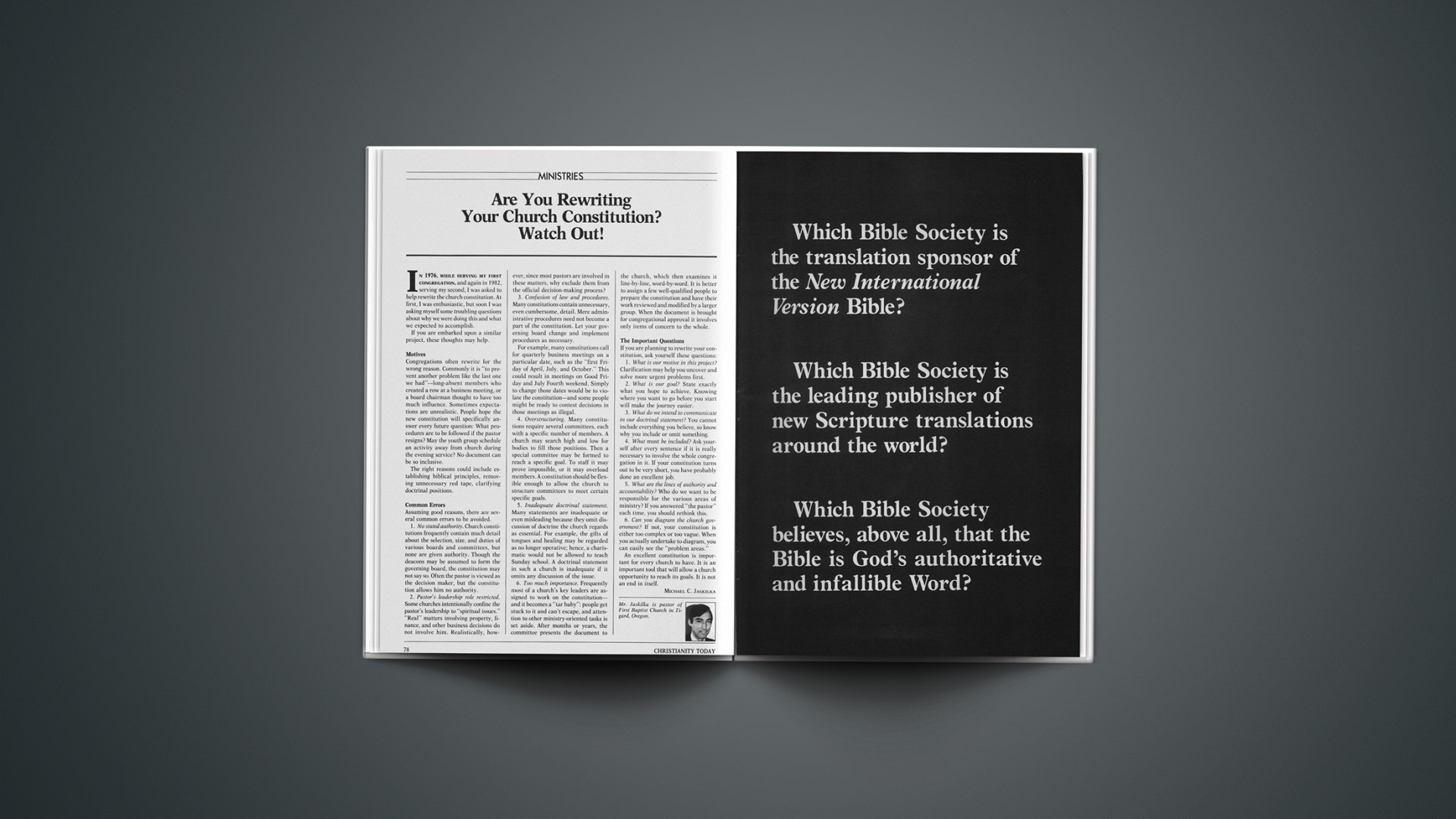
In 1976, while serving my first congregation, and again in 1982, serving my second, I was asked to help rewrite the church constitution. At first, I was enthusiastic, but soon I was asking myself some troubling questions about why we were doing this and what we expected to accomplish.

If you are embarked upon a similar project, these thoughts may help.

Speaking out: Frankly, I Don’t Care How Many Are in Your Sunday School

Last evening, my wife and I invited a minister friend and his family to our parsonage after the church activities of the day. First off, he asked me, “How did church go today?”

Without giving me time to talk, he told me about his church. He listed the number of persons in both of his services and how much money came in his offering plates.

Similarly, in my first pastorate back in 1964, a clergy friend of mine would phone me each Monday morning. First off, he would inquire: “How many did you have in Sunday school yesterday?”

The number was no sooner out of my mouth when I was told how many he had. So it went, week after week. Now, almost 20 years later, it is still going on.

What I would like to tell these poll takers is that they are asking me the wrong questions. Finally, when the dust of planet Earth will have settled and souls will have departed, who will care how many we had in Sunday school and how many bucks were deposited in the plate?

This kind of criterion has been communicated likewise to the laity, yet revamped a bit to suit their own purposes and interests. For instance, when new people come into my church, they ask these questions: “What programs do you have for my teens? What activities are there for my little children? Do you have a choir? When does it meet?” After these new parishioners get somewhat established their questions are a bit more subtle: “How can I get elected to the top board?” I actually had one woman ask a veteran of the congregation, “How does the pastor operate?” When the veteran answered, “He doesn’t operate, he pastors,” she responded with, “Come on, now. You can finally figure out every minister as to how he operates.”

So there they are—the yardsticks of the church:

• How many were in Sunday school?

• How many showed up for worship?

• How much money came in?

• How many buses do you have running?

• How many are on your staff?

• What programs do you have for my kids?

• How can I get elected to the power elite?

• How can I get in on the “operation”?

But what a wearisome yardstick. There is definitely a self-centeredness about it. And it smacks too much of the business syndrome of success. Further, I do not have an easy feeling about it in that it does not seem to have biblical support. Instead, it appears to be more “wood, hay, and stubble” than “gold, silver, and precious stones.”

One of these days, I just know it has to happen—someone is going to approach me with these questions:

• How much unity is there in your church?

• Is there real love there?

• Do your people have an excitement about the Bible?

• Do your parishioners know how to pray?

• How solid are the Christian families in your congregation?

• How much time do the fathers of your church spend with their children?

• Does your church allow much time for people to be away from the church building in order to build their homes?

• Are new people coming to know Christ personally?

• Have the households of your congregation given up the notion that the church program should babysit their offspring?

Well, if that miracle does not take place soon, I just may plant a zinger the next time one of my colleagues starts in with, “How many did you have in Sunday school yesterday?” That is, playing deaf to the question, I may ask, “How strong are the marriages in your congregation?”

Who knows, it may actually open up a whole new kind of evening.

Interestingly enough—and logically enough—that could also go for our annual reports to the congregation, the district and general levels of the denomination. Instead of reporting the number of heads and dollars for one year, what if each cleric gave an honest accounting of the oneness, caring, and strength of his congregation? It would not be as easy to feed into the computer, but it just might have more value in the sight of God.

J. Grant Swank, Jr., is minister of the Church of the Nazarene, Walpole, Massachusetts. He is the author of four books and more than 200 magazine articles.

A Fiery Baptist Evangelist Adopts Some New Doctrines

James Robison is embracing charismatics—to the chagrin of many fellow Southern Baptists.

Southern Baptist evangelist James Robison has some new friends, including highly visible charismatics Pat Robertson, Jim Bakker, Oral Roberts, and Kenneth Copeland. Robison, who says he was released from demonic oppression two years ago, is shedding his reputation as a fundamentalist.

Evangelists within his denomination are distressed with his new theology. They contend that he has erred in his biblical interpretations on divine healing and warfare with demons. They also say he has become too critical of denominations and local churches. His influence on the Southern Baptist Convention (SBC) was the subject of a 4-page article in the Baptist Standard, the journal of Southern Baptists in Texas.

A Fort Worth crusade evangelist and television preacher, Robison is no newcomer to controversy. He was at the forefront of the “Religious Right” movement that helped elect Ronald Reagan in 1980. During Robison’s fundamentalist days, he was known for his fiery denunciations of homosexuality, women’s liberation, evolution, and secular humanism.

The emphasis of his message has changed. Robison now talks about demons, supernatural healing, and “doing the works of Jesus.” Such changes led evangelist Freddie Gage to leave Robison’s ministry earlier this year. Gage charges that Robison is now part of a “cult.”

“All these men said I was God’s prophet until I say something that they don’t agree with,” Robison says. “Then I’m not a prophet—I’m a cultist.”

The charge of cultism stems from Robison’s association with Milton Green, a former Tennessee carpet cleaner turned Bible teacher. Robison credits Green for facilitating his deliverance from demonic oppression. In an Alabama motel room, Green asked to pray for Robison. The evangelist says Green rebuked several evil spirits. Two days later, Robison says, he was free from “a clawlike feeling that had often blocked my thoughts.”

Robison and Green have since conducted seminars in Texas and in several southeastern states. For three days, from 8 A.M. to 6 P.M., they review a multitude of Scripture verses, many related to divine healing and spiritual warfare. There has been no emphasis on the baptism of the Holy Spirit or on speaking in tongues. Robison says he believes tongues is a valid spiritual gift, but adds, “I don’t have that gift.”

The seminars have become sore spots for a number of Southern Baptist leaders, including SBC president Jimmy Draper. Draper is pastor of the First Baptist Church of Euless, where Robison is a member.

Draper says Robison and Green engage in too much allegorizing of Scripture. He mentions as an example their belief that demons attacking the church today are symbolized in the Old Testament by Babylonians and any nations attacking Israel from the north. With such an approach to Scripture, he says, “a person can make it mean anything he wants it to.”

Draper and others also criticize the teaching by Robison and Green that demons are the cause of most diseases and other human problems. Manley Beasley, a revivalist who addressed Robison’s annual Bible conference in previous years, has asked a lawyer to document the death of a sugar diabetes patient who went without medication after Green proclaimed healing in Oklahoma City.

“I believe it [the seminar controversy] has set back revival among Southern Baptists by 20 years,” Beasley says. “The revival movement has lost its credibility” because Robison and Green have espoused “truth out of balance, which is error.”

Robison says his ministry is not intended to hurt any denomination, but to promote Christian unity. “If Baptists won’t receive the fullness of God’s work—or any group won’t receive it—then their structures are going to collapse.”

Many Southern Baptist pastors—including W. A. Criswell of Dallas’s First Baptist Church and Bailey Smith, immediate past president of the SBC—have canceled Robison’s speaking engagements in their churches. They are concerned about such frequent statements by Robison as, “The church has lived in darkness for centuries,” and “One of the darkest places you’ll find on this earth has got a steeple on top of it.”

His new allies are supportive of his change in direction. “He is totally committed to bringing the body of Christ together, according to the prayer that Jesus prayed,” says Jim Bakker, host of the “PTL Club.” “I have a hard time believing that true Christians could criticize a man for preaching the love of God.”

Robison has apologized to Bakker, Oral Roberts, and other charismatic leaders for the animosity he once showed toward them. His gestures opened up new opportunities, including speaking engagements at Oral Roberts University. Ben Kinchlow, cohost of the “700 Club,” a telecast Robison once vowed never to visit, interviewed him on the show in December.

The evangelist says his new direction has not reduced his ministry’s finances. He reports a continuing budget of $1 million a month, much of it spent for producing and airing his half-hour weekly telecast on 110 stations and on the CBN and PTL networks. He also broadcasts a daily hour-long show in six markets.

ART TOALSTONin Fort Worth

Humanism Suffers From A Lack Of Young Leadership

Astronomer Carl Sagan is the only person most Americans can identify as a humanist celebrity. His name and face are familiar as a result of his 1980 “Cosmos” television series.

That poses a problem for organized humanism. Apart from Sagan, the movement’s leaders are known by only a handful of people. Sagan accepted the Humanist of the Year award from the American Humanist Association in 1981, but he is reluctant to accept the role of spokesman for organized humanism.

If anyone wears the mantle of “Mr. Humanist,” it is Paul Kurtz, professor of philosophy at the State University of New York at Buffalo. Last year he announced the establishment of the Academy of Humanism to call attention to living humanists. Thirty laureates were honored for devotion to free inquiry, commitment to a scientific outlook and the use of reason toward nature, and upholding humanistic ethical values.

Kurtz was asked recently who would be the top candidates for a contemporary “humanist hero.” He mentioned Sidney Hook, 81, professor emeritus of philosophy at New York University and part of the five-member secretariat of the Academy of Humanism. Asked to narrow the list to younger persons, Kurtz named several already tapped as academy laureates—author Isaac Asimov, 64; sociobiologist Edward 0. Wilson, 54, of Harvard University; Sagan, 45; and two scientists born in the 1940s, paleontologist Stephen Jay Gould and anthropologist Donald Johanson.

In April, the American Humanist Association honored Asimov as Humanist of the Year and gave Gould the 1984 Humanist Distinguished Service Award. Johanson was presented the latter award last year.

Maxine Negri, a retired psychologist from Los Angeles, acknowledges the need for younger humanist spokespersons. National vice-president of the American Humanist Association, she says scientist Linus Pauling would be a “humanist hero,” adding, “I’d like to see some younger ones, too.”

Kurtz says the lack of “charismatic leadership” is only one reason organized humanism is failing as a mass movement. In addition, he says, it lacks “an inspiring message of sufficient clarity and drama to command public attention.” He adds that the strategy of trying to become another religious organization rather than a broad-based educational movement has hurt humanism.

A small step in the educational direction was taken when the Humanist Institute was opened in New York to train leaders. The institute was formed last August by the North American Comittee for Humanism. However, at an organizational meeting, Kurtz declared that the movement had “collapsed and does not exist in North America.”

RELIGIOUS NEWS SERVICE

Personalia

Tyndale House Publishers, Inc., has named Mark D. Taylor as president and chief executive officer. Taylor will take over responsibilities from his father, Kenneth N. Taylor, author of The Living Bible paraphrase and founder of Tyndale House. The younger Taylor has been with Tyndale since 1973. His father plans to promote the work of Living Bibles International, which has produced translations of The Living Bible in more than 100 languages.

William S. Barker, president of Covenant Seminary in Saint Louis, has been named editor and publisher of the Presbyterian Journal, an independent weekly published in Asheville, North Carolina. Barker succeeds the late G. Aiken Taylor, who resigned last year.

W. Ward Gasque has been elected president of the Canadian Evangelical Theological Society. Gasque, 44, is professor of New Testament at Regent College in Vancouver, British Columbia. Baptist theologian Clark Pinnock will serve as vice-president.

Jonathan Petersen, a graduate of Moody Bible Institute, has joined United Press International (UPI) Radio in Washington, D.C., as religion news editor, UPI is competing with Forest Boyd, whose International Media Service reaches Christian radio stations through the Moody Broadcasting Satellite System, UPI formerly distributed Boyd’s newscasts, but he cancelled his contract when UPI insisted on exclusive distribution rights.

Former Reagan administration appointee Carl Horn lost his bid for election to the U.S. House of Representatives in a Republican primary in North Carolina. Horn has served as legal counsel to Wheaton (Ill.) College and the Christian Legal Society. He formerly worked in the civil rights division of the U.S. Justice Department.

James W. Clark, executive vice-president of the Southern Baptist Sunday School Board, has been elected president of the Protestant Church-Owned Publishers Association. The organization represents some 30 denominationally owned publishing houses. It provides training opportunities and encourages cooperative ventures among publishers.

World Scene: June 15, 1984

British teenagers are deserting the nation’s churches. A survey indicates that 71 percent of Britain’s teenagers who attended church at age 14 had left by the time they reached the age of 20. Half of those interviewed condoned sex outside marriage, and 40 percent supported homosexuality. Conducted by the British Council of Churches, the survey involved 90 congregations in England, Wales, and Scotland.

Baptist leaders in Nicaragua again are calling for Baptists worldwide to help change U.S. foreign policy in that country. In a letter condemning U.S. support for rebels fighting the Sandinista government, Baptist Convention of Nicaragua leaders write that “it is urgent that we make an all-out effort … to stop the plans for war and destruction against us.” Meanwhile, a former Sandinista claims the government is trying to destroy churches. In Nicaragua: Christians Under Fire, Humberto Belli states that the Sandinistas are dedicated to Marxist principles, including the elimination of religion.

Twenty-nine Christians in Nepal face from one to six years in prison for their evangelistic activities, according to the religious freedom group Christian Response International. Under Nepal’s law, people cannot leave the religion into which they were born. Christians can be jailed if they are caught trying to convert a member of the Hindu majority. A number of U.S. congressmen are mediating on behalf of the jailed Nepalese Christians.

Reports of tiny gatherings of Christians meeting in house churches are filtering out of North Korea. Not a single church building stands in the Communist country, but according to some estimates there are 1,000 house churches. The North Korean government tolerates minimal expressions of Christian faith, but will not permit the building of churches.

A top-level Church of Scotland study group cannot agree on whether God can be legitimately addressed as “Mother.” The group was appointed in response to intense reactions, pro and con, to a prayer offered at the annual meeting of the Women’s Guild of the Church. The prayer began: “Dear Mother God …” The panel so far has said it recognizes motherly elements in the fatherhood of God and that the Christian God is not a male.

The first Bible school in Austria is due to open this fall under the sponsorship of Gospel Missionary Union. A growing number of Austria’s youth are looking for church and mission vocations.

The United States last year was the world’s top exporter of arms to developing countries, according to a study conducted by the nonpartisan Congressional Research Service. The monetary value of arms agreements between industrial and nonindustrial nations fell last year. However, the U.S. share rose from 32 to 39 percent of the total.

Deaths

Glenn W. Barker, 63, provost of Fuller Theological Seminary, an ordained Conservative Baptist minister, theologian, teacher, and scholar who made major contributions to numerous works, including The Expositor’s Bible Commentary; May 1, in Pasadena, California, of a heart attack he suffered during a tennis match.

Ramsey Pollard, 81, former president of the Southern Baptist Convention, pastor of Broadway Baptist Church in Knoxville, Tennessee (1939–60) and Bellevue Baptist in Memphis (1960–72); April 20, in Memphis, of natural causes.

Will questions of creedalism and the ordination of women divide the 14-million-member body?

Once confined to the Old South, the 14-million-member Southern Baptist Convention (SBC) now stretches from Key West to Nome. With its numerical growth and its entrance into regions outside the South, the SBC has been faced with diversity not known in earlier years.

This month 36,302 Southern Baptist congregations will send messengers (delegates) to Kansas City for the denomination’s annual convention. For the first time in recent years, the issue of women’s ordination threatens to become a major issue at the meeting.

SBC president Jimmy Draper, a conservative, says it is not essential that Southern Baptists agree on the ordination question. Yet he concedes that the issue “has the potential of splitting the convention.” Reba Sloan-Cobb, a leader among SBC women activists, agrees. “This is more volatile simply because the churches that ordain women can be easily identified,” she says.

In previous years, resolutions skirted the problem out of respect to the autonomy of the ordaining body, the local church. However, fierce debate ensued at last year’s convention when Joyce Rogers, wife of inerrantist leader Adrian Rogers, sought to amend a resolution on women. Her proposal stated that the resolution “should not be interpreted as endorsing the ordination of women.” The amendment was defeated by a narrow margin.

Debate hit high decibels last fall when a local Southern Baptist association in Oklahoma voted against seating messengers from Oklahoma City’s First Baptist Church after it ordained three women as deacons. The California Redwood Empire Baptist Association took the same action against three churches that had ordained women. Montana’s Yellowstone Association passed a resolution criticizing the Southern Baptist Home Mission Board for hiring an ordained woman.

However, the Chicago Metropolitan Baptist Association refused to disfellowship the 25-member Cornell Baptist Church for calling a woman pastor. Subsequently, an attempt to disenfranchise the church at the state level was beaten back by a vote of 509 to 189. Resolutions concerning the ordination of women as ministers were debated last fall in five other state Baptist conventions.

Says Sloan-Cobb: “The only way we can survive is to tolerate different views. I can tolerate Jimmy Draper’s ideas if he will allow me to have the same privilege.”

“We would let the issue lie, if the feminists would,” Draper says.

The ordination question is only one of the controversial issues that promises to surface in Kansas City. A suggestion by Draper earlier this year that Southern Baptists establish guidelines for belief is already a hotly debated subject in the denomination.

His suggested doctrinal guidelines—called a “creed” by critics—is partially a product of the conservative-moderate confrontation in the SBC. Biblical inerrantists have dominated the denomination on the national level for the past five years. They maintain that lax direction in the past permitted some institutions and leaders at the state and national levels to stray into liberalism. Since coming to power, conservatives have been calling for a restoration of theological balance in denominational institutions.

Draper, in a book titled Authority: The Critical Issue for Southern Baptists (Revell), suggested doctrinal “parameters” to which all Southern Baptist leaders and faculty members at SBC colleges and seminaries should agree. He asserts in his book that faculties at some of the denomination’s schools “grant only token acknowledgment to conservative views.”

Glenn Hinson, professor of church history at Wake Forest University, opposes Draper’s proposal. He likens the push for doctrinal agreement to a “corporation mentality” in which denominational employees cannot interpret Scripture for themselves, because “they ought to think like the corporation.”

With charges of creedalism being leveled against Draper, and with activists pushing for the ordination of women, this month’s meeting might present a difficult test for America’s largest non-Catholic denomination.

An Evangelical Thinker Who Left His Mark

Francis A. Schaeffer IV: 1912–1984.

Francis August Schaeffer, 72-year-old author and Christian apologist, died May 15 after a lengthy battle against lymphatic cancer. He was known for founding L’Abri (French for “shelter”), his Swiss mission to youth and intellectuals, and for authoring 25 books.

“I’m simply an old-fashioned evangelist,” Schaeffer often said. He tried to proclaim that Christianity is true, that God is there, and that God can be rationally known. As a result, he said, the church can give “honest answers to honest questions.”

Brought up in a nominally Lutheran working-class family in Philadelphia, Schaeffer embraced Christianity in high school after a short flirtation with agnosticism. A few years later two contacts at the Germantown First Presbyterian Church helped set his intellectual course. They encouraged him to drop out of an engineering major at the Drexel Institute and enroll in Hampden-Sydney College, a Presbyterian liberal arts school. Weekends and holidays he carried on a courtship with his future wife, Edith, back in his home church.

Later, two events marked Schaeffer’s formative years as a student at the fledgling Westminster Theological Seminary. The first was the expulsion of J. Gresham Machen from what was then the Presbyterian Church, U.S.A. Schaeffer saw the 1936 defrocking of Machen by liberal forces in the mainline church as a paradigm of the intellectual conflict, first of Christianity and liberalism, then of the entire culture.

Machen and others formed what later became the Orthodox Presbyterian Church. A split in the newly formed separatist Presbyterian body provided the second formative event in Schaeffer’s early life. Machen loyalists soon found differences among themselves, chiefly over eschatology, Christian liberty, and denominational sectarianism. Though Schaeffer was still a student, he sided with the element that became Faith Theological Seminary and the Bible Presbyterian Church. The key leaders were James O. Buswell, Jr., Carl McIntire, and Harold Laird.

Schaeffer’s early pastorates in Pennsylvania and Missouri gave little hint of the future mission Schaeffer would have among educated people. He and Edith more commonly developed a ministry with blue-collar workers and children. Children for Christ, their outreach program, followed them to each church and became the basis for their move to postwar Europe as missionaries with the Independent Board for Presbyterian Missions.

Based in Switzerland, the Schaeffers in time found themselves ministering to travelers, neighbors, and students. At the same time, Schaeffer was continuing to pursue his love for philosophy and apologetics through a friendship with Amsterdam art historian Hans Rookmaaker. By the mid-1950s it was clear that the Schaeffers’ work was evolving toward a ministry of apologetics and evangelism. They sought to demonstrate how all their needs would be met by looking to God alone and not to a mission or denomination. However, conflicts and disillusionment with American Christians were taking their toll. In the early fifties, Schaeffer went through a spiritual crisis that affected his intellectual commitments as well. Alone in a barn in Switzerland, he wrestled with the great questions that would mark his subsequent ministry.

A serious breach was developing between Schaeffer and the most vocal figure in his American denomination, Carl McIntire. In 1956 the majority of the Bible Presbyterian group removed McIntire from power and founded Covenant College and Seminary as an alternative to the McIntire-controlled Shelton College and Faith Seminary. Though in later years he would rarely speak of this era, Schaeffer was a principal figure in the anti-McIntire element that would become first the Evangelical Presbyterian Church, then the Reformed Presbyterian Church, Evangelical Synod (now part of the Presbyterian Church in America).

By 1961 the Schaeffers’ evangelistic efforts had become widely known, attracting an article in Time magazine; but their ministry had no mass audience. It would first take tapes, then books, then films to make Francis Schaeffer a household name among lay Christians in the English-speaking world.

Using a transcribed series of chapel lectures delivered at Wheaton (Ill.) College in 1965, the London publisher Hodder and Stoughton brought out The God Who Is There: Speaking Historic Christianity into the Twentieth Century. InterVarsity Press published the American edition plus Escape from Reason, Schaeffer’s explanation of Western culture’s transition from orthodox Christianity to the despair of secularism. Though he did not originate the term, Schaeffer’s popular usage of the phrase “secular humanism” in his books of the 1970s introduced the concept to the Christian public.

Two films helped move Schaeffer’s analysis into the thinking of ordinary church people. How Should We Then Live? (1977) documented the decline of culture in the absence of a Christian world view. Whatever Happened to the Human Race? (1979) exposed the cheapening of human life that followed the loss of the Christian view of man.

In the seventies, some faculty members at evangelical colleges were becoming critical of Schaeffer. His earlier world-affirming message was gratefully acknowledged, but he was sometimes regarded as a dilettante who pronounced outside his competence. The specialists felt he had invaded their turf, and they resented the “guru” role Schaeffer filled for many of their students.

In contrast, he enjoyed unusual credibility among most American evangelicals and many fundamentalists. This is partly traced to his strong stand for biblical inerrancy and against accommodation to the world spirit on the part of the church.

Learning of his cancer in 1978, Schaeffer moved to the United States where he increasingly focused on abortion and religious freedom issues. Because his son, Franky Schaeffer, expounded a conservative political ideology, the public began to identify both father and son with the New Christian Right. But Francis Schaeffer denied there was any shift in his outlook and agenda or any politicizing of his ministry.

Schaeffer died at home in Rochester, Minnesota. He is survived by his wife, the former Edith Rachel Seville; a son, Francis August “Franky” Schaeffer V; three daughters, Susan Macaulay, Debby Middelmann, and Priscilla Sandri; and 14 grandchildren.

A Friend Of Many Years Remembers Francis Schaeffer

Vernon C. Grounds, president emeritus of Denver Theological Seminary (Conservative Baptist), and Francis Schaeffer met in the midst of theological studies. Here are reflections of a friend of 50 years.

When I heard that Francis Schaeffer had died, I recalled what Edwin Markham wrote about the death of Abraham Lincoln: his passing from the human scene was like the falling of a great tree, which in its falling left a lonesome place against the sky.

Sadness swept over me. Yet, absent from the body, Fran was present with the Lord. Death, I reflected, was indeed great gain for him, since he had valiantly fought a long battle with cancer; but his death was a great loss for worldwide evangelicalism.

Memories flooded my mind. I thought back to 1937 when I first met Fran at Faith Theological Seminary in Wilmington, Delaware. Like myself, he was one of the students attending that “new school of the prophets,” as its founding fathers liked to call it. Arthur Glasser, John and Douglas Young, Kenneth Kantzer, Joseph Bayly, and John Sanderson were Fran’s fellow students, all of whom in the ongoing of the years were to become evangelical leaders. I remembered Fran’s visits to Denver, especially his lectures in the 1950s to our seminary. I also vividly remembered the Sunday in the 1960s that my wife and I spent at L’Abri in reunion with the Schaeffers. I remembered that he and I once had managed to engineer a long, almost leisurely conversation at the Los Angeles airport.

I remembered, further, highlights of our infrequent correspondence, in particular his typically detailed and carefully thought out explanation in response to a question I had raised about his interpretation of Sören Kierkegaard. So, with mingled nostalgia and gratitude, I remembered in kaleidoscopic sequence a host of things. And then I remembered John Bunyan’s triumphant sentence as Pilgrim crossed the river and reached the golden shore: “All the trumpets sounded for him on the other side.”

God granted to Francis and to Edith Schaeffer—his more-than-gifted colaborer—a phenomenal ministry. In 1948, they left Saint Louis (where Fran had been a successful pastor) to undertake evangelism among children in Europe. Eventually they settled in an obscure Swiss village, apparently destined to have a relatively limited impact geographically and spiritually. But God, whose sovereignty Fran and Edith emphasized, made that little village a center of planetary influence for his glory.

L’Abri began almost accidentally (details are in Edith’s autobiographical book, The Tapestry). One weekend in 1955, Schaeffer answered questions put to him by some houseguests of his daughter Priscilla. These guests told their friends how much he had helped them, and before long people were coming to L’Abri with their problems. At first only a few journeyed to Huémoz. But with astonishing speed the news spread by letter and word of mouth: there is an out-of-this-world place high in the Swiss Alps where anybody disillusioned and skeptical and questioning can find welcome and illumination. More and more people came as the months passed. And through the years, thousands came to L’Abri—turned-off evangelicals, searching intellectuals, cynical hippies, neurotics, alcoholics, human beings of many ethnic and cultural backgrounds.

Besieged by people, and under unceasing pressure, the Schaeffers were forced to live in remarkable simplicity. For example, Fran’s study and office was their little bedroom, overflowing with his books. There he read, wrote, corresponded globally, counseled, received guests (even the United States ambassador to Switzerland!), and served tea. L’Abri developed into an extraordinary community with a semi-transient, heterogeneous clientele who worked and studied together, incessantly in dialogue about personal quandaries and ultimate issues. It was a community of prayer, where any sudden crisis or pressing need brought the whole family together for intercession. It was a community of worship where Schaeffer preached on Sunday mornings—an experience that created an unforgettable awareness of God. It was a community where divine reality and sufficiency permeated life.

In the earlier years of L’Abri, Fran took the keenest interest in each student and guest, tirelessly making himself available to offer counsel and insight. And Edith infused L’Abri with a spirit of Christian hospitality, transforming simple meals into occasions of grace.

At L’Abri, residents learned by tapes, lectures, readings, and discussions that there is a Christian world view, one that appreciatively embraces all of human creativity and gives a coherent interpretation of nature and history. It is a world view that supplies spiritual dynamic and moral direction to those who have become uncertain in this age of uncertainty. Little wonder, therefore, that hundreds of thankful guests left L’Abri committed or recommitted to the Christian faith.

Schaeffer’s books were transcripts of the wide-ranging lectures he gave at L’Abri and elsewhere. The first of these, The God Who Is There (1968), embodied a series of talks he had given at Wheaton (Ill.) College. From then on his output was prolific; he became one of the most widely read and influential authors of modern times. His discussions of apologetics, ethics, theology, philosophy, art, politics, music, and literature, as well as explicitly scriptural themes, were all designed to show something about biblical faith: It, and it alone, has an integrated world view providing the absolutes of revelation that can authenticate us and fulfill us in our post-Reformation world.

The books were rough-hewn lecture and sermon transcripts with no pretense of being polished academic productions. So they will no doubt prove somewhat ephemeral despite their immense popularity and their recent edition in the imposing format of Complete Works. But I suspect Fran would cheerfully point out that he had engaged in the task of pre-evangelism and “served God in his own generation,” as David did (Acts 13:36).

He aroused tremendous interest and focused attention on such issues as abortion, which he considered not only a tragic evil, but also perhaps the prime symptom of society’s moral decay and need for spiritual renewal. Thus viewed simply as a popular communicator of Christianity, Schaeffer had few equals.

It is difficult for a contemporary to pronounce definitive judgment on the achievement of his peers. Time performs a winnowing process in which once-towering heroes sink into oblivion, and those who were little applauded while living gain in stature and significance. My own surmise, however, is that, while many current evangelical luminaries will fade into obscure references in church history, Francis Schaeffer will be recognized as a key figure in twentieth-century evangelicalism.

Of John the Baptist our Lord said, “He was a burning and a shining light.” That can justly be said about Francis Schaeffer. I say it in sincere tribute to a passionately Christocentric friend and brother, a man of conviction, compassion, and courage, undeviatingly one-directional in God’s service.

VERNON C. GROUNDS

Billy Graham’S England Crusade Gets Off To A Strong Start

Billy Graham’s 11-week preaching tour of six British cities got off to a strong start last month in the Southwest port city of Bristol. Crowds packed the city’s soccer stadium during each of the eight meetings. Aggregate attendance, including those who came more than once, totaled nearly a quarter of a million. The Graham crusade is part of a three-year evangelization campaign known as Mission England.

The turnout in Bristol was far higher than British and American organizers had expected. Media interest in Graham and his message also was strong and generally respectful. News reports were an important means of spreading word about the event since British law prevents the selling of radio and television time for religious commercials and programs.

Unusually large numbers in Bristol responded to Graham’s nightly invitations to accept Christ or to recommit themselves to God. On the next-to-the-last night of the meetings, for example, some 3,900 people—nearly 11 percent of the crowd of 36,500—streamed onto the playing field at the close of the message. That percentage is significantly higher than is normal for a Graham crusade in the United States. In all, 20,400 responded to the evangelist’s invitations in Bristol.

A week before the Bristol meetings began, Graham underwent surgery in London to relieve acute sinus congestion. He said the operation improved his health remarkably. A week later in the United States, Graham’s wife, Ruth, also underwent surgery to correct an esophageal problem that had been causing a persistent cough. She plans to join her husband in England before his preaching tour ends in July.

Black Muslims, Christians Unite Behind Economic Development

An April meeting of black religionists in New Orleans signaled a newfound alliance between Christians and Muslims. Those attending the National Assembly of Black Church Organizations were more concerned with economic development than ecclesiastical or theological issues.

The coalition included T. J. Jemison, president of the National Baptist Convention U.S.A., Inc., and Louis Farrakhan, leader of the Chicago-based Nation of Islam. Assembly participants dismissed differences of doctrine as irrelevant. At the same time, they called black denominations and black caucuses within predominantly white church bodies to a unity based on common political and economic interests. Some 25 churches and church organizations were represented.

The assembly took no decisive action. However, it appeared that the coalition of businessmen, Christian clergy, and Muslim leaders could lead to future cooperative ventures.

Speakers hammered home the message that black churches—by combining their financial and voting strength—could exert a formidable influence in public life and attain a measure of self-sufficiency.

The meeting included a speech by Democratic presidential hopeful Jesse Jackson. Jemison, cochairman of the assembly, earlier had endorsed Jackson’s candidacy. Though Jackson’s appearance was important to those who attended the three-day meeting, church leaders said the economic agenda was primary.

New Jersey businessman James E. Hurt, Jr., proposed the assembly, and persuaded black denominations to support it. He promised that an economic plan would be unveiled, but by the end of the meeting the plan remained sketchy.

The most ambitious element of the scheme was a national black church bank designed to keep within the black community the money black congregations collect in offerings. It was estimated that the 50,000 black churches in the United States collect and deposit in banks $10 million every week. The economic proposal also called for the creation of an insurance company, a credit union, and an investment group, and the marketing of such products as jewelry, choir robes, caskets, and cosmetics.

The only business proposal that appeared close to fruition was one of Hurt’s own ventures, a book titled Who’s Who Among American Black Churches. The directory would include biographies and pictures of pastors and would sell for $49.95. Hurt said churches that sell the book will receive a percentage of the profits. He plans to publish a companion volume next year, called Who’s Who Among Elected and Appointed Lay Persons.

Assembly planners had projected an attendance of up to 60,000 for the evening meetings, but Jemison and Farrakhan drew fewer than 2,000. Only Jackson pushed the attendance above 5,000. Daytime meetings on economic, political, and educational development, for which registrants paid a $75 fee, drew no more than 200.

RELIGIOUS NEWS SERVICE

North American Scene

Sun Myung Moon, founder of the Unification Church, may soon begin an 18-month prison term for income tax fraud. Moon was convicted by a federal court in 1982. The U.S. Supreme Court last month declined without comment to review the case. Moon’s lawyers say they will present new evidence to the lower court in an effort to overturn the conviction.

The Pennsylvania Superior Court has ruled that homosexual marriages are not legal. In a unanimous decision, the three-judge court dismissed an appeal by a man who had filed a divorce action against another man. The court ruled that Pennsylvania law does not specify that marriage is limited to two people of the opposite sex, but that the “inference that marriage is so limited is strong.”

A federal judge has declared unconstitutional an Illinois law requiring that parents be notified 24 hours before a minor obtains an abortion. The state’s lawmakers had passed the measure over Gov. James Thompson’s veto. U.S. District Judge Hubert L. Will said the law “impermissibly burdens a woman’s abortion choice.” Sponsors of the law in the Illinois Senate say they will appeal the ruling.

An organization of black United Church of Christ ministers has endorsed the presidential campaign of Jesse Jackson. However, some of the members of Ministers for Racial and Social Justice oppose the endorsement on grounds it oversteps the boundaries between church and state. Replying to dissenters, Charles Cobb, executive director of the church’s Commission for Racial Justice, said there is a contradiction between “not believing in politics” and caring for “the well-being of your fold.”

George Gallup’s latest religious poll shows evidence of a self-centered faith among Americans. Gallup discussed the survey in an interview for “The 700 Club.” He said many respondents indicated their religious life made them “feel good.” “People are not getting a sense of challenge in their prayer or Bible reading,” Gallup said. “They’re not getting the feeling that they’ve got to go out and change the world.”

A California woman has filed a $3 million lawsuit against officials of the church she attended for 19 years. Jan Brown named the pastor and six elders of the Fairview Church of Christ in Garden Grove as defendants. She charged libel, slander, invasion of privacy, and intentional infliction of emotional distress. Brown divorced her husband last October. Her legal action is based on a letter read to the congregation in January, urging church members not to associate with her until she repents. In March, an Oklahoma woman won $300,000 in a suit against three elders of the Collinsville Church of Christ who had publicly denounced her for fornication.

Even parents who do not belong to an organized religious body can object on religious grounds to having their children inoculated. That was the ruling of U.S. District Judge Roger Miner who decided in favor of two Albany, New York, parents whose daughters could not attend school because they were not immunized. Miner said the parents were entitled to personal religious beliefs in “the natural order of life,” even though they do not belong to a church.

The Southern Baptist Convention has launched a huge telecommunications effort unprecedented for a denominational body. The satellite-fed American Christian Television System (ACTS) got off the ground last month. This month it will expand from 6 to 18 broadcast hours a day. Eventually ACTS will reach a potential audience of 40 million. The system is unique because it links a national network with local churches. In cities where ACTS is on cable television, Southern Baptist churches can preempt the network for local programming.

A group of Republican political activists met recently to plan an organization of homosexuals who are political conservatives. The goal of the organization, to be called Concerned Americans for Individual Rights, is to promote a better understanding of homosexual issues among Republicans. A spokesman for the group told a New York Times reporter that there is a “tremendous pent-up frustration among Republican gays over our party’s direction on this issue.”

The House Votes against Student Religious Meetings in Public High Schools

The bill’s supporters hope for another chance.

The steady progress of “equal-access” legislation through Congress halted abruptly last month in the House of Representatives, where the bill fell 11 votes short of the two-thirds majority required for its passage. Supporters began exploring possibilities for a second House vote, while pinning their hopes on eventual Senate passage. The measure enjoys overwhelming support among Christian groups and denominations, including several that opposed President Reagan’s ill-fated constitutional amendment to restore vocal classroom prayer.

The bill would guarantee student religious groups in junior and senior high schools the right to meet on school property on an equal basis with other extracurricular clubs (CT, April 20, 1984, p. 36). It was developed because of discrimination against student religious groups that were meeting at school. Organizations in Washington, including branch offices of the National Association of Evangelicals and Christian Legal Society (CLS), tenaciously built a bipartisan base of support for the bill. It was sponsored by Don Bonker (D-Wash.) in the House and by Mark O. Hatfield (R-Oreg.) and Jeremiah Denton (R-Ala.) in the Senate. During the crucial, final weeks before the House vote, they were outmaneuvered by a powerful network of opponents.

One equal-access supporter said opponents of the bill—including the American Civil Liberties Union, National Education Association, American Jewish Committee (AJC), and Anti-Defamation League—staged an “unbelievable blitz.” Their chief ally in Congress, U.S. Rep. Don Edwards (D-Calif.), boxed Bonker in by introducing an alternative. He threatened to offer it as an amendment to the equal-access measure. To guard against his bill being “amended to death,” Bonker said, he agreed to bring it up under special rules that limit debate and require two-thirds support rather than a simple majority. This “gag rule” is the same tactic used last year by supporters of the Equal Rights Amendment. A number of congressmen oppose anything introduced in this way. Edwards’s efforts were enhanced by four vehement Washington Post editorials that portrayed the bill as “forcing junior high schools and high schools to give space to every cult that can muster a quorum.”

Jewish groups—among the most effective persuaders on this issue on Capitol Hill—emphasized an opposite concern. They said equal access would establish a “majority religion” in schools and leave minorities out in the cold. The AJC’s Howard Kohr said 1,000 participants at his group’s annual meeting voted “almost unanimously” to work against the bill. “From our committee’s perspective, this doesn’t have any minority group provisions,” he said. “There may not be enough Jewish students in some schools to meet the threshold number for a club.” He shared the concerns of other opponents as well, questioning provisions in Bonker’s bill that allow outside speakers to address religious clubs and enable these clubs to meet during regular school hours.

The National Education Association (NEA) dispatched up to 200 paid lobbyists to visit congressmen. NEA spokesman Joel Packer said religious meetings are “very inappropriate things to have happen in public schools. Actual religious activities are unconstitutional [in that setting].”

Supporters of equal access framed the issue in free-speech terms, pointing out that long-standing court decisions affirm the rights of students to retain their constitutional rights while at school. They see this as an essential correction to several recent decisions by school boards to ban Bible clubs.

Hatfield’s companion bill in the Senate would be likely to pass if it reaches the floor for debate, but upon being sent to the House it could founder in a committee where Edwards has jurisdiction. “It is well known his committee is a burial ground for constitutional issues,” Bonker said, “especially if they have anything to do with religion.”

Despite the loss in the House, Bonker and the bill’s organizational supporters were heartened by the response of the Christian community. Last-minute appeals for grassroots support came from James Dobson’s “Focus on the Family” radio program and Pat Robertson’s 700 Club, among others. Together, these generated hundreds of calls to congressional offices, in favor of equal access. Nonetheless, the education establishment, civil libertarians, and Jewish groups made superb use of their long-term relationships with Congress.

Sam Ericsson, of CLS, has been advocating equal access ever since court decisions on religious meetings in schools cropped up two years ago. He retains a long-term perspective and dismisses suggestions of defeat. “The principle of equal access is clearly constitutional,” he said. “It is going to win eventually. It would be nice if Congress would write the laws on these issues rather than leaving it to the courts, and then accusing them of usurping the legislative function.”

Because of contradictory lower court rulings, Ericsson said he expects the U.S. Supreme Court to take up the matter. The high court already has ruled that universities must grant equal access to student religious groups, but it has not spoken for or against similar rights for younger students.

“The game’s not over until the Supreme Court rules,” he said, “and we have every confidence it’s going to rule in our favor.”

In American Methodism’s 200th Year, Evangelicals Are Celebrating

Conservatives win major victories during a meeting of the denomination’s highest lawmaking body.

At Christmastime in 1784, 60 preachers traveled on horseback to the Lovely Lane Meeting House in Baltimore, Maryland. At this historic gathering, led by Francis Asbury and Thomas Coke, American Methodism was born.

Just a few blocks from that first conference site, the United Methodist General Conference, the denomination’s highest lawmaking body, met last month for a nostalgic look back and an anxious look ahead. In its bicentennial year, the church suffers from disunity and faces a severe identity crisis. Membership has fallen substantially in recent years. Many of its boards and agencies have been hammered by major news media for inefficiency and for their uncritical support of leftist political causes.

What transpired in Baltimore may do little to change the widespread notion among evangelicals that the 9.5-million-member United Methodist Church has drifted hopelessly from its biblical roots. But evangelicals who are working for reform within the denomination left last month’s conference with a distinct sense of accomplishment.

Their most visible victory was the adoption of a resolution that unequivocally bans the ordination of “self-avowed and practicing homosexuals.” In addressing a separate resolution earlier in the conference, delegates reaffirmed a statement in the denomination’s Social Principles that the practice of homosexuality is “incompatible with Christian teaching.”

Evangelical David Seamands, a delegate from Wilmore, Kentucky, and the author of the amendment banning homosexual ordination, called the two-week meeting “the most conservative conference in two decades.… It’s like turning a big ship around in the ocean.”

Initially, delegates voted against Seamands’s proposal and in favor of compromise language calling only for “fidelity in marriage and celibacy in singleness.” Neither conservatives nor the United Methodist gay/lesbian caucus were satisfied. Within 24 hours, the church’s Judicial Council, its “supreme court,” ruled that the language did not necessarily preclude ordination of homosexuals. The council ruled that the church’s annual (regional) conferences had the last word. Delegates then decided to reconsider the issue, and the restrictive language was approved.

Seamands said he believes that had this firm decision on homosexual ordination not been reached, the result would have been a mass exodus from the United Methodist Church. “We have set some negative parameters,” he said. “We can now ask conscientious young ministers and faithful United Methodists to remain in the church because now revival is possible.”

In addition, conservatives were pleased with what they considered a favorable response to the new Mission Society for United Methodists. The missions agency was established early this year by evangelicals who are disenchanted with the official United Methodist agency’s ties to liberation theology. The new mission society was not recognized as official, but the church’s Council of Bishops arranged for dialogue between the new agency and the official United Methodist Board of Global Ministries (BOGM). Peggy Billings, who heads BOGM’s world division, said she is optimistic the talks will contribute to unity in the denomination.

Conservatives count among their additional victories the passage of various measures that call the United Methodist bureaucracy to accountability. In an extremely rare move, delegates put a cap on increases in funding for the denomination’s programs. “This reflects a lack of confidence in the liberal leadership of our boards and agencies,” said Texas evangelist Ed Robb, a leading spokesman for evangelical United Methodists.

Robb is a board member of the new mission society and chairman of the Institute on Religion and Democracy (IRD). IRD provided much of the ammunition for last year’s media assaults on the National Council of Churches (NCC) and World Council of Churches (WCC). Those attacks prompted the United Methodist Church’s scrutiny of its BOGM, which is closely linked to the NCC and WCC. In Baltimore, a proposal for a no-holds-barred study of the BOGM was defeated, but the vote was close and the message clear that the board is under a magnifying glass.

As recently as 1970, the United Methodist Church was America’s largest Protestant denomination. Its membership has dropped by nearly 2 million in the last 15 years. Conservatives maintain the biggest reason for the drop is theological pluralism, Methodism’s trademark. Nobody—Methodists included—is quite sure what the denomination affirms concerning the classical tenets of the Christian faith.

In 1966, a group of United Methodists organized an evangelical caucus known as Good News. In part, the movement is trying to recover Methodism’s historic commitments to evangelism and the authority of Scripture. Good News leaders say the United Methodist Church for years has actively suppressed evangelical viewpoints.

The movement is fueled by the belief that the church’s leadership has not represented the concerns of the majority of United Methodists. Speaking on the conference floor, Seamands said the demand for specific language banning homosexual ordination “is not just a call from the grassroots. It is a shout from the whole forest of the church.” He noted that the general conference received more than 900 petitions protesting the ordination of homosexuals, including petitions from 30 of the church’s 73 annual conferences.

Yet Seamands said the most important development at the conference was a call for the Council of Bishops to appoint a committee to study the church’s doctrine. “History will see that this was the most significant evangelical victory at this conference,” he said. The committee will address itself to a section in the Methodist Book of Discipline in which conservatives believe firm doctrinal stands were slaughtered.

“The record will show this conference was doing a housekeeping job,” said Bishop Roy C. Nicholls, one of the few Methodist bishops respected by liberals and conservatives alike. He said the time spent on the homosexual issue “is a sign of the church’s sickness.” That issue, he said, “is not a major agenda item on the world calendar.”

If it was a victory for conservatives in Baltimore, it was by no means a landslide. Though language affirming the sanctity of unborn human life was retained, attempts to insert language condemning abortion on demand failed. On political issues, such as U.S. policy in Central Amercia, liberals swept the deck.

“We won some and lost some,” Robb said. “But we won more than we lost.

“If you were a member of the Evangelical Free Church, what we’ve seen here might not look very good,” he said. “But for someone who’s been a United Methodist for 50 years, it looks very good.”

RANDY FRAMEin Baltimore

Apple PodcastsDown ArrowDown ArrowDown Arrowarrow_left_altLeft ArrowLeft ArrowRight ArrowRight ArrowRight Arrowarrow_up_altUp ArrowUp ArrowAvailable at Amazoncaret-downCloseCloseEmailEmailExpandExpandExternalExternalFacebookfacebook-squareGiftGiftGooglegoogleGoogle KeephamburgerInstagraminstagram-squareLinkLinklinkedin-squareListenListenListenChristianity TodayCT Creative Studio Logologo_orgMegaphoneMenuMenupausePinterestPlayPlayPocketPodcastRSSRSSSaveSaveSaveSearchSearchsearchSpotifyStitcherTelegramTable of ContentsTable of Contentstwitter-squareWhatsAppXYouTubeYouTube