The Still Small Voice

THE STILL SMALL VOICE

Many of us are so conditioned to look for, admire, and react to the spectacular that we forget God does not act or react in terms of modern Madison Avenue superlatives.

We are also prone to evaluate things, movements, and people in terms of bigness or noise, and thereby overlook the work and moving of the Holy Spirit.

Elijah had exercised a valiant ministry for God, but there came a day when, fearful and discouraged, he fled from the threatening boast of Jezebel.

Elijah was dispirited, complaining, and on the defensive, but God graciously gave to his faltering prophet a new vision of Himself.

Standing alone on the mountain, Elijah experienced a windstorm of herculean proportions; then an earthquake followed by a fire. But God was not in these exaggerated manifestations of nature.

Then it was that Elijah heard a still small voice; and although it was one of stillness and quietness, it was the voice of God himself.

We are experiencing today the storms of world tension and uncertainty, the earthquakes of national and international upheaval, and the fires of testing adversities. God may be using these developments as a warning to men everywhere, for he uses as his agents of judgment many strange phenomena. But that to which we should have our ears attuned is the still small voice which speaks to the opened mind and surrendered heart.

Although we know better, we are prone to put our trust in the might and power of this world. Even in the affairs of the Church we so easily sin against God by trusting in the arm of flesh rather than in the Spirit of the living God.

To be still in God’s presence in order to know him is a lesson hard to learn, for it runs counter to the inner urge to be doing something when we should be listening.

To stop and observe quietly people and events with Spirit-directed eyes is not easy, for we look on outward appearances with their many-sided impressions while all the time God is looking on hearts, and is blessing and using those who are surrendered to him.

As we read about, view, and hear the conflicting voices from the United Nations, and from all over the world, we can easily lose perspective and forget that man proposes many things, but only God determines the outcome.

The prophet Isaiah, with a vision of the coming Messiah, wrote: “He shall not cry, nor lift up, nor cause his voice to be heard in the street. A bruised reed shall he not break, and the smoking flax shall he not quench.” Here is a picture of the coming One who some day would triumph over sin and death.

It is he with the still small voice who will eventually “bring forth judgment unto truth. He shall not fail nor be broken till he shall have set judgment in the earth.”

Looking at the power of long-range missiles, the devastating potential of atomic detonations, and the satanic clever devices for destruction, it is easy to forget that God will “bare his holy arm in the eyes of the nations; and all the ends of the earth shall see his salvation.” He still speaks with a still small voice to those whose ears are attuned to hear.

Today there may be heard speaking from the Cross the still small voice proclaiming God’s cleansing and redeeming love to all who will hear. The crowning shameful act of men with sin-deadened hearts is eternally the most glorious news of the ages; and it is the foolishness of the message of that event which is still God’s power unto salvation for any who will believe.

The God of Israel has not changed. The God for whom Isaiah spoke is the same God who speaks to us. We look to the power of man-made schemes to solve the world’s problems, but the answer lies elsewhere—“In returning and rest shall ye be saved; in quietness and in confidence shall be your strength.”

But the prophet continues: “and ye would not.”

The individual and the nation need the rest that is found in utter faith in the triune God. There is little rest today because individuals and nations are seeking it apart from him.

James, speaking to his generation, speaks also to us: “Ye ask, and receive not, because ye ask amiss, that ye may consume it upon your lusts. Ye adulterers and adulteresses, know ye not that the friendship of the world is enmity with God?”

Small wonder that the Church has so little power today, for she has conformed her message and her way of living so closely to that of the world, which is at war with God, that his still small voice is not discernible above the noise.

It is hard for the Christian to learn that he triumphs in weakness, not in strength; that he often shines most effectively in what the world calls “obscurity”; and that ultimate victory is a matter of the Spirit, not of the flesh.

The great battles of the world are not detailed in newspapers nor recorded in books of history. Rather, they are the conflicts of the human soul which are known only to the individual and his God, and are won or lost as the still small voice that says “This is the way, walk ye in it” is heard or rejected.

One of the hardest lessons for some of us Christians to learn is the admonition Paul gave to his spiritual son, Timothy: “And the servant of the Lord must not strive; but be gentle unto all men, apt to teach, patient.” Only as we hear the still small voice can we learn that the spirit of force must give way to the inexorable power of the Holy Spirit.

To be “blameless and harmless, the sons of God, without rebuke, in the midst of a crooked and perverse nation, among whom ye shine as lights in the world; holding forth the word of life,” requires a supernatural work in our hearts as we listen to his still small voice.

Standing in the shadows today, not noted by the New York Times or the Chicago Tribune, or any secular agency, is the One who would speak to men everywhere. He speaks through the voice of his creation. He speaks through his overruling providence, his written Word, his Son the living Word, through his Church, through the Gospel.

In all of these the Holy Spirit whispers, “Turn ye, turn ye from your evil ways; for why will ye die?”

May the Christian hear this voice and obey. May the Church pray for the listening ear and the obedient heart, for there is always the temptation to confuse the activities of an earth-bound religion with the transforming work of the living Christ.

Not every one who says, Lord, Lord, will enter the kingdom of heaven. God’s eternal presence is reserved for those with the listening ear, who hear his still small voice, and with willing hearts and minds obey.

L. NELSON BELL
Eutychus and His Kin: November 7, 1960

PROGRESS IN PROCESS

Now I saw in my dream a great globe in the heavens, and within it were many chambers and courts, and I saw Christian knocking at a door on which there was written, Navigation. Keep Out. Suddenly the door opened.

Professor Neinstein: You again! Oh, come in.

Christian: Forgive my importunity, but I am seeking the city of the King, and I must know if that be your destination. They say you alone chart the course.

They entered the room together, and sat near a wall in which strange lights glowed, and from which there came sounds as of the purring and growling of beasts.

Professor: Destination! What a nostalgic term! In the early days of space flight interplanetary ships had destinations, but even then men had learned to stress process rather than goals. Since technology has made cosmic ships completely self-sustaining, a destination is quite needless.

Christian: Can you mean that we are bound nowhere, like a wandering star in darkness forever?

Professor: What earthy language you use! You really must become an informant for one of our research groups. But surely you find this a happy ship. Our last complete renovation eliminated all shadow and improved the tranquilizer distribution in the air conditioning.

Christian: I know not what power grips these smiling folk who never laugh or weep, but they have not read this Book.

Professor: Your antique book can be stored by our electronic pluvaric file if it is not already recorded. You must excuse me. I must give our guidance system directional instruction.

Christian: Direction, sir? But said you not that we have no destination?

Professor: Surely you don’t confuse the two? At present we are establishing direction in relation to a solar orbit. Here, take this memo to the Delta group office. I believe you’ll adjust well to their structure. They have been the leading group in our recent directional elections. Your persistent concern could find a desirable outlet in their group dynamics. They have been discussing the inauguration of a chaplain role, and you project a superb father image.

Now I saw Christian hasten away, singing as he went:

The wanderers in goalless flight,

Descend the pit of soulless night;

The wonder of their fall is this:

With instruments they find abyss,

And by atomic automation

Achieve the orbit of damnation.

EUTYCHUS

PLUNGE INTO THE VOID

Many, many thanks for the excellent Sept. 26 issue! What a joy it is—to men struggling to put their Christian faith to paper—to see a national magazine plunging into the void—and making such wonderful arguments for the rise of a truly Christian literature in our land.…

We really need magazines and publishing houses who will at least consider the Christian novel, the Christian play, the Christian poem—and if it is literarily and intellectually trustworthy—publish it. Many thanks for your efforts in behalf of all the unknown “triers” in the Church.

… I could go on endlessly with the efforts I have made in the last eight years. Many of my manuscripts have received favorable comments from editors, but always, the fact that they were based on a Christian world view, caused them to be called “limited in appeal.”

JOHN C. COOPER

Faith Evangelical Lutheran Church

Tampa, Fla.

Ten thousand orchids to Mr. Ingles for his excursion into the question which embarrasses the teachers of literature in every Christian college, annoys their students, and dogs the thinking of any sensitive evangelical.

May I add a little fuel to his fire which will, I hope, bring some latent Christian artist to a productive simmer. After a good deal of rumination on the whole wretched question concerning the breakdown between Christianity and aesthetics (e.g., why is evangelical taste so vulgar? why is the poetry, fiction, and art of this sector of Christendom so incorrigibly platitudinous?) I wonder if, for one thing, the evangelical has had rather too confined a view of the compass of art. Art has, as Mr. Ingles has said, the whole world as its province. The artist is not writing a tract when he sets about writing a novel. He is not illustrating a church bulletin when he takes up his brush. He is not writing a DVBS closing-exercises pageant when he tackles a drama. Perhaps we have had too immediate and easy a view of what we were about in our so-called art. One doesn’t write a novel to get people saved. One is commenting on life—all of life. And there is a great deal of horror, chaos, and bitterness in life. All is not sweetness and light.

I wonder, further, if the one thing which artists of all sorts and conditions must share is lacking in evangelicals. I refer to the agonizing search for meaning and form. It is not, I think, purely fortuitous that when the artistic temperament is mentioned, one immediately conjures images of turbulence, passion, revolt, and tempest. The man who is not plagued by the ache to discover form, who is satisfied with the banalities of the status quo, is not likely to create anything of significance. Perhaps the fact that we have been taught that we have the answer to all the problems and unknown quantities of life (which is, in a sense, true) has muffled the voice of unrest in us which would call forth the creative process. We are inclined to silence any disturbing question about the suffering of innocents, or the ascendency of injustice, or man’s inhumanity to man, with a reference to God’s wisdom and inscrutable goodness, or an airy, “Oh, we’ll find out when we get to glory.” Perhaps so. And admittedly there is the place where doubt turns to unbelief. But let us also remember that faith is large enough to encompass doubt. It does not preclude doubt. A faith which has no questions is something less than faith. It does not take faith to see that two apples placed beside two other apples on the table makes four apples. It does take faith to be able to say, in the face of Budapest or Dienbienphu or Auschwitz, “I know that God is the loving Father.” It seems to me that the kind of faith necessary in the soul of a Christian artist must be this kind, which holds firmly to its trust in God as revealed in Jesus, but allows itself to take its place alongside suffering humanity and to ask unsettling questions. It cannot be a faith (or sub-faith) which looks with horror on the honest questions which ravage every sensitive mind, and feels that the very entertaining of such questions is immoral and blasphemous.

One other thing: there are not many noble savages, Chattertons, or tinkers of Bedford about who will produce great works of art from a position of ignorance or rusticity. Most of the great works of literature have come from a broad background of the humanities. And our (evangelical) emphasis on the study of the humanities has not been altogether overwhelming. We may produce great preachers, great scholars, and great missionaries in our Bible schools and Christian colleges. We will not produce any novelists, poets, or dramatists. I submit that there is something not quite honest in the approach to literature in these institutions. We have confounded Christianity with Victorianism. The Old Testament, with its earthy, robust, and lusty method of story telling, would never pass muster in our evangelical English Departments. The names of D. H. Lawrence, Proust, Gide, Zola, and Mailer are dirty words. One may take vigorous issue with the view of life which some of these gentlemen evidence (I, for one, do), but they are the writers who have influenced the literary scene, and if we set about to study literature, let us do it with a vengeance. If we cannot, let us be candid and admit that we are conducting a course more suited to some 19th century finishing school for young misses.

THOMAS T. HOWARD

The Sunday School Times

Philadelphia, Pa.

Bravo, Dr. Ingles!… You took the words right from my pen! An ardent reader, including best-sellers in the field of fiction, I am bored by the average “Cinderella Fairy Tale” in our Christian novels.

Have threatened to write a novel portraying 20th century Christianity but never dared. Who would publish it?

You have given me an incentive!

TINA MASELLI

Woodlynne, N. J.

Mr. Ingles has voiced the plight of many evangelicals who must needs read secular writing alone. We have no real choice.

… Where does a Christian go with his finished work? Neither secular nor so-called Christian presses will touch his works.… The easy way out is to stick to the secular field. But I found I could not write and disregard Jesus Christ, for it was empty and lifeless without Him.… It’s easy to write for slicks, but it does not satisfy the writer, the reader, or God.

JUNE STEPHENSON

Chicago, Ill.

Some of us young Christian writers would even dare to rub the sanctified keys of our typewriters together against the highly fissionable problems of Atomic Age Christianity if conservative, evangelical publishers would ignite us with a brighter spark than the standard yellow rejection slip.

PATRICIA E. CULVER

Buffalo, N. Y.

CRUCIAL CALL

While praying for the United Nations at Asbury Theological Seminary, during a prayer convocation under the leadership of Dr. Frank Laubach … we feel led to request you … to call this entire nation to pray … that God’s will may be done. This is the supreme crisis of history. People are desperate.… Other things can wait; this cannot. Now is the time. We need … a mighty prayer movement.

OFFICERS OF ADMINISTRATION

Asbury Theological Seminary

Wilmore, Ky.

MISSOURI AND ROME

If Reader Kofahl finds it amazing that the Lutherans of Fort Wayne see no violation of the separation of Church and State involved in the public transportation of parochial school children (Sept. 12 issue), one can imagine the surprise of several of us Missouri Synod Lutheran pastors when we found that Synod has repeatedly adopted convention resolutions favoring such transportation.…

The feeling among us is that the resolutions are the opinion of a majority of convention delegates but not the consensus of the vast rank and file of Missourians. At one time an entire district of the Missouri Synod fought against state aid to parochial schools. This was a Texas proposal to supply free text books to all school children.

In many a locality Lutheran school children ride the public school bus. However, it is distinctly understood that this is purely a courtesy; that the driver may not go out of his way to pick up or deliver a child of the parochial school; that parochial school pupils may ride the public school bus only as there is surplus seating; and that the practice may be discontinued at any moment and without any explanation from the public school officials. It is my understanding that Lutherans generally have this understanding: by virtue of payment of taxes we are entitled to the common facilities offered in the public school system, but that if we desire something different or something beyond these common facilities, that is a special privilege for which we are willing and obliged to pay special. In other words, if something is offered to us, we may accept it, but we do not demand it as a right. In this we differ antipodally from the Romanists.

KARL F. BREEHNE

Our Redeemer Lutheran Church

Greenville, Ill.

I was talking to a Lutheran minister the other day who said that his Reformation Day radio sermon would be edited two weeks in advance. Have we already lost freedom of radio and press?… In Walter Montaño’s book Behind the Purple Curtain he says that the Catholic Church has Catholic editors and coeditors on all important U. S. newspapers. I now believe that he is right.

MRS. IRIS LARSEN

Hales Corner, Wisc.

Had you thought of discussing the secularistic materialism, with its subtle insinuation of humanistic agnosticism, of Kennedy’s presentation of “American brotherhood” as his political religion to the Houston, Texas, ministerial group?

It ought to be said, by someone with the facilities to do so, that positively no good Roman Catholic could possibly set aside the Roman hierarchy’s definition of what, to them, constitutes issues of “faith and morals,” as did Senator Kennedy in that address—for the sake of political expediency. If he will do that in the realm of his religion, for the sake of getting elected, what will he do in the realm of constitutional principles after being elected?

ELBERT D. RIDDICK

Portland, Ore.

DARWIN DEBATED

Professor Leith’s review of Darwin, Evolution and Creation (Aug. 29 issue) characterizes the book as being “not quite fair.” We believe that he has not understood the thrust of our book. The authors feel that the non-scientific public is too often exposed to the idea that the theory of evolution deserves the status of a scientific law. They deserve to know that the theory of the evolution of man from a one-celled creature has not been proved and indeed faces tremendous obstacles.

The reviewer asserts that theories are never proven. This is an incorrect statement. The progression from theory to scientific law is well established, particularly in the physical sciences. Furthermore evolutionary theory, since it deals with the past, cannot he put to the acid test of experiment in the same way we examine other theories.

Professor Leith asserts that evolutionary theories have secured the adherence of the majority of the scientific community for a century. This statement neglects to mention the numerous and radical revisions in evolutionary theory. More important, it neglects to mention that evolutionists refuse to consider the supernatural (i.e. the miraculous) when dealing with the question of origins. This rules out creation, leaving only one alternative—evolution.

The chapter on the age of the earth points out that the methods used are based upon certain unprovable assumptions, that they often give discordant results, and that they may suffer the fate of earlier methods, now discarded as unreliable. These propositions have been presented in seminar to other chemists who regarded them as worthy of consideration. The literature itself has carried these same criticisms. Again the purpose is to inform those whom Leith terms the “uninitiated” that the age of the earth and the universe have not been definitively determined.

We make no apology for taking God’s Word concerning creation seriously and for applying accepted rules of hermeneutics to it. Certainly many who depart from this practice also abandon the very fundamentals of the Christian faith. Nor do we regret exposing the fact that the evolutionary theory has an attendant philosophy which contradicts the Christian doctrine of man and which has led many to deny the very existence of God.

The reader will judge for himself. Certainly we agree that there has been much variation within the limit of the created “kind.” Moreover, the term “kind” is much broader than “species.” But we do not believe that science has shown anything beyond this.

Interested parties will do well to read the Darwin Centennial volume Evolution After Darwin, Volume I, University of Chicago Press, 1960, the chapter on “Morphology, Paleontology, and Evolution.” Dr. E. C. Olson, geologist, is the author. We think the statement on page 523 applies to the present discussion: “There are, of course, degrees of difference in the evaluation of successes, from healthy skepticism to confidence that the final word has been said, and there are still some among the biologists who feel that much of the fabric and theory accepted by the majority today is actually false and who say so.”

PAUL A. ZIMMERMAN

Concordia Teachers College

Seward, Nebr.

Perhaps Leith knows more about the matter than Dr. Louis Agassiz, who called evolution “a scientific mistake, untrue in its facts, unscientific in its methods, mischievous in its tendencies.” Or it may be that he is wiser than Dr. Robert A. Millikan, who said, “The pathetic thing is that we have scientists who are trying to prove evolution, which no scientists can ever prove.”

E. P. SCHULZE

The Lutheran Church of Our Redeemer Peekskill, N. Y.

DOOYEWEERD DEFENDED

I am disturbed by the inadequate and frivolous review of In the Twilight of Western Thought by Herman Dooyeweerd. It would be unreasonable for me to protest, since I have not seen this volume, but from the review this book appears to be an abbreviation of the author’s A New Critique of Theoretical Thought (almost 2000 pages, plus an extensive index) with which work I am endeavoring to acquaint myself. This is not an easy task, as Paul Tillich is a model of clarity compared to Dooyeweerd.

To quote briefly from Dooyeweerd is most unfair, as it only displays his very personal technical language and turgidity of expression, without giving any indication of the close reasoning which is the vital element in his writing. Contrary to the reviewer’s final quip, Dooyeweerd knows of no other revelation than that accepted by all Christians, creation, the written Scriptures, and the Word made flesh. Is it heretical to believe that any and all parts of the revelation are made available and administered to the believer by the Holy Spirit as the administrator of the Church? The reviewer seems to think so.…

May I point out one other bit of criticism where it seems to me the reviewer was not too careful. He objects to the author saying “God’s creative deeds surpass the temporal order.…” I cite 1 Cor. 2:7: “… which God ordained before the world unto our glory.” Certainly ordaining is creative and it antedates and surpasses the temporal order.

Why is it that so many fundamentalists (or conservatives) are so quick to knock down and jump on any writer who doesn’t express himself in the accepted set of clichés? It looks to me as if that is a good three-quarters of objections to Barth, Tillich, and Niebuhr.

Dooyeweerd is attempting to construct a philosophy based on Christ as revealed in the Scriptures. As part of this work he feels it is necessary to destroy the foundational errors of the worldly philosophers, using their own language and techniques to point out their shortcomings.… We all actually hold some sort of philosophy, usually irrational and incomplete, and very little Christian. Dooyeweerd is trying to remedy this unnecessary weakness. Let us do him and ourselves the justice of giving a fair hearing to his study.

DON MARTY

Sacramento, Calif.

Dooyeweerd is being given an awful brush-off. It’s grossly unfair. He’s probably the greatest Christian thinker alive. I can’t find words to deplore the cheap sarcasm with which Clark dismisses him. About four years ago Dr. Buswell had a similar obscure, bad-tempered review of Dooyeweerd in the Christian Record and I think that’s the poorest thing Dr. Buswell ever wrote.… Seldom has godly reverence been combined with philosophical acumen as in the case of Dooyeweerd.… In your circle there should by all means be a sphere of fruitful dialogue about Dooyeweerd, but now there just “ain’t.”

SAMUEL WOLFE

Santa Barbara, Calif.

THE THIRD FORCE

I have been greatly intrigued by Thomas F. Zimmerman’s article on the “Third Force” (Aug. 1 issue). Certainly the marks of this force sound like a description of New Testament Christianity.

He leaves me with one or two great questions in my mind. For example, after giving Dr. Sweet’s definition of a church as “an organized body which accepts ‘(1) creed or confession of faith, (2) infant baptism and automatic membership, and (3) an elaborate church polity,’ ” he goes on to state that “many Baptist groups have moved or are moving into the church category.” Being currently a Baptist, I have yet to meet or hear of one who accepts point (2) above, let alone a group of them.

ELLSWORTH C. BEATTY

Kansas City, Mo.

Do not these groups have much in common with the early Methodists, Quakers, Huguenots and Moravians?

LIDA CHAPPELL

Takoma Park, Md.

Thank you and your fine publication for your courtesy toward our beloved Pentecostal faith. Your inclusion of Mr. Zimmerman’s article … substantiated a definite place in the Christian publication for Pentecostalism—a faith always admirable but scorned because of peculiar truths. Talk about “space frontiers”—you, in effect, have acomplished an equal feat!

G. J. SIMMONS

Ottumwa, Iowa

[The] argument that the “third force” must be right and modernism wrong because of its great evangelistic fervor could be used with equal logic to prove that communism is right and Christianity and democracy wrong.… Mr. Zimmerman overlooks the possibility that the New Testament position may be the one that is inadequate and one-sided.

THEODORE B. DUFUR

Los Angeles, Calif.

The issue of August 1, containing the “census figures” on the peoples and religions of the world, was a “high point” in the history of a rather dull and one-sided magazine.

PAUL E. WALTHOUR

Phoenix, Ariz.

The Threat of Aestheticism

That there has been a direct relationship between religion and the arts is evident from primitive times. Men have used statuary, chants, paintings, and places of worship to objectify and house his spiritual experiences. Not always so obvious, however, is the danger of making aesthetics a substitute for true devotion, of becoming so enamored with our inner responses to experiences of beauty that we turn our products of artistic creation into objects of adoration. Thus we glorify man rather than worship God. The threat of aestheticism persists wherever churches become so concerned with safeguarding ceremonial traditions that they fail to respond creatively to the challenge of the Gospel for a more constructive spiritual and social ministry. When art faithfully communicates elements of confession and exaltation, it may then serve a unique role in nourishing spiritual life.

MAN’S NEED FOR ORDER

A characteristic of man’s mind is his need for order. His artistic impulse arises from a hunger to find and re-create meaningful relationships and harmony in life. The artist labors to bring music out of sound, line and symmetry out of unrelated forms, and to proclaim reasonable order in the face of much that seems accidental or even chaotic in life. Fritz Kreisler and Albert Einstein agreed that music and mathematics have much in common; science and art both seek to objectify the inward urge for order and meaning. Plato, finding reason for relating art and science to religion, held that beauty and truth are realities in themselves to which man may become committeed in a religious attitude. For Nietzsche, religion was no more than an aesthetic response to beauty and truth; in religion, as in art or science, he contended, the wellspring of inspiration and insight is inside ourselves and not in some supernatural “cloudland.”

Practicing artists have not infrequently been among the first to assert the close relationship between their faith in God and their creative endeavor. Johann Sebastian Bach, in giving musical expression to his experience of the wonder and majesty of God’s Word, made his personal faith so contagious that even the irreligious temporarily laid aside their doubts while hearing his works. For Bach, as for Handel and other artists, the very raison d’être of art was to reveal God’s will for order and harmony in man’s disordered world. “In the architecture of my music,” Bach wrote, “I want to demonstrate to the world the architecture of a new and beautiful social commonwealth … it is the enlightened self-discipline of the various parts—each voluntarily imposing on itself the limits of its individual freedom for the well-being of the community. That is my message.”

DANGERS IN THE ART PURSUIT

Several elements of danger are to be noted as the artist agonizes over his work to make the “felt” become a tangible reality. The first perhaps is that of forcing techniques of art to serve ends they were never intended to serve. In the truest sense artists do not “create,” they can only represent, symbolize, or translate what is given. At best they can take materials such as pigment, stone, words, or musical symbols, and rearrange them in such a way as to give communicable impressions of their ideas. The ever-present danger is in substituting the artistic product for the ideal to which it relates. Beethoven, for example, tried to make his musical setting for Goethe’s Ode to Joy take the place of personal communion with his fellow men. The singing of hymns about brotherhood or the enjoyment of international art exhibits, seems to represent for many people the limit of their desire for genuine fellowship beyond their parochial horizons.

A MEDIATING MESSIAH?

Those who look to the arts as a kind of mediating messiah for fractured human relations are doomed to disappointment; that people can sing together or enjoy the same kind of poetry or sculpture does not erase the causes of tension between them. Heated competition among members of a ballet troup, supposedly dedicated to a harmonious performance, would dispel such illusions. One would hardly expect to quell a race riot by singing the national anthem! But should such a miracle occur, it would be because the combatants were already dedicated to the democratic ideal behind the song, and not because of the chord structures or harmonies.

HEDONIST TEMPTATION

A second problem relates to the fact that much of art is “escapist” in nature. It idealizes the real and fosters a merely spectator attitude toward life for the sake of protecting one’s own tranquility. The hedonist temptation is always present in art, and it draws men apart from the real issues of our pilgrimage. Since the “Golden Age” of Greece, attitudes of detachment and “apathy” (from the Epicurean apathia) have been upheld among aesthetes for whom contemplation of things beautiful becomes a necessary buffer against “the shocks that flesh is heir to.”

In the development of formal religion, the aesthetic problem is particularly evident in the demand for spiritual and mystical effects in ceremonial worship. The pastor who has struggled through the preparatory years of church building, and has held services in store buildings or school auditoriums, is familiar with the words, “We’ll join after your church is built; we just can’t get into the mood of worship in this place.” The requirement of organ music, stained glass windows, and the traditions of a recognizable sanctuary can rob us of the scriptural concept of worship and service. In mystical contemplation of abstract ideals, our practical response to God’s moral call-to-action is too easily evaded. It is easy to sing “Onward Christian Soldiers” while sitting in air-conditioned comfort, aided by a resplendent choir. It is something else to oppose with Christian vigor the racial or commercial injustices practiced in the neighborhood.

THREAT OF IDOLATRY

Art and religion together may plunge us into a morass of “symbols, echoes, and myths” in the effort to tranquilize our discordant souls. Aestheticism then becomes a new idolatry, harder to combat than the old idolatry because it is less concrete. Since art is essentially of the imagination, it imposes a devastating threat to the integrity of faith.

The European Reformers were not alone in warning against the abuses of art by the Church (wherein standards of taste were literally dictated), and against the intrusion of pagan art in Christian guise in churches where prelates were culturally illiterate. Botticelli, who became a Christian under Savonarola’s influence, destroyed all of his own paintings done prior to his conversion so that he might dedicate his subsequent work to the specific glory of God. And no less a genius than Michelangelo, who probably did more than any other graphic artist to aid the church in communicating the Gospel, wrote in a rare poetic effort:

Now know I well how that fond fantasy

Which made my soul the worshiper and thrall

Of earthly art, is vain;

Painting nor sculpture now can lull to rest

My soul that turns to His great love on high,

Whose arms to clasp us on the cross were spread.

Art’s gift to the life of the spirit is twofold. By its protest against and idealization of “the rude world,’ it can provide a needed element of confession. It can reveal the elements of beauty which the Creator intended for us to find in the same effort by which it communicates our dissatisfaction with things as they are and portrays them somewhat ideally as they ought to be.

Secondly, having reflected the truth about the world, it should as Browning said go nature one better by leading us consciously to exalt the Lord. Religious art is not merely that which portrays religious themes or illustrates biblical events. Rather it is that which, by word or music or whatever medium is employed, portrays man’s very real struggle with sin in its contemporary guises, and man’s yearning for release; which interprets God’s stern demand for justice while also reflecting “the beauty of holiness.” Such art both confesses mankind’s dilemma and glorifies the Almighty God.

Wonder-full

“I am fearfully and wonderfully made.”Psalm 139.

Who, since, has said it better

Than the faithful, pre-scientific

Writer of verse, the sensitive soul

Who paused to reflect, who saw

Himself a miracle, a wonder

To behold in a universe

Miracle-and-wonder-full.

Little could he know of the

Stranger-than-fiction molecule,

The atom, or the atom’s nucleus.

Knowing what not how

Seemed stupendous enough

To a man intent upon the source.

He called God, God; man, man;

And let the chips fall where

And in the way they always fell.

DONALD REAM

Samuel M. Shoemaker is the author of a number of popular books and the gifted Rector of Calvary Episcopal Church in Pittsburgh. He is known for his effective leadership of laymen and his deeply spiritual approach to all vital issues.

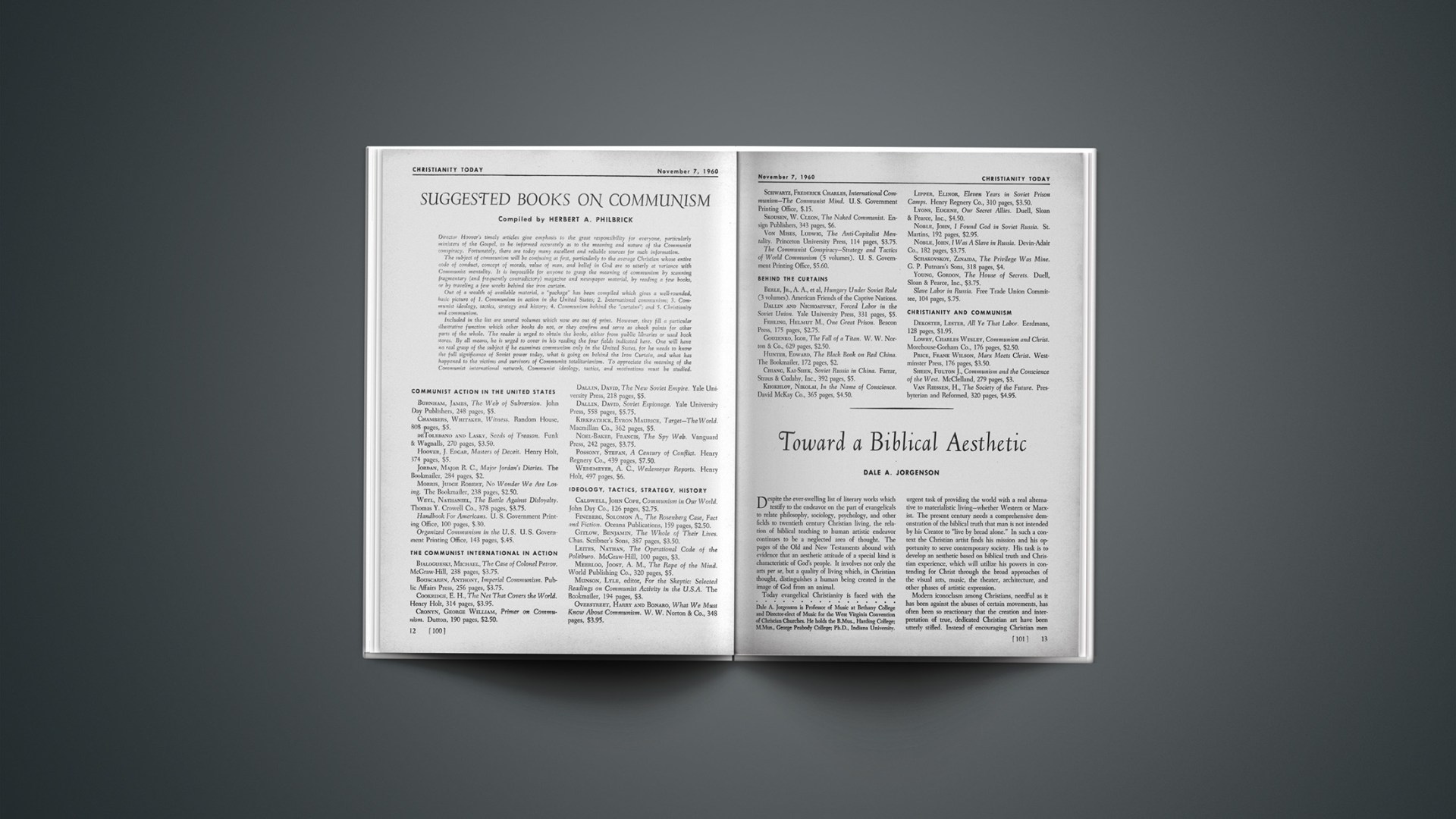
Toward a Biblical Aesthetic

Despite the ever-swelling list of literary works which testify to the endeavor on the part of evangelicals to relate philosophy, sociology, psychology, and other fields to twentieth century Christian living, the relation of biblical teaching to human artistic endeavor continues to be a neglected area of thought. The pages of the Old and New Testaments abound with evidence that an aesthetic attitude of a special kind is characteristic of God’s people. It involves not only the arts per se, but a quality of living which, in Christian thought, distinguishes a human being created in the image of God from an animal.

Today evangelical Christianity is faced with the urgent task of providing the world with a real alternative to materialistic living—whether Western or Marxist. The present century needs a comprehensive demonstration of the biblical truth that man is not intended by his Creator to “live by bread alone.” In such a context the Christian artist finds his mission and his opportunity to serve contemporary society. His task is to develop an aesthetic based on biblical truth and Christian experience, which will utilize his powers in contending for Christ through the broad approaches of the visual arts, music, the theater, architecture, and other phases of artistic expression.

Modern iconoclasm among Christians, needful as it has been against the abuses of certain movements, has often been so reactionary that the creation and interpretation of true, dedicated Christian art have been utterly stifled. Instead of encouraging Christian men and women who have talent and ability in artistic pursuits, evangelicals have consistently made one of three common errors in their relationships with young artists: 1. they have directed them to schools of aesthetic experience which have no appreciation for the Christian beginning-point in philosophic expression or cultural attitude; 2. they have advised them to restrict their efforts to “religious” art; or 3. they have discouraged them entirely by implying that artistic impulses are from the evil one.

THREE COMMON ERRORS

It is disturbing that the young people who have succeeded in artistic endeavors and those who have formed conclusions regarding the function of art in the total Christian experience, have done so usually with the help of scholars who entertain no decided Christian convictions. Two options are thereby open to them. The students can follow thinkers whose naturalistic tendencies lead to an inevitable relativism in aesthetic value judgments; or they can follow artists and authors who begin by making idealistic assumptions. In the first instance there is the danger that relativism will have repercussions in ethical judgments made by the same individuals. In the second case, while relativism and its dangers are avoided and there is a more stable basis for the assessment of the worth of a given piece of art, the idealistic approach robs the Christian student of an intellectual integration of his ethical and aesthetic values, and fails to relate to his actual faith in its initial assumptions.

Those who would restrict Christians to “religious” art are also guilty of a damaging error. They are like the Christians who imagine that evangelism is a program that confines itself to inviting people to church. They are reluctant to wrestle with true-life people in their own habitat. Religious art is a field of rich possibility to be sure, but it touches only the hem of the garment of the aesthetic experiences of human beings. The ostrich-like approach has characterized too many aspects of fundamentalist outlook. As a result, the great movements in the history of art have been supremely ignored because they have taken place outside the specifically “religious” category. A truly evangelical point of view, on the other hand, exempts no human experience from study and evaluation because it is considered “unreligious.” The symphonies of Beethoven, the literature of Shakespeare, and the art creations of Picasso are not all specifically religious in conception, but they cannot therefore be exempted from the realm of legitimate Christian inquiry.

By linking art with the demonic, some evangelicals have displayed a fundamentalist attitude which has been correctly criticized by liberal theology and philosophy. The ‘counselors’ who endeavor to move young people away from their innate interest in the arts because they do not foresee how such a vocation can make any contribution to the cause of God’s Kingdom, have robbed contemporary society of an influence which could have made a worthy and needful addition to the total witness of twentieth-century Christianity. Such an attitude is related to the fear of scholarship and philosophy typical of the anti-intellectualism of certain fragments of Christianity, and has abandoned the field to the anti-Christian forces in the battle for the minds and spirits of men. To dodge the problem, to default the issue, and to argue that art has nothing to do with the battle is to ignore the true nature of he human species.

The aesthetic area is one where the evangelical position is highly vulnerable. Christians may hold to a highly stable definition of values in ethical thinking, yet superficially tolerate a highly relativistic attitude toward aesthetic values. To say that this is axiological inconsistency is the kindest sort of understatement. It would seem that a careful study of value judgments in art, biblically oriented, on the part of evangelical scholars, and a fresh consideration of the problem by Christian ministers and laymen, is one of the great needs of our day.

Younger Christian students need encouragement and motivation if they are to wrestle realistically with the aesthetic problems and needs of our times and not surrender in desperation to a watered-down idealism or to naturalism in aesthetic philosophy. For the Christian student who is seeking to give glory to Christ, any art philosophy erected upon a naturalistic or idealistic rationale is an altar built of unregenerate material. The stones may be pure gold, but the sacrifice is unacceptable. Let those who are in covenant relationship with Christ raise to him a sanctified altar of dedicated, Spirit-filled artistic accomplishment. When the problem is taken seriously, a serious gap in evangelical thinking will be closed.

Captive

To escape the tenacious pleadings Of a patient God has been impossible.

He gives so much, pursues relentlessly.

He never tires,

But wearies the mind, the heart, the conscience Until at last the weariness is rest,

The emptiness is filled,

The disappointment gone.

God is Victor!

Captive in Christ.

ROBERT WINSTON ROSS

Samuel M. Shoemaker is the author of a number of popular books and the gifted Rector of Calvary Episcopal Church in Pittsburgh. He is known for his effective leadership of laymen and his deeply spiritual approach to all vital issues.

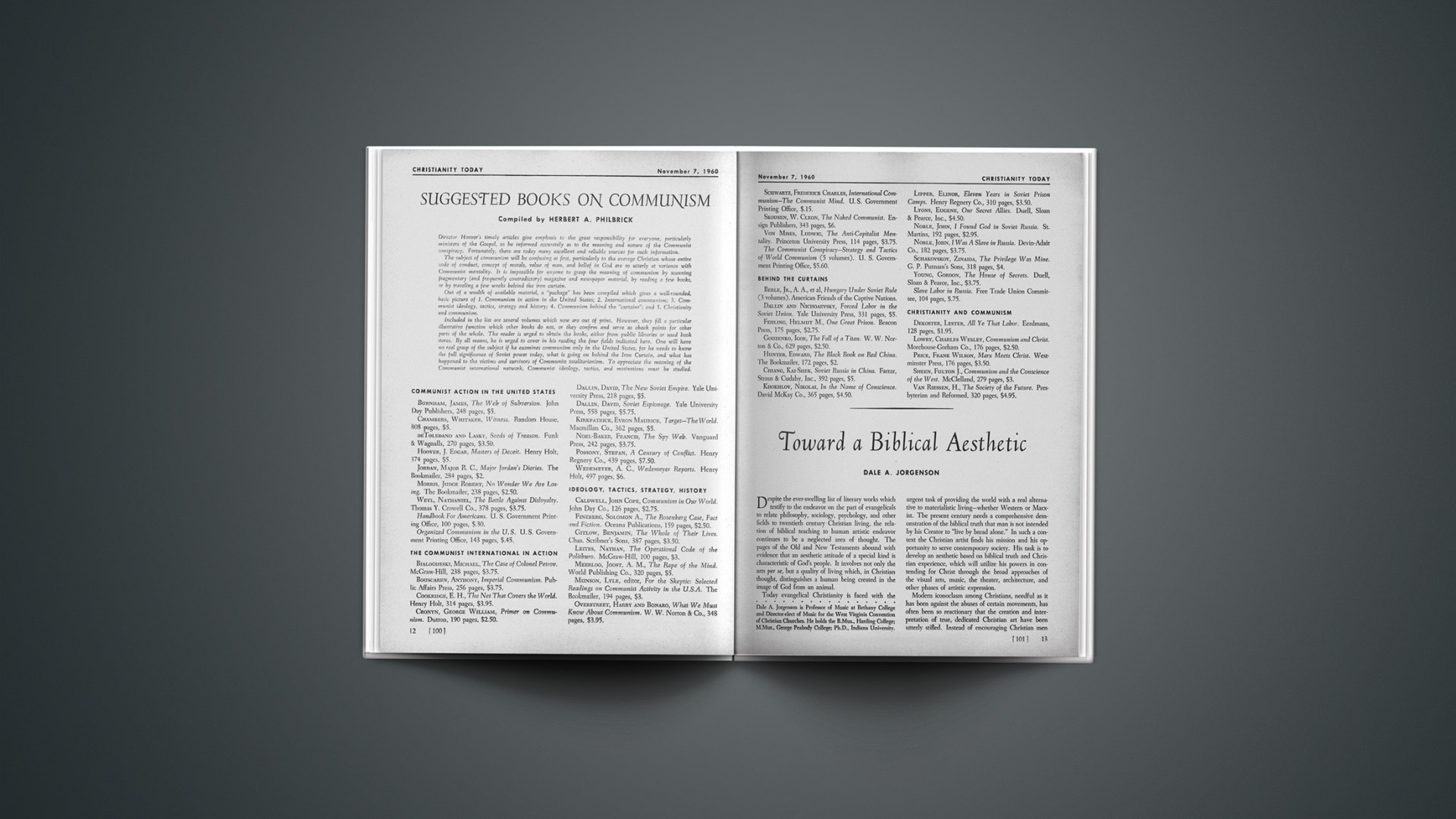
Suggested Books on Communism

Director Hoover’s timely articles give emphasis to the great responsibility for everyone, particularly ministers of the Gospel, to be informed accurately as to the meaning and nature of the Communist conspiracy. Fortunately, there are today many excellent and reliable sources for such information.

The subject of communism will be confusing at first, particularly to the average Christian whose entire code of conduct, concept of morals, value of man, and belief in God are so utterly at variance with Communist mentality. It is impossible for anyone to grasp the meaning of communism by scanning fragmentary (and frequently contradictory) magazine and newspaper material, by reading a few books, or by traveling a few weeks behind the iron curtain.

Out of a wealth of available material, a “package” has been compiled which gives a well-rounded, basic picture of 1. Communism in action in the United States; 2. International communism; 3. Communist ideology, tactics, strategy and history; 4. Communism behind the “curtains”; and 5. Christianity and communism.

Included in the list are several volumes which now are out of print. However, they fill a particular illustrative function which other books do not, or they confirm and serve as check points for other parts of the whole. The reader is urged to obtain the books, either from public libraries or used book stores. By all means, he is urged to cover in his reading the four fields indicated here. One will have no real grasp of the subject if he examines communism only in the United States, for he needs to know the full significance of Soviet power today, what is going on behind the Iron Curtain, and what has happened to the victims and survivors of Communist totalitarianism. To appreciate the meaning of the Communist international network, Communist ideology, tactics, and motivations must be studied.

COMMUNIST ACTION IN THE UNITED STATES

BURNHAM, JAMES, The Web of Subversion. John Day Publishers, 248 pages, $5.

CHAMBERS, WHITAKER, Witness. Random House, 808 pages, $5.

DETOLEDANO AND LASKY, Seeds of Treason. Funk & Wagnalls, 270 pages, $3.50.

HOOVER, J. EDGAR, Masters of Deceit. Henry Holt, 374 pages, $5.

JORDAN, MAJOR R. C., Major Jordan’s Diaries. The Bookmailer, 284 pages, $2.

MORRIS, JUDGE ROBERT, No Wonder We Are Losing. The Bookmailer, 238 pages, $2.50.

WEYL, NATHANIEL, The Battle Against Disloyalty. Thomas Y. Crowell Co., 378 pages, $3.75.

Handbook For Americans. U. S. Government Printing Office, 100 pages, $.30.

Organized Communism in the U.S. U.S. Government Printing Office, 143 pages, $.45.

THE COMMUNIST INTERNATIONAL IN ACTION

BIALOGUESKI, MICHAEL, The Case of Colonel Petrov. McGraw-Hill, 238 pages, $3.75.

BOUSCAREN, ANTHONY, Imperial Communism. Public Affairs Press, 256 pages, $3.75.

COOKRIDGE, E. H., The Net That Covers the World. Henry Holt, 314 pages, $3.95.

CRONYN, GEORGE WILLIAM, Primer on Communism. Dutton, 190 pages, $2.50,

DALLIN, DAVID, The New Soviet Empire. Yale University Press, 218 pages, $5.

DALLIN, DAVID, Soviet Espionage. Yale University Press, 558 pages, $5.75.

KIRKPATRICK, EVRON MAURICE, Target—The World. Macmillan Co., 362 pages, $5.

NOEL-BAKER, FRANCIS, The Spy Web. Vanguard Press, 242 pages, $3.75.

POSSONY, STEFAN, A Century of Conflict. Henry Regnery Co., 439 pages, $7.50.

WEDEMEYER, A. C., Wedemeyer Reports. Henry Holt, 497 pages, $6.

IDEOLOGY, TACTICS, STRATEGY, HISTORY

CALDWELL, JOHN COPE, Communism in Our World. John Day Co., 126 pages, $2.75.

FINEBERG, SOLOMON A., The Rosenberg Case, Fact and Fiction. Oceana Publications, 159 pages, $2.50.

GITLOW, BENJAMIN, The Whole of Their Lives. Chas. Scribner’s Sons, 387 pages, $3.50.

LEITES, NATHAN, The Operational Code of the Politburo. McGraw-Hill, 100 pages, $3.

MEERLOO, JOOST, A. M., The Rape of the Mind. World Publishing Co., 320 pages, $5.

MUNSON, LYLE, editor, For the Skeptic: Selected Readings on Communist Activity in the U.S.A. The Bookmailer, 194 pages, $3.

OVERSTREET, HARRY AND BONARO, What We Must Know About Communism. W. W. Norton & Co., 348 pages, $3.95.

SCHWARTZ, FREDERICK CHARLES, International Communism—The Communist Mind. U. S. Government Printing Office, $.15.

SKOUSEN, W. CLEON, The Naked Communist. Ensign Publishers, 343 pages, $6.

VON MISES, LUDWIG, The Anti-Capitalist Mentality. Princeton University Press, 114 pages, $3.75.

The Communist Conspiracy—Strategy and Tactics of World Communism (5 volumes). U. S. Government Printing Office, $5.60.

BEHIND THE CURTAINS

BERLE, JR., A. A., et al, Hungary Under Soviet Rule (3 volumes). American Friends of the Captive Nations.

DALLIN AND NICHOAEVSKY, Forced Labor in the Soviet Union. Yale University Press, 331 pages, $5.

FEHLING, HELMUT M., One Great Prison. Beacon Press, 175 pages, $2.75.

GOUZENKO, IGOR, The Fall of a Titan. W. W. Norton & Co., 629 pages, $2.50.

HUNTER, EDWARD, The Black Book on Red China. The Bookmailer, 172 pages, $2.

CHIANG, KAI-SHEK, Soviet Russia in China. Farrar, Straus & Cudahy, Inc., 392 pages, $5.

KHOKHLOV, NIKOLAI, In the Name of Conscience. David McKay Co., 365 pages, $4.50.

LIPPER, ELINOR, Eleven Years in Soviet Prison Camps. Henry Regnery Co., 310 pages, $3.50.

LYONS, EUGENE, Our Secret Allies. Duell, Sloan & Pearce, Inc., $4.50.

NOBLE, JOHN, I Found God in Soviet Russia. St. Martins, 192 pages, $2.95.

NOBLE, JOHN, I Was A Slave in Russia. Devin-Adair Co., 182 pages, $3.75.

SCHAKOVSKOY, ZINAIDA, The Privilege Was Mine. G. P. Putnam’s Sons, 318 pages, $4.

YOUNG, GORDON, The House of Secrets. Duell, Sloan & Pearce, Inc., $3.75.

Slave Labor in Russia. Free Trade Union Committee, 104 pages, $.75.

CHRISTIANITY AND COMMUNISM

DEKOSTER, LESTER, All Ye That Labor. Eerdmans, 128 pages, $1.95.

LOWRY, CHARLES WESLEY, Communism and Christ. Morehouse-Gorham Co., 176 pages, $2.50.

PRICE, FRANK WILSON, Marx Meets Christ. Westminster Press, 176 pages, $3.50.

SHEEN, FULTON J., Communism and the Conscience of the West. McClelland, 279 pages, $3.

VAN RIESSEN, H., The Society of the Future. Presbyterian and Reformed, 320 pages, $4.95.

Samuel M. Shoemaker is the author of a number of popular books and the gifted Rector of Calvary Episcopal Church in Pittsburgh. He is known for his effective leadership of laymen and his deeply spiritual approach to all vital issues.

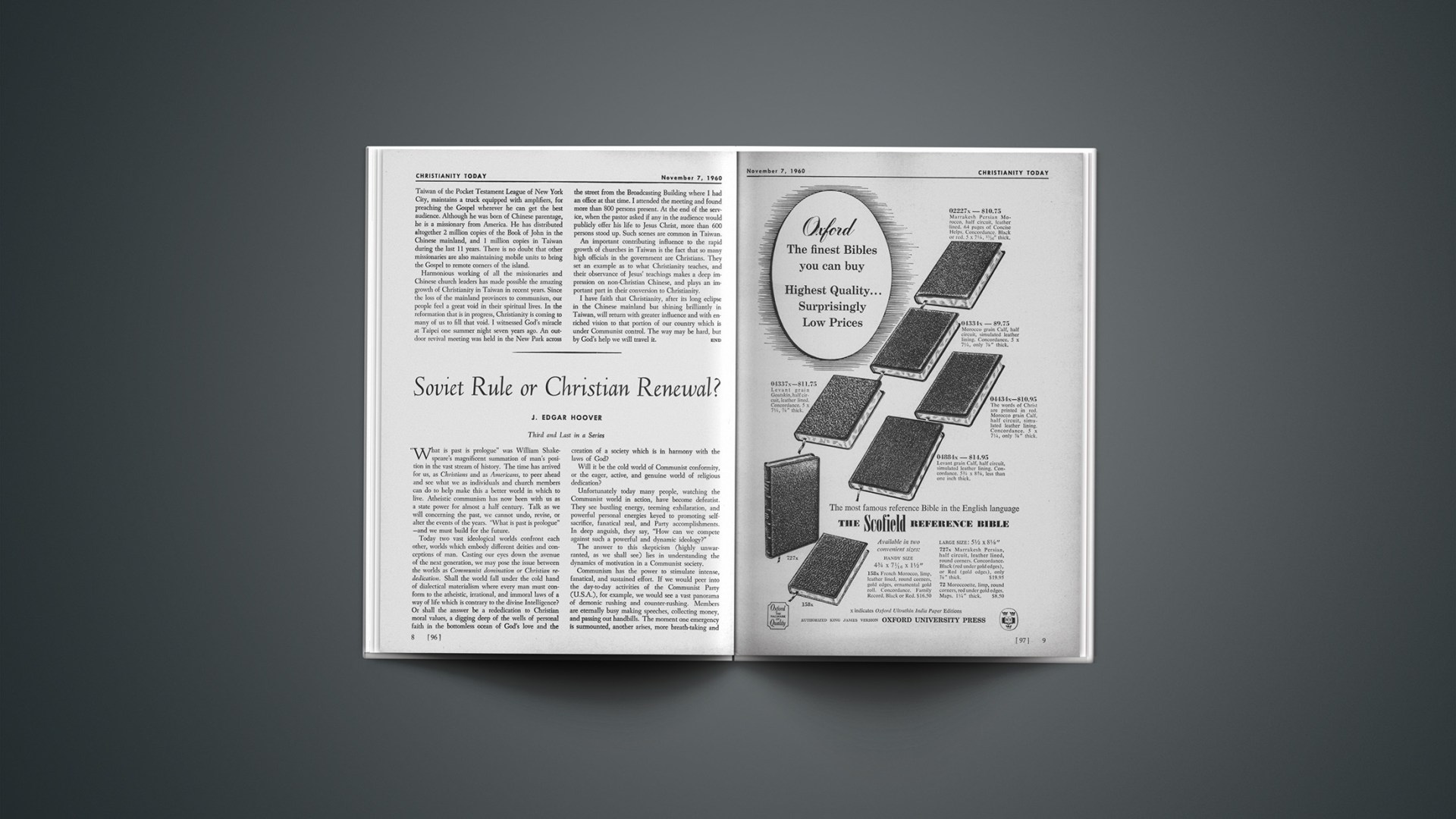
Soviet Rule or Christian Renewal?

Third and Last in a Series

What is past is prologue” was William Shakespeare’s magnificent summation of man’s position in the vast stream of history. The time has arrived for us, as Christians and as Americans, to peer ahead and see what we as individuals and church members can do to help make this a better world in which to live. Atheistic communism has now been with us as a state power for almost a half century. Talk as we will concerning the past, we cannot undo, revise, or alter the events of the years. “What is past is prologue”—and we must build for the future.

Today two vast ideological worlds confront each other, worlds which embody different deities and conceptions of man. Casting our eyes down the avenue of the next generation, we may pose the issue between the worlds as Communist domination or Christian rededication. Shall the world fall under the cold hand of dialectical materialism where every man must conform to the atheistic, irrational, and immoral laws of a way of life which is contrary to the divine Intelligence? Or shall the answer be a rededication to Christian moral values, a digging deep of the wells of personal faith in the bottomless ocean of God’s love and the creation of a society which is in harmony with the laws of God?

Will it be the cold world of Communist conformity, or the eager, active, and genuine world of religious dedication?

Unfortunately today many people, watching the Communist world in action, have become defeatist. They see bustling energy, teeming exhilaration, and powerful personal energies keyed to promoting self-sacrifice, fanatical zeal, and Party accomplishments. In deep anguish, they say, “How can we compete against such a powerful and dynamic ideology?”

The answer to this skepticism (highly unwarranted, as we shall see) lies in understanding the dynamics of motivation in a Communist society.

Communism has the power to stimulate intense, fanatical, and sustained effort. If we would peer into the day-to-day activities of the Communist Party (U.S.A.), for example, we would see a vast panorama of demonic rushing and counter-rushing. Members are eternally busy making speeches, collecting money, and passing out handbills. The moment one emergency is surmounted, another arises, more breath-taking and earth-shaking than the former. Like ants scurrying on a hot summer day, Party members are whirling fanatical action at all levels of the Party.

This incessant Party activity arises, to a large extent, because of what the Communists call ideological cultivation—which means an educational program designed to immerse the individual in Communist thought for the purpose of making him a more effective Party member. Communists speak of ideological cultivation as a weapon of attack. Actually it is the foundation stone of Marxism-Leninism.

TRAINING NEW RECRUITS

A recruit joins the Party. Immediately he is sent to a Party school to learn, among other things, the ideas, opinions, and prejudices of the Communist “masters” (Marx, Engels, and Lenin; Stalin is now “out of date”). Regardless of how busy a member may be in everyday Party work or how long he’s been in the Party, he must continue to attend indoctrination schools and do home work. Among Party slogans is “One night a week for Marxist study.”

The idea is to make the member think like the Party “masters,” to imbue him with the Communist personality of these men. To the Communists, the reading, studying, and discussion of Communist “classics,” such as Marx’s Capital and Lenin’s State and Revolution, as well as the latest works of the current Party leaders, help raise the Communist qualities of the members. “Strive to become the best pupils of Marx, Engels and Lenin.…” These source books of Communist doctrine, in the Party’s eyes, give the members a sense of Communist purpose and direction and a zeal to push forward to achieve the Party’s goals.

Hence, to the Communists, the member must, in the Party’s language, constantly raise his own ideological level, that is, increase his knowledge of the Party’s doctrines. Gradually, under such an educational program, the member becomes an “advanced” or “mature” Communist able to handle the most difficult of Party assignments. Such an individual, because of his indoctrination, automatically thinks as the Party wants him to think, subordinates his personal desires to the interests of the Party, and works only for Communist goals.

Here arises the dynamics of motion in communism. In the Party there is a close relationship between theory and practice. Ideological training is designed to make the member a man of action—revolutionary action. The member is steeled in revolutionary discipline, armed for battles in the fields of infiltration, agitation, and propaganda.

At first blush communism may seem almost like an invincible monster. Admittedly, it can engender tremendous personal effort and zeal, but it has a tragic flaw, a flaw which heralds its eventual destruction.

Communism is anti-God: this is its fatal weakness. Hence, it is contrary to divine laws which give meaning, validity, and depth to the dignity of human personality. The world of communism, despite its overt bustling, energy, and action, is a cold world of sterility, conformity, and monotony. One is no longer regarded as a child of God, to bloom from spiritual roots. Rather, a deadly sameness is enforced, and the individual becomes a robot of the state, servile in thought, and groveling in attitude. The great seedbeds of dissent are deracinated. Critical thought and independent judgment are hunted down and destroyed. Freedom of expression is prohibited. Purges, concentration camps, and faked trials betray the poisonous hand of communism which corrupts everything it touches, creates error, evil, and sin, and transforms love into hate, justice into slavery, and truth into falsehood.

Contrasted to the world of Communist conformity, we as Christians have the unmatched power of Christ. The task for us is spiritual rededication—the creation of a world of love, justice, and truth. This is the Christian ethic which is part of our heritage. Ministers have a vital role in helping to roll back the iron curtain of communism and making real the world of divine love.

HOW COMMUNISM WORKS

In discussing such a mission, let us see what we can learn from the Communists by noting the way in which they inspire their members.

1. Note the Communists’ emphasis on returning to the original source of their beliefs to secure inspiration for their members. Communists encourage members, young and old, to study the Party’s “classics.” To read such books, they say, is to gain personal guidance and raise the members’ Communist qualities “in every respect to the same level as those of Marx, Engels, Lenin.…”

Answer: Think how much more enriching, rewarding, and satisfying are the original sources of Christian belief than the writings of the bigoted minds of the Communist “masters.” The Bible is the Word of God. But besides the Bible, the writings of men of God, both clerical and lay, over 20 centuries are also guidelines to personal action. Do we as Christians take enough time to read the Bible—and these other affirmations of our faith? Do we quench our spiritual thirst (symbolized by the troubles, tensions, and anxieties of the day) with the truth ground in such sources? Are we digging deep enough in the wells of our faith? Most truly, the Bible gives inspiration, zeal, and guidance for life. To neglect it, is to reduce our national vitality and strength.

2. Communists stress not only the reading of Marx, Engels, and Lenin, but reading them constantly—on a daily or weekly schedule—and never neglecting this habit even though the member becomes older. “Comrades! Of course it is no easy matter to take Marx, Engels, and Lenin … as our models in self-cultivation and to become their most faithful and best pupils. It calls for an iron will and firm determination.… It calls for a life-long devotion to studying Marxism-Leninism.…”

Answer: How many Christians read the Bible only on special occasions? How many Christians set aside a certain amount of time each day or week for reading religious literature? Do some Christians regard the Bible as a book only for children; do they think that as adults they have outgrown it? Do we view the Bible as an “antique book” which has no message to our modern age? Do we display the same “iron will and firm determination” to learn the Christian faith as the Communists do for their ideology?

These are key questions, striking at the very heart of our religious faith and practices.

3. The Communists have no use for a mere ceremonial avowal of Marxism or members interested only in acquiring a minimum knowledge of ideology. “Every one of our Party members should not merely be a member of minimum qualifications … but should rather seek to make progress and ceaselessly raise his or her own consciousness and understanding of Marxism-Leninism.”

Answer: Here again serious challenges are posed. How many church members today are merely members in name, not knowing or even caring what membership in the church of God really means and entails? Do some members object to learning about the tenets of their faith, and say that a few minimum requirements are enough? Has our Christian heritage been diluted by the inroads of secularism and materialism? Is our faith in God a growing, creative experience? Or are we satisfied with lesser visions of inspiration? The answers to these questions will help chart our way.

4. At all times the Communists stress the relationship between theory and action. To study the Communist “masters” is to ready oneself for revolutionary action. Communists are not interested in preparing members to parade their Marxist IQ’s or pass academic examinations. Their knowledge must become a weapon to turn the world upside down for communism. “We study for the sole purpose of putting into practice what we have learnt. It is for the Party and for the victory of the revolution that we study.”

Answer: In Christianity the study of the Bible is a guide to action—action in building a deeper Christian experience for the individual, and a better, more wholesome community. Are we as Christians adapting to actual practice the teachings of Christ? Are our day-to-day actions in the secular world determined by our Christian beliefs? Is the church—the Christian pulpit—effective today in determining men’s actions? Are there individuals who think the church is a “good” organization to have in the community but should not be taken too seriously in everyday community action? These are challenges to us today.

5. The Party stresses the development of the “politically mature” comrade, the individual on whom it can depend to carry out its mission. The whole purpose of ideological cultivation is to produce the member who will become a better Communist and work for the revolution.

Answer: Christians are also working for a revolution—a revolution of the spirit, not the sword. Deeply-committed Christians are needed to carry on the work of the Church, to uphold the Judaic-Christian faith. We may raise the question, are we working tirelessly enough to create these deeply-committed Christians? Are we training our members to buckle on the full armor of God, to commit their full lives to Christ? Working for Christian goals is a full-time job, not just a task for Sundays or evening meetings.

THE STRUGGLE IS REAL

How can we compete against such a powerful and dynamic ideology as communism? By way of answer we must say that as Christians and as Americans we can compete. We can defeat this atheistic enemy by drawing upon our spiritual resources.

Make no mistake about it, the struggle ahead is real. The Communists are determined, rugged, and treacherous enemies. The ideology of communism, as we have seen, generates great power. But the faith of communism is a perverted faith, giving predominance to evil, sin, and wrong. It draws its strength from deceit, chicanery, and hypocrisy. That is its fatal flaw, the rotten core which spoils the fruit of its branches.

The future, to a large extent, will be determined by what we as Christians have to say and do. Those who are ministers of the Gospel can help determine this fateful decision: shall it be a world of Communist domination or Christian rededication? Shall it be the cold world of Communist inhumanity, sterility, and conformity, where the bodies, minds, and souls of men become as stone, lifeless in the darkness of atheistic perversity, or shall it be Christian regeneration, where the power of the Holy Spirit floods in with joy, love, and harmony?

No group in America has a more key responsibility than the clergy. The answer to communism must be on a spiritual level. As representatives of a great tradition, the clergymen of America must light men’s souls with deep enthusiasm for the teachings of Christ. A God-centered nation, ever humble before the majesty of the divine Creator, can keep alive freedom, justice, and mercy. This is the heritage of America.

Samuel M. Shoemaker is the author of a number of popular books and the gifted Rector of Calvary Episcopal Church in Pittsburgh. He is known for his effective leadership of laymen and his deeply spiritual approach to all vital issues.

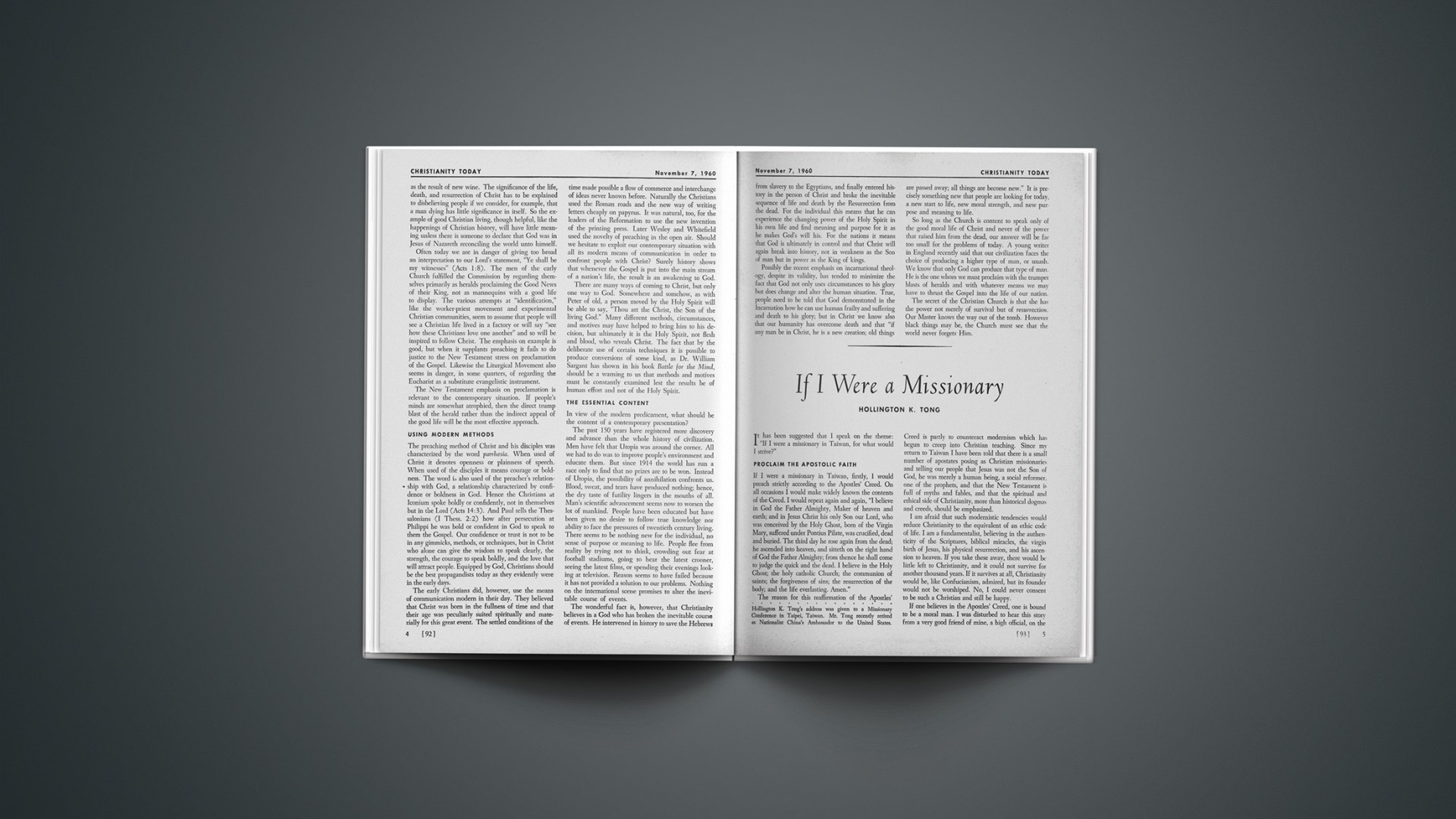
If I Were a Missionary

It has been suggested that I speak on the theme: “If I were a missionary in Taiwan, for what would I strive?”

PROCLAIM THE APOSTOLIC FAITH

If I were a missionary in Taiwan, firstly, I would preach strictly according to the Apostles’ Creed. On all occasions I would make widely known the contents of the Creed. I would repeat again and again, “I believe in God the Father Almighty, Maker of heaven and earth; and in Jesus Christ his only Son our Lord, who was conceived by the Holy Ghost, born of the Virgin Mary, suffered under Pontius Pilate, was crucified, dead and buried. The third day he rose again from the dead; he ascended into heaven, and sitteth on the right hand of God the Father Almighty; from thence he shall come to judge the quick and the dead. I believe in the Holy Ghost; the holy catholic Church; the communion of saints; the forgiveness of sins; the resurrection of the body; and the life everlasting. Amen.”

The reason for this reaffirmation of the Apostles’ Creed is partly to counteract modernism which has begun to creep into Christian teaching. Since my return to Taiwan I have been told that there is a small number of apostates posing as Christian missionaries and telling our people that Jesus was not the Son of God, he was merely a human being, a social reformer, one of the prophets, and that the New Testament is full of myths and fables, and that the spiritual and ethical side of Christianity, more than historical dogmas and creeds, should be emphasized.

I am afraid that such modernistic tendencies would reduce Christianity to the equivalent of an ethic code of life. I am a fundamentalist, believing in the authenticity of the Scriptures, biblical miracles, the virgin birth of Jesus, his physical resurrection, and his ascension to heaven. If you take these away, there would be little left to Christianity, and it could not survive for another thousand years. If it survives at all, Christianity would be, like Confucianism, admired, but its founder would not be worshiped. No, I could never consent to be such a Christian and still be happy.

If one believes in the Apostles’ Creed, one is bound to be a moral man. I was disturbed to hear this story from a very good friend of mine, a high official, on the first day of my return. Two American missionaries called on him and asked for his reaction to Christianity. Not being a Christian he said he admired Christianity for its teaching that a husband should have only one wife. The American visitors told him Christianity was not opposed to polygamy.

SUPPORT INDIGENOUS CHURCHES

Secondly, if I were a missionary in Taiwan, I would try to have a better understanding of the tendency among Chinese Christians to break away from their foreign connections and to found self-supporting churches of their own, and I would give all encouragement to this tendency. I have noticed during my brief stay here this time that the movement for the establishment of indigenous churches is in full swing in Taiwan. I think it is a praiseworthy movement.

It goes without saying that there would be no parallel between independent Chinese churches in Taiwan and so-called independent Chinese churches on the mainland. Here the churches would be dedicated, as they are now, to the service of God. On the mainland the so-called independent churches are designed not for the service of God but for the service of a state founded on an atheistic, materialistic basis.

It is unfortunate, however, that the promoters of the indigenous or independent Chinese churches are highly critical of the denominational churches in their midst. They claim that their churches are preaching the authentic Gospel—an insinuation that other churches are less orthodox. Certainly I cannot endorse such a narrow-minded view.

It is also unfortunate that some of these indigenous churches have refused to cooperate with other churches and particularly with the denominational churches. Unity is essential to the Christian movement especially on this island.

TAKE THE MEASURE OF MARXISM

Thirdly, as a missionary to Taiwan, I would strive to understand the popular sentiment toward communism. To us communism is the worst enemy of God. Its doctrines are anti-Christian. As such, communism must be destroyed. Communism flourishes where Christianity recedes, withers where Christianity advances.

In Taiwan, under the democratic rule of the Republic of China, all residents enjoy full freedom of religious belief and practice. When Taiwan was first restored to China at the end of the war in 1945 there were fewer than 30,000 Christians among its inhabitants. Today this number is calculated at more than 200,000. In addition to the Protestant Christians, there are also a large number of Catholics on the island.

The purpose of the Communists is to destroy the Christian basis of democracy as a preliminary to their domination of Asia; but Taiwan stands as a great obstacle. Taiwan, inspired by the Christian faith of President Chiang and other leaders, and the strenuous work of your missionaries, is invulnerable to Communist intrigues, and sooner or later is destined to succeed in the overthrow of the Communists in Asia. I must admit that the Christian Church in this part of the world is passing through a dark night, but God will give us the light of dawn, if we continue, like Paul, to fight the good fight.

If I were a missionary in Taiwan, I would seek to have a true understanding of the political realities under which the 10 million people are working. Free China lives under the constant threat of Communist aggression. Only a narrow strip of water separates Taiwan from jet bombers and concentrated armed might of the ruthless Chinese Communist dictators on the mainland across the Strait. To retain our liberty, to keep alive our determination to return some day to the mainland and reclaim China from its present black night, our people must be continually alive to the Communist menace and be militarily and spiritually prepared to repel it. We cannot afford to relax our vigilance for even one moment.

We need tolerance and understanding from our friends in this critical hour. Our fellow Christians from America and other countries must understand the overriding necessity of defense against Communist aggression and refrain from words and actions which would serve to weaken the will to resist it. We in the Republic of China have an historical mission to perform in Asia—a mission which will increase the security of the whole free world. Our Christian friends must understand the great imperatives which move us into this emergency. As a foreign missionary in Taiwan, I would certainly share their view on this important question and would not do anything to create an impression that a compromise between democracy and communism is possible.

DEEPEN SOCIAL CONCERN

Fourthly, if I were a missionary in Taiwan, I would devote attention and energy to such activities as hospitals, care for tuberculous and leprous patients and destitute children, and do everything else within my power to promote the general well-being of the people among whom missionaries are preaching the Gospel of mercy and good will.

In my own life, the Baptist church has played a recurrent role, and it has ever been remembered gratefully. It was in Elizabeth Hospital in Shanghai—a Baptist institution—that our first child, a daughter, was born. Although Mrs. Tong and I were in strait circumstances at the time, I recall the sympathetic and helpful cooperation which we received from Elizabeth Hospital during that time of need.

Fifthly, if I were a missionary in Taiwan, I would devote my time and energy to such techniques as public relations, radio broadcasting, and mobile preaching units which would make possible the mass conversion of people to Christianity. It is superficial to confuse public relations with propaganda and publicity. Of course, it is something quite different. Public relations addresses itself to the basic problem of creating an atmosphere—a climate of opinion—favorable to a projected course of action. As such it embraces many and varied activities. Among these, radio broadcasting and mobile units for preaching the Gospel are instruments.

Nowadays, there are few men of major stature in the United States who are not regularly advised by public relations counselors. Public relations has become an accepted “must” for American business. It has an important place in the spread of Christianity. Naturally, it calls for a study of Chinese history, culture, and customs. China’s cultural heritage and historical backgrounds offer many similarities to Christianity. These similarities should enable a missionary to overcome unreceptiveness to the teachings of the Bible and pave the way for acceptance of the doctrine of the forgiveness of sin and of the immortality of the soul through the grace of Jesus Christ.

PRESENT ACHIEVEMENTS

Ten days after Mr. James Dickson suggested to me the topic of this message, “If I were a missionary in Taiwan, for what would I strive?,” Mrs. Dickson allowed me to accompany her in a four-day inspection of various mission stations in the island. During the trip I often asked myself whether I could make myself a better missionary or whether I could do something which missionaries had not yet done. Before our return to Taipei, I came to the conclusion that if I were a missionary in Taiwan, I could not have done better than what has been done by more than 500 Protestant missionaries now working in the island.

Most of the missionaries with whom I came in contact have been preaching according to the Apostles’ Creed. I saw evidence of the spirit of sacrifice that has inspired them in their work of mercy. Some are doctors or dentists; some render service to leprous or tuberculous patients; some are training mountain tribe boys and girls, or men and women, to be nurses, kindergarten teachers, Bible instructors, and preachers. I was particularly struck with the selfless devotion of a young couple who minister to children suffering from tuberculosis in its active stage. The couple work in a poorly equipped clinic, with their own living rooms in an adjoining section. The husband is a doctor and his wife a trained nurse. Both of them show their affection for their little patients and would pick them up and embrace them and comfort them whenever they cried.

Unless they had the Spirit of the Lord in them, such love for diseased children would have been impossible. I also saw other missionaries, both men and women, devoting their lives to the care of their fellow men and women who would otherwise have not received medical attention. They live in quarters which I would not regard as modern, but they do not complain because the Spirit of God abides with them.

As to the independent Chinese churches in the island, the missionaries are encouraging their establishment. The spread of Christianity in Taiwan has been so fast that it is not possible to finance all churches with funds raised abroad. Chinese Christians and even mountain tribe Christians are relying more and more upon themselves to erect churches and to carry on activities of mercy.

As to my suggestion that we should resort to such modern techniques as public relations, radio broadcasting, and mobile units for the preaching of the Gospel, some missionaries are already employing these methods. To me, both Mr. and Mrs. Dickson are good public relations counselors. Her book, These My People, dealing with her beloved mountain people of Taiwan, bears the mark of an expert writer. Mr. Dickson’s book, Stranger Than Fiction, a story of modern Christian missions among the mountain tribes of Taiwan, is truly a story of the wonderful working of the Spirit of God among primitive people.

Another public relations expert in Taiwan is Miss Gladys Aylward, “The Small Woman,” featured in a book by that name which was condensed for the August, 1957, edition of Reader’s Digest. Her amazing life was the subject of a film, “The Inn of the Sixth Happiness,” which Mrs. Tong and I saw in Europe last winter. She maintains an orphanage in Taiwan.

As early as May, 1951, some missionaries started radio preaching at Hualien. At the time I was the managing director of the Broadcasting Corporation of China and was able to help it in a small way. Today Team Radio Formosa has a staff of 27, including nine nationals and four missionary personnel, and consisting of three departments, namely, programming, correspondence, and outreach. Its programs are released on 12 stations in seven different cities in Taiwan in addition to station HLKX in Inchon, Korea, and FEBC station in Manila. There is a total of 120 outlets per week requiring the production of at least 20 programs every week. The correspondence course department, using “The Light of Life” course translated into Chinese, has an enrollment of one thousand. More than 100 letters a day are received from listeners.

The Reverend Andrew Loo, sole representative in Taiwan of the Pocket Testament League of New York City, maintains a truck equipped with amplifiers, for preaching the Gospel wherever he can get the best audience. Although he was born of Chinese parentage, he is a missionary from America. He has distributed altogether 2 million copies of the Book of John in the Chinese mainland, and 1 million copies in Taiwan during the last 11 years. There is no doubt that other missionaries are also maintaining mobile units to bring the Gospel to remote corners of the island.

Harmonious working of all the missionaries and Chinese church leaders has made possible the amazing growth of Christianity in Taiwan in recent years. Since the loss of the mainland provinces to communism, our people feel a great void in their spiritual lives. In the reformation that is in progress, Christianity is coming to many of us to fill that void. I witnessed God’s miracle at Taipei one summer night seven years ago. An outdoor revival meeting was held in the New Park across the street from the Broadcasting Building where I had an office at that time. I attended the meeting and found more than 800 persons present. At the end of the service, when the pastor asked if any in the audience would publicly offer his life to Jesus Christ, more than 600 persons stood up. Such scenes are common in Taiwan.

An important contributing influence to the rapid growth of churches in Taiwan is the fact that so many high officials in the government are Christians. They set an example as to what Christianity teaches, and their observance of Jesus’ teachings makes a deep impression on non-Christian Chinese, and plays an important part in their conversion to Christianity.

I have faith that Christianity, after its long eclipse in the Chinese mainland but shining brilliantly in Taiwan, will return with greater influence and with enriched vision to that portion of our country which is under Communist control. The way may be hard, but by God’s help we will travel it.

Samuel M. Shoemaker is the author of a number of popular books and the gifted Rector of Calvary Episcopal Church in Pittsburgh. He is known for his effective leadership of laymen and his deeply spiritual approach to all vital issues.

Effective Evangelism: Striking at the Modern Dilemma

Living as we do under the shadow of the mushroom cloud, mankind is having an experience of insecurity comparable to that of primitive man. At one time men were driven by the hazards of life to seek divine aid in their struggle for daily survival. Twentieth century man, instead of being better equipped mentally and morally by the progress of the ages, is becoming under the stress of modern insecurity less and less a man and more and more the pawn of organized state and business enterprise.

If there is to be a presentation of the Gospel to this generation, the nature of our predicament must be studied in order to find the factors necessary for making the presentation meaningful and effective. Like the prophets of old we must find a “touch” that will reach society. Amos found a “touch” by emphasizing the judgment of God; Hosea found his in the love of God. What relevant factors must we consider in our society if we are to cultivate a “touch” that will make for a contemporary presentation?

THE DECLINE OF REASON

The first factor is that people are using their minds less and less to determine the course of their lives.

Apart from the more obvious ways in which independent thought is being controlled or hindered—such as, brainwashing, advertising by suggestion, and conditioning—there are more subtle ways which, because of their indirect influence on the mind, are more universal and effective. More people than ever are living together in big cities where genuine individuality of thought and action is difficult. The daily work of many no longer demands the concentration of the skilled craftsman. Rather, life’s complexities exhaust the mind with the trivialities of red tape, and then leave it too fatigued to meditate on important things.

Knowledge has become specialized. A hundred years ago the average person could have a fair idea of why and how things happened in the world around him. Today only the expert can profess to know this. The average person is content with the bits of knowledge he picks up from magazines, radio, and television, and can leave to the experts, computers, adding machines, and electronic brains the responsibility of doing his thinking for him in areas he cannot understand.

The strongest deterrents to the use of the mind are modern views which do not regard man’s reason as having any objective validity. If man’s behavior is determined by his glands, his subconscious mind, or economic factors, any reasoning that he may claim to do is but the response of inner or outer environmental factors and is therefore purely subjective. And if he is no longer responsible for his actions, then condemnation of his behavior when unacceptable becomes unfair. But if objective truth and standards do exist, modern views notwithstanding, then the application of them to daily life demands considerable thought on our part.

THE GOSPEL THRUST

Now we must ask, how is the Gospel to be presented in the face of the situation? The content of the message will be determined by its aim, and the aim of true evangelism is to bring glory to God. The disciples witnessed to what they had seen and heard of Christ, who was the objective source of their experience. As Christians we experience the gift of grace from the risen Christ. So we also are able, like the disciples, to witness to our experience of Christ if, in realizing the wonder of the gift of grace, we point away from our own experience to the Giver. God can only receive the glory when he has the initiative and men are asked to believe his words and his acts.

The importance of an actual declaration of God’s message, as opposed to the witness of an example of a good Christian life, whether lived in a community or in a factory, is emphasized by the nature of Christianity as basically a series of happenings caused by God. Things that happen have to be explained, otherwise God will not receive the glory. Christ was said to have cast out devils by the prince of devils, the empty tomb was “explained” as the result of the disciples stealing the body, and Pentecost was put down as the result of new wine. The significance of the life, death, and resurrection of Christ has to be explained to disbelieving people if we consider, for example, that a man dying has little significance in itself. So the example of good Christian living, though helpful, like the happenings of Christian history, will have little meaning unless there is someone to declare that God was in Jesus of Nazareth reconciling the world unto himself.

Often today we are in danger of giving too broad an interpretation to our Lord’s statement, “Ye shall be my witnesses” (Acts 1:8). The men of the early Church fulfilled the Commission by regarding themselves primarily as heralds proclaiming the Good News of their King, not as mannequins with a good life to display. The various attempts at “identification,” like the worker-priest movement and experimental Christian communities, seem to assume that people will see a Christian life lived in a factory or will say “see how these Christians love one another” and so will be inspired to follow Christ. The emphasis on example is good, but when it supplants preaching it fails to do justice to the New Testament stress on proclamation of the Gospel. Likewise the Liturgical Movement also seems in danger, in some quarters, of regarding the Eucharist as a substitute evangelistic instrument.

The New Testament emphasis on proclamation is relevant to the contemporary situation. If people’s minds are somewhat atrophied, then the direct trump blast of the herald rather than the indirect appeal of the good life will be the most effective approach.

USING MODERN METHODS

The preaching method of Christ and his disciples was characterized by the word parrhesia. When used of Christ it denotes openness or plainness of speech. When used of the disciples it means courage or boldness. The word is also used of the preacher’s relationship with God, a relationship characterized by confidence or boldness in God. Hence the Christians at Iconium spoke boldly or confidently, not in themselves but in the Lord (Acts 14:3). And Paul tells the Thessalonians (1 Thess. 2:2) how after persecution at Philippi he was bold or confident in God to speak to them the Gospel. Our confidence or trust is not to be in any gimmicks, methods, or techniques, but in Christ who alone can give the wisdom to speak clearly, the strength, the courage to speak boldly, and the love that will attract people. Equipped by God, Christians should be the best propagandists today as they evidently were in the early days.

The early Christians did, however, use the means of communication modern in their day. They believed that Christ was born in the fullness of time and that their age was peculiarly suited spiritually and materially for this great event. The settled conditions of the time made possible a flow of commerce and interchange of ideas never known before. Naturally the Christians used the Roman roads and the new way of writing letters cheaply on papyrus. It was natural, too, for the leaders of the Reformation to use the new invention of the printing press. Later Wesley and Whitefield used the novelty of preaching in the open air. Should we hesitate to exploit our contemporary situation with all its modern means of communication in order to confront people with Christ? Surely history shows that whenever the Gospel is put into the main stream of a nation’s life, the result is an awakening to God.

There are many ways of coming to Christ, but only one way to God. Somewhere and somehow, as with Peter of old, a person moved by the Holy Spirit will be able to say, “Thou art the Christ, the Son of the living God.” Many different methods, circumstances, and motives may have helped to bring him to his decision, but ultimately it is the Holy Spirit, not flesh and blood, who reveals Christ. The fact that by the deliberate use of certain techniques it is possible to produce conversions of some kind, as Dr. William Sargant has shown in his book Battle for the Mind, should be a warning to us that methods and motives must be constantly examined lest the results be of human effort and not of the Holy Spirit.

THE ESSENTIAL CONTENT

In view of the modern predicament, what should be the content of a contemporary presentation?

The past 150 years have registered more discovery and advance than the whole history of civilization. Men have felt that Utopia was around the corner. All we had to do was to improve people’s environment and educate them. But since 1914 the world has run a race only to find that no prizes are to be won. Instead of Utopia, the possibility of annihilation confronts us. Blood, sweat, and tears have produced nothing; hence, the dry taste of futility lingers in the mouths of all. Man’s scientific advancement seems now to worsen the lot of mankind. People have been educated but have been given no desire to follow true knowledge nor ability to face the pressures of twentieth century living. There seems to be nothing new for the individual, no sense of purpose or meaning to life. People flee from reality by trying not to think, crowding out fear at football stadiums, going to hear the latest crooner, seeing the latest films, or spending their evenings looking at television. Reason seems to have failed because it has not provided a solution to our problems. Nothing on the international scene promises to alter the inevitable course of events.

The wonderful fact is, however, that Christianity believes in a God who has broken the inevitable course of events. He intervened in history to save the Hebrews from slavery to the Egyptians, and finally entered history in the person of Christ and broke the inevitable sequence of life and death by the Resurrection from the dead. For the individual this means that he can experience the changing power of the Holy Spirit in his own life and find meaning and purpose for it as he makes God’s will his. For the nations it means that God is ultimately in control and that Christ will again break into history, not in weakness as the Son of man but in power as the King of kings.

Possibly the recent emphasis on incarnational theology, despite its validity, has tended to minimize the fact that God not only uses circumstances to his glory but does change and alter the human situation. True, people need to be told that God demonstrated in the Incarnation how he can use human frailty and suffering and death to his glory; but in Christ we know also that our humanity has overcome death and that “if any man be in Christ, he is a new creation; old things are passed away; all things are become new.” It is precisely something new that people are looking for today, a new start to life, new moral strength, and new purpose and meaning to life.

So long as the Church is content to speak only of the good moral life of Christ and never of the power that raised him from the dead, our answer will be far too small for the problems of today. A young writer in England recently said that our civilization faces the choice of producing a higher type of man, or smash. We know that only God can produce that type of man. He is the one whom we must proclaim with the trumpet blasts of heralds and with whatever means we may have to thrust the Gospel into the life of our nation.

The secret of the Christian Church is that she has the power not merely of survival but of resurrection. Our Master knows the way out of the tomb. However black things may be, the Church must see that the world never forgets Him.

Samuel M. Shoemaker is the author of a number of popular books and the gifted Rector of Calvary Episcopal Church in Pittsburgh. He is known for his effective leadership of laymen and his deeply spiritual approach to all vital issues.

Review of Current Religious Thought: October 24, 1960

Meeting in Switzerland this summer were two consultation groups which, otherwise unrelated, were linked by a common theme. One was called “World Consultation on Evangelism” with the World Council of Churches as its aegis; the other, “Twentieth Century Evangelism,” whose convener and chairman was Dr. Billy Graham.

Evident in the World Council group was the tendency (often noted) of the “Continental” members to be heavy on the side of the academic and the theoretical, and of the “American” section to be articulate on the side of the pragmatic and the mechanical. Generally recognized was the need of getting to grips with evangelism far more seriously and lucidly than could possibly be claimed hitherto, at least so far as wide sectors of the Christian front are concerned. The “theology of evangelism” evoked lively discussion, as it should. But when this is taken to mean that an evangelism which is contemporarily valid must be poured into the thought form and the vocabulary matrix of Kirkegaard, Barth, Brunner, Bultmann and Tillich, sympathy is generated for one member of the group from the United States, who asked: “Is this to be followed by another brand which we must understand before we can get busy to win people in a nation desperately fighting for its soul?” This query was not offered, it should be made clear, in contempt of the importance of a basically biblical theological underpining for all evangelism that is Christian.

The brethren in the World Council gathering gave some of their longest thoughts to Dr. Graham and the “mass evangelism” which he so influentially represents in today’s world. Two things emerged, one concrete, the other intangible (but perhaps even more significant): (1) for the first time the evangelism section of the WCC drew up a resolution of approval with respect to “mass evangelism” as a method, and (2) what amounted to hostility toward Dr. Graham’s work became at least a partial “thaw” as honestly sceptical men got to know the man and his motives.

The other consultation, “chaired,” as our British friends say, by Dr. Graham, brought together a cross-section of leadership ranging geographically from Glasgow to Sydney in one direction and from London to San Francisco in another; and, ecclesiastically, from the “free church” tradition and the “faith missions,” on the one hand, to the Church of England on the other.

Live issues that impinge on evangelism and which require a fraternal and fruitful “airing,” are felt by Dr. Graham to be: (1) the theology of “universalism” which, either implicitly or explicitly, is held in wide areas of the Church’s life today; (2) the unique authority of the Bible and the form in which it may be maintained; (3) contemporary trends in ecclesiology, with an increasing polarity between centralizing tendencies (as in the growing acceptance of episcopacy) and decentralizing tendencies (as in the church-in-the-house advocacy of Karl Barth’s son in Chicago); (4) the variety and validity of evangelistic methods, including possible modifications in mass evangelism; (5) eschatology, a field in which radical theologians are moving toward a more realistic New Testament position and conservative theologians are moving from ultradispensationalism to what one of them has called “classical premillennialism;” (6) a resurgence (particularly in Great Britain) of hyper-Calvinism, with overtones (in some quarters) of antinomianism and with aggressive disavowal of “modern evangelism” and its whole apparatus; and (7) the whole question of an “experience” of the Holy Spirit distinguishable from conversion, an option represented, along with historic Wesleyanism and Keswick “deeper life,” by contemporary Pentecostalism in its more mature and less bizarre expressions.

It was submitted by one of the members of the group that evangelicals generally are failing to grasp, in depth, the magnitude of the evangelistic problem. They tend to feel that they are getting on with the job if they are tinkering with mechanisms or methods. Overlooked, for one thing, is the immensely urgent task of definition. “Mission,” “missions,” “revival,” “witness,” “evangelism”—what precisely do we mean by these words on which we ring the changes?

Communication bulked large in all the discussions. All agreed “we are not on speaking terms with vast sections of the community.” Why? For one thing, because the community of the believing seems not to realize the extent to which the community of the unbelieving has had drained from it all consciousness of life’s eternal dimension. “Man has become one-dimensional.” True, from Cain to King Farouk there have been secularists and sensualists. What is extraordinarily appalling is the depth and spread of what Sorokin calls a “sensate culture” as the milieu in which Western man is content to live. Some of our Christian writers discern this situation and endeavor to speak to it. C. S. Lewis does. Trueblood does. Carnell does. Some of our evangelists do: Bryan Green, Alan Walker, Billy Graham.

This, however, falls far short of meeting the need. What is missing is the “witnessing community” within the dynamic context of which the public proclaimer of the evangel—be he evangelist or pastor—will be able to speak both more relevantly and convincingly. It was asserted that three strands in this “witness” to be given by the “community of the redeemed” are: (1) kerygma (preaching), (2) koinonia (fellowship), and (3) diaconia (service). The fundamental (as distinguished from the peripheral) marks of such a community of witness are (1) learning, (2) worshipping, (3) sharing. How does it emerge? Along three lines: (1) prayer, (2) obedience, (3) preaching.

If more of the great “unwashed” in our cities could see Christ climbing a tenement stair, it would be easier for them to see Him in a parson’s sermon.

Book Briefs: October 24, 1960

Prospects For World Peace

Peace with Russia, by Averell Harriman (Simon and Schuster, 1960, 174 pp., $3, is reviewed by William K. Harrison, Lieutenant General, U. S. Army, Ret.

Probably few men are as well qualified as Mr. Harriman, former governor of New York, to write on the problem of peace with Russia. Following earlier visits to deal with the Soviet government, he was the American Ambassador in Moscow, from 1943 to 1946. After his return to the United States, he made particular efforts to keep abreast of the situation in Russia. On a recent visit to the country, he sought factual information relating to questions and ideas which had been advanced by other visitors to Russia. He had access to localities and persons where this information might be found. Among these persons were Khrushchev, other government officials, and many ordinary persons. To the reviewer, it appears that Mr. Harriman is a careful and dispassionate observer, and that he has written in a clear, easy to read, objective fashion. Mr. Khrushchev’s recent destruction of the Summit Conference in Paris, with his subsequent attacks against the United States and its leaders, emphasize to Americans the importance of Mr. Harriman’s book.

Based on his recorded observations, too numerous to mention here, Mr. Harriman reaches certain conclusions.

With regard to the Russian people, he says that although some scattered resentment and discontent does exist among the people, there is no evidence that they have any desire to overthrow their government. The present condition has resulted from a number of government actions since the time Stalin died. There has been a considerable relaxation of the policy of rule by terror, with a corresponding increase in personal freedom. There is improvement in food supply, housing, education, consumer supply, and in medical and collective recreational facilities. The people (outside of the Communist Party) seem to have little interest in the aim of Communist world revolution. They are more desirous of improving their personal situation. The desire for peace seems to be uppermost in their minds because the government’s propaganda has convinced them that the United States is an aggressor and poses a strong threat of war. Believing as they do, they would be loyal to their government were it to launch a war, and they would accuse the United States of being the aggressor.

It is probable that in the long run the public in Russia will gradually exercise increasing restraint on the totalitarian nature of their government.

With regard to the Soviet government, he claims that there has been no relaxation of its determination to spread Communist doctrine throughout the world by means of revolution within each country—supported by the Soviets. Social and economic weapons are employed, but the war machine is kept strong through emphasis on heavy rather than consumer industries, and through stress on scientific education rather than the humanities. Education is pointed toward the needs of the state rather than the individual. Because of the devastations of nuclear war and the need for other uses of national resources, the Soviet government will not launch war except by miscalculation or mistake. Therefore, there might be a chance of achieving some agreement on limitation of armaments.

Mr. Harriman believes that the United States must maintain the vigor and vitality of its social and economic system: it must improve its system of scientific education without sacrificing the developing of well-rounded individuals; maintain strong defenses until an arms limitation agreement with fool-proof controls is achieved: strengthen NATO militarily and make it a united and productive community which, with the United States, can contribute to the well-being of its members and of the free world; meet the challenge of Russia in underdeveloped countries: and be prepared to recognize basic changes in Soviet conditions and policies, and to adjust our own policies accordingly.

To the foregoing, the reviewer would like to add two thoughts. The first is that their past actions have demonstrated that Khrushchev and other Communist leaders are utterly ruthless in seeking their international objectives. They resort to the means and actions of the vilest gangsters when such are expedient. The second is that, being what they are, their unwillingness to start a war is not based on moral considerations but solely on fear of consequences and the costs. Were the United States to disarm unilaterally, or by an agreement without fool-proof controls, or even with strong armaments, to fall into a Pearl Harbor attitude, there is no legitimate reason to hope that the Soviet rulers would hesitate to use nuclear weapons to destroy the United States, the only power now able to hinder their ambitions.

WILLIAM K. HARRISON

Catholic Education

American Culture and Catholic Schools, by Emmett McLoughlin (Lyle Stuart, 1960, 288 pp., $4.95), is reviewed by G. Aiken Taylor, Editor, The Presbyterian Journal.

What is the nature and purpose of Roman Catholic education? What are its methods and results? What effects will such education have on democratic institutions, and what impact will such a system exert upon the traditional American way of life?

A former priest, author of the best seller, People’s Padre, has written a richly-documented, first-person description of the vast and incredible system which the Roman state within the American state has created and maintains for the training of its “shock troops,” as McLoughlin calls them—that relatively small number of dedicated Roman Catholics who do not hesitate to intimidate the local, state, and even federal government when it suits their purposes.

Step by step the author vividly describes his 21 years of Catholic schooling in a system which was “in the American world but certainly not of it.” He tells how he was indoctrinated in loyality, then obedience, then blind obedience; how he was taught to accept, but not to think.

With more charity than one suspects would be granted to him by those of whom he writes, he shows how priests and nuns are recruited at the dawn of adolescence. He shows how parochial schools are exempt from state control and how this exemption affects what Catholic children learn.

He details the propaganda in Roman textbooks. He cites the censorship that warps the sources and suppresses or distorts the facts of world history. He points out that parents have no voice in the operation of Catholic schools.

The priest turned citizen describes the fundamental conflicts between the papal teachings and the ideals of American democracy. He cites growing infringements on the principle of separation of Church and State.

If there were any questions about the “religious issue” in the reader’s mind before picking up this book, they will be answered before he puts it down.

G. AIKEN TAYLOR

Communicating The Gospel

The Word of the Cross, by Peter H. Eldersveld (Eerdmans, 1959, 97 pp., $2), is reviewed by Paul S. Rees, Vice-President at Large of World Vision, Inc.

When you preach, year in and year out, over a coast-to-coast radio network, supplemented by 300 television stations, with the official backing of such a respected conservative communion as the Christian Reformed Church, two quite natural and unastonishing things may be expected: (1) a book of representative addresses by the preacher and (2) a title for the book that exalts, in some central way, the gospel of the crucified Savior. Both results have been achieved.

Peter Eldersveld is the beloved “voice” of “The Back-To-God Hour.” “The Word of the Cross”—to clear away a possible misapprehension—is a title applying only to the first chapter. The author has not in any sense attempted a treatise on the Atonement.

Actually, the thread that runs through the collection of 10 addresses is that of the task and art of communicating the Gospel. The best chapters, in the reviewer’s judgment, are the four (in effect on evangelism) that form the middle section based on the narrative of Philip and the Ethiopian in Acts chapter 8.

The most controversial chapter is one called “Why Christianity Does Not Count.” (“Count” is used in the sense of compute.) It may be helpful to some to be told that in the last analysis the poor showing of evangelism and of the Christian Church is to be explained by a rigid doctrine of divine election and its decrees. Others will demur, and remain unhelped.

Throughout the messages, however, there are numerous illuminating insights and helpful biblical interpretations. In “Communication—For What?” Dr. Eldersveld rightly holds that radio and television are deficient if they serve to create social community in the nation but fail to facilitate spiritual communion (vertically as well as horizontally). “Radio can be used, by the grace of God, to serve that high purpose: to bring men not merely together, but to bring them to God, through Jesus Christ, the only place where they can really be together in any lasting sense …” (p. 25).

Here is firm, faithful, forthright preaching, thoroughly textured with theology, but skillfully adapted to “untheological” minds which, beyond all cavil, make up all but one-half of one per cent of the typical radio audience.

PAUL S. REES

Dispensationalism

Backgrounds to Dispensationalism, by Clarence Bass (Eerdmans, 1960, 177 pp., $3.50), is reviewed by Bernard Ramm, Professor of Systematic Theology, California Baptist Theological Seminary.

The past decade has witnessed an unrest with dispensational theology. That dispensationalism is the best guardian of orthodoxy, that it alone really understands the Scriptures, and that the hermeneutical “liberties” of the nondispensationalists is already the crack in the dike allowing the inrush of modernism, are theses undergoing serious challenge and Dr. Bass’ book is one of the best products of this challenge.

Dr. Bass opens his book with an outline of the distinctive beliefs of dispensationalism which is followed by several chapters of careful historical survey centering in Darby, the intellectual and spiritual giant behind the movement. The book concludes with an evaluation of Darbyism for the present church situation.

Bass’ theses are plainly stated on page 155: (1) dispensationalism is not part of the historic faith of the church; (2) nondispensational premillennialism has pride of place in the church; and (3) dispensationalism represents an unjustifiable literalism in hermeneutics. However, a fourth thesis keeps recurring in the book which is stated particularly on page 99, namely, that separatism in church polity stems directly from Darby.

The spirit in which the book is written is excellent. Bass was a confirmed dispensationalist himself before he undertook his doctoral studies (p. 9). There is no rancor here nor excessive statement.

Bass essentially attempts to put the shoe on the other foot. Dispensationalists claim that they alone can be trusted with true doctrine, the Lord’s money, and the training of the prophets. Bass argues that to the contrary dispensationalists are newcomers and the burden of proof is upon them to show upon what grounds they attempt to displace the historic faith of the church. Is it not an odd situation when an interdenominational school indoctrinates its students in dispensationalism which is the faith of no great historic denomination?

With reference to the pretribulation rapture, Bass makes a telling point by noting that such a view can be defended only upon Darby’s view of the church. How then in good faith can Presbyterian or Baptist theologians who stand committed to the historic view of the church in virtue of their confession or creed concede to Darbyism at this point? Dr. Bass also challenges the consistency of those denominational men who accept dispensational theology, but have a failure of nerve and fail to accept Darby ecclesiology.

Although Bass finds the beginning of dispensationalism almost exclusively in Darby, some scholars find a direct line from Bengel’s doctrine of the ages to Darby.

BERNARD RAMM

Matthew’S Christology

Jesus in the Gospel of Matthew, by Edward P. Blair (Abingdon, 1960, 176 pp., $3), is reviewed by George Eldon Ladd, Professor of Biblical Theology, Fuller Theological Seminary.

The Gospels are not only sources of Christian faith and doctrine, they are also historical documents written to given audiences to meet particular historical siuations. By a comparative study of Matthew’s Christology, Professor Blair attempts to recover the historical setting and purpose of the first Gospel. After surveying comprehensively recent criticism of the first Gospel, Blair studies the portrait of Jesus via the Messianic titles, and concludes that Matthew’s Christology is primarily a Son of man—Son of God concept of a supernatural Saviour. Against the background of this exalted concept, he analyzes the authority of Jesus in the realm of knowledge and conduct. He concludes that in Matthew, knowledge of and belief in Jesus and his eschatological mission were essential to salvation.

The author concludes that Matthew was the product of the Hellenist-Jewish group represented by Stephen in Acts 6–7 which later took the Gospel to Syria (Acts 11:19–21). He tries to find common elements in Matthew, Stephen’s speech, and the Qumran literature which suggest a common background. The three-fold purpose of Matthew was to vindicate the Church as the true Israel against attacks from the Synagogue, to appeal to the Gentiles on behalf of the Christian faith, and to challenge Christians to spiritual growth and to be ready for the expected Parousia of Christ. All who are interested in serious historical study of the Gospels will want to read this book.

GEORGE ELDON LADD

British Apologetic

Miracles and Revelation, by John S. Lawton (Association Press, 1960, 273 pp., $6.50), is reviewed by Bernard Ramm, Professor of Systematic Theology, California Baptist Theological Seminary.

The author who put us all in debt with his historical study of recent British Christology (Conflict in Christology) has again put us in debt with a comprehensive study of miracles in British apologetic and theological literature from English deism to the present. The basic structure of the book is that of a series of digests of the different theologians or apologists’ views of miracles correlating them with the philosophical, scientific, and theological beliefs of their times. It thus forms a valuable source book of the history of Christian apologetics of this period of British theological thought.

The book reveals the inability of most theologians to surrender biblical miracles despite enormous pressures to do so stemming from theology (in interest of a theology of divine imminence), biblical criticism, scientific historiography, positivistic philosophy, and science (with its axiom of uniformitarianism). Lawton records for us the numerous and diverse maneuvers of the apologists in their attempt to justify miracles and to maintain the relevance of the miraculous in a cultural atmosphere which was increasing its hostility towards the supernatural with every passing decade.

Guessing from silence is always dangerous, but at least this reader got the impression that intensive first-hand reading of Luther and Calvin was virtually undone. Much modern theological thought has been a return to the insights of the reformers and it represents quite a strategical loss for apologists not to have profited by such study.

Another distinct impression reading the book gave to me was the degree to which the theologians and apologists were children of their times, and how much that prevented them from recovering certain key biblical perspectives. To put it another way, they learned really little of a thorough, consistent, theological approach to their problems. One of the gains of the theology of the twentieth century is an intense awareness of the problem of methodology in theology.

Lawton makes it clear by the very nature of his exposition that there can be no mature interaction with the problem of miracles unless one has considerable background in theology, biblical criticism, history and the science of writing history, philosophy, science, and the philosophy of science. The study of miracles cuts across all of these areas.

Lawton’s own position is close to that of the new biblical theology (e. g., A. Richardson’s The Miracle Stories of the Gospel) and what he calls “English Conservative theology” which he contrasts with liberalism and Catholic modernism.

In critical evaluation we would suggest: (1) Lawton, to our way of thinking, puts some men in the conservative camp which do not belong; (2) there is a failure of a sharp critical evaluation when he does come to his favorites in British theology—I doubt if the merit he sees in Temple is worth it; (3) and perhaps the gains of the new biblical theology in Great Britain could have been more thoroughly exploited.

In conclusion, despite all the work in history, criticism, philosophy, and science, miracles are with us as much today as in the time of English deism. They are stuck to the biblical record with an amazing adhesiveness.

BERNARD RAMM

Understanding The Bible

The Enduring Message of the Bible, by L. Harold DeWolf (Harper, 1960, 128 pp., $2.75), is reviewed by Harold B. Kuhn, Professor of Philosophy of Religion, Asbury Theological Seminary.

To separate the temporary from the permanent, the peripheral from the fundamental, is important in the treatment of any system or movement. Professor DeWolf undertakes in his short volume to effect such a separation for the Christian understanding of the Bible. It seems inevitable that one will read the given work of a scholar in the light of what he has previously written. The reviewer found himself, from time to time, setting the work alongside the author’s earlier volume, A Theology for the Living Church. The present book seeks to avoid the negativism of the earlier work with respect to the doctrines essential to historic Christian faith, and it tries to present to the reader something which he can believe, rather than a series of denials in the name of alleged scientific scholarship.

The present volume divides the subject conveniently into three parts, upon the basis of which Professor DeWolf seeks to establish the unity of Scripture. They are: “From God,” “To God,” and “With God.” The first seeks to do justice to God’s downward movement toward man; the second treats of human recovery; the third has to do with the common life of man within the Church. The treatment of the materials within each of these divisions is practical and avoids areas of major controversy.

What might be the logical impact of such a book upon the average layman who picks it up and reads it through? Certainly he would have some vague impression that the Bible is not an ordinary book but one embodying lofty insights concerning God, man, and human destiny. Fie would be impressed with the fact that God somehow cares very much for man. He might well conclude that Jesus of Nazareth was an unusual figure. However, he would scarcely be led to believe that the Scriptures are final as God’s revelation to man. He certainly would not regard them as being basically trustworthy in matters of fact. More probably he would be bewildered by the manner in which things so highly important were dealt with in ‘myth’ and in legend.

This volume represents an attempt to breathe some kind of life into the dead form of conventional theological liberalism.

HAROLD B. KUHN

Lutheran Education

What’s Lutheran in Education?, by Allan Hart Jahsmann (Concordia, 1960, 185 pp., $3.50), is reviewed by Arthur C. Repp, Professor of Christian Education and Academic Dean, Concordia Theological Seminary.

Dr. Jahsmann has shed new light on an old subject. What’s Lutheran in Education? is certainly an interesting book. The author, who is general secretary of Sunday Schools for the Lutheran church (Missouri Synod), has for years been steeped in his subject, particularly as a member of his synod’s committee on Lutheran Philosophy of Education. The book serves well as a preliminary study for those interested in formulating an integrated statement of educational theory.

Dr. Jahsmann begins with a discussion of the function of Lutheran education and endeavors to delineate what the Christian seeks to achieve through education. He shows that God’s final purpose is more than man’s redemption in Christ and that the goal of Christian education is “full grown completeness of perfection of the total human being.” But such Christian perfection and maturity involves all aspects of spiritual life. The Christian is “spiritual, he is moral, he is religious in the various other aspects of his life. Hence complete sanctification, the total Christianizing of the individual, is the goal of Christian education” (p. 9). In setting forth his goal, the author makes clear the distinctive nature of Lutheran education as reflected in the doctrine of man and the doctrine of the means of grace wherewith the Holy Spirit creates, sustains, and nurtures the Christian in faith and life.

With the purpose of Lutheran education described, the writer discusses who the responsible agents of Christian education are. This aspect of the book marks his major contribution. Dr. Jahsmann goes at the heart of the matter in providing a rationale why the church, besides the home, has the God-given obligation to teach. This is an important point, particularly in view of those who, by their dedication to various forms of statism, believe that the state has the prime duty to foster education. The vexing problems revolving about church and state education are given some forthright biblical answers.

The next chapters deal with the form of the program of education and also the function of the relationships. Dr. Jahsmann calls for intelligent fusion of the traditional approach of the church and the democratic approach of the present day.

The final chapter on church-state relations is another of the more outstanding sections of the book. With our society’s rising economy and growing concentration of social welfare, the church may easily be tempted to barter her principles for unwarranted aid. Yet the church has at times been unnecessarily modest in not asserting her right in education. She needs to reappraise her relationship to the state. Unfortunately in this chapter, as well as the section on higher education, the author has failed to make use of valuable studies outside of his synodical affiliation.

While the book presents a view that is clearly distinguishable from Protestantism and Roman Catholicism, it will nevertheless be valuable for all Christian educators who are attempting to draw up a clear and integrated philosophy of Christian education.

ARTHUR C. REPP

addApple PodcastsDown ArrowDown ArrowDown Arrowarrow_left_altLeft ArrowLeft ArrowRight ArrowRight ArrowRight Arrowarrow_up_altUp ArrowUp ArrowAvailable at Amazoncaret-downCloseCloseellipseEmailEmailExpandExpandExternalExternalFacebookfacebook-squarefolderGiftGiftGooglegoogleGoogle KeephamburgerInstagraminstagram-squareLinkLinklinkedin-squareListenListenListenChristianity TodayCT Creative Studio Logologo_orgMegaphoneMenuMenupausePinterestPlayPlayPocketPodcastprintremoveRSSRSSSaveSavesaveSearchSearchsearchSpotifyStitcherTelegramTable of ContentsTable of Contentstwitter-squareWhatsAppXYouTubeYouTube