The Tragedy of the Unemployed

Unemployment is a perennial problem in the world economy, but nowhere is it a more poignant tragedy than in the Christian Church. And what deepens the tragedy of evangelical idleness is the fact that it is so unnecessary because it springs from a fundamental misunderstanding of the Church.

To the average man, the “work of the church” involves serving on the official boards, teaching in the Sunday School, singing in the choir, or ushering. The work of the church has come to mean what the church is doing for herself through the maintenance of her own life and program and organization. The impression prevails today that the church is an institution preoccupied mainly with her own survival. A patronizing attitude rises toward the church, and groups of citizens feel that the church “certainly should receive more support than she does from the community.” The church is thus regarded as an entity separate and distinct from those who compose her. She is seen as an institution—one of many community organizations—that ought to be supported by the community along with all the other organizations.

Whether local or national, the church is viewed as an agency to be served, in direct contrast to the New Testament view of the church as a servant.

ONE VIEW OF THE MATTER

Prospective applicants for church membership generally evaluate a church in one of two ways: “What can the church do for me?” or “What can I do for the church?” They think of the church as an institution that does something for them or for which they are expected to do something. The number is legion of those who go to church—or don’t go—with an eye on what the church will do for them; and numberless others are idle because they are unable to find anything “to do for the church.”

Burdened pastors are soon exhausted by the effort of finding something for activistic members to do so they can be “working for the church.” Many a pastor’s effectiveness is diminished or destroyed because of the pressure of finding a way to keep people “busy for the church.” If he is not careful, his pastoral duties suffer and he is pressed into the role of personnel manager who, in a kind of quiet desperation, must invent jobs to satisfy the insatiable appetite of members who crave “work in the church.” Special committees plan special programs to integrate new members (old ones too) into the “work of the church.” Yet, despite all the ingenious activity, the task is a hopeless one, for there simply is not enough “work” in the church to absorb the membership.

The frustration is vividly dramatized by two situations. For nine years the writer was a member of the staff of a church of 7,000 members, said to be the largest in my denomination. If one in four were male members, there were about 1,750 men in the church. The official boards enlisted 90, there were about 30 men in the choir, 15 in the Men’s Council, 20 ushers, and perhaps 150 to 200 teachers and officers in the Sunday School. The church, in other words, required a work force of about 300 to 350 men (the figure is actually exaggerated, since many of the officers also sang in the choir, ushered, and taught Sunday School). This left 14000–1500 men without “jobs in the church”—1400–1500 unemployed Christians, if the work of the church is assessed in terms of the official boards, choirs, ushering, and teaching.

At present the writer is pastoring a church of approximately 700 members, of whom more than 200 are men. The official boards comprise 36 men, the other “jobs” require 40 more. This means that three-fifths of the men are doomed to idleness so far as “the work of the church,” as commonly understood, is concerned. A perceptive church member will quickly see that, by the law of averages, there is little chance for “a challenging opportunity to work for the church.” And a serious-minded pastor who accepts this view of the work of the church will get tied up in knots trying to find things for men to do before interest evaporates.

Generally, the men who are called into leadership in the upper echelons of their denomination are men who have been “proved” (to use a church administrator’s term) at the local level. This means that the “working force” of the denomination is in inverse ratio to its membership in the levels above the local congregation. No matter how much a church grows, the work force remains relatively static. Literally millions of members will never have an opportunity to do “the work of the church.” Many, unwilling to be idle, become busy in civic and community activities which lack any direct relation to the church and which, in some cases, become competitive and woo members from the church. To be sure, some are content to occupy a pew for an hour on Sunday morning and let this crown their religious activity. They patronize a religion that makes no demands, carries no obligations. Their discontent increases whenever the program of the church threatens their status quo.

But others will never be satisfied to vegetate in the pew, for they dignify life with a purpose that demands their utmost dedication and allegiance. And if they cannot find this expression in the church, they will seek it elsewhere! They will not wait indefinitely to be involved, especially when it becomes apparent how few demanding jobs exist in their church in ratio to the available manpower. Life’s greatest challenge then lies outside the church, in business and industry and the professions, which demand man’s highest concentration of energy and ability.

INSTITUTIONALIZING THE CHURCH

Paralleling the misconception of the “work of the church” is a corresponding notion that the real influence of the church in the world is institutional. To exert an influence commensurate with her claims, the church must therefore strengthen herself. The effort to increase her influence then involves preoccupation with herself—with her own strength and size and efficiency. The church becomes an agency to be served instead of the servant her Lord intended. And she is a stranger to the priceless lesson on grace learned by the Apostle Paul: “My grace is sufficient for thee, for my strength is made perfect in weakness.”

The real impact of the Church on the world is not institutional! The real impact of the Church is not that of world councils or national councils or denominational councils, necessary though they be. The real impact of the Church on the world is not the influence of a gigantic, monolithic organization overwhelming the opposition like a juggernaut by the sheer might of her size and power. Neither the influence of council or clergy, nor the influence of church boards or administrators, is her power index.

The authentic impact of the Church of Jesus Christ in the world is the collective influence of individual Christians right where they are, day in, day out. Doctors, lawyers, merchants, farmers, teachers, accountants, laborers, students, politicians, athletes, clerks, executives—by the tens of thousands, by the millions—quietly, steadily, continually, consistently infecting the world where they live with a cantagious witness of the contemporary Christ and his relevance to life.

God’s method is men, not machinery. God has his men everywhere! They are there everyday, quietly invading their worlds for Christ—beachheads of the Kingdom in business, education, government, labor, and the professions established by regenerate men doing their job daily to the glory of God as servants of Jesus Christ. This is the work of the Church!

It is not what goes on when the Christian occupies the pew that counts, but what he does when he leaves the pew; not what happens in the sanctuary, but when the sanctuary is deserted. The measure of the effectiveness of the sanctuary on Sunday is its carry-over downtown Monday through Saturday. Indeed, the measure of the pastor’s effectiveness in the pulpit is the measure of what happens when he has stopped preaching. Everything done inside the church and for the church is in order that the real work of the Church might be done in the world. The work of the official boards, teachers and officers, choirs and ushers is the means to the end of the church’s work.

The work of the Church means a perpetual witness next door and around the world, the daily, consistent Christlike influence of every Christian in his home, on his job, in his social circle, around the clock, seven days a week, to the glory of God. This is the work of the Church and it requires every member! Evangelism is everybody’s business in the Church, the task of every Christian without a single exception. The relatively few who are employed in “official business” are there to equip the whole membership to do the work of the Church everywhere.

Unemployment in the Church will be eliminated as the Church abandons secular ambitions of bigness and institutional influence, as she “apprehends that for which Christ has apprehended her,” and then dedicates and equips herself to do the thing her Lord commissioned her to do in the beginning. “Ye shall be witnesses unto me.…”

“When he ascended on high, he led captivity captive, and gave gifts unto men. His gifts unto men were varied. Some he made special messengers, some prophets, some preachers of the Gospel; to some he gave the power to guide and teach his people. His gifts were made that Christians might be properly equipped for their service, that the whole Body might be built up until the time comes when, in the unity of common faith and common knowledge of the Son of God, we arrive at real maturity …” (Eph. 4:8, 11–13, Phillips).

Jacob J. Vellenga served on the National Board of Administration of the United Presbyterian Church from 1948–54. Since 1958 he has served the United Presbyterian Church in the U.S.A. as Associate Executive. He holds the A.B. degree from Monmouth College, the B.D. from Pittsburgh-Xenia Seminary, Th.D. from Southern Baptist Theological Seminary, and D.D. from Monmouth College, Illinois.
The Scientist’s Vocation

At a joint meeting of scientists and theologians, devoted to better understanding of one another’s work and to clarifying tensions between the scientific and theological disciplines, one scientist insistently repeated the question: “How can I, as a Christian, conduct my research to the glory of God? What must I do different than non-Christian scientists?” Because the main discussion was pointed another way, and perhaps because others were taken somewhat by surprise, the question remained largely unanswered—despite its repetition by the inquirer, once with the implication that perhaps one had better desert scientific endeavor if no clear answer could be given.

The question could probably have been differently phrased, but it needed answering. In a sense, the devout scientist has no greater problem than other Christians in any lawful occupation. Thinking Christians will always be concerned with the problem of relating their faith to daily life, of finding the best ways and means by which the Gospel may be reflected in their daily tasks. It is the old problem of letting the light so shine that the Father may be glorified. But strong feelings have developed over the years in some tension areas, and scientists who are Christians are sensitive to the problems which their discipline has created for theology. The more active and sincere their Christian faith, the greater is the urgency in their thinking on this requirement of their vocation.

NON-CHRISTIAN APPROACH

For the non-Christian, science is an empirical activity whereby one tries to enhance his approximation of what he thinks is a reasonable explanation of the world about him. The activity includes careful observation, creative imagination, hunches, trial and error, instrumentation, controlled experimentation, mathematical analysis, and logical deduction. For the most part, the endeavor is intellectually honest and is pursued by individuals for a variety of reasons—for example, to enjoy it, to effect some psychological compensation, to satisfy curiosity and reduce ignorance, or for prestige or remuneration. There are many reasons why most of us keep at the particular job or profession we prefer. But the non-Christian, since he is unregenerate, tries to suppress any thoughts within him that there is a Supreme Being, a Creator who transcends the material world, and who may not be truly known through avenues of knowledge which lead to empirical understanding of our world.

THE BELIEVER’S APPROACH

For the man who knows God and believes in his redemptive power, science is all of the things previously mentioned, plus something more. It is an activity whereby he increases his knowledge of God’s creation. He knows that this is a fallen creation, but he avoids the danger of considering it so corrupt that he cannot get a glimpse of the truth through open inquiry. Thus in his research he tries to increase, albeit indirectly, his knowledge and understanding of God.

For the Christian, such an outlook or starting point makes a great deal of difference. He realizes that his efforts in a particular science will be limited, that his methods are fallible, and that even the most rigorous experimental and statistical technique may be subject to valid criticism if appraised from some reference frame outside its own postulates. Furthermore, he knows that induction and deduction both have inherent limitations, and that models or theories developed from either mode of logic contain the cumulation of all original error plus errors within the theories themselves. Because no model or theory, therefore, ever fits all of the data perfectly, its service can be merely that of a map, a guide, or an approximation.

RELIABLE AUTHORITY

Realization of such limitations will cause the Christian scientists to follow one of the operational concepts of science, namely, that of reserved judgment and tentative conclusions. He will never knowlingly venture conclusions and generalizations that go beyond what the data permit. But he will follow the operational concept for an altogether different reason than does the non-Christian. The skepticism and caution of the latter are based on an inherent scorn for all authority. The former realizes that there is only one reliable authority, namely, divine authority. He will therefore tend in his theoretical projections to be guided by other criteria than the popular one which states that an hypothesis is good if it works. His hypothesis will be tempered by ultimate implications, if these are foreseeable. In so thinking, he is not only being a good Christian but realistic, for many are the hypotheses that have been workable but completely unconformable with the facts later discovered. In many cases such facts have been useful scientifically because they have stimulated further research. But the fine line between workability and representation of reality is often overlooked, and right here great harm has been done to the cause of truth and spiritual values, which are quite obviously the deep concern of the believing scientist.

Thus, scientific methodology and philosophy cannot always be neatly paralleled by the believing scientist. He considers his work justified by the biblical precept that whatsoever he does, he does to the glory of God; and he firmly believes that his vocation is honorable and pleasing to God because it flows from a regenerate heart committed to the service of God and man. His science will therefore be moral, not amoral, the latter being an avowed operating conception of non-Christian science. Yet, because his pursuit is moral does not mean he needs to moralize over every minor observation he records nor every conclusion he reaches. Such a procedure would stand in the way of effective work. Although science has more than once been accused of assuming some of the characteristics of a religious cult, its whole atmosphere discourages moralizing. Real scientific generalizations have a way of sifting themselves out and becoming established on their own merits. But the Christian scientist will seek to find the moral implications of his work and those of other scientists, and the norm which he applies in making such evaluations will be the principles of revealed truth.

In short, what the Christian scientist does is outwardly no different from what any scientist does. Both receive the same training, read the same instruments, apply and examine the same laws, and experiment with the same matter. If the methods of science are at all valid in their own realm, both will arrive at the same generalizations and laws. But there is an essential difference between the two because each will be working for a different reason and with a different purpose. The believing scientist is actually the better equipped because the Christian virtues of integrity and personal humility are his by deep conviction rather than adopted because scientific circles advise them.

A careful and considered answer to the question of the Christian scientist in his vocation is much needed in our day. Even agnostic scientists in the midst of modern research are asking for consideration of the moral implications before certain areas are fully explored. They have seen enough to have become cautious and even apprehensive. The beacon of scientific illumination followed by responsible moral behavior no longer shines as clearly as was once hoped. In the years to come, humanly speaking, the welfare of many will depend upon scientists who are more than scientists because they are conducting their research for a good reason and with an eternal purpose. Such scientists need an answer to the question, “How can I, as a Christian, conduct my research to the glory of God?” The answer can come only from Him whose handiwork they probe, and from his will reflected in the attitudes and research of those who serve him.

We Quote:

THE POWER TO TRANSFORM—“By no stretch of the imagination can I see Christ or the apostles placing the emphasis of the Gospel on social and political agitation. It is but a step from social and political agitation to legal action, and legal action must be backed by force and police action to be legal. Here is the trouble with present ‘integration agitation’—it looks to agitation rather than a change of heart. Are we seeking to run the business of the Church without the inspiration and power of the Holy Spirit? The central truth of the Gospel is its power to transform human hearts by what Jesus did through His Cross, Resurrection, and outpouring of His Spirit at Pentecost.

“The greatness of St. Paul’s theology is that his heart always stayed close to the Cross and therefore his mind stayed on the track of God’s Truth. There is no guarantee that any theologian’s mind will stay on the track of Truth if his heart is not ruled by the Holy Spirit.

“Communism is essentially ‘man’s mind in control’—and relying on force because it has not the secret of changing human nature. Social and political agitation tend to veer in this same direction because it no longer trusts in God’s power to change the heart—and so it plays into the hands of Communism.

“If we really believe the Gospel’s power to radically change the human heart and behavior—because it has done just that for us personally—we will not readily rush off on social and political agitation tangents. And I believe the battle must be fought here: not so much by argument, as by determined passion to raise up and demonstrate a force of Christian people who are committed to changing the world by changing human nature.

“The Gospel is God’s property. We tamper with it at our peril. He will take in hand and correct or discredit those who try to change the Gospel that Jesus Christ bought for us at such great cost.”—The Rev. C. LEWIS IRWIN, formerly missionary to China and now pastor of the Covenant Presbyterian Church in Indianapolis, in a letter to U. S. News & World Report, May 9, 1960, p. 123.

Jacob J. Vellenga served on the National Board of Administration of the United Presbyterian Church from 1948–54. Since 1958 he has served the United Presbyterian Church in the U.S.A. as Associate Executive. He holds the A.B. degree from Monmouth College, the B.D. from Pittsburgh-Xenia Seminary, Th.D. from Southern Baptist Theological Seminary, and D.D. from Monmouth College, Illinois.
Preaching and Worship

In some quarters we hear the cry for more worship in our churches, and less preaching. Many church members are asking pertinent questions in this respect. Why is so much modern preaching (even within conservative circles) apparently ineffective? Why do so many preachers lack verve and conviction, or, if they have these, why do so many ramble aimlessly in a discussion of social trends or content themselves with a neat moral essay?

The writer searched a number of dictionaries and found discussions of the form of worship and its history, but seldom was its meaning considered. The cry for more worship is revealing.

PURPOSE OF WORSHIP

What is worship? An exhaustive definition is probably impossible, but some vital elements should be noted. The word means to honor and recognize the ‘worth-ship’ of another. In Old English it was used in regard to the honor given to our fellowmen as well as to God. Worshiping God involves approaching him with the honor due to him as our Creator and Redeemer; and if it is to be acceptable, it must be performed in the way which accords with the revealed will of God. Inwardly, the worshiper experiences feelings of love, confidence, and submission; outwardly, he takes part in prayer, praise, and offerings.

When, through Jesus Christ, we worship our heavenly Father, we experience fellowship and communion with him. We are drawn closer to him to the end that his will becomes ours; we are transformed. In other words, in worship God speaks to man and man to God. That is why the Reformers laid such emphasis on the reading and exposition of Scripture and the singing of Psalms, through which the people heard the voice of God. Worship is essentially reciprocal, and only when this is realized does the house of God become a Bethel in actual fact. We may sum up the situation in two words—adoration and encounter. As we draw near to God in the way which he has appointed, he speaks to our hearts and lives; that is worship in the deepest and most practical sense. Dr. William Temple was certainly right when he said, “To worship is to quicken the conscience by the holiness of God, to feed the mind with the truth of God, to purge the imagination by the beauty of God, to open the heart to the love of God, to devote the will to the purpose of God.” Over a century ago, Alexander Smith Paterson in his excellent analysis and explanation of “The Shorter Catechism” gave his famous definition of worship: “To worship God, is to make Him the supreme object of our esteem and delight, both in public, private, and secret.” Worship therefore is both relevant and dynamic.

CENTRALITY OF THE WORD

Dr. J. J. Van Oosterzee remarked that “Christianity is par excellence the religion of the Word.” As we ponder upon the elements of worship, it is natural to ask how they are produced and if man can worship independently of the Word. In view of the modern clamor—a clamor reflected in much modern church architecture with its pulpit to one side—we must ask and answer the vital question—just how important is preaching?

Scripture presents the exposition of the Word as an integral part of worship. The only preaching we find in the Bible is expository. And this is tremendously important in that it emphasizes the Godward side of worship—where God speaks and draws near to us in his grace. The New Testament shows and the experience of the Church confirms that wherever the Word is faithfully expounded, Christ the living Word draws near, so that the most important question that a person can ask himself after a service is, “Did I meet Christ today?” The sermon may have been orthodox, the service harmonious and sincere, but if the answer to that question be in the negative, then for that person at least the main thing was missed.

The all too current view of a service consisting of prayers, praise, readings (“preliminaries”—that dreadful word!) with preaching as a sort of intrusion or intellectual interlude is deadly. And the view that draws a sharp line of distinction between “the worship part of the service” and “the sermon” is not much better. We would repeat, therefore, and insist with our whole being that preaching is an integral part of worship. And the Word we preach is absolutely essential to all worship whether it be prayer or praise. The Scriptures provide the atmosphere, the framework, the foundation, the purpose, and vade mecum of all worship. They give the preacher authority. Recent writers have shown that there was a sense in which Calvin taught that the preached Word became God’s Word to the hearers. On John 10:4 Calvin says, “Though he speaks here of ministers, yet, instead of wishing that they should be heard He wishes that God should be heard speaking by them.” And on Heb. 2:11, “This ought to add no small reverence to the gospel, since we ought not so much to consider men as speaking to us, as Christ by His own mouth; for at the time when He promised to publish God’s name to men, He had ceased to be in the world; it was not however to no purpose that He claimed this office as His own; for He really performs it by His disciples” (compare Calvin’s Doctrine of the Word and Sacrament, by Ronald S. Wallace, chap. 7, for a helpful discussion of this point). Dr. Van Oosterzee reminds us that the pastor is “impelled and called to lead his flock, so far as possible as one whole, in the pasture of the Word.” He speaks the Word of God for the salvation of men. And he speaks with authority because he is proclaiming God’s Word and not his own. That is why only expository preaching is true preaching in the biblical sense. And such preaching is doctrinal, practical, devotional, and exhortative—it covers all the generally recognized types of preaching.

Basic to the uniqueness and authority of the Word in worship is its inspiration. What right has a man to speak so definitely about salvation and damnation? Why should I pay heed? The answer lies in the fact that all Scripture is “God-breathed” and therefore of supreme authority. It is precisely this point that sets Christians poles apart from pagan religions. Dr. William G. T. Shedd was right when he wrote, “Unless Christendom possesses a superior knowledge, it has no right to instruct heathendom; and unless the Christian clergy are endowed with the authority of a special revelation, and can bring credentials therefore, they have no right to speak to their fellow-men upon the subjects of human duty and destiny.” Shedd continued, “No sacred orator can be bold and commanding in his tone, if he believes or if he fears that there are fatal and irreconcilable inconsistencies in the written revelation.”

CLIMAX OF WORSHIP

Once we grant that the minister is conducting worship not only when praying and singing but also when preaching, we have answered the popular appeal for more worship. But we must do more. We must show that preaching is the climax of worship, for this is God speaking to his people. In the best sense this is the crisis of the service. It is his Word demanding a verdict in my life; this is the vision which calls for obedience. “Where two or three are gathered together in my name, there am I in the midst of them.” To meet with him and hear his voice is the climax of worship. Commenting on 2 Corinthians 3:6, “Who also hath made us able ministers of the New Testament,” Calvin declares, “Christ, through our instrumentality, illuminates the minds of men, renews their hearts, and, in short, regenerates them wholly. It is in consequence of there being such a connection and bond of union between Christ’s grace and man’s effort, that in many cases that is ascribed to the minister which belongs exclusively to the Lord. For in that case it is not the mere individual that is looked to, but the entire dispensation of the Gospel, which consists, on the one hand, in the secret influence of Christ, and, on the other, in man’s outward efforts.”

How unspeakably solemn then is the preacher’s position! What a privilege is his, and what a tremendous responsibility! No wonder Richard Baxter wrote: “It is no small matter to stand up in the face of a congregation, and deliver a message of salvation or damnation as from the living God, in the name of our Redeemer.” “How few ministers do preach with all their might; or speak about everlasting joy or torment in such a manner as may make men believe that they are in good sadness!

Preaching which wearies the hearers is more than a fault, it is a sin and defeats the whole purpose of worship. Instead of climax there is anticlimax, and the hearers go away unedified and potential nonchurchgoers. What would Baxter say about the “sermon” of so many modern pulpits, where so often there is not even a text! Or what would he say of the orthodox ministers who depart from exposition to indulge in sensational subjects, such as substituting for the Word a lecture on Romanism, “Christian Science,” or “Apartheid”?

When the Word is given its rightful place in worship and is faithfully preached, it will prove doctrinally satisfying and socially relevant. As the ageless Word, it will never be out of date. True preaching, like the Word proclaimed, is Christocentric and issues in that crucial encounter between Christ and the soul. Such is the climax, the crisis for which we must ever pray and strive, and which can never be experienced apart from the activity of the Holy Spirit breathing the Word into the hearts of preacher and hearers alike.

Let us by all means have more worship, and let us recognize preaching for what it is and give it its proper place.

Jacob J. Vellenga served on the National Board of Administration of the United Presbyterian Church from 1948–54. Since 1958 he has served the United Presbyterian Church in the U.S.A. as Associate Executive. He holds the A.B. degree from Monmouth College, the B.D. from Pittsburgh-Xenia Seminary, Th.D. from Southern Baptist Theological Seminary, and D.D. from Monmouth College, Illinois.
At Home with the Clergy: The Protestant Parsonage Today

The Protestant parsonage (or manse), taken by and large, has come to occupy a rather special niche in the history of the Western world. Not everyone agrees, of course, that this niche is worth filling, nor that it is well filled by Protestant clergymen and their families. Just recently the dean of one of the larger theological schools in the eastern United States made a strong plea for a celibate clergy in the Protestant Church. He based his argument on the assumption that a good pastor cannot be a good family man, and that a good family man cannot be all that he should be as a pastor. An Anglican divine published a similar allegation several years ago, deploring, as I recall, the financial burden imposed on the churches by a married clergy. The Roman Catholics, as is well known, rejoice in the fact that they do not need parsonage families to keep their clergy ranks filled. To others, the “parsonage” or the “manse,” or however it be designated, frequently connotes genteel poverty, smugness, legalism, naiveté, and not a few other unpleasant things. In short, the parsonage is not and never has been everyone’s cup of tea, so to speak.

PRODUCTS OF THE PARSONAGE

In spite of its critics, however, the virtues of the parsonage as one fount of human life have not gone uncelebrated. Particular attention has been called through the years to the human products of the parsonage, the sons and daughters of the clergy. Many of these individuals have demonstrated in their lives that there is something peculiarly beneficent about maturing in the atmosphere of such a home. It is a well-known fact that Protestant clergymen have for many years sired more sons for Who’s Who than have the representatives of any other profession. Two of our presidents were parsonage products. Perhaps one could argue that the children of the parsonage, above all, justify Martin Luther’s drastic step.

Parsonage life at its finest, by providing a domestic milieu charged with profound religious convictions, high moral standards, a compassionate and broad-minded Weltanschauung, together with a genuine interest in things cultural and intellectual, often produces men and women of high calibre, well suited to the business of living a full, useful Christian life. Many, of course, can testify from experience that “preachers’ kids” aren’t always world-beaters. But at the same time, enough “P.K.’s” have grown up to wrestle effectively and creatively with the problems and possibilities of life, to evoke the suspicion that there is something advantageous about growing up in the environment afforded by a parsonage.

A TURN FOR THE BETTER

How about the parsonage today? Is it continuing to uphold the laurels won in past generations? How does the typical parsonage of the mid-twentieth century compare with those of the past? A number of gains can be listed. For one thing (and it is a big thing), there is a lot more “fresh air” in the modern parsonage. The rigid, Victorian atmosphere has been relaxed considerably, and all to the good. Parsonage children are, as a result, much less confined and no longer expected to set the standards for the children of the community. Pastors’ children today lead much more normal lives than was once considered possible, or even desirable, which is as it should be. Much the same can be said for the “mistress of the manse”; no longer is she required to be the meek, submissive servant of every parish whim, an unpaid clerical assistant. Her role in the modern parsonage is less restricted, and as a result her potential as a “helpmeet” is far greater than before.

AIR OF POVERTY VANISHING

Another major stride has been made possible by the gradual increase of clerical salaries. The air of genteel poverty which clung miasma-like to the parsonage up to a decade or two ago (and far back into our history) exerted a debilitating effect upon both parents and children. Those portions of the stipend which used to come in natura usually did not do much to raise the morale of the manse. No doubt there were those who drew odious comparisons between such donations and the dole. But such practices have now been changed for the most part, and in response we breathe a fervent Te Deum. Clergymen are still the poorest paid of all educated classes in our society, but significant improvements have been made, and their positive effect upon the parsonage and its inhabitants has been inestimable. A modicum of professional self-respect and economic security is certainly not misplaced even in the parsonage.

SOME CONCERNS THAT REMAIN

These gains, and perhaps others, can be placed on the record. At the same time it must be recognized that the entire story cannot be written on the positive side of the ledger. I for one admit I am somewhat concerned that the modern parsonage is confronted by rather serious problems which, unless faced and overcome (at least in part), could have a deleterious effect upon it and those residing within.

It is obvious, for example, that parsonage life is not nearly as serene as it commonly was in former years. The typical modern pastor is caught up in a web of busy work virtually unknown to previous generations of clerics. Much of it (extensive calling, for example) is commendable. But as Professor Joseph Sittler pointed out in his Lyman Beecher lectures, a great deal is peripheral and actually beside the point. Our frenetic push for statistical success is bound to leave its mark on parsonage life. The uniqueness of life in the parsonage has been due in measure to the fact that the father was able to be at home (in his study!) and with his family more than men serving other callings. Today the advantage is not as marked as it once was, and the quality of parsonage life in many instances will suffer as a result.

WORLDLINESS IN THE PARSONAGE

Futhermore, there is an increasing air of worldliness in the modern parsonage. Of all homes it ought to be “in the world but not of the world.” Of course our parsonages must not be thought of as coeducational cloisters; the inhabitants are first of all people, and only secondarily pastors, pastors’ wives and children. Even so, the danger is very real that one’s living room may be dominated by an undiscriminating television set, and that the coffee table may be littered with our gaudy, materialistically-oriented picture magazines. What might such intrusions do to the quality of parsonage life? Parsonage families must certainly understand the world, and they must of necessity be deeply involved in the world’s problems; but at the same time there are worldly ideas and standards (of success, for example) which ought to be resolutely rebuked. Our parsonages will not continue to make their superior contribution to life as a whole unless the clammy hand of “the world” is restrained.

The problem does not simply involve a potentially-subversive electronic gadget or the unctuous presence of “good life” magazines. They are but symptomatic of an underlying weakness of greater depth. In former days the parsonage was often different for the wrong reasons; today it should be different for the right reasons. But if the ethos of the parsonage is indistinguishable from that of the average home on the block, then there is something wrong. I do not say that the parsonage is above such a comparison with “the average home”; but if they are similar, then it should be for the reason that “the average home” has been elevated to the level of parsonage living at its best, and not because the quality of the parsonage has deteriorated to identification with domestic life on a lower level. Can we deny that parsonage life has been negatively influenced by the subtle intrusion of secular standards? Instead of setting the standards ourselves, we have too often permitted ourselves to respond to unworthy standards.

CHALLENGE TO INTELLECT DIMINISHED

Is the typical parsonage of the present day not guilty of diminishing the intellectual challenge to which clergymen’s children were once exposed? Many pastors confess today that they have little time and apparently little inclination for the perpetuation of studies begun in college and seminary. Some parsonages, to be sure, continue to provide rooms called “studies,” but it is fairly easy to perceive that the office frequently takes precedence over the study in making claims upon the pastor’s time.

Perhaps the articulation of such concerns will brand me as a clerical Don Quixote; the dangers may be more apparent than real. But as a clergyman, I am involved in them, and therefore concerned. I have glimpsed the great possibilities for good implicit in the particular domestic milieu, and I want to believe that the potential will not be dissipated. Furthermore, I believe that if the parsonage can continue to be what it often has been, a home of noble ideals and genuine human joys, a bulwark of spiritual and intellectual strength, purposeful and devoted to the best for both God and man, then we can anticipate even greater contributions from such a source. Certainly it is true that the continued well-being of the Church and the nation is related to the life of the Protestant parsonage and the products thereof.

Jacob J. Vellenga served on the National Board of Administration of the United Presbyterian Church from 1948–54. Since 1958 he has served the United Presbyterian Church in the U.S.A. as Associate Executive. He holds the A.B. degree from Monmouth College, the B.D. from Pittsburgh-Xenia Seminary, Th.D. from Southern Baptist Theological Seminary, and D.D. from Monmouth College, Illinois.

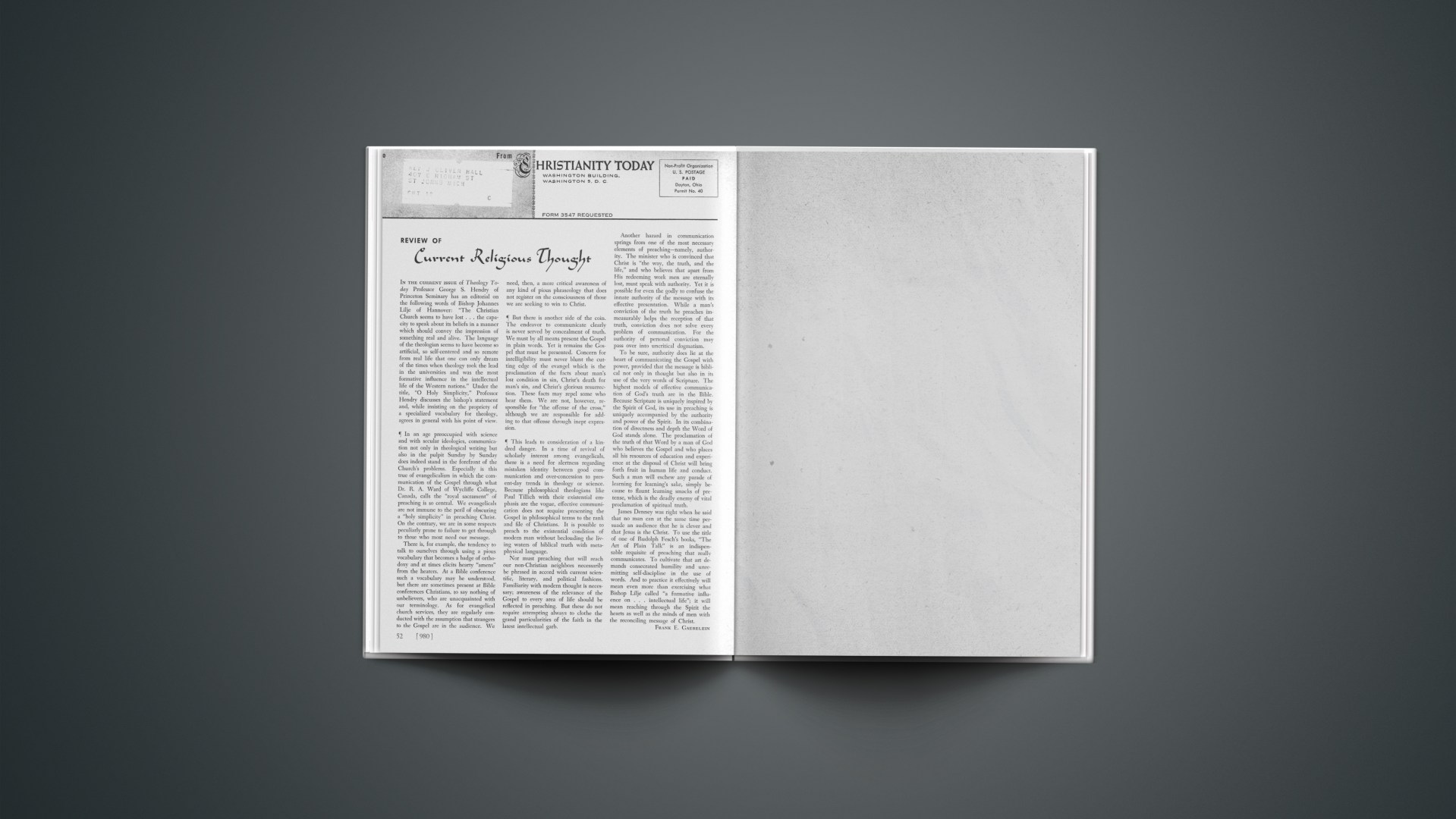
Review of Current Religious Thought: August 29, 1960

In the current issue of Theology Today Professor George S. Hendry of Princeton Seminary has an editorial on the following words of Bishop Johannes Lilje of Hannover: “The Christian

Church seems to have lost … the capacity to speak about its beliefs in a manner which should convey the impression of something real and alive. The language of the theologian seems to have become so artificial, so self-centered and so remote from real life that one can only dream of the times when theology took the lead in the universities and was the most formative influence in the intellectual life of the Western nations.” Under the title, “O Holy Simplicity,” Professor Hendry discusses the bishop’s statement and, while insisting on the propriety of a specialized vocabulary for theology, agrees in general with his point of view.

In an age preoccupied with science and with secular ideologies, communication not only in theological writing but also in the pulpit Sunday by Sunday does indeed stand in the forefront of the Church’s problems. Especially is this true of evangelicalism in which the communication of the Gospel through what Dr. R. A. Ward of Wycliffe College, Canada, calls the “royal sacrament” of preaching is so central. We evangelicals are not immune to the peril of obscuring a “holy simplicity” in preaching Christ. On the contrary, we are in some respects peculiarly prone to failure to get through to those who most need our message.

There is, for example, the tendency to talk to ourselves through using a pious vocabulary that becomes a badge of orthodoxy and at times elicits hearty “amens” from the hearers. At a Bible conference such a vocabulary may be understood, but there are sometimes present at Bible conferences Christians, to say nothing of unbelievers, who are unacquainted with our terminology. As for evangelical church services, they are regularly conducted with the assumption that strangers to the Gospel are in the audience. We need, then, a more critical awareness of any kind of pious phraseology that does not register on the consciousness of those we are seeking to win to Christ.

But there is another side of the coin. The endeavor to communicate clearly is never served by concealment of truth. We must by all means present the Gospel in plain words. Yet it remains the Gospel that must be presented. Concern for intelligibility must never blunt the cutting edge of the evangel which is the proclamation of the facts about man’s lost condition in sin, Christ’s death for man’s sin, and Christ’s glorious resurrection. These facts may repel some who hear them. We are not, however, responsible for “the offense of the cross,” although we are responsible for adding to that offense through inept expression.

This leads to consideration of a kindred danger. In a time of revival of scholarly interest among evangelicals, there is a need for alertness regarding mistaken identity between good communication and over-concession to present-day trends in theology or science. Because philosophical theologians like Paul Tillich with their existential emphasis are the vogue, effective communication does not require presenting the Gospel in philosophical terms to the rank and file of Christians. It is possible to preach to the existential condition of modern man without beclouding the living waters of biblical truth with metaphysical language.

Nor must preaching that will reach our non-Christian neighbors necessarily be phrased in accord with current scientific, literary, and political fashions. Familiarity with modern thought is necessary; awareness of the relevance of the Gospel to every area of life should be reflected in preaching. But these do not require attempting always to clothe the grand particularities of the faith in the latest intellectual garb.

Another hazard in communication springs from one of the most necessary elements of preaching—namely, authority. The minister who is convinced that Christ is “the way, the truth, and the life,” and who believes that apart from His redeeming work men are eternally lost, must speak with authority. Yet it is possible for even the godly to confuse the innate authority of the message with its effective presentation. While a man’s conviction of the truth he preaches immeasurably helps the reception of that truth, conviction does not solve every problem of communication. For the authority of personal conviction may pass over into uncritical dogmatism.

To be sure, authority does lie at the heart of communicating the Gospel with power, provided that the message is biblical not only in thought but also in its use of the very words of Scripture. The highest models of effective communication of God’s truth are in the Bible. Because Scripture is uniquely inspired by the Spirit of God, its use in preaching is uniquely accompanied by the authority and power of the Spirit. In its combination of directness and depth the Word of God stands alone. The proclamation of the truth of that Word by a man of God who believes the Gospel and who places all his resources of education and experience at the disposal of Christ will bring forth fruit in human life and conduct. Such a man will eschew any parade of learning for learning’s sake, simply because to flaunt learning smacks of pretense, which is the deadly enemy of vital proclamation of spiritual truth.

James Denney was right when he said that no man can at the same time persuade an audience that he is clever and that Jesus is the Christ. To use the title of one of Rudolph Fesch’s books, “The Art of Plain Talk” is an indispensable requisite of preaching that really communicates. To cultivate that art demands consecrated humility and unremitting self-discipline in the use of words. And to practice it effectively will mean even more than exercising what Bishop Lilje called “a formative influence on … intellectual life”; it will mean reaching through the Spirit the hearts as well as the minds of men with the reconciling message of Christ.

Book Briefs: August 29, 1960

Talking Sense About The Holy Spirit

With the Holy Spirit and With Fire, by Samuel M. Shoemaker (Harper, 1960, 127 pp., $2.50), is reviewed by Paul S. Rees, Vice-President at large, World Vision, Inc.

“So much real nonsense has been talked about the Holy Spirit by some people who scorn education, and so much is missing from churches that mention Him only theologically or preach about Him at one season of the year, that I think someone must try to talk sense about the Holy Spirit, avoiding the extremes of a pedestrian Christianity that leaves Him out of practical life, or of an excessive emphasis on experiences that seem merely strange or bizarre.”

With these candid words, snipped from the “Introduction,” the dynamic and dauntless minister of Pittsburgh’s Calvary Episcopal Church begins what must be at least his twelfth book. There is first a look at “Our Situation Today.” By and large, the world is not listening to the Church; nor will it listen until again, as in the New Testament beginning of it, the Church can speak with “a freshness, a stimulus, a shining sparkle.”

This leads to a discussion of “The Experience of the Holy Spirit,” an analysis that turns out to be primarily neither theological nor psychological, but practical. “The Christian experience of the Holy Spirit,” it is pointed out, holds “awesome power and cleansing judgment.” It holds more: the conviction of a Presence that can be relied on as Helper (Paraclete), the reality of guidance, the melting down of barriers between Christians, the creation of fellowship, and being used to bring others to faith in Christ as Saviour.

“Coming Into the Stream of the Spirit” is a chapter whose brevity belies its importance. Here an Episcopal minister, without conscious effort, finds certain affinities with all those “Deeper Life” movements (so variously named) that have arisen within the life of our Christian communions through the centuries.

“The New Reformation” that the book envisages as desirable will, on the one hand, recover an emphasis on the sacraments (an emphasis excessively deflated by the historic Reformers) and will, on the other, make room for “the freedom of the Spirit as He works beyond the borders of Church or Bible” (p. 64). By “beyond” the author means more than this reviewer finds it possible to concede, but he does not mean at all what some critics will he sure to assume that he means. That no real denigration of Scripture and Church is intended may be seen from the position clearly taken on another page: “I think that the experience of the Holy Spirit can grow individualistic and thin when pursued apart from constant absorption of the Word and constant immersion in the fellowship.”

In the chapter on “The Holy Spirit and Evangelism” the question from Paul Tillich (‘True communication of the Gospel means making possible a definite decision for or against it.’) is true enough, but one wonders about leaving the impression that Dr. Tillich is a safe interpreter of what the Gospel is in fact. The chapter sparkles with some first-rate suggestions for effective evangelistic preaching.

The freshness, candor, and verve that blow, gale-like at times, through the chapters on “The Holy Spirit and the Church” and “The Holy Spirit and the Layman” are not to be conveyed in a review such as this. The reader must feel their force for himself. This he will do, despite sentences here and there that he would like to recast to keep the truth in sharper biblical perspective.

PAUL S. REES

Criterion Of Love

Know Your Faith, by Nels F. S. Ferré (Harper, 1960, 125 pp., $2.50), is reviewed by Edward John Carnell, Professor of Ethics and Philosophy of Religion, Fuller Theological Seminary.

This is a model of concise writing. It is a summary of Ferré’s unremitting effort to define Christian theology from the perspective of self-giving love. “No book,” says Ferré, “has caused me more pain of authorship than this one.” I can understand why. The book breathes an authentic spirit of honesty and integrity.

Ferré is not easy to evaluate, however, for rather than using traditional theological language, he tends to coin expressions all his own. Sample: sanctification “denotes the process, sudden or gradual, whereby the person who has been saved in intention becomes saved in fact.” If a classical theologian has ever expressed the matter this way, I for one have never heard of him.

Since Ferré employs self-giving love as an all-encompassing criterion, he senses no necessity to be found by the exegetical limits of Scripture. He toys with the idea of human reincarnation; he argues for some sort of redemption for animals; and even in the heart of his Christology he does not seem to rise above traditional modelism. Still, he speaks with a candor that will disarm all but the most choleric reader. He attains rare heights when he develops the relation between our encounter with Christ and our fellowship with the saints.

We may disagree with Ferré; but at least he makes us earn our right to disagree. Ferré will have no truck with cheap faith.

EDWARD JOHN CARNELL

Fascinating Anthology

The Church and the Fine Arts, by Cynthia Pearl Maus (Harper, 1960, 902 pp., $6.95), is reviewed by Calvin D. Linton, Professor of English Literature and Dean of Columbian College, The George Washington University.

Anthologies would seem to be the easiest kind of book to produce. All one needs, after all, are scissors, paste, and copyright permission. But not so. Really good anthologies are notoriously rare. If, despite their diversity, they are to possess a true unity and a clear point of view, the anthologist must have a critical judgment which is at once broad and deep—broad enough to appreciate widely differing artistic purposes and effects, and deep enough to distinguish the truly excellent. Above all, he must hold criteria of admission which are rigorously defined and ruthlessly imposed.

This volume, while interesting, possibly useful, and astonishingly varied, is not, by these standards, a good anthology. Granted its vast purpose, it really could not be, for it sets out to cover (I quote the word) “the growth and development of the Church through nearly twenty centuries of Christian history, from the viewpoint of the four major fine arts: pictures, with their interpretations; poetry; stories; and music, in the form of hymns, canticles, and chants.” To do this, it calls on literally hundreds of authors.

Small wonder, then, that even with 900 pages available, less than two, on the average, can be devoted to each entry; small wonder that no single standard of taste can emerge. The poetry of John Milton joins that of Clarice White Luck and Walt Whitman; the prose of Erasmus shares space with that of Honomi Nagati; Raphael gives way to a photograph of the Kimpese Christian Institute in the Congo.

Fortunately, a sensible and consistent pattern of organization is used to channel this flood of droplets. Five different “specialists in the field of church history and the fine arts” handle the six major divisions: The Apostolic Church of the Palestinian Area; The Eastern Orthodox Church; The Roman Catholic Church; The Protestant Reformation in Europe; The Protestant Church in North America; and Christianity, A World-wide Religion. Within each section the sequence of entries is: Pictures, Poetry, Stories, and Music—the last given with music as well as words.

It is a fascinating volume to dip into. One cannot safely expect to find in it something particular in which he is interested, but he will usually be interested by something he did not expect to find.

CALVIN D. LINTON

Modes Of Thought

In the Twilight of Western Thought, by Herman Dooyeweerd (The Presbyterian and Reformed Publishing Co., 1960, 195 pp., $3.50), is reviewed by Gordon H. Clark, Professor of Philosophy, Butler University.

According to the author, all philosophers construct their different theories on the common ground of objective fact. These facts are not ordinary facts, such as the discovery of America or the sum of two numbers, but they are the “structural data” from which philosophy starts and to which it must conform. “One of the first structural data of human experience is the fundamental modal diversity of this experience.… My transcendental view of the mutual relation between the fundamental modes of experience is capable of verification by’ those who do not share my starting point” (p. 57).

These irreducible modes, which all philosophers must accept, seem to be 15 in number. “Our temporal empirical horizon has a numerical aspect, a spatial aspect, an aspect of extensive movement … followed by the economic, aesthetic, juridical, and moral aspects, and finally by the aspect of faith or belief” (pp. 7, 122).

The failure of other systems of philosophy, not only ancient pagan and modern secular philosophies but also the nominally Christian philosophies of Augustine and Aquinas, derives from their “absolutizing” of one or another of these fifteen modes.

For example, time has usurped faith, so that some ask whether the days of creation are 24-hour days or six geological ages. These days are neither the one nor the other, for “God’s creative deeds surpass the temporal order.… It was God’s will that the believing Jew should refer his six work days to the six divine creative acts … and it eliminates the scholastic dilemma concerning the exegesis of the six days of creation …” (pp. 150–151). Thus Scripture is not to be taken literally or univocally, for some of the Scripture is just legend (p. 68), but it is to be interpreted “analogically.” The analogical meaning apparently comes in a revelation. Creation, and presumably other parts of Christian belief, are not to be understood intellectually, but are revealed in our “heart.” This revelation “does not occur in any individualistic way, but in the ecumenical communion of the Holy Spirit …” (p. 186).

Not having had the same revelation as the author, the reviewer wonders whether the universe has had a finite past in astronomical time, or whether it is as eternal as God.

GORDON H. CLARK

Missions Classic

The Progress of World-Wide Missions, by Robert Hall Glover, revised and enlarged by J. Herbert Kane (Harper, 1960, $5), is reviewed by Harold Lindsell, Dean of the faculty, Fuller Theological Seminary.

This book, which was originally written by Robert Hall Glover, served a very useful purpose over many years as a textbook in the history of missions. It has needed revising for some time and the task has been undertaken by J. Herbert Kane of the Missions Department, Barrington College in Providence, Rhode Island.

The book has been brought up to date in the latter sections so that it has become usable once again for those who are interested in a history of missions. The statistical charts at the end of the book are helpful and the enlargement of the bibliography is all to the good. There are some titles which are missing, but in general there is a distinct improvement in the updating of the book.

The volume would be useful not only in college missions classes, but also for ministers who desire a source of reliable and easily obtained information about the various mission fields of the world.

HAROLD LINDSELL

Effective Preaching

Dynamic Preaching, by James W. Clarke (Revell, 1960, 128 pp., $2.50), is reviewed by Ben L. Rose, Professor of Pastoral Leadership and Homiletics, Union Theological Seminary (Virginia).

In the preface, the author correctly affirms that this is “not another work attempting to deal with the whole field of homiletics,” but it enforces three special truths. Belief in these truths, Dr. Clarke feels, is vital to effective Christian preaching.

The truths are: (1) “While the preaching of the Word is not the minister’s exclusive task, it is his supreme one”; (2) “The true and able Christian preacher is the most significant man in the community …”, and (3) “The bedrock on which Christian preaching builds is the devotional life of the minister.”

Each of the three sections of the book develops one of these three truths.

While little of the content is new, it is presented in a fresh and captivating style. The material is well organized and well illustrated, which makes the book easy to read.

The reviewer laid the book down with a new sense of gratitude for the glory of the task to which he had been called and with a new determination to hold himself with stricter discipline to his spiritual preparation.

Every preacher should read at least one book of this nature every year.

BEN L. ROSE

Medieval Song

The English Carol, by Erik Routley (Oxford, 1959, 272 pp., $5), is reviewed by F. R. Webber, Author of A History of Preaching.

To most Americans a carol suggests a picture of four singers and a fiddler, all dressed after the manner of Micawber, and standing before a British pub (the Boar’s Head or the Hare and Hounds), and all singing “God rest ye, merry gentlemen.” Dr. Routley, of Mansfield College, Oxford, assures us that the carol is much more than this. A carol is usually of Medieval origin, whereas a hymn is usually the product of the Reformation. A carol is not necessarily an act of praise to the Lord. It may be simply a joyous song of Christmas or Easter. This explains some of the curious things that came to us by way of England, such as “As Joseph was walking,” “God rest you, merry gentlemen,” “I saw three ships come sailing in,” and such German carols as “O Tannenbaum,” and “We gather ‘round the Christmas tree.” A carol may be seasonal, but it is not always especially religious.

Dr. Routley includes the history and the text of many carols. He tells us of the vehement efforts of the Puritans to suppress carol singing. The book contains several interesting illustrations, among which is one of Loughborough Pearson’s majestic Truro Cathedral, which is so hemmed in by other buildings that only its top is visible. It is not true, however, that the ancient church of St. Mary was demolished. Much of it stands intact, and forms the south aisle of the modern cathedral. Here the famous “Service of Nine Lessons and Carols” originated.

F. R. WEBBER

Togetherness For What?

The Social Sources of Church Unity, by Robert Lee (Abingdon, 1960, 238 pp., $4.50), is reviewed by Cary N. Weisiger, III, Pastor of Mt. Lebanon United Presbyterian Church, Pittsburgh, Pennsylvania.

Carrol M. Shanks, president of the Prudential Insurance Company of America, spoke recently in Pittsburgh at an annual brotherhood dinner of the National Conference of Christians and Jews. Citing the large-scale migration of Americans today as a cause of rootlessness, he said many “live on the surface of our society rather than in it.”

The reviewer cannot help putting the observation alongside of the thesis which Dr. Lee ably establishes in his book that social and cultural forces are thrusting unity upon us. Almost any pastor, except those in isolated pockets of rural and urban life, knows that new people in his parish area appraise him, his youth program, and his church’s location as decisive factors in the choice of a church home. Too often convenience, not conviction, brings new members. Probably most of us pastors soft pedal denominational distinctives to win new members. We build up a reserve of hearty welcomes. “Yes,” we say to the new Methodist family, “we need Methodist fire in our Presbyterian program”; or, “Lutheran solidity”; or, “Baptist loyalty.” Other appropriate flattery can be thought up as occasion requires.

Dr. Lee, Assistant Professor of Church and Community at Union Theological Seminary (New York), gives competent documentation of the reduction of old differences of race, section, and nation. The broadening of the middle class in the last generation and the standardizing of eating, dressing, and thinking habits have aided the centripetal tendency now manifested in church councils, mergers, reunions, community churches, and comity processes.

Dr. Lee is not disturbed by the resurgence of sectarianism (Assemblies of God, Church of the Nazarene), the renewal of fundamentalism (the National Association of Evangelicals), and the non-ecumenical Southern Baptist Convention. Such instances, by parallel tendency to the ecumenical movement or by resistance to social change, support his thesis.

So where are we going in our ecclesiastical togetherness? This is the big question provoked by Dr. Lee’s book and with which he does not pretend to deal. Is church unity a surface phenomenon of a people without depth of feeling? Will “common-core Protestantism” become so dogmatically diluted that it will be empty of real biblical and Christian content? Can we redeem the trend by bringing into it the strength of our best and most central denominational convictions? These questions clamor for consideration.

CARY N. WEISIGER, III

Evolution And Creation

Darwin, Evolution, and Creation, edited by Paul A. Zimmerman (Concordia, 1959, 231 pp., $3.95), is reviewed by Thomas H. Leith, Associate Professor of Science and Mathematics, Gordon College.

Here is a book to commend and condemn. It is to be commended as one of the most complete surveys available of all areas of the relationship of evolutionary thought to the Christian faith. Written by a group of Lutheran scholars, it is packed with the useful references, interesting facts, and thought-provoking ideas of the diligent student. There are competent articles on the past and present ideas of the origin and history of life, on the exegesis of Genesis chapters 1 and 2, on the presumed evidences for creation in nature, on the supposed evidences for evolution, on the age of the earth, and on the social and philosophical influences of Darwinism. It is to be condemned as not quite fair. The authors are opposed to much that they see in a century of evolutionary biology and its attendent philosophies. One may or may not agree with their conclusions, but the fallacious arguing they often use to get themselves there is thoroughly disagreeable. It leaves their claims often without valid demonstration.

Space forbids detailed analysis, but I shall review several widespread misconstructions. Perhaps the most glaring one is to argue that because evolution “has failed to achieve the absolute and factual” it is to be rejected. Apart from the fact that theories are never proven, this statement ignores their true role in science which is to synthesize data and suggest future experiments. Competitors who best achieve this gain the adherence of the majority of the scientific community. Evolutionary theories have survived this test for a century. Furthermore, disagreement on detail or unanswered problems does not provide grounds for rejecting a theory if no competitor can do as well. Some sort of evolution is the working hypothesis of almost all biologists, and there is no ground for a falling away.

Another fallacy presented is the thesis that nature provides a strong argument for creation as against “blind chance.” As expressed, the argument not only grossly misunderstands probability, but evidence for creation (logically impossible) is confused with arguments for design, and the whole ignores the quite unacceptable nature of the latter.

Then there is special pleading. Arguments generally used to defend evolution are criticized, but the genetic and paleontological case is mutilated by ignoring obvious disagreements with the critique presented. Again there is guilt by association. There are many examples which I could give here, but the final chapter on social Darwinism is most pertinent for discussion. Because of the gross philosophical, sociological, and theological ideas of varied evolutionists, the scientific thesis is rejected, and that this thesis in no way necessitates most of its misuse in the former ideas is forgotten. And again, the chapter on the age of the earth is one long fallacy of converse accident. One is asked to hold reservations about methods of age determination and dates obtained by taking unusual cases and precautionary statements in the literature and generalizing about them. This chapter is thoroughly misleading to the uninitiated, and I know no expert who would willingly accept its thrust.

Finally, although there is a most informative and thorough survey of pertinent biblical passages on the history of the world and the life on it, the writer so confuses the exegesis by an unconvincing literalness, an attempt to label those who differ as compromisers, a failure to see that even evolutionists believe in life reproducing “after its kind,” and a confusion of a scientific view of man as “nothing more” than animal with a necessary rejection of man as seen in Scripture, that he makes his whole position appear dubious.

This could have been a fine hook, and it still is useful, but it vitiates many of its possibilities with a coloring that can do little more than perpetuate the misunderstanding that has permeated 100 years of the dialectic.

THOMAS H. LEITH

Exposition On James

The Work of Faith, by Spiros Zodhiates (Eerdmans, 1960, 223 pp., $3.50), is reviewed by Walter W. Wessel, Professor of Biblical Literature, North American Baptist Seminary.

This is the first of three proposed expository volumes on the Epistle of James. The author is a Greek and prepared his studies under the auspices of the American Mission to Greeks.

The present volume contains 44 expositions on James 1:1–2:13. A warm devotional spirit pervades the treatment of the text. The author’s aim is to apply the message of James to practical life.

My basic objection to the book is its forced exegesis performed under the guise of a knowledge of the underlying Greek text. The author says, “As we scrutinize every word in the original Greek to get the utmost out of it we are really amazed at the discoveries we make” (p. 37). His amazement is shared by the reader when, for example, he categorically states that the lesson the Holy Spirit wishes to teach us in James 1:21 by the use of the word rhuparia, “filthiness” (a cognate of rhupos, “wax”), is that “sin in our lives is like having wax in our ears; it prevents the word of truth from reaching our hearts” (p. 105). Now this is an interesting idea and may have devotional value, but there is not a shred of evidence that rhuparia has anything to do with wax (cf. Arndt-Gingrich and Mayor’s rejection of this idea). There are all too many cases of such exegesis in the book.

WALTER W. WESSEL

Bishop Of Souls

Spencer Leeson: Shepherd, Teacher, and Friend. A Memoir by some of his Friends (SPCK, London, 1958, 149 pp., 15s. 6d.), is reviewed by Philip Edgcumbe Hughes, Editor of The Churchmen.

All who knew Spencer Leeson loved him and looked up to him, and to them this brief memoir will be more than welcome. It is indeed all too brief, even though it is intended to be a reminiscence rather than a biography. Yet this brevity must, in some measure at least, be attributed to the essential humility of Spencer Leeson, who, regarding the details of his life as of little moment, had purposely destroyed all records and letters in his possession so that the writing of a typical biography might not be possible. There must, however, be in existence many documents in the files of the institutions he served and letters written by him to others, which would afford material for a fuller study of this outstanding man.

After a disappointing start, the memoir gains momentum and presents a portrait of some warmth and vitality. The work of his life may perhaps best he described as pastoral, both in school-mastering—to which more than 20 years were devoted, notably as headmaster in turn of two great “public” schools, Merchant Taylors’ and Winchester—and in the final 10 years as Rector of St. Mary, Southampton, and Bishop of Peterborough successively. A notable feature of his excellent Bampton Lectures on Christian Education (1944) was the emphasis he laid on his conception of the teaching profession as a pastoral vocation, the chief task of which is to lead children to faith in Christ. His heart was that of a pastor, giving himself in affection and understanding to others.

In reply to a question concerning what he considered the three main qualities of a headmaster, he once said: “Spiritual leadership, intellectual distinction, and administrative ability—very definitely in that order.” Another thing he insisted on, as head of a school and as head of a diocese, was accessibility: “You must not become a distant inaccessible figure in an office,” he advised a young man about to become a headmaster. “If there is a danger of that, you must alter the whole organization of the school to prevent it.” Certainly no bishop was more accessible to his people than Spencer Leeson—concerned for the welfare of their souls, and respecting their dignity as persons, conscientious in the performance of his duties, entirely free from pomposity, loving and lovable, a true father in God to all. What a wonderful Archbishop of Canterbury he would have made! But it was not to be. As the present Archbishop says in his foreword to this book: “Because he was an enthusiast with a passionate devotion to his friends, to all under his care and to every good cause, he drove himself mercilessly to a premature end.… He changed little in his working life. From first to last he burned with the same bright and incandescent flame.”

PHILIP EDGCUMBE HUGHES

Baptist Evangelism

Basic Evangelism, by C. E. Autrey (Zondervan, 1959, 182 pp., $2.95), is reviewed by Faris D. Whitesell, Professor of Practical Theology, Northern Baptist Theological Seminary.

What is the secret of Southern Baptist expansion? The answer is evangelism, and here’s the book that outlines the theology, the principles, and the practices of Southern Baptist evangelism.

Written while he was occupying “the chair of fire,” the professorship of evangelism at Southwestern Baptist Seminary, Fort Worth, Dr. Autrey has since become director of evangelism for the Home Mission Board of the Southern Baptist Convention, which means their number one man in evangelism.

Believing that a sound, scriptural theology is essential to vital evangelism, the author gives the details for planning and executing all major phases of local church evangelism. Not confusing evangelism with “do good” projects, Autrey says, “Evangelism is not everything we do. One might conceivably spend all his time doing good and never evangelize. Moral righteousness is not evangelism. One never evangelizes until he stands directly before the heart’s door of a sinner and clearly confronts him with the Gospel of Christ” (p. 27).

Everything about this book is good, but readers familiar with the literature of evangelism will find little that is new. The style is somewhat tame, lacking both fire and fervor, but the strength of the volume lies in its strong scriptural undergirding, its earnest tone, its clear handling of every idea, and its complete coverage of those tried and true evangelistic principles and methods that are rapidly making Southern Baptists the largest non-Catholic denomination in America.

FARIS D. WHITESELL

Protestant Broadcasting Faces More Cutbacks

Religious radio appears to be in for even harder times.

New curtailments on paid religious broadcasts go into effect this fall, forcing more programs off the air. Hundreds of big stations now refuse to sell time for religious programs.

Latest to announce a cutback is the American Broadcasting Company radio network, which has the nation’s second largest chain of station affiliates. ABC has dropped four of its eight paid religious programs, including the Oral Roberts broadcast.

Network spokesmen say that failure of local stations to air the programs is responsible for the move, which follows a creeping trend toward general elimination of paid religious broadcasting. The trend runs in accord with National Council of Churches policy favoring bloc allocations of free time to major religious groups instead of individual sales to religious broadcasters. Evangelicals generally oppose such an either-or arrangement, but radio stations have asserted a right to refuse to sell time. Even though the broadcasting industry is federally-regulated, no religious broadcaster has thus far been able to prove his legal right to radio time.

A strong argument against paid religious broadcasting revolves on the poor quality of some programs which have been aired under such an arrangement. Once the time is sold, stations have no control over amateur producers who may alienate an audience.

Paying broadcasters will counter with the assertion that the free time concept does not guarantee quality programming inasmuch as there is no agreement on what constitutes good religious radio.

Another consideration: size of audience is not in itself a fair measure of religious program effectiveness.

Faced with the loss of radio time on commercial stations, some Christian groups are looking to stations all their own. A number of these have been springing up around the country, eight of them having already announced plans for an “inspirational network.”

Some evangelical groups are even launching into television. A non-profit Christian organization headed by radio evangelist Percy Crawford purchased the facilities of an ultra high frequency station in the Philadelphia area and began daily telecasts this summer.

Two Analyses Of Religious Broadcasting

Protestant broadcasting suffers from the lack of a master strategy, according to Charles Brackbill, Jr., executive director of radio and television for the New Jersey Council of Churches.

“It is a picture of confusion, waste, out-dated and incredibly dull programming,” he says, charging that individual producers follow patterns that seem right in their own eyes and fail to cooperate with other broadcasters.

Brackbill asserts that the Protestant ministry has failed to keep pace with developments in radio.

“Preachers could always preach,” he declares, “and they have been doing it on radio since the first religious broadcast. All during radio’s heyday of great variety productions, they preached. And now that radio has its strength back, religious broadcasters still preach. They haven’t moved backward, they just have not moved.”

Brackbill suggests that Protestant broadcasters should cooperate if only because they have in common so many problems, such as: (1) ineffective programming, (2) schedule extremities (“And it’s our own fault … The ‘public interest, convenience and necessity’ clause of the Communications Act will not protect our poor programming forever”), (3) mercenary motives, (“If a Congressional committee ever investigates the deceit and chicanery of some religious broadcasting, there will be a bigger scandal than that of the recent payola exposures”), and (4) denominational pride (“We ought to decide whether we are selling individual automobile brands or transportation”).

“Too much money is being spent to ‘save the lost’ by programs which the ‘lost’ never listen too,” according to Brackbill. “Often the whole program is pitched to the ‘beloved in Christ’ and then to ‘O sinners’ in the last 30 seconds. The ‘dear Christian friends’ must never stop praying for God to bless the program in its soul winning, or to send in the money on the chance that a ‘lost one’ will tune in.”

He charges that many Protestant broadcasters gear their programs to Christian supporters, fearful of abandoning “successful” formats.

“Radio today has changed drastically since its pre-television days.… Today on radio you move goods, sell services, and create good will, not by ‘programs’ as such but by short capsule messages repeated over and over to reach as many kinds of people as possible. With few exceptions, the only sponsors of 15-minute or longer programs these days are religious groups. So long as they are willing to pay, many radio station operators just smile and take the money.”

Brackbill suggests that Protestant broadcasting groups (1) call a “summit conference” of highest-echelon churchmen to coordinate broadcasting aims on an interdenominational scale, (2) establish an experimental study center to eliminate guess work, (3) set up, after study, local production priorities, and (4) seek to discover what could be the function and structure of an inclusive Protestant broadcasting agency.

The need of the hour is for more “programs dedicated to the moral and spiritual upbuilding of America,” says Dr. Eugene R. Bertermann, executive director of the Lutheran Church (Missouri Synod) Foundation and for 24 years the director of the famous “Lutheran Hour.”

How does Protestant broadcasting measure up?

“Sometimes the caliber of the program content leaves much to be desired,” Bertermann declares. “As a result, the audience level drops drastically, and station managers conclude that religious broadcasts must be relegated to marginal hours and minimal schedules. Regrettable, too, is the fact that some broadcasters have employed the vehicle of a religious program for personal profit. At the same time, however, it must be asserted that the vast majority of Protestant broadcasters are dedicated servants of Christ, earnestly determined to utilize effectively the twentieth-century miracles of radio and television for the proclamation of the Gospel.”

Program quality must ever be stressed, he says, for “the religious broadcast is not ‘good radio’ or ‘good television’ simply because it has as its purpose the salvation of human souls.”

“The radio and television industry has, on the basis of sound experience, developed proven principles of broadcasting which help to insure an effective presentation and, through the Holy Spirit’s power, help to attain blessed results in the lives of listeners,” Bertermann declares. He adds: “In preparing his radio or television program, the religious broadcaster has often been pictured as confronted by a two-fold dilemma: he will obtain either a maximum audience for a minimum message, or a minimum audience for a maximum message.

Actually he desires neither alternative; he wants maximums all down the line!”

As a means of silencing critics who picture the religious broadcaster as a “huckster,” Bertermann proposes issuance of periodic public financial statements. He urges evangelical Christians, moreover, to support continued access to the broadcasting media by Gospel broadcasters. “We heartily commend the granting of sustaining time, but we assert the basic freedom of a station to sell religious broadcasting time and the basic right of anyone to buy it.”

Does Bertermann suggest means specific of raising religious standards?

Yes, he says, by seeking and applying principles drawn from surveys and studies and by utilizing capably-conducted radio and television workshops and seminars throughout the country.

Finally, according to Bertermann, “a master strategy for Protestant broadcasting must have as its very cornerstone the positive proclamation of Bible truth, the preaching of the historic Protestant faith, and the fundamental biblical doctrines.

“An abundant measure of the Holy Spirit’s power accompanying the broadcasting of the Word will prove it to be ‘the power of God unto salvation to everyone that believeth.’ ”

Protestant Panorama

• Special services this month commemorated the restoration of Trinity Church—said to be America’s oldest with an active congregation—near Church Creek, Maryland. The church, now Protestant Episcopal-affiliated, dates back to about 1675.

• The Protestant Chapel Choir of Wright-Patterson Air Force Base (Ohio) is the winner of the U. S. Air Force’s 1960 chapel choir contest.

• A Georgia pastor is demanding the ouster of any member of his church who has signed a petition for a local referendum on beer sales. Dr. E. B. Shivers of the Central Baptist Church, largest in the city of Gainesville, says he is acting in accordance with the church covenant.

• Ground was broken this month for a $3,000,000 Assemblies of God administration building in Springfield, Missouri. Occupancy is scheduled for December of 1961.

• Consolidated Presbyterian College, to be opened next year by the North Carolina Synod of the Presbyterian Church in the U. S., will require all students to take a “Christianity and Culture” course during each of their four years.

• Theological schools in Africa and Asia will get the bulk of current grants totalling more than $1,000,000 under the International Missionary Council’s Theological Education Fund program. The grants are the latest of a series under the program established in 1958 by the Sealantic Fund and eight Protestant mission boards.

• A gigantic retirement center is planned in St. Paul, Minnesota, to be sponsored jointly by the Lyngblomsten Society and a group of Evangelical Lutheran Church congregations. Some 1,000 residents are expected in a decade. The cost of building may run as high as $10,000,000.

• The Navigators, Protestant lay organization which stresses Bible study and personal witness, will send representatives to 10 new areas this fall, including Beirut, Karachi, The Hague, Frankfort, Kenya, and Toronto.

• A key tourist attraction in Nashville, Tennessee, this summer is the Upper Room Chapel. The chapel features a giant woodcarving replica of Da Vinci’s “Last Supper” plus a striking stained-glass window symbolizing Pentecost.

• A merger of four church groups gives South African Lutherans a 160,000-member association known as the Evangelical Lutheran Church of the Zulu-Xhosa-Swazi Region. Lutheran statistics, which show a slight loss this year because of a reported membership drop in East Germany, now credit the world’s largest Protestant confession with a constituency of 71,101,780.

• Protestants travelling through Brussels may hereafter avail themselves of the services of the “International Christian Fellowship Center,” which has been opened with funds derived from the sale of the Protestant Pavilion of the Brussels World’s Fair to the American Church at The Hague, The Netherlands.

• The Jungle Aviation and Radio Service, technical arm of Wycliffe Bible Translators, is establishing its international headquarters in Charlotte, North Carolina. Larry Montgomery, veteran missionary pilot and mechanic, is director.

• The Church of the Nazarene is sponsoring four regional missionary conferences in September: in Indianapolis, September 5–6; in Charleston, West Virginia, September 8–9; in Dallas, September 12–13; and in Phoenix, Arizona, September 15–16.

• A number of Protestant groups are represented at this year’s Canadian National Exhibition, being held in Toronto. In all there are 12 religious groups on the grounds of the world’s biggest annual exhibition: the Oriental Missionary Society, the Salvation Army, the Upper Canada Bible Society, the Lutheran Laymen’s League, the Baha’is of Canada, Gideons International of Canada, World Vision of Canada, the Fellowship of Reconciliation, the Christian Businessmen’s Association, and three Roman Catholic organizations.

Enter ‘Kneel-ins’

“Kneel-in” demonstrations will spread across the South in coming weeks, according to a spokesman for a group which initiated the campaign August 7 when Negro college students attended Sunday services at six white Protestant churches in Atlanta.

Agenda: Doctrine

Delegates to the 46th convention of the Lutheran Synodical Conference in Milwaukee this month voted to call a special adjourned session for next Spring. The agenda: doctrinal differences which have threatened to disrupt the 88-year-old conference.

Such a recessed meeting had been suggested by the presidents of the four synods comprising the conference (the Lutheran Church—Missouri Synod, with 2,400,000 members; the Wisconsin Evangelical Lutheran Synod with 350,000 members, the Synod of Evangelical Lutheran Church [Slovak] with 20,000 members, and the Evangelical Lutheran Synod [Norwegian] with 15,000 members).

The doctrinal dispute centers on accusations by the Wisconsin and Norwegian synods that the Missouri group pursues unscriptural cooperation with other church bodies.

Moments before the recess was requested, the convention approved a compromise proposal aimed at relieving tension by calling for a study of the dispute by foreign theologians representing conservative Lutheran churches in doctrinal harmony with the synodical conference. A preliminary report from the study committee is scheduled to be made in November.

Also approved was a resolution asking the four synods to express their desires regarding possible creation of an international federation of confessional Lutheran groups.

The Rev. John Daniel was elected conference president, succeeding Dr. John S. Bradac, whose health forbade him to run for re-election.

There were approximately 300 voting delegates and 100 advisory members on hand for the Milwaukee meeting. Among other actions they voted to close Immanuel Lutheran College in Greensboro, North Carolina, and to build a $1,000,000 campus at Selma, Alabama. This project will be a four-year high school and a two-year junior college. The new school will be primarily for Negroes, as is the present Immanuel Lutheran College.

Re-entering Congo

As of the middle of August, Protestant missionaries who had evacuated the strife-tom Congo were slowly returning, urged on by appeals such as one received by Dr. C. Darby Fulton, executive secretary of the Presbyterian U. S. Board of World Missions. The letter to Fulton from Congolese Christians cited, in halting English, the “necessity” of having the missionaries return.

“We ask you to get them back in Congo immediately,” the letter said.

During his visit to North America this summer, Congolese Prime Minister Patrice Lumumba said that missionaries had done much for the “moral and intellectual upbringing” of his people.

“We want the missionaries to remain,” he said. “For years it was only the missions who looked after the Congolese. We ask them to continue their help.”

The Swiss Catholic press agency KIPA said, however, that it had secured a copy of a “secret instructions” document issued to militants of the Congolese National Movement singling out Christian missionaries as the “greatest enemy” of the people. The document apparently was issued before the proclamation of independence. Lumumba was head of the Congolese National Movement.

Mission Medicine

Sixteen U. S. medical students are gaining clinical experience by working at Protestant mission hospitals this year.

They are spending an average of 12 weeks at their remote posts, having won financing fellowships under a program made possible by the Smith Kline and French Laboratories of Philadelphia. A total of 29 U. S. medical students are going to various foreign hospitals and dispensaries under the program for 1960. Others will compete for similar fellowships in 1961 and 1962, all of which are to be paid from a $180,000 Smith Kline and French grant being administered by the Association of American Medical Colleges.

These are the Protestant institutions where the students are being assigned: the Bangkok, Thailand, Christian Hospital (Presbyterian); the McCormick Mission Hospital in Chiengmai, Thailand (also Presbyterian); the Mari Baptist Hospital in the Philippines; several Southern Baptist hospitals in Nigeria and Southern Rhodesia; several Methodist clinics in Bolivia; the Methodist Ganta Mission Hospital in Liberia; the Methodist Washburn Memorial Hospital in Southern Rhodesia; St. Theodore’s Episcopalian Hospital in the Philippines; the Takum Christian Hospital in Nigeria; and the Seventh-day Adventist Hospital at Bandung, Java.

Bethel Expedition

Archaeologist James L. Kelso says his expedition at the site of ancient Bethel this summer turned up the “altar” where early Canaanites sacrificed their animals. Kelso, a professor at Pittsburgh Theological Seminary, directed the expedition conducted jointly by the seminary and the American School of Oriental Research in Jerusalem.

The high place (altar) was located atop a hill at what is now Beitin, Jordan.

“At many points along an area of 50 feet, we noticed what appeared to be blood stains,” says Kelso. “We applied an FBI test at 10 points for identification of blood and secured a positive reaction each time.”

He describes a small temple built nearby whose proportions are similar to that of a tabernacle, the length being about three times the width.

“The earliest use of the high place which we were able to double check with pottery was about the twenty-second century B.C., although some shards dated back even further,” Kelso reports. “The temple was definitely still in use in Abraham’s time. The old Canaanite god El was worshipped here, and since it was a major sanctuary dedicated to his honor, the city was called Bethel (Beth-El).

This was Kelso’s fourth season at Bethel. He was assisted by Professor Theol M. Taylor.

Court Acquits Vocal Worshipper

Dave Van Ness shouted “praise the Lord” so often during an Apostolic church service at Hudson Bay, Saskatchewan, that other members took the case to court. He was acquitted last month of a charge of disturbing a religious gathering.

While agreeing that Van Ness could be a nuisance to others in the church, Magistrate Robert Macara ruled that the ejaculative member had not violated civil law.

Pastor Maurice Fuller said Van Ness had the habit of declaiming at great length during the time in the church service given over to testimonies. The congregation’s ruling body had decreed that the man could not speak in church or take part in church activities.

At a July 15 service the accused repeatedly shouted: “Praise the Lord. Amen.” Eventually, the pastor had to abandon the service. Fuller said Van Ness shouted the words even when they did not apply and disturbed the spirit of worship.

Van Ness, producing receipts to show he had made substantial contributions to the church during the last year, said his only purpose was to pray and sing.

In testimony prefaced by a prayer in which he led the court, he tried to quote lengthy passages from the Bible but was restrained by the magistrate.

“This is a most peculiar situation,” the magistrate said. He suggested that church authorities consult their legal advisers to seek some way to promote harmony.

J.N.

Correcting Mistakes

The American Friends Service Committee, world-wide Quaker welfare agency, reportedly plans to study and correct “mistakes,” following allegations that the AFSC has been infiltrated by “very pink” admirers of communism.

The Indiana Yearly Meeting of the Society of Friends, headed by Dr. D. Elton Trueblood, noted professor of philosophy at Earlham College, said it was pleased that the AFSC will undertake the self-examination.

Dr. Trueblood, clerk of the meeting, earlier had called for a “house-cleaning” of alleged un-American elements from the committee. Sharing in an effort to arrive at a “creative decision” on the problem, he said, were Dr. Landrum Bolling, president of Earlham; and Dr. William Cullen Dennis, president emeritus.

“The AFSC has done an outstanding humanitarian work,” Dr. Trueblood told the Indiana Meeting. “But persons who believe in peace at any price and are strong admirers of the Communistic system have been able to work their way into the committee.”

Dr. Trueblood said the Friends had received many complaints about a youth camp near Richmond, Indiana, sponsored by the committee this summer. He said the complaints alleged that high school youths were told that the Russian system was better than the democratic way of life and that the United States was responsible for the attack on Pearl Harbor that started World War II.

‘I Am a Protestant’

Wallet-size cards identifying the carrier as a Protestant are being distributed by The Protestant Council of the City of New York.

Some 80,000 have already been sent out in the New York area.

Birmingham Crusade

English evangelist Eric Hutchings is on a three-month tour of North America following a five-week crusade in Birmingham which drew an aggregate attendance of more than 120,000.

Hutchings and his “Hour of Revival” team never disclose the exact number of inquirers, but the figure is said to have been about 3,500 for the Birmingham meetings, held in famous Bingley Hall.

The evangelistic crusade was the largest in England since Billy Graham’s meetings at Harringay. Support came from all major denominations.

Hutchings, 50, has been conducting crusades since 1952. He left the business world to become an evangelist and now conducts a religious radio broadcast as well. He is married but has no children. His next crusade is scheduled for Brussels, beginning October 15.

To the East?

If evangelist Billy Graham enters the Communist sector of Berlin to hold a meeting he will be arrested, says Waldemar Schmidt, Red deputy mayor.

“Hysterical mass psychosis is not desired in socialist countries,” Schmidt declared.

Graham plans a week of services in West Berlin beginning in late September. The arrest threat came when the local committee sought permission to hold a single service in East Berlin.

The evangelist’s crusades in Switzerland are already under way. Here is a schedule of his European meetings:

Studying Liberalism

A permanent “Commission on the Study of Theological Liberalism” was created by delegates to last month’s annual meeting of the National Association of Free Will Baptists in Fresno, California.

The commission was made a permanent unit of the 200,000-member association following adoption of a commission report which warned against the infiltration of theological liberals.

“It is not enough to be relatively free from the peril now,” said the report. “Safeguards should be taken against future encroachments.”

The Rev. Ralph Staton of Belmont, North Carolina, was elected moderator.

The Five Years Meeting

Delegates to the quinquennial sessions of the Five Years Meeting of Friends, held last month in Richmond, Indiana, urged the United States to continue its moratorium on nuclear weapons testing.

Race prejudice and hatred were condemned as “spiritual and moral diseases,” the traditional Quaker stand on peace was reaffirmed, and opposition was expressed to capital punishment as violating “the Gospel we proclaim.”

The Five Years Meeting is the largest Quaker group in the world with 79,000 members in North America and more than 30,000 overseas. This constituency includes more than half of the world’s Quakers.

In other action, the delegates voted that hereafter they will meet triennially. They also decided to combine the meeting’s two publications, the American Friend and Quaker Action, into one magazine to be called Quaker Life.

Executive Secretary Colin Bell of the American Friends Service Committee reported that his group was involved in a “re-examination” of its role and relationship. The committee traditionally has been known as a world-wide quaker welfare agency.

Some 120 official delegates were on hand for the business sessions, while a worship service with Dr. Elton Trueblood drew more than 2,000 persons.

“Our trouble is having too low a goal,” Trueblood said. “We have an easy complacency and are satisfied with too little.”

The noted philosopher, a professor at Earlham College, challenged his fellow Quakers to rekindle the “blazing fire” of the 1660’s when Quakerism first came to America.

CONSERVATIVE DISCIPLES HOLD LARGEST CONVENTION

Burgeoning growth of the evangelical wing of the Christian Churches (Disciples of Christ) was dramatically demonstrated in the North American Christian Convention, Columbus, Ohio, July 12–15. More than 5,000 ministers and lay leaders made up the largest convention turnout in the NACC’s 34-year history.

Disciples, since their beginnings in 1809, have been strongly congregational in polity. Their national agencies have been voluntary in character and there was nothing unusual when evangelicals launched a national gathering in 1927 which had as its sole avowed purpose to exalt Christ and his Gospel and declare the cardinal doctrines of the apostolic church. The NACC seeks in no way to duplicate the ministry of the International Convention of Christian Churches.

The Columbus gathering did no politicking, passed no resolutions, promoted no agency programs and transacted no business except that necessary to provide a 1961 convention at Wichita, Kansas. There was, however, a gripping sense of evangelical commitment and purpose in all the proceedings. Program planners covered every phase of the functioning church in sermons, addresses, panel discussions, forums, and workshops—a veritable seminar of immense practical value in building the Kingdom.

“Jesus Christ is Lord of All” was the convention theme—Lord of Creation, Lord of Life, Lord of the Church. Edwin G. Crouch, well-known Indiana attorney and first lay president of the convention, keynoted this idea on the opening night. He asserted that “all the doctrinal difficulties in the church may be traced to the ignorance or indifference of laymen.… If the people in the churches knew their Bibles and respected the authority of Christ they could never be blown astray by popular winds of doctrine that blight and destroy the true faith.” University of Tennessee atomic scientist George Schweitzer stirred the convention with appeal for the Church to “get into orbit around Christ the center of all creation.” He characterized Christ as earth’s first visitor from outer space, who must eventually subdue all the earth to the glory of God. Ard Hoven, Lexington (Kentucky) pastor and “Christian Hour” radio preacher, gave the closing message on “Christ the Lord of the Church” in which he asserted that the only valid ecumenicity is to be found “in the pattern of the New Testament Church which was founded by Christ, grew and prospered under the personal direction of the Holy Spirit and the Apostles.”

NACC attendance was augmented this year by joint sessions with the National Christian Education Convention, concerned chiefly with Bible school work. There was much sentiment for a continuation of this arrangement.

Over 80 exhibits at Columbus reminded delegates and visitors that evangelical Disciples support more than 500 missionaries at home and abroad, more than 30 Bible colleges and seminaries, an immense publishing program and many other cooperative enterprises.

In effort to avoid the pitfalls of centralized authority over local congregations, the NACC has failed to give strong leadership to the million or more numbers in evangelical constituency. Growing problems confront the “brotherhood” such as responsibility in missionary activity, higher education, ministerial training standards, legal rights of local churches, inter-church cooperation, church extension, ministerial pensions, chaplaincy appointments, adequate national radio and television broadcasting media. Whenever these and other practical issues arise conservative Disciples have a big “blind spot” in their otherwise growing vision. The convention could well provide a forum whereby these problems might be resolved, and some consensus discovered for their solution, but reactionary forces have thus far blocked progress.

A “bull session” on internal unity packed out one of the conference rooms of the Deshler-Hilton Hotel. A series of consultations were proposed looking toward better understanding and unity.

Sentiment at the Columbus confab favored establishment of communication between these two groups in an effort to promote a more effective Gospel witness and to forestall the divisive tactics of left-wing Disciples bent on centralization of authority in state and national conventions and eventual merger with the United Church of Christ.

J.D.M.

A New Campus?

Plans are under way for a multi-million-dollar expansion of Bethel College and Seminary in St. Paul, Minnesota, under authority granted by delegates to the 81st annual meeting of the Baptist General Conference in Long Beach, California, this summer.

The delegates authorized the conference’s board of education to map plans for presentation at next year’s convention in St. Paul. The campus may be moved to a new 100-acre site.

People: Words And Events

Deaths:Dr. Ralph S. Cushman, 80, retired Methodist bishop and former head of the Anti-Saloon League; in Herkimer, New York … the Rev. Peter Kwei Dagadu, 52, Methodist leader in Ghana and member of the world Council of Churches Central Committee; in Accra … Dr. Fred F. Brown, 78, former president of the Southern Baptist Convention; in Knoxville, Tennessee … the Rt. Rev. Vedder Van Dyck, 71, Episcopal bishop; in Burlington, Vermont … Dr. A. E. J. Rawlinson, 76, Anglican bishop of Derby from 1936 to 1959 … Commissioner J. Allister Smith, 96, retired Salvation Army missionary to the Zulus; in Capetown, South Africa … Dr. Frank Benjamin Fagerburg, pastor for more than 20 years of the First Baptist Church of Los Angeles; in Redlands, California … Miss Evangeline French, 91, veteran missionary in the Gobi Desert under the China Inland Mission.

Resignation: As executive secretary of the Lutheran World Federation, Dr. Carl E. Lund-Quist.

Promotion: To the rank of Rear Admiral, Navy Chaplain Joseph F. Dreith (Lutheran Church—Missouri Synod), first Lutheran chaplain in naval history to be promoted to flag rank.

Elections: As bishops of The Methodist Church, Dr. Everett W. Palmer, pastor of the First Methodist Church in Glendale, California (Western Jurisdiction); Dr. Charles Golden, staff member of the Division of National Missions; Dr. Noah W. Moore, Jr., pastor of Tindley Temple in Philadelphia; and Dr. M. Lafayette Harris, president of Philander Smith College in Little Rock, Arkansas (Central Jurisdiction—all-Negro); Dr. James W. Henley, pastor of the West End Methodist Church in Nashville, Tennessee; Dr. Walter C. Gum, chairman of the jurisdictional committee on missions; Dr. Paul Hardin, Jr., pastor of the First Methodist Church in Birmingham, Alabama; and Dr. John Owen Smith, pastor of Bethel Methodist Church in Charleston, South Carolina (Southeastern Jurisdiction) … as president of the North American Christian Convention (Disciples of Christ), Robert O. Weaver … as moderator of the Orthodox Presbyterian Church, David E. Niland … as president of the National Association of Church Business Administrators, Leif R. Larson.

Appointments: As president of Lutheran Theological Southern Seminary, Dr. F. Eppling Reinartz … as director of the University of Hamburg, Germany, Professor Helmut Thielicke, first Protestant theologian ever to hold the post … as president of Pasadena College, Dr. O. J. Finch … as president of London (Ontario) Bible Institute, Dr. Joseph C. Macaulay … as visiting professor of ecumenics at Princeton Theological Seminary, Dr. J. Robert Nelson … as chairman of the Department of Religion at (West Virginia) Bethany College, Dr. Lester G. McAllister.

Eutychus and His Kin: August 29, 1960

!

Sue is away at camp and her correspondence has piled up in the family mail basket. The urge to communicate becomes strong during the summer dispersion of the teen tribes. Sue receives an average of four letters a day, and I notice that her own writing efforts have reduced her telephone time encouragingly. There is a delightful prospect that she will recruit a fresh platoon of correspondents at camp.

No doubt if these epistles were accessible to me I should find a wealth of suggestion for my own fortnightly letter. Indeed, the barest glance at one postcard that fell from the pile led to this column. The card was written in green ink in a precise backhand, and vigorously punctuated with exclamation points drawn in outline.

I had observed long ago that young women find exclamation points particularly congenial, and I began to reflect on the psychology of punctuation. Letters, of course, do not tell the whole story. In the same mail was a card from Charles, who never fails to write his mother from camp because this is required as a meal-ticket for dinner on the second day. Charles’ note was innocent of any punctuation whatever, although an exclamation point might have been appropriate after the statement that they had thrown the counselor into the lake. Punctuation appears to be deeper than the conventions of the style-book.

There are crisp individuals whose sign is the period. Often they are married to flighty, confused types, whose lives and speech are a wild succession of afterthoughts, qualifications, exceptions, and other interruptions, which careen along breathlessly in an endless rush of commas (when they do not stop for parentheses), or break down altogether into dots.… And who has not encountered the persistent rising inflection which betrays the question-marked man?

We may resent people who are in a perpetual comma, and tire of the endless series of the punctuational colonial, but unpunctuated life would be no less dull than confusing. Consider the rich punctuation of Scripture. The fervent rapids of a Pauline sentence cascading down a steep slope of thought, filled with whirlpools of unfinished movement … the great questions and the sublime answers of John’s gospel … the measured semicolons that mark the poetic parallels of Isaiah.…

But not least in Scripture is the exclamation point of praise. When we lose that we have lost worship and life! Preachers should learn from Paul the punctuation of doxologies. Even teen-agers might listen then!

EUTYCHUS

ACIDS OF MODERNITY

Gittings’ “A Letter to Ministering Brethren” (July 4 issue) graciously shares with us an unusual spiritual experience.… The acids of modernity have eaten deeply into a once healthy church.… The world task of the church is to speak the Word and let it do its own work. Time spent working out some type of syncretistic religion would be better spent understanding the needs of non-Christian peoples and in presenting the Gospel of Christ to them. Nationalism may be forcing us to reshape our procedures, but there is no need to attempt to reshape the Gospel.

W. L. THOMPSON

Christian Missionary Fellowship

Aurora, Ill.

I am one of those Gittings attacks in his “Letter.” I do not know whether everyone will be saved or not. I do not know whether there is a hell either. One thing I do know is, if there is there will be a special corner for those who spend their time attacking their fellow Christians in the Church who disagree with them theologically.… I am quite sure that the shepherd instinct of men like Paul Tillich and Nathaniel Micklem does more to point men to Christ and the Kingdom of God than the naked hatred of a neurotic like Gittings.

W. E. HINES

First Congregational

Texarkana, Ark.-Tex.

The Gittings “Letter” is one of the finest things I have read for some time. His attitude and concern should be displayed by more of us here on the “home” field.

RODERICK E. HURON

First Christian Church

Canton, Ohio

The Gittings Letter from West Pakistan ranks with the letters to the seven churches. The lukewarm “common dishonesty” of ministers who maintain membership in churches characterized by doctrines they no longer accept is but a symptom of the decay of the Church itself.

For the most part our numbers-conscious churches have been so intent on keeping a “relaxed, unstilted fellowship with other human beings” that we have indeed removed the offense from the Gospel. If we fearlessly preached the Gospel Sunday after Sunday our pews would grow more and more empty until we finally came to the hard core of those who are willing to follow Christ to the cross as the unavoidable cost of discipleship.

… We who see real but not extra-biblical merit in the Confessions are hard pressed to make our point: the Confessions were never meant to intellectualize the faith, and so give rise to the danger of equating faith with assent to definitive doctrines. But they were meant it be affirmations of faith called for in the light of … the abuses in theology in the time in which they were written.

RAYMOND A. PETREA

St. James Evangelical Lutheran

Brunswick, Ga.

SEX AND SOROKIN

It is good to see your publication (July 4 issue) presenting a confrontation of contemporary sex expression in America with the Gospel. The Church has been greatly remiss in its silence and blindness. But I was disturbed that such an extreme rightist as Pitirim Sorokin … completely oblivious to the dangers of population explosion … was chosen for an unbiased searching for a Christian message on sex.… With all due respect to the learned gentlemen who composed the panel on “Sex in Christian Perspective” their remarks are as uninspired as though they were sharing favorite recipes.… Thanks for the try.

ROBERT W. WOOD

First Congregational Church

Spring Valley, N. Y.

Dr. Sorokin claims Hegel coined “Die Weltgeschichte ist das Weltgericht”.…

The author is the German poet Friedrich Schiller.

T. W. BAULDER

Zion American Lutheran Church

Eureka, S. D.

BRUNNER ON COMMUNISM

The article by Emil Brunner (Apr. 25 issue) is a major landmark in the ever growing struggle for freedom. I am sure that it will have great impact among our churches in the United States.…

HERBERT A. PHILBRICK

Rye Beach, N. H.

The article is being prepared for insertion in the Congressional Record.

DONALD L. JACKSON

Congress of the United States

House of Representatives

Washington, D. C.

• The article has since appeared in the Congressional Record for June 28, 1960, pp. A5619, A5620. CHRISTIANITY TODAY reprints are also available at five cents each or $2.50 per hundred.

—ED.

ON UNIVERSALISM

With respect to “universalism,” you employ it generally as a diversionary channel through which you can send to oblivion any idea that might entail consideration of God as the Saviour of all men. Because this associates “universalism” with obscurantism, I eschew the term, and substitute therefore the appellative Christusaviorism—from Christ, the universal Savior.… For anyone who can discern that the Scriptures depict God as infinite in every respect, nothing less than universal regeneration can possibly serve as a measure of His will and power to turn the blasphemy of men into the mighty chorus of praise that His majesty demands.

F. S. DONN

San Luis Obispo, Calif.

STEWARDSHIP AND STAMPS

If there is a pauper-sized fund anywhere to be found, in the church, it is hiding in the gingham apron pocket of the Ladies Missionary Society. Our tithes do the great work of Christ, but the small leftovers that find their way into the Ladies Missionary basket have their job to do, also. If we do not want it to be a potluck job we have to put our thinking-chef-caps on and come up with a new recipe.

Recently some ladies in our missionary aid did just that. We do not claim the originality of the idea, only its ingenuity. Hoarding every penny of our prayed-for monies for the spreading of the Gospel, and [desiring] … a silver tea set which would be perfect for fellowships, we searched for a new solution.

Someone suggested trade stamps and the idea spread like virus. We brought them in: red, blue, green, any kind. If they were the wrong kind our resourceful committee exchanged them with other stamp collectors. Frequent announcements were made as to our progress and here and there a pep talk to remind us of our goal.

Today, it was on display, smug and shiny, reminding us that we didn’t have to use one cent of the Lord’s money. Why, it’s almost too beautiful to soil with the pouring of tea.

ROMAYNE ALLEN

Detroit, Mich.

WHAT THEY DIDN’T TEACH

After a second reading, the full impact of … “Spiritual Training of the Pastor” (July 18 issue) came upon me. So obvious it is that one wonders why it has not dawned on those responsible for teaching the future ministers of the Church.… Those who trained me were conscientious, dedicated and sincere men, earnestly attempting to train students for the ministry. Yet such disciplines as personal prayer and group fellowship were not insisted upon.

… I’m wondering why … the author … left out the … discipline which was most prominently used by our Lord—… that of field training.

THOMAS D. HERSEY

Methodist Church

Popejoy, Iowa

I owe much to my own seminary instructors. They taught me many things, but they did not teach me how to grow spiritually. The basic purpose of any seminary should be to train its students to lay hold of the great verities of our Christian faith in such a way that they become living realities in their lives, rather than intellectual concepts.

ROLAND J. BROWN

Clarendon Hills, Ill.

CONGRATULATIONS!

Heartiest congratulations on articles by Malik and Schaeffer in June 20 issue of CHRISTIANITY TODAY.

RALPH W. SOCKMAN

Christ Church (Methodist)

New York, N. Y.

Because of your fair coverage of the Methodist General Conference (May 23 issue) and your more usable articles recently you may renew my subscription.

EARL E. JOSTEN

First Methodist

Coon Rapids, Iowa

Ideas

The Lost Sense of Vocation

When Luther’s preaching opened the doors of the monasteries and convents, he not only liberated men and women for useful service, he also liberated the concept of Vocation which had been cloistered for centuries. According to the Catholic Encyclopedia, even today the word “vocation” is reserved in Romanist circles for “the religious”—priests, monks and nuns. But it was Luther’s joyful and triumphant discovery in the light of Scripture that “even the milkmaid can milk cows to the glory of God.” Every Christian, lie said, is called to serve Jesus Christ in his work and station. This is his true vocation.

The difficulty today is that the milkmaid is being replaced by the milking machine. To trip a lever in a bubble gum factory or to sell tranquilizer pills tor dogs is to earn a paycheck, but does it glorify the Creator through the work of our hands? Whoever equates modern-day work with the word “vocation” faces a serious dilemma. In fact, as a contemporary English writer has put it, the trouble about the word “vocation” is to find out what it means.

The changes that have taken place since Reformation times in the meaning of the identical words Calling and Vocation are so profound that no dictionary can adequately represent them. The process might be described as polarization. Thus the Christian Church clings to its classic scriptural interpretation—Vocation is God’s action in calling a man to salvation—so that a Scottish theologian, J. A. Robertson, can depict Vocation as “the supreme category of religion.” At the other extreme, the fields of education, industry, and trade have co-opted the term “vocation” to devolve into a convenient synonym for “occupation.” The inference drawn is that a man’s work today is not what he was divinely appointed to do, but simply that which occupies his time. Meanwhile “vocational” high schools have come to mean non-college-preparatory or trade schools, and nearly every country in the world is erecting a vast state-controlled “vocational guidance” edifice through its school system. Industry is itself developing a built-in program of “vocational selection” to weed out the misfits.

This profane deterioration of the word “vocation” is not just an American phenomenon; a similar fate has overtaken the German word Beruf, the Dutch beroep, the Danish kald, the Swedish kallelse, and no doubt others. Should we then agree that Luther was wrong; that the sacred cannot invade the secular, and that no one truly has a “vocation” who is not engaged in “fulltime Christian service?” Many persons believe there is no other way to rescue the word and the concept. Yet such a narrowing-down seems foreign to the mind of Paul. He clearly was not limiting himself to the “clergy” or to the field roster of a missionary society when he be sought the Christians of Ephesus to “walk worthy of the vocation wherewith ye are called.”

The solution seems to lie in a restudy of the biblical basis of God’s Call, clearly distinguishing it from the modern use (or misuse) of the term “calling.” The confusion probably began through a misunderstanding of Paul’s counsel to the church of Corinth (1 Cor. 7:20) in which he urges, “Let every man abide in the same calling wherein he was called.” The word “calling” was thought to refer to a man’s work, but the context does not suggest it, for Paul’s illustrations are slavery, circumcision, and marriage. The “calling” is really the condition of life in which a man finds himself. His “calling” is his total situation as he was when Cod called him. It is his state of being called. Thus Paul tells the Corinthians that in the short time remaining before Christ returns, they are not to be restless but to remain quietly “in their calling.”

If we desire a revival of the divine sense of Vocation today, the best place to start is where God himself started—not with Paul but with Abraham. As the Letter to the Hebrews has it, “By faith Abraham obeyed when he was called to go out to a place which he was to receive as an inheritance; and he went out, not knowing where he was to go” (11:8). Abraham’s call was a summons out of something and into something else. It was a change that affected his whole life and all that he did thereafter. It shaped his life work by turning his life into a mission for God, which was to build a nation that would be God’s people.

Vocation, then, is primarily God’s call to life mission in the Lord. The Christian is not merely called into the fellowship of the Beloved, he is handed a set of orders for his life. 1 his may involve work, as with Nehemiah; it may involve denunciation, as with Amos; it may involve any or all of the spiritual gifts as set forth in the New Testament; it may involve martyrdom. Vocation invariably goes beyond God’s call. It becomes also our response to God by way of witness to Jesus Christ in and through our environment—or, as it might be termed, through our function in the social order.

When we ask where one is to perform the service to God set forth as the Christian vocation, the only answer can be “everywhere.” Yet in reality the average Christian has only a limited number of places in which he moves: his home, his church, the homes of friends, occasional public gatherings, a few streets, one or two centers of leisure time activity, and his work. In all of these areas he can and should be witnessing to his Risen Lord. So far the greatest uncharted, unexplored region remains the place of work.

Work today has become the most important thing in life for millions of people. An industrial society tends to gravitate increasingly about the factor—the house of the machine. The machine does not ask a worker’s philosophy, it only demands the output of effort. The worker is required to bring to his labor the full scope of his efficient powers. A Christian witness at work is at a great advantage. Many Christians do not realize that there are thousands of workers who have almost no social intercourse outside of their work. It would never enter their heads to attend a church; yet they will discuss the claims of Christ with a fellow-employee.

The Christian, too, can be seen at work for what he is, and not for what he says he is. His vocation takes on new significance when his fellow-workers watch him react to the conditions they may face: temptation, corruption, danger, ennui, abuse, and all the rest. The Christian’s spoken testimony is gauged by his conduct. For many, the value of his witness in leisure hours and in church will depend upon the way in which he pursues his Vocation at the place where he works.

Taking Christ into the world of work raises many issues for the believer which cannot be dodged or winked at. If we are to follow the biblical injunction, “Whatsoever thy hand findeth to do, do it with thy might” (Eccl. 9:10), our work must validate itself before God. If we do not believe that God is interested in the work we do—if we believe that work has nothing to do with Vocation—we are playing not only into the hands of the medievalists, we are also abandoning the whole field of labor to the Communists. For Marxism has a carefully-thought-out doctrine of work which is designed to turn a man into a slave of the state, while brainwashing him until he is unaware of what has happened to him. One quotation from Vyacheslav Molotov, made at the Stakhanovite conference of 1936, will illustrate the point:

Counting minutes and seconds during one’s work means introducing a rhythm … means introducing culture in one’s work. It is therefore not a question of overstrain on the part of the worker but of a cultured attitude towards work (quoted in Koestler, The Yogi and the Commissar, p. 162). Such a comment indicates how hypocritical are the Marxist complaints about the “inhumanity” of the “capitalistic” machine age.

Communism, in fact, poses a warning threat to the Church of Jesus Christ. Unless the Church quickly reclaims her doctrine of Vocation, preaching and teaching the direct Call of God to every child of His, she will find herself without the real answer to the questions raised by the worker today. The twentieth century has seen men rise to power—perhaps for the first time since barbarian days—with a truly demonic sense of vocation. These men believe themselves to be chosen by the inexorable forces of historical destiny to rule the world. They merely underscore the fact that the task of winning the world for Christ is deadly serious work.

The enduring Labor Day message of the Church is therefore this: Whatever the particular task at which we labor, we must be prepared to use it, together with every other aspect of our lives, in the cause of the Saviour. The Call of God is not one that brooks an uncertain or half-hearted response. God makes no “deals.” He deals with men only at the Cross. Every committed heart finds its true Vocation at Calvary.

TIME TO QUIT PLAYING AT SUNDAY SCHOOL

The need for a living, vital Christianity has never been more urgent. In the nation there is a definite breakdown in morality and spiritual conviction; in the world atheistic communism threatens both faith and freedom. Education with Christian ends in view has new significance as a means of maintaining, strengthening, and advancing all that is best in American life.

There is no more effective agency of Christian Education at the grass roots of our society than the Sunday School. One of its foremost advocates is J. Edgar Hoover of the Federal Bureau of Investigation. His recently released 1959 crime chronicle reveals “an alarming 7 per cent increase in the number of crimes against the person … as compared with crime figures for the previous year reported by cities over 25,000” and that 5 per cent of this rise must be attributed to juveniles. The most significant increase was a 21 per cent jump in the number of murders in cities in the 500,000 to 750,000 grouping. Here again juveniles were the chief offenders.

It is Hoover’s conviction growing out of years of experience that

The Sunday school is a citadel of real spiritual influences. Religion to a boy or girl becomes a reality based on love and not on fear. Youngsters come to know that God asks more than mere lip service to His commandments; that He asks us to live under His guidance and love.

The Sunday school teaches the power of prayer and the need to make God an intrinsic part of our daily lives. The Sunday school teaches the child to “rule his spirit” and to place a reliance upon God which will not be shaken in later years. It stands as a strong bulwark against the angry waves of evil presently sweeping across our nation. It is a powerful medium in materially reducing the army of youthful offenders and delinquents.

The emphasis on Christian education in the local church in this issue of CHRISTIANITY TODAY corroborates and enlarges this view. In the midst of the profoundly disturbing events of our generation we need with new imperative to turn the minds of our youth to the Word of God and to Christ as Lord and Saviour. We have been playing at this task too long. We have downgraded the Sunday School and the Sunday School teacher and failed to provide the money and equipment essential to their effectiveness. Greater attention needs to be given to the development of a valid philosophy of Christian education, an adequate curriculum and competent professional workers to direct the teaching of the Scriptures with an incisive relevance to our crisis times. This is a task of staggering proportions but we must needs be about it with all our might. The night is far spent. The day is at hand.

LABOR DAY AN OCCASION FOR RECOGNIZING RESPONSIBILITY

All men stand under the judgment of God. All are objects of his preferred redemption. But sinful nature prompts men to resist this realization.

The labor movement could find no better way to observe this time of year when it is singled out for particular recognition than to affirm awareness of its responsibility before God.

Neither labor nor management can be confronted by the Church on terms other than those of the Christian ethic. God’s laws which apply to the one always apply to the other.

Labor-management rapprochement can never endure under the immoral stress of minority exploitation, coercion, or the perpetuation of inequities or injustices, regardless of the source from which they come.

The Christian community commends management and labor leaders who recognize the evils of our day and seek their eradication. Such men deserve our full support, and their deeds ought to be publicized and emulated.

There is but one Gospel. This gospel applies to labor and management. The warfare that exists between these two social elements must yield to enlightened realism.

STRATEGY FOR DISASTER: BURN THE FIRE TRUCK

In our rightful concern over the gradual spread of communism abroad we may prove to be like the man who vigorously fought a grass fire in a neighbor’s yard while his own house was ablaze.

The wide-spread revulsion against the late Senator McCarthy’s wholesale charges has resulted in apathy, indifference, and fear in respect to the exposure of subversive activities today. It is still highly popular to denounce Communist aggressions abroad. We are almost unanimously indignant over Moscow’s aggravating of the situation in the Congo. We view Khrushchev’s rocket-rattling in Cuba with alarm.

But what about subversive influences at home? What about the philosophies closely paralleling those of Marx advocated in the class rooms of our schools? What about atheism, the Siamese twin of Communism, espoused and taught in leading institutions?

We have before us a letter describing the sorrow of a man well advanced in years, one who for a long time has been an active Protestant churchman. His two grandsons were brought up in the church but succumbed to non-Christian influences in high school and now, in college, have become atheists and at the same time speak favorably of communism. Is there not some line of action against such things? Do Christians and taxpayers have to sit by idly while unworthy men and women subvert their children?

We know that academic freedom must be maintained. Tenure must be preserved. But neither academic freedom nor tenure should permit the unchallenged indoctrination of biases which strike at the very foundation of the life of the nation. Changes cannot be effected over night. Injustice must never be used as a tool to eradicate imagined wrongs. But every institution is governed by responsible citizens who owe it to the institution and to students to see that subversive teaching is not a covert part of the curriculum.

Equally responsible are the pulpits and Sunday School classes of America. A strong faith in God is the greatest single enemy of communism, and where such faith is fostered a bulwark is set up against materialism in all of its manifestations.

All of us need to recognize communism for the monstrous evil that it is. Posing as humanitarian, it is inhuman in application. While speaking of freedom, it enslaves. Catering to the material, it destroys the spirit. Denying God, it makes a god of itself.

Christian citizens should be the bulwark against which the designs of the international conspiracy of communism founder. To accomplish this, Christians must be informed as to the true nature of communism. They must recognize it in its various garbs and take the remedial action necessary.

While we fight brush fires in other lands we are in grave danger of ignoring the slow burning conflagration in our midst. Concerned over Communist aggression in other nations we ignore the termites of infiltration here at home. Some even fatalistically assume that communism will eventually dominate the world and shrug their shoulders in apathetic indifference. While we fight the fires of communism abroad let us beware of the Red-inspired pyromaniacs here at home.

WHAT CHRISTIAN INFLUENCES REACH 3 MILLION COLLEGIANS?

Three million future leaders are being trained in the colleges of our land. We are told that the number will more than double in a decade. Will the nation on that account be in more competent hands?

The present university training of these future leaders is seldom reassuring. The classroom emphasis at Harvard, a typical Ivy League school preparing many students for career service in government, is reflected by a student evaluation in the Harvard Crimson: “Economic proposals that might have sent people to jail not long ago and are still denounced as dangerously radical find remarkable acceptance within the college community.” The article points out that students are quietly absorbing the economic and political beliefs of the “left wingers.” One third of the students interviewed favor government ownership of basic industry, and socialization of all medicine. The same individuals are for the abolition of atomic tests, and an overwhelming number of students favor admission of Red China into the United Nations.

What of “religious revival” at Harvard, of which President Pusey has spoken from time to time? The Crimson is aware of no such “revival.” A random survey on the Harvard campus of the ethical views of 319 undergraduate students from leading homes in America discloses that 62 per cent of the students have no objection on religious grounds to extra-marital relations, and 78 per cent have no objection to premarital intercourse, homosexuality, divorce, or legalized abortion. Some students question the advisability of these activities only because of social consequences.

Do Christian students stand up under such pressures? In many cases they do not. An evangelical from a fine Christian home stated that the fellows in his group, meeting for prayer and Bible study, are sure only that they are certain of nothing. The pressure of lectures keyed to the norm “reject everything before accepting anything,” and reading lists generally slanted against more conservative views (according to the Crimson), softens up less stable students and exposes the woeful ignorance of many Christian students of the historic doctrinal and apologetic formulation of basic Christianity. Still others so superficially appropriate the life of Christ that faith does not stand the test, and they fall before the onslaught of secular education. One is left to wonder just how much faith they really had to lose.

If the foundations are destroyed, what can the righteous do? They must seek to rebuild these foundations, no matter how costly, no matter how difficult. How can this be done most effectively in student work?

First, we must re-evaluate our priorities in the outreach of evangelism and missions. We popularize such clichés as “Win the Student Today; Win the World Tomorrow,” “The Campus—America’s Greatest Mission Field,” “America’s Most Strategic Mission Field.” Tragically enough, the Church is not doing enough.

Because Paul said that “Not many wise, not many mighty” are won to Christ, evangelicals have allowed the intellectuals by default to remain outside the circle of evangelistic outreach. The Communists have not made this mistake. Witness the infiltration of university centers around the world.

Efforts such as Inter-Varsity Christian Fellowship, Campus Crusade for Christ, and International Students need our support; as well as every denominational student work that centers its ministry in the proclamation of the Gospel and the whole counsel of God. But the local church also must do more. Less than one per cent of our students on the campus are now being reached by evangelical causes. A Harvard survey of religious beliefs of students disclosed the local church to be one of the least significant influences in their lives. Of more than 300 students interviewed, 74 per cent had nothing to do with any church while in college. The local church must prepare its prospective collegians for the onslaught of secularism. It must equip them with an apologetic, giving a sure reason for the hope within.

Moreover, we need to make the Gospel relevant to the student mind. Too many students today feel the Church is behind the times, and in many cases they are correct. Not only the language we speak, but the problems we face, must be contemporary. The Word of God, through the Holy Spirit, is relevant to the needs of our generation for its message is still the sovereign power unto salvation, even for moderns.

Furthermore, there must be cooperation, both church with church, and church with the local campus Christian groups. Students are the first to discern if our Gospel draws us in love to fellow believers of other denominations, or if we are factious and sectarian in outlook. Nor can we expect the blessing of God on these human failures. In Greater Boston, where groups such as Inter-Varsity Christian Fellowship, Campus Crusade for Christ, and International Students have united with each other and with local evangelical churches in an unprecedented way for campus outreach, this cooperation has made a constructive impression on both students and college administrations.

Finally, the local church needs the on-campus students. The outreach of the local church must be campus-centered, for here is the great mission field to be reached. The indigenous emphasis of evangelism is still the basic New Testament teaching. Students make the best evangelists and missionaries in an effort to reach other students.

Teaching–Methods and Message

TEACHING—METHODS AND MESSAGE

Christian education has now become a highly specialized science with ever-increasing emphasis on methods and communication.

Many has been the Sunday School class that has gone through the boredom of a period of “teaching” which reflected the ignorance and ineffectiveness of the teacher.

That the curriculum and methods of the Church School are now under careful study is certainly to the good—provided that the biblical message is honestly and clearly presented.

With the increased concern for the Sunday School, the scientific methods of teaching being carried over from the secular to the religious field, and with new concepts of communication, it becomes imperative that these and other advances or improvements he anchored to the divine revelation and not become a clever means of substituting human opinions for the clear affirmations of Scripture.

To be an effective teacher of a Sunday School class, beginner or adult, he or she must know the Bible, not books about the Bible but the Bible itself. This is a basic requirement, and such knowledge is not acquired in a short time; rather it comes solely through the reading, studying, pondering, and obeying the Word of God in our personal lives.

To expound the opinions of men is only a matter of research, but to be able to teach the Holy Scriptures is a matter of faith and experience.

We need very much to guard against coldness or legalism, while at the same time we guard against every tendency to rob the Bible of its clearly indicated meaning.

With the increasing emphasis on methods of communication there goes hand in hand the question—What is it we are trying to communicate? It is possible to communicate untruths so effectively that they appear to be facts. It is possible to be pedagogically perfect and at the same time a menace to those whom we teach.

I mention these things because there is in the realm of Christian faith a great volume of truth to be imparted. And in many areas of doctrine there is no room for speculation or argument. An honest teacher of Christianity for instance, stands without equivocation on the deity of Christ and will support that fact along with its many implications.

Therefore while discussion, questions, yes even arguments may have their place in a class, they all must find their solution in an authority and wisdom which is above man, namely, the authority and wisdom of the Holy Scriptures.

Many is the “discussion class” that has foundered on the rocks of individual opinion because the leader, moderator, or teacher has failed to prove a worthy pilot, and because the course was not charted by the Bible itself. The same can be said for many things done in the name of “group dynamics.”

As important as methods and effective communication are, however, the primary concern in a Church School is the message. And it is here that many modern curriculae fail. Writers, giving often a lavish lip service to “biblical content,” leave people cold and uninstructed because their pious references to Scripture are lost in a miasma of rationalistic unbelief.

Of what use is teaching which results in unbelief rather than belief? What spiritual food can a little child, or adult, get from clever “explanations” which in effect deny the clear affirmations of Scripture? What is gained by explaining away the miraculous and making light of the supernatural? What has a method, coupled with adroit techniques of communication, accomplished when it leads people to question rather than believe the Bible which is supposed to be the heart of Christian instruction?

These are very relevant questions—not in all major denominations but in some, and not in all issues of materials but in some.

In the imparting of Christian truth there is an element not present in the secular realm, and this is spiritual. Also, in Christian teaching there is a supernatural Person without whom all is in vain—the Holy Spirit.

Methods may be perfect. The art of communication may be superb. But unless God’s Holy Spirit takes the message and makes it clear and applies it to the heart of the individual, no permanent good has been accomplished.

It is the spiritual phase which places the Church School in a class by itself. It is the need for supernatural help that places both teacher and pupil in a position unknown in the secular field.

Not only must the teacher in a Church School depend on the presence, illumination, and power of the Holy Spirit, but his efforts must be bathed in prayer. Prayerlessness is an affront to God and at no time more so than in presuming to teach of Him without adequate preparation and looking to Him for guidance and empowering.

Nor can the Christian teacher do his or her work effectively if one’s personal life gives the lie to the spiritual truths he is teaching. Consistency of words and life are nowhere more important than at the level of the teacher.

Much emphasis is also placed on making the lesson relevant to our times. This is of course good provided that divine revelation is applied to current problems on the basis of the principle involved. For instance it is imperative that the Christian’s obligation to love his neighbor be affirmed and taught with all the vigor at one’s command. But the enforcement of various concepts or programs by governmental intervention may transfer the problem to a category entirely separated from divine revelation. The man who demanded of Christ that he speak to his brother about an undivided inheritance did not get his wish because Christ saw through to the covetousness of his heart.

The inequity of an undivided legacy would appeal to any of us, yet Christ’s judgment of covetousness was the matter of prime importance.

Does not our Lord give us an example of placing emphasis on the things that are not seen rather than on things material? Is this not a principle on which Christian teaching should stand? We see the injustices and inequities of the world around us. With great zeal and enthusiasm we go out to correct social problems, but we fail to grasp the Christian principle that all of these things are symptoms of a disease which is sin in the hearts of the men and women making up society.

Those who teach in Church Schools have a glorious opportunity to go to the source of our problems and to the Fountain Head of their solution. Once those whom we teach come to know Christ as Saviour and make Him the Lord of their lives, all other things fall into their proper place and perspective, as promised in Matthew 6:33.

L. NELSON BELL

addApple PodcastsDown ArrowDown ArrowDown Arrowarrow_left_altLeft ArrowLeft ArrowRight ArrowRight ArrowRight Arrowarrow_up_altUp ArrowUp ArrowAvailable at Amazoncaret-downCloseCloseellipseEmailEmailExpandExpandExternalExternalFacebookfacebook-squarefolderGiftGiftGooglegoogleGoogle KeephamburgerInstagraminstagram-squareLinkLinklinkedin-squareListenListenListenChristianity TodayCT Creative Studio Logologo_orgMegaphoneMenuMenupausePinterestPlayPlayPocketPodcastprintremoveRSSRSSSaveSavesaveSearchSearchsearchSpotifyStitcherTelegramTable of ContentsTable of Contentstwitter-squareWhatsAppXYouTubeYouTube