Recent New Testament Studies

Two translations of the New Testament have reached their completion: The Amplified New Testament (Zondervan) and Kenneth S. Wuest’s three-volumed Expanded Translation of the Greek New Testament (Eerdmans). The former amplifies the language in order to bring out the full sense of the words; the latter expands it in order to bring out the finer shades of grammatical usage.

The Swiss scholar Robert Morgenthaler has provided New Testament students with a most useful tool for their work in his Statistics of the New Testament Vocabulary (Zürich: Gotthelf), a comprehensive analysis and synthesis.

Alfred Wikenhauser’s New Testament Introduction (Herder), translated from the German, is a distinguished combination of critical assessment and conservative judgment.

Among books of the Festschrift category, one may be mentioned—a collection of 21 New Testament Essays, originally planned as a presentation volume for T. W. Manson, but because of his death, May 1958, was completed as a memorial to him. To enumerate (not to say evaluate) the contents would outrun the scope of this survey. Mention may be made of a contribution by the editor of the volume, A. J. B. Higgins, on research into the “Son of Man” concept (since Manson published The Teaching of Jesus in 1931), one by Manson’s colleague H. H. Rowley on “The Baptism of John and the Qumran Sect,” and one by C. K. Barrett on “The Background of Mark 10:45” in which he criticizes adversely the current view that the background of this saying is the fourth “Servant Song” of Isaiah 52:13–53:12.

A monograph similar to Barrett’s article is Morna D. Hooker’s Jesus and the Servant. She argues that Jesus’ understanding of his own sufferings must be seen against a much wider pattern of suffering than the one based on the Servant Songs alone—that is, a pattern interwoven with the mission of God’s people in the world.

Oscar Cullmann in The Christology of the New Testament (London: SCM Press), translated from the German, expounds this important subject on the basis of the various titles given to Christ in the New Testament. In A New Quest of the Historical Jesus (SCM Press) James M. Robinson shows how the old quest was bound to fail, and expounds the possibility and necessity of a new quest in the post-Bultmannian epoch. This new quest must start with the New Testament kerygma, the primitive Christian message. An English translation of The So-Called Kerygma and the Historical Jesus (Edinburgh and London: Oliver and Boyd), by Paul Althaus, tackles the same problem together with the wider problem of the relation of faith to history, and takes issue with Bultmann’s existential Christology. The positive significance of God’s self-revelation in Christ is brought out in Karl Heim’s Jesus the Lord (Oliver and Boyd), also a translation from the German. Sherman E. Johnson’s Jesus in His Own Times (London: A. and C. Black) gives a useful picture of the world of the Gospels with special reference to the Qumran evidence. Josef Blinzler’s The Trial of Jesus (Cork: Mercier Press) provides the best available study of this controversial subject.

The student of the Gospels has a magnificent tool now in A Greek Synopsis of the Gospels (Leiden: Brill), by M. de Solages. This work of over 1,100 pages provides one with a synopsis, a concordance, statistical tables, an account of the help which mathematics may give in problems of textual interdependence, and a suggested solution to the Synoptic problem.

Martin Dibelius’ work on The Form Criticism of the Gospel (Tübingen: Mohr) has appeared in a third (posthumous) edition. A new line in this field of research is presented by Harald Risenfeld in The Gospel Tradition and Its Beginnings. Where Dibelius made the preaching basic to the formation of the gospel tradition, Riesenfeld thinks rather of the school—the school whose first teacher was Jesus and whose first pupils were the apostles.

F. C. Grant follows older established lines in The Gospels: Their Origin and Their Growth (London: Faber). Luke is evidently Dr. Grant’s favorite Evangelist; his account of the fourth Gospel is the least satisfactory thing in the book. Another veteran scholar, Edgar J. Goodspeed, has given us a well-argued defense of the apostolic authorship of the first Gospel in Matthew: Apostle and Evangelist (Winston). Matthew, he believes, was deliberately called and chosen by Jesus after the breach with the religious leadership of the Jews in order that he might put Jesus’ teaching on permanent record much as Isaiah’s disciples recorded his (Isa. 8:16). In view of the general consensus of exponents of classical Synoptic criticism that Matthew could not have been the first Evangelist, Goodspeed’s is a most notable book, especially as he continues to hold the priority of Mark.

A new edition of N. B. Stonehouse’s The Witness of Matthew and Mark to Christ (Eerdmans) is a most welcome sight. Stonehouse is abreast of the contemporary debate on the Gospels, and his work has been appreciated by liberal as well as conservative scholars. It is interesting to compare his chapter on “The Conclusion of Mark” with the recent reprint of J. W. Burgon’s The Last Twelve Verses of the Gospel According to S. Mark (Sovereign Grace Book Club) which is provided with a stimulating introduction by that doughty defender of the Byzantine text, Edward F. Hills.

A. R. C. Leaney contributes the commentary on The Gospel According to St. Luke (A. and C. Black) to the series of Harper’s New Testament Commentaries. He endeavors to assess the theological as well as the historical character and value of this Gospel, and points out that scholars of the previous generation would have found the conception of Luke as a theologian impossible. A second edition of Henry J. Cadbury’s The Making of Luke-Acts (London: SPCK) shows that the author has found little to change in the first edition; he is concerned with the literary criticism of the Lukan writings and the “element of historical certainty and human interest” which they lend to New Testament study. An original and readable study of Luke’s outlook is presented by Adrian Hastings in Prophet and Witness in Jerusalem (Longmans).

D. E. Holwerda’s doctoral dissertation, The Holy Spirit and Eschatology in the Gospel of John (Kampen: Kok), is planned mainly as a critique of Bultmann’s “present eschatology.” And it is good that a new English translation of Calvin’s commentaries should be inaugurated with T. H. L. Parker’s translation of his commentary on John (Oliver and Boyd)—the Gospel which Calvin was accustomed to describe as “a key to open the door to the understanding of the others.”

A study of Paul from an unusual angle is Jung and St. Paul (Longmans), by David Cox. This “study of the doctrine of Justification by Faith and its relation to the concept of Individuation” arose from the author’s reaction to Jung’s complaint that the Western mind has never devised a concept or a name for “the union of opposites through the middle path.” Does not the doctrine of justification by faith supply this need? That was his reaction which led to the writing of this book. He discovered that the matter is not so simple; there are radical differences as well as resemblances. But he ends on the Pauline note: “O the depth …!”

Ernest White, also a disciple of Jung, has given us St. Paul: The Man and His Mind (London: Marshall, Morgan and Scott). But Dr. White is an evangelical Christian as well as a psychiatrist, and it is Paul, not Jung, that he is concerned to present to his readers in this “psychological reassessment.” Many aspects of Paul’s career and teaching are illuminated by Dr. White. The Mind of St. Paul (London: Collins) by William Barclay, bears a similar title, but this is no psychological study of the apostle. It is based on a series of articles in The British Weekly. After initial chapters on the apostle’s background and environment, Dr. Barclay gives a systematic exposition of the main aspects of the apostle’s thought in which he makes good use of his expert knowledge of the New Testament vocabulary.

Paul and the Salvation of Mankind (SCM Press) by Johannes Munck, which is a translation from the German, breaks new ground in a study of Paul’s own conception of the part his ministry as apostle to the Gentiles played in the consummation of God’s saving purpose. It is a work of more than ordinary importance. H. J. Schoeps, internationally renowned expert in the history of religion, has given us a study of Paul’s theology in the light of Jewish religious history which is shortly to be published in English translation by the Lutterworth Press, London. The heart of Paul’s theology can only be understood by those who have shared Paul’s religious experience, but in so far as Paul’s theology can be subject of an objective academic study, it could scarcely be done Better than by Schoeps. Herman Ridderbos in Paid and Jesus (Baker) takes issue with Rudolf Bultmann’s synthesis of the eschatological and religious-historical interpretations of Pauline Christology. N. Q. Hamilton insists that Paul’s doctrine of the Spirit must be understood in an eschatological context in The Holy Spirit and Eschatology in Paid (Oliver and Boyd).

The volume on Acts in the “Evangelical Bible Commentary” series (Zondervan) is the work of two men, Charles W. Carter being responsible for the analytic outlines and exposition, and Ralph Earle being responsible for the introduction and exegesis. To the “Tyndale Commentary” series E. M. Blaiklock has contributed a historical commentary on Acts in which he stands in the succession of W. M. Ramsay and makes apt and illuminating use of his expert acquaintance with classical history and literature. Not a commentary but a series of helpful studies of the Palestinian background of Acts and the apostolic writings is given by Eric F. F. Bishop in Apostles of Palestine: The Local Background to the New Testament Church (London: Lutteworth Press).

The epistle to the Romans continues to provide material for an unending stream of commentators. The Letter to the Romans: A Commentary (Lutteworth Press), by Emil Brunner, is the English version of a commentary first published in German in 1938. For Brunner this epistle is “the chapter of destiny of the Christian Church”; the Church’s welfare has depended time and again on the fresh discovery and appropriation of the message of Romans. Why this should be is what he endeavors to show in his exposition. A Shorter Commentary on Romans (SCM Press), by Karl Barth, is not simply an abbreviation of the historic Römerbrief of 40 years ago; it is the mature Barth who speaks here, and echoes of the Church Dogmatics may be heard throughout the work. Indeed, of both these commentaries it may be said that they tell us as much about the thought of Brunner and Barth as about the thought of Paul—although they make it clear how greatly Paul’s thought has influenced theirs. From the older school of Reformed theology comes Floyd E. Hamilton’s The Epistle to the Romans (Baker), an exegetical and devotional commentary by a well-known writer who believes that the doctrine taught in the Westminster Confession of Faith is the doctrine taught in Holy Scripture, and not least in the epistle to the Romans. The volume on Romans in the excellent “Shield Bible Study Series” (Baker) is the work of Gleason L. Archer, Jr. On the second half of the seventh chapter, to which we regularly turn in a commentary on Romans to discover the commentator’s standpoint, Dr. Archer says that it describes the “tension and defeat in the life of a Christian who tries his best to lead his own good life.” It is unfortunate that the linguistic barrier will prevent most of our readers from appreciating the magnificent Dutch commentary on Romans (Kok) recently produced by Herman Ridderbos. But nothing should stand in the way of their appreciating the reprint of Robert Haldane’s Exposition of the Epistle to the Romans (London: Banner of Truth Trust), a volume which makes one’s heart rejoice as at the finding of great spoil. Dr. D. M. Lloyd-Jones of London, England, who writes a foreword to this reprint, couples Haldane’s exposition with Charles Hodge’s as the two best commentaries on Romans: “While Hodge excels in accurate scholarship, there is greater warmth of spirit and more practical application in Haldane.” The Imputation of Adam’s Sin (Eerdmans), by John Murray, is a characteristically able and thorough-going study of Romans 5:12–21. It will make one look forward all the more eagerly to the two volumes which Professor Murray is contributing on this epistle to the “New International Commentary on the New Testament.”

To the “Torch” series of Bible commentaries W. G. H. Simon, Bishop of Llandaff, Wales, has contributed a useful little volume on I Corinthians (SCM Press). The veteran Dutch scholar F. W. Grosheide has revised his large-scale commentary on II Corinthians (Kok) for the same series as includes Herman Ridderbos’ commentary on Romans. Floyd E. Hamilton has written the volume on Galatians for the “Shield Bible Study Series” (Baker): he prefers the “North Galatian” interpretation of the epistle.

F. W. Beare of Toronto has written the commentary on Philippians for the Harper-Black series (A. and C. Black). His attempt to distinguish three separate Pauline documents in the epistle falls short of cogency. But he writes as a man who has fallen under the apostle’s spell; the spending of six months in the study of this epistle he describes as “a most rewarding and at the same time a shattering experience.” He gives an interesting interpretation of the Christological passage of Philippians 2:6–11, and what he says about it, together with an appendix on “The Kenotic Christology” by E. R. Fairweather, exposes the futility of the once popular kenotic theory.

The volume on I and II Thessalonians in the “New International Commentary on the New Testament” (Eerdmans) is the work of Leon Morris who has already written on these epistles in the shorter “Tyndale Commentary” series. Dr. Morris has many good things to say, and he says them with a refreshing freedom from hallowed theological jargon.

John Knox’ Philemon Among the Letters of Paul (Abingdon) has appeared in a revised edition with its intriguing suggestions for the solution of quite a handful of problems in New Testament studies and early Church history. Some of the suggestions he gives are more convincing than others.

Two short but significant studies of Hebrews call for notice: Hebrews and the Scriptures (SPCK), by F. C. Synge, and New and Living Way (London: Faith Press) by Antony Snell. Synge takes note of the fact that in the Old Testament quotations at the beginning of Hebrews, God is represented as conversing with someone whom Synge calls the Heavenly Companion. He goes on to argue that Hebrews depends on a testimony-collection concerning this Heavenly Companion, identified by the writer of the epistle with Christ. Snell gives a fresh interpretation of the epistle which he thinks was written by Barnabas to a Jewish-Christian community in Cyprus.

The volume on I Peter in the “Tyndale Commentary” series (Tyndale Press) is the joint work of two authors: Alan M. Stibbs is responsible for the commentary proper, while Andrew F. Walls writes an excellent introduction.

On the book of Revelation comes a posthumously-published work by C. C. Torrey, The Apocalypse of John (Yale University Press), in which he repeats and expands his argument, first ventilated 18 years ago, that the odd Greek of this document is due to its being a meticulously literal translation from Aramaic. He provides a translation of the reconstructed Aramaic; we could wish that the reconstructed Aramaic text itself had been reproduced in full. Torrey makes out a stronger case for the Apocalypse than he does for the Gospels. H. M. Féret’s study of the same book has been translated from the French under the title The Apocalypse of St. John (London: Blackfriars). Féret’s aim is to inspire the same Christian optimism today as John sought to inspire in his day: the Christian “need never despair as to the ultimate victory of Christian truth.” An older work, Visions of the End (London: James Clarke), by Adam C. Welch, has recently been republished. His studies in Daniel and Revelation have still a timely message. Pierre Prigent studies the history of the exegesis of the twelfth chapter of Revelation (Tübingen: Mohr) from the earliest times to our own day.

Jacob J. Vellenga served on the National Board of Administration of the United Presbyterian Church from 1948–54. Since 1958 he has served the United Presbyterian Church in the U.S.A. as Associate Executive. He holds the A.B. degree from Monmouth College, the B.D. from Pittsburgh-Xenia Seminary, Th.D. from Southern Baptist Theological Seminary, and D.D. from Monmouth College, Illinois.
Survey of New Testament Literature 1960

Publishers have been active during 1959 and have provided an interesting and varied assortment of works dealing with the Old Testament and related subjects. We cannot mention all these works, nor would it particularly be profitable to do so. But we shall confine our attention to what appears to be most significant. Of course the new works are most appealing, but some valuable reprints have been made available. One that will cause Hebrew teachers to rejoice is the reprint of the Davies-Mitchell Hebrew and Chaldee Lexicon (Zondervan). It should take its place among standard helps for students of the Old Testament.

The controversy over evolution seems always to be with us, and we may welcome a paper-back reprint of Gillispie’s Genesis and Geology (Harper) which surveys the conflict between “science” and “religion” in the decades before Darwin. Of a different nature is the reprint of Andrew Bonar’s Commentary on Leviticus (Zondervan), a devotional work that will prove to be a study help. Of similar nature are Joseph Caryl’s Exposition of Job, Charles Bridges’ Exposition of Proverbs, and John Brown’s The Sufferings and Glories of the Messiah (Sovereign Grace Publishers). These works are all devotional and from voices of former years expounding the Old Testament to us.

NEW APPROACHES

A somewhat novel approach to the study of the Exodus comes from Theodor Reik, a colleague of Sigmund Freud, who presents a startling interpretation of the events connected with the revelation at Mt. Sinai. In Mystery on the Mountain (Harper) he attempts to show that the events of the Exodus and of Sinai can be understood only as acts in a central drama of revelation which were similar to initiation and rebirth rituals in the cultures of the ancient Near-Eastern world. In studying the puberty rites of the Australian aborigines, Reik thought that he detected a concealed similarity with the events at Sinai. What we have in the present volume is an interestingly presented thesis, one which requires examination. We do not believe that the thesis can stand, but it should not be ignored.

In this connection we must also note the English translation of Sigmund Mowinckel’s lectures The Old Testament as Word of God (Abingdon). These lectures were delivered in Norwegian in 1938, but they present a picture of the Old Testament that must more and more be reckoned with. This book, however, is disappointing, and does not measure up to the author’s He That Cometh (Abingdon). There is exegetical carelessness in the book as seen for example in the rendering of 2 Timothy 3:16: “Every scripture inspired by God is useful for doctrine,” or in the statement: “Luke says that he will write his Gospel because none of the previous ones was satisfactory” (p. 24). Luke, of course, actually said no such thing. This book will have to be taken into account because Dr. Mowinckel is its author, but in many respects it is unsatisfactory, and its basic position is one which, we believe, does not do justice to genuine Christian theism.

DEAD SEA SCROLLS

Books on the Dead Sea Scrolls are not coming forth as frequently as they were in the past few years. What is appearing, however, is of high quality. In Ten Years of Discovery in the Wilderness of Judaea (Alienson Inc.), a translation from the French by J. Strugnell, we have a useful and compact survey of the discovery and study of the Dead Sea Scrolls. The work is provided with helpful chronological tables and bibliographies and may be recommended as a satisfactory introduction to the study of the Scrolls. C. Roth, in The Historical Background of the Dead Sea Scrolls (Philosophical Library), has written quite a thought-provoking book. He presents a radical thesis, one that we believe to be incorrect, but one that nevertheless is challenging. The sectaries of Qumran, he maintains, were not the Essenes but the Zealots, and the Teacher of Righteousness was Menahem ben Judah who was killed in Jerusalem by the priestly faction in 66 A.D. or, if not Menaham, at least his nephew Eleazar ben Jair. The Wicked Priest was the one responsible for the death of Menahem, namely, Eleazar ben Hananiah, Captain of the Temple. We confess to a certain fascination with this theory, but the arguments against it are too strong for it to be acceptable.

A third work dealing with the Dead Sea Scrolls is F. F. Bruce’s Biblical Exegesis in the Qumran Texts (Eerdmans). Here we leave the realm of fancy and come down to the solid business of studying the contents of the texts as they should be studied. Bruce has given us a careful piece of writing which will serve as a useful work of reference for all who are engaged in studying the Scrolls. We need more work of this kind. The time for fancy and sensationalism over these Scrolls has passed. Bruce’s book may well set a truly profitable pattern for study in this field.

BIOGRAPHY

Of the great Old Testament prophets Jeremiah is certainly one of the most intriguing. In Fire in My Bones (Broadman Press) Fred M. Wood has given us a popular exposition of the teaching and ministry of this prophet. Dr. Wood is a pastor who did his doctoral work on the subject of Jeremiah. His attempt has been to relate the teachings of the book to present day problems, and this is helpful. There is a fair discussion of the problems of interpretation, and, although we are unable to agree with some of the emphases, we think that this little work should prove a helpful introduction to its subject.

Those who find the Old Testament difficult to read will discover a splendid introduction in William S. La Sor’s Great Personalities of the Old Testament (Revell). The author makes simple yet penetrating studies of several Old Testament personalities. Somewhat similar is the study of C. E. Autrey’s Revivals of the Old Testament (Zondervan). As its name indicates these are studies of periods in Old Testament history when God acted mightily among his people. The book is of a popular nature, and should prove helpful to those readers for whom it is designed.

JUDAISM

One of the most useful and needed works published during 1959 is that of an evangelical scholar, Charles F. Pfeiffer, titled Between the Testaments (Baker Book House). In simple, readable style, the author carries us through the difficult intertestamental period. His devotion to the authority of the Bible characterizes the book, and the result is that we now have a popular history of this period which all should find to be of great help.

Nor has post-biblical Judaism been neglected. Selections from the writings of Abraham Heschel have been edited by Fritz Rothschild. In Between God and Man (Harper) we have an interpretation of Judaism by one who is himself a Jew. Old Testament students can be grateful that this work is available, even though the Christian will find himself unable to agree with many of Heschel’s observations and comments.

BIBLE TRANSLATION

That a translation of the Old Testament should appear during the course of the past year is an event of no mean significance. And evangelicals may rejoice that a translation of such high quality has been produced. We refer to the Berkeley Version in Modern English (Zondervan). We congratulate the translators upon their work and rejoice in the generally high standard that appears in the volume. We are happy, too, for example, that Isaiah 7:14 is correctly translated with the English word “virgin” and not the incorrect “young woman.” We are happy too that Psalm 2:12 is accurately rendered and is not garbled as is the case in the Revised Standard Version. And it is cause for rejoicing that Isaiah 52:15 is translated with the Word “sprinkle” as it should be. The work throughout manifests a devotion to the true meaning of Scripture. In a revised edition we hope that some corrections will be made. The principal suggestion which we would offer is that the quality of the English be improved, as for example in Genesis 3:17. A number of the footnotes, some of which, despite the disclaimer, are doctrinal in character, could just as well be omitted.

INTRODUCTIONS

To the best of our knowledge no evangelical scholar has produced an Introduction to the Old Testament during 1959. Two works that fall into this category have made their appearance. G. W. Anderson of the University of Durham has written A Critical Introduction to the Old Testament (Duckworth) in which he gives us the latest views in brief compass. A far more pretentious work is the Introduction by Norman K. Gottwald, titled A Light to the Nations (Harper). This work is an Introduction but it is more than that; it comes close to being an interpretative history of the people of Israel. It is written from a modern point of view and the doctrine of “inerrant” Scripture is rejected. It is not at all clear, however, that the author really understands what the doctrine of “inerrant” Scripture is. One who wishes an up-to-date picture of Old Testament criticism will find it in this work. The book itself is most attractive and we congratulate the publishers upon having produced such a pleasing volume. Here are beautiful illustrations and useful tables and even translations of extra-biblical material. All in all, it is a useful compendium. We could only wish that its position were much more definitely biblical.

An evangelical scholar, Donald J. Wiseman, has produced a handbook of archaeology which should find wide acceptance. Illustrations from Biblical Archaeology (Eerdmans) contains more than a hundred photographs, charts, and drawings. Accompanied by an interpretative and explanatory text, they give to the reader a clear picture of the discoveries which illumine the background of the Holy Scriptures. The author is a master in his field.

ARCHAEOLOGICAL STUDIES

Ira Maurice Price’s The Monuments and the Old Testament has been revised and brought up to date by Ovid R. Sellers and E. Leslie Carlson (Judson Press), and the result is a remarkably attractive handbook of archaeology. The publishers have given us a lavishly illustrated book and one which should hold the field for many days to come. The volume makes an excellent companion for students of Old Testament history. We could wish that the treatment were more conservative in matters such as the authorship of Daniel, or at least that more care were devoted to a consideration of arguments for the traditional orthodox position respecting the authorship of the Old Testament books.

Robert F. Heizer, Professor of Anthropology at the University of California, has prepared a handbook of archaeological method and interpretation in The Archaeologist at Work (Harper). The volume consists of essays by different archaeologists and archaeological authorities and discusses practically everything that one needs to know concerning archaeology, Biblical and otherwise. For the scholar who does not have much opportunity to engage in actual excavation, this book is truly a boon, and is to be heartily recommended.

Illustrative of the interest being displayed in the prophets today is the work of S. Paul Schilling, titled Isaiah Speaks (Crowell). The author is concerned to bring out the message of the prophet and to demonstrate its relevance for the present day. He says many good and helpful things, and he has read widely in a certain type of literature on Isaiah. But the work is based upon the untenable “three-Isaiah” theory and, although we did not see the name of Bernhard Duhm in the book, we cannot escape the impression that much of what is said really betrays Duhm’s influence. The exegesis represents the dominant “critical” emphases of our day. For example, the Child in Isaiah 9:6 is not “… a king who is himself divine,” but simply one who is “… divine in might, gifted with extraordinary power and insight because the Spirit of God dwells within him” (p. 55). But this we believe is an improper interpretation of the Hebrew. And it is not encouraging to read “Had Isaiah wanted to specify unmistakably a miraculous birth from a virgin, he would have had to use the Hebrew bethulāh …” (p. 35). It is time that writers cease making such statements. In fact, to specify a miraculous birth as bethulāh would have been the worst possible word.

I close this brief survey with the consideration of a work of an entirely different type, a book that in some respects may be the most significant thing produced in the field of Old Testament study during 1959. We refer to John C. Whitcomb’s Darius the Mede (Eerdmans). One of the fundamental dogmas of those who deny the trustworthiness of the book of Daniel is that the character of Darius the Mede mentioned in the book is not an historical personage. With whom therefore is he to be identified? Attempts to answer this question have been made, but many of them are unsatisfactory. It is to the answering of this question that Professor Whitcomb has devoted his studies. His answer is as follows: Ugbaru, the governor of Gutium entered Babylon on the sixteenth day of Tishri, and on the eleventh of Arahshamnu (November 6) Ugbaru died. Gobryas, the governor of Cyrus, installed (sub-) governors in Babylon. Gobryas and Ugbaru were two different persons, and it is Gobryas whom we are to identify as Darius the Mede. This thesis is developed with skill and ability, and it removes at one stroke one of the principal objections that has been raised against the trustworthiness of the book of Daniel. Evangelicals should be grateful to Dr. Whitcomb for his research.

CONCLUSIONS

What does this brief survey of Old Testament literature have to teach us who claim to be evangelical? One thing is apparent. There is need for the production of more specialized monographs such as that of Whitcomb on Darius the Mede. Unless we are prepared to engage in the sacrificial and painstaking labor necessary to produce works of this kind, we shall be betraying our cause. And there is need also for the production of scholarly commentaries. These commentaries must reveal an adequate knowledge of the Hebrew and cognate languages on our part. They must also, if they are truly to serve the Church of God, reveal an attitude toward the Scriptures such as that expressed toward the close of Professor Whitcomb’s work. We cannot do better than to close with his words: “It is in this light (i.e., the view of Christ that the Scriptures cannot be broken) that the Christian scholar must approach the Scriptures and investigate such problems as the historicity of Darius the Mede. His conviction that Darius the Mede actually lived in the sixth century B.C. and did the things ascribed to him in the Book of Daniel does not depend upon the confirmation of cuneiform documents, but he is confident that the discovery of new documents can only serve to confirm the statements of God’s Word” (p. 67).

Jacob J. Vellenga served on the National Board of Administration of the United Presbyterian Church from 1948–54. Since 1958 he has served the United Presbyterian Church in the U.S.A. as Associate Executive. He holds the A.B. degree from Monmouth College, the B.D. from Pittsburgh-Xenia Seminary, Th.D. from Southern Baptist Theological Seminary, and D.D. from Monmouth College, Illinois.
Modern Fiction: The Effortless Journey

Upon the great king Solomon there came, at the end of his days, a vast boredom, a weariness deep as the sea, a melancholy made inconsolable by its own lassitude. He saw in the hearts of the sons of men while they live evil and madness, and “after that they go to the dead.” At the end of the path he sensed a time of deathly listlessness, a time when “the keepers of the house shall tremble, and the strong men shall bow themselves, and the grinders shall cease because they are few, and those that look out of the windows be darkened.” This is the road which T. S. Eliot describes in Murder in the Cathedral: “The honor of the effortless journey, to the empty land.…”

This melancholy had not come upon a work-ridden drudge whose fingers had never reached the bright consoling flowers of worldly enjoyment. It had descended upon the richest, wisest man of his day, one whose every earthly whim could be, and was, immediately satisfied. He had savored every delight of the senses with discrimination and sophisticated perceptiveness. He had, in the phrase of Walter Pater almost two millenia later, “burned always with a hard, gemlike flame”—but the promised harvest of “maintained ecstasy” and “success in life” had not been reaped. Instead, he foresaw a condition which takes the greatest imaginations to depict: the death of desire. Both Dante and Milton depict it: the utter deadness, mingled horribly with continued self-consciousness which is the condition of the damned.

From the example of Solomon there radiate many paths of meaning and truth, but the purpose of this writing is specific and twofold: to note briefly the reason why man sets his feet on the road of the effortless journey to an empty land; and to show how certain works of contemporary literature mark a dreadful culmination of the journey.

The cause is easily spotted and quickly named: pride, deadly pride, which seeks, through disobedience, “self-fulfillment.’ The futile quest began with Satan, who “trusted to equal the Most High if he opposed,” and whom “the Almighty Power hurled headlong flaming from the ethereal sky.” It touched man when he was seduced by the promise that if he and Eve sought a “higher freedom” in rebellion they should “be as gods.” (As W. H. Auden says, this is the only temptation which Satan has ever had to use, for this one always works.) Adam’s motive, writes Francis Bacon (Advancement of Learning, VI, 138), was “not curiosity about Nature’s secrets but the desire for moral omniscience in order that Adam might be a law unto himself.” Even to the pagan Greeks, a pride so overweening as to seek total freedom is a manifest symptom of madness—and whom the gods would destroy they first make mad.

For the moment, total rebellion is a heady wine. “O this cheers my soul,” cries Marlowe’s Faustus the moment after he accepts the dark counsel to “try his brains and gain a deity.” Milton shows Adam and Eve after the Fall as “swimming in mirth” as if intoxicated with new wine. Even in a modern work—a very great one—Conrad’s Lord Jim, the theme is still present, for Conrad still wrote within a framework of cosmic, divine order. Jim, abandoning his duty to the sinking ship Patna, saves his skin by leaping into a lifeboat. He decides to live to himself and for himself, and for the moment is exhilerated. As joyously as does Mammon in the “great consult” in hell, he dismisses his former condition of “splendid vassalage” in heaven and seeks his own good, from himself. “If God is dead,” says Dostoevski, “then all things are permitted.” The road of rebellion seems not to lead to the death of desire. There is none to cry “Ichabod!” Rather, the path seems to rise ever upward, shimmering in brightness. Forgotten as if never uttered is the ancient doom: “In the day that thou eatest … thou shalt surely die.”

But just as the plucked flower shows bravely for a day, and then droops and sickens and dies, so rebellious men and angels find that they have set their feet on a dry and rocky road leading to darkness. And they find that they have taken on their shoulders the yoke of a double and insupportable burden: the burden of irrelevance, and the burden of creation. They bear the burden of irrelevance because, so long as two things relate to each other in any way whatsoever, “freedom” is limited by the truth of that relationship; total freedom ends up in total fragmentation. Only in a meaningless jumble of atoms is such false freedom possible, and a sense of total irrelevance in the universe—an incapacity to see how any two things relate to each other—is a condition of total madness. To escape, then, they must try to bear the other insupportable burden, that of creation. Having escaped God’s environment, they must now escape chaos. But this they cannot do, for the power of true creation (the production from within one’s own power and virtue of a new environment in one’s own image) lies in none save God. Strain and twist as he may, the rebel finds that he can invent nothing new. It lies beyond him to imagine a new mode of existence, a new dimension of experience. Thus, hating that from which he has rebelled, he is forced into the humiliating role of imitator—in reverse. If heaven showed order, at least he can show disorder; if there was light in heaven, he can make darkness; if there was the unity of love in heaven, there can be the unity of shared hate in hell. Even in the realm of sensory pleasure, he finds he must continue to use those capacities which are not of his making but of God’s. So, in maddened frustration, he tries to pervert the channels of sense, only to find that misuse produces satiety and the death of desire. And then begins the boredom, the hopelessness, the ennui—the emptiness of Eliot’s hollow men whose dried voices, when they whisper together, are “quiet and meaningless as wind in dry grass or rats’ feet over broken glass in our dry cellar.” The distant echo of the curse, “In the day that thou eatest …”

Faustus’ eyes jerk upward. Is not the darkness deeper? Is it not peopled with vague shadows? “O whither should I fly?” he cries. And so cries Milton’s Satan: “Which way shall I fly infinite wrath and infinite despair? Which way I fly is hell; my self am hell.” (We are reminded of the terrible words in Isaiah: “Hell from beneath is moved for thee to meet thee at thy coming.”) There is only one way for the rebel to fly: inward, ever inward, seeking a foothold on that dwindling island of self originally created by God but now steadily eroded by the waters of dissolution. And that brings us to the revelation in contemporary literature of the deadly end of the rebel’s journey.

It is a truism of modern criticism that the literature of no previous period has showed such intense introspection. “Probably at no other time in the world’s history has the individual been so much occupied with himself,” writes J. Donald Adams of The New York Times Book Review. This is the burden of irrelevance. Lacking any vision of wholeness or harmony in the universe at large, of which man is a part, the modern writer must find his meaning, his morality, his values, his fulfillment within himself. It must be suggested that every tiny thought or physical sensation is of sufficient importance to be written about, talked about, and interpreted in a dozen ways. But as Katherine Mansfield points out, when every detail is presented as of equal importance, it is inevitable that we should conceive of each one as also of equal unimportance. Consequently, the stature of man as shown in the “hero” has shrunk like a withered leaf. No longer Hamlets and Lears but the shuffling Willy Lomans of Arthur Miller (who defines tragedy as the failure of a man to live up to his own image of himself) and the sex-ridden psychopaths of Tennessee Williams; no longer beings created to great estate, germane to God and the universe even though fallen, but biological specimens, collections of cells, blood vessels, and bones with nothing of dignity or worth. Here is the true cosmic irony. Man too great to obey anything has become man the insignificant fragment. “The problem of the 19th century,” says one critic, “was the death of God. That of the 20th is the death of man.” Ours is the age whose faith is summed up by Julian Huxley: Darwin and Freud suffice.

Evidence of the disintegration and degradation of man in the hands of modern writers is so abundant that any selection must be arbitrary. And it must of course be remembered that fine literature continues to be written in our day in almost every genre, but it is writing which continues the traditional order and hierarchy of past ages, whether of Classicism, or Hebraism, or Christianity, those three great strands of the rope of Western civilization. We are speaking here of the peculiar quality of twentieth century writing, that which sets it apart from earlier periods and which shows the culmination of the effortless journey.

Perhaps the disintegration first becomes vivid and distinct when, late in the nineteenth century, the romantic hero-rebel dwindles into the absinthe-scented aesthete. The god of the movement was Baudelaire, whose own ultimate ennui after a life spent in search of sensation grew so intense (as he tells in his Journals) that he greeted with delight the first touch on his brain of the black wings of syphilis-induced madness. It is the time of James Thomson’s “City of Dreadful Night,” the most frighteningly melancholy poem in the language (“Lo, thus, as prostrate, ‘In the dust I write my heart’s deep languor and my soul’s sad tears …’ ”). A few years later it is the time of Dowson, Beardsley, and Wilde—Wilde, who with poignant self-knowledge, quoted Scripture in a poem: “I did but taste a little honey with the end of the rod that was in mine hand, and, lo, I must die.” And it is the time when a minor figure, John Davidson (a suicide at Penzance in 1909), put his finger directly on the Satanic predicament: “For half a century I have survived in a world entirely unfitted for me … and I begin definitely in my Testaments and Tragedies to destroy this unfit world and make it over again in my own image; in my own image because that cannot be transcended” [italics mine].

But in the turn-of-the-century writers there lingers a faint beauty, overripe and sometimes corrupt, but suggesting that there has once been a fresh garden. In our own time almost every flower has rotted. The final writhing efforts to avoid the death of desire are all too clearly seen in Norman Mailer, James Jones, Mickey Spillane, Gerald Tesch, Jack Kerouac, and scores of others. It is with their perversions and barbarities in mind that Edmund Fuller writes in the April 26, 1958, issue of The Saturday Review: “It can be a somber and terrifying thing to contemplate man’s full measure of freedom and responsibility, and both his nearness to and alienation from his Creator God.” Only in our own day do we see eminent critics hailing as “modern and progressive” a literature which exhibits self-induced madness and cosmic disgust. These terms—madness and disgust—are not accusations cast at the modern cults; they are words used by the cults themselves. Writes Henri Barranger in Le Centaure: “Surrealism now aims at a condition which will be in no way inferior to mental derangement” (“Surrealism in 1931”). The entire “Dadaist” movement deliberately sought insanity, with its mink-lined teacups, its “pictures” consisting of a blank piece of canvas containing one tiny dot just off center, its “dramas” consisting of characters speaking inaudibly in diving helmets, its “objets d’art” such as the replica of a human eyeball swinging frantically on a metronome, its “poems” consisting of the alphabet spoken in the normal order, its “art exhibits” such as the solemn unveiling of a spot-lighted toilet seat, its shrieks of maniacal laughter and howls of defiance and despair. (The “beatniks” are rather enfeebled offspring of the Dadaists, but of them one does not so much ask “whence come these fiends” as “what meaneth this bleating of sheep in mine ears.”)

The symptom of disgust, the depiction of man as a repulsive blob, is the easiest of all to illustrate from contemporary writing. Limitations of space preclude even a partial catalogue. Two typical examples must serve. First, just to set the tone, the words of Wyndham Lewis in Blast three decades ago: “Men have a loathesome deformity called Self, affliction got through indiscriminate rubbing against their fellows: Social excrescence.… Only one operation can cure it: the suicide’s knife.”

And second, the works of the widely-hailed Samuel Beckett, an Irishman now living in France, author of the popular off-beat play Waiting for Godot. (Presumably Godot is God; he never comes.) In an astonishing, appalling trilogy, Buckett depicts human beings so far degenerated and corrupted that only the tiniest flicker of self-consciousness remains in the biological blob. Molloy, Malone Dies, and The Unnamable leave nothing more to be said. Man’s little drama, starring himself, is over. The name of his star is called Wormwood. Molloy, partially deaf and blind, victim to unnamed diseases, crippled, tries to cross a dark forest to get home to his mother. (A poignant homesickness pervades many sensitive modern novels.) The reader never knows what happens to him, but he never gets home. Malone in the second novel is even worse off, for he can only lie in bed and scrawl words with a pencil stub, reaching for objects with a crooked stick. He occasionally sees a hand reach in and place a dish near him or take one away, but he does not know where he is or why. Part of the time the place clearly is an insane asylum. He wishes only to be “neither hot nor cold any more.” (For the reader sensitive to rhythm, the background is haunted by the words, “They shall hunger no more, neither thirst any more.”) Malone is driven frantic by a “vast continual buzzing” in his ears, and is ultimately beaten to death by an asylum attendant. But worst of all is the “I” of The Unnamable, one of the most horrifying novels ever put on paper. Armless, legless, almost blind and deaf, “I” lives in a huge jar, head protruding from a neck-fitting cap at the top, his limbless trunk imbedded in fouled sawdust. Occasionally the owner of the restaurant in front of which the jar is placed comes out and throws an old piece of canvas over his head when it snows. The book ends: “Where I am I don’t know, I’ll never know, in the silence you don’t know, you must go on, I can’t go on, I’ll go on.”

And so the great adventure ends. From glorious rebel, to ecstatic sensualist, to bored worldling, to frantic pervert, to hideous blob. Truly, he that diggeth a pit shall fall into it. The reader of much modern fiction is inescapably reminded of King Lear’s revulsion after looking at man as pure biology: “There’s hell, there’s darkness, there is the sulphurous pit, burning, scalding, stench, consumption; fie, fie, fie! pah, pah! Give me an ounce of civet, good apothecary, to sweeten my imagination.” But we find a better sweetener than the apothecary’s perfumes in Solomon himself, for although he trod the effortless journey a great way, he did not, by the grace of God, complete it. He sought “acceptable words, … even words of truth”—and he found them: “Fear God, and keep his commandments, for this is the whole duty of man.” And perhaps, being wise, he remembered Samuel: “Behold, to obey is better than sacrifice, and to hearken than the fat of rams. For rebellion is as the sin of witchcraft.”

Jacob J. Vellenga served on the National Board of Administration of the United Presbyterian Church from 1948–54. Since 1958 he has served the United Presbyterian Church in the U.S.A. as Associate Executive. He holds the A.B. degree from Monmouth College, the B.D. from Pittsburgh-Xenia Seminary, Th.D. from Southern Baptist Theological Seminary, and D.D. from Monmouth College, Illinois.

Review of Current Religious Thought: February 01, 1960

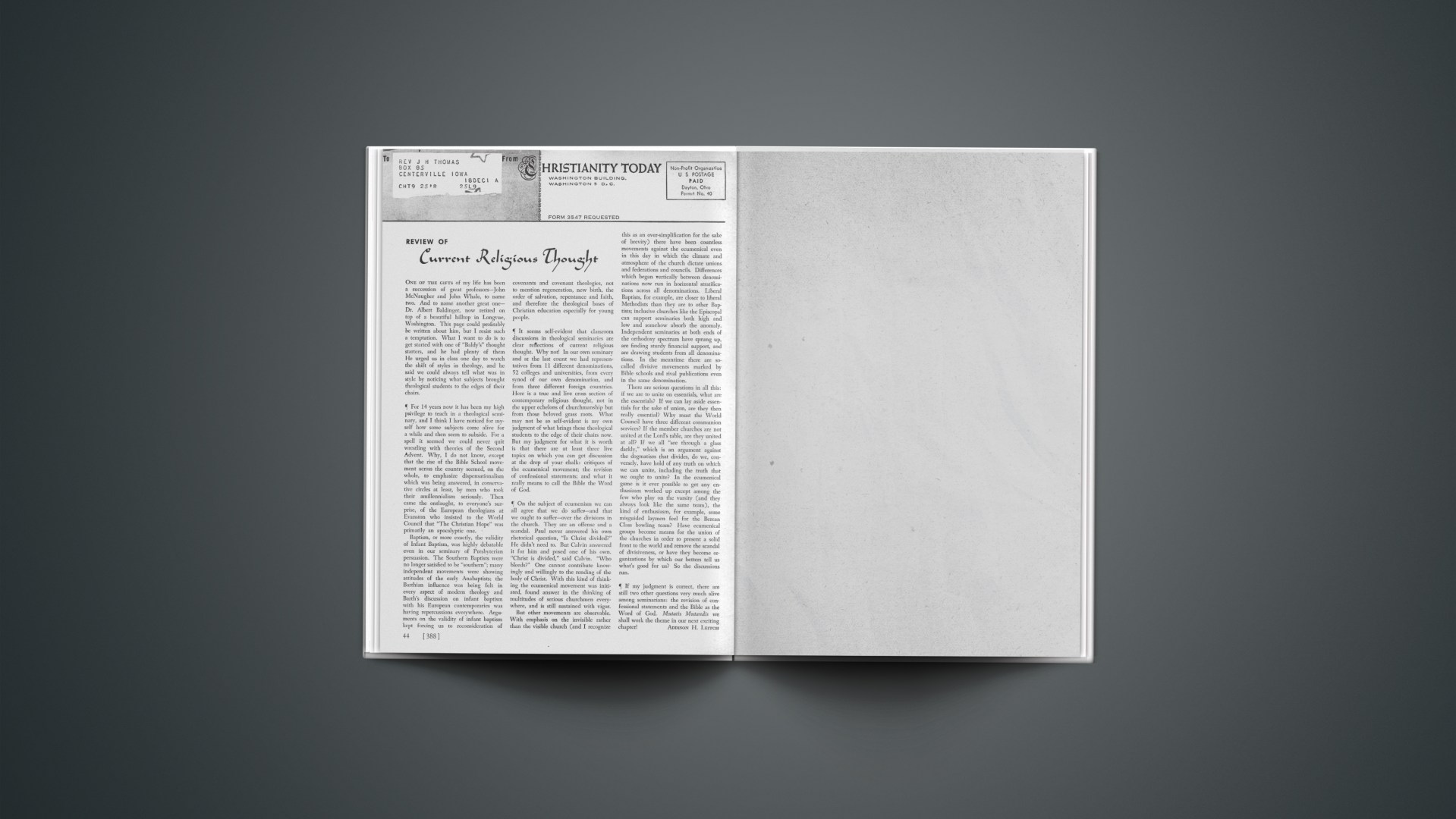
One of the gifts of my life has been a succession of great professors—John McNaugher and John Whale, to name two. And to name another great one—Dr. Albert Baldinger, now retired on top of a beautiful hilltop in Longvue, Washington. This page could profitably be written about him, but I resist such a temptation. What I want to do is to get started with one of “Baldy’s” thought starters, and he had plenty of them He urged us in class one day to watch the shift of styles in theology, and he said we could always tell what was in style by noticing what subjects brought theological students to the edges of their chairs.

For 14 years now it has been my high privilege to teach in a theological seminary, and I think I have noticed for myself how some subjects come alive for a while and then seem to subside. For a spell it seemed we could never quit wrestling with theories of the Second Advent. Why, I do not know, except that the rise of the Bible School movement across the country seemed, on the whole, to emphasize dispensationalism which was being answered, in conservative circles at least, by men who took their amillennialism seriously. Then came the onslaught, to everyone’s surprise, of the European theologians at Evanston who insisted to the World Council that “The Christian Hope” was primarily an apocalyptic one.

Baptism, or more exactly, the validity of Infant Baptism, was highly debatable even in our seminary of Presbyterian persuasion. The Southern Baptists were no longer satisfied to be “southern”; many independent movements were showing attitudes of the early Anabaptists; the Barthian influence was being felt in every aspect of modern theology and Barth’s discussion on infant baptism with his European contemporaries was having repercussions everywhere. Arguments on the validity of infant baptism kept forcing us to reconsideration of covenants and covenant theologies, not to mention regeneration, new birth, the order of salvation, repentance and faith, and therefore the theological bases of Christian education especially for young people.

It seems self-evident that classroom discussions in theological seminaries are clear reflections of current religious thought. Why not! In our own seminary and at the last count we had representatives from 11 different denominations, 52 colleges and universities, from every synod of our own denomination, and from three different foreign countries. Here is a true and live cross section of contemporary religious thought, not in the upper echelons of churchmanship but from those beloved grass roots. What may not be so self-evident is my own judgment of what brings these theological students to the edge of their chairs now. But my judgment for what it is worth is that there are at least three live topics on which you can get discussion at the drop of your chalk: critiques of the ecumenical movement; the revision of confessional statements; and what it really means to call the Bible the Word of God.

On the subject of ecumenism we can all agree that we do suffer—and that we ought to suffer—over the divisions in the church. They are an offense and a scandal. Paul never answered his own rhetorical question, “Is Christ divided?” He didn’t need to. But Calvin answered it for him and posed one of his own. “Christ is divided,” said Calvin. “Who bleeds?” One cannot contribute knowingly and willingly to the rending of the body of Christ. With this kind of thinking the ecumenical movement was initiated, found answer in the thinking of multitudes of serious churchmen everywhere, and is still sustained with vigor.

But other movements are observable. With emphasis on the invisible rather than the visible church (and I recognize this as an over-simplification for the sake of brevity) there have been countless movements against the ecumenical even in this day in which the climate and atmosphere of the church dictate unions and federations and councils. Differences which began vertically between denominations now run in horizontal stratifications across all denominations. Liberal Baptists, for example, are closer to liberal Methodists than they are to other Baptists; inclusive churches like the Episcopal can support seminaries both high and low and somehow absorb the anomaly. Independent seminaries at both ends of the orthodoxy spectrum have sprung up, are finding sturdy financial support, and are drawing students from all denominations. In the meantime there are so-called divisive movements marked by Bible schools and rival publications even in the same denomination.

There are serious questions in all this: if we are to unite on essentials, what are the essentials? If we can lay aside essentials for the sake of union, are they then really essential? Why must the World Council have three different communion services? If the member churches are not united at the Lord’s table, are they united at all? If we all “see through a glass darkly,” which is an argument against the dogmatism that divides, do we, conversely, have hold of any truth on which we can unite, including the truth that we ought to unite? In the ecumenical game is it ever possible to get any enthusiasm worked up except among the few who play on the varsity (and they always look like the same team), the kind of enthusiasm, for example, some misguided laymen feel for the Berean Class bowling team? Have ecumenical groups become means for the union of the churches in order to present a solid front to the world and remove the scandal of divisiveness, or have they become organizations by which our betters tell us what’s good for us? So the discussions run.

If my judgment is correct, there are still two other questions very much alive among seminarians: the revision of confessional statements and the Bible as the Word of God. Mutatis Mutandis we shall work the theme in our next exciting chapter!

Book Briefs: February 1, 1960

An Adventure In Christian Evidences

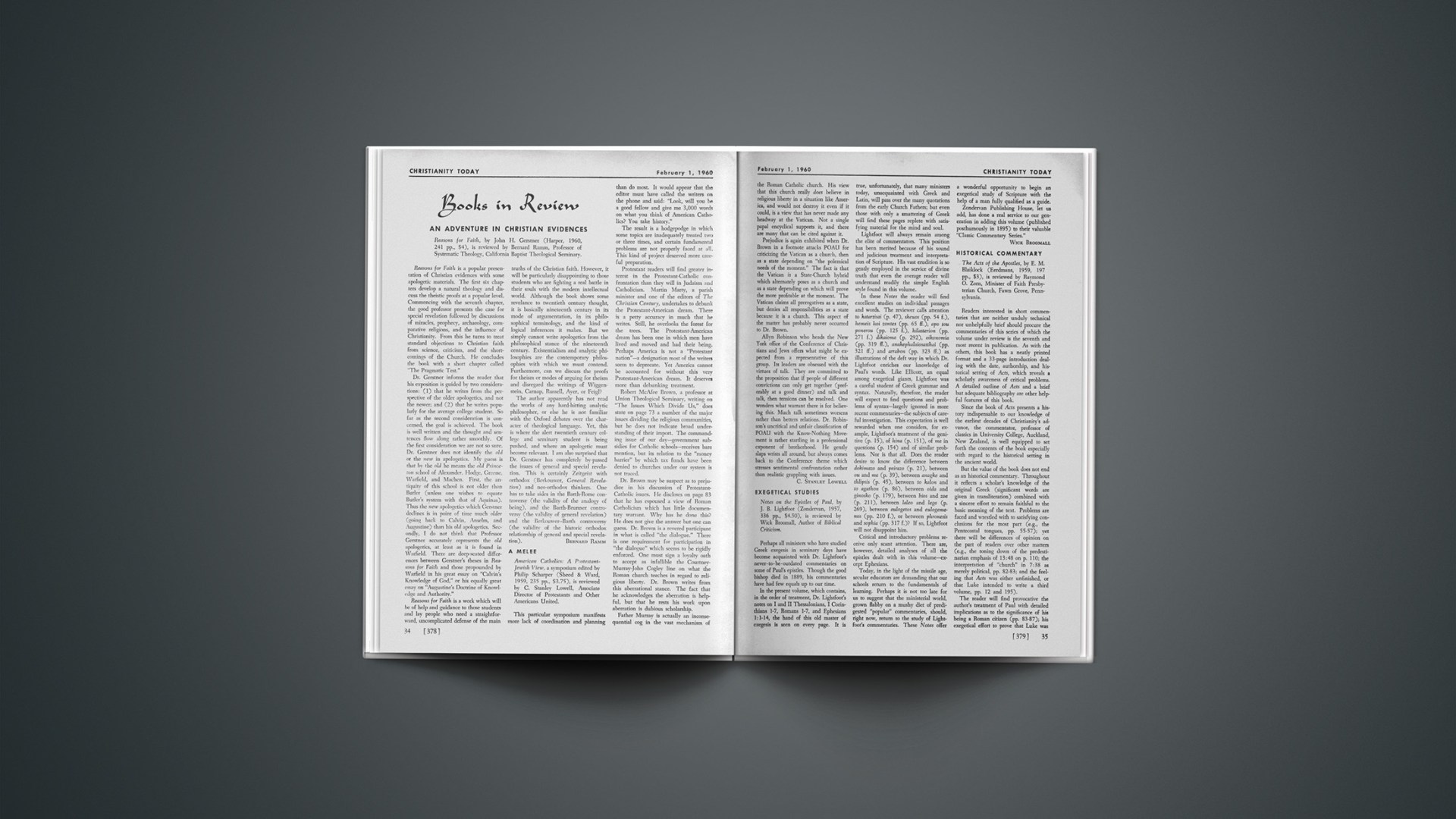
Reasons for Faith, by John H. Gerstner (Harper, 1960, 241 pp., $4), is reviewed by Bernard Ramm, Professor of Systematic Theology, California Baptist Theological Seminary.

Reasons for Faith is a popular presentation of Christian evidences with some apologetic materials. The first six chapters develop a natural theology and discuss the theistic proofs at a popular level. Commencing with the seventh chapter, the good professor presents the case for special revelation followed by discussions of miracles, prophecy, archaeology, comparative religions, and the influence of Christianity. From this he turns to treat standard objections to Christian faith from science, criticism, and the shortcomings of the Church. He concludes the book with a short chapter called “The Pragmatic Test.”

Dr. Gerstner informs the reader that his exposition is guided by two considerations: (1) that he writes from the perspective of the older apologetics, and not the newer; and (2) that he writes popularly for the average college student. So far as the second consideration is concerned, the goal is achieved. The book is well written and the thought and sentences flow along rather smoothly. Of the first consideration we are not so sure. Dr. Gerstner does not identify the old or the new in apologetics. My guess is that by the old he means the old Princeton school of Alexander, Hodge, Greene, Warfield, and Machen. First, the antiquity of this school is not older than Butler (unless one wishes to equate Butler’s system with that of Aquinas). Thus the new apologetics which Gerstner declines is in point of time much older (going back to Calvin, Anselm, and Augustine) than his old apologetics. Secondly, I do not think that Professor Gerstner accurately represents the old apologetics, at least as it is found in Warfield. There are deep-seated differences between Gerstner’s theses in Reasons for Faith and those propounded by Warfield in his great essay on “Calvin’s Knowledge of God,” or his equally great essay on “Augustine’s Doctrine of Knowledge and Authority.”

Reasons for Faith is a work which will be of help and guidance to those students and lay people who need a straightforward, uncomplicated defense of the main truths of the Christian faith. However, it will be particularly disappointing to those students who are fighting a real battle in their souls with the modern intellectual world. Although the book shows some revelance to twentieth century thought, it is basically nineteenth century in its mode of argumentation, in its philosophical terminology, and the kind of logical inferences it makes. But we simply cannot write apologetics from the philosophical stance of the nineteenth century. Existentialism and analytic philosophies are the contemporary philosophies with which we must contend. Furthermore, can we discuss the proofs for theism or modes of arguing for theism and disregard the writings of Wiggenstein, Carnap, Russell, Ayer, or Feigl?

The author apparently has not read the works of any hard-hitting analytic philosopher, or else he is not familiar with the Oxford debates over the character of theological language. Yet, this is where the alert twentieth century college and seminary student is being pushed, and where an apologetic must become relevant. I am also surprised that Dr. Gerstner has completely by-passed the issues of general and special revelation. This is certainly Zeitgeist with orthodox (Berkouwer, General Revelation) and neo-orthodox thinkers. One has to take sides in the Barth-Rome controversy (the validity of the analogy of being), and the Barth-Brunner controversy (the validity of general revelation) and the Berkouwer-Barth controversy (the validity of the historic orthodox relationship of general and special revelation).

BERNARD RAMM

A Melee

American Catholics: A Protestant-Jewish View, a symposium edited by Philip Scharper (Sheed & Ward, 1959, 235 pp., $3.75), is reviewed by C. Stanley Lowell, Associate Director of Protestants and Other Americans United.

This particular symposium manifests more lack of coordination and planning than do most. It would appear that the editor must have called the writers on the phone and said; “Look, will you be a good fellow and give me 3,000 words on what you think of American Catholics? You take history.”

The result is a hodgepodge in which some topics are inadequately treated two or three times, and certain fundamental problems are not properly faced at all. This kind of project deserved more careful preparation.

Protestant readers will find greater interest in the Protestant-Catholic confrontation than they will in Judaism and Catholicism. Martin Marty, a parish minister and one of the editors of The Christian Century, undertakes to debunk the Protestant-American dream. There is a petty accuracy in much that he writes. Still, he overlooks the forest for the trees. The Protestant-American dream has been one in which men have lived and moved and had their being. Perhaps America is not a “Protestant nation”—a designation most of the writers seem to deprecate. Yet America cannot be accounted for without this very Protestant-American dream. It deserves more than debunking treatment.

Robert McAfee Brown, a professor at Union Theological Seminary, writing on “The Issues Which Divide Us,” does state on page 73 a number of the major issues dividing the religious communities, but he does not indicate broad understanding of their import. The commanding issue of our day—government subsidies for Catholic schools—receives bare mention, but its relation to the “money barrier” by which tax funds have been denied to churches under our system is not traced.

Dr. Brown may be suspect as to prejudice in his discussion of Protestant-Catholic issues. He discloses on page 83 that he has espoused a view of Roman Catholicism which has little documentary warrant. Why has he done this? He does not give the answer but one can guess. Dr. Brown is a revered participant in what is called “the dialogue.” There is one requirement for participation in “the dialogue” which seems to be rigidly enforced. One must sign a loyalty oath to accept as infallible the Courtney-Murray-John Cogley line on what the Roman church teaches in regard to religious liberty. Dr. Brown writes from this aberrational stance. The fact that he acknowledges the aberration is helpful, but that he rests his work upon aberration is dubious scholarship.

Father Murray is actually an inconsequential cog in the vast mechanism of the Roman Catholic church. His view that this church really does believe in religious liberty in a situation like America, and would not destroy it even if it could, is a view that has never made any headway at the Vatican. Not a single papal encyclical supports it, and there are many that can be cited against it.

Prejudice is again exhibited when Dr. Brown in a footnote attacks POAU for criticizing the Vatican as a church, then as a state depending on “the polemical needs of the moment.” The fact is that the Vatican is a State-Church hybrid which alternately poses as a church and as a state depending on which will prove the more profitable at the moment. The Vatican claims all prerogatives as a state, but denies all responsibilities as a state because it is a church. This aspect of the matter has probably never occurred to Dr. Brown.

Allyn Robinson who heads the New York office of the Conference of Christians and Jews offers what might be expected from a representative of this group. Its leaders are obsessed with the virtues of talk. They are committed to the proposition that if people of different convictions can only get together (preferably at a good dinner) and talk and talk, then tensions can be resolved. One wonders what warrant there is for believing this. Much talk sometimes worsens rather than betters relations. Dr. Robinson’s uncritical and unfair classification of POAU with the Know-Nothing Movement is rather startling in a professional exponent of brotherhood. He gently slaps wrists all around, but always comes back to the Conference theme which stresses sentimental confrontation rather than realistic grappling with issues.

C. STANLEY LOWELL

Exegetical Studies

Notes on the Epistles of Paul, by J. B. Lightfoot (Zondervan, 1957, 336 pp., $4.50), is reviewed by Wick Broomall, Author of Biblical Criticism.

Perhaps all ministers who have studied Greek exegesis in seminary days have become acquainted with Dr. Lightfoot’s never-to-be-outdated commentaries on some of Paul’s epistles. Though the good bishop died in 1889, his commentaries have had few equals up to our time.

In the present volume, which contains, in the order of treatment, Dr. Lightfoot’s notes on I and II Thessalonians, 1 Corinthians 1–7; Romans 1–7, and Ephesians 1:1–14, the hand of this old master of exegesis is seen on every page. It is true, unfortunately, that many ministers today, unacquainted with Greek and Latin, will pass over the many quotations from the early Church Fathers; but even those with only a smattering of Greek will find these pages replete with satisfying material for the mind and soul.

Lightfoot will always remain among the elite of commentators. This position has been merited because of his sound and judicious treatment and interpretation of Scripture. His vast erudition is so gently employed in the service of divine truth that even the average reader will understand readily the simple English style found in this volume.

In these Notes the reader will find excellent studies on individual passages and words. The reviewer calls attention to katartisai (p. 47), skeuos (pp. 54 f.), hemeis hoi zontes (pp. 65 ff.), apo tou ponerou (pp. 125 f.), hilasterion (pp. 271 f.) dikaioma (p. 292), oikonomia (pp. 319 ff.), anakephalaiosasthai (pp. 321 ff.) and arrabon (pp. 323 ff.) as illustrations of the deft way in which Dr. Lightfoot enriches our knowledge of Paul’s words. Like Ellicott, an equal among exegetical giants, Lightfoot was a careful student of Greek grammar and syntax. Naturally, therefore, the reader will expect to find questions and problems of syntax—largely ignored in more recent commentaries—the subjects of careful investigation. This expectation is well rewarded when one considers, for example, Lightfoot’s treatment of the genitive (p. 15), of hina (p. 151), of me in questions (p. 154) and of similar problems. Nor is that all. Does the reader desire to know the difference between dokimazo and peirazo (p. 21), between ou and me (p. 39), between anagke and thlipsis (p. 45), between to kalon and to agathon (p. 86), between oida and ginosko (p. 179), between bios and zoe (p. 211), between laleo and lego (p. 269), between eulogetos and eulogemenos (pp. 210 f.), or between phronesis and sophia (pp. 317 f.)? If so, Lightfoot will not disappoint him.

Critical and introductory problems receive only scant attention. There are, however, detailed analyses of all the epistles dealt with in this volume—except Ephesians.

Today, in the light of the missile age, secular educators are demanding that our schools return to the fundamentals of learning. Perhaps it is not too late for us to suggest that the ministerial world, grown flabby on a mushy diet of predigested “popular” commentaries, should, right now, return to the study of Lightfoot’s commentaries. These Notes offer a wonderful opportunity to begin an exegetical study of Scripture with the help of a man fully qualified as a guide.

Zondervan Publishing House, let us add, has done a real service to our generation in adding this volume (published posthumously in 1895) to their valuable “Classic Commentary Series.”

WICK BROOMALL

Historical Commentary

The Acts of the Apostles, by E. M. Blaiklock (Eerdmans, 1959, 197 pp., $3), is reviewed by Raymond O. Zorn, Minister of Faith Presbyterian Church, Fawn Grove, Pennsylvania.

Readers interested in short commentaries that are neither unduly technical nor unhelpfully brief should procure the commentaries of this series of which the volume under review is the seventh and most recent in publication. As with the others, this book has a neatly printed format and a 33-page introduction dealing with the date, authorship, and historical setting of Acts, which reveals a scholarly awareness of critical problems. A detailed outline of Acts and a brief but adequate bibliography are other helpful features of this book.

Since the book of Acts presents a history indispensable to our knowledge of the earliest decades of Christianity’s advance, the commentator, professor of classics in University College, Auckland, New Zealand, is well equipped to set forth the contents of the book especially with regard to the historical setting in the ancient world.

But the value of the book does not end as an historical commentary. Throughout it reflects a scholar’s knowledge of the original Greek (significant words are given in transliteration) combined with a sincere effort to remain faithful to the basic meaning of the text. Problems are faced and wrestled with to satisfying conclusions for the most part (e.g., the Pentecostal tongues, pp. 55–57); yet there will be differences of opinion on the part of readers over other matters (e.g., the toning down of the predestinarian emphasis of 13:48 on p. 110; the interpretation of “church” in 7:38 as merely political, pp. 82–83; and the feeling that Acts was either unfinished, or that Luke intended to write a third volume, pp. 12 and 195).

The reader will find provocative the author’s treatment of Paul with detailed implications as to the significance of his being a Roman citizen (pp. 83–87); his exegetical effort to prove that Luke was a native of Philippi (pp. 123–124), though the Anti-Marcionite Prologue dating from the latter half of the second century makes Luke a native of Syrian Antioch; his support of the south Galatia hypothesis as the region where Paul established churches (pp. 121–123) to which the Galatian epistle was subsequently sent; his detailed background of Greek achievement as epitomized in the glory of Athens (pp. 132–136), and numerous other matters.

The major shortcoming of the commentary, if it can be classified as such, is its exegetical brevity. However, a commentary of 200 odd pages, the biblical text being omitted as is uniformly true of all in this series, may yet do justice to the exegesis of the text. The author subdivides Acts into rather large pericopes with comment on these sections in the form of condensed essays. Then a brief section on additional notes is appended in which exegetical treatment is given to selected verses of the context. A suggested remedy for future editions of this otherwise useful work, as well as for the commentaries not yet published for this series, might be the enlarging of the “Additional Notes” section by approximately 50 pages. This would still keep the volume within the handy limits of its originally intended range.

Blaiklock, in giving his estimate of Luke, says that he had a “scholar’s ability to strip away irrelevant or dispensable detail” (p. 15). Blaiklock has achieved to an admirable degree this same quality in his commentary.

RAYMOND O. ZORN

Strides In Archaeology

Light from the Ancient Past, by Jack Finegan (Second edition, Princeton University Press, 1959, 638 pp., $10), is reviewed by Charles F. Pfeiffer, Associate Professor of Old Testament, Gordon College.

Since its first publication in 1946, Light from the Ancient Past has been one of the most readable and informative works on the historical and archaeological backgrounds of Scripture. The reader is able to visualize the cultures of Sumer and Egypt, of Canaanites and Hittites, and relate them to the biblical narrative in such a way that both the Bible and ancient history take on new meaning.

Rapid strides have been made in archaeological studies since 1946, and the new edition brings both additions and changes. The volume has been enlarged by 138 pages which in part is old material reworked in the light of more recent studies, and in part consists of material unknown at the time of the first edition. Important in the latter category is the Dead Sea Scroll material.

Finegan has adjusted his chronologies in numerous instances. Changes are in decades rather than centuries. The division of the Israelite kingdom is dated 931/930 B.C. in the new edition, and 926 B.C. in the old edition of this work. The Egyptian twenty-first dynasty began, according to the 1946 edition, in 1150 B.C., whereas the new edition gives 1090 as the date.

The factual nature of Finegan’s work accounts in no small measure for its popularity. When controversial subjects are discussed (e.g. the date of the Exodus, pp. 117–121), arguments for the differing viewpoints are given fair hearing and the author presents his own conclusion in cautious terms.

Biblical studies need to be based on historical data. Finegan will help the student to read his Bible in the light of the world in which it was written.

CHARLES F. PFEIFFER

Spiritual Dynamic

Power Through Pentecost, by Harold J. Ockenga (Eerdmans, 1959, 128 pp., $2), is reviewed by Robert B. Dempsey, Pastor of Carlisle Congregational Church, Carlisle, Mass.

The nations are engaged in a race for power that the world might be changed for the better. Ironically, the Christian Church, the only body that could transform the world, is the one that seems least interested in doing so. Often she does not realize her weakness. When she does, she does not know where to find strength.

In this timely volume, the minister of Boston’s Park Street Church presents a soul-searching study of Pentecostal power in the individual experience. It is not a systematic study of biblical pneumatology but a thoughtful presentation of the secret of the unleashed dynamite of the Spirit in New Testament lives. Such a study will best teach us how this power may be unleashed in individuals and in the Church of this decade.

After two introductory chapters, the author examines the experiences of men wherein the power of the Holy Spirit was plainly manifested. The author repeatedly avers the New Testament truth that every believer is baptized, sealed, and indwelt by the Holy Spirit, and that this is entirely different from being filled with the Spirit (pp. 41, 57, 58, 60, 61, 74).

The term “second” is boldly used to describe the experience of being filled with the Spirit. It is a second crisis experience (pp. 61, 81, 125, 127). We do not tarry for the Spirit, but we must tarry for his power in our prayer of confession and consecration (pp. 31, 32, 23, 126). Dispelling any notion about sinless perfectionism (p. 23), the author is clear in stating that sin and self-centeredness are a barrier to power (pp. 14, 22). In fact sin will rob us of power and the fullness of the Spirit (p. 24).

The genuinely converted will earnestly seek to be filled with power through a Pentecostal experience. Christians who do not come to the place of surrender are living truncated, abnormal, and carnal Christian lives. They will lack power to change the world through revival. Like Peter, Stephen, Paul, and Philip, they are urged to yield themselves to the Holy Spirit.

The Church today needs to understand the secret of the power that rocked the first century world, if it is to rock the twentieth century world for Christ. “If the Holy Spirit is here in the Church and in the believers, there is no excuse for our not exercising power” (p. 104).

The weakest part of this most helpful study is Chapter 10 which expounds Acts 19:2: “Have ye received the Holy Ghost since ye believed?” A treatment of the meaning of the word “received” would have been helpful. Consistently it has been stated that believers already have the Spirit, and therefore questions directed to present day believers about receiving the Spirit seem inconsistent (pp. 95, 99).

ROBERT B. DEMPSEY

Essentially Theistic

Ancient Judaism and the New Testament, by Frederick C. Grant (Macmillan, 1959, 155 pp., $3.50), is reviewed by H. L. Ellison, author, Christian Approach to the Jews.

Dr. Grant, Professor of Biblical Theology at Union Theological Seminary, New York, has been for many years one of the leading biblical scholars of the Protestant Episcopal Church. Both his standing as a scholar and his conviction of the vital importance of the thesis put out in his present work demand that we consider it seriously.

Unfortunately the title is doubly misleading. The book is really an urgent plea for a return to a humanistic liberalism firmly based on the Bible and also on our classical heritage from Greece and Rome. The Bible is regarded as above all the treasure of the worshiping Church; its interpretation is to be based on strictest scholarship, but its evaluation is clearly to be a matter of sanctified rational subjectivism. The resultant religion is to be essentially theistic, not Christocentric, and ethical. He makes it clear that his evaluation of Judaism, and indeed of the Eastern religions generally, is in relative and not absolute terms, and he looks forward to Christian-Jewish rapproachment.

The other ambiguity lies in the term “Ancient Judaism.” Dr. Grant accepts, at least in general lines, the Wellhausen picture of the Old Testament and makes the Pentateuch in its present form, the Psalter, and considerable portions of the prophets post-exilic. For him ancient Judaism is not merely the religion of the Jews as it developed in the intertestamental period but also that of the Old Testament taken as a whole in the form that the best elements in the time of our Lord interpreted it.

The greatest weakness in the book is the author’s failure to grapple seriously with the New Testament’s presentation of the problem of the Jew. For him Matthew 27:25; John 8:44; 1 Thessalonians 2:16 would be blots on “any sacred books.” Our Lord’s condemnation of the scribes and Pharisees, his rejection by the Jews, and Paul’s agonized argument in Romans 9–11 are dealt with most superficially or not at all. Paul is even depreciated as a Hellenist to the greater glory of Palestinian Pharisaism.

The last defect we would mention may be due more to the publishers than to the author, for it is a growing defect in American books. Though the author complains rightly of the inability of most to check statements by reference to original sources, he has made it almost impossible for his readers to do so. There is no bibliography and we are given only four footnotes and rare indications of authorities. As a result only the specialist reader will be able to judge whether the strong and often sweeping statements and judgments are correct, as they often are, or whether they are controversial and debatable, or biased and unfair, or sometimes even simply false.

We appreciate Dr. Grant’s deep sincerity and his reaction from many perversions of truth in Christian circles made apparent by the horrors of Hitlerism. We quite understand why it received the 1958 award of the Christian Research Foundation, but we cannot recommend it except those who are sufficiently experts hardly to need it.

H. L. ELLISON

Marxism

Foundations of the Responsible Society, by Walter G. Muelder (Abingdon, 1959, 304 pp., $6), is reviewed by Irving E. Howard, Assistant Editor, Christian Economics.

Dr. Walter G. Muelder, author of Foundations of the Responsible Society, is dean and professor of social ethics at Boston University School of Theology. In this volume, he betrays an awareness of the thought of the so-called neo-orthodox theologians, if not of the orthodox, but he is himself a religious liberal of the old school. What is more significant, he holds uncritically several Marxist dogmas. Thus, he states on page 53: “Karl Marx, for example, showed that class conflict characterized Western society.” This Marxian dogma of the inevitability of class conflict in a capitalistic society has distorted much modern thinking. However, both Kenneth Boulding and Ludwig von Mises have shown that a capitalistic market economy makes for peaceful cooperation while government intervention in a planned economy produces tension, conflicts, and war. Of course, this is the contrary to what Dr. Muelder assumes. One should read the Foundations of the Responsible Society with the understanding that it has been written from a Marxian point of view.

The early American political philosophy, which produced our Constitutional system, is ridiculed without being identified. The core of that philosophy was fear of government. Says Dr. Muelder on page 108: “Too much thinking about the state today is rooted in fear.…” While agreeing with opponents of the omnicompetent state, Dr. Muelder continues by describing the function of government in such a way that it implies a government with power equal to any totalitarianism. “The state takes logical and ethical precedent over the economic order,” says Dr. Muelder as he continues an argument for a welfare state which extends beyond national boundaries. A government with the power to do all that Dr. Muelder wishes to have it do would be a government with too much power to be controlled by the so-called “democratic process.” Indeed, the government Dr. Muelder describes looks like a lamb with compassion for the welfare of people, but, if realized, such a government would “speak like a dragon.”

Since Dr. Muelder reports the various ecumenical conferences as though they represent the synthesis of “Christian” thought, this book is valuable as documentary evidence of the direction the ecumenical movement is taking in social ethics. It is valuable for little else. It offers no biblical insights into the problems discussed. It misrepresents both capitalism and the political philosophy of the American Constitution. Nevertheless, it is a persuasive book which uses a descriptive approach and makes a pretense of scholarly objectivity while it is, in truth, a clever example of special pleading for the welfare state.

IRVING E. HOWARD

Neglected Heritage

Freedom and Federalism, by Felix Morley (Henry Regnery, 1959, 274 pp., $5), is reviewed by Carl F. H. Henry.

A champion of limited government and of free enterprise traditions against socialist encroachments, Felix Morley’s political perspective cherishes America’s neglected heritage of Federalism. With the blurring of representative government into majoritarian democracy, he warns, “the era of the American Republic” may be “drawing to a close” a scant two centuries after its beginnings. The implementation of centralized government, rather than the dispersal of political power, is the corrupting evil.

Although more an idealist than a biblical theist in temperament, Dr. Morley is alert to the political implications of Christianity. He views the maintenance of limited government as a moral issue, its preservation as much dependent upon the alertness of the churches as upon legislators and law courts. “The growth of Big Government goes hand in hand with the loss of Big Convictions” (p. 240).

CARL F. H. HENRY

Sermon Methodology

We Prepare and Preach, edited by Clarence Stonelynn Roddy (Moody Press, 1959, 190 pp., $3.25), is reviewed by H. C. Brown, Jr., Professor of Preaching, Southwestern Baptist Theological Seminary.

Throughout the history of Christianity successful preachers have stimulated other ministers to give more diligent attention to the art of preaching. But alas, it is also true that some undiscerning preachers have imitated and copied in toto their more talented brethren and have thereby destroyed their own creative talents. The level of pulpit excellence rises and falls to the degree that the mass of ministers is motivated toward copying or creativity. Blessed is that capable preacher who can convey to his fellow ministers “abiding principles” without causing them to become slaves to homiletical minutiae or without encouraging them to become “addicted to plagiarism.”

Creative practice should produce creative principles and rules, and these in turn should make for better practice in the next generation. In recent years several volumes of sermon methodology by successful contemporary preachers have been compiled for the purpose of improving preaching. This volume by Clarence Roddy is another volume attempting this task. It makes available biographical sketches, sample sermons, and personal homiletical theories of William Ward Ayer, Donald Grey Barnhouse, Howard W. Ferrin, J. Lester Harnish, Robert G. Lee, J. Vernon McGee, Harold John Ockenga, Alan Redpath, Paul Stromberg Rees, Wilber Moorehead Smith, and J. R. W. Stott.

The reader should study and analyze, compare and contrast, and agree and disagree with Roddy’s contributors if he is to receive full benefit from this book. Since these men are individualistic in their methods, the reader wall profit most by making a personal homiletical synthesis from the preaching theories expressed. When the digest has been prepared, then let the reader pass judgment on the various parts of his synthesis. This book has much to teach the careful and thoughtful reader.

H. C. BROWN

Inter-Testamental Period

Between the Testaments, by Charles F. Pfeiffer (Baker, 1959, 132 pp., $2.95), is reviewed by Edward J. Young, Professor of Old Testament, Westminster Theological Seminary.

What occurred in Jewish history between the close of the Old Testament and the beginning of the New? This is a question upon which many Christians are ill-informed. To many the period is hazy, and it is difficult to keep events clearly in their proper order. One need has been for a concise, popular history of the period that would help to place events and people in their proper perspective.

That need has now been filled. The present work is a popular history dealing with the period between the two testaments. It treats of matters in a popular, readable style, and whets the appetite for more. Despite the concise nature of the book, the author has managed to include a tremendous amount of useful material and to do justice to all the principal events. Even the Dead Sea Scrolls are included, and the author is most competent to deal with these.

Helps are provided for further study. The reading of this excellent little work should make the general outlines of the period clear to anyone. The writing of the book must have been a difficult task, but Dr. Pfeiffer has done a most creditable job. This book is ideal for young people, and indeed for anyone who wishes to understand the period of which it treats.

EDWARD J. YOUNG

Limitation Of Offspring

Planned Parenthood and Birth Control in the Light of Christian Ethics, by Alfred Martin Rehwinkel (Concordia, 1959, 133 pp., cloth $2.25, paper $1.50), is reviewed by E. P. Schulze, Minister, Lutheran Church of Our Redeemer, Peekskill, N. Y.

Rehwinkel defines planned parenthood or birth control as “the voluntary limitation of possible offspring by artificial means.” Having listed hygienic, eugenic, and economic considerations, he concludes that “there are times and circumstances in the life of a married couple when they are free to practice birth control with a good conscience and that the method employed is of no maerial importance from the moral point of view.”

It was the late Dr. S. Parkes Cadman, a man not to be suspected of strong evangelical leanings, who said: ‘The only proper form of birth control is self control.” Sublimation has its virtues. Rehwinkel, however, holds continence in low esteem, regarding it as being under normal conditions “contrary to nature and undesirable from a psychological point of view.” With regard to contraceptive devices he seems to have no such scruples.

The command, “Be fruitful and multiply,” has not yet been repealed, and children are still “an heritage of the Lord.” Let us be thankful that our own ancestors did not deprive us of the opportunity of temporal and eternal life. Let us thank God that Leah did not stop with three boys and that Jesse had an eighth son named David; else the Messiah had not come. In gratitude, let the omniscient Father of us all determine the size of our families. He does it with infinite wisdom, and often permits us fewer children than we wish. And yet one may look upon the subject of birth control with considerable equanimity when we view the wholesome desire for children manifested by most young married couples, and the likelihood that the people who are best fitted, spiritually and morally, to be parents are the least apt to limit the number of their offspring.

Rehwinkel, a professor at Concordia Seminary, St. Louis, has written one most excellent book, The Flood. Probably the outstanding influence of the present work—whatever the intention of its author may have been—will be to foster a sexual life divorced from its basic purpose and responsibilities.

E. P. SCHULZE

The Fundamentals

God Hath Spoken, by T. Roland Philips (Eerdmans, 1959, 181 pp., $3), is reviewed by Massey Mott Heltzel, Minister of Ginter Park Presbyterian Church, Richmond, Virginia.

The great Glasgow preacher, Norman MacLeod, often visited a certain elderly, sick lady in his congregation. On every occasion she would place her ear horn to her ear and say, “Now, Normie, gang ower the fundamentals.”

That is what Dr. Philips does in this book of sermons. He goes over the fundamentals. He deals only with the great biblical themes. He lets the reader hear again and again the good tidings of God’s saving grace. He rides no theological hobbies, but presents a rounded view of the Christian faith.

The author served nearly 40 years as pastor of the Arlington Presbyterian Church in Baltimore. From his pastoral experience he draws effective illustrations for his sermons. He deals with profound matters in simple terms and his down-to-earth language has clarity and force. The sermons are straightforward and hard-hitting. Here is a sample: “I buried a man who belonged to a certain fraternity. They had a service at the grave, and in the ritual they said this: ‘We cannot hope to see beyond the veil. We can only seek for truth, and hope that we shall find it.’ Well, that may be true of them, but that is not true of me. I am not seeking for truth. I have found it. I am not hoping. I know.”

This book is not what could be called gripping. The reviewer admits that, in spite of the good qualities just mentioned, he did not find the sermons interesting. This is due not to the themes handled, but to something in the manner of handling, for the reviewer finds the “fundamentals” not only interesting, but exciting. He would not give this book as a Christmas present to a minister friend. But he would, without hesitation, give it to a seeker after basic Christian truth.

MASSEY MOTT HELTZEL

Maps And History

Rand McNally Historical Atlas of the Holy Land, edited by Emil G. Kraeling (Rand McNally & Company, 1959, 88 pp., including 22 maps in color, 70 photographs and line-cut maps, and a Table of Early History, $2.95), is reviewed by William Sanford LaSor, Professor of Old Testament, Fuller Theological Seminary.

This volume is essentially a reprint of the maps and some of the other materials in the Rand McNally Bible Atlas (1956), together with a very brief sketch of early history in the form of extended captions for the illustrations. While it is a useful work, it is too brief for serious study and too much vitiated by the uncertainties of extreme critical scholarship. The reproduction of the Dead Sea Isaiah Scroll (Plate 5) is upside down.

WILLIAM SANFORD LASOR

The Apostolic Idea

Preaching to Meet People’s Needs, by Charles N. Pickell (New York: Exposition Press, 1958, 82 pp., Bibliographies, $3), is reviewed by Andrew W. Blackwood, Author of Leading in Public Prayer.

The subtitle, ‘The Meaning of the Acts as a Guide for Preaching Today,” accurately describes the contents and purpose of this little book. It opens up a field that has been strangely neglected. Preaching bulks large in the Book of Acts, but there is in print no adequate discussion of the preaching by Peter or Paul, as an example of what to preach today, as well as how and why.

The author has read the appropriate literature by C. H. Dodd and others. The book reaches sound conclusions about the preachers and the preaching of apostolic times as ideals for today. In his Boston ministry, according to my friends there, this young man’s pulpit work follows these ideals.

His book will serve any student or class as a suitable guide for a fresh and rewarding way of dealing with the Acts. The subject deserves fuller development and discussion of the good ideas in this book.

ANDREW W. BLACKWOOD

Seminary Centennial

A History of Southern Baptist Theological Seminary, by William A. Mueller (Broadman, 1959, 256 pp., $4), is reviewed by Richard L. James, Minister, of the Riverside Christian Church, Jacksonville, Fla.

When an American institution passes the hundred year mark, it deserves an appraisal from the perspective of history. Professor Mueller does this in an interesting manner. Though of primary value to Southern Baptists, the book will assist others in appreciation of the development of theological education in America.

Professor of philosophy of religion at Southern Baptist Theological Seminary, Dr. Mueller approached his task largely from the biographical viewpoint. He follows the development of the seminary by concise accounts of the lives of its founder, the presidents, and faculty members.

The separation among Baptists and the organization of the Southern Baptist Convention in 1845 left the South without a source of training for its ministry. To meet this need Southern Seminary came into existence. It was a difficult struggle and its achievement owed much to James P. Boyce, John A. Broadus, Basil Manley, Jr. and William Williams, the “Faithful Four” who constituted the founding fathers and original faculty.

Under James P. Boyce, the Seminary pioneered in the study of the Scriptures in the English language in contrast to the practice of other institutions which specialized in Bible study in Greek and Hebrew. The development of a system of electives in the curriculum was also in keeping with the experimental spirit of the founder.

The shadows of the founders have lengthened into an institution celebrating its centennial, and the story makes for fascinating reading.

RICHARD L. JAMES

Liberia Introduction to Africa

Although Liberia as a republic is a distinct product of U. S. Christian colonization, it may well prove to have been a difficult introduction to Africa for the Billy Graham team. Some team members felt that the first stop on their nine-country evangelistic tour posed more problems than any other.

The Graham African crusade began January 13 in a 1,500-seat stadium in Monrovia, Liberia’s capital, chief port, and principal city. Nightly meetings were conducted for a week with evangelist Howard Jones, U. S. Negro minister who is the African expert of the Graham team. Graham dedicated a new 50,000-watt transmitter for ELWA, a Christian broadcasting station, and addressed the two closing services of the Monrovia series, on January 21 and 22.

When slaves freed from America were settling on the west coast of Africa during the first half of the nineteenth century, they found they had to battle aborigines just as colonists in America fought Indians. Nevertheless, a chunk of land now compared in size with the state of Ohio became an independent country in 1847. It was the first republic in Africa (the second: Egypt). It is one of only two Negro republics in the world (the other: Haiti).

Descendants of the slave colonists, called Americo-Liberians, still form the ruling and intellectual class of Liberia, though they are far outnumbered by the natives of the interior. Some estimates say there are fewer than 15,000 Americo-Liberians in the entire country, said to have a population nearing 2,000,000.

“This is a sick country,” John Gunther’s Inside Africa quotes an American official in Liberia, “maybe it will get well.” In 1953 Gunther found the Liberians “too poor, too mercilessly exploited,” more than 90 per cent illiterate, and abounding in thievery and corruption.

A chief drawback to mass evangelism in Liberia is the lack of adequate roads. There are only a few miles of paved highways in the entire country. Other roads become impassable during rainy seasons. Result: Travel between communities is at a minimum and large gatherings of people are rare.

Liberia’s backwardness is a distinct reflection on Christian America, for the country has been closely linked with the United States politically and religiously from its inception. Monrovia was named after U. S. President James Monroe. Many sincere, well-meaning Christians were behind efforts of the private American Colonization Society which promoted the settling of the slaves in what is now Liberia. These slaves took along their Protestantism. A number of missionary groups in Liberia trace their roots back more than 100 years.

Most Americo-Liberians are still nominal Protestant Christians living largely along the 350-mile coast line. Methodist and Episcopalian work is well situated among these coastal people. Lutherans are noted for their work in the interior, where as many as 40 dialects are spoken and where paganism prevails.

Other groups working in Liberia, both on the coast and in the interior: Baptist Mid-Missions, Seventh-day Adventist, Assemblies of God, Child Evangelism Fellowship, Sudan Interior Mission, World-wide Evangelization Crusade, and Open Bible Standard Missions.

The nominal Christian culture does have official standing. Competent missionary work has the fullest sympathy of the government. William V. S. Tubman, President of Liberia since 1943, is a graduate of a Methodist missionary school and first visited the United States in 1928 as a delegate to the General Conference of the Methodist Episcopal Church in Kansas City.

Roman Catholicism is represented in Liberia, but its influence is not believed to be strong.

The Graham team, having flown in from Dakar via commercial airliner, landed at Roberts Field, some 50 miles from Monrovia. Their auto trip to the capital took them through the rubber plantations which are now so closely identified with the Liberian economy. Rubber is the chief export, and most of it comes from land acquired in the twenties by Firestone Tire and Rubber Company interests. Firestone employs more than 25,000 Liberians and is a major source of government revenue. Gunther said Firestone does more for its workers than the government itself does for the majority of citizens.

Another bold U. S. enterprise was set up in 1952 when R. G. LeTourneau, noted Christian industrialist, leased 100,000 acres of land and shipped in construction and agricultural machinery for large scale commercial cultivation and mechanized production of rice, sugar, cocoa, coffee, and lumber.

Under Tubman, Liberia has made remarkable progress in recent years. But as with its physical resources, which have yet to be fully measured, Liberia’s spiritual potential still represents a challenge to the Christian world.

Mrs. George A. Padmore, wife of the Liberian ambassador to the United States, has said that the Christian church has in Africa the most massive single opportunity of its history.

But she asserted that “here is the first time that the challenge of an entire continent has confronted the church with such a limited timetable.”

Crusade Coverage

Coming issues of CHRISTIANITY TODAY will include special, interpretative dispatches cabled directly from the scene of Graham’s African meetings by News Correspondent Tom McMahan.

McMahan also is preparing twice-weekly stories for the Columbia State, largest newspaper in South Carolina, where he is religion editor, and for more than 425 other U. S. dailies which sought coverage of the crusade in Africa.

McMahan will travel with the Graham team for the duration of the crusade.

8,500 Hear Graham In Monrovia

Billy Graham’s two evening meetings in the Liberian capital city of Monrovia drew an aggregate attendance of approximately 8,500.

The meetings addressed by Graham climaxed a crusade begun a week earlier with associate Howard Jones.

Some 1,160 persons recorded commitments to Christ, of which 671 were first-time decisions.

Although the Monrovia crusade was pitched to English-speaking city church people, a surprising number of semi-illiterates attended the meetings.

A new transmitter erected by ELWA, Christian radio station, was pressed into temporary service, extending the impact of the crusade. Missionaries and national churchmen said the crusade saw unprecedented unity.

On the day of his arrival, Graham was invited to the executive mansion of President William V. S. Tuban, who extended an official welcome.

Later, in a special ceremony, the evangelist was awarded the Order of African Redemption, second highest decoration in Liberia.

From Liberia, the Graham team was scheduled to move on to Ghana, then to Nigeria, where meetings were slated for this week.

Temperance Aloft

Commercial airlines are prohibited from serving alcoholic beverages to any passenger “who appears to be intoxicated” under a Federal Aviation Agency regulation which becomes effective March 10.

The rule also imposes civil penalty of up to $1,000 on any passenger who insists on drinking from his own bottle while aloft. The passenger must give his bottle to the stewardess who can then supply the “set-ups.”

FAA Administrator Elwood R. Quesada, in announcing the regulation, stoutly defended the growing practice of airlines in serving alcoholic beverages to passengers in flight and attacked legislation pending in Congress which would ban the serving of liquor on planes.

“It is a generally accepted fact that flat prohibition has not proven successful in preventing consumption of alcoholic beverages,” said Quesada.

A Mosque for Zürich

The Ahmadiyya Moslem Mission plans to build a mosque in Zürich, the first in Switzerland.

Layman’s Leadership

Some 850 persons, including leading business and political figures, assembled in Miami Beach’s Americana Hotel last month for a four-day “Layman’s Leadership Institute.” Aim: to strengthen spiritual lives of participants.

Addresses, personal testimonies, and discussions constituted the program.

Information to the selected and invited participants stressed the institute’s functioning as an interdenominational meeting without a membership organization, without elected officers and void of funds solicitation.

The institute, fifth of an annual series, was a project of a laity research foundation now known as Christian Men, Incorporated. Sponsors were Dr. Duke McCall, President of the Southern Baptist Theological Seminary in Louisville, Kentucky, evangelist Billy Graham, and Texas grocery executive Howard E. Butt.

Why The Jews?

A prominent Hebrew Christian identifies current anti-Semitic demonstrations as part of an “anti-Christian scheme.” [See also editorial on page 23—ED.]

The Rev. Daniel Fuchs, missionary secretary of the American Board of Missions to the Jews, suspects some foreign demonstrations may also betray anti-American feeling.

Fuchs characterizes the anti-Semitic expressions as a trend inspired by Satan.

Among those at this year’s institute: Senator Stuart Symington, Florida Governor LeRoy Collins, Dr. L. Nelson Bell, Executive Editor of CHRISTIANITY TODAY, and Maxey Jarman, shoe manufacturer.

Ecumenical Radio

The Lutheran World Federation plans to share broadcasting time of its projected radio station in Ethiopia with the Near East Christian Council.

The two groups worked out an agreement for joint use of a proposed 50,000-watt transmitter after each had asked a franchise from the Ethiopian government only to learn that just one would be issued.

The government informed the LWF early in December that it had been granted permission to erect and operate the first private radio station in Ethiopia.

As part of the radio project, plans call for studios to be erected in five countries—Ethiopia, Tanganyika, South Africa, Madagascar, and perhaps India. These studios will feed programs in various languages to the Ethiopian transmitter. Some of the funds for the project, which also includes a second 50,000-watt transmitter, will be raised in the United States by the National Council of Churches’ overseas radio, visual education and mass communication committee.

Both short and medium wave frequencies will be utilized. The station is scheduled to be on the air by Christmas Day, 1961.

Participating in the Near East Christian Council are national Protestant, Orthodox and Coptic churches in the United Arab Republic, Lebanon, Jordan, Iraq, Kuwait, Bahrain, Aden, Sudan, Algeria, Tunis, and Iran, plus foreign missions groups situated in those countries.

Easing Rules

Two Eastern universities eased chapel attendance rules last month.

Princeton University trustees announced that sophomores will not be required to attend chapel services, leaving only freshmen who must be present for worship at least half of the Sundays of the school year.

Wesleyan University in Middletown, Connecticut, will no longer require any of its students to attend chapel.

Fire at Taylor

A $750,000 fire last month destroyed the administration building of Taylor University, liberal arts school in Upland, Indiana, which numbers among its graduates many leading evangelicals.

Following the pre-dawn blaze, which started in a basement chemistry laboratory, classes met without interruption in improvised quarters.

University officials immediately launched a drive for $1,500,000 to erect replacement facilities.

Taylor University was established in 1846 by Methodists. The school became independent in 1922, but retained high Christian standards.

After the Twelve

A Dutch father gave his newborn son the names of all 12 of Christ’s Apostles, the Dutch Radio reported last month. It said a registry office clerk argued with the father, saying the boy would have much trouble filling forms when he grew up, but the man insisted on officially recording all 12 names.

Protestant Panorama

• President Eisenhower says construction of the National Presbyterian Center in Washington “will be something that will challenge us and show that our Protestant beliefs can be held forth as one of the truly basic values of civilization.” Eisenhower made the remark during the unveiling last month of a tentative design for the center, projected at a cost of $20 million to replace the National Presbyterian Church.

• Some 10,440 converts from Roman Catholicism were admitted to the Church of England between 1954 and 1956, says the latest Anglican yearbook.

• The Salvation Army in the United States will be received as an affiliate member of the National Holiness Association at the NHA’s spring convention. The Army, now numbering more than 250,000, becomes the 14th denominational group to be fully affiliated with the NHA.

• The first Protestant communion service at the U. S. South Pole Station was conducted last month by Navy Chaplain Edwin R. Weidler, minister of the Evangelical and Reformed Church.

• A National Council of Churches agency is sponsoring what is described as the first effort to train Protestant church administrators at the regional level in responsibilities involved in administering large, corporate church enterprises. The effort got under way with a 12-day session in Detroit last month. More than 50 ministers from 13 Protestant denominations attended the session, held under auspices of the NCC’s Department of the Urban Church.

• “A Protestant minister should not vote for a Roman Catholic candidate under any circumstances.” The statement, which appeared on a questionnaire sent to readers of Monday Morning, a magazine for Presbyterian clergymen, drew this reaction: 379 agreed, 390 disagreed, and 17 were undecided.

• A number of Protestant ministers are under subpoena to appear before a grand jury in Wheeling, West Virginia, when it begins a probe of vice and corruption February 8.

• Dr. Lester A. Crose, secretary of the Board of Foreign Missions of the Church of God (with headquarters in Anderson, Indiana), is making a world tour in connection with the board’s 50th anniversary observance.

• The United Church of Christ is introducing a new Sunday School curriculum to some 8,000 congregations across the country.

• Baylor University Press plans to publish a semi-annual Journal of Church and State to be devoted to a study of Church-State relations.

• A specially-commissioned committee of the Kentucky Methodist Conference is exploring possible merger with the Louisville Annual Conference.

• Dallas Theological Seminary dedicated a $400,000 library building January 18. The edifice, of modified Spanish modern architecture, is designed to accommodate 100,000 volumes.

• Twenty Protestant ministers joined six Catholic priests in a joint protest last month to the Port of New York Authority, denouncing its choice of a site for a jet airport in Morris County, New Jersey. The clergymen say the airport would cause a mass turnover of area residents and would give rise to deterioration in living conditions.

• Lung cancer is 90 times less likely to occur among Seventh-day Advenists, who don’t smoke, according to a report made public last month by the Sloan-Kettering Institute of Cancer Research. The report also discounts air pollution as a great risk factor inasmuch as it came out of a study made mostly of Seventh-day Adventist men who live in smog-ridden Los Angeles.

• “Voters do well” to study papal decisions which place the church over the state, according to a statement adopted last month by the Harris County (Houston, Texas) pastoral conference of the Lutheran Church—Missouri Synod.

Church Attendance

A Gallup Poll shows church attendance leveled off during 1959 following a record high in the previous year.

An estimated 49 million adults attended church services during a typical week in 1959, or 47 per cent of the adult civilian population (excluding those living in institutions).

During an average week in 1958, 49 per cent of the population was to be found in church, the poll said.

‘No Basic Changes’

A special fact-finding commission of The Methodist Church advises against “basic changes” in the church’s regional and racial jurisdictional structure.

A 32-page report prepared by the church’s 70-member Commission on the Jurisdictional System says immediate alteration of the system would be “harmful” to the denomination and “especially disastrous to Negro Methodists.”

The report will be presented this spring to the quadrennial Methodist General Conference, which appointed the commission four years ago to study segregation in the church and the jurisdictional system.

Since 1939, The Methodist Church has been divided into six U. S. administrative jurisdictions—five regional and one all-Negro central jurisdiction. Opponents of the existing system claim that it encourages sectionalism and segregation.

“The central jurisdiction assures racial integration in the highest echelons of our church,” the report counters. “There is no other denomination in America where this degree of racial integration in the governing bodies of the church has been achieved.”

AME Observance

Philadelphia will be the focal point of a three-day celebration by the 1,200,000-member African Methodist Episcopal Church in honor of the 200th birthday of the denomination’s founder, Richard Allen. Services are planned February 14–16.

Allen was born in Philadelphia February 14, 1760, of slave parents. In protest of the segregation of Negroes he withdrew as a communicant of Old St. George’s Methodist Church in Philadelphia and founded the first AME congregation in 1816.

The AME Church is represented in 47 states, Canada, Bermuda, the West Indies, South America, and Africa. In the United States there are some 5,000 local AME congregations.

The Drive For Peace

The Christian message bears “tidings of peace” to the world. Why, therefore, does widespread distrust shadow the “drive for world peace” currently being advanced in the churches?

Answer: Ecclesiastical leaders today insist on blending Christian concerns with political propaganda. Doubtless legitimate elements of Christian motivation support these Church efforts for peace. But the ecclesiastical thrust often dilutes and even loses the biblical emphasis on spiritual regeneration and reconciliation in a cross-current of political and ecumenical tensions.

• In the United States, the National Council of Churches is following up its Cleveland World Order Conference, which urged U. S. approval and U. N. admission of Red China, by a “peace program” (see “The Church’s Mission and NCC’s Propaganda Drive,” page 22) distressing to many American Protestants. Despite the NCC General Board’s artful dodge of responsibility for the Cleveland commitments, NCC policy, to many observers, seems an evasive disguise in politico-economic affairs (see Council President Dahlberg’s comments in Formosa, p. 27).

• The Third Christian Peace Conerence (CPC), scheduled in Prague, Czechoslovakia, from April 20–24, 1960, has an eye on “ending the Cold War.” Not only pro-Communist regime Protestant and Eastern Orthodox churchmen, but all ecumenical agencies are being invited. The conference expects 150 participants, among them representatives of churches (including the “young churches”), church councils, and individuals. Its leaders welcomed Khrushchev’s proposals to the United Nations.

• An All-Christian Conference for World Peace (ACC) is tentatively projected early in 1961 somewhere in Europe, after the World Council of Churches assembly in New Delhi the same year. Behind the scenes leaders are debating the merits of 1961 or 1962 for this ACC session, which is viewed by some as the fusing point of the world thrust by both the ecumenical and peace movements. Some ecumenical leaders think a 1961 date will prove damaging to the New Delhi assembly, at which integration of International Missionary Council into WCC will be in the forefront. But peace proponents think that a world conference will be “stale” by 1962. They argue that Khrushchev’s U.N. initiative has now “left the churches behind the politicians.” The effect of Khrushchev’s visit to the United States has already been to persuade some satellite rulers that the churches are no longer indispensable peace propaganda agencies, but can now be by-passed by a strictly political thrust.

Anxieties over the blending of Christian concerns with specific programs of political action exist on many levels. Some Christian observers are distressed over the activities of politically-minded secretaries. Others note the readiness of certain leaders (some serving even on theological commissions) to dispense with dogmatic foundations for practical Christian goals and programs. Many complain that the peace propagandists tend to oversimplify the problem of reconciling Christians and Marxist atheists. Others, although recognizing that church spokesmen are determined not to become agents of government, point out that ecclesiastical strategy nonetheless often seeks and shapes an official status-role with government.

C.F.H.H.

The League of Nations, which after World War I set up principles for recognition of governments, said recognition should not be extended to any government that came to power in any way other than by the will of the people over which it ruled. Has the Red Chinese regime come into power by the will of the people? A resounding “no” comes from some 10,000 people who each month flee the mainland into Hong Kong. A similar answer is voiced by the majority of Korean war prisoners, who voluntarily went to Formosa rather than to return to their Red-dominated homeland. These have had the privilege of making their choice; most Chinese have not had the chance; their rulers dare not let them see the outside world.

Another principle established by the League of Nations was that recognition should be extended only to a government which keeps its promises and honors its agreements. When the present regime came to power in China, it immediately seized U. S. consular property, appropriated American business, and confiscated other foreign property. Protests were ignored. This lawless behavior has characterized the regime to the present time. It is difficult to imagine normal relations with such a government.

What happens when groups of people in the Free World—sometimes even Christian groups—send petitions to their governments advocating recognition of Red China and pressing for her admission to the United Nations? Millions of oppressed Chinese, Poles, Hungarians, and others feel they have been betrayed. These have suffered for their principles in the hope that the Free World will likewise challenge tyranny, condemn its principles, and oppose its spread.

Inasmuch as there are today two Chinese governments, each purporting to be the rightful government, people in favor of recognizing the Red regime often belittle the Nationalist government. On the mainland, they say, it was a corrupt and inefficient government whereas Communists have brought reform and modernization.

Those who were in China at the close of World War II must admit that there is much truth to this charge. The country had been through a long war with Japan, as well as a simultaneous civil war with Communists in the northwest. Actually, the end of the war did not bring peace to China. Civil war flared anew when Russians who disarmed the large Japanese army in Manchuria turned over their war equipment to the Communists. There was little time to reorganize the government and to put things in order. People were weary of fighting. Communists descended with fresh troops and glowing promises. Quickly they rolled up a large following.

To judge the government of Chiang Kai-shek, you must begin in 1927, when his government came to power. During Chiang’s first five years in office China made the greatest progress of her long history—in education, sanitation, industry, communications, and in many other ways. Some say that despite its imperfections, the government of China at that time was the best the country had ever had.

Then China was involved in a terrible war for more than a decade. Her coasts were blockaded, her soil occupied. All the evils of that grim period came to fruition in the post-war years.

The government of Nationalist China finally moved to Formosa, where again it established democratic rule. There, many U. S. advisers and observers have praised the kind of government now in operation as even better than that of Chiang’s early years on the mainland. People enjoy a free press, public education, and progressive governmental policy which is changing the country from an agricultural to an industrial economy.

The issue often comes down to a choice between Free China and Red China. Considering all the facts, it seems hard to understand that anyone in good conscience would not favor Free China.

Christian people often ask: “Is Generalissimo Chiang really a Christian?” Yes, he is, however unusual that may seem for a president in a nation largely non-Christian. So is Madam Chiang. Both attend church regularly and are earnest students of the Word of God. They witness outspokenly to their Christian convictions. Having such national leaders in these dark and uncertain times is a strong encouragement to the Christian cause in Free China.

End of an Era?

Noted Protestant theologian Paul Tillich warns that there is “a trend away from Reformation individualism” and toward “authoritarian” forms of religion which may end the Protestant era.

He remarked to newsmen in Los Angeles last month that this trend was indicated by recent mergers of Protestant groups, the ecumenical movement, and Roman Catholic encouragement of Christian unity.

“Ecumenicity doesn’t do much theologically,” he noted. “What is produced in terms of theology is not very impressive. A committee cannot make a theology,” so victory is based on “the lowest common denominator.”

Dr. Tillich, professor at Harvard Divinity School, made the observations at a news conference preceding a lecture series he delivered at Occidental College (United Presbyterian).

“The Protestant theology is essentially non-conformist,” he said, “but rugged individualism has disappeared and has been replaced by ‘Organization Man,’ the development of the collective spirit.”

He declared that “the trend toward spiritual security and, therefore, authoritarian forms of religion poses a threat to Protestantism.”

Tillich’s remarks, however, gave scant comfort to the mid-century “evangelical revival.”

Popularity of “primitive orthodoxy revivalism” also evidences a desire for security since “authority gives security,” he said.

“Today’s younger generation wants to be sociologically, ethically and spiritually secure,” he observed. “One hardly finds a type of liberal theology in theological faculties of American educational institutions.”

“The liberal philosophy which I found when I came to America 26 years ago does not exist today,” the German-born theologian added. “The liberal movement came suddenly to an end in the 1920s.”

Despite all this, Dr. Tillich said, “You can’t kill the prophetic spirit, although it may go underground” if the Protestant era should be ended by authoritarianism.

Mental Health

The first annual meeting of the Academy of Religion and Mental Health was held in New York January 14–15. Organized in 1955, the academy claims to be the first organization ever to be established for research in relations between religion and mental health. Membership includes 1,000 psychiatrists and 1,300 clergy. The meeting helped to inaugurate 1960 as “World Mental Health Year.” The World Federation for Mental Health was a joint sponsor.

Among those who addressed the New York meeting was Dr. Paul Tillich. Tillich, who rejects the concept of a personal God, credited depth psychology with helping theology to rediscover the biblical doctrine of God as a near, embracing and accepting God.

People: Words And Events

Deaths:Dr. Reuben E. Nelson, 54, until last year the general secretary of the American Baptist Convention, in New York … Catholicos Melchisedek III, 88, head of the Orthodox Church in the Georgian Soviet Socialist Republic, in Tbilisi … Professor Max Huber, 85, known in ecumenical circles for his role as Church-State chairman at the 1937 Oxford Conference of the Life and Work Movement, in Zurich … the Rev. August M. Berg, 64, American Baptist missionary to India, in Malden, Massachusetts … Dr. Thomas Moseley, 73, retired president of Nyack Missionary College, in Glendale, California … Charles Manuel “Daddy” Grace, founder of the “House of God” following, in Los Angeles.

Retirement: As president of Blue Mountain College of the Mississippi Baptist Convention, Dr. Lawrence T. Lowery, effective May 31.

Resignation: As chairman of the board of directors and the corporation of the American Friends Service Committee, Dr. Henry J. Cadbury.

Recommendation: To be next general secretary of the Baptist World Alliance, Dr. Josef Nordenhaug, president of the Baptist Theological Seminary at Ruschlikon-Zürich, Switzerland (the recommendation will be made by the BWA executive committee to a special nominating committee of the Baptist World Congress).

Appointments: As president of the National Association of Schools and Colleges of The Methodist Church, Dr. Willis M. Tate, president of Southern Methodist University … as co-pastor (with his father) of Ebenezer Baptist Church in Atlanta, Georgia, Dr. Martin Luther King, Jr., who became a noted champion of integration while pastoring the Dexter Avenue Baptist Church in Montgomery, Alabama … as president of Wesleyan College in Macon, Georgia, Dr. W. Earl Strickland … as president of Baptist Mid-Missions, the Rev. Allan E. Lewis … as the first holder of the Lilly Endowment Visiting Professorship of Christian Ethics at the International Christian University near Tokyo, Dr. Charles Wheeler Iglehart … as professor of New Testament at Pacific Bible Seminary, Dr. T. Ralph Applebury … as African radio director for the Lutheran World Federation, Dr. Sigurd Aske … as educational secretary and citizenship director of the International Society of Christian Endeavor, Delno W. Brown.

NCC Head Pleads Red China’s Case in Formosa

Top ecumenist Edwin T. Dahlberg, on a year-end world tour of U. S. military installations, found himself called upon in Formosa to answer for anti-Nationalist China recommendations of the Fifth World Order Study Conference, held in Cleveland more than 14 months ago.

Far East News Service reported that Dahlberg voiced “complete agreement” with findings of the widely-criticized Cleveland report which urged that Communist China be recognized by the United States and admitted to the United Nations.

Dahlberg stopped in Taipei while on the annual visit of the National Council of Churches’ president to American servicemen abroad. At a dinner in the Grand Hotel he faced 21 representatives of American missionary, military, and government bodies.

Asked point blank about his stand, Dahlberg replied: “My personal conviction regarding this NCC world study group recommendation is that I am in complete agreement with their report. Furthermore, I think that years from now we will look back to this as one of the great steps of the Christian Church. I do not think that the NCC will repudiate the recommendation of the world order study group.”

Dahlberg thus discarded recently emerging hesitancies on the part of Ernest A. Gross, chairman of the Cleveland conference and of the NCC’s Department of International Affairs, which sponsored the conference.

Several weeks earlier, Gross told a church council seminar in Albany, New York, that Communist China is “not entitled” to be recognized by the United States. He had made no such public statement during the Cleveland meeting.

Gross is a former U. S. ambassador to the United Nations and a former assistant secretary of state. He said:

“For the United States to grant judicial recognition to the Chinese Communist regime so long as it pursues its present course appears to many of us to confer upon that government a benefit to which it is not entitled.”

Prior to arrival in Formosa, Dahlberg had been given an advance billing as “principal voice of American Protestantism.” He was accompanied by Dr. Fred S. Buschmeyer, assistant general secretary of the NCC and director of its Washington, D. C., office. Buschmeyer also was a delegate to the Cleveland conference.

In the hotel meeting, Dahlberg conceded that perhaps as many as 90 per cent of the Chinese people oppose the present mainland regime. His comment:

“I don’t think that our Christianity depends on our freedom. I believe we will get farther with all countries in the United Nations. Wherever the United Nations steps in, it brings a healing influence.”

At that point one missionary challenged the NCC leader to explain what “healing influence” the U.N. was able to exert in the Red rape of Hungary.

Asked how he could urge the U. S. government to recognize and cooperate with a government which has persecuted churches, Dahlberg replied:

“Recognition and cooperation are two different things.”

His strong endorsement of the Cleveland conference’s recommendations drew vigorous protests from American Protestant missionary leaders in Formosa. They charged that he had embarrassed the missionary community of Formosa and had flagrantly abused his “diplomatic immunity” (as a guest of the U. S. government) in advocating Red China recognition while visiting on Free China soil.

“No objection to the NCC’s study course was answered,” observed one missionary, “and no effective notice was taken of the unanimous opposition of those here whom Dr. Dahlberg admitted were qualified observers.”

Another missionary asserted that Dahlberg’s statements were a basic violation of the American principle of separation of church and state.

The Case For Free China

James Dickson, Taipei correspondent forCHRISTIANITY TODAY, is one of the most noted and respected missionaries on Formosa. Except for a five-year stint in British Guiana during World War II, Dickson and his wife have served there continuously since 1927. Though both are Americans, they work under the General Board of Missions of the Presbyterian Church in Canada. Dickson holds degrees from Macalester College and Princeton Theological Seminary.

Here is his appraisal of tensions between Red China and Free China:

China is one of four nations which in the past few years have been divided between communism and democracy.

Little is said for recognition of Red regimes in Germany, Korea, and Indochina. But certain groups have rather persistently demanded recognition of Communist China. Why?

Many well-meaning people, in no way sympathetic with the Communist system, sincerely feel there is good reason to recognize the Peking government.

Some argue that recognition of Communist China might cause her rulers to become more conciliatory, and that international tensions would thereby be eased.

But is there evidence of such change of heart where other Communist regimes have been recognized? On the contrary, Communist leaders have used added prestige to further their own diabolical aims at the expense of non-Communist governments. It is unrealistic to imagine that Red China, already notorious for the oppression that has characterized communism everywhere, will do an about-face.

Some feel recognition of Red China would be valuable because it would result in increased international trade.

Again, evidence does not support the argument. Great Britain, which extended recognition to the Chinese Reds soon after they took over, found that it took years to bring the value of its trade with mainland China to the levels recorded in pre-Communist days. On the other hand, West Germany, which still has not recognized the Peking government, annually surpasses Great Britain in the amount of trade with Communist China. Communist countries seem to have a well-established trade principle; when it is to their advantage, and at their own terms, are they ready to do business. There is no free trade on a people-to-people basis. Trade must be done with the government.

Then there is the argument that Communist Chinais the de facto government of China, and—so the advocates of recognition say—it is wrong to recognize the government of Free China in Formosa (which controls only a small portion of the area which made up the Chinese Republic at the end of World War II) and to refuse recognition to Red China.

True, the Communist regime is in control of the great land areas of China. But is this the decisive determinant in recognition of a government?

Ideas

Bigotry or Smear?

During the coming presidential campaigns the possibility of a Roman Catholic nominee will again occupy the attention of the country. The politicians will calculate whether the solid Catholic vote will overbalance the number of Protestants who may bolt their party. The fate of Al Smith will be recalled.

But conditions are different now from those of 1928. Roman Catholics have elected a record number of governors; their political power has greatly increased. Then too, several periodicals have made soundings and have reported that anti-Catholic feeling is on the wane. Protestants who oppose the election of a Romanist have been and are going to be called bigots; and some Protestants will vote for a Catholic nominee just to show how broad-minded they are.

But is it bigotry to oppose the election of a Roman Catholic for president? What is bigotry? The dictionary defines a bigot as one who is obstinately and irrationally, often intolerantly, devoted to his own church, party, belief, or opinion; and bigotry is said to be unreasoning attachment to one’s own belief. Is then opposition to the election of a Roman Catholic bigoted?

Well, first of all, this opposition is certainly not unreasoning. The past history and present practice of the Roman church illustrates its acceptance of the policy of persecution and oppression. The Protestants do not base their opposition merely on the massacre of St. Bartholomew’s Eve nor on the Pope’s efforts to raise a rebellion against Queen Elizabeth. There are current events in Colombia, Spain, Italy, and Quebec. Where the Romanists are strong enough, they persecute; where less strong, they oppress and harass; where they are in the minority, they seek special privileges, government favor, and more power. A Catholic president alone will not turn the United States into a Colombia or Spain, but he would in all likelihood knowingly or otherwise take what steps he could in that direction.

Opposition to political Romanism is not unreasoning, because a Catholic in the presidency would be torn between two loyalties as no Protestant has ever been. A candidate may announce, and even sincerely believe, that he is immune to Vatican pressure; but can we be sure that he will not succumb in the confessional booth to threats of purgatory and promises of merit from the organization which he believes to hold the keys of heaven?

The Vatican does all in its power to control the governments of nations, and in the past and present it has often succeeded. The Pope favored Mussolini’s conquest of Ethiopia. He made a concordat with Hitler, a concordat that still is in force in Germany as a last remnant of an evil rule. The United States a century ago had unpleasant experiences with the Vatican and had to break off diplomatic relations—relations that should never have been established in the first place and should never be resumed. We know that Romanists do not accept the separation of the Church and State; we know that they oppose a government’s treating all churches alike; we know that they constantly seek tax money for their own uses.

Informed Protestants therefore believe, not at all irrationally, that the interests of the nation are safer in the hands of one who does not confess to a foreign, earthly power.

Far from bigotry, opposition to the nomination and election of a Romanist is perfectly rational. To suggest that this opposition is bigotry is itself a smear campaign. It is an effort to distract the public’s mind. It attempts to obscure the important difference between the wise policy of acknowledging religious liberty for all, even for Roman Catholics who do not believe in it, and the unwise policy of choosing a Romanist government that could take the first steps which would extinguish religious liberty.

The truth of the situation is not Protestant bigotry, but Romish smear.

WHITE HOUSE CONFERENCE ON AMERICAN YOUTH

The sixth White House Conference on Children and Youth, scheduled March 27-April 1, promises to be a colossal affair with significant ramifications. For one thing, this “golden anniversary” conference will be bigger than its predecessors: in 1909, there were 200 participants, whereas in 1960 invitations will go to 1700 representatives of national organizations, 2900 representatives of state agencies and committees, and 500 international guests. A million dollar budget is being met by $350,000 from government agencies, a lion’s share from private foundations (including $250,000 from Ford Foundation), and token appropriations by denominational boards. A staff of 50 specialists is correlating background data, and Columbia University Press is publishing three volumes, including 33 background papers. Plenary sessions will have to be held in University of Maryland fieldhouse and in the Armory.

But significance is no mere matter of size. The conference, notably, is the first in its series to deal overtly with values and ideals. Somewhat oversimply it may be said that the 1909 conference was concerned mainly with institutions, 1919 and 1930 with health, 1940 with children in a democracy, while 1950 popularized the relevance of new psychiatric concepts. But the 1960 conference sets sights on development of the creative life and freedom and dignity of the person, through commitment to values and ideals. President Eisenhower has previously emphasized the importance, in the present ideological and moral crisis, of articulating basic values in the home, in the school, and in the churches, and some observers expect the White House conference to echo this note.

A second important development lies in the fact that every other major speaker is prominently identified with religion. The executive committee (of 92 persons), significantly, did not split apart in projecting this emphasis on religion. The apparent basis of concord, however, is additionally noteworthy, for it marks an approach to American youth problems on an interfaith platform. One workshop will wrestle with the significance of personal faith for children and youth. The “coalition” of Protestant-Catholic-Jewish religious views may also be detected in the Columbia Studies, the first volume of which is devoted to perspectives. A fourth feature of the conference, perhaps not fully reconciled with other facets, is the prominent role comprehended for the Church, its exact nature left undefined.

While differences are submerged in the background studies, the conference itself doubtless will propel many of these topics into the controversial foreground, among these “planned parenthood” and “Federal aid to education.” Secretary of Health, Education and Welfare Arthur Flemming, most “welfare state”-minded member of the Eisenhower cabinet and former NCC leader, will close the conference “looking to the future.” Roman Catholic delegates will be outnumbered—and their spokesmen lost a strategy battle to allow the executive committee to draft the final report, rather than a decision on its contents by democratic floor vote—but procedural rules will allow a minority report wherever the dissenting vote reaches 15 per cent.

To what extent will the interest in values prove genuinely theistic, let alone Christocentric, rather than merely humanistic? To what extent will it reflect a spontaneous reaching toward spiritual dedication, rather than merely a veering from a vacuum by uncommitted men suddenly concerned because communism vaunts a specific ideology? All this remains to be seen. One fact, however, is sure. Although the White House conference lacks authority to speak for government, for educators, or for the churches—and will be formulating nobody’s “official” point of view—its prestige will carry to many special interests. It will be in the national interest and well-being, therefore, that study sessions reflect the concerns not only of “the experts,” but also of the American multitudes at grass roots, to whom school boards and teachers are answerable for the public training of American youth.

THE CHURCH’S MISSION AND NCC’S PROPAGANDA DRIVE

Some agencies of the National Council of Churches seem determined to propagandize World Order Study Conference commitments—including the Cleveland plea for Red China—despite the fact that 1. NCC publicly minimized responsibility for Cleveland positions; 2. trustworthy polls of Protestant conviction discredited the plea for recognition of Red China; 3. several NCC member bodies dissented sharply from Cleveland commitments; 4. some leaders concede that NCC has already lost $100,000 in gifts because of its shallow position on Red China.

The newsletter of the Greater Portland Council of Churches, announcing an orientation meeting for “Peace Education,” lists six areas “which the National Council of Churches has suggested” for discussion, including “Should the representatives of Red China be recognized by the U.N.?” The announcement adds: “An outstanding group of speakers has been selected to speak on these issues. After the panel presents their statements, there will be workshops on implementation of this subject in the local church.” Nobody should be surprised, in view of the preoccupation of the panels with the proposed subjects of birth control, atomic bombs, foreign aid, restrictive real estate contracts, and recognition of Red China, that the NCC’s list of topics ends with: “Are Christian Missions obsolete?”

During the “nationwide program for peace” pushed by NCC’s Department of International Affairs these next five months in “education and action programs for peace in every possible local church throughout the country,” background papers of the World Order Study Conference are being widely distributed by NCC agencies. The literature proposes that the minister and lay leaders insinuate the peace program into every phase of local church life, including the pulpit, study classes, schools of missions, and prayer meetings. One continuing NCC goal is “the establishment, or strengthening, of a Christian social action committee in every possible local church … to assure an ongoing focus of responsibility in international affairs and related matters.” A pattern is to be laid for an ongoing annual program after 1960 “in which the churches will seek to concentrate on three or four issues each year in international affairs, primarily those which would be up for consideration by the people and government of the United States or at the United Nations.”

One might wish that ecumenical leaders were concerned to mobilize the resources of the local churches as fully and effectively for the reconciliation that proceeds from “peace through the blood of Christ’s cross” (cf. Col. 1:20). Then the declaration that “the Church is mission” would raise fewer fears that her historic mission is being subtly transformed.

THE MODERN DEBATE ON THE DEATH PENALTY

This issue of CHRISTIANITY TODAY carries forward the discussion of capital punishment, initiated some months ago, with special attention to the biblical data.

One gains the impression that opponents of the death penalty, even when appealing to Scripture, often rely decisively on modern social and penal theories. Since the arguments on this horizontal level are not confronted by Dr. Gordon H. Clark’s comments, a supplementary word may be in order.

Statistics have been cited both to support and to oppose the claim that execution deters capital crimes. But a Christian lawyer, Roscoe G. Sappenheld of Geneva, Illinois, reminds us of an observation made by Judge Marcus Kavanaugh of Cook County Superior Court, Illinois, before the Detroit College of Law (Michigan does not impose the death penalty): “Detroit with 1,600,000 residents, has had 484 homicides in two years, while Windsor, only twenty minutes from here, and with 75,000 residents, has had no homicides. Do you need any further arguments for capital punishment?” When capital crime statistics are unfavorable in jurisdictions that impose the death penalty, Attorney Sappenfield adds, the law is not a deterrent because it is not really enforced.

The judicial taking of human life is, in fact, the state’s most solemn function. Efforts to contravene capital punishment by appeal to the commandment against murder, or to Christ’s exhortation to love of enemies, do less than justice to the divinely decreed role of the state, that of preserving justice in a fallen society. Even ancient pagan moralists like Plato and Cicero noted what modern social theorists so often overlook, that punishment is related to justice more fundamentally than to utility, and that it is retributive. The guilty are not condemned to death primarily for their own ethical improvement, or to deter others from similar crimes—although contemplation in the shadows of doom encourage the criminal to side with the law and may shape moral earnestness and repentance, and hinder others also from similar crimes. But, as Mr. Sappenfield writes, “consequence must not be confounded with purpose. For the reason capital punishment is inflicted is not utility but the fact that the law has been violated, and that the capital crime requires the death of the offender. The protection of society, like the personal conversion of the criminal, is secondary. If the public good were the basic reason for punishment, the criminal could be made to suffer more than his crime deserves in order to effect public safety, and man is made to suffer, not for the sake of justice, but for the sake of others.”

Mr. Sappenfield calls attention to another interesting correlation, the fact that the distaste for capital punishment often proceeds alongside a rejection of the doctrine of eternal punishment of sinners. In both cases, modern social conscience suffers from an undervaluation of the righteousness of God and of the wickedness of wrongdoing.

U.S.I.S. FUNDS USED FOR BUDDHIST PROPAGANDA

Although American traditions are mainly shaped by the Christian heritage of the West, the founding fathers insisted on “separation of Church and State” as an essential safeguard in the platform of liberty.

In their official capacities, American government leaders often refer to this “wall of separation” by speaking simply of God the Creator and suppressing a high Christology. The United States Information Agency, meanwhile, takes a provocative course in its direct use of government funds in the service of pagan religion.

A pointed example exists in Thailand. Last fall United States Information Service presented 4,000 copies of The Life of Buddha (edited by a Thai scholar of international stature and published by U.S.I.S. in 1958) to the Anandba Mahidol Foundation. The book was also distributed to Thai clerical and lay leaders throughout that land, and used as a personal presentation item by Embassy and U.S.I.S. officers. The agency’s dull awareness of the underlying issue—use of U.S. funds for anti-Christian propaganda abroad while Christian propaganda is avoided at home in deference to “Church-State separation” is obvious from its confidence that the project was “extremely successful” since “USIS received more favorable public acclaim for this project than for any other we have ever organized in Thailand.”

EXPLODING POPULATIONS AND BIRTH CONTROL

Exploding world populations pose new problems. But much of the prattle stressing birth control as the main solution is more wordy than wise. It proposes, for one thing, a quantitative solution of man’s moral and spiritual dilemma. And frequently it involves earnest churchmen in sheer relativism.

Take the Lambeth conferences. In 1920 contraceptives were declared immoral. A subsequent conference “hedged.” The last conference approved. What next?

There is reason for dissatisfaction, of course, with pretensions that the Roman church has power to decide that birth control is moral by natural law but immoral by artificial means. But an individual’s “good conscience” before God, in view of the principled claim of the biblical revelation upon his heart, can be equally thwarted by Protestant pronouncements—which unfortunately count for less and less.

Many churchmen are uneasy because attempts to justify birth control by appeal to population explosions come dangerously near to making the end justify the means. So responsible parenthood, not exploding population, gets more and more emphasis. But just which parents are responsible for whose children?

JUNGLE ROT COMES FROM THE JUNGLE

Anti-Semitism is best described as a jungle rot of the human spirit. It is a particularly unpleasant testimony to original sin, and a sign of ill-health in any environment. Recent outbreaks of defamation in Germany, England, America and other countries provide both an index and a warning. Jungle rot develops where dampness and lack of sunshine create fungus conditions. Anti-Semitism can breed only in diseased segments of the human family where unfettered pride cohabits with unlimited ignorance.

Regardless of what may be thought to the contrary, the Christian Church has no part of anti-Semitism. The divinely-prescribed attitude of the Christian toward his Jewish neighbor has not changed since Paul wrote the ninth, tenth and eleventh chapters of Romans. We honor the sons and daughters of Israel. We thank God for them. In a free land we acknowledge and defend their rights individually and as a group. We look forward to the day when “all Israel shall be saved: as it is written.” No Christian who has been to the Cross and has found his sins forgiven through the blood of Jesus Christ could possibly take any other position.

Yet here is the paradox: anti-Semitism (which is as old as the Pharaohs) has been sown in earlier centuries by those who have claimed to walk under the banner of Jesus. We have lived to reap the whirlwind, for today’s hostility toward the Jewish people has left the “Church” to stalk the world. The latest pack of synagogue-smearers lays no pretense to historical or sacred motives, any more than the Nazis did. It should not be forgotten that Hitler needed no slogan such as the medieval mob’s “Get the Christ-killers!” to perpetrate his grisly genocide.

When we ask why—apart from the ubiquitous possibility of Communist influence—men and women should so act in the year of our Lord 1960, we are forced back to the Scriptural understanding of the nature of man. There probably is no simple answer. The only real explanation of jungle rot is the jungle. The tragedy is that this jungle was once the Garden of Eden.

THE UNIMPEDED DRIFT TO THE DEFENSE-WELFARE STATE

On numerous occasions President Eisenhower has given lofty expression to America’s heritage of belief in God the Creator and in man’s dignity as a creature endowed with inalienable rights. But in a recent news conference on foreign affairs he voiced a turn of credo reflective of a widening mood in national circles today: “I believe in the United States’ power.…”

Taken in context of other public statements, this need not imply a saving trust in missiles, rockets and the atomic or hyrdogen bomb. The President stressed defensive use of military power (“I believe it is there, not to be used, but to make certain that the other fellow doesn’t use his.…”). Yet human perversity encourages the appraisal of defense power as a greater resource than spiritual and moral strength. Our growing reliance on defense structures in national education policy reflects this tendency.

Mere verbalizing about spirit and conscience is, of course, for the semantic swamps. What Americans need most is day-to-day heart for life’s durable concerns. From Mr. Eisenhower’s last year in office we covet enlarging dedication to the big issues in the world crisis. In Crusade in Europe he wrote: “We believe individual liberty, rooted in human dignity, is man’s greatest treasure.” Beyond this, if our historic traditions count, stands the divine sanction for human rights and responsibilities. General Eisenhower himself has testified how, at Normandy, when all human plans were made, the outcome was entrusted to God.

The President’s budget contains a surplus designated (happily if belatedly) to help lower the staggering national debt. But it also includes $3½ billion for welfare purposes (and social security dispersements will lift welfare payments above $15 billion). When elected in 1952, Mr. Eisenhower was interested in curtailing “welfare spending” and assailed the Truman “welfare state.” But Mr. Eisenhower’s new budget for the Department of Health, Education and Welfare runs one quarter of a billion dollars above what he asked for these purposes a year ago. Obviously neither of the established political parties can now be counted on to halt this ‘welfare” drift. Small wonder the cutting edge is dull on another of Mr. Eisenhower’s confident assumptions in Crusade in Europe: “We believe that men, given free expression of their will, prefer freedom and self-dependence to dictatorship and collectivism.”

“Father, Our Children Keep”

“FATHER, OUR CHILDREN KEEP”

In speaking to parents of the responsibilities of parenthood in our day, I have known many fathers and mothers to throw up their hands in despair. Those who would rationalize their failures have transferred parental duties to outsiders—teachers, Scout leaders and the like—in the expectation that they will or ought to succeed where parents cannot.

The fact remains that God has placed into the hands of parents a privilege and a duty which only Christians can appreciate.

To pagans (and these may be cultured Americans) children are often little more than biological trophies (or accidents) of marriage. While there exists for them a degree of love which finds expression in providing for their physical needs, there is no sense of spiritual obligation. The outlook for such children is rather bleak.

Christians believe that children are a blessing from the Lord. With the Psalmist they say: “Lo, children are an heritage of the Lord: and the fruit of the womb is his reward. As arrows are in the hand of a mighty man; so are children of the youth. Happy is the man that hath his quiver full of them: they shall not be ashamed, but they shall speak with the enemies in the gate” (Ps. 127:3, 4, 5).

What then is the duty of Christian parents? Are there scriptural guides which they may follow? Yes, there are certain specific leads of importance.

Concern

Christian parents should be deeply concerned about the spiritual welfare of their children. The patriarch Job exhibited concern and exercised a priestly ministry for his own family.

In Job 1:5 we read: “And it was so, when the days of their feasting were gone about, that Job sent and sanctified them, and rose up early in the morning, and offered burnt-offerings according to the number of them all: for Job said, It may be that my sons have sinned, and cursed God in their hearts. Thus did Job continually.”

In his day Job offered sacrifices for suspected breaches of the divine Law. Today we have the great eternal Sacrifice to whom we turn for protecting and cleansing power in the lives of those we love.

It is a lack of such concern that is in part responsible for the juvenile delinquency of our time. Adult delinquency spawns the same in its offspring. The tragic thing is that many of today’s parents are themselves victims of neglect by their fathers and mothers who gave scant heed to the things of the Spirit.

Convictions

Christian parenthood entails convictions that find expression in action. There are things to be believed and truths to be imparted.

Moses, speaking to the children of Israel in the sunset days of his life, said: “Set your hearts unto all the words which I testify among you this day, which ye shall command your children to observe to do, all the words of this law. For it is not a vain thing for you; because it is your life” (Deut. 32:46, 47a).

The ability of parents to command their children in Christian love and conviction is almost a lost art. We have passed through a generation of pernicious philosophy which has demanded that children be permitted to follow their own inclinations. Child psychologists are belatedly learning (it was in the Bible all the time) that children need to be commanded, guided, and disciplined for their own souls’ good. Many a spanked child has found in that encounter a sense of security and of being loved which has carried its blessings into mature life. To know that a parent cares enough to demand obedience and good behavior is itself sound child psychology.

Teaching

Not only should Christian parents learn the grace of commanding their children when necessary, but they also must acquire the ability of teaching them the things of God. The principle involved in the days of Moses has never been abrogated: “And these words, which I command thee this day, shall be in thine heart: and thou shalt teach them diligently unto thy children, and shalt talk of them when thou sittest in thine house, and when thou walkest by the way, and when thou liest down, and when thou risest up” (Deut. 6:6, 7).

Christian teaching involves example; no amount of lip profession can atone for a life inconsistent with professed belief. But an inescapable part of our obligation to our children is to teach them the truths of God’s Word. And children still thrill to hear stories of adventure, daring and divine deliverance that are found in the Bible.

Such teaching can become a fascinating game and the basis of life-transforming faith under the guidance and blessing of the Holy Spirit.

Decisions

There are times when Christian parents must make decisions for their children, even though this idea runs counter to some contemporary teaching.

Children and teen-agers are often confronted with problems that they cannot handle. Because of limited outlook and experience they desperately need the guidance of older and wiser minds. Therefore, at times a strong parental “Yes” or “No” can stem the headstrong impulses of youth as nothing else can.

It is neither fair nor right to leave to immature minds certain decisions which have to do with their immediate and eternal welfare. While the ultimate decision of eternal salvation through faith in Christ is made by no other than the individual himself, God does use the decisions of godly parents in starting children in the right direction.

Joshua, in his final exhortation to the people, urged them to make a clear-cut decision to follow God. But should they waver in their allegiance, he testified that “as for me and my house, we will serve the Lord.”

Young people need the stabilizing influence of parents who have Christian convictions and the courage to make them stick in their own homes.

Prayer

God has placed in believers’ hands a privilege and a power that will never be fully appreciated or understood this side of eternity.

Through the ages God has attended to the prayers of parents to protect, restrain, and bless their children.

Some of us can thank God for parents whose consistent lives and prayers blessed us during the formative years.

This ministry of prayer for our children is not one to be lightly exercised. It involves importunity—the claiming of God’s promises and faithfulness in our own lives. It may even mean hours of wakefulness on our part, yet the reward is that we may see precious young lives secure in the everlasting arms.

When Christian parents are themselves faithful, they can rest in full assurance of the faithfulness of God for their children.

L. NELSON BELL

Eutychus and His Kin: February 1, 1960

COLLAGE

Thanks to Picasso, collage is now regarded as a fine art as well as a kindergarten pastime. Recently a New York Times critic objected to the technique of a Swiss collagist who wadded up pasted paper to resemble oil paint. It reminded him of a woman who achieved newsreel recognition through the unusual occupation of making pictures from pellets of chewing gum.

Ecclesiastical collage is a deserving subject for thesis research. Comprehensive surveys of the undersides of pews would reveal collage creations accumulated by generations of discreet chewers. Chemical analysis of deposits might indicate when Wrigley displaced peppermints as sermon solace.

Pulpit collage is even more fascinating. Few pulpits have parked chewing gum undercoatings, but sermon collaging is a diligently practiced art. To understand the popularity of outlandish scissors-and-paste theories of biblical criticism, we need only to scan the sermon notes of the more gullible divines.

There are three main types of homiletical collage: the anecdotal, the quotational, and the sampler. The anecdotal is the most common and the most varied. It presents a sermon collage of stories, usually from the minister’s own experience, real or imagined. The personality of the preacher determines whether the selection is humorous or lugubrious. Favorite classifications are: Personal Problems I Have Solved; My Summer Travels; Happy Memories of a Former Charge. A good anecdotal collage will not average above one minute of connective material between stories.

Quotational collages require either a wide acquaintance with literature or the Oxford Dictionary of Quotations. Long quotations from Shakespeare are favored; hymn quotations are excellent, particularly if the hymn has seven verses. This method has been falling into disuse, however, and is seldom found in churches with pew collages.

The sampler collage is a craftsmanlike assembly of paragraphs from various printed sermons that have some possible relation to the subject in hand. Fortunately there are manuals with material for this kind of thing. A firm artist’s hand is necessary to hold the seams together.

There are many ways of expressing your appreciation of artful pulpit collage. Attempts at source criticism will show your alert interest. You may murmur, “Your sermon was simply mosaic! Wasn’t that last issue of CHRISTIANITY TODAY stimulating?” Or you may whisper confidentially, “My cousin was a member of your church in Kankakee, and I was intrigued by your imaginative description of her neurosis.”

Your contribution to our gallery of pulpit collage will be appreciated.

EUTYCHUS

CHURCH TAX

Your editorial (Jan. 4 issue) concerning Dr. Eugene Carson Blake’s suggestion that churches should voluntarily pay taxes is an excellent statement of the many facets of this complex problem.

As I see it, the central issue is the question: What should the government subsidize?

Very few will disagree that government should subsidize national defense and police activity for this is the proper function of government. Beyond that, disagreement begins. When Dr. Blake’s suggestion is limited to houses of worship, many questions arise. What about the almost endless list of other government subsidies in our shored-up economy? If Dr. Blake were to demand the abolition of all subsidies including tax exemption for churches, libertarians would applaud his consistency.

However, since Dr. Blake does not appear to be willing to abolish public education, TVA, public housing and many of the other subsidies Americans have grown to accept, I am constrained to ask: “Why should a religious leader wish to give the churches a greater handicap than any other cultural institution in our subsidized economy?”

IRVING E. HOWARD

Christian Freedom Foundation

New York, N. Y.

In the eyes of the state the church is performing a function and is being paid for that function by being released from the obligation to pay real estate taxes and the like. It is when the churches cease to fulfill that function which the state demands that the religious organizations of this country should be taken to task and made to pay the tax.

JOHN H. FRYKMAN

Philadelphia, Pa.

Having wrestled with the taxation problem for many years as a vestryman and churchwarden, let me list some specific decisions of our vestry, out of which a philosophy can be read:

1. Some of our funds go to aid a struggling country church, whose members contribute time and labor to till the church’s small landholding, bringing in produce which is either sold or given away. We have felt that neither the value of the land nor the produce should be taxed.

2. We have vigorously supported the program of our Diocese to “Raise Our Sites,” designed to acquire 5-acre plots in areas of anticipated community development, before prices go out of sight. We do not consider this a land-grab—just prudent planning. Since these lands do not produce income, we do not think they should be taxed.

3. An opportunity arose recently to purchase a close-by walk-up apartment building, which would have saved us a lot of annual expense and also produce some welcome revenue. We refused to do it because we could no longer certify that we received no rentals.

4. Our dear ladies developed a plan to open an “opportunity shop” on the church premises, mainly for the redistribution of children’s clothing and accessories. Although the women pointed out many instances where this sort of praiseworthy activity is going on, we could not in conscience permit it and still claim tax exemption.

5. Whenever the women put on a bazaar or the like, we do collect and pay the local sales tax.

The emphasis which you have been giving to the church taxation matter is most timely and objectively intelligent.

JOHN H. DONOGHUE

Old St. John’s Protestant Episcopal

Washington, D. C.

The Church is here neither to serve the State financially nor to be served by the State financially. I am disturbed over the way Dr. Blake, Stated Clerk of our General Assembly, materializes the Church, “the Body of Christ,” in his article “Tax Exemption and the Churches” (August 3). To talk as he does about taxing the body of Christ appears to me to be the latest long step down the secularist road away from the perfectly unique spiritual reality of the Church. The average American church with its average of 200–300 members, these small divine communities, isn’t the “large and rich” institution Dr. Blake fears it is, especially where these evangelical congregations are sending away to mission fields all they can spare from their current expenses.

It is tragic that a churchman can be so obsessed with ‘this worldliness’ as to blur principle like this and thus plant such effective propaganda against God’s business as if His business were no different from the world’s. Fortunately, a Stated Clerk in our United Presbyterian form of government has never been regarded as a spokesman in himself for the Church on matters theological, moral or spiritual!

ROBERT W. YOUNG

North Presbyterian

Pittsburgh, Pa.

WHITHER BAPTISTS?

In reviewing Harrison’s book, Authority and Power in the Free Church Tradition (Dec. 21 issue), it is noted that the author “grants to separationists that ‘organized Christianity’ represents a ‘compromise of the Gospel.’ ” One could hardly expect a Baptist and an Episcopalian to agree on polity, but I wonder if those who consider all ecclesiastical organization to some extent a betrayal of the Gospel can legitimately quarrel with any historical developments of institutional leadership, such as that taking place in the Baptist fellowship.

STANLEY R. SINCLAIR

St. John’s Church

Roseville, Calif.

I cannot agree with everything you say, since I write from a somewhat different theological perspective, but I deeply appreciate your careful reading of the book and your general appraisal of it and share with you the hope that these issues will be discussed, whether or not this particular book is used as a foundation for the discussion.

PAUL HARRISON

Princeton University

Princeton, N. J.

The author has explicated what should be obvious to all concerned, namely that an exaggerated conception of local autonomy has hindered the Baptists from developing an orderly relationship to their agencies. The fact that power resides in the hands of bureaucratic experts is not the result of an evil conspiracy, but the inevitable outcome of a system which delegates responsibility without assigning and delimiting authority. Pure autonomy of local congregations not only frees them from external control, but it denies them the opportunity of providing controls which would make their agencies responsible to them.

In several places you suggest that Baptists can solve their problems by a return to their distinctive principles. There is no contradiction between a recovery of our heritage and the proposals offered by Harrison. The difficulty is that so many Baptists seem to think that slogans like “soul competence” and “local autonomy” represent classic Baptist doctrines, whereas they are only caricatures of Baptist views. Baptists do need a more adequate view of the Church than they commonly have today, and they can find guidance toward such concepts in early Baptist confessions of faith. Many early Baptists were much more “ecumenical” in their understanding of the Church than are some contemporary Baptists.

NORMAN H. MARING

Eastern Baptist Seminary

Philadelphia, Pa.

It is quite futile to suggest that the situation be corrected by a return to an insistence upon local autonomy, for it is an insistence upon local autonomy that has produced the present concentration of irresponsible power within both the American Baptist Convention and the Southern Baptist Convention.

Actually “local autonomy” is a twentieth century term rather than a New Testament term. The idea of local autonomy among Baptists, to lie sure, antedates the twentieth century. It was partly the product of the Lockean philosophy of individualism and it was partly the product of the agitation of some nineteenth century Baptists who seized upon it as an ideal instrument by which denominational societies could be controlled by a denominational elite. It is hardly a New Testament concept nor a distinctly Baptist concept. Indeed, the old-line Baptists opposed it as an innovation.

What the early Baptists emphasized was the fact that a local church was fully the church, and fully equipped to minister Christ in the place where it was set without having need to derive either authority or power from any bishop, synod, or presbytery. This they believed to be the New Testament concept of the church. But this did not mean that these churches should remain isolated from one another. Nor did it mean that the joint concerns of local churches should not be carried on jointly in an ordinary fashion, with clear lines of authority by which those who administered the joint activities could be held responsible by the local churches.

WINTHROP S. HUDSON

Colgate-Rochester Divinity School

Rochester, N. Y.

CRITIC OF CHALCEDON

“Have We Outmoded Chalcedon?” (Dec. 7 issue). My own answer to this question is: Yes, long ago—insofar as concerns the authenticating by that council of the heathenish, yes, blasphemous epithet “Theotokos” for Mary, mother of Jesus.

MEYER MARCUS

New York, N.Y.

WORLD RELIGIONS

Your [Dec. 21] issue containing a symposium on Christianity and World Religions was generally very good.… It seems to me unfortunate, however, that in the article on Judaism no mention was made of the Hasidim or of Martin Buber, which represent a current of faith within Judaism that I think is much akin to the spirit of Protestantism within Christianity, and something from Which many Protestants could refresh their faith—or in any case an optimum point of contact for interfaith dialogue. It is all too easy for us to speak of Judaism as legalistic and Christianity as liberated from legalism, when in point of fact much of Christianity suffers from legalism and there are such currents as Hasidism alive within Judaism. This is not to equate Judaism and Christianity at all, but to indicate that the superiority of the Christian faith is not something to be lightly established by comparing Christianity at its best with merely normative Judaism.

WILLIAM ROBERT MILLER

Managing Editor

Fellowship

Nyack, N. Y.

Thank you for the symposium.… This comprehensive presentation helps the readers understand more clearly that the church, at its heart, is mission, and that Christianity is challenged today by powerful, dynamic faiths. Man needs a renewed dedication to proclaiming God’s Word—Christ—unto the far corners of the globe.

JAMES W. CARTY, JR.

Bethany College

Bethany, W. Va.

addApple PodcastsDown ArrowDown ArrowDown Arrowarrow_left_altLeft ArrowLeft ArrowRight ArrowRight ArrowRight Arrowarrow_up_altUp ArrowUp ArrowAvailable at Amazoncaret-downCloseCloseellipseEmailEmailExpandExpandExternalExternalFacebookfacebook-squarefolderGiftGiftGooglegoogleGoogle KeephamburgerInstagraminstagram-squareLinkLinklinkedin-squareListenListenListenChristianity TodayCT Creative Studio Logologo_orgMegaphoneMenuMenupausePinterestPlayPlayPocketPodcastprintremoveRSSRSSSaveSavesaveSearchSearchsearchSpotifyStitcherTelegramTable of ContentsTable of Contentstwitter-squareWhatsAppXYouTubeYouTube