Cover Story

What of ‘The New Barth’?

Anew Barth has been discovered by some theologians. They date this change from 1952, when Barth’s famous article on Rudolph Bultmann appeared.

Barth accused Bultmann of being too subjective (Theologische Studien, Heft 34), and of being concerned only with man’s understanding of himself (Idem, p. 37). In opposition to Bultmann, Barth urges us to interpret man, not in terms of himself, but in terms of Christ. This Christ addresses us in his Word, the Scriptures, telling us that in Christ we are reconciled to God (Christ and Adam, p. 21, in Theologische Studien, Heft 35), and that our salvation is “objectively complete” in Christ (Idem, p. 23). We are told that faith cannot be subjective only, that faith must not project itself “Prometheus-like into the void” (K.D. IV: 1, p. 375); it “must spring from the Christ-Event. The decisive element in the texts of the Gospels is surely that the disciples did find themselves faced with an incontrovertable fact, a fact which led to the awakening and development of their faith” (Idem, p. 374).

It is in Geschichte rather than in Historie that Barth looks for the objectivity that he seeks over against Bultmann. What he means by Geschichte as against Historie is difficult to define. Barth tells us that it is the realm where our ordinary understanding of space and time has no application (IV:2, p. 370). Geschichte has a space and time of its own. For Barth Geschichte overlaps and in some measure enters into Historie but always with the understanding that fully real transaction between God and man takes place in Geschichte, not in Historie.

Barth On The Resurrection

The resurrection event, says Barth, must explain our faith. Bultmann puts the cart before the horse when he would have our faith explain the event. But this is not all. Our faith must be based on the memory of a datable time (I:2, p. 127). If Christ is not risen in the same concrete manner in which he died, then our faith is vain (IV: 1, p. 389; cf. also IV, p. 377). The resurrection is an event in time and space (p. 371).

At this point, evangelicals might assume that, over against Bultmann, Barth defends Christ’s resurrection and believes in the resurrection because he submits himself to the teaching of the Scriptures.

The fact is, however, that Barth does not submit himself to Scripture as a direct revelation of God.

And, likewise, he does not think of Jesus Christ as a direct revelation of God. He is still devoted to his basic principle that, while revelation is historical, history is not revelational. The resurrection of Jesus Christ is therefore not that on which he relies for an answer to subjectivism; to do so would for Barth be a denial of one of his most basic principles.

To some readers, this may seem confusing. Either Barth believes, or he doesn’t believe! But the matter is not so simple. It is true that Barth seeks a resurrection in space, and time, and that he seeks the Christ and his resurrection in Scripture. But he finds the resurrection in a Scripture which he asserts to be “full of obscurities and indissoluble contradictions” (IV: 1, p. 377). He finds the resurrection to be an actual event in history even though in all history God is said to be wholly hidden as well as wholly revealed. When, in opposition to Bultmann, Barth seeks for an actual Easter-Event from which faith must proceed, he is not for one moment proposing to find this where evangelical theology finds it. Why was it necessary, Barth asks, to attest the concrete objectivity of the Easter narratives? He answers very plainly: “Certainly not in order to explain the resurrection of Jesus Christ as a historically indisputable fact” (IV: 1, p. 388). The “incontrovertible fact” which led to the resurrection faith is primarily an event in Geschichte rather than in Historie, in this ‘real’ history as against ordinary history. The resurrection may, perhaps, best be said to have taken place in Prae-historie (IV: 1, p. 371). Usually, Barth speaks of Geschichte.

Here we deal with a peculiar sort of history. When we turn from the passion narratives in the Gospels to the resurrection accounts Barth says we sense that we are “led into a historical sphere of a different kind” (IV: 1, p. 369). “The death of Christ can certainly be thought of as history in the modern sense, but not the resurrection” (Idem, p. 370). The resurrection happens “without our being able to ascribe a ‘historical’ character to it” (Idem, p. 331). When we deal with the resurrection, we do not deal with something that happened in the past (Idem, p. 345), for, says Barth, if we did we would be back in historical relativism. This is indeed a strange dilemma: to escape subjectivism, we must avoid an objective resurrection! To escape relativism in history, we must avoid history!

History As Presence

Barth therefore turns to the idea of Geschichte in order to avoid what he thinks of as the relativities of Historie. If we were to speak of the resurrection as taking place in Historie, Barth argues, we should have to say that the resurrection is an event in the past and not in the present. We would then have to say that Jesus went from the Jordan to Golgotha. But this is not sufficient for our need. What we need is a God who in Christ is present with us. And this idea is expressed in the notion of Geschichte. In terms of Geschichte we can say that God goes with us now from Jordan to Golgotha (Idem, p. 345). In Jesus Christ as man’s substitute with God, his time is made into the time “That always was where men lived—always is where men lived, and always will be where men will live.”

The facts are plain. Barth does not seek objectivity for the Gospel message by the method of evangelical orthodoxy. Barth says clearly that what he cannot understand in Bultmann is what he cannot understand in the “entire old orthodoxy” (Bultmann, p. 14).

Barth wants neither the old orthodoxy nor Bultmann, neither the objective historical revelation of the one nor the subjectivism of the other. How then can subjectivism be overcome?

In the very volume in which he seeks to establish a true objectivity against the subjectivism of Bultmann, Barth insists on discarding the calendar. To answer Bultmann, Barth is apparently convinced that he must also destroy evangelical orthodoxy.

To fail to place Barth’s view of the resurrection of Christ in the framework of his theology as a whole is to misconstrue it. If Barth were to identify the resurrection of Christ with an event in ordinary history, as Luther and Calvin did, he would have to take into the bargain the whole orthodox scheme of things which he abhors as much today as ever. And he would have anything but the kind of objectivism that he wants in order to answer Bultmann.

Objectivism

Barth needs an Easter-Event in which God is wholly revealed. It must be that, in order to be the Event that lights up all other events (IV: 1, p. 331). Precisely for this reason, Barth says it cannot be identified with any fact of ordinary history (Idem, p. 333). For history is not revelation. God is wholly hidden as well as revealed in history.

To have the true objectivity of grace set forth in the resurrection, we must say that the being of Christ as God, as man, and as God-man consists in his work of having completed the work of reconciliation of all men (Idem, p. 139). And that can only be if the resurrection is primarily an event in terms of which Christ is present to all men, past and present, in the divine Presence. “God allows the world and humanity to take part in the Geschichte of the inner life of his Godhead, in the movement in which from and to all eternity He is Father, Son and Holy Spirit, and therefore the one true God” (Idem, p. 236). “The resurrection of Jesus Christ makes that to be true which is real in his death; the turning of all men to God in him” (Idem, p. 349). To do this the resurrection cannot be identified with a fact of ordinary history.

If, in conclusion, we ask whether Barth has found a really objective basis from which to answer Bultmann, the answer must be in the negative. On his own basis, all history hides as it reveals. On his basis history is utterly ambiguous.

Worse than that, it must be plainly stated that Barth’s position is as subjective as that of Bultmann.

In Barth’s theology, no less than in that of Bultmann, faith must, Prometheus-like, cast up its anchor into the void. Barth’s theology, no less than that of Bultmann, is a reinterpretation of the Gospel in terms of the self-sufficiency of man.

To say this is not to judge the personal faith of either Barth or Bultmann. Bultmann is no less anxious than Barth to bring the Gospel to modern men. But neither of them has any Gospel in the evangelical sense of the term. Rejecting the “old orthodoxy,” they continue still in the wastelands of consciousness theology with its relativism and subjectivity.

END

Cornelius Van Til is Professor of Apologetics at Westminster Theological Seminary, Philadelphia. He holds the Th.M. degree from Princeton Seminary and the Ph.D. from Princeton University. He is the author of The New Modernism (1947), Common Grace (1954), The Defense of the Faith (1955).
Cover Story

Giving Christ the Place of Honor

To be an evangelical minister or layman ought to mean one’s giving Christ the place of honor. In the New Testament, in the writings of the Church Fathers, and in our noblest hymns, the Lord Jesus towers above all the sons of men. “Crown Him with many crowns!” Yet, it is disconcerting to see in our time a tendency among religious people to let other good men and causes take the place that should be accorded to Him. To a certain extent this inclination prevails among us who call ourselves evangelical.

To deal with the matter adequately, one would have to write a book, a well-documented book. In an article, however, one can only attempt a sort of “cake mix,” and leave the reader to supply the plentiful ingredients. Perhaps in order to keep the matter simple, we may think about it only as it relates to the four Gospels.

The Christ Of The Gospels

Every reader knows that throughout the Gospels, Christ has the place of honor. It is for him—the Son of God and Redeemer of men—that the Gospels exist. The earliest of them, for example, begins this way: “The beginning of the gospel of Jesus Christ, the Son of God.” Each of the others also, in a fashion all its own, presents a Christ-centered beginning. Every one of the four stresses Christ at the end; and between the opening and the closing words, it would be hard to find an important paragraph that is not mainly about him as central Figure.

In a painting by Michelangelo or Raphael, Christ may be made to appear walking or sitting with other men, but always it is on his face that the light falls most strongly. So in the Gospels, with the sort of art that does not call attention to itself, the Lord Jesus stands as the focal point of every scene in which he appears. Other men emerge only as they have dealings with him. Herein lies the idea, for all evangelical preachers, writers, and teachers.

We note that two of the evangelists, for example, deal with the birth of the Lord Jesus. In paragraph after paragraph the light falls chiefly upon him, not upon Mary, the shepherds, or the wise men. In the pivotal chapter of Matthew’s Gospel (16:13–28), the discussion has to do with Christ’s Person, his Church, his coming Cross, his disciples, and his later Glory. With the hand of a master, the evangelist here shows how the Lord Christ dominates every situation.

So in the account of the Transfiguration, Christ stands out in relation to Moses and Elijah, as well as young Peter, James, and John. Little by little these other persons fade from view, so that the beholder, now as then, sees no man but Jesus. By faith being “lost in wonder, love, and praise,” the onlooker ought to be changed into his likeness, “from glory unto glory” (2 Cor. 3:18). What a way to read the Bible! The interpreter does more for his lay friends by introducing Christ than by talking about them to those callow young men on their way down to the valley of service.

At the Passion play in Oberammergau the action starts with the Triumphal Entry on Palm Sunday. Throughout 40 successive scenes Christ stands forth as the dominant Figure. Ideally, no man ought ever to act the part of Christ. While witnessing the Passion play two different years, many of us learned to “see” as well as think about the dying Redeemer. One year we felt that “Judas” had overshadowed the Christ; the other time, Christ himself stood out almost as clearly and superlatively as in the Gospel records. “No mortal can with Him compare.”

We may observe that same truth in glancing through the pages of a good hymnal. I was going through our standard Presbyterian book of praise and found a few poems such as Washington Gladden’s “O Master, Let Me Walk with Thee,” which I seldom use, and James Russell Lowell’s “Once to Every Man and Nation,” which I never have sung in worship because I do not believe in a succession of “new Calvaries,” nor in any modern cause as “God’s New Messiah.” But to my delight I found that among the 513 hymns in the book, nearly all of those about Christ accord him the place of honor he has everywhere in the Gospels. These Christ-centered hymns nearly all come from earlier times.

In the pulpit and in Bible classes the trend of late has changed. Even with evangelicals, other persons and interests tend to overshadow the Lord Jesus, both in his Deity and in his humanity. A glance through the index of any religious journal today will show that other good men of Bible days and Church history receive from writers more attention than the Lord of Glory. In a laudable endeavor to promote Bible reading among church women, leaders in certain circles promoted wide use of an able book about Luke. Many of the women imagined that they were learning how to read and enjoy the Bible.

But what are the facts? The author of the third Gospel and the “Fifth Gospel” never refers to himself directly. In every paragraph he presents a truth, a person, or persons in relation to Christ. Christ is the central Figure. Nowhere is the attention called away from him. As for the other writers, as well as Luke, their purpose for writing was not to exalt themselves.

The Christ Of Today

An unintentional humanization seems to appear in much of our reading and preaching about the Christ of the Gospels. At Christmas we stress Mary as the ideal mother, or put a caption underneath the shepherds to emphasize ourselves: “The Christ of the Common People.” A little later we show the wise men: “The Christ of the Uncommon People.”

In preparing a sermon or a Bible lesson about the Transfiguration (Matt. 17:1–21), how many of us attain to artistry like that of Raphael? At the top of one of his paintings he shows the scene on the mountain with the heavenly visitants and astonished disciples. Then at the foot of the canvas he portrays a scene of the multitude in the valley. But gazing up at the Lord of Glory are the eyes of a demoniac lad. Here in this painting we see many lines converging on the Christ, with the light full in his face. How did Raphael bring unity out of these two contrasting scenes? He used imagination, the God-given power to see. Then he used lights and shadows in order to make the truth about Christ stand out. Again, this is the way we ought to preach and teach about the Christ of the Gospels! On behalf of the preacher or Bible teacher, the dearest friend ought often to intercede: “Lord, I pray thee, open his eyes that he may see” (2 Kings 6:17b). Then the man of God will see his Lord, and enable his friends to see him as Redeemer and King.

In the days that lead up to Easter, modern misinterpreters of Holy Writ seem to insist on preaching or teaching mainly about “Personalities Around the Cross.” All of them have their place, but only with reference to Christ as the central Figure. Even on Good Friday an ingenious preacher or teacher can deal with the “Seven Last Words” in a way that makes them seem to be about those for whom the dying Redeemer prayed—such as, the penitent thief whom Christ forgave, the impenitent one who refused to plead for mercy, or the mother of Jesus with her adopted son John. No one could correctly present the facts without showing these human aspects as well as the divine, but surely the stress ought to fall on the facts about Christ, for he alone can redeem.

One Good Friday the Protestants of Trenton, New Jersey, filled the largest local assembly hall for a union service. As their speaker they had invited a widely-known and gifted evangelical divine from a large city nearby. He “rose to the occasion” with a brilliant study of “Dreams that Disturb” (Matt. 27:19). With no special reference to Christ as the dying Redeemer, the speaker dealt ably with various sorts of dreams that disturb us today. In a way, that semi-secular address could have qualified as a masterpiece. And yet more than one hearer felt that if he had gone over to the Roman Catholic church he might have heard or seen something about Christ and his Cross.

Before any critic casts a hasty aspersion on such a speaker, let him examine his own record. Did he, as a preacher or teacher, stress God the Father, the Son, or the Holy Spirit on the preceding Lord’s Day? During the last few months has he often presented the Gospel as it centers in some one Person of the Triune God? Surely we ought never to ignore the way God reveals truth by means of Peter, James, and John; or Pilate, Herod, and Judas. But no less surely this truth can save and sanctify us only as it relates to Christ, the “central Sun of all our seeing.”

Man-centered preaching and teaching have become so common in some cities that an evangelical can give way to the contagion without knowing that he has fallen short of his early vows. For instance, a young man of ability came from a city church to the seminary for study. One day in class he preached an able man-centered sermon from a text and topic about Christ as Saviour. By appointment he came to the study that same afternoon to discuss his sermon. Before we began I asked if he had any questions. Indeed he had!

“Why do you have us fellows read the sermons of Fosdick?” he asked. “Surely you know that he is a humanist, and that he almost always deals with a subject horizontally.”

I answered that every young man going into the ministry ought to know about the pulpit work of the most widely-read pulpiteer of that decade. Personally I did not agree with Fosdick, but I had learned from him a good deal more than from many writers with whom I agreed.

“Before I answer your question more fully,” I went on to say, “let us look at your sermon, which is good of its kind. Please glance over it, a paragraph at a time, and when you find a unit of thought about Christ, God, or anything else that you call vertical, mark the paragraph D(ivine). If the paragraph is mainly about us or other persons and things not calling for an upward look, mark it H(uman).”

The young man started with alacrity. He had grown up “determined not to know anything among you, save Jesus Christ, and him crucified” (1 Cor. 2:2). He was sincere and high-minded. After he had glanced at the first paragraph he went back and read it through again. With a frown he wrote in the margin “H.” And so it was with all the paragraphs that followed. Then he exclaimed, “Why, professor, here I am doing what I have found fault with Fosdick for doing!”

“Yes,” I replied, “the difference between you and many other young evangelicals is that you now know what you have been doing. You have time and opportunity to learn how to present the claims of Christ Jesus.” Would that we who hold a different theory of preaching than that of Harry Emerson Fosdick could present our way with as much human interest and practical effectiveness as he does in dealing with human problems on the basis of human experience, much of which he draws from the Bible.

A Closing Word

We have not yet faced “the preacher’s forgotten question, How?” “How can I preach or teach so as to give Him the place of honor?” The answer calls for hard thinking. I am going to do what many men do when they come face to face with a problem they cannot solve. They ask, “What do you think?”

If you preach or teach the Bible, you ought to face this question “How?” Think about it and pray. If by grace you come to the right answer, and accept it, you will learn to present Christ the way he appears in the Gospels. Then those to whom you introduce him will exclaim to one another, “Did not our heart burn within us, while he talked with us by the way, and while he opened to us the scriptures?” (Luke 24:32).

END

Andrew W. Blackwood is Professor Emeritus of Princeton Theological Seminary and is at the present time engaged in writing. Author of many books, he has served most recently as compiler and editor of Evangelical Sermons of Today.

Review of Current Religious Thought: May 25, 1959

DR. OSCAR CULLMANN recently proposed that once a year an ecumenical collection be gathered for the poor of Protestant and Roman Catholic churches following the example of the primitive Church. Having first offered his suggestion in January of 1957, in connection with a week of prayer for the unity of the Church, he repeated the same proposal to Roman Catholic groups in Rome and Paris. Responses to his proposal have been many and varied, and in answer to them Cullmann published a brochure explaining and elaborating upon his unique proposal.

After his Rome lecture, Cullmann received a check from a priest for some poor Protestant family, the check being turned over to a representative of a small Waldensian theological faculty. The Waldensian Protestants in turn responded with a check for a poor Roman Catholic family. This kind of practical response to Cullmann’s suggestion was not an isolated example. Cullmann reported several gifts offered for the poor of other churches. There was talk of a miracle with greater potential for unity than many ecumenical conferences. Others, however, recalled Gamaliel’s caution: If this thing is of God, it shall prosper; if not, it shall come to naught.

Cullmann emphasized that his proposal was meant in no way to water down the real differences that exist between Rome and the Reformation. Confessional distinction, according to the Basel professor, cannot be washed away in the milk of charity.

However, he insists, a sign of solidarity between Christians can purify the atmosphere of doctrinal dispute and this can be significant.

The careful reader of Cullmann’s proposal will be concerned with the distinction that he makes between the unity of the Church and the solidarity of Christians. The unity of the Church is a manifest reality in the New Testament, the unity of the Body of Christ, and the unity of love within the Body. The tragedy of our present situation is our too evident lack of unity. Cullmann is not optimistic about the promises of unity. Roman Catholic and Protestant churches are separated by a wall of division that seems unbreakable. But Cullmann adds that he is pessimistic in view of human considerations. Along with his pessimism concerning the unity of the Church he is optimistic concerning the solidarity of Christians. He offers his proposal of a collection for reciprocal needs in the churches, not as a tactic or a means of converting one side to the other, but as a simple act of recognition, one for the other, in Jesus Christ.

Understandably, Cullmann has inspired both sympathy and questions. The great variety in the responses underscores the problem that lies in the background of Cullmann’s proposal. I refer to the problem that holds all of the churches in tension, namely, the problem of the disunity of the churches in the face of the clear witness of the New Testament concerning the Church’s unity. The New Testament insists that there be one Church because there is but one Body, one Shepherd, and one flock. There is no straight line from the New Testament situation to our own. And many have given up hope that the world will ever again see the one flock of the one Shepherd. This failure of hope sometimes takes the form of a purely eschatological perspective. But Cullmann’s proposal forces us to look at the problem anew, to feel again and profoundly the contradiction between the New Testament unity and the actual disunity of the churches. As we do, we sympathize with Cullmann’s combination of pessimism and optimism. We can immediately understand the motive of Cullmann’s suggestion and can echo his deep concern. But at the same time we sense that he raises a genuine problem by his distinction between the unity and solidarity of Christianity.

Does not the solidarity of Christianity rest indissolubly with the unity of the Church? The source of Christian solidarity lies in the unity of the Body of Christ, the unity which the ancient Church confessed and in which it lived. One can appreciate Cullmann’s insistence that we guard against creating an impure atmosphere, that we avoid conflict which does not arise from the Gospel itself. But when he speaks of the solidarity of brethren in Christ, we are forced to face again the question of the unity of the Church. Is there solidarity without unity? This is the question.

There is no human possibility, according to Cullmann, for restoring visible unity to the Church. He is so right about human possibility: here there is every reason for pessimism. But as I read John 17 and hear again the prayer of our Lord concerning the unity of the Church, I cannot escape the truth that the Church is to be one even as the Father and Son are one so that the world may know that God sent the Son. Here we see that unity has everything to do with solidarity. There is one Body, one Spirit, one Lord, one faith, one baptism, one God and Father of us all. This is the disturbance that the New Testament projects into the division of the churches, a disturbance that keeps us from ever being content with the divisions. Our disturbed minds may not lead us to relativize the truth for the sake of unity. The struggle of the Church must be to maintain the Gospel against all the falsehoods which would imperil the Church and against which the New Testament warns as strongly as it urges unity. But the New Testament image of the one flock and one Shepherd still inspires our hearts. And the prayer of Jesus Christ, the Shepherd, still ascends to the Father for the fulfillment of this ideal.

Therefore we cannot abide long in pessimism. We have a conviction that the unity of the Church does not lie in our hands, and that a lot must happen before the one flock is again a visible reality. But we must not pass it off with the cliché that unity will come to pass in God’s future alone. There is no hope for the future which does not contain a calling for the present. If there are signs of solidarity between Christians, then we can only pray and work that the light of the Gospel may triumph in the world. It is the Gospel that places us under responsibility for the truth, but it is also the Gospel that sets us under responsibility for the unity. The two are in unbreakable connection.

Cullmann’s proposals urges action for Christian solidarity. But it also places us anew before the problem of Church unity in the midst of its disunity. Someone remarked recently that the New Testament never uses the expression “the one Church.” But the New Testament does not use the literal expression only because to it the unity of the Church is a self-evident fact. We are faced with this fact and cannot avoid it in any of our reflections about the Church. It is the pre-eminent fact that must guide and challenge our lives always—the one Shepherd and the one flock.

Book Briefs: May 25, 1959

Religion And Psychiatry

God and Freud, by Leonard Gross (David McKay Company, Inc., 1959, 215 pp., $3.95), is reviewed by Lars I. Granberg, Professor of Pastoral Counseling and Psychology, Fuller Theological Seminary.

This is a book which is bound to call forth strong reactions. The author is a journalist who compiled material for his book by interviewing some 200 persons throughout the United States—ministers, theological professors, religious historians, psychiatrists, and others interested in the relationship between religion and psychiatry. The book is written in an easy style and characterized by the kind of positive pronouncements based upon sweeping generalizations that should make it widely quoted. Reading it is like being caught in a conversation with an opinionated nonstop talker. One keeps trying to insert, “Yes, but …”

The book is essentially a tract. Its thesis appears to be that psychiatry has provided a way to preserve significance for religion, which had become in good measure either irrelevant or inhumanly destructive—irrelevant as a result of its propensities for platitudinous homilies, and destructive because it has been responsible for producing guilt-ridden neurotics by an unmitigated diet of angry harangues on the vengefulness of God. Psychotherapy, he argues, has shown unmistakably the primacy of love in changing anxious, angry, guilt-ridden men into loving, constructive persons.

A chapter titled “Sin or Symptom” points up the neurotic dimension in problems that have been traditionally treated as purely moral problems and with great severity. To provide the church with a psychologically oriented theology, he suggests Paul Tillich’s view of man and Martin Buber’s view of God. There is also a survey of the impact of psychiatry upon the various functions of the church: pastoral counseling, institutional chaplaincies, teacher training and curriculum appraisal in the Sunday School, assistance in the screening of applicants for theological training through clinical tests, and the use of small group techniques to appraise one’s “working creed” and induce a deeper personal commitment. To my mind his chapter, “God, Freud and Susan Peters” should be given a thoughtful reading by every pastor who is concerned about how to help his people into a personal wrestling with the demands of Scripture. It describes the Parish Life Conference of the Protestant Episcopal Church. The chapter should prove both disturbing and of great potential benefit.

A book such as this can be criticized from many perspectives. Theologians are likely to feel that he has pretty well equated religion with morality, and has defined morality in terms of the current concept of mental health. Moreover, his strong sense of kinship with what he calls “the progressive elements in Protestantism” may cause some to dismiss it prematurely as a disguised return to nineteenth century liberal theology.

Nor are many religiously oriented psychologists and psychiatrists likely to give the book wholehearted endorsement. His tendency to derive neuroticism from “condemnatory religion” on a kind of 1:1 basis, for example, leaves a good many questions unanswered. Most people are not neurotic, he states. This presumably includes members of congregations which are rather persistently exposed to a portrait of God as angry, harsh, and vengeful. Even if it should turn out that most members of such congregations were neurotic, could one not as readily conclude that this kind of preaching attracts people who suffer from certain neurotic trends as that the preaching caused it?

His assumption that morbid guilt inheres pretty much from the harsh, exacting demands made by “condemnatory religion” also seems oversimplified. (It is regrettable that he does not distinguish between morbid, emotionally-based guilt and objective guilt. While I do not think he actually subscribes to this, he seems to be saying that guilt is per se bad, whereas what can be bad is guilt that becomes fixed in an unresolved state. Guilt should lead to repentance and forgiveness, and it is the essence of the Christian Gospel to delineate the true nature of sin so as to point men to its proper resolution through Christ.)

In counseling one finds harsh superegos among nonreligious people who have been reared apart from condemnatory religion. While it is possible to attribute this to a harsh puritanism that has permeated our entire culture, I am inclined to think this is not the explanation. Persons reared in the benign tradition that the author endorses do have harsh superegos, but these are oriented toward economic success and enhanced social status rather than religious prohibitions. Man is a standard-setting being. If no standards were created for him, he would create them for himself. This is intrinsic in the capacity to value. Therefore it is dubious that a program of setting “attainable standards,” which he appears to endorse, will have the salubrious effect of lessening neurotic guilt.

Moreover, in an age of “permissiveness,” can one really trace all cases of fear to excessive moral structuring? Some of our penetrating social commentators are suggesting that today much fear and guilt stems from a lack of moral structuring, which has led to moral confusion and the conviction that one is not an object of real moral concern—i.e., that one does not matter enough to people to get them excited about his moral condition.

It is undeniable that the church often has tended to use approaches apparently based on the assumption that most men were conscienceless psychopaths who needed a shock treatment to awaken their moral sense. For this reason the discoveries of psychiatry concerning the dynamics of neuroticism deserve careful consideration by those who propagate the Gospel. But may not an appreciation of these psychiatric insights lead one into the opposite error? May it not cause him to universalize techniques which have proven themselves effective for treating neurotics but which have had little success with psychopaths? Nevertheless, the church cannot afford to dismiss the lessons from psychotherapy which the book underscores: 1) God’s judgment should be preached in a context that gives primary stress to his mercy and forgiving grace; 2) all guilt is not objective and a sign of moral awakening; 3) men, including preachers, do tend to structure God in their own image, and their own unresolved guilt and anger may well cause them unconsciously to distort the character of God in their preaching and teaching (but we can distort in the direction of a vapid benignity as well as toward capricious vengefulness); 4) the positional doctrines, which God provided to enable us to deal with his absolute standards, need greater clarification and emphasis—they are crucial in the healing aspect of the Gospel.

While this may not be the best book available to orient one’s self regarding the present interaction between religion and psychiatry, it does provide a certain type of shock therapy of its own (guilt-inducing?), is highly readable, and will prove profitable to such persons as are not too familiar with the movement but who are able to give thoughtful consideration to well-intended and serious criticisms leveled at one’s cherished convictions.

LARS I. GRANBERG

Evangelical Polemic

Revelation and the Bible, edited by Carl F. H. Henry (Baker Book House, 1958, 413 pp., $6), is reviewed by Andrew K. Rule, Professor of Church History and Apologetics, Louisville Presbyterian Theological Seminary.

Until quite recently, the evangelical Protestant was in danger of being a frustrated and lonely person. Indeed, most of the religious and theological books asserted or implied that since fundamentalism, liberalism, and Catholicism were the only possible points of view, and since he belonged in none of these, he really did not exist—a somewhat disconcerting conclusion, to say the least. It was perhaps some temporary relief to watch theological liberalism run into frustration, but that relief did not last long. For all the world then seemed to be running after the realists as they poked around in man’s darkest experiences in search of grounds for hope, or running after the ponderous neo-orthodox who have never been able to extricate themselves from a rational presentation of irrationalism. Now, however, the evangelical scholars, who were really present all the time, have begun to speak up and talk back. In the process, they are discovering one another, and the loneliness is disappearing. In this volume, 24 of them are collaborating upon a single theme. They come from the British Isles, France, South Africa, the Netherlands, and our own country. It would not have been difficult, perhaps, to select a similar number from a totally different part of the world.

One wonders whether they will receive much of a hearing except among those already interested in, or committed to, the evangelical position. They deserve to be heard, for they are really scholars, and they have obviously given a courteous if critical hearing to contemporary scholars of a different persuasion. The index shows that nearly three hundred scholars have been cited, a large proportion of whom may be classed as contemporaries. Each of the authors deals with their subject in the light of most recent factual discoveries. They show scholarly restraint in their assertions and a due respect for their opponents. This is polemics at its best.

The topic under discussion is of fundamental importance and one to which general approach has become more reverent and constructive than was the case a generation ago. At that time the main thrust seems to have been an effort to eliminate or at least minimize the supernatural by every possible device. Today the effort is rather, as these writers show, to reverence and defend the written Word while finding some middle ground between supernaturalism and naturalism. Evangelicals are not satisfied with such a middle ground. As the editor says in his preface: “Indebtedness to Kant and Kierkegaard, as well as additional liability to Ebner and Buber in formulating the divine-human encounter; perpetuation of Schleiermacher’s profoundly unbiblical notion that God communicates no truths about himself and his purposes; and above all, injustice to the revelation-status of Scripture were some of the features of neo-orthodoxy that specially troubled us.”

The authors in this book argue for the complete authority of the Holy Spirit, speaking to the whole person, through the Scriptures of which He is the ultimate author. They are contending for no dictation theory. They recognize that, in revelation and inspiration, the human factor was employed and honored; but they maintain that through such means and not in spite of them the Holy Spirit succeeded in imparting the divine message reliably and authoritatively. The present canon of Scripture is the result. The present text, though it contains some errors, most of which are inconsequential, and other parts which may or may not be errors, is a very reliable representation of what was originally written. At least one of the authors seems ready to contend that the original autographs were without error, though many of the writers make no mention of this claim except to maintain that error cannot be attributed to the Holy Spirit.

It seems to this reviewer that they have made out an excellent case for the orthodox view of Scripture which is really, as they show, the Scripture’s own conception of itself. At one point, we started to select which of the chapters seemed to be the most attractive and convincing; but we presently abandoned the attempt through inability to decide which of them could be omitted from the list.

That is not to say, of course, that one will agree without reservation to everything in the volume. For example, we may conclude that the charge made against the claim for inerrant original autographs on the grounds that no one for centuries has ever seen them may be a good debating parry, but it is not good logic to reply, as one of these authors does, that no one has ever seen erroneous original autographs either. For, since the documents now available do seem to contain errors, the burden of proof would seem to lie on those who claim absolute inerrancy for the originals. It would seem better to maintain, as one author does, that in the present state of knowledge and ignorance there are passages over which judgment should be reserved. But that counsel applies to the facile critics as well as to the more cautious orthodox.

This volume should do much to restore to the world of scholarship that respect for the Scriptures which is the characteristic of true Christian piety and which never wholly disappeared even from among the critics.

ANDREW K. RULE

Erecting The Sanctuary

A Guide to Church Building and Fund Raising, by Martin Anderson (Augsburg, 1959, 69 pp., 45 plates, $5), is reviewed by F. R. Webber, Author of The Small Church.

This book is written by a fund raising consultant. His 17 pages devoted to fund raising contain many useful suggestions and may well be used by building committees in their study of the project. The 48 pages of text in which the church building itself is discussed are rather brief. One wishes that Mr. Anderson had said more, for he has some good ideas. For example, he says correctly that choir stalls in the chancel are losing their popularity. A few arguments in favor of the organ and choir loft over the doorway in the architectural “west” end of the building might help convince the building committee. A number of congregations in our eastern States have returned to this arrangement.

The chapter on The Building Committee and Architect is excellent. The organ is worthy of more than five or six lines, and the pulpit, communion rail, and altar cross deserve more than the three words “of appropriate design.” Building committees welcome dimensions.

There are many books on church building. The writer of this review has some 20 shelves of such books, and they all have one shortcoming. They are too vague. It is to be hoped that somebody may write a book on church building that will include full length chapters on such subjects as stone, brick, concrete, timber and other materials of construction. To a building committee stone is stone. They are not aware that there are many grades of stone, ranging from excellent to worthless. It is not enough to specify wood for floor joists and girders. What kind of wood, and what grade? Shall it be structural, select structural, common or ordinary yard-run? How about spans, and spacing? It is just such things that determine whether a church floor will be strong enough to support the live load of 100 pounds per square foot that most laws require, or whether it will sag under its own weight. Three church floors have actually collapsed within living memory. The book that approaches church building from the standpoint of materials of construction has yet to be written.

Augsburg is to be congratulated both for a pleasing example of typography, and for their praiseworthy omission of pages of advertisements of commercial church supply firms and jobbers. Such things are publishers’ devices, and can only bring unhappiness to the man who writes the book.

F. R. WEBBER

Evangelist And Scholar

The Book of Nahum, by Walter A. Maier (Concordia, 1959, 386 pp., $5.75), is reviewed by Edward J. Young, Professor of Old Testament, Westminster Theological Seminary.

Can scholarship and evangelism go hand in hand? Is it possible for a man to be deeply concerned about the eternal welfare of men and at the same time be a genuine scholar? Will not scholarship kill evangelistic fervor? Dr. Walter A. Maier, author of this work, was one of the greatest evangelists of our generation. He was great, not merely because he loved the souls of sinners, but because in great humility he faithfully preached the Word of life. He was a man unwilling to compromise with error, and utterly abhorring expediency. He preached God’s Word as a twentieth century prophet.

At the same time, he was a great scholar. The book under consideration is a scholarly, capable commentary on the biblical book of Nahum. It is quite different from some commentaries produced today. There is none of the verbiage that glosses over biblical passages in the interests of Kierkegaardian existentialism such as some modern writers are fond of employing. There is rather a serious grappling with the text and an honest endeavor to present its meaning. Dr. Maier does not give us the Bible in the light of existentialism and dialectical theology. Rather, he is truly biblical in his presentation and gives us the thought of the Bible as it actually is.

This book comes to serious grips with questions of introduction and exegesis. It is solid treatment of the Hebrew text, a real commentary, the kind of work that will prove of inestimable benefit to any student who truly desires to understand the message of the prophet Nahum.

EDWARD J. YOUNG

The Spiritual Order

A New Heaven and a New Earth, by Archibald Hughes (Presbyterian and Reformed, 1958, 222 pp., $3.75), is reviewed by Loraine Boettner, Author of The Millennium.

This book deals with a subject concerning which there is considerable difference of opinion, namely, the return of Christ and the attendant eschatological events. The author traces the unfolding of revelation from the beginning of the Old Testament, through the prophets, until it becomes clearer and more specific and reaches its climax in the New Testament. The viewpoint is that of Amillennialism.

An admirable feature of the book is the writer’s constant reliance on Scripture to support his position. References are quoted, not merely cited, which is a considerable convenience to the reader. Throughout most of the book controversial matters are kept at a minimum, although in the latter part such matters are anticipated and are dealt with quite fully. The writer is a true scholar and the book bears abundant evidence of careful research.

The peculiar genius of Old Testament prophecy is well brought out in the author’s handling of that subject. He shows that the prophets in portraying the Church era could not use the richness and fullness of New Testament language, for such language would have been largely meaningless to their hearers. Instead they found it necessary to picture the unknown under the terms familiar to their people, such as the land, the temple, and the sacrifices. Similarly he shows that the “natural” children of Israel, the Jews, are for the most part blind to their true inheritance, that they read the Old Testament and long for a restoration of the political kingdom because they do not see that Christ is the promised Messiah and the key to the understanding of the Old Testament. And it is pointed out that the preservation of the Arabs who, through Ishmael, also are descendants of Abraham, is scarcely a less remarkable phenomenon than is the preservation of the Jews.

The kingdom of God as it relates to this world is presented as a spiritual order, inward and individual, which lies within the visible world and expresses itself through its subjects. Furthermore, it is shown that as men are changed, they change institutions and thereby change nations.

A little known quotation from Dr. G. Campbell Morgan is given in which, in 1943, two years before his death, he expressed a view quite different from those he had promoted earlier, which reads as follows: “I am quite convinced that all the promises made to Israel have found, are finding, and will find their perfect fulfillment in the Church. It is true that in the past, in my expositions, I gave a definite place to Israel in the purposes of God. I have now come to the conviction, as I have just said, that it is the new and spiritual Israel that is intended.”

The writer was born in Johannesburg, South Africa, educated in England, and has spent most of his adult life in Australia. He has served as lecturer in the Wesleyan Bible College in Melbourne, and has had a fruitful ministry primarily in the Baptist denomination.

The book is heartily recommended for all who seek a clearer understanding of the events connected with the return of Christ and the attendant events of the end time.

LORAINE BOETTNER

For Sermon Tasters

Great Sermons of the World, edited by Clarence E. Macartney (Baker Book House, 1958, 454 pp., $4.95), is reviewed by V. T. Crawford, Minister, La Grange Methodist Church, North Carolina.

Preachers, students of preaching, and the Christian public will welcome this large and beautifully-bound reprint of Dr. Macartney’s compilation of great sermons. There are 25 given in this book, and they range “from Clement of the first century after Christ to G. Campbell Morgan,” and are prefaced by the Sermon on the Mount and two other sermons taken from the Bible.

Dr. Macartney’s rare selective judgment, always evident in his own religious writings, is seen here in his choice of great sermons.

V. T. CRAWFORD

Bible Book of the Month: Jude

The Epistle of Jude, apart from the mode of its opening, resembles an urgently penned tract rather than an ordinary letter. It does not appear to have been directed to any particular group of Christians; it is addressed without closer qualification “to them that are called, beloved in God the Father, and kept for Jesus Christ” (v. 2). It thus seems to have been intended for Christians everywhere, since it dealt with a situation which was not confined to any single locality. Therefore it is rightly listed as one of the “general” or “catholic” epistles of the New Testament.

The Author

The author of the little tract identifies himself as “Jude (Judas), a servant of Jesus Christ, and brother of James” (v. 1). In the early Church—at any rate after the martyrdom of James the son of Zebedee in A.D. 44 (Acts 12:2)—there was only one James who could be referred to in this absolute way without the need of further specification; that was James of Jerusalem, “James the Lord’s brother” as Paul calls him in Galatians 1:19; “James the Just” as his contemporaries called him because of his exemplary piety. If the writer of this document was the brother of this James—and there is nothing that forbids the identification—then he was in all probability the Judas who is enumerated among the brothers of Jesus in Matthew 13:55 and Mark 6:3. He is to be distinguished from the apostle Judas (the “Judas not Iscariot” of John 14:22), because it is evident from John 7:5 that the brothers of Jesus did not believe in him before his crucifixion, although they do appear among his followers on the morrow of his resurrection and ascension (Acts 1:14). But, like his brother James, Jude does not claim any authority by virtue of his natural relationship with the Saviour; he is but “a servant of Jesus Christ” (cf. Jas. 1:1).

The second century Christian traveler and narrator Hegesippus tells a story about two grandsons of Jude, which has been preserved for us by the fourth century writer Eusebius in the second book of his Ecclesiastical History. Some ill-disposed persons reported to the Roman Emperor Domitian (A.D. 81–96) that these two men belonged to the royal house of David, and were therefore potential rivals for the imperial authority in Judea, being in fact closely related to one who had been executed as a messianic claimant in Jerusalem two generations previously. Domitian was naturally suspicious, and moreover his attitude to the Jews was markedly unfriendly. It might therefore have gone hard with Jude’s two grandsons; but when the emperor summoned them to his presence, and discovered that they were poor peasants with no royal pretensions, and that the Kingdom in which they were interested was not of this world, he dismissed them as being unworthy of his concern. They lived on into the second century.

The Date

The date of this epistle cannot be fixed with certainty. But if we are right in our conclusions about the author, it must belong to the first century A.D.—possibly to the second half of that century, after the fall of Jerusalem in the year 70. It is included in the Roman list of New Testament books called the “Muratorian Canon,” which belongs to the closing years of the second century. About the same time it is quoted by Clement of Alexandria and Tertullian of Carthage; but there are probable allusions to it much earlier in the second century, in the Syrian document called The Teaching of the Twelve Apostles, and in the allegorical work called The Shepherd, written by a Roman Christian named Hermas. Although there was some dispute in the third and fourth centuries whether it should be included among the canonical writings or not, we may well be glad that its place among them was at last securely established, for (as Origen puts it) “while it consists of but a few verses, yet it is full of mighty words of heavenly grace.”

The Occasion

This was not the treatise with which Jude intended his name to be associated. He tells his readers that, when he had it in mind to write to them on the subject of “our common salvation” (v. 3), he found himself constrained to take up a more controversial line in vigorous defence of the true faith. We need not doubt that this constraint which came suddenly upon him was the constraint of the Spirit by whose inspiration he wrote the short treaties bearing his name.

The early Church was seriously troubled by a fashionable way of thinking and teaching which we know as Gnosticism. The Gnostics, who propagated it, took this name because they believed themselves to be in possession of the true gnosis, or knowledge. The faith and practice of ordinary Christians might be good enough for the rank and file, but for the spiritual elite there were deeper mysteries to penetrate. The full flowering of Gnosticism belongs to the second century, but incipient forms of it can be traced in the first century and are rebutted by such New Testament writers as Paul, John, and Jude.

Gnosticism viewed the material order as being either unreal or inherently evil. This view undermined the biblical doctrine of creation, for obviously something unreal or inherently evil could not have been created by God. It also undermined the doctrine of the Incarnation, for the Eternal Word of God could not have taken to himself a real body according to Gnostic principles; Gnostics therefore could not avoid “denying our only Master and Lord, Jesus Christ” (v. 4)—denying him, that is to say, in the sense in which he is presented in the true Gospel.

The ethical consequences of this false conception revealed themselves in one or the other of two opposite ways. Many Gnostics thought that spirituality was best attained by subjecting the body to a severe ascetic discipline, imposing prohibitions on it like the “Handle not, nor taste, nor touch” of the Colossian errorists (Col. 2:21). Others argued that, since everything material is transient and worthless, the body, which belongs to the material order, is morally neutral; its desires might therefore be indulged at will without doing any harm to the life of the spirit. Some of these may have tried to find support for this position in Paul’s teaching about Christian liberty, misinterpreting that liberty as licence and using it “for an occasion to the flesh” (cf. Gal. 5:13). Jude charges them plainly with “turning the grace of our God into lasciviousness” (v. 4).

Analysis And Argument

The epistle may be divided into five parts: (1) Salutation (vv. 1, 2); (2) Jude’s purpose in writing (vv. 3, 4); (3) False teachers denounced and their doom foretold (vv. 5–16); (4) Exhortation to Christians (vv. 17–23); (5) Doxology (vv. 24, 25).

False teaching compels us to expose such for what it is; it is not enough to set the truth alongside the false in the expectation that everyone will recognize which is which. The refutation of error is an essential correlative to the defence of the faith “once for all delivered unto the saints” (v. 3). Incidentally, this “once for all” character of the Christian faith must be reckoned with as a stumblingblock to secular wisdom, although it is a foundation rock to those who take their stand upon it. This is the very feature that marks Christianity off from ethnic religions; it is firmly anchored in history at the point where God became man for man’s salvation and suffered for us under Pontius Pilate. God has, indeed, fresh light to burst forth continually from his Word; but that Word has already been uttered in Christ and recorded in Holy Writ.

The doom of the false teachers, says Jude, has been pronounced of old. And God’s judgment, though slow, is sure, and once carried out, abides for ever. This, he says, is shown by the examples of the disobedient Israelites whose carcases fell in the wilderness, of the inhabitants of the cities of the plain who were overwhelmed by fire and brimstone, and of the rebellious angels who are reserved for final judgment (vv. 5–7).

These people set constituted authority at defiance, whereas the archangel Michael would not use insulting language to the devil himself (vv. 8–10). The reference to Michael’s dispute with the devil has given rise to much speculation; according to Clement and Origen, the incident was related in The Assumption of Moses (but it does not appear in the part of this work which has survived to our day). With the words of Michael’s rebuke we may compare Zechariah 3:2 where Satan is so addressed by Jehovah himself, “And Jehovah said unto Satan, Jehovah rebuke thee, O Satan; yea, Jehovah that hath chosen Jerusalem rebuke thee: is not this a brand plucked out of the fire?”

The examples of Cain, Balaam, and Korah also point the lesson of doom when the sin and judgment of these Old Testament characters is recalled (v. 11).

When the false teachers mingle with Christians (vv. 12, 13), they introduce trouble and disgrace into the very love feasts of the Church; they are shepherds who feed themselves instead of the flock of God, “blind mouths” in Milton’s telling phrase; they are clouds which hide the sun but send no refreshing rain; they are trees which produce only Dead Sea fruit; they are ineffectual as roaring waves whose rage expends itself in froth and foam; they are stars wandering out of their orbits into everlasting night. The judgment which awaits them at the coming of the Lord was foretold even in antediluvian days by Enoch; the words of verses 14 and 15 can still be read in the first chapter of the Book of Enoch. That the Lord at his coming will be attended by holy myriads is taught elsewhere in both Testaments (cf. Zech. 14:5; Matt. 25:31; 2 Thess. 1:7).

True believers, however, need not be alarmed at the activity of such people whose rise and fall was foretold by the apostles. Let them safeguard themselves by being built up in the faith, by praying in the Spirit, by keeping themselves in the divine love, and by looking forward to the final manifestation of mercy and life at Christ’s appearing (vv. 17–21). While they must abhor and avoid the false teachers, they should pity and rescue those who are misled by them (vv. 22, 23).

The treatise ends with an ascription of praise through Christ to God as the One “that is able to guard you from stumbling, and to set you before the presence of his glory without blemish in exceeding joy, to the only God our Saviour, through Jesus Christ our Lord, be glory, majesty, dominion and power, before all time, and now, and forevermore”—a fitting description in view of the subject with which Jude has been dealing.

Literature

The best commentary is that by Joseph B. Mayor, The Epistle of Jude and the Second Epistle of Peter (Macmillan, 1907). Because of its close relationship with II Peter, Jude is often treated along with it in commentaries, and frequently along with the other general epistles. Mayor’s commentary is on the Greek text, so is the volume on St. Peter and St. Jude, by Charles Bigg, in the International Critical Commentary (Edinburgh, 1902). In the Moffatt New Testament Commentary (on the English text), Jude is treated in the volume, The General Epistles, by James Moffatt himself (London, 1928). The massive Exposition of the Epistle of Jude by the seventeenth century Puritan Thomas Manton was reprinted last year by The Banner of Truth Trust, London; the patient reader will find it a mine of spiritual wealth. The volume on the epistles of Peter and Jude in the New International Commentary on the New Testament is being prepared by Professor John H. Skilton of Westminster Theological Seminary.

F. F. BRUCE

Professor of Biblical History

and Literature

University of Sheffield, England

Chaplains Probe Moral Decay

Religious Assemblages

U. S. military chaplains got an intensive briefing on the nation’s declining morals this month and promptly pointed accusing fingers at Playboy magazine and the government’s judicial branch.

Protestant ministers, Catholic priests, and Jewish rabbis looked very much alike in military attire. They also thought very much alike at the 34th annual convention of the Military Chaplains Association in Washington’s Sheraton-Park Hotel. Most of the 287 registered delegates appeared to agree that American morality was deteriorating. After hearing speeches and panel discussions centering on the convention theme, “Moral Leadership for American Youth,” many seemed to be convinced that the hour had come for bold, new approaches.

In a resolution, the chaplains cited Playboy and other publications “which appeal to the prurient interest” and “often openly advocate the overthrow of the basic morality upon which our nation and our Constitution were founded.” The resolution also took a swing at the “judicial branch of our government (which) has been, in many instances, unrealistic in its appraisal of the nature of these publications and fails to realize their incompatibility with the morality of this country.”

A challenge from the floor precipitated the hottest debate of the convention. Dr. Edward L. R. Elson, minister of National Presbyterian Church who as a Reserve colonel has been president of the MCA, wielded the gavel during the 10-minute exchange on the question: Should Playboy be singled out as proposed by a resolutions committee? One delegate asserted it would greatly strengthen the resolution to cite Playboy as a “flagrant example” of the type of periodicals to be condemned. Another argued that naming just one magazine would merely increase the demand for it. A minority cried “no” in the showdown voice vote, but Elson declared the resolution passed unanimously and no objections were raised.

A spokesman for Playboy said “the resolution seems to us to be essentially libelous.” “We have been a victim of the stereotype of Playboy which has sprung up because of our many shabby imitators,” he added. “This is a campaign of intimidation and it has no legal basis. The real issue here is whether any private group—however well-meaning—has a right to dictate what other people may read.” In Playboy’s attitudes toward sex, he said, there is “an essential rapport” with “attitudes of young moderns everywhere.”

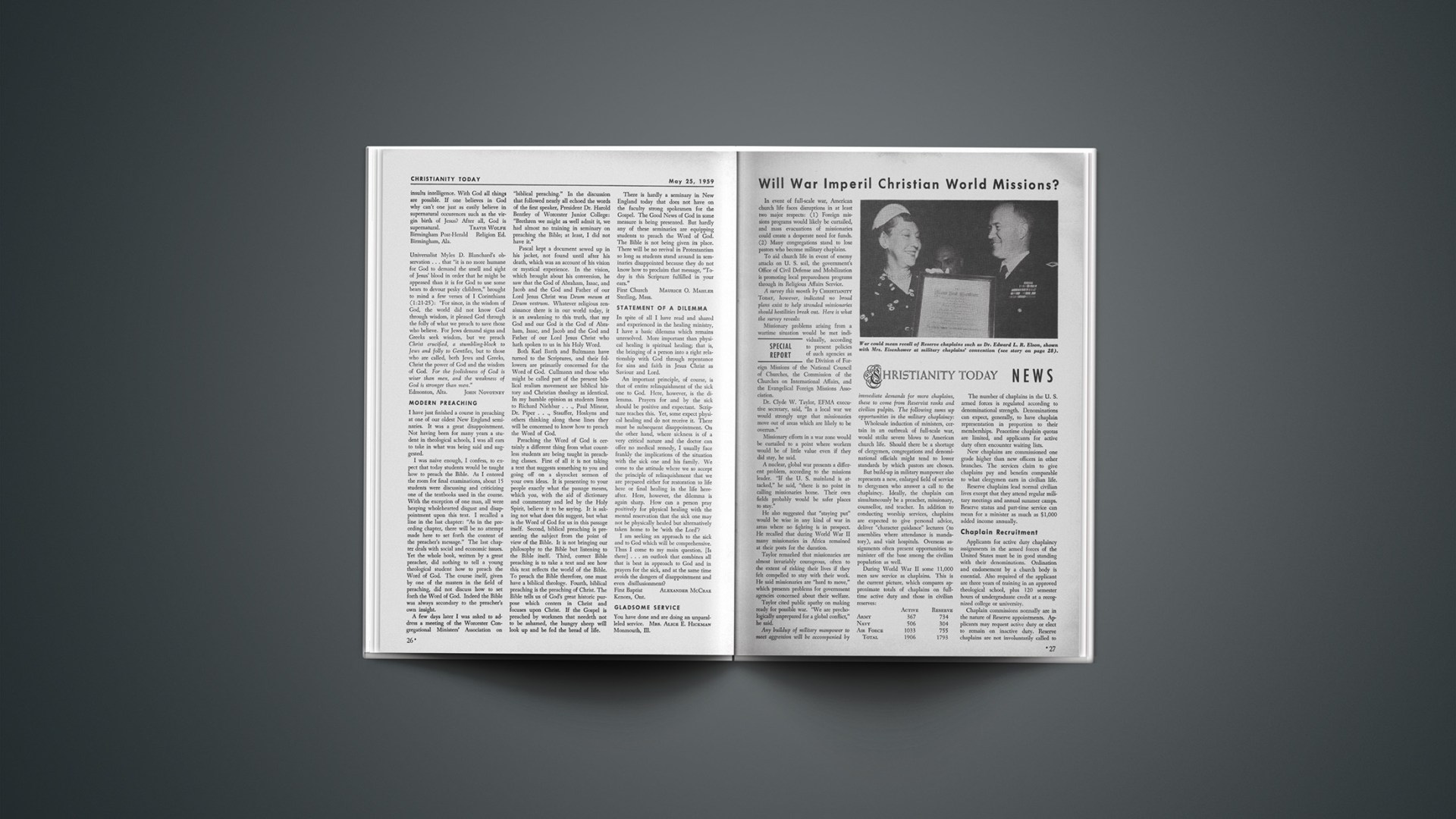
The chaplains were pressed for time when they came to grips with Playboy. A few minutes after resolutions were passed, Mrs. Dwight D. Eisenhower arrived and was given a citation commending her for “maintaining an exemplary Christian home.”

Another highlight of the convention was the report of best-selling author Vance Packard (The Hidden Persuaders and The Status Seekers). Packard, who attends a Congregational church in Connecticut, told the chaplains that advertising media and institutional education exert the greatest influences on American thinking and that both outweigh effects of clergy teachings.

Manipulation of the public by advertisers, Packard said, “raises questions of morality.” He stressed that he was not making a general indictment of advertising, but that he was limiting his criticisms to the misuse of motivation research.

He said he was apprehensive over the “deliberate encouragement of irrational behavior” in certain advertising. He cited, for example, (1) planned obsolescence of manufactured products, and (2) emphasis on impulse buying.

According to Packard, changes in the American character are resulting from current commercial techniques. He said younger people especially are responding, becoming more passive and pleasure-minded. Commercial interests, he added, are establishing a mood of “living it up.”

For the coming year, the convening chaplains elected an Episcopal priest as their new president. The office went to Dr. C. Leslie Glenn, now doing research in human relations at the University of Michigan. He is a former rector of Washington’s “Church of the Presidents,” St. John’s on Lafayette Square, and holds the rank of captain in the Navy chaplaincy reserve.

The Military Chaplains Association has a membership of some 1500. Active duty chaplains are given time off to attend the convention. Reservists who register are granted retirement points.

The convention had a grim sequel. A noon luncheon proved to be the occasion of the last public address of Deputy Secretary of Defense Donald A. Quarles. The former Secretary of the Air Force appeared to be in good health and spirits when he spoke to the convention. Three days later he was found dead.

Xenia, Western Merge

Consolidation of Pittsburgh-Xenia and Western Theological seminaries now seems assured, giving Pittsburgh an institution second in size only to Princeton among the seminaries of the United Presbyterian Church in the U.S.A.

The boards of both seminaries met jointly May 8 to hear Dr. Hermann N. Morse, retiring general secretary of the Board of National Missions, give the Survey Committee recommendation of consolidation after a year-long study. Also on the committee were Dr. Wilson Compton, former president of the State College of Washington, and Dean Liston Pope of Yale Divinity School. Acceptance of the Survey Committee’s recommendation was to be reported May 19 to the Committee on Consolidations at the pre-General Assembly meeting in Indianapolis, and approval was expected.

For months apprehension over consolidation centered in Pittsburgh-Xenia, only seminary of the former United Presbyterian Church of North America. Since denominational union with the Presbyterian Church in the U.S.A., many observers wondered about the institution’s future in a city in which Western already existed as a Presbyterian seminary. Two schools in one city made a plausible case for merger. Western was also under pressure to move from its North Side site because of urban redevelopment in that area. Pittsburgh-Xenia’s spacious 10-acre property with new buildings at its East Liberty location has room for expansion.

Pittsburgh-Xenia’s merger anxieties were largely theological. Joint faculty meetings in recent months revealed some marked doctrinal differences. The majority of the faculty at Pittsburgh-Xenia is committed to a conservative professional position, and these faculty members did not welcome a consolidation which would equate their position with a more liberal view. It was widely known that Dr. Addison H. Leitch, president of Pittsburgh-Xenia, did not in general favor consolidation, although he was willing to cooperate in an originally proposed theological foundation consisting of several schools and preserving the identity and continuity of Pittsburgh-Xenia for bachelor of divinity training. He was prepared to concede graduate instruction to the Western faculty. So far, no public announcement of separate schools of instruction has been made.

Opposition to merger also developed among Pittsburgh-Xenia students. Of the 180 students working toward the B.D. degree, 139 are of the United Presbyterian Church denomination; 90 of these signed a petition against merger.

Pittsburgh-Xenia’s board voted 22 to 10 for merger at the end of a meeting marked by prayer, fairness and courteous restraint but heavily charged with emotion. Board members were conscious of potential reaction among former United Presbyterians, who for sentimental or theological reasons will be deeply disappointed that the only seminary from the United Presbyterian side in the church merger of a year ago will now lose its particular identity.

On the other hand, merger news brought rejoicing at Western. Dr. Clifford E. Barbour, president, vigorously favored one theological institution in Pittsburgh. He and his faculty and students will soon move to an attractive new campus. Western’s board voted unanimously for the merger, reflecting satisfaction with the prospect of a larger and stronger institution whose theologically inclusivist character will represent the pronounced denominational trend of 25 years. This trend was firmly established by the excommunication from the Presbyterian Church in the U.S.A. of Dr. J. Gresham Machen and others in 1936.

Of considerable interest remained the question of the choice of a president for the merged seminary—a choice that now will demand a delicate balancing of denominational feelings and tensions.

A New High

A total of $261,686.72 was raised for missions at closing sessions May 3 of the 20th annual Missionary Conference at Boston’s Park Street (Congregational) Church. The funds will support the church’s 120 missionaries in 50 countries and will be distributed among a number of denominational mission boards, large and small, and interdenominational agencies.

The figure was $6,437 greater than the amount reached in last year’s drive. Subscriptions have increased steadily since the present series of missionary conferences began in 1940. That year the church gave $21,000 to missions. The 20-year total exceeds $2,900,000.

The 10-day conference, a highlight of the church’s 150th anniversary observance, broke all previous attendance records. On the program were some 50 missionaries. Morning, afternoon, and evening services were held daily.

Park Street Church’s missionary program is believed to be the largest of any one congregation in the United States. On the North American continent its scope is exceeded only by the Peoples Church of Toronto, whose pastor, Dr. Oswald J. Smith, led the first of the present series of missionary conferences at Park Street in 1940. Smith’s church was to wind up its own missionary conference this month (for a report, see the next issue of CHRISTIANITY TODAY).

International Ethics

Liquor advertising which finds its way north of the border was the topic of a conversation between American and Canadian churchmen and brewery officials at Buffalo, New York, last month.

Representatives to the meeting agreed that a code of “international ethics” should be adopted. Their prime concern was U. S. television and radio advertising which is beamed to Canada, where liquor advertising is prohibited. Liquor advertising in American magazines which circulate in Canada is another problem.

The Buffalo meeting recognized that legal control of across-the-border liquor advertising could probably never be achieved. Its 60 participants issued a statement in which they said that “ethical standards must be formulated and observed.” They recommended further discussion between the Canadian Council of Churches and the National Council of Churches in the U.S.A.

The meeting was sponsored jointly by the Canadian Council of Churches and New York State Council of Churches. Among church leaders attending were the Rev. George Dorey, president of the Canadian Council; the Rev. Kenneth A. Roadarmel, general secretary of the New York Council, and the Rev. Cameron P. Hall, secretary of the NCC’s Department of the Church and Economic Life.

Worth Quoting

Anent recent talk of Protestant-Roman Catholic rapprochement, the 1959 Southern Presbyterian General Assembly reissued a 1946 pastoral letter on the close Protestant-Roman Catholic relationship involved in marriage. Excerpts: “Increasingly evident is the unwisdom of the marriage between Presbyterians and Roman Catholics.

… If a priest of the Roman Catholic church performs the ceremony, the Presbyterian party to the marriage is required to promise to do nothing to change the faith of the Roman Catholic party; although the Roman Catholic is expected by his church to win the Presbyterian. Also the Presbyterian is required to sign away the unborn children to an ecclesiastical organization that will forever forbid them to worship with their parent in the Presbyterian Church.

“We call upon our members to stand uncompromisingly in this matter, to resist resolutely this unfair demand and refuse to make such a promise.… In view of these facts, the General Assembly counsels Presbyterians to refrain from marriage with Roman Catholics as long as the demands and rulings of that church remain unchanged.… The Roman Catholic attitude with reference to mixed marriages makes it impossible for a wholesome family religious life to exist.”

Federal Parochial Aid?

A resolution that virtually calls for federal funds for Roman Catholic parochial schools was adopted by leaders of the National Catholic Educational Association meeting last month in Atlantic City. They urged “that any federal aid be distributed equitably within the limitations of the Federal Constitution so that it may serve the needs of all the youth of our country.”

A Call For Quakers

The 279th Philadelphia Yearly Meeting of Friends last month called for a national conference of Quakers to discuss criminology—particularly capital punishment and juvenile delinquency.

The “Yearly Meeting,” which represents some 100 “Monthly Meetings” in two states, is historically opposed to capital punishment. The Quakers’ concern revolves on such matters as developing job opportunities for released offenders and promoting legislation for rehabilitation programs.

Mormon Converts

The largest of the Mormon bodies claims to have picked up 33,330 converts last year. Membership in the Church of Jesus Christ of Latter-day Saints passed the million-and-a-half mark during 1958, according to statistics released at the church’s 129th General Conference.

Among delegates at last month’s three-day meeting in the Mormon Tabernacle, Salt Lake City: Ezra Taft Benson, secretary of agriculture and a member of the church’s Council of the Twelve Apostles.

Protestant Panorama

• JB, a verse play which puts the story of Job into a modern setting, is the 1959 winner of the Pulitzer prize for drama. The play by Archibald MacLeish has been running on Broadway since December 11.

• The U. S. Supreme Court ruled this month that a municipality, by enforcement of a zoning ordinance, can prohibit erection of a church building.

• The first U. S. transatlantic flagship to pass eastward through the St. Lawrence Seaway included a cargo of more than 4 million pounds of supplies from Lutheran World Relief … Seamen aboard the Prins Johan Willem Friso, first ocean ship to dock in Chicago by way of the new seaway, were given copies of the Scriptures on behalf of the Chicago Bible Society.

• St. Paul, Minnesota, now has six accredited church-related colleges. Latest to be officially recognized by the North Central Association of Colleges and Secondary Schools were Bethel College, a four-year liberal arts college operated by the Baptist General Conference, and Concordia Junior College, operated by the Lutheran Church—Missouri Synod.

• Salvador Dali, Spanish surrealist painter, says he would like to design a church dedicated to the success of the Ecumenical Council to be called by Pope John XXIII.

• The world’s largest statue to Christ was unveiled May 17 on the banks of the Tagus River near Lisbon, Portugal. The 92-foot white stone statue stands on a four-pillared pedestal that rises more than 250 feet. Roman Catholics sponsored construction at a cost of some $500,000.

• The United Church of Canada is planning French translations for portions of its Book on Common Order.

• Members of the Evangelical United Brethren Church and the Evangelical Congregational Church formed a pilgrimage to the grave of Jacob Albright, founder of the U. S. Evangelical movement, on the 200th anniversary of his birth. Albright was buried near Lebanon, Pennsylvania.

• Westminster Abbey begins participation this summer in an annual clergy exchange program between councils of churches in the United States and Britain. The Rev. Charles R. Stires, rector of Trinity Episcopal Church in Syracuse, New York, will be first visiting preacher at Westminster.

• Lutherans in the world now total 71,135,068, about one-third of Protestantism, according to the Lutheran World Federation.

• A service in Amsterdam marked the founding there of the world’s first Baptist church 350 years ago. Baptist leaders from many lands attended.

• Some 8,000,000 U. S. youngsters and nearly 100,000 Canadian children will attend vacation church schools, day camps, and work-and-play assemblies this summer, according to an agency of the National Council of Churches.

• The National Council of the Protestant Episcopal Church, rejecting a bid to establish its headquarters in the Interchurch Center in New York, will look elsewhere to locate its offices. “We do not feel that ecumenicity is necessarily or even wisely based on cohabitation,” said Bishop Frederick J. Warnecke.

• The Convocations of Canterbury and York will consider at fall sessions a proposal to embody in Church of England canons a clause ensuring the secrecy of confessions made to priests.

• March and April evangelism campaigns resulted in 143,327 baptisms within the Southern Baptist Convention, according to the department of evangelism of the denomination’s Home Mission Board. A spokesman said Southern Baptists have never had so many baptisms in such a limited period. The campaigns were part of the five-year Baptist Jubilee Advance.

• Dr. Oswald J. Smith, founder of the Peoples Church in Toronto, will conduct an evangelistic series in Europe next month. He plans an 18-day meeting in Helsinki and five-day campaigns in Stockholm and London.

Continent Of Australia

Evangelistic Epoch

Billy Graham, whose crowds have no parallel in religious history, saw his own record broken May 10 when some 150,000 braved chilly winds and rain to attend the evangelist’s closing rally in Sydney, Australia. Graham spoke before 80,000 in the Sydney Showground while another 70,000 listened in an adjoining cricket ground. His previous attendance record, 143,750, was set at Melbourne.

The Sunday afternoon finale saw 5,683 step forward to bring to 56,840 the number of persons who made decisions for Christ in 26 Sydney meetings.

Graham said at the close of the Sydney crusade that his ailing left eye felt “better than it has for months.” He said that his vision was “almost normal.”

Meetings in Adelaide, Perth, and Brisbane were being held with the aid of Graham’s associate evangelists. Graham himself was to speak at closing rallies at each of the cities. His last scheduled public meeting in Australia was set for May 31, in Brisbane.

Hoping for a summer’s rest, Graham has kept his engagements for the coming weeks to a minimum. His next extended crusade is scheduled for Indianapolis, beginning October 6.

Following is an appraisal of Graham’s Australasia crusade by Dr. Sherwood E. Wirt, California Presbyterian minister who witnessed the meetings:

As their epoch-making Australasia crusade neared its climax this month with meetings in Adelaide, Perth and Brisbane, members of the Billy Graham team devoted Saturday morning sessions to pondering and praying over concerns fraught with spiritual significance for the lands “down under.”

To be specific, evangelicals in 1954, at the close of the Harringay crusade, thought Great Britain was on the verge of the major “break-through” of the Holy Spirit. That hour has passed, and doors which seemed open, appear to have closed. Now God is presenting a fresh opportunity. Australia and New Zealand, after meetings which have seen nearly every Graham crusade record broken, share a spiritual mood unparalleled in the history of the antipodes.

There is scarcely a church in either commonwealth that has not felt the direct or indirect impact of the crusade. There is hardly a village that has not sensed the throb of new life in the midst. If the history of the Christian Church in the Southern Hemisphere is ever written, it will certainly characterize A.D. 1959 as the year of revival.

Melbourne was amazing; Tasmania was heartwarming; New Zealand’s “feast of a week” was a miracle of grace; and yet somehow what happened in and out of the Showground at Sydney surpassed them all! During the final two weeks land relay lines, carrying the direct telephonic message from the rostrum, penetrated far into the “bush country,” bringing the message into 300 communities of New South Wales and beyond. In halls where platforms were empty save for a sound box, Australians gathered by hundreds of thousands to hear the Gospel flanked by pastors and counselors. Showground crowds were tremendous. In two weeks Sydney had more decisions and inquiries than San Francisco had in seven. A crowded chartered train arrived from Melbourne and Billy appealed to the throng for housing. It was estimated that the number of persons attending actual crusade meetings in Australia alone would surpass two million.

In New Zealand, with the addition of land-line listeners (as in Dunedin, where the town hall was packed for all six nights), it was believed that one-fourth of the entire dominion population heard the preaching of the Gospel of Christ through Mr. Graham and his associate evangelists, Grady Wilson, Leighton Ford and Joseph Blinco. (Cultural note: there is no television yet in New Zealand.) In one small city, Matamata, after a relay line meeting, the ministerial association was specially convened and the pastors unanimously agreed to issue a public Gospel invitation from their pulpits on the following Lord’s Day.

Graham To Moscow?

Billy Graham may hold a three-day evangelistic series in the First Baptist Church of Moscow, according to reports from the Russian capital.

Graham’s Moscow visit presumably would come in June, when he is returning from his Australasia crusade via Europe. However, as of the close of his Sydney crusade, the evangelist had not commented on the Moscow report.

Graham also is reported to have an invitation from the Archbishop of Canterbury to visit Lambeth Palace while en route back to the United States.

Yet to the subjects of the Queen in Australasia the most remarkable feature of the crusade was not the strong preaching of the evangelist, or the thrilling stories of conversions and altered lives that filtered up through the counseling and follow-up departments; or the masses that swarmed over the great rugby and cricket parks and choked the aisles at the invitation. Australians were aware that these phenomena had attended other Graham meetings elsewhere in the world. What really amazed the folk “down under” was the way they began treating each other.

Call the fourteen visiting Americans what you will (Mr. Blinco is a Britisher, but is moving this summer to Oklahoma City), they had the church people of Australia and New Zealand working and talking together and recognizing each other as they had never done before. After Billy Graham had addressed the pastors of Sydney, Alan Walker, noted leader of world Methodism, rose deeply moved to say, “I see now that the unity we have sought so long in committees, and seen so little of, comes only when we are actively seeking to fulfil our common task in the carrying out of the Great Commission.” So it was that Anglicans, Presbyterians, Plymouth Brethren, Disciples of Christ, Congregationalists, Baptists, Methodists, Pentecostals and the Salvation Army suddenly “discovered” each other in a new and significant way.

To be sure, there was foot-dragging in all these groups, but they made an impressive Christian front as they labored on bus assignments, handed out memos, counseled inquirers, prayed, took notes, sang, set up chairs and drank endless cups of “tay” together for the glory of God and the triumph of his grace. One noted author and ecclesiastic, a bishop of the Church of England, politely refused to sit on the platform and chose instead the anonymity of the follow-up room, where he helped 50 to 75 volunteer typists crank out decision card referrals to be posted to ministers before dawn.

One Presbyterian minister in Sydney found himself with 300 such cards after only two weeks of meetings, threw up his hands and invited them all to tea in his church. Another pastor, who told the press, “I don’t agree with Billy Graham,” nevertheless found himself reading the Scripture at the Showground and opening his pulpit to a member of the team—who responded by giving an invitation to Jesus Christ. Dr. Stuart Barton Babbage, dean of Melbourne Cathedral of St. Paul, on the first Sunday evening after the crusade invited those who would like to make a commitment to Jesus Christ to remain after the service. Three hundred stayed!

Australia’s moral problems were reflected in odd ways. One lady who used to stable her horses under the stands in Sydney Showground now found herself in the same stable—taking instruction in the Christian life from Mr. Blinco. Another lady who had gone forward to receive Christ announced, “I feel as if I had just won the lottery!”

As usual, back of the great surge of love and light and tears and joy was the careful preparation and organization of dedicated men. The chief architect of the Australasia crusade, humanly speaking, was the Rev. Jerry Beavan, who spent 18 months on the site. Visitation evangelism follow-up was directed by the Rev. Leslie Green, an American Disciples minister who took a leave of absence from his church in Chatswood, a suburb of Sydney. Graham himself went to Australia against the advice of doctors, but has promised to listen to them this summer as he takes a three-month rest without major responsibilities.

Meanwhile Australia and New Zealand churchmen were urging other members of the Graham team to remain behind or to return soon, to help them deal with the tremendous question, “What next in Australasia?”

Dominion Of Canada

A Coordinated Brief

Representatives of more than 40 organizations, including major Protestant denominations in Canada, presented a brief to Prime Minister John Diefenbaker last month urging a constitutional amendment to guarantee freedom of religion. The brief recommends a freedom of religion clause in Diefenbaker’s proposed bill of rights.

The brief suggested that this clause be included in the bill of rights: “Every one has the right to freedom of thought, conscience and religion; this right includes freedom to maintain or to change his religion or belief and freedom either alone or in community with others and in public or private, to manifest his religion or belief in worship, teaching, practice and observance, all without coercion in any way.”

The prime minister, however, said that certain rights of provinces preclude a constitutional amendment on freedom of religion at this time. He indicated that a statute could be enacted to the same effect.

Continent Of Europe

A Leading Issue

German churchmen are sharply divided on the question of whether their country should utilize atomic armament in the event of war. Dr. Martin Niemoeller, president of the Evangelical Church of Hesse and Nassau, upholds an even more pacifistic question: Shall the state employ force of any kind to defend itself?

The showdown came last month in the synod of Niemoeller’s church. After heated debate in which the president raised unsuccessful objections, the synod upheld the right of a state to employ force in the protection of justice and peace in a “Clarifying Message to Soldiers.”

The church’s primary mission, the message stated, is “to preach the Gospel of the free grace of God.”

Some weeks ago, Defense Minister Franz-Josef Strauss instituted legal action against Niemoeller for allegedly insulting the West German army. The churchman was charged with making derogatory remarks at a pacifist rally.

The message said that while helpful understanding on the part of the church includes protection of those refusing armed service on conscientious grounds, “the church, at the same time, has a responsibility to render pastoral care to politicians and soldiers who are forced by their conscience to take upon themselves, according to human insights and ability, the gravest decisions for the sake of preserving peace.”

People: Words And Events

Deaths: Dr. Yngve T. Brilioth, 67, former Archbishop of Uppsala and Primate of the Lutheran Church of Sweden, in Uppsala, Sweden … Archdeacon Donald Rieginald Weston of the Anglican Church in Northern Rhodesia, in an automobile accident near Lusaka, Northern Rhodesia … Dr. George B. Connell, 54, president of the Southern Baptists’ Mercer University, in Macon, Georgia … Albert Crews, 51, director of program promotion and station relations for the Broadcasting and Film Commission of the National Council of Churches, at Port Washington, New York … Dr. Henry R. Boyes, 69, medical missionary of the United Presbyterian Church in the U. S. A., in Detroit … Dr. John Bunyan Smith, 85, for 25 years pastor of the Baptist White Temple of San Diego, California.

Elections: As Bishop of the Evangelical Augsburg (Lutheran) Church in Poland, Dr. A. Wantula … as president of the Hungarian Ecumenical council, Dr. Tibor Bartha … as president of the General Convent, highest governing body of the Hungarian Reformed Church, Bishop Elemer Gyory … as executive secretary-treasurer of the Historical Commission of the Southern Baptist Convention, Davis Collier Woolley.

Appointments: As cadet chaplain at the U. S. Military Academy, West Point, New York, Dr. Theodore C. Speers, minister of the Central Presbyterian Church, New York City … as president of Seattle Pacific College, Dr. C. Dorr Demaray … as president of Texas Lutheran College, Dr. Marcus C. Rieke … as academic dean and professor of psychology of religion at Scarritt College, Dr. John W. Johannaber … as associate professor of Old Testament at Gordon Divinity School, Dr. Charles F. Pfeiffer … as associate professor of Christian education at Wesley Theological Seminary, Dr. Mary Alice Douty … as associate director of the National Council of Churches’ Office of Finance, Herbert T. Miller … as general secretary of the Congregational Christian Churches’ Board of Home Missions, Dr. William Kincaid Newman … as chief executive assistant to the presiding bishop of the Protestant Episcopal Church, Warren H. Turner, Jr.

Retirement: As editor of the weekly Biblical Recorder, Dr. L. L. Carpenter, effective December 31.

Coronation: As Patriarch of the Coptic Church under his chosen name of Kryollos VI, the former Archpriest Mina Albaramoussi Elmetwahad.

Nero’S Gardens

Archeologists in Rome claim to have found the site of Emperor Nero’s gardens where Christians were massacred in the first century. Ancient walls, stairways, and mosaics found in excavations between the River Tiber and the Vatican are said to constitute the remains of Nero’s infamous pleasure grounds where Christians were burned to death.

Will War Imperil Christian World Missions?

NEWS

CHRISTIANITY TODAY

Special Report

In event of full-scale war, American church life faces disruptions in at least two major respects: (1) Foreign missions programs would likely be curtailed, and mass evacuations of missionaries could create a desperate need for funds. (2) Many congregations stand to lose pastors who become military chaplains.

To aid church life in event of enemy attacks on U. S. soil, the government’s Office of Civil Defense and Mobilization is promoting local preparedness programs through its Religious Affairs Service.

A survey this month byCHRISTIANITY TODAY, however, indicated no broad plans exist to help stranded missionaries should hostilities break out. Here is what the survey reveals:

Missionary problems arising from a wartime situation would be met individually, according to present policies of such agencies as the Division of Foreign Missions of the National Council of Churches, the Commission of the Churches on International Affairs, and the Evangelical Foreign Missions Association.

Dr. Clyde W. Taylor, EFMA executive secretary, said, “In a local war we would strongly urge that missionaries move out of areas which are likely to be overrun.”

Missionary efforts in a war zone would be curtailed to a point where workers would be of little value even if they did stay, he said.

A nuclear, global war presents a different problem, according to the missions leader. “If the U. S. mainland is attacked,” he said, “there is no point in calling missionaries home. Their own fields probably would be safer places to stay.”

He also suggested that “staying put” would be wise in any kind of war in areas where no fighting is in prospect. He recalled that during World War II many missionaries in Africa remained at their posts for the duration.

Taylor remarked that missionaries are almost invariably courageous, often to the extent of risking their lives if they felt compelled to stay with their work. He said missionaries are “hard to move,” which presents problems for government agencies concerned about their welfare.

Taylor cited public apathy on making ready for possible war. “We are psychologically unprepared for a global conflict,” he said.

Any buildup of military manpower to meet aggression will be accompanied by immediate demands for more chaplains, these to come from Reservist ranks and civilian pulpits. The following sums up opportunities in the military chaplaincy:

Wholesale induction of ministers, certain in an outbreak of full-scale war, would strike severe blows to American church life. Should there be a shortage of clergymen, congregations and denominational officials might tend to lower standards by which pastors are chosen.

But build-up in military manpower also represents a new, enlarged field of service to clergymen who answer a call to the chaplaincy. Ideally, the chaplain can simultaneously be a preacher, missionary, counsellor, and teacher. In addition to conducting worship services, chaplains are expected to give personal advice, deliver “character guidance” lectures (to assemblies where attendance is mandatory), and visit hospitals. Overseas assignments often present opportunities to minister off the base among the civilian population as well.

During World War II some 11,000 men saw service as chaplains. This is the current picture, which compares approximate totals of chaplains on full-time active duty and those in civilian reserves:

The number of chaplains in the U. S. armed forces is regulated according to denominational strength. Denominations can expect, generally, to have chaplain representation in proportion to their memberships. Peacetime chaplain quotas are limited, and applicants for active duty often encounter waiting lists.

New chaplains are commissioned one grade higher than new officers in other branches. The services claim to give chaplains pay and benefits comparable to what clergymen earn in civilian life.

Reserve chaplains lead normal civilian lives except that they attend regular military meetings and annual summer camps. Reserve status and part-time service can mean for a minister as much as $1,000 added income annually.

Chaplain Recruitment

Applicants for active duty chaplaincy assignments in the armed forces of the United States must be in good standing with their denominations. Ordination and endorsement by a church body is essential. Also required of the applicant are three years of training in an approved theological school, plus 120 semester hours of undergraduate credit at a recognized college or university.

Chaplain commissions normally are in the nature of Reserve appointments. Applicants may request active duty or elect to remain on inactive duty. Reserve chaplains are not involuntarily called to active duty unless mobilization needs so demand. Some Reservists subsequently are awarded “Regular” commissions.

Some denominations submit chaplain applications directly to the services. Most, however, deal through agencies such as the General Commission on Chaplains and the National Association of Evangelicals’ Commission on Chaplains.

Upon induction, the new chaplain is sent to an orientation school for some two months “to assist … in making the transition” to service life.

Each service procures its own chaplains. In recent months, all have been emphasizing solicitation of inactive duty Reservists. Details of chaplaincy programs are available from the Chief of Chaplains of the Army, Navy, or Air Force, Washington 25, D. C.

‘Discriminatory’ Act

The 34th annual convention of the Military Chaplains Association petitioned Congress to revise a law which is eliminating certain Army officers before they are eligible for paid retirement.

Army chaplains bear the brunt of an amendment tacked on to the Reserve Officer Personnel Act of 1954 by the 85th Congress. The amendment set up for Army officers a “basic age at 25,” which interpreted by service heads means that those below the grade of colonel who have not completed 28 years of active and reserve duty by age 53 cannot be retained, No exception is made for chaplains, whose training and experience requirements make it virtually impossible for them to enter the service before they reach their late twenties. All officers must have at least 20 years of service before they can retire with pay.

A resolution of the convening chaplains charged that the amendment is “discriminatory” and that it constitutes an “unethical change in contract with all reserve officers.” The resolution said the existing law would force more than 150 Army chaplains from active duty by June, 1960, and many more from Reserve ranks.

The “basic age at 25” amendment was said to be aimed at thinning out the large number of Army majors and lieutenant colonels given commissions during World War II.

Eutychus and His Kin: May 25, 1959

TO H.W.L.

Lives of great men all remind us

Maladjustment is sublime;

Non-conforming leaves behind us

Footprints on the sands of time.

Footprints from conditioned masses,

Crowding in canalized grooves,

Mark the pioneer who passes

Beaten paths the group approves.

Let us, then, be up and doing,

Deviate our attitudes,

Rock our social role, pursuing

Our abnormal aptitudes!

Life is real! Life is earnest!

And the mean is not the goal;

Normal curves are not the sternest

Mark and measure of the soul!

If computer correlation

Lacks percentiles for your case,

Just employ your situation

To observe the human race.

Every function, status, mission

Can be socially defined

Just because the statistician

Never had your id in mind.

Since an average distribution

Rates performances by par,

You may rate an institution

With a profile so bizarre!

If your size would shame Colossus

Group dynamics in a week

Offers, through adjustment process,

Your acceptance—as a freak!

Do you differ in your fears?

Whiskers? I.Q.? Art? or ears?

Please remember that your peers

Have one catalogue for queers.

Go your way in isolation,

Carrying “Excelsior,”

Shunning every explanation

As to what it’s useful for.

But remember, footprint maker,

You may soon expect to find

As you cross some upland acre,

Power shovels close behind!

COMMUNIST OR FREE

I want to express my appreciation for the several articles concerning the theory and practice of communism, and their relation to the Christian faith (April 13 issue). My elderly grandparents, who are leaders of their local church in China, stated in their letters that life has become progressively more unbearable than before. Grandmother is now forced to cook for a community dining hall, while grandfather has to attend scheduled indoctrination classes. Your articles should dispel many misconceptions in this country concerning the real nature of Marx-Leninism.

[Identity withheld]

Washington, D. C.

Your issue of April 13 reached a new all-time low in Christian reporting and commentary. I deliberately accuse you of being an utter traitor to Jesus Christ.… You do not bring justice to any man by spitting on him! Yet this is the course you would propose we continue in regard to many millions of Orientals. I find no compassion or sense in your stand.

Western Knoll Congregational Church

Los Angeles, Calif.

Your choice of men “who have earned the right to speak” on the subjects of peace and the capitalist-communist issue is revolting to anyone who calls himself an evangelical Christian.

St. John’s Immanuel Parish

American Lutheran Church

Bancroft, S. Dak.

How you could ever hope to write a significant issue dealing with the question of “peace” by mustering a retired army general, a State Department representative, and others committed as a primary aim, to the destruction of Communism, is beyond me. To think there was not even included one representative of modern pacifism.

San Anseimo, Calif.

Having heard my old friend, Walter Judd, again yesterday speak to the clergy in Pittsburgh and say that he thinks the world is going to be free or Communist within our life time, and having just got a group of young laymen started on the basis of concern for the direction in which this nation is going (we call them Men For Freedom Through Faith), I am very deeply troubled by the kind of blind sentimentalism to which you refer.… Your position is vastly sounder than that of The Christian Century, and I am so thankful to you for taking it.

Calvary Episcopal Church

Pittsburgh, Pa.

Having been born, reared, and educated in Russia, and as public school teacher, having personally observed the rise and development of Bolshevism, I ought to know something about the nature, purpose, and aim of present day communism. I must attest that every word and warning of Fred C. Schwarz in “Can We Meet the Red Challenge?” is certainly true, and should be heeded and responded to by every sincerely believing Christian throughout the world. Perhaps the most appalling truth mentioned in the article is the fact of the amazing widespread ignorance and unforgivable blindness of the majority of American Christians, including some of the highest influential leaders, who almost deliberately close their minds and senses in refusing to recognize the existing threat and peril of this most pernicious of anti-Christian movements since the beginning of times. Why can’t we see what is going on before our very eyes and how can any of us be so blind and indifferent?

Christ Lutheran Church

(U.L.C.A.) Wisner, Neb.

Dr. Schwarz’s article is grand. Yet he talks about “communism” when he and you must know that there isn’t any Communist nation, but there is a mighty socialist empire, with the central committee in the Union of Soviet Socialist Republics’ capital of Moscow.

Westminster Hill Ch. (Congregational)

Canterbury, Conn.

Dr. Schwarz’ article … would be valuable to give to many ignorant and wavering Christians and ministers.

Central Baptist

Dayton, Ohio

THE EMPTY TOMB

I think Dr. Smith misses something important in his argument (Mar. 30 issue).… The empty tomb from which [Christ] rose is only accessory evidence after the fact of the Resurrection. The prime evidence is the resurrected Jesus himself. Surely primitive Christianity did not have as its igniting spark such belabored reasoning as this article presents, but rather the encounter of the disciples with their risen Lord after his death and burial.

Saint James Memorial Church

Pittsburgh, Pa.

PROPHETIC INSIGHT

Just after having read your article “The Resurgence of Evangelical Christianity” (Mar. 30 issue), I had occasion to turn to the preface of J. Gresham Machen’s The Virgin Birth of Christ. With true prophetic insight he tells of the very resurgence of biblical Christianity which we may be on the threshold of today: “The author is not, indeed, inclined to accept the dictum of John Herman Randall and John Herman Randall, Jr., when from the point of view of those opposed to all traditional Christianity, they say (Religion and the Modern World, 1929, p. 136): ‘Evangelical orthodoxy thrives on ignorance and is undermined by education.…’ He makes bold to think that the scholarly tradition of the Protestant Church is not altogether dead even in our day, and he looks for a glorious revival of it when the narrowness of our metallic age gives place to a new Renaissance.” Machen wrote these words in 1932!

Calgary, Alta.

I have been amazed and delighted with CHRISTIANITY TODAY. I am an Anglican Catholic, and I have always looked out on pale, liberal, humanistic, unbelieving Protestantism with real distaste. Frankly, I did not believe, before I began to see your magazine, that there were enough Protestants in the country who really believed the classical doctrines of Christianity sturdily enough to support a national periodical. Your articles and editorials and the letters responsive to them have quite opened my eyes. One sees evidence in CHRISTIANITY TODAY, of course, of the great gulf fixed, as always, between Catholicism and Protestantism on the doctrines of the Church, the Ministry, and the Sacraments. This has always been very serious, and still is. But when you deal with the Incarnation, the Holy Trinity, the Virgin Birth, the Resurrection—oh, it is so fine to know that there are Protestants who really believe the Christian religion!

The Church of Our Saviour

Milton, Mass.

The resurgence of the Christian faith is everywhere evident today. CHRISTIANITY TODAY is one of the best things which has happened in 40 years. I am an old-timer and I watched with sorrow the decline of the faith. So far had the church fallen that one who believed the Bible was called a “bibliolater!” What blasphemy!…

Those who have their spiritual eyes open today will stand by and uphold your Bible-honoring publication. I have enjoyed every issue of it.

Yoder Presbyterian Church

Yoder, Wyo.

I have an observation to make with regard to your preference for the word evangelicalism over fundamentalism. In your issue of September 16, 1957, (and in subsequent issues as well) you clearly point out the unfortunate associations which have accrued to the term fundamentalism. Most reasonable people will agree that your observations were in large part correct. However, I feel that you lay yourself wide open to a charge of special pleading by your failure to note the disadvantages accompanying a general usage of the term evangelical. Certainly, you must be aware of the fact that to millions of nominal Christians here in Europe, the term evangelical is simply a synonym for the word Protestant. In fact, inquiry as to a man’s religious affiliation elicits either Katholisch or Evangelisch as a reply.

Further, you deplore the fact that the word fundamentalism does not possess biblical background. However, I believe that here again something is being overlooked. It seems to this observer that it is purely an accident of language that the Greek euaggelion was transliterated—and is used in this form not only in English, but in German, French, and other modern languages—while themelios was translated. The Vulgate uses fundamentum in 1 Corinthians 3:10–12 and elsewhere in referring to foundations.… Certainly, nothing could be more detrimental to your work as outlined in various editorials than a senseless quibble as to why one should try to place evangelicalism on a more respected level and why fundamentalism is not worth upgrading!

Kinder-Evangelisations-Bewegung Supt. in Deutschland

Frankfurt Am Main, West Germany

MARTYRDOM DISOWNED

Mrs. John Osborne’s “Ten Commandments” for ministers’ wives (News, Apr. 13 issue) is another of those offerings which point out the supposed martyrdom of women who chose to marry clergymen.… For the whole list of ten … I would like to substitute one. “Thou shalt strive to live in a spirit of fellowship with your Lord and Master, seeking a close communion and sense of consecration to Him.” Only as we find … joy in fellowship and love, can the problems that beset us … [be] overshadowed by the satisfaction of serving Christ.

Central City, Neb.

MUTENESS IN THE CRISIS

Can you tell me where a Christian can go to hear the prophetic word interpreted? Most of our ministers today are as mute as the Statue of Liberty when it comes to interpreting Daniel, Ezekiel or Revelation in terms of the world-stirring events of the past half-century. Has God no definite message to us from these great books? Has He left us in the dark concerning the mobilization of the largest anti-Christian forces in all history, that threatens Christendom?

Mendota, Ill.

WHENCE THIS OCULIST?

Will reader Alfred H. Fowlie (March 30 issue) who is “convinced that man is not depraved, fallen, or sinful,” please give us the name of the oculist who prescribed his rose-tinted glasses?

He speaks of being a “truth sharer” and in the next line says “we have not found the truth.” How can one share what he has not found? O consistency, thou art a jewel!

His concept of Christ—“absurd.… a man no more, no less” and his own job based upon a “resolve to become a minister” make me ever the more grateful for Christ Jesus, my Saviour, Lord, and Master, and my own sense of mission and high calling.

Middletown, Pa.

What I can’t understand about Unitarianism is: How do Unitarians determine what parts of the Bible to accept or reject? I find nothing in the Bible that insults intelligence. With God all things are possible. If one believes in God why can’t one just as easily believe in supernatural occurences such as the virgin birth of Jesus? After all, God is supernatural.

Religion Ed.

Birmingham Post-Herald

Birmingham, Ala.

Universalist Myles D. Blanchard’s observation … that “it is no more humane for God to demand the smell and sight of Jesus’ blood in order that he might be appeased than it is for God to use some bears to devour pesky children,” brought to mind a few verses of 1 Corinthians (1:21–25): “For since, in the wisdom of God, the world did not know God through wisdom, it pleased God through the folly of what we preach to save those who believe. For Jews demand signs and Greeks seek wisdom, but we preach Christ crucified, a stumbling-block to Jews and folly to Gentiles, but to those who are called, both Jews and Greeks, Christ the power of God and the wisdom of God. For the foolishness of God is wiser than men, and the weakness of God is stronger than men.

Edmonton, Alta.

MODERN PREACHING

I have just finished a course in preaching at one of our oldest New England seminaries. It was a great disappointment. Not having been for many years a student in theological schools, I was all ears to take in what was being said and suggested.

I was naive enough, I confess, to expect that today students would be taught how to preach the Bible. As I entered the room for final examinations, about 15 students were discussing and criticizing one of the textbooks used in the course. With the exception of one man, all were heaping wholehearted disgust and disappointment upon this text. I recalled a line in the last chapter: “As in the preceding chapter, there will be no attempt made here to set forth the content of the preacher’s message.” The last chapter deals with social and economic issues. Yet the whole book, written by a great preacher, did nothing to tell a young theological student how to preach the Word of God. The course itself, given by one of the masters in the field of preaching, did not discuss how to set forth the Word of God. Indeed the Bible was always secondary to the preacher’s own insight.

A few days later I was asked to address a meeting of the Worcester Congregational Ministers’ Association on “biblical preaching.” In the discussion that followed nearly all echoed the words of the first speaker, President Dr. Harold Bentley of Worcester Junior College: “Brethren we might as well admit it, we had almost no training in seminary on preaching the Bible; at least, I did not have it.”

Pascal kept a document sewed up in his jacket, not found until after his death, which was an account of his vision or mystical experience. In the vision, which brought about his conversion, he saw that the God of Abraham, Isaac, and Jacob and the God and Father of our Lord Jesus Christ was Deum meum et Deum vestrum. Whatever religious renaissance there is in our world today, it is an awakening to this truth, that my God and our God is the God of Abraham, Isaac, and Jacob and the God and Father of our Lord Jesus Christ who hath spoken to us in his Holy Word.

Both Karl Barth and Bultmann have turned to the Scriptures, and their followers are primarily concerned for the Word of God. Cullmann and those who might be called part of the present biblical realism movement see biblical history and Christian theology as identical. In my humble opinion as students listen to Richard Niehbur …, Paul Minear, Dr. Piper …, Stauffer, Hoskyns and others thinking along these lines they will be concerned to know how to preach the Word of God.

Preaching the Word of God is certainly a different thing from what countless students are being taught in preaching classes. First of all it is not taking a text that suggests something to you and going off on a skyrocket sermon of your own ideas. It is presenting to your people exactly what the passage means, which you, with the aid of dictionary and commentary and led by the Holy Spirit, believe it to be saying. It is asking not what does this suggest, but what is the Word of God for us in this passage itself. Second, biblical preaching is presenting the subject from the point of view of the Bible. It is not bringing our philosophy to the Bible but listening to the Bible itself. Third, correct Bible preaching is to take a text and see how this text reflects the world of the Bible. To preach the Bible therefore, one must have a biblical theology. Fourth, biblical preaching is the preaching of Christ. The Bible tells us of God’s great historic purpose which centers in Christ and focuses upon Christ. If the Gospel is preached by workmen that needeth not to be ashamed, the hungry sheep will look up and be fed the bread of life.

There is hardly a seminary in New England today that does not have on the faculty strong spokesmen for the Gospel. The Good News of God in some measure is being presented. But hardly any of these seminaries are equipping students to preach the Word of God. The Bible is not being given its place. There will be no revival in Protestantism so long as students stand around in seminaries disappointed because they do not know how to proclaim that message, “Today is this Scripture fulfilled in your ears.”

First Church

Sterling, Mass.

STATEMENT OF A DILEMMA

In spite of all I have read and shared and experienced in the healing ministry, I have a basic dilemma which remains unresolved. More important than physical healing is spiritual healing; that is, the bringing of a person into a right relationship with God through repentance for sins and faith in Jesus Christ as Saviour and Lord.

An important principle, of course, is that of entire relinquishment of the sick one to God. Here, however, is the dilemma. Prayers for and by the sick should be positive and expectant. Scripture teaches this. Yet, some expect physical healing and do not receive it. There must be subsequent disappointment. On the other hand, where sickness is of a very critical nature and the doctor can offer no medical remedy, I usually face frankly the implications of the situation with the sick one and his family. We come to the attitude where we so accept the principle of relinquishment that we are prepared either for restoration to life here or final healing in the life hereafter. Here, however, the dilemma is again sharp. How can a person pray positively for physical healing with the mental reservation that the sick one may not be physically healed but alternatively taken home to be ‘with the Lord’?

I am seeking an approach to the sick and to God which will be comprehensive. Thus I come to my main question. [Is there] … an outlook that combines all that is best in approach to God and in prayers for the sick, and at the same time avoids the dangers of disappointment and even disillusionment?

First Baptist

Kenora, Ont.

GLADSOME SERVICE

You have done and are doing an unparalleled service.

Monmouth, Ill.

Ideas

Churches and Hidden Persuaders

Public relations today involves almost as many problems of ethics as prospects of sales. Man’s easygoing traffic in words and ideas has swept this “problem of communication,” as it is now often called, onto the expressway of modern concerns.

The use of guise and disguise in contemporary advertising is also provoking a long look at the religious use of persuasive techniques seeking the spiritual commitment of the masses.

Motivational research has bared many deep subconscious drives that influence the purchasing habits of the American people. Madison Avenue agencies gear their promotional efforts to these insights. In The Hidden Persuaders—a book now in its third or fourth printing, with built-in reader appeals of its own, and publisher’s advertisements alert to motivational devices—Vance Packard causticly indicts this “engineering of consent.” Packard touches the pulpit only in a passing way; neither the term “religion” nor “church” is found in his index. But what he says inevitably raises questions about the field of religious promotion.

To the process of confrontation and communication our modern age has made the special contribution of a vast range of electronic gadgets and gimmicks. It is easy to underestimate and to disparage this gift. The physical extension of Christianity in modern times stands vastly indebted to science and invention. The printing press, the radio, and now the era of television; the train, the airplane, and now the jet—who can foresee what these developments still hold in prospect for evangelism, missions and Christian education?

Without special lighting, microphones, and other electronic gadgets, many a pulpiteer today would feel quite cheated, and even lost. Perhaps, right there, is an occasion of stumbling. Do we perchance rely on gadgets more than on spiritual factors for effective proclamation? The psychiatrist Karl Stern reminds us in The Commonweal that “God, in the language of the Old Testament, speaks to us with a still, small voice. He needs no amplifier.” So we are driven to see again that proclamation is essentially a spiritual venture—not simply a program beamed by efficient technical devices to an effective “sales pitch.” What Dr. Ralph W. Sockman has said of religion—that it cannot be sold, but must be sown—is most true of the religion of supernatural redemption.

The work of the Holy Spirit remains the one indispensable factor in our effective presentation of the Gospel. The test of a “good commercial”—does it hurry a potential buyer to a sales transaction?—cannot therefore be pressed. Preaching is a hopeless pursuit apart from the life-giving power of the Divine Spirit. The outpouring and programming of the Spirit are entrusted neither to advertising agencies nor to church publicity clinics nor to ministers who have read Dale Carnegie. Christian virtues like love, joy, peace, gentleness, and faithfulness simply cannot be verbalized into Christian experience. Preaching reaches for genuine spiritual decision, and this cannot be engineered.

If the minister presents the Gospel faithfully and devoutly, must the lack of response be put to his blame? Or is such seeming defeat for the Gospel quite consistent with dedicated Christian preaching? A disturbing feature of motivational research is its tendency to regard man himself as a mere machine to be manipulated, rather than as a personality to be divinely confronted and renewed. Even when the approach to human beings is not made on this subpersonal level, in quest of scientific control, the appeals are addressed to the natural ego so as to reinforce the old or unregenerate nature, instead of unmasking man’s pretensions and driving him to Christ. Can the Gospel actually be presented to the sinner as an “attractive proposition”? The question is not merely about the “sales pitch,” but about the “product” itself which must not be misrepresented. Slick promotion can “soup up” almost any quack product to give it a magical appeal, but dare we permit the distortion, as it were, of the Gospel? Dare its essential nature be hidden by concealing it beneath a wrapping that makes it more palatable to the natural man, that seeks its acceptance by a primary appeal to unregenerate desires and preferences?

At this level the slick promoter easily falls into idolatry, and easily tempts others to spiritual adultery. His manipulation of words like “success” and “happiness” is a quick giveaway. He sets out to show that, without adequate religious experience, every man is really a failure and is foredoomed to despair. He ends up by making religious commitment a means to other ends, without challenging their priority status in the unregenerate heart. A promotional technique that prompts man to seek many “things” but ignores man’s spiritual destiny seems on its surface to run counter to Jesus’ exhortation to “seek first the kingdom of God … and all these things will be added” (Matt. 6:33). Christ pledges blessedness only to those who seek first the kingdom of God, not simply as a means but as life’s highest end, to which all else is consciously subordinated. Were even an angel from heaven to alter the basic nature of the Gospel, flames the Apostle Paul, “let him be accursed.” That curse falls necessarily on modern promoters who would confer contemporary glamour upon the Gospel by adding to it or subtracting from it, by giving it a natural turn for winning friends and influencing people, and relieving it of an obvious supernatural message for saving and sanctifying sinners. Purveyors of a divine word, the success of the ministry depends upon fidelity in proclamation even more than efficiency in communication.

The Gospel stands—once for all given to the saints. Only the package dare be changed, yet never by way of concealing the content. The “good news” is only good because of prior bad news for mankind. If the Gospel proclaims that Christ died and rose for us, it proclaims at the same time our wickedness, our dire predicament in sin. That is why the Gospel cannot hope to appeal to the vulgar desires in men; it repudiates those desires. The Gospel challenges and disputes fallen man’s accepted standards of value. It does not flatter man, but tells him the facts about himself. The plain truth is that he is a liar, and that God alone is Truth; that he is a hater, an enemy, and that God alone is Love; that he is a fornicator, and that God alone is holy; that he is a creature of dust, and that God alone is almighty. Hence the Gospel confronts man as a scandal; it scandalizes him. He can “save face” only by rejecting it—at the cost of “losing soul.”

The study of psychology and public relations, however, can provide insights helpful in “protecting” this spiritual clash against unnecessary and unjustifiable offenses which belong not to the essential nature of the Gospel, but to the crudity and insensitivity and lovelessness of its ministers. Public relations, therefore, can help to bring even the churches under criticism of the Gospel, provoking earnest self-criticism. The Church bears an awesome task of proclamation and communication. How often she fails to make herself intelligible to modern men—not simply because she finds the locus of her message in past redemptive events outside the purview of modern preoccupations, but because she has not learned to speak the vulgar language of our times (as did the inspired New Testament writers). Thus the Church compounds the scandal of the Gospel with the burden of linguistic remoteness. She faces the danger, of course, that in translating her message into the jargon of the age, she in fact may reduce it, blunting its offense, masking the Gospel. But no amount of evangelistic energy, or multiplication of study conferences, holds hope for significant Christian penetration into the cultural order unless the Gospel is preached and understood.

Some current discussions of the theology of evangelism are so full of existential and/or dialectical jargon, obviously balancing conflicting theological points of view, that evangelists seeking to apply these covering principles would simply wander in the wilderness of contemporary confusion. Evangelism has a primary obligation to the evangel. The evangel itself is simple enough—so simple that Jesus could speak of it in terms of sower and seed, new birth, living water, living bread. Whatever may be said about the unintelligibility of the Bible to unchurched multitudes today, there is nothing intrinsically impenetrable about Scripture; indeed, it often appears refreshingly direct and perspicuous in contrast with much of the preaching and theological literature of our era. It is sheer tragedy to seek modern relevance—and to gain irrelevance instead—by complicating it with the subtle prejudices and complex idiom of modernity.

For those whose vocations border on the religious sphere, the communications problem seems specially acute. The clergy are obviously called to measure success or failure by more complex criteria than extensive publicity and a “good press”; questions of morality and truth crowd their moment-to-moment deeds. But what of religious promoters and public relations experts? Responsibilities of sacred ordination do not devolve upon them. Their very vocation, moreover, requires their creation of highly favorable interest in special programs and particular personalities. What does “a good conscience” imply for them?

Some temptations peculiar to secular promotion seem happily absent from religious promotion. Among these are the striving for an artificially created sense of obsolescence, and the creation of wants that do not really exist. Yet other temptations remain: shading the truth by telling “the good things” and ignoring the bad (the sin of “weaseling,” as some call it); catering to people’s wants, rather than promoting what they ought to want. These failings color almost all persuasive communication of the day; not even preaching is immune from them. They are sins of the pulpit as well as sins of the public relations desk. Are they therefore to be excused and justified as simply an inevitable part of the human equation?

If the most precious thing in human relations is truth, if the Holy Spirit uses truth as an instrument in the conversion of sinners, if Jesus Christ is himself the Truth, if the Holy Bible is a rational revelation of the nature of God and his will for man, then Christian communication is answerable to the priority of truth. Integrity in communication cannot be sacrificed without demeaning these values. The cause of true religion is best advanced by a regard for Christ the living Word more than by one-sided reliance on the gimmicks of manipulative psychology.

Insensitivity to truth, or devaluation of truth, in the course of religious promotion, implies a latent cynicism about basic spiritual values, and cheapens the “word business” to sheer commercialism. The modern manipulation of audiences by rhetorical devices, the professional reliance on subtle techniques to evoke predictable responses, recall the ancient sophists who looked upon words and ideas as mere instruments of persuasion but not as bearers of objective truth. It must be obvious how much this practice, ancient or modern, has in common with those perverse naturalistic theories in our own century that deny the existence of changeless truth and morality, and repudiate Jesus Christ as the Truth. If spiritual realities are most effectively promoted by unspiritual means, then life’s vital dynamisms are serving false gods.

The great truths of revelation and the facts of history are still the best persuaders. Reinforced by the Spirit of God, who employs truth as a means of convicting and converting men, these truths have proved their mettle in each generation and in all quarters of the earth, serving to call men out of darkness into light, and shaping a new race of twice-born men. The Church of Christ doubtless has much to learn about the secret workings of the mind and the subtleties of human response. But some things she does not need: a new gospel, a new scale of values, new principles of blessedness. The weakness of pulpit proclamation and of religious promotion lies in the concealment of sanctions for action which still stand in the forefront of the biblical revelation. What the Bible unveils, the Christian movement seems again to have covered from view. Having hidden the persuasive features that stand in the forefront of biblical teaching, the Church and churchmen fall easily into a temptation to advance spiritual forces through dependence instead on the hidden persuaders of manipulative psychology.

What then shall we say? That man is a dependent creature, because God is his Maker; that man is a sinner, because he has violated the dignity and squandered the righteousness that were his by creation; that man has a rendezvous in eternity, because God has fashioned him for this inescapable destiny; that Christ Jesus alone can lift man to life fit for eternity, alone can wash away his guilt and shame and restore him to fellowship with the Father, because man cannot save himself; that the life of unregenerate men seldom rises above the curbstones of morality, because the enduring virtues are the transforming work of the Spirit of God who sanctifies the redeemed; that an awful and irrevocable doom awaits those who spurn the opportunities of redemption, because the holiness of God cannot be forever mocked; that God providentially superintends the sweep of history for the ultimate good of those who put their trust in him, because the ultimate triumph of divine love is assured; that Christ himself will return to climax the movement of history and unveil in fullness the promised Kingdom of justice and peace, because God has already pledged to his Son those kingdoms of earth for which the tyrants of our time bargain away their souls. These are the persuasive truths by which the Church of Christ lives, to which Christian witness is bound, and by which Christian promotion must be tested. Whenever the Church hides them she enfeebles herself. For a time, manipulative techniques may compensate for this decline. Not forever, however. The Church that does not live by every word that proceeds from the mouth of God must soon starve herself and her hearers on the prattle that flows from the grist mill of the hucksters.

END

Albright’S Influence In The Study Of The Bible

We live in an exciting era of theological activity. Among scholars that have contributed to a fresh outlook in biblical studies is William F. Albright who has stripped away many bulwarks of the older critical views of the Bible. When Albright contends, for example, that the New Testament books could all have been compiled by contemporaries of Jesus of Nazareth (since a great deal of what has been considered to be Greek or Gnostic in the New Testament may now be traced presumably to the Essenes or similar Jewish groups of the last century B.C., thereby destroying the supposed foundations for late dating), conservative scholars understandably find in Dr. Albright a champion of positions significant for their point of view.

This issue of CHRISTIANITY TODAY carries the first of two essays by another prominent Old Testament scholar, Oswald T. Allis, of the “old Princeton school” of Warfield and Machen days. Dr. Allis warns that Albright’s contributions, important as they are, give the conservative camp reason for caution and anxiety as much as for gratitude. Allis asks whether, despite their contribution to a more conservative evaluation of the Bible, Albright’s views really sustain the reliability of Old Testament history and the uniqueness of biblical revelation. It will be well to examine his arguments.

Albright is currently Visiting Professor at Jewish Theological Seminary of America, across the street from Union Theological Seminary. He is at work on the first volume of Finkelstein’s multivolumed history of Judaism. Under his teaching at Johns Hopkins University the “Albright school of thought” forged a significant alternative to many Wellhausen positions, reflected today on the Continent, and in some degree in England as well as in America, both in Catholic and Protestant circles. Many able evangelical Old Testament scholars have come within this orbit of training.

Albright’s great weapon in biblical studies is archaeology. Although archaeological research goes back a century in Palestine and Syria, the really decisive discoveries have been made in our lifetime. These findings contradict the Wellhausen theory at crucial points. Albright’s mastery in Palestinian archaeology, Near East history, comparative religion, and Semitic languages shaped his rise as a mighty antagonist of the Wellhausen view. Albright prefers designation as a conservative Protestant, and indeed exemplifies a rationalistic conservatism of sorts. He is an avowed trinitarian. As a biblical scholar he holds a constructive rather than destructive view of the Bible as a source of history, at least of comparatively reliable history. Reconstructing the past by scientific methodology, acknowledging the unbiased voice of archaeology, and guided by the good (if distant) star of theistic faith, he is a positive influence in a theological world that now stands mostly to his left. Against negative critics who tend to disparage the Bible as a mere conglomerate mass of historically worthless myths and traditions, Albright has proved by scientific methods that it contains authentic history.

Yet Albright supports a documentary view of the Old Testament, holding even to the J and E documents of Genesis, and assigning them much the same date as did Wellhausen, although for different reasons. Pre-patriarchal records are evaluated as primitive myths. While he holds that monotheistic religion is found in very remote times and that it is quite possibly the original religion, he retains the critical view that it did not rise to self-consciousness until later. Instead of postponing its emergence as self-conscious until the time of Amos, however, he dates this as early as Moses. He insists that “the saga of the Patriarchs is essentially historical” (Archaeology of Palestine and the Bible, p. 145), and contends that the findings of archaeology have discredited the old critical theory that patriarchal accounts are mainly throwbacks to an earlier period from the ninth-eighth centuries B.C.

Albright readily agrees, moreover, that historical continuities alone cannot explain the emergence of great religions like the faith of Moses and Christianity. What we have, in his opinion, are “rearrangement and revaluation” of continuous strands in such a way that the historical continuities are there, while yet an over-all discontinuity breaks abruptly into history.

While there is a clash between Albright and Wellhausen, it should be clear also that Albright halts short of a return to the traditional evangelical view of the Old Testament. Indeed, Albright’s revolt against Wellhausen is today combined with a wide diversity of theological perspectives. Albright’s own Christian theism mediates between neo-Thomism and neo-Calvinism or neo-orthodoxy, although he differs from both in essentials. While Albright views the biblical records as sources of history—contrary to the Wellhausen dismissal of them—he pursues a naturalistic scientific methodology in the reconstruction of history that tends to push the supernatural or miraculous outside and above the historical sphere into the (to him) incomprehensible realm of super-history.

Many evangelical scholars now active in the Old Testament field owe a firm debt to Albright, from whom they learned the disciplines of graduate study, the need for academic precision, and an awareness of the instability of critical biases dominating modern biblical studies. But they also learned what some magazine enthusiasts seem not to recognize, that Albright is no champion of evangelical views of revelation and inspiration. He deplores the evangelical approach to Scripture as involving an “excessive attachment to the letter as against the spirit of the Bible”; over against the conservative identification of Scripture with the Word of God, he repudiates literalism as “one of the great enemies of the Christian faith today.” It is curious then to find some evangelicals ascribing to Albright an orthodoxy which embarrasses the Old Testament scholar. The issues of reliability and uniqueness reach even deeper, however, and these are the questions raised by Professor Allis. One gains the clear impression that, having already nudged significantly to the right, Dr. Albright must move still further if he would share the benefits of a genuinely biblical theism.

END

Rome’S Church Unity Plea Stirs Multiple Reactions

Rome’s openness to ecumenical talks with Eastern Orthodox leaders has ready echoes. World Council-affiliated, Greek Orthodoxy now countersuggests conversations with WCC. Jesuits had noted that (contrary to Protestantism) the Greek Church accepts church tradition alongside the Bible, and also the immaculate conception of the Virgin; moreover, that in exchange for recognition of the Pope, the Vatican sometimes allows much liberty in internal church affairs. The filioque controversy, they say, had old political and theological facets now reconcilable.

Meanwhile, some Protestant leaders are also encouraging talks with Rome—not simply in quest of merger, but to test Rome’s readiness to honor the Bible. In this issue’s “Review of Current Religious Thought,” Dutch theologian G. C. Berkouwer appraises Oscar Cullmann’s call for the solidarity of Christendom.

END

Security

A well-known psychiatrist was recently asked what he had found to be the basic problem troubling the majority of his patients. His reply was: “Insecurity.”

Unquestionably there are many people suffering today from insecurity based upon deep-seated mental problems which have their roots in past experience, environmental and otherwise.

But we believe the lack of security which is so much a part of the lives of many today is spiritual in origin. Man has been created for companionship with God, and until this fellowship of spirit is established he is restless, ill at ease, and insecure.

In Jesus Christ all of this can be changed. Not that the problems, pressures and overwhelming circumstances of life will cease, but when Christ lives and rules in the heart of a man he no longer faces life alone, for the sovereign God of the universe lives in him in the person of the Holy Spirit and all things become new. For the past there is forgiveness; for the present there is divine companionship; for the future there is absolute assurance.

God increases multiplied blessings to them that trust him, and it is the Christian’s privilege and duty to know what they are and appropriate them to the fullest extent.

Even in the heart of the most benighted pagan—and he may live in an exclusive residential area or in the jungles of the Amazon—there lurks a sense of longing, of separation, and futility. This emptiness expresses itself in excesses, in various religious rites, or an unending search for diversion and pleasure. It produces animosities, fears, discontent, complexes, and various mental and physical reactions which torment one’s life.

Into such a situation comes the calm, assuring voice of the living Christ: “Come unto me, all ye that labor and are heavy laden, and I will give you rest. Take my yoke upon you, and learn of me; for I am meek and lowly in heart: and ye shall find rest unto your souls. For my yoke is easy, and my burden is light.”

“Rest unto your souls”—that is security. That is the comforting good news which the Father has not chosen to reveal to the wise of the world, but unto babes.

The Christian should be aware of the security that is his which stems from faith in and commitment to Christ as Saviour and Lord.

First, he is secure in the redeeming work of Jesus Christ. The salvation wrought out for him on the Cross of Calvary was complete. There is nothing we can do to add to its efficacy, there is nothing we can do to take away its sin-cleansing power. It is ours to be received as the free gift of God’s loving grace. Furthermore, once a man receives this, it is a continuing experience.

For the Christian there should always be a sense of security, for he stands on an immovable Rock in the midst of a changing and uncertain world. The apostle Paul tells us that man can lay no other foundation, for there is none, and this foundation is Jesus Christ.

Relief to a drowning swimmer is the sudden discovery of a firm rock on which to stand. How much more wonderful is it for man, surrounded by the problems and difficulties of life, to realize suddenly that underneath there is One who never changes, and that around him are the everlasting arms.

The Christian is also secure because it is his privilege to enjoy the comfort of God’s presence in the Holy Spirit who was sent into the world to counsel and comfort those that trust Christ. Confronted with problems and decisions to be made, buffeted by combinations of circumstances over which he has no control nor solution, the Christian should have the assurance in his heart that he is not alone, that God is not only near, he is available to help and does so in the light of his love and eternal purposes.

We are not told in vain that “all things work together for good to them that love God, to them who are the called according to his purpose.” We have the comfort of knowing that in the inscrutable and perfect will of God all things, regardless of their immediate import, work for good to them who love him.

Another source of Christian security is the assurance we have of God’s sustaining grace. The cause of Christ has suffered at the hands of those who seem to picture Christianity as a life of unending protection from viscissitudes and reality. Nothing could be further from the truth. We who have committed ourselves to the living God through his Son are not carried to the skies on flowery beds of ease. We know we are not only tested by adversity, but there are times when our greatest witness for the faith finds its expression out of the troubles and sorrows through which we are called to pass. In all these things we can rest secure in the grace which God unfailingly supplies to those who are his own.

Life entails decisions, many of them minor in import, others crucial and affective. To the Christian is given the privilege of divine guidance in the making of decisions. The One who sees the past, the present, and the future will, in his infinite love and mercy, show us the way we should take.

Many are the Christians who have prayed earnestly for guidance and have had fulfilled for them the promise: “And thine ears shall hear a word behind thee, saying, “This is the way, walk ye in it; when ye turn to the right hand, and when ye turn to the left” (Isa. 30:21).

Basic to a Christian’s sense of security is a knowledge of the love of God. The people of this world desperately need to be loved, and God has loved them. The Cross is the central evidence of God’s love, and this love abounds toward us richly. Little children bask in the knowledge of parental love, often an unspoken devotion but real nonetheless.

How much greater is God’s love, and the therapeutic value of that love when we accept it through faith in Jesus Christ! With a realization of this overwhelming fact there comes to one a security against which even the demons of hell cannot prevail.

Our Lord speaks of this when he says, “Peace I leave with you; my peace I give unto you: not as the world giveth, give I unto you. Let not your heart be troubled, neither let it be afraid.”

We hear much these days about a “guilt complex.” Unquestionably there are unfortunate sufferers from a sense of guilt which may be because of imagined wrongs. But the world’s great problem is that so few have a sense of the guilt of sin and sin’s affront to a holy God.

To avoid the fact of sin or the effects of sin is to be utterly unrealistic. Furthermore, to ignore the wonderful news that the penalty and guilt of sin has been removed forever for the believer through the atoning work of the Saviour is to disregard the greatest news of all history.

At the center of man’s security is the Christ of Calvary. In and through him the weary soul finds rest and hope now and for all eternity.

addApple PodcastsDown ArrowDown ArrowDown Arrowarrow_left_altLeft ArrowLeft ArrowRight ArrowRight ArrowRight Arrowarrow_up_altUp ArrowUp ArrowAvailable at Amazoncaret-downCloseCloseellipseEmailEmailExpandExpandExternalExternalFacebookfacebook-squarefolderGiftGiftGooglegoogleGoogle KeephamburgerInstagraminstagram-squareLinkLinklinkedin-squareListenListenListenChristianity TodayCT Creative Studio Logologo_orgMegaphoneMenuMenupausePinterestPlayPlayPocketPodcastprintremoveRSSRSSSaveSavesaveSearchSearchsearchSpotifyStitcherTelegramTable of ContentsTable of Contentstwitter-squareWhatsAppXYouTubeYouTube