Eutychus and His Kin: February 2, 1959

SERMON DOODLES

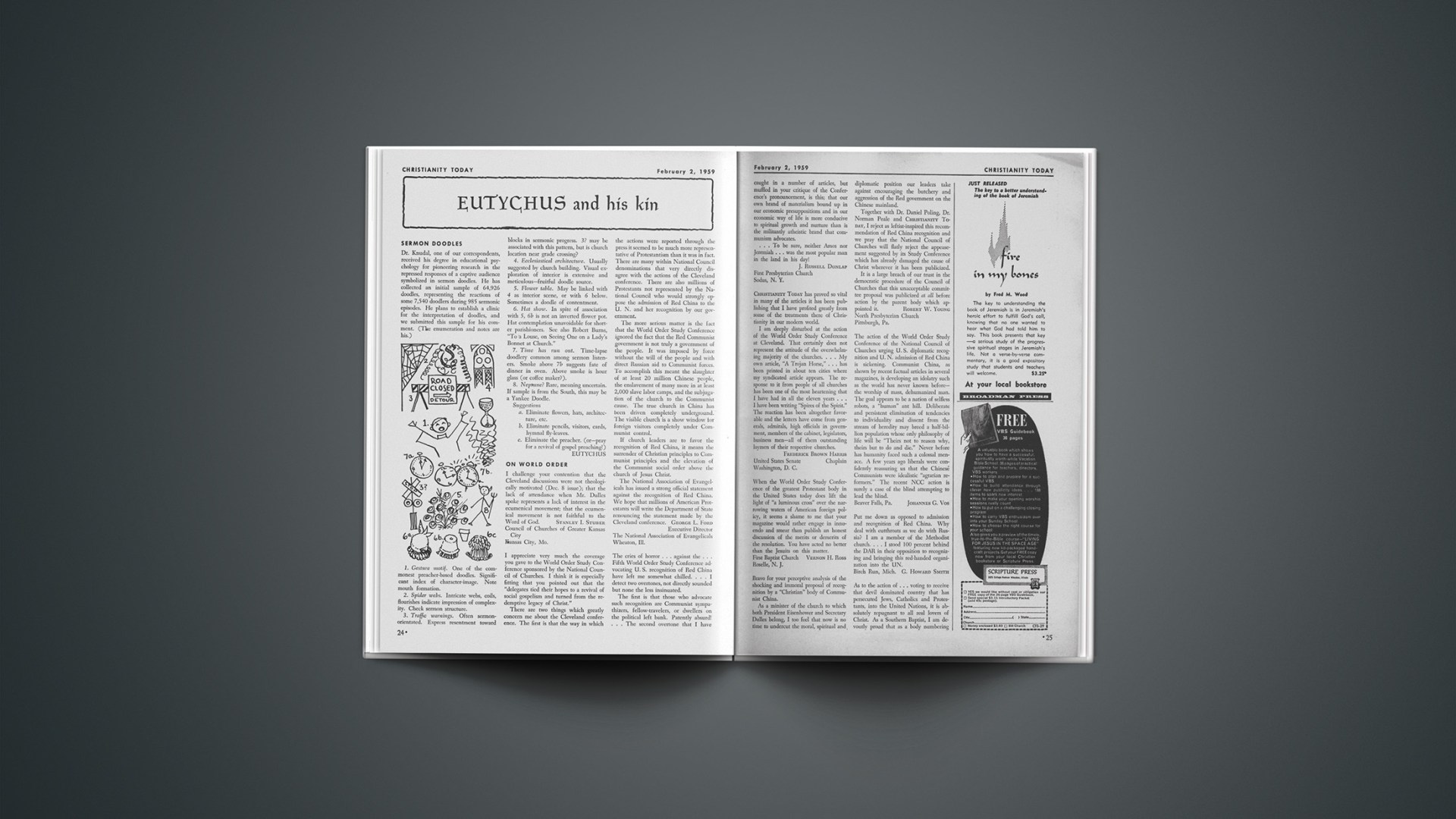
Dr. Knudal, one of our correspondents, received his degree in educational psychology for pioneering research in the repressed responses of a captive audience symbolized in sermon doodles. He has collected an initial sample of 64,926 doodles, representing the reactions of some 7,540 doodlers during 985 sermonic episodes. He plans to establish a clinic for the interpretation of doodles, and we submitted this sample for his comment. (The enumeration and notes are his.)

1. Gesture motif. One of the commonest preacher-based doodles. Significant index of character-image. Note mouth formation.

2. Spider webs. Intricate webs, coils, flourishes indicate impression of complexity. Check sermon structure.

3. Traffic warnings. Often sermon-orientated. Express resentment toward blocks in sermonic progress. 3? may be associated with this pattern, but is church location near grade crossing?

4. Ecclesiastical architecture. Usually suggested by church building. Visual exploration of interior is extensive and meticulous—fruitful doodle source.

5. Flower table. May be linked with 4 as interior scene, or with 6 below. Sometimes a doodle of contentment.

6. Hat show. In spite of association with 5, 6b is not an inverted flower pot. Hat contemplation unavoidable for shorter parishioners. See also Robert Burns, “To a Louse, on Seeing One on a Lady’s Bonnet at Church.”

7. Time has run out. Time-lapse doodlery common among sermon listeners. Smoke above 7b suggests fate of dinner in oven. Above smoke is hour glass (or coffee maker?).

8. Neptune? Rare, meaning uncertain. If sample is from the South, this may be a Yankee Doodle.

Suggestions

a. Eliminate flowers, hats, architecture, etc.

b. Eliminate pencils, visitors, cards, hymnal fly-leaves.

c. Eliminate the preacher, (or—pray for a revival of gospel preaching!)

ON WORLD ORDER

I challenge your contention that the Cleveland discussions were not theologically motivated (Dec. 8 issue); that the lack of attendance when Mr. Dulles spoke represents a lack of interest in the ecumenical movement; that the ecumenical movement is not faithful to the Word of God.

Council of Churches of Greater Kansas City

Kansas City, Mo.

I appreciate very much the coverage you gave to the World Order Study Conference sponsored by the National Council of Churches. I think it is especially fitting that you pointed out that the “delegates tied their hopes to a revival of social gospelism and turned from the redemptive legacy of Christ.”

There are two things which greatly concern me about the Cleveland conference. The first is that the way in which the actions were reported through the press it seemed to be much more representative of Protestantism than it was in fact. There are many within National Council denominations that very directly disagree with the actions of the Cleveland conference. There are also millions of Protestants not represented by the National Council who would strongly oppose the admission of Red China to the U. N. and her recognition by our government.

The more serious matter is the fact that the World Order Study Conference ignored the fact that the Red Communist government is not truly a government of the people. It was imposed by force without the will of the people and with direct Russian aid to Communist forces. To accomplish this meant the slaughter of at least 20 million Chinese people, the enslavement of many more in at least 2,000 slave labor camps, and the subjugation of the church to the Communist cause. The true church in China has been driven completely underground. The visible church is a show window for foreign visitors completely under Communist control.

If church leaders are to favor the recognition of Red China, it means the surrender of Christian principles to Communist principles and the elevation of the Communist social order above the church of Jesus Christ.

The National Association of Evangelicals has issued a strong official statement against the recognition of Red China. We hope that millions of American Protestants will write the Department of State renouncing the statement made by the Cleveland conference.

Executive Director

The National Association of Evangelicals

Wheaton, Ill.

The cries of horror … against the … Fifth World Order Study Conference advocating U. S. recognition of Red China have left me somewhat chilled.… I detect two overtones, not directly sounded but none the less insinuated.

The first is that those who advocate such recognition are Communist sympathizers, fellow-travelers, or dwellers on the political left bank. Patently absurd!… The second overtone that I have caught in a number of articles, but muffled in your critique of the Conference’s pronouncement, is this; that our own brand of materialism bound up in our economic presuppositions and in our economic way of life is more conducive to spiritual growth and nurture than is the militantly atheistic brand that communism advocates.

… To be sure, neither Amos nor Jeremiah … was the most popular man in the land in his day!

First Presbyterian Church

Sodus, N. Y.

CHRISTIANITY TODAY has proved so vital in many of the articles it has been publishing that I have profited greatly from some of the treatments there of Christianity in our modern world.

I am deeply disturbed at the action of the World Order Study Conference at Cleveland. That certainly does not represent the attitude of the overwhelming majority of the churches.… My own article, “A Trojan Horse,” … has been printed in about ten cities where my syndicated article appears. The response to it from people of all churches has been one of the most heartening that I have had in all the eleven years …

I have been writing “Spires of the Spirit.” The reaction has been altogether favorable and the letters have come from generals, admirals, high officials in government, members of the cabinet, legislators, business men—all of them outstanding laymen of their respective churches.

Chaplain

United States Senate

Washington, D. C.

When the World Order Study Conference of the greatest Protestant body in the United States today does lift the light of “a luminous cross” over the narrowing waters of American foreign policy, it seems a shame to me that your magazine would rather engage in innuendo and smear than publish an honest discussion of the merits or demerits of the resolution. You have acted no better than the Jesuits on this matter.

First Baptist Church

Roselle, N. J.

Bravo for your perceptive analysis of the shocking and immoral proposal of recognition by a “Christian” body of Communist China.

As a minister of the church to which both President Eisenhower and Secretary Dulles belong, I too feel that now is no time to undercut the moral, spiritual and. diplomatic position our leaders take against encouraging the butchery and aggression of the Red government on the Chinese mainland.

Together with Dr. Daniel Poling, Dr. Norman Peale and CHRISTIANITY TODAY, I reject as leftist-inspired this recommendation of Red China recognition and we pray that the National Council of Churches will flatly reject the appeasement suggested by its Study Conference which has already damaged the cause of Christ wherever it has been publicized.

It is a large breach of our trust in the democratic procedure of the Council of Churches that this unacceptable committee proposal was publicized at all before action by the parent body which appointed it.

North Presbyterian Church

Pittsburgh, Pa.

The action of the World Order Study Conference of the National Council of Churches urging U. S. diplomatic recognition and U. N. admission of Red China is sickening. Communist China, as shown by recent factual articles in several magazines, is developing an idolatry such as the world has never known before—the worship of mass, dehumanized man. The goal appears to be a nation of selfless robots, a “human” ant hill. Deliberate and persistent elimination of tendencies to individuality and dissent from the stream of heredity may breed a half-billion population whose only philosophy of life will be “Theirs not to reason why, theirs but to do and die.” Never before has humanity faced such a colossal menace. A few years ago liberals were confidently reassuring us that the Chinese Communists were idealistic “agrarian reformers.” The recent NCC action is surely a case of the blind attempting to lead the blind.

Beaver Falls, Pa.

Put me down as opposed to admission and recognition of Red China. Why deal with cutthroats as we do with Russia? I am a member of the Methodist church.… I stood 100 percent behind the DAR in their opposition to recognizing and bringing this red-handed organization into the UN.

Birch Run, Mich.

As to the action of … voting to receive that devil dominated country that has persecuted Jews, Catholics and Protestants, into the United Nations, it is absolutely repugnant to all real lovers of Christ. As a Southern Baptist, I am devoutly proud that as a body numbering approximately nine million we have no official relation with this body.…

Shiloh Baptist

Villa Ridge, Ill.

When even political leaders, military experts, and many others who do not represent the clergy but accept and uphold Christian faith, love, and truth, and can themselves see and warn of the dangers which do face this land of free men, it would seem clergymen themselves would open their eyes.…

Christ has a far different message to the churches than that which was drafted at Cleveland. It … can be found in the Bible.…

Tracy, Calif.

You don’t expect me to cut up my CHRISTIANITY TODAY, do you? But here is my ballot.…

Greenville, S. C.

SORROW BUT HOPE

Nothing has appeared in CHRISTIANITY TODAY which mingles more, hope and sorrow, with hope still uppermost—than “Where Are We Drifting?” (Dec. 22 issue). The very same idea appeared in a great sermon by Spurgeon in 1889, “A Dirge for the Downgrade and a Song for Faith” (Metropolitan Tabernacle pulpit), in which the great popular preacher uttered what could be words of sanguine augury: “The battle is not ours, but the Lord’s. God knows no difficulty. Omnipotence has servants everywhere. Sitting in the chimney-side tonight, a young Luther is preparing, as he looks into the fire, to burn the bulls of the philosophic hierarchy of today.”

Statesville, N. C.

I appreciate the frankness and reality that is presented in the editorial.… Thank you for being realistic about the world situation and our Christian situation.

New York, N. Y.

VIEWS OF REVELATION

James Packer … quotes me quite correctly in the discussion of contemporary views of revelation (Nov. 24 issue). He goes on, however, to say, “Theology pursued in this fashion is held to be ‘scientific’ and that on two accounts.”

There is some implication in the way he puts this that my own view of revelation, or the one I am summarizing, necessarily leads to this view that theology is scientific. He does not say that he is continuing to interpret my statement, but the reader might be misled on this point. However, I am not so much concerned about this as about the substantive matter that most of those for whom I am speaking in my statement about revelation would not hold that theology is scientific, and certainly not in the senses which Mr. Packer gives to that word here. Or rather, I should say that in the second sense of taking account of a scientific view of the Bible, he is correct. But on the first point of getting a strictly scientific elucidation of the nature of faith and its object, practically all the contemporary theologians that I am interpreting here would surely say no. Theology is a precise and responsible discipline, but it is confusing to call it scientific in this sense. Of course many contemporary theologians, Barth for example, speak of theology as “science,” but here it is clear the word is used in the sense of the German “geisteswissenschaft” and not in the sense of the methods of natural science.

Mr. Packer is raising, of course, a very important question of the criterion of truth for the Christian, and I am sympathetic with his emphasis upon the importance of this question.

Union Theological Seminary

New York, N. Y.

How much longer will we contend that the Bible is the final authority for Christians? Surely we have discovered that no one sees the Bible just as it is, but only as he sees it according to the background of his understanding.… Sooner or later we must admit that the Church, the extension of the Incarnation in the world, is the final authority. No self-appointed man or group of men has the right to assume that position for another. Only the Church is big, wise and holy enough to do that. Why then do we not admit that we are rebels and lay down our arms?

Superintendent

The Akron District

North-East Ohio Conference, Methodist Church

Akron, Ohio

Thank you very much for the two first articles of [the November 24 issue]. They are vital and powerful treatments on the Bible.

I appreciate [your] balance and sanity of presentation of biblical truth, as well as [your] practice of Christian love. While I accept the fundamentals of the Christian faith I cannot see a rabid fighting fundamentalism that goes out of its way to find and pick quarrels with those who do not see eye to eye with them.

The Rock Hill Presbyterian Church

Bellaire, Ohio

SOCIAL DRINKING

You speak of the “approval of social drinking voted by the Protestant Episcopal Church’s Convention in Miami Beach this fall.” (“News,” Dec. 22 issue).

I was a Deputy in this Convention and I am not aware that we voted on the subject of social drinking at all.… I assume that the misunderstanding arises from distortion of a publication of the Joint Commission entitled “Alcohol, Alcoholism and Social Drinking.” This was not voted upon by the Convention.…

Alpine, Tex.

The notorious “Report” of a committee on alcoholism which was placed before the House of Bishops of the Episcopal Church last October has unfortunately been misrepresented in both the daily press and the temperance press as setting forth the position of the Episcopal Church. Actually, the Report was merely presented, never approved or disapproved by the Bishops and never considered by the Convention, and was intended to be one of several steps of approach to the whole problem.

Wollaston, Mass.

• CHRISTIANITY TODAY’S news section fell into the same error as many other journals and regrets the mistake. In fairness to the Protestant Episcopal Church, we are glad to set the record straight. The action in question was correctly set forth in our original Miami Beach report (Nov. 10 issue).—Ed.

MEN OF UNION

The three new presidents in our seminaries—McCormick, San Francisco, and now Princeton—are all Union Seminary men. Is that a sine qua non?

Phoenix, Ariz.

• The Union Seminary attended by Dr. James I. McCord (see Oct. 27 issue) is the Southern Presbyterian institution in Richmond, Va., rather than the New York divinity school.—Ed.

THANKS

Sincere thanks for what you have given us in this superb magazine.

Christian Reformed

Modesto, Calif.
Ideas

Brotherhood for a Week

The National Conference of Christians and Jews has promoted inter-religious brotherhood in the United States since 1928. Some 10,000 American communities now observe Roman Catholic-Protestant-Jewish “Brotherhood Week” every February. (Metropolitan church editors are more and more persuaded, however, that the categories of Protestant-Catholic-Jew are an oversimplification of American life. Non-religious humanists are a powerful minority, and Christian Scientists also; evangelical Protestants, moreover, claim to be poorly represented in the inter-religious “brotherhood.”) An international World Brotherhood in 1950 widened the movement’s horizons. In 1951 the Ford Fund gave the Conference a million dollars; in 1957 Mrs. Roger W. Straus added another million to promote national and world objectives.

Fuller understanding among adherents of the world religions is necessary to advance religious freedom and civic cooperation. Earnest conversation between leaders of theistic persuasion could forge a strategic link in the world conflict against atheistic communism and naturalism. Moslems might also be included in the world program with good reason. The spiritual dearth of our foreign policy (the majority of United States citizens are church members) is attested by the effective slander of Arab propagandists who speak disdainfully of America’s “materialistic atheism.”

The unity of mankind is fundamentally a spiritual conception; sooner or later “brethren” who gloss over spiritual ultimates in their togetherness will demean the dignity of human nature and will begin goosestepping to the siren call of false gods.

Among the great religious traditions none has the design and dynamic for materializing brotherhood more than the Hebrew-Christian revelation of God and the world, which stresses the universal rational and moral responsibility of the race as well as its physical similarities. Biblical religion declares that all men by creation are children of the one Creator (Acts 17:28 f.); that they are obliged to love each other (Luke 10:27, 36 f.); that as sinners they have forfeited man’s original spiritual sonship to God (John 8:42 ff.); that they are restored to divine sonship through supernatural grace and saving faith in Jesus Christ (John 1:12; 3:5). A long view of the Western world discloses that redemptive religion alone unleashed such reservoirs of neighbor-love that caused even astonished pagans to exclaim: “See how they love one another!”

If the modern emphasis on “brotherhood” energized the preaching of the good news of man’s redemption to a lost world, evangelical Christians would soon show some enthusiasm for it. Even if these notions of brotherhood sought only to rebuke the tides of hatred in the world, and nourished man’s confidence in his created dignity, and quickened conscience in terms of the Ten Commandments and the Sermon on the Mount, much could be said in their favor.

But the distressing fact is that some of the modern “partnership” programs become agencies that not only militate against the missionary zeal and message of the Christian religion, but may even camouflage special and selfish interests in American life while they bask in the propaganda impression of devotion to the common good. By virtue of their very titles the “brotherhood” agencies have the psychological advantage of making anyone who questions their validity appear to be unbrotherly. That risk seems necessary, however, for the issues involved are worthy of examination. If today the idea of love is so often perverted (in Washington, D. C., a former theology student some months ago murdered a Howard University coed, explaining to police: “I shot her because I loved her”) it is quite possible that some prevalent ideas of brotherhood are faulty as well. At any rate, since the National and World Brotherhood Conferences hope to ply schools, colleges, churches, synagogues and community and youth and adult agencies with educational films, the underlying philosophy of brotherhood will bear scrutiny. The Christian churches will welcome every sign of concern for “the family of man” provided “the family of redemption” is not thereby subtly dissolved.

Biblical Christianity finds the restoration of the broken unity of the race in man’s supernatural redemption from sin. Without his central consideration, the “brotherhood ideal” remains too tenuous a moral and spiritual foundation for universal peace and justice. Doubtless the twentieth century cannot wait for the luxury of world conversion to repress the threat of mass annihilation, but neither dare it be betrayed into an abandonment of the decisive significance of personal regeneration. Unfortunately, because some Christian leaders minimize the importance of revealed truths even in their search for Christian unity, the churches themselves may be misled into romantic and disillusioning programs that underestimate the strategic theological basis for true brotherhood. Brotherhood has become a cliché through which the twentieth century often misunderstands and even repudiates the Bible.

Brotherhood, if it is real, expresses a loving concern for others that is not easily come by. Slogans of “togetherness” are not enough. Too many solutions to the problem of prejudice, intolerance, religious disagreement are too hurried, too parochial, too cheap. Even a brotherhood that is skin deep may go further than the spirit of the times, but for genuine understanding, brotherhood must be soul deep.

If we win a lasting brotherhood, it will mean that we can disagree without rancor and engage with maturity in constructive debate. The Bible extends a sobering lesson. Both Old and New Testaments exhort men to love God with their whole being, and their neighbor as themselves. Such love is not to be restricted to men of similar religious convictions—on the authority of revealed religion. Jesus’ great parable on neighbor-love characterizes the priest and the Levite as derelict onlookers, while the Samaritan—whose religious views were in low repute (cf. John 4:22)—Jesus made the bearer of neighbor-love.

Such brotherhood has the right, the necessity, to explore all areas of truth, including Church-State tensions; it does not consist in an evasive denial or concealment of differences, but in facing such differences in frankness and love. Loss of interest in truth leads inevitably to loss of interest in love as well.

Evidence is not hard to find that the National Conference operates not only as an inter-faith agency alongside existing religious thrusts, but in the case of Protestantism even functions over and above it, thereby sapping its evangelistic and missionary vitality. In many communities the YMCA, a Protestant movement with a tradition of evangelistic emphasis, has become the channel for inter-faith agencies whose entire and only gospel is the notion of world brotherhood. In turn, this interfaith emphasis sometimes infuses the thinking of Protestant councils of churches.

For example, during the closing days of the Graham Madison Square Garden Crusade, a Lutheran missionary among the Hebrews of New York asked if a page of paid, dignified advertisement could be placed in the metropolitan dailies inviting the Jews to a meeting which would present evidences that Jesus is the Messiah of Old Testament promise. A representative of the Protestant Council of New York protested that this would undo the gains achieved in inter-faith relations. In rejoinder, the Editor of CHRISTIANITY TODAY questioned why suppression of Protestant missionary proclamation should be the price of inter-faith cooperation. The Council spokesman yielded the point, but felt another approach would be less offensive. The upshot of the matter was that no specific appeal of any kind was officially directed to the Jews of New York. The modern emphasis on religious brotherhood does more than repudiate religious bigotry in its emphasis on love-for-neighbor; it objectively implies that the very preaching of the Christian Gospel is an ugly prejudice menacing human brotherhood.

On the other hand, Roman Catholic participation in inter-faith activities curiously involves not the slightest suppression of that church’s missionary program. It was a Roman Catholic priest, in fact, who a quarter century ago suggested the first Brotherhood Week. Yet Rome has never wavered in its highly questionable teaching that all Protestants are heretics, nor ceased to pray that all outside the Roman church will enter its fold. While New York Protestant leaders hesitated to invite Hebrews to Madison Square Garden, the National Catholic Welfare Conference did not fail to warn Roman Catholics against attending. The Jesuit weekly America constructively publicized the Lutheran World Federation’s establishment of a Confessional Research Institute to study Roman Catholic theology but only as a hopeful means of converting Lutherans to Romanism! The Roman church commends Protestant “openness” but deplores and, where Romanism is predominant, not infrequently opposes and persecutes Protestant missions. Indeed, the inter-faith movement is a serviceable framework for promoting the long-term goals of Romanism.

Through its propaganda agencies Romanism, at least in the United States, may speak flatteringly now and then about certain Protestant or Jewish virtues which it commends to its own constituency for emulation. The editor of America, for example, emphasizes that Catholics and Jews have a long common spiritual tie reaching back to Abraham. And the Rev. John A. O’Brien of Notre Dame University urges 4,800 school teachers in the New York Archdiocese to emulate Protestant evangelistic zeal. Father Gustave Weigel, distinguished Jesuit theologian, thinks the time long overdue for Catholics and Protestants to “live together and talk together in harmony and fellowship.” Only a cynical spirit could resent such expressions of sentiment; they are worthy in mood and to be encouraged.

The National Conference of Christians and Jews gives Rome strategic opportunity to participate in interfaith pronouncements against social evils and for their correction. Roman pleas for inter-faith collective moral force sometimes carry broader overtones as well. The Catholic Legion of Decency, formed in 1934 to combat immoral movies, not only failed to gain effective support from Romanists, but also experienced opposition from Protestant leaders hostile to ecclesiastical censorship. Some pleas for Protestant cooperation in the Roman Catholic battle against lewd and immoral films imply that lack of Protestant enthusiasm for the Legion of Decency approach reflects a weak social conscience.

The same double turn sometimes seems latent in Roman Catholic enthusiasm for inter-faith pronouncements against religious prejudice that stress the Constitution’s exclusion of any religious test as a qualification for high office. This Roman Catholic public enthusiasm for equality of political opportunity is linked with private pursuit of special privilege alongside the shaming of all public criticism of Rome as bias and bigotry. The force of inter-faith efforts today is thus a means to nullify Protestant criticism of Romanism, while Rome proceeds to stigmatize Protestants with everything from heresy to religious prejudice. An NCCJ spokesman urged Chicago editors for the sake of brotherhood not to print the address of a leader in Protestants and Other Americans United.

If brotherhood is to gain headway, Catholicism must face the historic fact that Protestantism in America, by and large, is committed to a separation of Church and State. Certain matters will have to be faced, and it is no service either to Church or State to cry “bias” when an open political discussion of Church-State issues is at once essential and desirable. But what is the reaction when matters involving the nature of the American tradition are brought up? Catholic spokesmen react critically to an emphasis on the historic Roman Catholic view of State and Church, to a questioning of the legitimacy of an American envoy to the Vatican, citing this as a form of prejudice and even making public charges of bigotry in the local press. Using inter-faith spirit as an umbrella, Rome can discredit any challenge to its partisan ambitions. Although repudiating tolerance when it has a majority, Rome publicly emphasizes tolerance as a means of “softening up” a resistance movement, whose public disclosure of this contradiction in Romanism is scurrilized as poor taste and intolerance.

This situation has a repressive effect upon Protestant analysis and criticism. Since Catholics foster the notion that any criticism of Romanism is bigotry, non-Catholics prefer to maintain silence rather than to protest infractions lest they jeopardize their community status. This is seen in current misgivings of some Protestants over the 10-year-old organization of POAU. Certainly human movements are imperfect, and certainly POAU has never claimed infallibility for its spokesmen. CHRISTIANITY TODAY has private reservations concerning some of its statements that sound not simply non-sectarian but actually secular in tone. So absorbed has been the POAU in fighting sectarianism that the evil of secularism has been too much overlooked. Some POAU statements sound not simply non-sectarian, but actually secular in tone. Had the dangers of secularism as well as sectarianism been stressed by POAU, the joint statement of Roman Catholic bishops that secularism is the great peril in our national life would hardly have been news. Most Americans are as eager to keep the nation from falling into the lap of the devil as from kneeling at the feet of the Pope.

Undoubtedly POAU has been preoccupied mostly with Roman Catholic infractions, and has therefore sometimes been accused (mainly by Roman Catholics) of an anti-Catholic bias. The fact remains, however, that no organization has so provoked Protestants to scrutinize their own inconsistencies on Church-State issues. Whatever may be said against POAU—that it has concentrated one-sidedly on the Roman Catholic issue, and that it sometimes defines the American “wall of separation” in a secular mood—nonetheless this organization has performed the necessary service of pressing the important question of American traditions and sectarian political ambitions. Furthermore, it has required a verdict of the American conscience on Roman Catholic goals in view of that church’s traditions and contemporary policies and practices. Those inclined to dismiss POAU as “too reactionary” dare not dismiss its concerns as unimportant. Silence becomes irresponsibility when great matters are at issue.

No fact is clearer than the world’s need of brotherhood. It needs more than “Brotherhood Week,” however. It needs more than a brotherhood in America that is repudiated in Colombia. Absence of the biblical ideal of neighbor-love threatens more than society; in the modern world, it jeopardizes Christianity and democracy alike.

END

Even The Devil Wears A Smile

Americans are guilty of the grossest folly whenever they fail to distinguish between the good will, friendliness and colossal ignorance of the Russian people about the free world, and the cold calculating smile of a godless leadership which has been guilty of the murder of millions; of every form of intrigue, subversion, infiltration, intimidation, oppressing and double-cross; of every device for the immediate and ultimate destruction of human freedom; of open and blatant suppression of faith in God and the Church; and, of the murder of young people’s minds through atheistic indoctrination.

No right thinking person hates either the Russian or the Chinese people. But Christians must hate that for which communism stands like they hate the devil himself, for communism has its source in him.

Some have been impressed by the smiling, if cynical, countenance of Soviet Deputy Premier Anastas I. Mikoyan during his recent visit to the United States. News cameras have followed him everywhere and we have seen him in stores and shops and in innumerable interviews. His apparent friendliness has been disarming, and, to some people, very convincing.

It will be a sad day for America when we accept communism or any ism at a prearranged propaganda value. Let us not forget: Satan also can wear a smile.

Protestant Muddle In Social Welfare

Increasing reliance upon Federal funds for Protestant social welfare activity is currently provoking a good deal of denominational soul-searching, as a special report in CHRISTIANITY TODAY’S news section indicates. Misgivings reach far and wide, but the vexing problem is how to resolve a compromising situation.

The analogy between Big Government and the devil, fortunately, lacks universal application. But Protestantism’s staggering involvement of social welfare in government subsidies recalls words uttered in another connection by an early critic of higher criticism. Give the devil your little finger, he warned, and soon he will possess your soul.

In view of growing sectarian pressures for Federal funds, some Protestant leaders now sense that their own eagerness for government monies may have provided Roman Catholic agencies with effective leverage for obtaining enlarged public funds serviceable to a highly objectionable Church-State philosophy.

Protestantism’s largest denomination is open to the charge of “fund grabs” as assuredly as Roman Catholicism. As the 75th hospital affiliated with its Board of Hospitals and Homes, The Methodist Church has just added the hospital in Oak Ridge, Tennessee. Now being government-built for $3,000,000, the hospital by law must be removed from federal control by 1960 along with other community installations. In its November, 1958, issue, Tell-A-Scope, newsletter of the Board of Hospitals and Homes, notes: “Residents of Oak Ridge favored Methodism by a vote of 4,209 to 2,950 for sponsorship of the 175-bed hospital.… The hospital … will be turned over to the Church for operation.… Dr. Carroll H. Long, of Johnson City, Tenn., is chairman of the Holston Conference Board of Hospitals and Homes, and has worked untiringly in gaining support for Methodist operation.… The hospital at Oak Ridge was not ‘born’ into the Methodist family. It was adopted. And it was adopted after careful study, considerate thought, and understanding action. It is an example of ‘what can be done’ to provide expanded and quality care under Church sponsorship, if enough persons are interested and willing to speak for their ‘Cause.’ At least one other group in Oak Ridge was being considered as sponsor of the hospital.… What was done at Oak Ridge can be done in a hundred other communities if people care enough.” What troubles us deeply is this denominational assumption that use of Federal funds to expand church welfare services becomes sacrosanct when it benefits Methodism rather than Romanism.

Sentimental support for welfare statism as a species of Christian, social action unfortunately has blurred the American vision for a generation. Many denominational leaders still fail to discern the semi-socialistic shadows of the times, moving in an environment that dims the distinctives of free enterprise and voluntarism. The growing provision of government security from cradle to crematory is hailed as a magnificent application of Jesus’ “love your neighbor” commandment; few detect the outlines of the omnicompetent State more and more arrogating to itself the powers of free men.

In this social climate many church social welfare workers were satisfied that national churchmen gave their blessing to federal programs, that denominations in turn were allowed to cooperate in their implementation, and that the government reimbursed such church welfare efforts for value received. The fact that the job was getting done was the all-important consideration. Other facts—the progressive curtailment of voluntarism, the growing denominational reliance on government initiative and implementation in social welfare fields, the government’s growing use of the Church to expedite State programs of welfare—meant little.

For what comfort it now affords, welfare workers lean upon the present lack of clear policy in Church-State relations to excuse their variance and diversity in practice. Instead of frank admission of Protestant inconsistencies, they point out that the churches do not know what they mean by separation of Church and State or by cooperation between Church and State. Discrepancies, they say, imply that practice is not in accord with policy—and such policy is lacking.

That these variances spring from lack of attention to Church-State relations is surely no matter of surprise. The urgent need for a serious study of Church-State frontiers and of the theology of social welfare is apparent. During the past generation highly organized Protestant social action has been less efficient in its pursuit of consistent controlling principles than in its promotion of costly and comprehensive programs. The drive for unity in action that neglects changeless principles is always in danger of running zestfully toward the wrong goal post. News that denominational leaders are taking an earnest look at divergencies in social welfare activity, now so deeply indebted to federal funds, is therefore more than welcome. What the lofty affirmation that Jesus Christ is Saviour and Lord implies for a Protestant theology of social welfare, and of the State, and of the Church, and their mutual interrelations, is a worthy and imperative study.

END

Convictions

“He’s a good fellow but he does not seem to have any fixed convictions.” This identical statement was recently made by three different people, each speaking of different individuals. All were engaged in Christian work.

But how can one be a Christian without strong convictions? How can one bear an effective witness for Christ and Christian truth on a basis of uncertainty?

Convictions are an expression of faith. “I believe” is the gateway to Christianity itself. But one of the strange phenomena of much in contemporary theological thought is uncertainty about divine revelation and a blind acquiescence in the affirmations of human speculation.

We all know that misplaced convictions can close the door to truth. “My mind is made up, do not confuse me with facts” is a humorous description of the man who has closed his mind. Often applied to those dedicated to an unreasoning orthodoxy it is equally true of some devotees of humanistic philosophy.

Admitting the possibility of arriving at conclusions which cannot be supported by fact, nevertheless, when the Christian faith is involved one must solemnly say, “God help the man who has no theological convictions!”

In the realm of Christianity there are things a man must believe—convictions which must be held—without which he remains a pagan.

Man must believe in God. Without such faith it is impossible to please Him. Not only do we believe that He is but we also believe that he is the rewarder of those who diligently seek Him.

The Scriptures makes it plain that where man denies the existence of God he is utterly without excuse. In Romans 1:18–20 we read: “For the wrath of God is revealed from heaven against all ungodliness and unrighteousness of men, who hold the truth in unrighteousness; because that which may be known of God is manifest to them; for God hath shewed it unto them. For the invisible things of him from the creation of the world are clearly seen, being understood by the things that are made, even his eternal power and Godhead; so that they are without excuse.”

Man must have a conviction about himself, a conviction which enables him to realize that he is a sinner in God’s sight. This is not easy. It is humiliating to admit our complete insufficiency and unpleasant to admit that within us there is operative a law which leads us to do evil even when good intentions are present. Lack of conviction on the matter of sin is a tragic evidence of spiritual blindness.

A Christian must have convictions about Christ; about His person and His work. At this focal point there is no room for uncertainty. There is but one Christ to be accepted: the Christ of divine revelation; of scriptural record; of historical fact; of divine Saviorhood; of personal experience. Or, he must reject Him for a Christ of human limitations, devised by human imagination and changing with the whims and opinions of men.

A Christian must have convictions about the Bible. Either it is that which it claims for itself, the written Word of God; or, it merely contains the word of God; or, it is a human document comparable in some measure with other books on ethics and religion.

Holding the latter view a theological student recently wrote: “I fail to see why we must venerate the Bible as an authentic document of religious history.… It is … a document which speaks of man’s quest for the infinite.… Is not the Koran as valid a religious source for the Moslem as the Bible is for the Christian?”

But the Christian must recognize that in the Bible there is a divine revelation, a system of truth which man could never have discovered for himself. Part of this truth is that it is God, not man, who has provided the way back to Himself.

A Christian must have convictions about the way and means of salvation. Either it is a work of divine grace by which man receives the love and atoning sacrifice of the Son of God on the basis of faith alone; or, he in some measure earns his salvation and is to that extent saved by works. An understanding of this basic truth is of the greatest importance for it involves the question of how salvation itself becomes a reality.

There are many phases of Christian truth on which men have convictions. Some are trivial or of secondary importance. On these Christians can disagree because personal redemption is not involved. But along with them there are those on which clear convictions are essential.

To those who carry responsibilities in the pulpit or classroom, Christian convictions are an imperative, for it is those who speak with the authority of personal conviction who influence others to a like commitment of faith. An evangelical scholar was recently invited to speak to the students and faculty of a very liberal theological seminary. Later some of the students remarked that it was the first address they had heard since coming to that institution in which the speaker had convictions about his faith.

In the unbelieving world, represented by professional associates; by the people with whom we work day after day; by casual acquaintances on the bus; or by the bewildered men and women sitting in the pews of many churches on Sunday, it is only those who have strong convictions based on a Christ-centered faith, and a Bible-centered message who will carry conviction to others.

But in Christian convictions there also lie a danger and a challenge. One’s certitudes of faith lose both their appeal and their witness when they beget belligerency or lovelessness. Convictions are no excuse for boorishness in any form. Of what value is a faith which is antagonistic? Our Lord set the supreme example of unswerving convictions coupled with loving consideration for those who did not believe. Rejecting unbelief, our own convictions on truth must be bathed in loving regard for those who have not yet seen that truth.

At the same time a pallid philosophy of “live and let live” has little to commend it in living men surrounded by the living dead.

In our honest desire to be judicial, fair and open-minded, it is often easy to take the fatal step of failing to have convictions in those areas where the issue is one of darkness or light; bondage or freedom; spiritual death or eternal life.

One of the appeals of the numerous cults of our day is the assumed authority and convictions of their adherents. It is precisely at this point that our Christian witness often fails.

We need to affirm with Paul, “I know whom I have believed.” It is the certainty of our faith and the object of our faith which bring comfort to our own hearts and conviction to others.

Woe to the man who has no convictions!

Bible Book of the Month: Malachi

The last book of the old dispensation mingles remonstrations against the sins of priests and people with threats of judgments, exhortations to repentance, and prophecies of the calling of the Gentiles and the coming of Christ. The burden or oracle of the word of the Lord was addressed to the small colony of Jews who had returned to Judea after the captivity of 70 years. Under the leadership of Nehemiah and Ezra, Jerusalem and its temple had been rebuilt. The prophecy of Nehemiah informs us of a great revival that occurred after Ezra expounded the law. Later, however, the people lapsed into careless worship and developed an ungrateful spirit.

Authorship And Date

The name Malachi means “my messenger.” Whether this was the actual name of the prophet has been a matter of debate among commentators. Some contend that it is the actual name of the prophet since the other prophetic books of the Old Testament are not anonymous; some feel that it was a self-designated title; and others conjecture it to be bestowed by an unknown editor. To maintain that Malachi is not a proper name and that the book is anonymous comes under the head of speculation and has no substantial proof. No historical proof has been advanced that the name was added by an editor. But whether personal or official, the name is significant in that the Lord has a revelation of great significance to the chosen people.

The date of writing has also been the subject of difference of opinion. There is general agreement, however, that Malachi prophesied during the Persian period and after the exile. Internal evidence indicates that the temple was rebuilt and the ritual restored. The second temple was dedicated in 516 B.C. Many scholars allow that the prophet was a contemporary of Ezra and Nehemiah and wrote either about 458 or 432 B.C. The later date may be more exact as the sins which Malachi exposed were similar to those that aroused Nehemiah on his second visit to Jerusalem.

Authenticity

Until recently the authenticity and integrity of the book of Malachi had not been called to question. George Adam Smith questioned the authenticity of verses 11 and 12 of chapter 2. He writes: “But in truth the whole of this passage, chapter 2:10–16, is in such a curious state that we can hardly believe in its integrity. It opens with the statement that God is the Father of all us Israelites, and with the challenge, why then are we faithless to each other?—verse 10. But verses 11 and 12 do not give an instance of this: they describe the marriages with the heathen women of the land, which is not a proof of faithlessness between Israelites” (Book of the Twelve Prophets, p. 340). But that is the exact point of the prophet: the Israelites manifested their unfaithfulness to the wives of their youth by divorcing them and taking pagan wives.

R. C. Denton in The Interpreter’s Bible (p. 1137) states that chapter 4:5, 6 was the addition of a later editor. He writes: “The editor who added 4:5, 6 thought it was Elijah. The prophet himself was not thinking in such definite terms.” Dr. Denton does not give substantial proof that the editor added this portion and how he knows the thinking processes of the prophet is somewhat of a mystery. The general reason advanced for denying the integrity of this passage is the reference to the law in verse 4. G. A. Smith stated: “Bohme, indeed, took the last three verses for a later addition, on account of their Deuteronomic character, but, as Kuenen points out, this is in agreement with other parts of the book” (The Twelve Prophets, p. 339).

Exception to the authenticity of chapter 3:1 is also taken by the Interpreter’s Bible: “The words the messenger of the covenant … he is coming, which somewhat confuse the picture, are probably the parenthetical note of a commentator who wished to explain that even at this second stage it would not be the transcendent God in the fulness of his being (the tendency of priestly theology was to remove God as far as possible from direct contact with men), but his angel or messenger—a special revelational manifestation of God—who would finally appear in the temple.” However, the reference is to the transcendent God for the Lord whom ye seek is the answer to the question of the people, “Where is the God of Judgment” (2:17). The “Messenger (angel) of the covenant” undoubtedly has reference to the extraordinary Messenger, or Angel, to whom divine names, attributes, purposes, and acts are ascribed in other passages of the Old Testament. Malachi’s reference to the Angel of the Covenant does not confuse the picture but rather illustrates the marvelous unity of Holy Writ.

Not only the unity of the Old Testament is involved in the integrity of Malachi but also that of the New Testament with the Old. The evangelists Matthew, Mark, and Luke link these prophecies—particularly the passages questioned by some critics—with the time of the Messiah (Matt. 9:10, 14; 17:10–13; Mark 1:2; 9:11, 13; Luke 1:17, 76; 7:27). To the evangelist the prophecies of Malachi were fully authentic and indeed confirmed that Jesus of Nazareth was “the Lord whom ye seek.”

Content

The background of this book furnishes the key to the understanding of the “burden” of Malachi. After the restoration of Jerusalem and its Temple, the Israelites expected more than a return of former blessings. Their hopes were fired by the expectation that now the glorious prophecies of Isaiah and other prophets would be fulfilled. From their complaints one can glean that their hearts were set on great material blessings. Spiritual blessings seemed of small consequence. In their disappointment they lapsed into careless, outward worship; adopted a complaining spirit; and transgressed the laws of God.

In the introduction (1:1–5) the prophet assured the Israelites that God had not forgotten them but on the contrary loved them above all other nations. Both Israel and Edom had sinned grievously against the Lord and both experienced judgment but only Israel had been restored. Not the love of God for Israel was in question but the love of Israel for Jehovah. The love of God was the foundation of chastisement and also his mercies. Indeed, the contempt of his love was the root cause of their present predicament.

In two major divisions the messenger of the Lord rebukes the priests (1:6–2:9) and the people (2:10–4:3). The priests were rebuked first because they had the responsibility of leading in worship and teaching the law. They were accused of despising the name of the Lord by offering impure sacrifices (1:6–10). Their impure offerings betrayed an impure disposition. In spite of the commandment of the Lord they offered animals that were blind, lame, and sick. They would not offer such to the Persian Governor ruling over them, yet they offered defective sacrifices to the living God!

The sin of the priests, however, will not frustrate the covenant promise of God to Abraham that all nations would be blessed, and the encouraging promise is given that from the rising of the sun even unto the going down of the same the name of the Lord would be great among the Gentiles who would give a pure offering (1:11).

Further evidence of their profane spirit is given (1:12–14), and that is followed by a terrible judgment against the priests because they did not keep his covenant of life and peace (2:1–9). That the levitical priesthood was to do more than keep the ritual of the temple is seen in verse 7: “For the priest’s lips should keep knowledge, and they should seek the law at his mouth: for he is the messenger of the Lord of hosts.” Mere sacrifices without true knowledge of the revelation of God would not suffice. The priest’s responsibility was to instruct the people.

However, the people cannot cast the full responsibility of their defection upon the priests. The prophet in the second major section (2:10–4:3) reveals how short the people had come of performing the law of God. This they showed first of all in divorcing their wives and marrying pagans (2:10–6). This was extreme cruelty and profaning the holiness of the Lord. Instead of being frightened by this rebuke, the people scornfully asked, “Where is the God of judgment?”

The prophet indicates that the Lord whom they sought would suddenly appear in his temple (2:17–3:6). He would come in judgment against the wicked and yet in mercy would purify the true sons of Levi. The wicked would not frustrate the grace of God. As revealed in the Gospels this was the day of the Messiah.

Another grievous sin of the people was the withholding of the tithe (3:7–12). Yet the Lord promises them great material blessings if only they would not rob him of tithes and offerings. But the people remained perverse and refuse to heed the words of the Lord’s messenger. (3:13–15).

Then again the prophet interjects a note of encouragement (3:16–4:4). They that feared the Lord would receive salvation and protection. “And they shall be mine, saith the Lord of hosts, in that day when I make up my jewels” (3:17). Yet that will not prevent the fearful judgment of the proud and the wicked (4:1). This undoubtedly takes in the destruction of Jerusalem in the year 70 A.D. Nevertheless, those who fear the Lord experience the bright rays of “the sun of righteousness.” Again and again the prophet indicates that the wicked will not prevent the glorious day of the Messiah and the establishment of his kingdom of righteousness. In light of the coming of the Messiah, Malachi urges the Israelites to repent and keep the law of Moses.

The final attention of the people is focused on the coming of Elijah who would precede and prepare the way for the coming of the day of the Lord. Jesus declares that Elijah is none other than John the Baptist (Matt. 11:14; Mk 9:13; Lk. 7:27).

Relevance

The burden of Malachi could well be the burden of today’s preacher. He must apply the prophet’s admonition to the priests to his own heart and see if he is profaning the name of God by imperfect service. God’s reaction to divorce and the withholding of tithes has a modern application. Also a message of hope can be given in the prophecy of the Gentiles’ conversion and reign of the Messiah.

Outline

I. Proof of God’s Love 1:1–5

II. Rebuke of Priests 1:6–2:9

A. Impure sacrifices 1:6–10

B. Prophecy of Gentile conversion 1:11

C. Profanation of God’s name 1:12–14

D. Judgment against Priests 2:1–9

III. Rebuke of People 2:10–4:3

A. Cruelty of Divorce 2:10–16

B. Jehovah’s Messenger 2:17–3:6

C. Withholding of Tithes 3:7–12

D. Perverseness of People 3:13–15

E. Blessing of Righteous 3:16–4:4

IV. Coming of Elijah 4:5, 6

Brief Bibliography

Literature on Malachi may be found in general works on the Minor Prophets. Among them are: John Calvin, Commentaries, Minor Prophets; E. B. Pusey, Minor Prophets; Keil & Delitzsch, Commentaries on the Old Testament, Minor Prophets; C. Von Orelli, The Twelve Minor Prophets; G. A. Smith, The Book of the Twelve Prophets in The Expositor’s Bible; George L. Robinson, The Twelve Minor Prophets; Theodore Laetsch, The Minor Prophets; H. L. Ellison, Men Spake from God. Good surveys on the book of Malachi are found in Fairbairn’s Bible Encyclopedia and The International Standard Bible Encyclopedia.

J. MARCELLUS KIK

Associate Editor

CHRISTIANITY TODAY

Perspective for Social Action (Part II)

Given the contemporary renewal of evangelical social interest, the problem now confronting conservative Protestantism is the definition of a sound evangelical social thrust.

To answer “Not the social gospel,” is at once too simple and too full of risk. For one thing, while the old optimistic liberal theology is now dead, the optimistic ethic it generated in practice remains a very lively corpse. One need only consider government policy in the U. S. State Department. American foreign policy remains predominantly keyed to optimistic liberal assumptions about human nature and history. It is easy to detect still the lingering influence of liberal Protestant ministers whose sons and converts were attracted to government service as a form of Christian activity through the romantic vision of the social gospel. American strategy within the United Nations and her dealings with foreign powers often reflect the moralistic expectation (and naive trust in unregenerate human nature) that Christian principles must inevitably acquire self-evident compulsion in the thought and action of men everywhere. But naively to expect that just and durable peace can be spawned on purely natural foundations simply by the vision of righteousness (or simply to rely on the dread of mutual destruction, to add a mid-century modification based on an appeal to self-interest) is to underestimate the depth of depravity in human life and history and to disregard the indispensability of divine regeneration if the human heart is to grasp and pursue the course of righteousness.

Danger Of Liberal Inheritance

Ironically, fundamentalists, in their new eagerness to correct their past social neglect, at times themselves imbibe certain errors of the social gospel. They have happily avoided the popular tendency to embrace left-wing philosophies of the day, which many liberal reformers mistook for authentic expressions of Christian ethics. (Certain American evangelical enthusiasts in the nineteenth century confessedly already had fallen into this same error, and, like some British evangelicals sympathetic to socialism in our century, thereby disclosed their failure to discern the basic clash between Christian libertarianism and collectivism.) The social gospel came to be prominently identified with collectivistic theory because Protestant liberalism has surrendered Christianity’s historic confidence both in a revealed theology and in a revealed ethic. The formative philosophies of the modern era were therefore easily confused with a creative Christian social morality. Its defection from revealed doctrines and principles enabled Protestant modernism to confer Christian blessing upon contemporary programs whose basic principles sometimes contradicted the revealed social philosophy of the Church. While evangelical circles by contrast have clung fast to a biblically revealed theology and ethic, and through this fidelity have largely escaped enthusiasm for collectivistic theories of social life, evangelicals in their rediscovery of social concern stand in danger of being drawn, as Protestant liberalism was, into an arbitrary identification of current social movements and programs as intrinsically Christian. Liberal Protestantism openly equated Christian social concern with support for specific modern enterprises and goals such as the League of Nations, the United Nations, giant labor unions, and integration. During the First World War the program embraced pacifism as well. Some contemporary evangelicals newly concerned with the problems of social justice naively imply that the social gospel is acceptable enough provided only that the requirements of personal redemption and regeneration appear as its preface. But if evangelical conscience grasps basic presuppositions, it cannot regard the social gospel as an acceptable vehicle and exposition of biblical social ethics, much as the Gospel of redemption has both personal and social implications.

We do not say that the evangelical is called upon in advance to reject and repudiate everything that the social gospel espoused. But even the social gospel’s constructive elements must be brought for their justification within the orbit of divinely revealed principles, and related properly to the biblical view of life and history. Moreover, social gospel insistence that only by the approval of specific contemporary agencies and programs as authentically Christian does Christian ethics become relevant must be challenged. All “isms and ists” must be brought constantly under the scrutinizing Lordship of Christ and tested by his revealed will.

Neo-Orthodox Dissent

Although the social gospel approach is still influential, the evangelical attack upon it is today assisted by neo-orthodox critics who now hold a virile grip upon many Protestant intellectual centers. Both conservative and neo-orthodox theologians scorn the optimistic portrait of a universe progressively evolving to perfection, and doubt the sufficiency of Christian idealism alone to inspire an age of dedication to truth and justice. Both movements insist that the universe is fallen and desperately wicked, and that supernatural redemption is its lone hope. Pronouncements of neo-orthodox thinkers often diverge and conflict, but certain elements nonetheless set apart the American articulation of its view of social ethics from both the classic liberal approach crystallized in the social gospel and the historic outlines of evangelical social ethic: 1. The depth-dimension of sin in human history is regarded as so determinative that the ideal of Christian culture is dismissed, all cultures being viewed simply from the standpoint of Christian criticism. 2. Social problems are regarded as not decisively responsive to personal redemption. Hence its advancement of social justice relies upon the pressure of organized opinion and the compulsion of legislation more than upon evangelism and a ministry of regeneration. 3. Although special supernatural redemption is affirmed, both revealed ethical principles and doctrines are scorned, in common with the liberal tradition in Protestant theology; social strategy is held to be governed by “middle axioms” which, while held to be creatively and critically relevant, abandon a basis in revelation.

Now the social outlook of liberalism had sought above all else to avoid Christianity’s preoccupation with the world to come in order that it might fervently address the vexing social evils of this life. The unhappy outcome was the social gospel, prone to equate the activities of unregenerate humanity at its best with authentic Christian achievements, and neglectful of the wholly proper priorities of supernatural revelation and redemption. Neo-orthodoxy is concerned to hold both worlds in view—not simply in their chronological succession of this life and that to come, but in the existential relationship of this life continually judged by Christ its exalted Lord. Yet speculative considerations bulk large in its theological and ethical positions; guiding elements already given suggest some of the unfortunate consequences accruing to its social perspective. Distrust of rational revelation leaves neo-orthodoxy without absolute basis for the ethical positions it advocates, and also with the practical problem of enlisting Christian commitment and action for temporary imperatives as if they were in fact the will of God. The anti-intellectual element in neo-orthodoxy thus ultimately dissipates its social dynamic and divorces its ethical declarations from an assured basis in revelation. The further reliance on factors not found in the Great Commission for the Church’s special penetration into the social order tends to formulate Christian social action in terms competitive with the proclamation of the Gospel and minimizes the significance of evangelism and spiritual revival for the advancement of social morality. Moreover, the neo-orthodox disparagement of the ideal of Christian culture fails to do full justice to the power of the Holy Spirit in the life of the redeemed community. Although a sound theology must recognize that the defilement of sin precludes both glorification in the present life of the believer and absolute perfection in history, and also that the aggregate of group behavior is likely to compound the weaknesses of individual behavior, nonetheless a distinctive social morality seems possible to the community of evangelical faith as assuredly as sanctification is normative for the regenerate person.

Evangelical Strategy

The evangelical perspective for social action is therefore sharpened by a distinctive vision of life and history inspired by the revelation of God’s glory and grace.

1. Christian social leaders set their cultural objectives in the larger framework of the Christian mission, and do not regard themselves primarily as social reformers. They give no quarter to the illusion that Christianity is primarily an ethical idealism engaged in denouncing political and social injustice, or aiming at social reform as an end in itself. Even in the social thrust they preserve Christianity’s basic nature as a religion of supernatural redemption for sinners. The Christian leaders who opposed slavery a century ago did so not simply as abolitionists, but as heralds of freedom under the Creator-Redeemer God dealing simultaneously with man’s spiritual and material condition. Even well-intentioned men who regrettably turned the Scriptures to objectionable conclusions in the controversy over slavery rightly sought an ultimate sanction, and therefore judged slavery from the standpoint of divine approval or disapproval. The anti-slavery evangelicals saw that to undermine slavery (they would have spoken similarly of segregation and other contemporary vices), men must be led to see its intolerable contradiction of the rights dignifying all men by their creation as members of one common family, of the value attached to all men by our Lord’s incarnation, atonement and resurrection in the body, and of the temple of divinity God would make of humble believers irrespective of color and race. It would not have surprised them to learn that a citizenry that argued the question of human freedom within narrower limits would some day sense an emptiness and bondage even in the workaday world that would encourage white worker and black worker alike to reach wistfully for social redemption through the promise of a collectivistic society. They saw the interconnection of the Christian mission and human liberty.

2. Evangelical social action throbs with the evangelistic invitation to new life in Jesus Christ. “Ye must be born again” is the Church’s unvarying message to the world. Evangelical Christianity allows the secular world no hopeful program of social solutions that renders merely optional the personal acceptance of Jesus Christ as Saviour and Lord. It holds hope for the social order because it offers the prospect of personal redemption. Individual regeneration is not only a chief but an indispensable means of social reform. The kingdom of God is not to be separated from a redeemed society.

3. Reliance on the Holy Spirit to sunder the shackles of sin requires a regard for social evils first in the light of personal wickedness. The evangelical recognizes that social disorders are in the last analysis a commentary on the disorder of private life, and that the modern dilemma is essentially a predicament involving persons who need to be addressed individually. The hidden connection between social and private vices—as between war and lust (cf. James 4:1, “From whence come wars and fightings among you? come they not hence, even of your lusts that war in your members?”)—is thus kept in conspicuous view. The spectacle of prominent social reformers indifferent to their own private vices—the divorced statesman championing international unity, the debauched psychiatrist promising soul health to others, for example—is an absurd spectacle and an amoral luxury for the theory that decency begins at home. Deep experience of “the things of God” is thus considered the Christian reformer’s best asset. The new birth restores fallen man’s personality and his powers to the service of God, qualifying him with a new nature and moral dynamic.

4. Evangelicals insist that social justice is a divine requirement for the whole human race, not for the Church alone. The revealed commandments and rules of behavior are universally valid. All the basic laws of society begin with the divine law. Righteousness exalts a nation; a people voluntarily given over to oppression must suffer divine judgment. That man and society live on a moral basis is a requirement of both human laws and of the law of God as well. The Christian witness will stress the interdependence of revealed religion and human freedom, which is dependent on spiritual and moral foundations. Freedom is indivisible (it is not “four freedoms” nor five); man’s liberties are interdependent. (Wherever freedom’s spiritual foundations crumble, these liberties vanish; conversely, where freedom disappears, the propagation of Christianity is jeopardized). Revealed religion proclaims the threat to freedom latent in collectivistic social planning and in big government. The neglect of the larger facets of freedom, and the consequent detachment of social principles from a supernatural source and sanction, have indirectly aided the socialistic and totalitarian assault on free enterprise, private property and the profit motive, as well as upon other principles approved by the biblical doctrine of human rights and responsibilities. To assail national strongholds of evil in quest of a righteous nation, to challenge institutional sin in order to widen Christian influence over human society, are essential requirements of the Christian conscience. Both the affirmation of the Lordship of Christ and the imperative of the Great Commission provide an impetus to seek the renewal of society.

5. Despite their insistence on the spiritual and moral roots of social evil, evangelicals are aware that personal sin often finds its occasion in the prevailing community situation. They do not underestimate the importance of the general environment. In the task of social reform evangelical Protestantism exalts the ministry of preaching with its call to personal decision; it stresses the role of Christian preaching, evangelism and revival in weakening and overcoming community evils. The prophetic ministry of the pulpit creates a climate which moves toward effective solution of the problems of social injustice by calling out a race of renewed men bound heart to heart in devotion to the purpose of God in creation and redemption.

6. The fellowship within the churches is a mirror of the realities of a new social order. The new order is therefore not simply a distant dream; it exists already in an anticipative way in the regenerate fellowship of the Church. The neglect of a shared community experience within the fellowship of the churches is one of the lamentable facets of twentieth century Christianity. The believer’s vision for a more equitable social order gains its clearest perspective and major dynamic in this circle of faith. For regenerate believers are constituted one body of which the exalted Christ—having already passed through death, judgment and resurrection for us—is the living head. Moreover, from his life in the eternal order he already mediates to the body an earnest of the powers that belong to the coming age. The Christian responsibility for a more equitable social order is thus to be fulfilled first within the life of the fellowship of faith, where the passionate concern for righteousness and love is presumably the daily burden of each and all. The mission of the Church is not simply to condemn social injustices; it is to exhibit what can be done to transcend them in a spiritual society of redeemed persons. Men everywhere are called to obedience to the revealed will of God, summoned to repentance from sin, to personal trust in Christ, and to identification with Christ’s Church.

7. By maintaining the connection between social reform and the law of love, evangelicals face the organized evils of society with the power of sanctified compassion. Christian holiness issues no license for the ecstatic enjoyment of the vision of God as a merely private option; rather, it insists that love of God reflects itself in love for neighbor, and enlists men of piety as sacrificial servants of their fellows. The experience of sanctification more and more socializes the individual disposition and qualifies men with new moral power to implement benevolent motives. The influence of spiritual revivals and the resultant quest for Christian holiness have therefore been a prime source of humanitarian impulses. The believer’s personal debt of love to God and his passion for the lost impel him, so that Christian activity transcends the antithesis between spiritual and social service. The compassionate factor in the Christian social thrust, with its eye on the value of the individual, delivers social service from its impersonal tendency to deal with the people as merely so many cases or illustrations of a given complex of circumstances. Social compassion thus holds status as a prime motive and duty of the Church. He who withholds love from another because he considers him unworthy removes himself from the love God manifested to us in the gift and death of Christ while we were yet sinners, yea, actually enemies of God.

8. The pulpit is to proclaim the revealed will of God, including the ethical principles of the Bible. The spoken word is to urge man’s acceptance of the Crucified and Risen Christ. It prompts obedience to his will. It tests contemporary solutions by the plumb line of these permanent guideposts. It has no franchise to invest specific contemporary parties, programs and personalities with approval in the name of divine revelation and the Church. But it has biblical authority for the courageous proclamation of the state divinely willed but limited in power, of man’s inalienable freedom and duty under God, of private property as a divine stewardship, of free enterprise under God, and much else that speaks relevantly to our social crisis.

9. The Christian influence upon society is registered most intimately through family and immediate neighbor relations, and then more broadly in the sphere of vocation or daily work in which the believer’s service of God and man is elaborated in terms of a labor of love, and then politically as a citizen of two worlds. In the fellowship of marriage, believers are not to be yoked with unbelievers; thus a family circle is shaped to lift the ideal of neighbor love to the most intimate and sacrificial heights. But the believer’s involvement in the world of economics and the state involves necessary relations with others outside the circle of redemption. The society of the home, where children are first welcomed into the family of creation and then later into the family of faith, is a parable that quickens neighbor love and Christian witness to men in the world at large. In the realm of work, the believer blends these concerns by the way he values his daily job as a calling by which to serve God and man. In the political realm, he supports the state as an instrument of justice subordinate to the revealed will and purpose of God.

10. Concern for righteousness and justice throughout the social order requires the believer as an individual to range himself for or against specific options for social reform and change. In discriminating these he will seek in good conscience to promote above all the revealed ethical verities, bringing the contemporary alternatives under their critical scrutiny, and approving what is good, disapproving what is objectionable.

Spared From Deviations

This frame of conviction and action not only has supplied the evangelical movement with a special orientation on social evils but has protected the community of faith in the past from many errors:

1. Indifference to the cultural situation outside the churches. They deprived “infidel” reformers of the opportunity to shame them to action because they disallowed the initiative for social renewal to pass the secular agencies which wailed the decay of Christianity. No agency more than the churches manifested a ceaseless interest in the welfare of mankind and made the elevation of degraded humanity its task.

2. The hasty imposition of Christian ideals upon the social order in the hope that their validity would be self-evident and their performance implemented by unregenerate humanity as an avenue to social stability.

3. The needless and arbitrary identification of particular social programs, sometimes quite secular in spirit, as essentially and authentically Christian.

4. An undue reliance merely on propaganda, education, and persuasion, or yet on legislation and compulsion to revolutionize society, rather than on the spiritual weapon of a regenerate morality. They suffer no illusion that society can be coerced into the practice of brotherly kindness and mutual devotion. Rather they recognized that conscience must be rebuked and sensitized, and the will supernaturally re-empowered in the battle against social ills.

END

Cover Story

The Hardest Thing in Life

What is the hardest thing in the Christian life? Probably a majority of Christians would agree—forgiveness, for it is not easy to forgive one who has seriously and grievously wronged you. Yet, Jesus put forgiveness at the center of Christian living. He forgave men their sins, and for this the Pharisees opposed him and finally crucified him. Their contention was that he was assuming prerogatives belonging only to God; and in a sense they were right for only God, himself being sinless, could truly forgive. But where they erred, of course, was in that they rejected Christ’s claim to be God. It was Christ who put forgiveness central in the Christian life, and it was God in Christ doing it.

Four Sides To Forgiveness

We note that upon consideration there are really four sides to forgiveness. The first is God’s forgiveness of us. The Bible teaches us that God forgives; nevertheless, we know from Scripture that it cost God a most terrible price to forgive us of our sins. It cost him the death of his Son at Calvary. By his very nature of righteousness and holy perfection, God could never at any time condone sin; his attitude toward it was and always will be one of righteous hatred. But when we say that God forgives us of our sin, we are nonetheless uttering a terrible and wonderful truth!

The second side of forgiveness, we note, is our forgiveness of ourselves. To be able to face oneself and at the same time accept oneself is often very hard. But only as we learn to forgive ourselves, can we experience self-acceptance and impose self-criticism at the same time. This side of forgiveness involves a matter of faith, of truly believing that, “If we confess our sins, he is faithful and just to forgive us our sins and cleanse us from all unrighteousness.” Self-forgiveness depends simply upon our truly believing that God has forgiven us as we have confessed our sins, and has cleansed us.

But there, you say, lies the trouble. I did confess my sin, and I asked for forgiveness and cleansing. Then, a few days, or maybe a month later, I sinned again. And with tears I went to God once more in prayer for forgiveness. And for a while I felt clean until—one day I slipped all over again. This has been the story till I’ve lost faith in the promise of 1 John 1:9. If I am cleansed from all unrighteousness, how can I fall again and again?

We are reminded of Jesus’ words in Luke 17:3–4: “If thy brother trespass against thee, rebuke him: and if he repent, forgive him. And if he trespass against thee seven times in a day, and seven times in a day turn again to thee, saying, I repent: thou shalt forgive him.” Seven times in a day! Would God do less for us than he asks us to do for others? If I wash my hands this morning and later pick up some object that soils them, this does not mean that my cleansing was ineffective. God does not promise that cleansing “from all unrighteousness” will be permanent. He does promise, however, that it will be thorough when applied, and will be applied as often as we need it and ask for it. How thankful we are that there are no limits to his wonderful grace.

The third side of forgiveness, that which concerns our relationship with others, is the critical realm that matters most for most of us. Many tend to forgive themselves too easily, but are not so quick to forgive others. Scripture is urgent in its teaching about this. Jesus taught us to pray “forgive us our debts (trespasses) as we forgive our debtors (those who trespass against us).” He also said, “For if you forgive men their trespasses, your heavenly Father will also forgive you, but if you do not forgive men their trespasses, neither will your Father forgive your trespasses” (Matt. 6:14).

This is not to understand God’s forgiveness as something we may buy provided we meet a certain condition. What is implied in these words is that if we really receive God’s forgiveness for our sins, our gratefulness to him will act as a dynamic within our hearts causing us to forgive others of their sins. If we do not have a forgiving spirit, then it is evident that we really have not received God’s forgiveness for ourselves. God forgiving us and our forgiving others go together; there cannot be one without the other.

The Need For Forgiveness

Most people recognize that being right with God involves being right with man. Even children sense this. One pastor relates that “some years ago, after a vigorous brotherly and sisterly disagreement, our three children went to bed only to be aroused at two o’clock the next morning by a terrific thunderstorm. Hearing little noises upstairs, I called to find out what was going on. A small voice answered, ‘We are all in the closet forgiving each other.’ ”

A refusal to forgive always results in wrong relationships, and this is tragic. W. Waldemar Argow illustrates a rather odd incident: “I passed a building undergoing repairs,” he reported, “and on one side workmen were removing large quantities of bricks which had crumbled away. Why, I asked, had some bricks disintegrated and not others? The foreman answered: ‘Fifty years ago, when the building was erected, there came a day when the laborers at the brickyard had trouble with one another. Now, long years after that single day, a moral is written in crumbling brick.’ ” There is probably some “natural” explanation as to why the disagreement meant an inferior portion of wall. But whatever it is, the illustration fits the principle. Paul wrote, “… be ye kind one to another, tenderhearted, forgiving one another, even as God for Christ’s sake hath forgiven you” (Eph. 4:32).

Jesus gave the Golden Rule: “So whatever you wish that men would do to you, do so to them; for this is the law and the prophets” (Matt. 7:12). The Rule then is a statement of divine law. But as Christians we are not under law, we are under grace; and grace at work in our hearts will lead us to go beyond the law—beyond the Golden Rule. We may hear a lot of preaching that claims all will be well if only we obey the Golden Rule. That is certainly true, but we live also in a world where multitudes do not obey it. We need, therefore, a new principle, one that will meet the situation where people flout the other. And this we find in the Grace Rule: “Do unto others as Christ did for you.” It is the rule of divine forgiveness, and the biblical statement for it is: “forgiving one another, even as God for Christ’s sake hath forgiven you.”

Restitution Required

We have hereto considered three sides of forgiveness. There is one more, namely, our seeking the forgiveness of those whom we have wronged. Remember Jesus’ words?—“If thou bring thy gift to the altar, and there rememberest that thy brother hath aught against thee; leave there thy gift before the altar, and go thy way; first be reconciled to thy brother, and then come and offer thy gift (Matt. 5:23). We need to be willing to forgive, and we need also to seek forgiveness when we have been wrong. This takes humility and requires the grace of God in one’s heart. To go to another person and admit a sin done against him and ask forgiveness from it is not easy. But it is Christian, and our Christian life begins simply with our seeking God’s forgiveness, and continues with our forgiving and seeking the forgiveness of others.

There is, of course, a danger in forgiveness that must be avoided. Easy forgiveness that becomes merely a condoning of another person’s sin does not help him, and certainly does not rescue him. It harms him, for such forgiveness is not moral and not Christian.

But Christians are called upon to practice moral forgiveness. There is the record of a young man who once burglarized the home of Phillips Brooks. The good bishop, to the amazement of his fellow townsmen, helped to send the youth to prison. But that was not the end of the story. It is said that he wrote to the young man every week; and when the youth was finally released, he secured for him a job. By good counsel, therefore, and understanding on the part of a great Christian, a wayward one was put on solid ground. He became a Christian as well as a solid citizen.

‘Faithful And Just’

The Bible puts forgiveness on a moral foundation. It is a forgiveness that involves the suffering of the innocent. God “is faithful and just to forgive,” and that justification is made possible because Christ bore our sins for us on the cross. In truth God does not forgive the sin, nor does he ignore it; he hates it. And yet he will forgive the sinner; not that the sinner is in any sense “let off,” but that forgiveness is made possible because God has met and overcome man’s sin by way of the cross. We must remember that the cross is both a fact in time and an experience in eternity. God conquered all sin once at Calvary, but the application of that act is ever a continuing process for generation to generation.

When we realize also that sin is not just a surface stain but a deep flaw, then we realize how deep and thorough God’s forgiveness of us really is. “If any man be in Christ, he is a new creation,” the recipient of redeeming forgiveness. Of course, it does not mean we become perfect. Our slates may still be stained from the world. But if we have had first a true and wonderful change of nature, the cleansing power of God may be repeatedly applied to our slates to offset that stain. By receiving God’s forgiveness we learn to forgive ourselves and to experience, in Paul’s words, the “forgiving one another, even as God for Christ’s sake hath forgiven you.”

END

Norman L. Godbey is Pastor of the State Street Baptist Church of Rockford, Illinois, where he has served since 1945. Previous to that he pastored other Baptist churches in Illinois cities and in Kansas. He holds his B.A. from Ottawa University and the Th.B. from Northern Baptist Seminary. He served as President of the Illinois Baptist State Convention in 1950–1951 and has held other posts in the American Baptist Convention.

Cover Story

Barth: A Contemporary Appraisal

Until the text of the Dogmatics is more widely and thoroughly read, one of the main tasks in assessing Barth will be to dispel imaginary pictures. Even yet, for example, it hardly seems to have penetrated the theological world what a decisive turn was taken by Barth in the early thirties, especially through his contact with Anselm (cf. his book on Anselm [1931] and Church Dogmatics, II, 1, 25 ff.). More recently, his emphases have been profoundly affected by his decisive rejection of the new modernism associated with Bultmann; and it is in the light of this rejection that much of his latest work is to be understood (cf. his study Rudolf Bultmann, Zollikon-Zurich, 1952, to which the page numbers in this article refer).

Bultmannism Rejected

A first point is his very strong insistence that, while occasionally mythical terms may have been borrowed, myth itself is not a genre which is found or used in the Old Testament (pp. 31 f.). What is narrated, for example, in the creation stories, is real event, though in this particular instance it is not expressed in historiographical form (cf. the full discussion in Church Dogmatics, III, 1, 41, 1). When we come to the Gospels, we have to do with a work of God in time and space, worked out in the actual life and death and resurrection of Jesus of Nazareth and credibly attested by those associated with him as apostles (pp. 32 f.). If these events have more than ordinary significance, it is not as marginal symbols but as real events (pp. 16 ff.). Hence the so-called “demythologization” demanded by Bultmann is formally an impossible enterprise. There can be no other statement of the Gospel than in the form of narration (pp. 32 f.). More basically, however, it is a theologically mistaken enterprise, for at bottom it presupposes that the events narrated either did not happen at all, or did not need to happen (cf. p. 34). In reaction, Barth insists more strongly than ever upon the genuine historicity of what took place (miracles and all) for our salvation (pp. 19 ff., 32 f.).

Second, Barth is confirmed in his earlier insistence that the Bible must be read with genuine objectivity (pp. 34 ff., 48 ff.). The error of Bultmann is to import external categories. On the one side, he has a presupposed conception of what is meant by understanding the New Testament (pp. 31 f.). On the other, he allows abstract and non-biblical concerns to dominate his reading and therefore to cause him to reject what appear to him to be mythological elements (p. 27). At root, he reinterprets the whole Gospel, not in terms of itself, but philosophically in terms of an existentialism which he has really learned from Heidegger (pp. 36 f.). The genuinely pre-Copernican attitude, which demands demythologization, is that of Bultmann himself in making self the measure of understanding instead of being truly scientific and being willing to learn from the Bible as it actually is (p. 52). In reaction therefore, Barth insists that theology must rest upon exegesis of the text in terms of itself and not of alien categories, problems, or assumptions.

The Work Of Christ

Third, Barth is led to take with seriousness much needed in all circles today the fact that the center and basis of the Christian message are the work of Christ for us rather than the work of Christ in us (pp. 12 ff., 19). He has no wish to deny the importance of personal repentance, faith, and discipleship. This is self-evident (p. 12). But he has good cause to insist that this work in us is possible only on the basis and in the power of a work already done for us before our faith, apart from our faith, and in spite of our lack of faith (pp. 18 f.). And it is this work for us which forms the substance of the Christian message (pp. 21 ff.). Hence, existentialism does not lead us to the real core of the Gospel. It may well be only another form of the self-exaltation which is the very reverse of the Gospel (pp. 35 f.). What has to be kept in the forefront is that God himself has already worked for us; and that it is only on this basis that, by the Holy Spirit, we may enter into this work in personal response. Otherwise, Christ himself is lost in the so-called kerygma (p. 17). The work of Christ is cut loose from his person. Salvation is severed from Christology (pp. 17 ff.). What took place in the incarnation, crucifixion and resurrection of Christ is given only marginal significance, the really “crucial” thing being that which takes place here and now in me (p. 18).

Death And Resurrection

This is best appreciated in relation to the crucifixion and resurrection. For Bultmann, the all-important thing is my self-crucifixion with Christ; for Barth it is the fact that Christ himself died on the cross (pp. 18 f.). For Bultmann, the real resurrection is the rise of the Easter faith, the Easter message, the Church, the kerygma; for Barth, it is the actual rising again of Jesus Christ as the noetic basis of all these things (pp. 22 f.). If it is important to think of God’s work in terms of its benefits for me or outworking in me, it is even more important to think of what secured these benefits, of what is worked out in me (pp. 12 f.). If I am to die and rise again, I can do so only on the ground and in the power of Christ’s prior death and resurrection for me and in my place. This objectivity of God’s salvation is, as Barth sees it, the real target of Bultmann’s demythologizing rather than the so-called errors in scientific conception; and it is this which must be the more strongly asserted in answer (pp. 24, 32 f.). For the full development of this answer, see Church Dogmatics, IV, 1, which is written in conscious though not explicit repudiation of Bultmann (cf. Preface, p. ix).

In Line With Evangelicalism?

In respect of these three underlying principles in Barth’s work, it will be seen at once that he stands in line with three of the great emphases of evangelicalism: the historicity of God’s saving action; the supremacy of the Bible; and the objectivity of God’s work, particularly in atonement. To the extent that these may not always be conceived in the same way as in orthodoxy, there is ground for criticism. But to the extent that the same things are at stake, this criticism can take the form of fruitful discussion in which the participants on both sides may both help and be helped. Some of the lines along which such discussion could be conducted may be briefly indicated.

As regards historicity (cf. Church Dogmatics, I, 2, 19), it seems that Barth should give a better account of the reliability of Scripture than is actually the case. He makes two good points: (1) that there is a problem of genre, and (2) that in the last resort we depend upon the testimony of the Spirit. But in his abstract concession of errancy he both accepts a canon of historical judgment and allows a weakening of reliability which has only to be pressed to jeopardize the very thing which he wishes to maintain. If he has a lesson for the evangelical world it is that the historicity should not be suspended upon our ability to prove inerrancy, and that we should not be obsessed with this problem as it is posed by scientific historicism. But the converse is also true, that historicity implies the reliability of the testimony, and that this reliability surely means inerrancy according to the biblical category which should be our norm. In other words, the Bible does properly what it sets out to do in its account of God’s saving work.

Supremacy Of The Bible

As regards the supremacy of the Bible, it seems that Barth has a real lesson for the evangelical world in his attitude of openness to be taught by Scripture and his attempt to read the Bible in terms of itself and not of alien categories or assumptions (pp. 50 f.). This does not mean, however, that his own exegesis is right, and certainly not that he claims infallibility for it (p. 52). There thus opens up an exciting task of genuine biblical theology in which many of Barth’s own positions must be weighed by the scriptural rule, and positive exegesis or exposition may and should be undertaken, not in a mere attempt to wrestle with the errors of others, but in a constructive effort to understand the text and teaching of Scripture as it actually is. On this common acceptance of the biblical norm there is room for plenty of disagreement, but it will be friendly, humble and positive disagreement around the one Word and under the direction of the one Spirit.

As regards the objectivity of the divine work, it must be asked whether there is not a dangerous subjectivizing in much that passes for evangelical theology today. Yet the question must also be put to Barth whether he does not fall into much of the same error in his doctrine of inspiration by making the real inspiration the work of the Holy Ghost in the readers rather than a given and objective work in and through the authors. In the light of his own rejection of Bultmann, is there not demanded a reconsideration of his whole doctrine of inspiration? Does he not play right into the hands of Bultmann at this very sensitive point? Can objectivity be safeguarded anywhere if it is not really safeguarded everywhere?

These are some of the live and relevant questions and counterquestions which urgently need to be raised in the light of the developing emphases of the Dogmatics. It is not a matter of whether or not, or to what extent, we are to be Barthians. It is a matter of taking part in a stirring and constructive exegetical and theological interchange in which the only consideration is whether or not, or to what extent, we are or will be genuinely biblical.

END

Geoffrey W. Bromiley is translator of Karl Barth’s Church Dogmatics and currently is Visiting Professor in Church History at Fuller Theological Seminary, Pasadena. His aim in this article is not to promote Barthianism, since many large as well as detailed criticisms of Barth’s views are made by evangelical theologians, but to encourage the critical yet constructive interchange promotive of a genuinely biblical orientation in the contemporary theological discussion and debate.

Why Is NCC Prestige Sagging?

Criticism of the Protestant ecumenical movement in America has soared to new heights. Laity and clergy inside the National Council of Churches, as well as Protestants outside the movement, even Roman Catholic leaders, are voicing stern disapproval of ecumenical trends in consequence of the Fifth World Order Study Conference’s “Message to the Churches.” Criticized many times for actions of the Federal Council of Churches and then the National Council of Churches, the ecumenical movement today faces widening deterioration of its already tenuous relationship to American churchgoers. At no time in recent years have the prestige and morale of ecumenism sagged so low.

The Ecumenical Dilemma

The dilemma of corporate Protestantism in America may be stated simply. On one hand, ecumenical leaders hail the National Council for achieving a new unity of the disjoined American churches. On the other, increasing numbers of churchmen and churchgoers publicly assert that ecumenical leaders speak neither authoritatively nor authentically for American Protestantism in their pronouncements on major issues.

The Cleveland Conference on World Order, convened by National Council mandate, commended to NCC’s 144,000 churches a message urging U.S. recognition and U.N. admission of Red China, and far-reaching socio-political changes. Although the NCC General Board emphasized that the study conference spoke only for itself, it defended the conference’s right to frame a position on these issues, did not repudiate its message, and some officers expressed private and even public approval of the action.

The NCC resolutions at Cleveland drew a thunderbolt of criticism. Government protested: Secretary of State John Foster Dulles, himself an elder statesman in the ecumenical movement and former participant in similar world order conferences, commented that: (1) the action did not fairly represent “a cross section of the religious people of our country”; (2) issues were not adequately presented; (3) church pronouncements are to be respected in the realm of moral principles but carry no special competence in the details of political action. Roman Catholic leaders criticized: The Jesuit weekly America scored disregard of the anti-religious aspect of communism, called the action disheartening to “those who expected something more worthy of the cause of peace,” and sensed a reversion “to the strong pacifism characteristic of American Protestantism before the war.” Protestant groups outside the National Council condemned: Dr. Herbert S. Mekeel, speaking for the National Association of Evangelicals, and Dr. Carl McIntire, for the American Council of Churches, issued sharp reproofs, and in Formosa, Chinese pastors of 57 Protestant churches and organizations deplored NCC’s “terribly misguided judgment.” Protestant editors chided: Dr. Daniel A. Poling, of Christian Herald, said: “With every influence that I have, I repudiate it,” and Dr. Carl F. H. Henry, of CHRISTIANITY TODAY, told the Washington Post that the Cleveland conference “would have put ahead the Christian cause had it prayed for the conversion of the Communist leaders … and had it set the world task of Protestantism in the historic context of foreign missions instead of in the modern framework of socio-political expedience.”

Within NCC circles criticism of the delegates’ action ran heavy. Representatives of the Greek Orthodox church disapproved the NCC General Board’s call to 33 Protestant and Orthodox denominations to study the Cleveland message, and the Rumanian Orthodox representative abstained from voting. Protestant members of the General Board did not repudiate the Cleveland action despite a tide of criticism from NCC churches indicating they had been unauthentically represented. Dr. Norman Vincent Peale, one of the NCC’s radio voices, declared himself “completely opposed.” CHRISTIANITY TODAY’S poll of ministers and lay leaders ran 8 to 1 against the Cleveland action while the Committee of One Million tally (implemented by Christian Herald) ran 7 to 1 against.

Some significant comments: “I have always tried to defend the NCC liberal pronouncements, but this action was base betrayal of both God and man” (Reformed pastor); “Their abysmal ignorance of the price of freedom, their readiness to sell the ‘inalienable rights’ of others down the river, indicates not only their beclouded thinking but equally a decay in their moral fibre” (Episcopal rector); “Although an active member of the County Council of Churches, I am absolutely opposed” (Baptist pastor); “You could render the Protestant Church a service by shipping these Council men to Red China for a year” (Christian Reformed minister).

Threats To Unity

Tensions have always strained the ecumenical boast of a new unity of the scattered churches. These rise from the movement’s shallow devotion to theological truth, its persistent support of objectionable social views despite vigorous grass-roots dissent, and the leadership’s lack of democratic sensitivities to the local constituency.

Unity At Truth’S Expense

The ecumenical movement’s lack of depth in the concern for truth follows from the fact that the passion for inclusive unity outstrips the devotion to theological fidelity. Even the required minimal affirmation that Jesus Christ is God and Saviour—skeletal as it is alongside the great ecumenical creeds—is not viewed as a doctrinal formula by some NCC adherents. Hence the ecumenical constituency contains two significant groups among others: (1) Those who view the movement primarily as a platform for discussion; (2) Those who view the movement as a corporate Church based on an inclusive theological affirmation. Curiously, some non-related evangelical leaders intimate they would happily join the dialogue if NCC would set aside its “Jesus Christ as Divine Lord and Saviour” formula, thereby removing all theological criteria and precluding the option of an organizationally-structured super-church. For that matter, they say, participation in discussions ought hardly to require identification with the ecumenical movement. Thus the precedence assigned to enlarging the visibly structured Church above sound theological commitment supplies the movement with a perpetual temptation to disunity.

The movement’s definite social and political commitments, even in details, contrast with its theological vagueness. This fact has prompted some observers to comment that American ecumenism rests in the hands of church politicians more than of church dogmaticians. A leadership that scorns theological infallibility ironically assumes its special competence in politico-economic pronouncements on details of social action in the name of the Church.

Distorted Church Mission

Disregard of scriptural authority by ecumenical leaders leads them far beyond theological license; it involves their loss of the controlling principles of revealed ethics as well. Instead of championing revealed social principles, and justifying man’s freedoms and duties by divine imperatives, and then urging churchgoers to apply these in good conscience to pressing issues of the day, ecumenical spokesmen repeatedly neglect the principles and instead pledge the consciences of their constituencies in advance to specific social programs and actions.

The tendency to seek social change primarily through legislative and other non-spiritual means, moreover, is now so characteristic of social action groups as to raise a question as whether they any longer understand the Christian mission in the world. Displacement of evangelism and missions by social action, or the more subtle remodeling of evangelism and missions into a socio-political program and the promotion of secular notions of world redemption, are perils inherent in this shift of emphasis. The conflicting perspectives emerge repeatedly in the opposition of social action enthusiasts to cooperation with the Graham crusades and other evangelistic efforts. Seldom are leaders in the vanguard of social action conferences churchmen known throughout their denominations for evangelistic zeal. Their promotion of legitimate humanitarian objectives through objectionable means such as government intervention and compulsion, in fact, has sometimes ranged social action not only in competition with the spiritual mission of the Church, but in violation of divine moral law.

Many observers today feel that the basic error of the Fifth World Order Study Conference was its reliance on world systems for the redemption of humanity, and its bestowal of the Church’s blessing upon specific socio-political programs as the route to rescue.

Tilting To The Left

Criticisms of ecumenical social action strategy run deeper yet. The fact that church pronouncements in the politico-economic realm repeatedly have tilted to the left—advancing the cause of government controls, weakening free enterprise traditions, and enlarging government paternalism and the welfare state—has been a mounting source of complaint. Communist infiltration of the churches is no idle dream; it is an announced Communist objective. More than 20 years ago Communist Party leadership acknowledged its close cooperation with dozens of churches and religious organizations in economic and political matters. J. Edgar Hoover, head of the Federal Bureau of Investigation, in his recent book Masters of Deceit declares that “the Party is today engaged in a systematic program to infiltrate American religious groups.” Some Protestant lay leaders hold that the collectivistic assault on American free enterprise traditions has made its greatest progress through the support given quasi-collectivistic programs by leaders professing to speak for the corporate Church. The House Un-American Activities Committee has done much to publicize the left-wing associations of certain clergymen active in political and social agitation, and it is the object of bitter cross-fire from ecumenical leaders. [The Committee has made mistakes, but its constructive service far outweighs its failures. Yet some ecumenical leaders who participated aggressively in the World Order Conference (John C. Bennett, Eugene Carson Blake, John A. Mackay among them) are urging the 86th Congress to abolish the Committee.] M. G. Lowman, head of Circuit Riders, a Methodist lay movement to counteract left-wing social propagandists, charges that at least 105 of the 237 clergy registered for Cleveland have Communist affiliations. After Cleveland, the Communist organ The Worker approvingly featured World Order action, referring to “some 600 spokesmen for 38,000,000 churchgoers,” and commended participating churchmen.

Lack Of Democratic Vision

During the past ten years Protestant groups outside the NCC orbit have been steadily driven to distinguish their identity from the ecumenical body, in view of a wide impression that NCC alone is the authentic voice of American Protestantism. The growing organizational power of the Federal Council of Churches provoked evangelical churches still outside that frame to gather beneath the banners of the National Association of Evangelicals and the American Council of Churches. Meanwhile, large denominations like Southern Baptists and Missouri Synod Lutherans maintained independence and isolation from all groups. To this day, 23 million of the 60 million American Protestants remain outside NCC. These groups have made significant gains in distinguishing their points of view from ecumenically structured Protestantism.

Nonetheless, the bulk of Protestant publicity, prestige, and power has fallen to the ecumenically-organized church, on the assumption that NCC leadership authentically represents the denominationally-diversified churches. Until recent years there was little disposition to question this representation, despite the fact that in many denominations the question of membership in the Federal Council, and later the National Council, was not in fact ever presented on the local level to constituent churches. Leaders in some communions whose denominational distinctives included such tenets as the autonomy of the local church nonetheless united in deliberate commitments of their constituencies to the ecumenical movement in the absence of consent. To this day, the memory of this overriding of the conscience and will of local churchgoers remains as a source of local distrust of denominational leadership in some communions, and is one factor responsible for the continuing lack of grass-roots enthusiasm for ecumenism.

Deteriorating Relationship

This relationship between ecumenical leadership and denominational constituencies is now rapidly deteriorating. At no time in recent years has the NCC seethed as now at the local level with dissent and dissatisfaction over official pronouncements.

The “widening cleft” between clergy and laity in ecumenical ranks has been one major source of stress. After “the Protestant position” had been officially relayed by church leaders, and given great weight in government circles, some congressmen reported hundreds and sometimes thousands of letters from laymen in affiliated churches expressing an opposite point of view. Laymen complained that a comparatively small group of carefully screened delegates meets for study conferences with a small circle of specialists and, after a week of lectures and discussions, the vote of several hundred men somehow emerges as the voice of American Protestantism. Lay leaders also protested the growing tendency of ecumenical and denominational leadership to make pronouncements in areas wherein they lacked a mandate to speak for their churches and constituencies. Such continued pronouncements were viewed as violating the right of fair representation by lay leaders who resented issuance of official statements without proper consultation of the constituency, and who voiced confidence that a majority of NCC’s own constituency resolutely opposes the sentiment of many top-level pronouncements.

Revolt Of The Laity

This issue came to a head in 1954, when 171 members of the National Lay Committee (presumably named to give the laity a larger voice in ecumenical affairs) presented the NCC with an “Affirmation on the Subject of Corporate Pronouncements of Denominational or Interdenominational Agencies.” The General Board (by a 77 to 4 vote) defeated a proposal to print this Affirmation, while accepting a statement prepared by its ministerial leaders on “Christian Principles and Assumptions for Economic Life.” The Christian Century hailed the statement as “a landmark for Christian thinking” that had won its way against “the conviction … of some that economic life should be outside the scope of church and National Council concerns.” But the laymen’s affirmation had expressly declared: “We believe the pervading purpose of God’s will extends to every aspect of life and suggest no limitation on its application to the affairs of men.” What the National Lay Committee really opposed was not the social relevance of the Gospel, but the supposed relevance of socialism as a strategy of Christian ethics.

Clergy Protests Grow

In recent months ecumenical troubles have worsened. The avalanche of protest in the wake of the Cleveland conference came not simply from the laity but from the clergy. For the first time it was clear as day that ecumenical leaders had not only failed the laity, but also the clergy. The objectionable conclusions of the Cleveland conference, moreover, were not spontaneously arrived at. They were hailed openly as the prelude to a year-long ecumenical peace offensive in the 144,000 churches of the NCC beginning next June, and social action champions in major denominations rose during the plenary session to indicate the extensive preparations already underway to implement that program throughout their churches, and the availability of foundation funds to help implement it.

The Future Of Ecumenism

The sense of indignation at grass-roots—where the ecumenical movement has always been weak—now clamors for official expression. The conviction is widening that leaders who propagandize their own views, and then catapult these into prominence by exaggerating their known support, border on a type of misrepresentation specially despicable in Christian circles professing an attachment to democratic concerns. Almost every city and village across America today houses clergy and laymen, presumably represented by NCC, who sense that the Cleveland misrepresentation of their convictions must lead to vocal protest or to a deterioration of personal integrity. What the NCC does to give free expression to its own constituency may well be determinative of ecumenical morale and prestige in the immediate future.

In the long run, however, the fate of ecumenism hangs on deeper issues. Instead of moving theological concerns to the sidelines and substituting the babel of ecumenical tongues, will American Protestantism find its way to the theology of special revelation and recover the authoritative note found in the sacred Scriptures? Instead of seeking the redemption of the world through a reliance on secular agencies and world systems, will American Protestantism return to the service of the incarnate, crucified, resurrected and exalted Lord, and to the mission of evangelism which he has assigned as the Church’s primary task? Instead of preoccupation with mere temporary programs and parties, will American Protestantism find the controlling guidelines of policy and action in the revealed truths and principles that the Holy Spirit has plainly enunciated to the churches? Upon considerations of this kind depends the legitimacy of the ecumenical vision.

Let men of spiritual dedication pray and speak and work for these great concerns. In the long run these will prevail, while the works of men, even good and mighty men, will wither.

END

Braille

Blessed are the blind

who stretch forth hungry hands

and touch the very word of God,

feeding their souls

through sentient fingers.

TERENCE Y. MULLINS

Cover Story

The Sin of Tolerance

One of the pet words of this age is “tolerance.” It is a good word, but we have tried to stretch it over too great an area of life. We have applied it too often where it does not belong. The word “tolerant” means “liberal,” “broad-minded,” “willing to put up with beliefs opposed to one’s convictions” and “the allowance of something not wholly approved.”

Tolerance, in one sense, implies the compromise of one’s convictions, a yielding of ground upon important issues. Hence, over-tolerance in moral issues has made us soft, flabby and devoid of conviction.

We have become tolerant about divorce; we have become tolerant about the use of alcohol; we have become tolerant about delinquency; we have become tolerant about wickedness in high places; we have become tolerant about immorality; we have become tolerant about crime and we have become tolerant about godlessness. We have become tolerant of unbelief.

In a book recently published on what prominent people believe, 60 out of 100 did not even mention God, and only 11 out of 100 mentioned Jesus. There was a manifest tolerance toward soft character and a broad-mindedness about morals, characteristic of our day. We have been sapped of conviction, drained of our beliefs and bereft of our faith.

The Way Is Narrow

The sciences, however, call for narrow-mindedness. There is no room for broad-mindedness in the laboratory. Water boils at 212 degrees Fahrenheit at sea level. It is never 100 degrees nor 189 degrees—but always 212. Water freezes at 32 degrees—not at 23 or 31.

Objects heavier than air are always attracted to the center of the earth. They always go down—never up. I know this is very narrow, but the law of gravity decrees it so, and science is narrow.

Take mathematics. The sum of two plus two is four—not three-and-a-half. That seems very narrow, but arithmetic is not broad. Neither is geometry. It says that a straight line is the shortest distance between two points. That seems very dogmatic and narrow, but geometry is intolerant.

A compass will always point to the magnetic north. It seems that is a very narrow view, but a compass is not very “broad-minded.” If it were, all the ships at sea, and all the planes in the air would be in danger.

If you should ask a man the direction to New York City and he said, “Oh, just take any road you wish, they all lead there,” you would question either his sanity or his truthfulness. Somehow, we have gotten it into our minds that “all roads lead to heaven.” You hear people say, “Do your best,” “Be honest,” and “Be sincere—and you will make it to heaven all right.”

But Jesus Christ, who journeyed from heaven to earth and back to heaven again—who knew the way better than any man who ever lived—said, “Enter ye in at the strait gate: for wide is the gate, and broad is the way, that leadeth to destruction, and many there be which go in thereat: because strait is the gate, and narrow is the way, which leadeth unto life, and few there be that find it” (Matt. 7:13, 14).

Jesus was narrow about the way of salvation.

He plainly pointed out that there are two roads in life. One is broad—lacking in faith, convictions and morals. It is the easy, popular, careless way. It is the way of the crowd, the way of the majority, the way of the world. He said, “Many there be that go in thereat.” But he pointed out that this road, easy though it is, popular though it may be, heavily traveled though it is, leads to destruction. And in loving, compassionate intolerance he says, “Enter ye in at the strait gate … because strait is the gate and narrow is the way which leadeth unto life.”

Our Lord’S Intolerance

His was the intolerance of a pilot who maneuvers his plane through the storm, realizing that a single error, just one flash of broad-mindedness, might bring disaster to all those passengers on the plane.

Once while flying from Korea to Japan, we ran through a rough snowstorm; and when we arrived over the airport in Tokyo, the ceiling and visibility were almost zero. The pilot had to make an instrument landing. I sat up in the cockpit with the pilot and watched him sweat it out as he was brought in by ground control approach. A man in the tower at the airport talked us in. I did not want these men to be broad-minded, but narrow-minded. I knew that our lives depended on it. Just so, when we come in for the landing in the great airport in heaven, I don’t want any broad-mindedness. I want to come in on the beam, and even though I may be considered narrow here, I want to be sure of a safe landing there.

Christ was so intolerant of man’s lost estate that he left his lofty throne in the heavenlies, took on himself the form of man, suffered at the hands of evil men and died on a cross to purchase our redemption. So serious was man’s plight that he could not look upon it lightly. With the love that was his, he could not be broad-minded about a world held captive by its lusts, its appetites and its sins.

Having paid such a price, he could not be tolerant about man’s indifference toward him and the redemption he had wrought. He said, “He that is not with me is against me” (Matt. 12:30). He also said, “He that believeth on the Son hath everlasting life, and he that believeth not the Son shall not see life; but the wrath of God abideth on him” (John 3:36).

He spoke of two roads, two kingdoms, two masters, two rewards and two eternities. And he said, “Ye cannot serve God and mammon” (Matt. 6:24). We have the power to choose whom we will serve, but the alternative to choosing Christ brings certain destruction. Christ said that! The broad, wide, easy, popular way leads to death and destruction. Only the way of the Cross leads home.

Playing Both Sides

The popular, tolerant attitude toward the gospel of Christ is like a man going to watch the Braves and the Dodgers play a baseball game and rooting for both sides. It would be impossible for a man who has no loyalty to a particular team to really get into the game.

Baseball fans are very intolerant in both Milwaukee and Los Angeles. If you would cheer for both sides in Los Angeles or Milwaukee, someone would yell, “Hey, make up your mind who you’re for.”

Christ said, “Ye cannot serve God and mammon … no man can serve two masters” (Matt. 6:24). One of the sins of this age is the sin of broad-mindedness. We need more people who will step out and say unashamedly, “As for me and my house, we will serve the Lord” (Josh. 24:15).

Jesus was intolerant toward hypocrisy.

He pronounced more “woes” on the Pharisees than on any other sect because they were given to outward piety but inward sham. “Woe unto you, Scribes and Pharisees, hypocrites!” He said, “for ye make clean the outside of the cup and of the platter, but within ye are full of extortion and excess” (Matt. 23:25).

The church is a stage where all the performers are professors, but where too few of the professors are performers. A counterfeit Christian, singlehandedly, can do more to retard the progress of the church than a dozen saints can do to forward it. That is why Jesus was so intolerant with sham!

Sham’s only reward is everlasting destruction. It is the only sin which has no reward in this life. Robbers have their loot; murderers their revenge; drunkards their stimulation; but the hypocrite has nothing but the contempt of his neighbors and the judgment of God hereafter. That is why Jesus said, “Be not as the hypocrites” (Matt. 6:16).

Jesus was intolerant toward selfishness.

He said, “If any man will come after me, let him deny himself” (Luke 9:23). Self-centeredness is the basic cause of much of our distress in life. Hypochondria, a mental disorder which is accompanied by melancholy and depression, is often caused by self-pity and self-centeredness.

Most of us suffer from spiritual near-sightedness. Our interests, our loves and our energies are too often focused upon ourselves.

Jesus was intolerant of selfishness. He underscored the fact that his disciples were to live outflowingly rather than selfishly. To the rich young ruler he said, “If thou wilt be perfect, go and sell that thou hast, and give to the poor, and thou shalt have treasure in heaven …” (Matt. 19:21). It wasn’t the giving of his goods that Jesus demanded, particularly—but his release from selfishness and its devastating effect on his personality and life.

He was intolerant of selfishness when he said, “For whosoever will save his life shall lose it; and whosoever will lose his life for my sake shall find it” (Matt. 16:25). The “life” which Jesus urges us to lose is the selfishness that lives within us, the old nature of sin that is in conflict with God. Peter, James and John left their nets, but Jesus did not object to nets as such—it was the selfish living they symbolized that he wanted them to forsake. Matthew left the “custom seat,” a political job, to follow Christ. But Jesus did not object to a political career as such—it was the selfish quality of living which it represented that he wanted Matthew to forsake.

So, in your life and mine, “self” must be crucified and Christ enthroned. He was intolerant of any other way, for he knew that selfishness and the Spirit of God cannot exist together.

Jesus was intolerant toward sin.

He was tolerant toward the sinner but intolerant toward the evil which enslaved him. To the adulteress he said, “Neither do I condemn thee: go, and sin no more” (John 8:11). He forgave her because he loved her; but he condemned sin because he loathed it with a holy hatred.

God has always been intolerant of sin! His Word says: “Wash you, make you clean; put away the evil of your doings from before mine eyes; cease to do evil” (Isa. 1:16). “Awake to righteousness, and sin not” (1 Cor. 15:34). “Let the wicked forsake his way and the unrighteous man his thoughts …” (Isa. 55:7).

Christ was so intolerant of sin that he died on the cross to free men from its power. “For God so loved the world, that he gave his only begotten son, that whosoever believeth in him should not perish, but have everlasting life” (John 3:16). Sin lies at the root of society’s difficulties today. Whatever separates man from God disunites man from man. The world problem will never be solved until the question of sin is settled.

But the Cross is God’s answer to sin. To all who will receive the blessed news of salvation through Christ, it forever crosses out and cancels sin’s power.

Forest rangers know well the value of the “burn-back” in fighting forest fires. To save an area from being burned, they simply burn away all of the trees and shrubs to a safe distance; and when the fire reaches that burned-out spot, those standing there are safe from the flames. Fire is thus fought by fire.

Calvary was a colossal fighting of fire by fire. Christ, taking on himself all of our sins, allowed the fire of sin’s judgment to fall upon him. The area around the Cross has become a place of refuge for all who would escape the judgment of sin. Take your place with him at the Cross; stand by the Cross; yield your life to him who redeemed you on the Cross, and the fire of sin’s judgment can never touch you.

God is intolerant of sin. That intolerance sent his Son to die for us. He has said “that whosoever believeth in him shall not perish.” The clear implication is that those who refuse to believe in Christ shall be eternally lost. Come to him today, while his Spirit deals with your heart!

END

Billy Graham’s ministry to the big cities, widened in its outreach by radio and television, is one of the outstanding contributions to the resurgence of evangelical Christianity in our generation. His radio message on “The Sin of Tolerance” has been especially blessed. Reprints are available from the Billy Graham Evangelistic Association in Minneapolis.

Review of Current Religious Thought: January 19, 1959

We have largely forgotten the art of public disputation, the ability to discuss divergent points of view with due regard to the accepted proprieties of debate. We should welcome the free and frank interchange of opinion, for it is only by such discussion and debate that we can hope to arrive at an informed judgment. For this reason a recent debate (conducted in the best academic tradition) between Professor C. S. Lewis and Professor Norval Morris is to be welcomed. The debate gains an added interest from the fact that it took place in an Australian setting. It began over an article in the Australian legal journal, Res Judicate, by C. S. Lewis on “The Humanitarian Theory of Punishment.” (At the end of the article C. S. Lewis writes: “You may ask why I send this to an Australian periodical. The reason is simple and perhaps worth recording: I can get no hearing for it in England.”)

The subject at issue was the nature of crime and punishment. Is crime to be regarded as sickness or as sin? This basic question determines our concept of punishment. If crime is the result of disease the remedy is psychiatry; if crime is the result of deliberate lawlessness the remedy is punishment. Lewis is concerned lest we surrender ourselves to the “conditioners” and “straighteners” on the specious ground that those who transgress are only sick.

It is obvious that this raises questions of the most far-reaching consequence. Whether crime is judged to be the result of mental sickness or the manifestation of an evil heart will determine to a great degree the treatment of the criminal. People are not always aware of the implications of each position to the criminal and to society. Therefore it will be useful to summarize the arguments at this point.

C. S. Lewis points out that if we believe crime is pathological we shall be concerned to “mend” the criminal. It would appear, at first sight, as if we had passed “from the harsh and self-righteous notion of giving the wicked their deserts to the charitable and enlightened one of tending the psychologically sick.” The consequences, however, are not always clearly understood. “The things done to the criminal, even if they are called cures, will be just as compulsory as they were in the old days when we called them punishments. If a tendency to steal can be cured by psycho-therapy, the thief will be forced to undergo treatment.” And this is precisely the danger. Lewis says: “My contention is that this doctrine, merciful though it appears, really means that each one of us, from the moment he breaks the law, is deprived of the rights of a human being.”

The implications are not always grasped. Lewis warns us of the consequences:

“The Humanitarian theory removes from Punishment the concept of Desert. But the concept of Desert is the only connecting link between punishment and justice. It is only as deserved or undeserved that a sentence can be just or unjust. I do not here contend that the question ‘Is it deserved?’ is the only one we can reasonably ask about a punishment. We may very properly ask whether it is likely to deter others and to reform the criminal. But neither of these two last questions is a question about justice. There is no sense in talking about a “just deterrent” or a “just cure.” We demand of a deterrent not whether it is just but whether it will deter. We demand of a cure not whether it is just but whether it succeeds. Thus when we cease to consider what the criminal deserves and consider only what will cure him or deter others, we have tacitly removed him from the sphere of justice altogether; instead of a person, a subject of rights, we now have a mere object, a patient, a ‘case’.”

The humanitarian is not concerned with punishing, but with healing. Lewis writes:

“Do not let us be deceived by a name. To be taken without consent from my home and friends; to lose my liberty; to undergo all those assaults on my personality which modern psychotherapy knows how to deliver; to be re-made after some pattern of ‘normality’ hatched in a Viennese laboratory to which I never professed allegiance; to know that this process will never end until either my captors have succeeded or I have grown wise enough to cheat them with apparent success—who cares whether this is called Punishment or not? That it includes most of the elements for which any punishment is feared—shame, exile, bondage, and years eaten by the locust—is obvious.”

Ultimately two different conceptions of man lie behind the traditional and the so called humanitarian approach:

“To be ‘cured’ against one’s will and cured of states which we may not regard as disease is to be put on a level with those who have not yet reached the age of reason or those who never will; to be classed with infants, imbeciles, and domestic animals. But to be punished, however severely, because we have deserved it, because we ‘ought to have known better’ is to be treated as a human person made in God’s image.”

It is the supreme limitation of the humanitarian approach that it ignores the doctrine of original sin. It does not reckon seriously with the fact that human nature is fallen. Lewis comments:

“The practical problem of Christian politics is not that of drawing up schemes for a Christian society, but that of living as innocently as we can with unbelieving fellow-subjects under unbelieving rulers who will never be perfectly wise and good and who will sometimes be very wicked and very foolish. And when they are wicked the Humanitarian theory of Punishment will put in their hands a finer instrument of tyranny than wickedness ever had before. For if crime and disease are to be regarded as the same thing, it follows that any state of mind which our masters choose to call ‘disease’ can be treated as crime; and compulsorily cured. It will be vain to plead that states of mind which displease government need not always involve moral turpitude and do not therefore always deserve forfeiture of liberty. For our masters will not be using the concepts of Desert and Punishment but those of disease and cure. We know that one school of psychology already regards religion as a neurosis. When this particular neurosis becomes inconvenient to government what is to hinder government from proceeding to ‘cure’ it? Such ‘cure’ will, of course, be compulsory; but under the Humanitarian theory it will not be called by the shocking name of Persecution. No one will blame us for being Christians, no one will hate us, no one will revile us. The new Nero will approach us with the silky manners of a doctor, and though all will be in fact as compulsory as the tunica molesta of Smithfield or Tyburn, all will go on within the unemotional therapeutic sphere where words like ‘right’ and ‘wrong’ or ‘freedom’ and ‘slavery’ are never heard. And thus when the command is given every prominent Christian in the land may vanish overnight into Institutions for the Treatment of the Ideologically Unsound and it will rest with the expert gaolers to say when (if ever) they are to re-emerge. But it will not be persecution. Even if the treatment is painful, even if it is life-long, even if it is fatal, that will be only a regrettable accident; the intention was purely therapeutic.”

Lewis is under no illusions concerning the peril which confronts us. He says it is essential to oppose the humanitarian theory of punishment, “root and branch.” He clinches his argument with these final reflections on the therapeutic theory of punishment.

“It carries on its front a semblance of Mercy which is wholly false. That is how it can deceive men of good will. The error began, perhaps, with Shelley’s statement that the distinction between Mercy and Justice was invented in the courts of tyrants. It sounds noble, and was indeed the error of a noble mind. But the distinction is essential. The older view was that Mercy ‘tempered’ Justice, or (on the highest level of all) that Mercy and Justice had met and kissed. The essential act of Mercy was to pardon; and pardon in its very essence involves the recognition of guilt and ill-desert of the recipient. If crime is only a disease which needs cure, not sin which deserves punishment, it cannot be pardoned. How can you pardon a man for having a gum-boil or a club foot? But the Humanitarian theory wants simply to abolish Justice and substitute Mercy for it. This means that you start being ‘kind’ to people before you have considered their rights, and then force upon them supposed kindnesses which they in fact had a right to refuse, and finally kindnesses which no one but you will recognize as kindnesses and which the recipient will feel as abominable cruelties. You have overshot the mark. Mercy, detached from Justice, grows unmerciful. That is the important paradox.”

Norval Morris, then Professor of Criminology at the University of Melbourne, endeavored to reply to these incisive criticisms.

“We face this task with trepidation, seeing ourselves as Davids with literary slings incapable of delivering a series of blows as incisive as even one phrase from the armoury of Goliath Lewis.”

Norval Morris asserts that it is possible to use psychiatry without surrendering to its totalitarian claims. The psychiatrist, he says, “can be kept on tap and yet not on top.”

Morris discounts the dangers to which Lewis refers: “The Courts have to hand excellent techniques for controlling the exuberance of the expert in criminology or penology. Let the ultimate control always reside in the Courts, let the expert always be accountable to them, let the criminal always have access to the Court, let the controls of natural justice which the law has built up be applicable, and, it is suggested, the tyranny which Lewis foreshadows will not eventuate. This type of protection of the individual citizen is surely not beyond the wit of a Nation that has built up the concept of a Parliament and the idea of a Jury.”

More positively, Norval Morris points out that the retributive conception of punishment is inapplicable in all circumstances:

“Thus for child delinquents, for habitual criminals, and for those on Probation—to take only a few—the punishments accepted by all civilized societies as suitable are not ‘deserved’ punishments in any expiatory talionic sense. This concept of ‘desert’ is really the lynch-pin of Lewis’ article. As he sees it, the idea of the ‘deserved’ or ‘just’ punishment is an acceptance that for each offense, calculated in the light both of the crime committed and the history of crimes perpetrated by that individual, there is a price of punishment known fairly widely throughout the community—that there is, in other words, a price-list of deserved punishments. This may well be a true picture of what is in many men’s minds; but it is only true for those people who consider a static situation in crime, who consider only two parties to any crime—the criminal and his victim. Now the contrast with this is the Humanitarian Theory which sees crime as a dynamic situation, not involving two parties, but involving many parties: not only a criminal and his victim, but a whole list of future potential victims who, unless they are protected with the best means at our disposal, are likely to suffer hardship.”

He claims that law has a limited efficacy: “It may be that a vital cause of our different view of punishment from that accepted by Lewis lies in our lower estimation of the efficacy of law as a means of social control. Law stands below Custom and well below Religion as a means of guiding men to the Good Life. It is a relatively blunt instrument of moral control, and should not be thought of as a means of achieving expiation of sin or completely just retribution for evil-doing.”

No one can fail to be grateful to C. S. Lewis for raising these points in such trenchant form.

addApple PodcastsDown ArrowDown ArrowDown Arrowarrow_left_altLeft ArrowLeft ArrowRight ArrowRight ArrowRight Arrowarrow_up_altUp ArrowUp ArrowAvailable at Amazoncaret-downCloseCloseellipseEmailEmailExpandExpandExternalExternalFacebookfacebook-squarefolderGiftGiftGooglegoogleGoogle KeephamburgerInstagraminstagram-squareLinkLinklinkedin-squareListenListenListenChristianity TodayCT Creative Studio Logologo_orgMegaphoneMenuMenupausePinterestPlayPlayPocketPodcastprintremoveRSSRSSSaveSavesaveSearchSearchsearchSpotifyStitcherTelegramTable of ContentsTable of Contentstwitter-squareWhatsAppXYouTubeYouTube