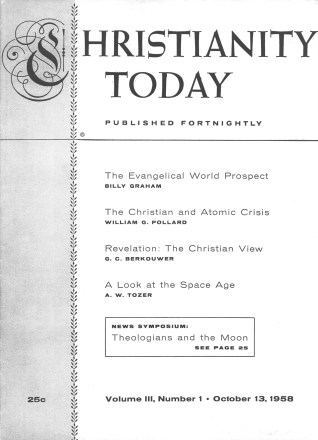
Cover Story

The Christian and Atomic Crisis

In a recent issue of The Nation a professor of sociology in Columbia University, C. Wright Mills, issues a stinging condemnation of Christianity (“A Pagan Sermon to the Christian Clergy,” The Nation, March 8, 1958). Cast in the form of a sermon preached by a pagan to Christian clergy, he deals positively and emphatically with the problem of total war in an atomic age. He sees only one possible attitude of the Christian toward this problem. “But truly,” says Professor Mills, “I do not see how you can claim to be Christians and yet not speak out totally and dogmatically against the preparations and testing now under way for World War III. As I read it, Christian doctrine in contact with the realities of today cannot lead to any other position.… I believe the decisive test of Christianity lies in your witness of the refusal by individuals and by groups to engage in war. Pacifism, I believe, is the test of your Christianity—and of you.” Since the vast majority of those who claim to be Christians, even among the clergy to whom he is preaching, fail in this decisive test, he finds Christianity bankrupt in moral imagination and a party to the moral defeat of contemporary man.

As a priest of the Church, I am one of those to whom Mr. Mills’ sermon is particularly addressed. But in my added capacity of one who consents to direct a small part of the program of the Atomic Energy Commission, I would certainly be singled out as a glowing example of treachery to the Faith.

The Nature Of Christianity

There is a widespread impression both in the secular world and in large segments of Protestant Christianity that the essence of Christianity is to be found in an ethical idealism. Christianity is interpreted as a religion founded by a teacher in much the same way as Confucianism is based on the teachings of Confucius, or Islam on the teachings of Mohammed. Its essence is considered to be found in the teaching of the Sermon on the Mount, supplemented with certain other selected teachings from the Synoptic Gospels which have a suitable ethical or idealistic content. All the rest of the New Testament and essentially all of historic Christianity along with it is rejected as being primarily dogmatic and doctrinal and, therefore, unessential. Judged by this standard of the essentials of Christianity, one who professes to be a Christian can preserve the integrity of his profession only by evident adherence to this ethical ideal.

Sociologists are able to adopt an especially patronizing attitude toward religion in general and Christianity in particular. Having made an exhaustive study of the structure and characteristics of human communities, they are aware of the essential role played by religion in giving meaning, purpose, vitality, and stability to sociological structures. Although confident from the vantage point of their own world view that religion of all kinds is essentially unreal, they nevertheless consider it to be a practical necessity as a source of values which a community must have in order to cohere. Although the objects of religious faith are axiomatically disposed of as having no external reality, and the belief in them as a sad illusion, the majority of men are unable apart from such belief to maintain a sufficiently unshakable loyalty to the central values whose preservation is a pragmatic necessity for society. Thus the typical sociologist is quite prepared to put up with religion and even assign it a place of real practical importance in his scheme of things. However, it is permitted to enjoy this privileged status only so long as it really fulfills its intended function in society.

Any sociologist who preaches a sermon to Christian clergy, whether an acknowledged pagan or not, can be counted upon to make this demand for functional fulfillment his central point. Dogma and doctrine, liturgy and worship, institutions and personnel, and all other aspects which the clergy take so seriously are permissible and acceptable, but not essential. Since all such things have no reference in reality, they do not really matter one way or the other. But society does depend, really and substantially, on having the Christian clergy actualize the Christian ethical ideal. Sociologically speaking, this is the only real role they have. If they fall down at this crucial point, then Christianity ought to be discarded as a useless and pointless appendage to society. In this judgment both liberal protestantism and secular humanism concur. If the central reality and point of Christianity resides in its ethical teachings and ideals, then the Christian Church is admissible as a proper and useful institution in society at large only insofar as it makes this ideal ultimate in its own life and demands a rigorous adherence to it.

A Sublime History

This view of the essential nature of Christianity is radically at variance with what in fact has been its essential character throughout almost the entire course of its history. Thus none of the great historic affirmations of the Christian faith, the catholic creeds, contain any ethical assertions whatever. They, in full agreement with the central witness of the New Testament, present as the very heart and essence of Christianity not an ethical ideal, a moral code, or a philosophical system, but rather simply a story. To the twentieth century secular humanist as to the first century Greek, this story may seem sheer foolishness or even, as to the first century Jew, a stumbling block in the way of achieving the larger schemes for the perfection of society to which he is committed. It may seem unimportant or irrelevant to the complex issues of the modern world. But however it may be regarded, it nevertheless remains true that Christianity itself has always maintained that this story does in fact constitute its essence.

Essentially all other world religions have proclaimed the necessity of a reformation of the world before it could be saved. They have held up an ethical ideal and demanded that men somehow acquire the stamina and the moral courage to live up to it before the world could become worthy of God. It is here more than in any other aspect that Christianity is unique among all other religions. For the wonder and power of Christianity and that which made its proclamation really good news was that, while the world was still unworthy and evil, God had acted to save it. This is the great meaning of the story. It is the story of God’s action in power on behalf of sinful and unreformed man. As St. Paul put it, “While we were yet helpless, at the right time Christ died for the ungodly … while we were yet sinners Christ died for us” (Rom. 5:6, 8). Incredible as it might seem, the good news is that “God was in Christ, reconciling the world to himself, not counting their trespasses against them” (2 Cor. 5:19).

This is the story, and its great and astounding meaning is that the divine Word by whom all things were made “came down from heaven,” as the creed says “for us men and for our salvation, … and was made man.” “The Word became flesh and dwelt among us, full of grace and truth.” This story is the dogma. It is the story of a rescue operation carried out at great cost and danger, even to death upon the cross, by God himself. The good news of it has warmed the hearts and lifted the spirits of men down through the ages. Over and over it has brought with it redeeming and saving power. It is a tragedy of our time that so many have removed this story from the center of Christianity and replaced it with an ethical ideal. In so doing they have taken all the good news out of the Faith, put Christianity on the same status as other religions, and converted Jesus from the Christ into merely one among many in a long line of ethical teachers and moral leaders.

Other religions have shown their power over men by drawing them out of involvement in the world into a life of superior virtue insulated from the tough immediacies and hard dilemmas of history. The world could stew in its own evil while the religious man separated himself from it and need no longer suffer with it in its misery. Christianity, on the other hand, has shown its unique power in its capacity to send men in the opposite direction into the midst of the world to share fully in all its sickness and misery and unrighteousness. The typical Christian saint has been found in the slums and the leper colonies, bringing the redeeming and saving power of Christ to the publicans and sinners of every age. Other religions call men out of the world into an artificial environment of superior righteousness. Christianity on the contrary draws them into the world to share in its life as it is actually lived and to share too in the joy of participation in its wonderful energy and glorious power to heal and to save.

The Believer’S Involvement

What then shall we say about the role of the Christian in the world today with respect to his involvement in his country’s preparations for nuclear warfare? What must be the response of one who, like myself, after becoming fully involved in the national effort in atomic energy, finds himself discovering that this central story of Christianity really happened, that the incredible assertions of the Church about it are really true, and is thereby caught in the grip of its redeeming power? Must he in response to this discovery escape from his involvement in a situation in which God had placed him beforehand? Are we called upon to break away from the history of which we are a part as our necessary response to the call of a Lord in whom God himself entered human history? Undoubtedly this was the response which much of the world expected of me. But then the world at large in seeking an explanation for my having taken Holy Orders seized upon a moral revulsion at my involvement in the atomic project as the most likely reason. Should I then bear witness to the living reality of my discovery by withdrawing, and so confirm the world’s opinion that Christianity is after all only an ethical ideal? Or would it be a truer witness to stay where I am, the world then wondering whether Christianity might after all involve something more than mere idealism?

Mr. Mills, from whose pagan sermon to Christian clergy we quoted at the outset, has issued a call to all Christians to join in an all-out effort to end warfare at all costs. One of the chief difficulties with such a call, as I see it, is the sheer enormity of the task. Taken seriously it could easily absorb the entire energy of the Church and make the elimination of war so overriding a consideration that the real task of the Church of proclaiming the Gospel would be swallowed up and lost.

A serious effort of the necessary scope to mobilize all Christians in the service of such an end would involve the Church in what seems to me a most damaging identification of Christianity with the aims and aspirations of the secular world. For secular humanism is just as intensely idealistic and humanitarian as Christianity appears to be to those who have made it into an idealism. Modern man by and large looks upon contemporary history as his own affair, and the world as something to be molded by science to the benefit of man. This is the secular ideal, and it necessarily abhors war because war threatens man’s autonomy and is by now capable of wiping out the gains he has so far made in his quest for self-sufficiency, mastery, and omnipotence. Secular humanism places its whole hope and trust in the efficacy of improved social structures and informed political action to cope successfully with the “problem” of war. It insists that the Church, if it has any residual social value, should join with it so as to form a united front against this dark threat to the sovereignty of man. Placing all our confidence in informed social and political action, let us, they say, make together a great effort to achieve a peaceful world. For them Christianity as such is unreal and outmoded, but they are quite ready to recognize Christian love as a powerful sociological force and to exploit it to the full for the achievement of their goal.

The easy identification of Christian ethics with secular goals is perhaps the greatest barrier in the way of modern man’s receptiveness to the central proclamation of Christianity, the wonderful good news that “God was in Christ reconciling the world unto himself.” It is important for the Christian to see this clearly and to avoid the temptation to allow something secondary and derived to obscure the central theme to which he is called to bear witness. War, death, and destruction are not the ultimate calamity. If they were, we should be lost indeed, for time would then see to it in any event that every achievement of man would finally be swallowed up in meaninglessness and nothingness.

Terrible as atomic war unquestionably is, it does not stand as dominantly against Christianity as another more subtle, and from man’s standpoint much less fearful, aspect of our contemporary life. For the most radical opposition between Christian faith and the actuality of modern life is found not in modern warfare but rather in our modern quest for the complete autonomy of man. The prevailing spirit is one of marvel at the triumphs of science, medicine, and modern technology. The prevailing hope lies in the expectation of the practical achievement of a man-made universe functioning in accordance with man-made standards of efficiency, economy, and comfort. No more terrible affront to his Creator can be made by man than this all-out determination to seize God’s creation from him and make himself sovereign within it.

War is not only a fruit of the wickedness of human hearts whose cure we must be ever vigilant to bring about. It is also, and always, at the same time a manifestation of divine judgment on human sin. We must be careful that in bringing the redemptive power of the Gospel to the cure of the one, we do not at the same time become involved with the world at large in a proud and unrepentant rebellion against the other. For how can we be sure that it is really God’s will that modern man should be released from the judgment of war, and set free thereby to proceed once more unhampered along his chosen path toward the achievement of mastery over nature and society?

Dispelling Human Autonomy

The great truths of the Christian faith, which must be proclaimed if the prevailing secular illusions of the possibility of human autonomy are to be dispelled, are the Lordship of Christ in history and man’s need for humbling himself and seeking guidance and mercy from him who really created the universe. We must at all costs avoid committing ourselves to any course which weakens or obscures this primary mission of Christianity. This to me is a crucial problem for those Christian bodies organized for action on behalf of world peace. How, for example, is the world at large to distinguish between the Christian mission for world peace and the equally urgent call to all secular humanists of reasonableness and good will which was issued a few years ago by Mr. Lewis Mumford in his book, In the Name of Sanity? If we in the name of Christ issue the same call as that which the world at large issues in the name of sanity, how is Christ to be truly known again in our time? If our preaching becomes identical with Mr. Mills’ pagan sennon, who is to preach the truth of Christ to the pagan world?

From our finite vantage point on the earth we can easily acquire a view of reality and a scale of values which is the direct opposite of God’s view which encompasses the whole of creation from an infinite vantage point. The contrast between God’s view and ours can be made with respect to the whole modern technological enterprise including as its most striking manifestation the atomic energy enterprise. Doubtless the majority of people would agree that the expenditure of human energy in the development of the beneficial aspects of atomic energy for power, industry, agriculture, and medicine, is a social good directed toward the betterment of the conditions of human life and, therefore, doubtless pleasing to God and in accordance with his will for man. General assent would also be given that the devotion of such a large part of our energy to the perfection of atomic and thermonuclear weapons in preparation for a holocaust on a truly terrible scale is an unmitigated evil diametrically opposed to God’s will and meriting only his wrath and righteous indignation. Before giving our approval to these apparently axiomatic assertions, let us, however, pause to ask whether it might be that in God’s sight these two aspects of our atomic energy efforts would stand in a quite different contrast?

An unusual and important book was published several years ago under the title, Tomorrow is Already Here, by the Swiss journalist, Robert Jungk (Scribner’s, 1954). This book is not nearly so well known as it deserves to be. He holds up a mirror to American life which reflects a rather ugly image. In summary he says of this image: “America is striving to win power over the sum total of things, complete and absolute mastery of nature in all its aspects. This bid for power is not directed against any nation, class, or race.… The stake is higher than dictators’ seats and presidents’ chairs. The stake is the throne of God. To occupy God’s place, to repeat his deeds, to re-create and organize a man-made cosmos according to man-made laws of reason, foresight, and efficiency: that is America’s ultimate objective.”

If this indeed is a valid picture of the innermost drives which empower contemporary American life, would it not be true that such a “grasping for omnipotence” could well be a far more terrible affront to God than even our current preparations for atomic warfare? If our effort in the peaceful development of atomic energy is taking place in such a context, it may really be worse when viewed from the perspective of the eternal purpose and destiny of human life than is our effort to develop the military aspects of atomic energy. If this is indeed the case, then it is perhaps not God’s will that we be released from the threat of nuclear warfare.

With respect to the proposal that the United States immediately and unilaterally stop all military preparations and weapons development, which Mr. Mills’ sermon urged the Christian clergy to adopt, I could not possibly conscientiously urge such a policy upon our government. I do not believe it would make World War III less likely, but rather my own expectation would be that such a decision would encourage war. Moreover, I cannot believe that a free decision on our part to abandon ourselves and the rest of the world to the grim tyranny of communism would represent a right or moral action on our part. At the same time, however, I must agree with Mr. Mills that war has become so total and so horribly destructive that any policy of preparation for it which seriously contemplates engaging in it is morally indefensible. I cannot develop a rational reconciliation between these two positions.

What will be the outcome of this terrible juncture we cannot foresee. We must, of course, do everything in our power to find ways of restraining the terrible potentialities of the human will now that the vast powers locked in the very heart of matter have been placed at man’s disposal. But when we have done all that is within our power to do, what if the end is nevertheless upon us? Is this prospect to be the occasion for us of hysterical fear and panic?

For secular man it is indeed a black and fearful prospect. But for the true Christian it is nothing of the kind. For the Christian lives in a created world; a world that has had a beginning in time and is moving toward an end; a world which was brought into being in the first place for some wonderful and mysterious purpose of its Creator, and whose unfolding in time is leading toward some great and wonderful fruition at its climax. The whole New Testament is pervaded with a thrilling sense of the imminent possibility of the termination of history in a great climactic act in which the judgment of the Creator is to be finally rendered on his creation. Within the life in Christ the contemplation of such finality is the occasion of sober joy and prayerful anticipation. As St. Paul puts it: “For the creation waits with eager longing for the revealing of the sons of God … the creation itself will be set free from its bondage to decay and obtain the glorious liberty of the children of God” (Rom. 8:19–21).

From his own profound understanding of the dark depths of his own sinful nature, the Christian knows that it is the power of Almighty God alone which can “order the unruly wills and affections of sinful men;” that in the words of the 65th Psalm it is he “who stilleth the raging of the sea, and the noise of his waves, and the madness of the peoples.” But knowing this in a spirit of deep contrition and repentance, the Christian also knows the joyous wonder of the Good News that “God so loved the world that he gave his only begotten Son to the end that all that believe in him should not perish, but have everlasting life.” Secure in this knowledge the Christian, having by the grace of God done all that he can in his own small way, is content to leave the ultimate destiny of the world in the hands of its Creator.

Dr. William G. Pollard is Priest-in-Charge of St. Francis’ Episcopal Church, Norris, Tennessee, and Executive Director of the Oak Ridge Institute of Nuclear Studies in Tennessee. This article abridges his closing address in the Bohlen Lectures delivered in Philadelphia’s Church of the Holy Trinity on the timely subject of “Peaceful Uses of Atomic Energy.”

Cover Story

Billy Graham Speaks: The Evangelical World Prospect

EXCLUSIVE INTERVIEW

CHRISTIANITY TODAYis indebted to Dr. Billy Graham for this significant interview in which the distinguished evangelist relays personal impressions of the status of the Christian impact upon our generation and of spiritual trends throughout the world. No evangelist in Christian history more than Dr. Graham has proclaimed the gospel of Christ to multitudes on a world scale by mass meeting, radio and television. He expressed the following views on the eve of his evangelistic crusade in Charlotte, North Carolina. Questioners included distinguished members of the Board of Directors ofCHRISTIANITY TODAY, Dr. Harold John Ockenga of Boston’s Park Street Church and Dr. Robert J. Lamont of Pittsburgh’s First Presbyterian Church, and Editor Carl F. H. Henry.

DR. HENRY: Do you sense any world-wide moving of the Holy Spirit today?

DR. GRAHAM: Yes, I do. Most everywhere, Christian leaders have told me that it is easier to win people to Christ than ever before.

DR. HENRY: Any particularly noteworthy areas?

DR. GRAHAM: I think that possibly in Latin America I have sensed the greatest spirit or manifestation of what I call genuine revival in the Protestant church. The Protestant church in Latin America has suffered a certain amount of persecution from various sources. This has brought about the emergence of a strong, virile, and dynamic leadership that I have not sensed in any other part of the world.

DR. LAMONT: What of the missionary witness?

DR. GRAHAM: I found practically no extreme liberalism in Latin America. There is no modernism. The Gospel is preached by most of the denominations in its purest form, compared with other mission fields I have visited.

DR. OCKENGA: Do you see Latin America as a promising field for a reformation in our century?

DR. GRAHAM: I couldn’t answer that. I do know that Catholicism in Latin America takes a different thrust than it does in the United States. A Catholic theologian recently told me that unless there is a reform within the Catholic church, in many countries there will be a revolt against the Catholic church, and that only the Protestants and Communists would profit by it. In many countries one senses anti-clericalism. I think that there is something new in Latin American countries. Brazil, Chile, Guatemala, perhaps even Mexico might be Protestant within another generation.

DR. OCKENGA: Have you any particular anxiety about the course of foreign missions today?

DR. GRAHAM: I am alarmed over the thought prevailing in some denominational missions that they should not penetrate any further into Hinduism, Buddhism, or other religions. The idea is that we should peacefully co-exist—hold what we have, and evangelize as we can. Pioneer missions is something some denominational leaders are no longer interested in. To do pioneer missions work a man not only has to have a dedication but he has to have a message. Unfortunately, a lot of our seminary graduates today just don’t have the message.

DR. LAMONT: As far as your appraisal of the new independent indigenous churches is concerned, is there any marked evangelical leadership in these younger foreign churches?

DR. GRAHAM: I would say that in the overwhelming majority of the places I’ve visited, at least in many cases, nationals are more evangelical than the missionaries.

DR. HENRY: You have spoken of the comparative ease with which converts are now being made and you have said this happens in many religions today. How do you discriminate the presence of the Holy Spirit in this general religious moving? What are the criteria of the presence of the Holy Spirit?

DR. GRAHAM: I think there is a hunger of the soul and an inquiring of the mind after some philosophy, some ideology, or some religion that will satisfy. The talk of scientists about annihilation of the human race is penetrating the thinking of the world. Many people are beginning to reflect on the possibility of racial suicide and they wonder, “What have I to hold on to? What do we have that can save us?” I think that’s one element. But I also feel that beyond that is the sovereign presence of the Holy Spirit in penetrating power that perhaps is using this religious inquiry in allowing an acceptance of the Gospel all over the world, perhaps in such scale as we have not seen before in history.

DR. OCKENGA: Could you elaborate on that point?

DR. GRAHAM: I think that we are seeing on the one hand this tremendous spiritual emphasis and religious interest, and on the other hand materialism is gaining in many different ways. When God does great work, powers of evil also rise.

DR. LAMONT: The Bible says wickedness shall grow worse and worse. But at the same time, is it not possible that the church is going to grow better and better? Don’t you think that at the same time it’s possible for the saints to become more sanctified?

DR. GRAHAM: I am not sure that I would say that in America saints are more sanctified. I’m not so sure but what they are less sanctified. I think that television, for example, is having a detrimental effect on Christians. I think that they are no longer sensitive to sin. I think that television has brought the night club into the home, along with violence and sex—things that Christians looked upon 10 years ago with abhorrence. They have gradually become desensitized, and I can cite case after case in which Christians now watch television without feeling any twinge of conscience.

DR. HENRY: Do you mean that the secular thrust has penetrated more deeply in America than the spiritual thrust?

DR. GRAHAM: The spiritual thrust, it seems to me, has been almost numerical. There is this great influx into the churches and this great interest, but so much of it is superficial.

DR. HENRY: What would you say is the greatest need of the Church today?

DR. GRAHAM: I believe that the thing that we are missing today is not organization, it is not facilities, and it is not communication. The great need in the world today is for Spirit-filled men who really produce the fruit of the Spirit. I had a Hindu student say to me in Madras, “I would become a Christian if I could see one.” And when he said that to me he was looking at me. That was one of the greatest sermons ever preached to me.

DR. LAMONT: Last year, the growth in American church membership failed to keep up with the population increase. What is your comment?

DR. GRAHAM: The increase in population over the increase in church membership was small. In my opinion, there is no indication of a trend here. I don’t think there should be any discouragement over this at all.

DR. OCKENGA: As population increases and Christianity vies for the additional people with other major religions, we’ll probably have fewer Christians proportionately. How do you reconcile this with your viewpoint of a greater hunger for spiritual things?

DR. GRAHAM: Well, the job of the Christian Church in the proclamation of the Gospel is not necessarily to win the world, but to confront the world with the Gospel of Christ and to give the world an opportunity to receive or reject him.

DR. OCKENGA: Does the Bible teach, in your opinion, that the whole world is going to be converted?

DR. GRAHAM: No. I think the Bible teaches to the contrary. The Scripture says that the cup of iniquity will become so filled that the only alternative is judgment.

DR. HENRY: What spectacular gains are evangelicals making today and what can we look for next?

DR. GRAHAM: The growth of Bible schools and colleges, and accreditation of our academic efforts are evidence of great strides being made by evangelicalism. Then there is the tremendous discussion about evangelical theology. Ten or fifteen years ago evangelicalism was almost dead. It was in a rut. Now great discussions are going on and liaison is being established between various shades of thought within evangelical circles. I think Fuller Theological Seminary is an evidence of that. I think that CHRISTIANITY TODAY is an evidence of that. I think perhaps our crusades are additional evidence.

DR. LAMONT: How about the large denominations?

DR GRAHAM: I see evangelical wings within the denominations having a revival. There is unquestionably a new emphasis on evangelism.

DR. HENRY: Do you find any evidence that in the Protestant churches there is a new note of authority—a note of authority sounded afresh? What rediscovery of the Bible do you sense in the pulpits of America?

DR. GRAHAM: I feel that there is in process a return to biblical preaching. I would say that the greatest emphasis at the moment is probably being given to the social concern of the Old Testament prophets such as Amos and Hosea, that in studying those Old Testament prophets some of our brethren have come up with the realization of judgment. I think we are hearing a note of judgment being preached today a little more, perhaps, than we did before. And I think the lordship and the centrality of Christ and the Cross is being emphasized in the pulpit today. But probably not the substitutionary aspect of the Cross that we would like to see; sometimes the Cross is held up as a sentimental thing to which we are to come. But I feel that there is a great shallowness in preaching today, and I feel that the Church is lacking in great preaching. For example, when they have a conference in any of our great interdenominational meetings, you will notice how often they have about the same list of speakers. At least, they are trying to get the same speakers, because there are so few great preachers in America today. And I think one reason is because the minister today seldom does any creative thinking. He’s not studying. And many of our seminaries are not emphasizing the need of preaching. We are turning out administrators. We are turning out personal counsellors, particularly along lines of psychological counseling. I think our need is to return to great preaching, great Bible preaching! And I think that people will come to hear great preaching.

DR. HENRY: Do you sense within the organized church a drive toward ecumenism as fully as a move for evangelism?

DR. GRAHAM: The emphasis on the ecumenical movement, it seems, is primarily in the hands of the leadership of the denominations. I do not think there is very much ecumenicity on the parish level. I think that the minister down in the grass roots is becoming far more interested in evangelism of one sort or another—perhaps not using my definition of evangelism but some sort of evangelism. And I think he recognizes that there is a need within his own congregation and in his community. To many, evangelism is the penetration of the Christian influence within the social structure of a community.

DR. HENRY: In Germany after World War I, spiritual leaders were saying that unless we bridge the gap to the university mind and to the laboring forces with the Gospel, it was dubious that any significant Christian advance would be registered. How do you feel about that?

DR. GRAHAM: I feel that is absolutely true. And I think we are making practically no spiritual penetration into the laboring class.

DR. HENRY: Does the destiny of Christianity in our generation hang in any significant way upon the layman?

DR. GRAHAM: Wasn’t the Early Church primarily a lay movement, and haven’t we perhaps made a tragic mistake in this distance that we have built up between the laity and the clergy? And haven’t many churches made the mistake of depending on the minister to do their work for them, when actually all laymen are called to be workers? Many laymen feel that their job is to sit in the pew on Sunday and perhaps contribute a few things, when actually their job is also to be ministers.

DR. LAMONT: If you were a pastor of a large church in a principal city, what would be your plan of action?

DR. GRAHAM: I think one of the first things I would do would be to get a small group of eight or ten or twelve men around me that would meet a few hours a week and pay the price! It would cost them something in time and effort. I would share with them everything I have, over a period of a couple of years. Then I would actually have twelve ministers among the laymen who in turn could take eight or ten or twelve more and teach them. I know one or two churches that are doing that, and it is revolutionizing the church. Christ, I think, set the pattern. He spent most of his time with twelve men. He didn’t spend it with great crowds. In fact, every time he had a great crowd it seems to me that there weren’t too many results. The great results, it seems to me, came in his personal interviews and in the time he spent with his twelve.

DR. LAMONT: Would you say that Khrushchev’s conversion is an impossibility?

DR. GRAHAM: No! No man is beyond the mercy of God.

DR. LAMONT: Ought Christians to pray for him?

DR. GRAHAM: Yes. We are to pray for all men.

DR. LAMONT: How best can Communist leaders be reached with the Gospel?

DR. GRAHAM: Through prayer.

DR. LAMONT: Would you like to go to Russia to preach?

DR. GRAHAM: Yes.

DR. LAMONT: Is there any prospect?

DR. GRAHAM: There is no contact at the moment.

DR. OCKENGA: Has there been a shift of emphasis in your preaching?

DR. GRAHAM: I have preached a great deal of judgment, and still do, but I would say there has been a shift toward emphasis on other aspects of the Gospel. Especially has there been a shift to the Cross which I believe is central. In fact, now I feel that if I preach any message on any subject in which the Cross is not central, I have not truly preached the Gospel.

DR. OCKENGA: Would you name another aspect of the Gospel in which you are now placing emphasis?

DR. GRAHAM: Within the last year, I have been emphasizing the cost of discipleship. I care less and less how many people come forward—whether anybody comes forward or not. The important thing is whether I have made clear the Gospel and the cost of following Christ. We’re saved by grace, but discipleship also means making Christ the Lord of our daily lives and this costs dearly. And I believe that one of the emphases needed in evangelism is to spell out the cost of following Christ. Many people fail to count the cost. Yet it seems to me that the times that I have preached and made it more difficult than any other time, that is the night we have our greatest response.

DR. HENRY: What has heartened you most?

DR. GRAHAM: During the past year, the tremendous response which we had in California was unprecedented in all our travels over the world.

DR. HENRY: Numerically? Is that what you mean?

DR. GRAHAM: Yes, in a way. Everywhere we went the crowds came. The people came forward, as if they had been waiting. This is to God’s glory.

DR. LAMONT: What is the largest numerical response you have seen in America?

DR. GRAHAM: At our San Antonio rally in July, some 3,000 came forward. That was the largest number to come forward at an American meeting.

DR. OCKENGA: What does that signalize?

DR. GRAHAM: That signalized to me that television has given us a penetration that radio has never accomplished.

DR. HENRY: What are you hoping for next?

DR. GRAHAM: I’m giving some thought to taking less time in a crusade and going to some cities for just a week, so that we can get to more cities now, while this great harvest seems to be ready. Invitations for such meetings seem almost unlimited but the decision to accept must be of the Holy Spirit. For this I request your earnest prayers.

END

News Briefs from October 13, 1958

Religious Meetings

Carolinas For Christ

Billy Graham team members must go back at least two years to recall anything like the Charlotte crusade.

Reinforcing a warm North Carolina welcome is a spirit of expectancy and conviction in the meetings. In his home town, Graham is preaching with unusual freedom and power.

At the very outset, the crusade broke into a cultural and social bracket that was not thoroughly penetrated since Graham’s Oklahoma City meetings of 1956. The country club set not only turned out to hear the evangelist at the big-domed Charlotte Coliseum, but arranged inquiry meetings in homes. As a result, many of the Carolinian elite were coming to grips with spiritual reality.

Graham feels that the crusade went deeper more quickly than any other he can remember. He says many are coming to the meetings with the definite expectation of responding to the invitation. Nation-wide telecasts helped to prepare the way, Graham explains, along with the general feeling that the world is at a dead end and that something radical must be done.

The crusade is the talk of the town. Communications media are giving it the big-story treatment. One newspaper is publishing every sermon in full.

The Coliseum manager said the opening service of the crusade found an overflow crowd of 13,175 in the main auditorium and another 1,200 in an adjoining auditorium, where sound equipment a few days later was augmented with closed circuit television. Even during weekdays, vacant seats were scarce. Nearly 3,000 decisions for Christ were recorded during the first week of the crusade.

The crusade is scheduled to run through Sunday, October 19. Graham was considering a one-week extension. Every Saturday night meeting is being telecast nationally.

T. M.

Count Down

Philadelphians will likely see many a smartly-dressed male with Bible under arm this week. Typical is G. Tom Willey, vice president of the Martin Company and secretary of Christian Business Men’s Committee International, which holds its 21st annual convention at Philadelphia’s Benjamin Franklin Hotel, October 15–19.

Willey authored a tract which the American Tract Society published especially for the convention. Titled “The Last Count Down,” the tract describes a typical missile firing and makes a Christian application.

“Some have said that the satellite proves there is no God,” Willey writes. “To me it proves the exact opposite. The only reason we can orbit is because God has set up some rules.… The same force that keeps the stars going keeps the satellite going when it is set in its right orbit.”

“Dental Evangelism”

Missionaries in pioneer areas know well the attraction provided by a medical clinic. Not as widely recognized is the appeal of free dental treatment. In India, for instance, the ratio of dentists to population is reported about one to 180 thousand. Natives will travel far for treatment of dental diseases.

Seizing upon this acute need as a means of ministering to a much greater need (that of a Saviour) is The Missionary Dentist, Inc., an organization headed by Seattle dentist Vaughn V. Chapman. Now in its eighth year, the organization recruits dentists to serve as foreign missionaries, and encourages establishment of dental clinics at missionary outposts.

Late in August, Chapman’s group sponsored the second “Missionary Dentist World Conference” at Eugene, Oregon. One of the speakers was Dr. Ted Shanks, missionary dentist in the French Camerouns, where under sponsorship of the United Presbyterian Church in the U. S. A. a dental clinic is operated along with a school for training African young men to become “dental evangelists.”

Dominion Of Canada

United Church

Delegates at the 18th biennial General Council of the United Church of Canada approved a report of its Commission on Union which declared that “unmistakable apathy” toward merger of the denomination with the Anglican Church of Canada existed in both communions.

The report urged that lines of communication and friendship remain open, although it added, “the time has come when the Anglican church should make it plain whether it really wishes to continue these conversations, or whether it now desires to terminate them.”

Union discussions between the two bodies, initiated by Anglicans 15 years ago, have been at a standstill.

Following action on the report, delegates asked the General Council to turn its attentions toward possible union with the Presbyterian Church in Canada, “a sister church.”

The Presbyterian church organization remained out of the union with Methodists and Congregationalists in 1925 when the United Church of Canada was formed. But about 70 per cent of Presbyterian congregations joined in the merger. The United Church now has a membership of more than 955,000.

Dr. W. Harold Young, chairman of the Commission on Union, said two of the biggest obstacles to union between Anglicans and the United Church are “Anglican insistence on the acceptance of bishops as spiritual descendants of the original Apostles and the recognition of holy orders.”

Prime Minister John Diefenbaker told the 400 commissioners to the General Council that “Canada has a message to the world to reject unchristian theories of race superiority which stand in the way of true brotherhood of man and which are in no small measure responsible for the march of communism.”

Diefenbaker said he hoped to persuade Parliament to open a prayer room in the House of Commons similar to one in the U. S. Congress.

The council voted $50,000 for experimental television ministries during the next two years and increased the minimum salary for ministers.

Among resolutions passed was one which urged recognition of Communist China by the Canadian government. This was the third General Council to call for such action. Delegates refused to approve a section of the resolution presented by the church’s Board of Evangelism and Social Service which called for “a penitential attitude” on the part of Red China before admission to the United Nations.

The Rt. Rev. Angus J. Macqueen, minister of First-St. Andrew Church in London, Ontario, was elected moderator.

A New Synod?

Leaders of seven Canadian Lutheran synods conferred for a third time last month on the possibility of merger.

Chief development of the latest meeting at Winnepeg: Four districts of the Lutheran Church—Missouri Synod with representation in Canada reorganized to establish eligibility for a common charter.

The Missouri Synod has 75,000 members in Canada. Total Lutheran membership in Canada is 240,000.

The Ideal Sermon

The fifth World Conference of Pentecostal Churches, held in Toronto last month, drew 9,000 delegates from 40 countries (including Poland and Yugoslavia), representing every continent.

High point of the eight-day conference was a colorful missionary rally. All meetings were held on the Canadian National Exhibition grounds.

Clergymen present received specific advice on sermon lengths from Dr. Lewi Pethrus, highly successful Swedish Pentecostal pastor who estimates he has preached some 50,000 times during his 56 years in the ministry. Pethrus said sermons should be no shorter than 35 minutes and no longer than 45.

Pethrus is pastor of a Stockholm church which has about 6,500 members, although the sanctuary seats “just” 4,500. “But we have outposts for them,” he said. “We have 58 Sunday schools in the city.”

Eutychus and His Kin: September 29, 1958

LIMERICK CONTEST

The unusual reception of my Rally Day collection has encouraged me to undertake a new anthology for grown-ups in the Sunday School. Since the classical limerick form is ideal for the width of this column, I plan to devote a major section to Sunday School limericks.

Your cooperation is invited in this venture, which already promises to be the outstanding limerick collection of the decade on this subject. Entries may be submitted on discarded Sunday School papers retrieved from the church lawn or parking lot. Limericks will be judged as to poetic structure (five anapaestic lines: 1, 2, and 5 are of three feet and rhyme; 3 and 4 are of two feet and rhyme), incisiveness, and gentle charm. Get the swing of it from the samples below and send your entries before midnight to the undersigned.

There was a Beginner named Muntz

Who never missed Sunday School once;

His award bars galore

At last reached to the floor

From the stool where he sat as a dunce.

A teacher in primary grades

Loved audio-visual aids;

She never was seen,

For the filmstrips and screen

Required that she keep down the shades.

The committee conducted research

In the basement of Center Street church,

And it silenced the noise

Of the chairs and the boys

With rubbers and switches of birch.

Librarian Lillian Gray

Read three Christian novels a day.

When asked to explain,

She replied with disdain,

“Don’t you think I am earning my pay?”

Mrs. Fixture’s been teaching for years

Countless classes of Primary dears,

And now it appears

That if she perseveres

Our whole staff will be leaving in tears.

Our class always meets to discuss

All the problems related to us.

We can get most involved,

Although nothing is solved

And we seldom remember the fuss.

EVOLUTION REVISITED

Professor Clark points out that the term “evolution” involves an ambiguity and that the basic idea of descent with modification has been used by some evolutionists illogically as a support for an atheistic philosophy (Sept. 1 issue). It might also be pointed out that the term “creation” involves an ambiguity of the same type. Sometimes the term is used to cover everything which exists (as in the expression, “we are His creatures”), but at other times it is limited to things which came into existence suddenly and entirely apart from process. Professor Clark uses the term “special creation” in this latter sense to avoid ambiguity, but it seems to me that he is in danger of falling into the same type of non sequitur as that of the atheistic evolutionists.

The quotation from Lamont says essentially, “We now know that these things came about by slow processes, so God cannot have done it.” Is not Clark saying, “We cannot find evidence of slow processes in certain cases, so God must have acted in these cases”? Why should the spontaneous development of anything, even of simple life from inanimate matter, be regarded only as an atheistic idea? Does God never act through processes?

There are certainly “gaps” in the scientific evidence for evolution; the “theory of evolution” assumes that mechanistic processes can be found to close these gaps or at least to account for them. The only alternative is to believe that they cannot even theoretically be accounted for mechanistically. But the gaps have never been static; some of them have closed. Pointing out the existence of gaps does not weaken the theory of evolution; on the other hand, unless the gaps are completely static, their existence cannot be safely used to support special creation.

To be a genuine alternative to the theory of evolution, the theory of special creation must say exactly at which points God has acted suddenly and without process. The creation of life is usually taken as one of these points, but investigators in my own field, biochemistry, are actively narrowing this “gap” from both sides. The gap between inanimate matter and living things is not where it used to be. Inanimate matter has been shown to be capable of spontaneously forming more complex arrangements than previously thought possible; sub-living systems less complex than the cell have been shown to carry on many of the processes formerly associated only with living things. As Christians, can we not still see the creative hand of God in these places where gaps used to be?

Professor Clark points out that special creation is incompatible with what might be called “general evolution.” After reading his article and trying to think through my own position I have decided that I must be a “general creationist” and a “special evolutionist.”

Asst. Prof. of Chemistry

Iowa State College

Ames, Iowa

“The fresh look at the hypothesis of evolution” has a helpful insight into the problem faced by the orthodox who still resist the acceptance of the total evolutionary philosophy. Dr. Clark is to be commended for recognizing that species need not be considered incapable of mutating to other species. He quotes Goldschmidt who held that species are separated by bridgeless gaps. This concept is not held by the majority. Dobzhansky, for example, has a section in his 1951 volume which shows how some species of fruit fly are clearly separable from others, but others are on the borderline of the separation of one species into two. Let no creationist be found maintaining that species are fixed.

Scripture teaches that man arose from non-living matter—dust—by the act of God. Did not the first living thing so arise? Read George Wald’s … article on the “Origin of Life” in Scientific American a couple of summers ago to see modern ideas of life’s origin.

To be sure, we do not have a continuous fossil series (there are a number from a species through a second to a third, or even farther). Anyone will be cautious in using this argument from silence if he reads G. G. Simpson’s The Major Features of Evolution, 1953. Our belief in creation rests on revelation, not on an incomplete fossil record.

Prof. of Zoology

Wheaton College

Wheaton, Ill.

Triplet Of Evils

Triplet Of Evils

It is not pessimism but realism which erects the warning, “Bridge Out Ahead.” And it is because of public interest that the health department places a card with “Smallpox” on the door where that disease has been diagnosed. Also, it is because of the inherent danger to the patient that narcotics are legally dispensed only on the prescription of a licensed physician.

We believe there are trends in America today which, if unchecked, will lead inevitably to national ruin. There are many of these, varying in their degree of importance perhaps, but demanding the concern of Christians because of their spiritual and moral implications.

Just as the legion of evil spirits entered into and drove the swine of Gadara down the steep slope into the sea, so there are abroad in America evil forces driving us down the slope of folly into the oblivion of national destruction. I will mention three of these evils.

Deficit Spending

The day before the 85th Congress adjourned, Senator Barry Goldwater (R. Ariz.) took the floor and said: “We have appropriated and authorized the expenditure of enough money to give this country in the approaching years its greatest peace-time deficit, a deficit as high as twelve billion dollars annually.

“I want to remind my colleagues again, as I often have, that our enemies in Russia have for many years said they would destroy us by causing a collapse of our economy, and it seems to me, as we wind up this 85th Congress, that we are making better progress towards this means of ending our freedoms than they are making in the material field of weapons.”

A few days later another senator, addressing a meeting of the AFL-CIO in San Diego, outlined a program for additional benefits which he is planning to ask the next Congress to vote for in regard to Civil Service workers; and at the same time numerous other politicians are staking their political futures on the promises they give of bigger and better federal spending.

The American voter has no one but himself to blame for falling for a program of deficit spending which pushes upward the national debt, accelerates inflation, and hastens the day of national insolvency. For decades our fiscal policies have been those which long ago would have landed prodigal individuals in bankruptcy courts or jails.

Sex Obsession

The second of the evil spirits driving us to national destruction is the exploitation and perversion of sex. In our literature and art, on the stage and on screen the beauty and rightness of a God-given aspect of life has been perverted to the place where lust and license are paraded as the right way of living, and adultery and fornication as normal and desirable.

Sophistication in matters of sex has arrived at the place where homosexuality has been an underlying theme in two successful plays on Broadway, and lewdness has pervaded extravagantly the “best seller” of recent months.

This sex obsession has taken such a hold on America that nothing less than an aroused Christian conscience, activated at every level of society, beginning with the individual Christian, can check and bring under control the fire of lust which has been the undoing of nations in the past and can prove to be cancer to our own moral foundations.

Alcohol

Alcohol has been a problem from the days of antiquity. It is a narcotic liberated almost immediately after ingestion into the brain. Habit forming and dulling to the senses, it slows reactions, beclouds thinking, removes inhibitions and restraints, and leads to false values and conclusions.

Because of the tremendous profits involved, however, and the searing of conscience which seems to go hand in hand with the business, the liquor industry has foisted on the American public a philosophy of life where “gracious living” is the home with alcoholic beverages, and the man of distinction is the man with a whiskey glass in his hand.

Legislatures have been corrupted, voices of protest have been silenced, good men have been discredited—all because interested parties have stopped at nothing in their quest for more drinking in our land.

The media of mass entertainment only too often have the most attractive, desirable programs liquor-sponsored. And this expensive propaganda turns out to be cheap in the long run to those who thereby increase the number of alcohol users.

No one begins drinking with the intention of becoming an alcoholic. But it is a scientific fact that a certain percentage of drinkers are destined to become drunkards, of whom there are some six million in America today.

Behind the attractive advertisements luring men to drink is the other side of the coin visible to those who are willing to look: sickness, suffering, crime, economic loss, broken homes, and quarreling.

We Americans are a peculiar people. We seem to do things harder than many other people, and carry them to extremes. We can also be amazingly naive. At face value, we take the claims of those who speak glowingly of the advantage to local, state and federal treasuries accruing from the taxes on alcohol, and we never stop to study the statistics which prove that alcohol costs the taxpayer far more than it brings in the form of taxes.

The question of national security in all this is also involved. During World War II General George Marshall is reported to have said that the cocktail lounges of Washington were a greater menace to our country than some of our battlefield problems. And this danger has by no means ceased. Entirely too many conversations of world importance are being conducted today through the haze of brains numbed by liquor.

Solution

One of the cardinal principles of the Christian faith is honesty, and we who name the name of Christ should study and recognize those basic economic laws which govern both individuals and nations.

The Bible is explicitly clear on the privileges and blessings of sex and on the judgment which inevitably attends wilful and sinful exploitation of sex. Purity of life should be the badge of any Christian; it is something which sets him apart from the world and increases his witness to the saving and keeping power of Christ.

Scripture is equally clear about the danger of alcohol. Christian freedom is a glorious fact, but along with it goes the restraint of love for one’s neighbor, love which is willing to forego anything that might be a stumbling block for a weaker brother.

The answer to this problem—three evil spirits impelling our nation down the slope to oblivion—is found in the transforming, saving and energizing power of the Christ of Calvary. Let our witness begin right there.

L. NELSON BELL

Review of Current Religious Thought: September 29, 1958

The publication of Alan Walker’s book on evangelism, The Whole Gospel for the Whole World, has focused attention on the content of the Gospel. Dr. W. E. Sangster describes it as “an outspoken challenge to current evangelistic message and method.” Alan Walker led the Methodist campaign in Australia known as “The Mission to the Nation.” More recently, he has given addresses throughout America. Now he has returned to become superintendent of the Central Methodist Mission in Sydney.

Mr. Walker is an impassioned speaker with unusual gifts of oratory. He began his ministry among the miners of New South Wales, and later published a volume, entitled: Coal-town—A Sociological Survey of Cessnock, N.S.W. It marked the beginning of his deep involvement in social problems. Since that time he has spoken in season and out of season on the social implications of the Christian faith—particularly on such issues as peace and war, security and the welfare State, gambling and drink.

These themes are prominent in this new publication. In the introduction E. G. Homrighausen writes: “Alan Walker’s name is increasingly associated with that ‘larger evangelism’ which is needed in our time.… He rightly maintains that nineteenth century evangelism is not enough for the twentieth century.” Alan Walker does not hesitate to enumerate what he calls “the serious limitations and weaknesses which belong to nineteenth century evangelism.” “They are: a message which stops short of being the whole gospel for the whole world; an intellectual presentation of the faith which denies or ignores the great gains of biblical scholarship of the last one hundred years; a personal evangelism which has no social dynamic; an inadequate relationship with the Church as the body of Christ; an exaggerated trust in mass meetings as such and a calling for commitment to Christ in an emotional atmosphere with a limited intellectual and specific content.”

We are all familiar with Dean Inge’s quip: “Any stigma is good enough to beat a dogma.” If we ask “what is the kind of message which God seems to use in this twentieth century for bringing men and women to commitment?” (p. 99), the answer is “an evangelism which is … relevant to real-life situations.” This is the burden of his preaching. “To many it is destructive of faith that the Christian Church so often fails to be in the forefront of the reformist movements in history.” He passionately and stridently proclaims that the Church must give a social witness. Only so can modern man hear the Gospel.

Alan Walker is urgently insistent that the evangelization of the twentieth century man is dependent upon the social and political involvement of the Church.

All this involves a number of fundamental fallacies. It is imperative that we should make a clear distinction between the Gospel itself (with its message of repentance and forgiveness) and the application of the faith in personal and social life. William Temple made an important point when he said: “Social witness is both a preparation for evangelism and a consequence of it.” It is unfortunate that Alan Walker (despite his great gifts) is unable to understand this.

Again, there is, behind this interpretation of evangelism, a regrettable failure to understand the nature of the Church. The Church is more than the accredited officers of the Church making pontifical ecclesiastical pronouncements. The Church is the fellowship of the redeemed, clerical and lay. The world will not be redeemed by the leaders of the Church making ex cathedra statements on social and political problems—for the leaders of the Church are neither infallible nor impeccable; but rather by each member of the Church giving his own personal witness in his own local situation. It is the worship and witness of each member of the Church that is truly converting.

Finally, there is an unhappy disregard for the work of the Holy Spirit as the divine Agent of evangelism. “Unless the Lord build the house, they labour in vain that build it.” “Without Me,” Jesus said, “ye can do nothing.” How often we forget these facts! The Holy Spirit can alone convict men of sin; he alone can bring to men a realization of their need. As we condemn “the serious limitations and weaknesses” of mass evangelism we need to remember that it is still the good pleasure of God to save by the foolishness of preaching them that believe.

These are serious strictures. Nevertheless there is much to be gained from a consideration of Alan Walker’s conclusions concerning the planning and conduct of evangelistic crusades. He says that evangelistic meetings ought to be held on “neutral territory.”

We have made a significant discovery in Australia. From one end of the land to the other we have found that whenever Mission to the Nation meetings have been held in public halls or theatres or auditoriums audiences were two or three times larger than if meetings were planned in church buildings. This evidence has come to us so consistently that we now refuse to plan evangelism in anything but neutral territory—that is, when we are concerned with the true outreach of the Church to the people beyond its life. So startling has been this discovery that it has caused us to seek the psychology that lies behind it. Why should people be ready to come to public halls and shrink from entering churches? The chief reason is that most people dislike above all else to be called hypocrites. They have the mistaken idea that to be seen entering a church building is to be making a certain Christian profession. As yet they are not willing to declare themselves Christian in case their associates, knowing their lives, regard them as insincere and inconsistent. Therefore, they stay away. Also to enter a church is to be plunged into the style of worship that goes on in that church and there is fear of personal embarrassment through ignorance of procedures. So, rather than be noticed standing or sitting at the wrong time or fumbling in ignorance a hymn or prayer book others know so well, they stay away. Perhaps it is the very situation that Jesus found, and which led him to speak in the open rather than in synagogues. Perhaps the same discovery caused John Wesley to go out of the churches in his day to where the people were. Perhaps then, too, if men were to be won to the Church, they had first to be met and reasoned with outside the Church. Certainly it is logical to say it is a waste of time to preach in church trying to reach people who do not go to church.

This is an arresting comment and the conclusion is challenging. These observations are worthy of serious reflection.

Book Briefs: September 29, 1958

Authority Of Scripture

Authority, by D. Martyn Lloyd-Jones (Inter-Varsity Fellowship, London, 94 pp. 3s) and “Fundamentalism” and the Word of God, by J. I. Packer (Inter-Varsity Fellowship, London, 191 pp., 4s. 6d.) are reviewed by Donald Guthrie of the London Bible College.

Both these books deal with the problem of the Christian’s ultimate authority, although they treat it from rather different points of view. Dr. Lloyd-Jones has an essentially practical aim, whereas Dr. Packer’s plan is more systematic. The former book contains the substance of three addresses and retains the characteristics of the preacher’s style. It deals with the authority of Jesus Christ, of the Scriptures, and of the Holy Spirit. The author shows that evangelicals base their doctrine on Christ’s doctrine of Scripture. The only alternative to accepting on this basis the full authority of Scripture, is to acknowledge the uncertain authority of “modern knowledge” and “human ability.” Dr. Lloyd-Jones sees the issue as a clear alternative between Christ and the critics. Those who class themselves among the critics will find many challenging statements in this little book. In his chapter on the Holy Spirit the author shows special interest in the phenomena of revivals in which the authority of the Spirit is particularly manifest, and he makes a strong plea for more earnest prayer that the Spirit might again manifest his power in the Church.

Dr. Packer’s book performs several invaluable services for evangelicals. He makes clear that the manner in which the word “fundamentalism” is often used by liberal critics is not only misinformed but positively misleading. He points out that a different situation exists in Britain and America, since in the former the word has been employed by critics to describe a completely mechanical theory of inspiration, whereas in the latter it was coined by evangelicals themselves to denote their fundamental beliefs. Dr. Packer pleads that the word should be disused and replaced by the word “evangelical.” If this advice is followed a good deal of misrepresentation of the conservative position would be swept away. In his carefully reasoned chapter on “authority” Dr. Packer asserts that liberal critics are essentially subjectivists, who exalt

Christian reason to the position of arbiter to decide what is and what is not the word of God in the Scriptures. He rightly points out that the only sound approach to biblical interpretation is to submit the method used to the testimony of the Bible itself.

Dr. Packer gives a very lucid account of the evangelical doctrine of Scripture. He rejects as a critical “man of straw” the dictation-theory of inspiration, which he claims no serious evangelical scholar has ever maintained. The Bible is “word for word God-given; its message is an organic unity, the infallible Word of an infallible God” (pp. 113–114). Dr. Packer suggests that the problems and difficulties raised by biblical interpretation (e.g. problems of harmonization) cannot be considered a sufficient reason for disputing the evangelical doctrine of inspiration, since every other Christian doctrine raises problems unresolvable by human reason. In other words, the doctrine itself does not depend on rational demonstration. Dr. Packer clearly brings out the basic character of the differences separating conservative and liberal theologians. In the modern expositions of biblical theology he sees an example of the inconsistency which so often vitiates the liberal approach, since what is really in mind is not the theology of the Bible, but the theology of what subjective opinion declares to be “biblical.” Evangelicals can find little common ground with such a subjective approach that has been prevalent in liberal circles.

The important issues of faith and reason have a chapter each, while a concluding chapter on liberalism contains a penetrating comparison between the old and the new. This is a small but amazingly comprehensive book which will supply evangelicals with a reasoned statement of their own position and challenge liberals to re-examine their fundamental presuppositions.

DONALD GUTHRIE

Subjective Rationalism

Can People Learn to Learn?, by Brock Chisholm (Harper, 1958, 143 pp., $3), is reviewed by Arthur H. De Kruyter, Minister of the Christion Reformed Church of Western Springs, Illinois.

The title of the book is misleading, since the bulk of the material is on the content rather than on the technique of learning. Harping on an old theme, in almost every chapter Chisholm discredits the church by declaring it to be responsible for the problems of the world. And what is even worse, according to the author, is that the church is now the major institution preventing the necessary humanistic changes which can save the world from complete disaster.

The book contains a lopsided view of the world. Chapter 2 describes nations and continents from a so-called objective viewpoint which blames religion for promoting selfishness, exploitation, bad government, and other cleverly devised ills. Chapters 4 to 9 discuss problems of anxiety, aggression, population control by state birth controls, natural resource controls, a world language and monetary system, racial barriers, and the supremacy of the mind in contrast to authoritarian revelation of God. Mr. Chisholm has solutions for all of these problems and repeatedly states that the United Nations, which is destined to become the seat of the inevitable world government, is the answer.

The last four chapters deal with education—both method and content. Needless to say, there is no room in his curriculum for authority or convictions. A subjective rationalism is the genius of his system.

Having read other writings of Chisholm, father of the Mental Health Movement, it was not surprising to read his caricatures and abuses of the church and religion. What is surprising is that Harper has published such a brazen attack on Americanism and Christianity.

ARTHUR H. DE KRUYTER

Wide-Open Spaces

One Way of Living, by George M. Docherty (Harper, 1958, 173 pp., $3) is reviewed by Richard Allen Bodey, Minister of Third Presbyterian Church of North Tonawanda, New York.

Like Peter Marshall, his illustrious predecessor at the New York Avenue Presbyterian Church in Washington, D. C., George Docherty is a Scot who turned to preaching after having already embarked on another vocation. The present volume, his first, discusses the basic and broader aspects of Christian commitment under four headings: The Way, Decision For The Way, Difficulties In The Way, Discipleship In The Way. The chapters are revisions of messages preached from the New York Avenue pulpit.

The author’s purpose is to provide answers to questions concerning the nature of conversion and its issue, answers which lie somewhere between those of Billy Graham and Reinhold Niebuhr. He certainly has allowed wide-open spaces!

Docherty, again like his predecessor, has a colorful style; however, he is considerably less vivid, dramatic, and compelling. There is much that is good here, but nothing new. Generally sound, there are some shaded passages, i.e., his implication that Albert Schweitzer is a true believer (p. 9), and his apparent approval of the critical interpretation which sees in the Song of Solomon nothing more than “a collection of secular love songs, spiritualized by the Fathers of the Church” (p. 119). We believe it only honest to say that this subject has been much better handled in a dozen other books.

RICHARD ALLEN BODEY

Bible Text of the Month: Galatians 3:13

Christ hath redeemed us from the curse of the law, being made a curse for us: for it is written, Cursed is every one that hangeth on a tree (Galatians 3:13).

It is no doubt possible by sufficient ingenuity to explain these words away: but their plain meaning is obvious enough. The Lord redeemed us from the curse of the law by taking that curse upon himself. And this was symbolized by the fact that the very death he died was under a curse in the Law.

Redemption

To redeem—(exagorazo)—by payment of a price to recover from the power of another, to ransom, buy off; metaphorically of Christ freeing men from the dominion of the Mosaic law at the price of his vicarious death.

THAYER’S GREEK-ENGLISH LEXICON

The thought of the price that had to be paid for it must not be pushed too far into the background (cf. 1 Cor. 6:20; 7:23, and Rev. 5:9). We must think of this passage in relation to what is said in other places of Scripture about ransoming (Matt. 20:28; 1 Tim. 2:6) and redeeming (“purchasing free”: Titus 2:14). A more particular thought is attached to this redeeming than simply that of the emancipation of a prisoner. At issue here is satisfaction of violated justice, as is evidence from the phrase: from the curse of the law. Behind the imagery employed, there very probably lies the old practice, circumscribed by the Jewish legal code, according to which ransom money could be paid for a forfeited life (cf. Exod. 21:30). According to this line of thought those who were under the curse were to be regarded not merely as prisoners but as persons appointed to die (cf. Deut. 27:15 ff and 30:15, 19). It is from this sentence of death that Christ has redeemed them by himself “becoming a curse” for them.

HERMAN N. RIDDERBOS

Curse Of The Law

“To be made a curse” is a strong expression for becoming accursed; or, in other words, being subjected, by the Divine appointment, to that suffering, the infliction of which sin had rendered necessary for the honour of the Divine character and government—that suffering which is the manifestation of the Divine displeasure at sin. Christ was thus “made a curse” for or in the room of those whom he redeemed from the curse; and this substituted endurance of the curse was the ransom-price by which he redeemed them. It was that, in consideration of which they obtained deliverance—pardon and salvation.

JOHN BROWN

The curse which the law threatens, and which the execution of the law would inflict, is the punishment due to sin. This must mean, that he has rescued us from the consequences of transgression in the world of woe; he has saved us from the punishment which our sins have deserved. The word us must refer to all who are redeemed; that is, to the Gentiles as well as the Jews. The curse of the law is a curse which is due to sin, and cannot be regarded as applied particularly to any one class of men. All who violate the law of God, however that law may be made known, are exposed to its penalty. ALBERT BARNES

This passage (Deut. 21:23) is applied to the death of Christ, not only because he bore our sins and was exposed to shame, as these malefactors were that accursed of God, but because he was in the evening taken down from the cursed tree and buried, (and that by the particular care of the Jews, with an eye to this law, John 19:31) in token that now, the guilt being removed, the law was satisfied, as it was when the malefactor had hanged till sunset; it demanded no more. Then he ceased to be a curse, and those that are his. And as the land of Israel was pure and clean, when the dead body was buried, so the church is washed and cleansed by the complete satisfaction which thus Christ made.

MATTHEW HENRY

This curse culminated in the wrath of God. And here I must take occasion to expose the unbiblical theory prevalent in a certain school of theologians at present, that the element of wrath did not enter into the atonement, and that Christ was in no sense the object of the wrath of God. It suffices to explode such a notion to direct attention to this single phrase, which conveys the opposite thought: Were not men under the wrath of God when they were under the curse? (Gal. 3:10; Eph. 2:3.) And when Christ was made a curse, was he not, in an official respect, of necessity the object of divine wrath? The term used in the text has only to be alternated with the equivalent term, to convince any mind that the theory in question is no better than a neutralizing evasion, if not a contradiction, of Scripture. That curse was the penal sanction of the law with which we were burdened, and from which we must needs be redeemed; and the words will bear no other comment.

GEORGE SMEATON

For Us

All virtue lies in the little words: for us.

MARTIN LUTHER

It seems plain that the huper (for us) must be understood in the substitutive, and not merely in the beneficiary sense. For “the making of Christ a curse” is represented as the ransom by which our “redemption from the curse” has been obtained. The curse was removed from us by being transferred to Him.

THOMAS J. CRAWFORD

After the same manner John the Baptist calleth him, “The Lamb of God, which taketh away the sins of the world.” He verily is innocent, because he is the unspotted and undefiled Lamb of God. But because he beareth the sins of the world, his innocency is burdened with the sins and guilt of the whole world. Whatsoever sins I, thou, and we all have done, or shall do hereafter, they are Christ’s own sins, as verily as if he himself had done them. To be brief, our sin must needs become Christ’s own sin, or else we shall perish forever. This true knowledge of Christ, which Paul and the prophets have most plainly delivered unto us, the wicked sophisters have darkened and defaced.

MARTIN LUTHER

Our sins were imputed to him as to a sacrifice. Christ the just is put in the place of the unjust to suffer for them (1 Pet. 3:18). Christ is said to bear sin as a sacrifice bears sin, Isaiah 53:10–12. His soul was made an offering for it; but sin was so laid upon the victims, as that it was imputed to them in a judicial account, according to the ceremonial law, and typically expiated by them. As a surety, “He was made sin for us” (2 Cor. 5:21), and he bare our sins.

STEPHEN CHARNOCK

Lawyer, Theologian, and Dialogue

Martin Luther once studied law. So did John Calvin. Deans of law schools and theological seminaries point to interchange of students between the two disciplines. Now for the first time a full-fledged national conference has been held by American Protestants on “Christianity and Law.” Some four years of preparation produced four days of intensive discussion at the University of Chicago, September 7–10. And though Wittenberg and Geneva showed greater strength than many would expect in these environs, the theology of Basel cast the longest shadow across the campus. It did not, however, have entirely its own way, despite the presence of able proponents, including the Basel master’s son Markus Barth, associate professor of New Testament of the University of Chicago’s Federated Theological Faculty.

In fact, one of the most interesting points of the conference was the reaction of lawyers, judges, and law professors and students—meeting with theologians and parish clergy—to dialectical theology.

The conference, sponsored by the United Student Christian Council and the Faculty Christian Fellowship of the National Council of Churches, brought together 120 registered participants from 30 states, along with numerous visitors, and consisted of three “dialogues,” three “sub-conferences,” more than a dozen seminar sessions, worship services led by conference chaplain Professor A. T. Mollegen of the Episcopal Theological Seminary, Alexandria, Virginia, and daily Bible study conducted by Professor Barth.

Already aware of the “increasing evidence of an earnest concern among Christians in the legal profession about the issues of Christianity and law,” the conferees were accorded a sharpened awareness by means of three resource papers sent out in advance of the conference. The selection of these was criticized as weighting the conference prematurely toward a Barthian orientation, one essay being a reprint of Karl Barth’s “Gospel and Law.” Following this line was the paper by Jacques Ellul, professor of law at the University of Bordeaux in France. Disdaining the optimism of liberal theology as to man’s goodness and human progress, he emphasizes that everything in this world is doomed to death. Only men can be Christian—not “things, ideas, or institutions.” Thus law cannot be based on Christian love (“unthinkable”!), nor can it “express justice.” Rather it is “a waiting place” and will only become justice at the coming of Christ in his glory. It has now but a relative value.

In other conference literature, chairman F. William Stringfellow, young New York attorney, denies the possibility of a Christian philosophy of law. As Professor Wilber Katz of the University of Chicago Law School put it, Stringfellow “denies that Christianity provides ethical norms and asserts that the gospel stands in opposition to laws both good and bad. For him Christianity offers not standards for rational criticism but a vocation to worship and witness” which may be lived within the legal profession.

On the other hand, Professor Katz argues for the possibility of a Christian philosophy of law and “for Christian ethical standards for criticizing particular laws.”

In the first dialogue, Professor Katz contended that the law should provide freedom for moral growth and that in criminal law should be found a place for forgiveness (he urged the abolition of capital punishment, charging it ineffective as a crime deterrent). The law should find a “token fulfillment” of the future that Christ would bring. It should provide for equality of economic ability, as for example in “progressive taxation.”

In answer, Markus Barth found the law to be good only when “Christ takes it in his hand” and gives it a “spiritual interpretation.” The lawyer who is a Christian—in contradistinction to the term “Christian lawyer,” to Barth an unreality—will follow Christ by seeking to do the law. He will thus enter into a solidarity with evildoers and intercede for them. Clarence Darrow’s practice of taking “hopeless cases” provides a worthy example of a willingness to “get one’s hands dirty.” Christians are thus to serve persons and not institutions, which, though they may improve temporarily, will always in time decline.

In the second dialogue, Professor Paul Lehmann of Harvard Divinity School surprised some with his optimism, contending that “love can be unsentimentally translated into concrete terms of justice” through the possibility of law acting as “a function of forgiveness” and “an instrument of reconciliation.”

In the most optimistic presentation given thus far, Professor Harold Berman of Harvard Law School defended the concept of a Christian jurisprudence and traced its course through history. Calling upon his hearers to be “more realistic than liberalism or neo-orthodoxy,” he professed to see no tension between law and love. “Law needs love for its motivation and direction, and love needs law for its structure in society.” The church is challenged to create a legal environment where “love can flourish.” Professor Barth retorted that “only the gospel creates conditions under which law can flourish.” Katz and Mollegen also opposed Berman’s optimism, the latter sensing that the Cross had somehow been left out.

The third dialogue found many of the lawyers breathing a sigh of relief that they were to hear at last the practical application of Christianity to their daily practice of law. The two speakers were John Mulder, Chicago attorney and occasional lecturer at McCormick Seminary, and Professor Karl A. Olsson of North Park Seminary, Chicago. Olsson had already sounded an orthodox Protestant note in criticizing liberalism for reducing theology to a social science, and in finding fault with dialectical theology for not taking history, society, and institutions seriously enough.

A difficult question was raised as to whether it was right for a lawyer to defend a client he believes to be guilty. Attorney Mulder’s conclusion, seemingly a popular one: the adversary system in this country demands that every client’s case be argued as strongly as possible, though the lawyer’s conscience may experience anguish in this “ambiguous life.”

Mulder and Olsson defended the concept of “Christian lawyer,” the latter finding it indicated in the doctrines of creation, providence, and redemption. And in some sense, law “reflects God’s will for the world.” The Christian lawyer lives in two worlds—he knows a solidarity with the sinner in this world and gives himself in love to this service, but he also sees this world passing away and looks for the New Jerusalem.

Professor Barth assured the writer that the concept, “Christian lawyer,” is permissible if “Christian” is understood in terms of sovereign grace, with exclusion of any notion of human merit or accomplishment in salvation. But he prefers to drop the term rather than add the cumbrous definition each time it is used.

Indeed, the conference debates were often reminiscent of the Barth-Brunner controversy on common grace. But the thunderous “nein!” was uttered this time in the more dulcet tones of the amiable younger Barth, who was troubled at the difficulty of communication between lawyer and theologian.

The optimistic lawyers were at times nonplused at the “gloom” and “unreality” of dialectical theology. Some theologians thought this due to the “rational” conditioning acquired in the course of legal training. One pointed out that on certain of the issues, conservatives, liberals, Roman Catholics, Greek Orthodox, and Judaists would stand together in opposition to neo-orthodoxy.

In any case, the theology of crisis seemed to exhibit little attraction for the men of law over so brief an exposure. The attorneys generally saluted the conference for the excellent idea that it was, but often they watched arguments expose Protestant cleavages much as one sees an iceberg—only the upper ninth being visible. But the cleavages are deep. Some call them wounds.

Canada

Siberia Bound

Spokesmen for the extremist Doukhobor group known as “Sons of Freedom” say they accept “in principle” conditions under which they can get aid to return to Siberia.

Canadian governmental authorities, which “Sons” have defied since emigrating to western Canada some 60 years ago, promise financial help provided that sect members renounce Canadian citizenship, give proof that Russia will take them back, and supply evidence of a means of transportation.

The State Of Jewry In 5719

Jews still waiting for the Messiah were blowing the shofar unto the ends of the earth this month, in observance of the year 5719 on the Hebrew calendar. The new Israel was in its eleventh year and still growing, but more than 10 million Jews were still away from “home.”

Even as Yom Kippur drew nigh, reports out of Romania told of new Jewish persecution by Communists. Fleeing refugees said virtually all Jews in government posts had been dismissed. Personal effects and real estate were being confiscated.

As if in relief, the Soviet press broke a 10-year silence on the fate of Jews in Birobidzhan. The autonomous Jewish province was described as a successfully flourishing center of industry and agriculture.

Jews back in Israel were thinking of material success as well. The government announced that within five years steps would be taken toward setting up an atomic power plant.

Australia

Prayer Support

Many thousands of Australians are praying daily for the ministry of Billy Graham. Protestant churches in Sydney observed a night of prayer September 21 to coincide with the opening of Graham’s crusade in Charlotte, North Carolina. Prayer programs are scheduled to continue through the spring of 1959, when the evangelist visits Australia and New Zealand for campaigns in a number of cities. Australasia has never seen a religious revival. But neither has there ever been such a prayer offensive as is now going on “down under.” There are signs of awakening spiritual interest.

Meanwhile, Christians in the Carolinas fixed eyes on Charlotte, where a fully-integrated crusade was launched amidst a school integration crisis.

Africa

Race Relations

The Reformed Ecumenical Synod, meeting last month in the South African city of Potchefstroom, adopted a statement which emphasizes that no single race should consider itself superior.

The statement says “unquestioned equality” of all races “must be recognized according to Scripture.”

Middle East

From Zion … The Law

Amos Khaham, 30-year-old partially-paralyzed clerk in the Jerusalem Institute for the Blind, won the first international Bible quiz sponsored by Israel’s Tenth Anniversary Committee and the Israel Broadcasting Service.

Some 26,000 persons, including Israeli Prime Minister David Ben-Gurion and President Yitzhak Ben-Zvi, witnessed the contest held at the Hebrew University amphitheater in Jerusalem.

Mrs. Myrtle Davis, 49-year-old Baptist teacher from Georgia, who was declared Bible champion of the United States on “The $64,000 Challenge” television program, tied for seventh place.

Archbishop’S Deportation

The Jordanian government seized and deported to Lebanon last month Archbishop Tiran Nersoyan of the Armenian Orthodox Church. The patriarch-elect of Israel and Jordan is a naturalized American citizen, having served as primate of the American diocese from 1944 to 1954.

In 1956, Nersoyan was named to the Israeli-Jordanian patriarchate in an election which was disputed and never recognized by the government at Amman. In ensuing months, Nersoyan and his predecessor, Archbishop Yegeshe Derderian accused each other of being sympathetic to communism.

Europe

True Or False

Iron Curtain representatives generally got their way with the World Council of Churches’ Central Committee last month.

The Central Committee, meeting at Nyborgstrand, Denmark, (1) acceded to demands of Hungarian Bishop Lajos Veto, a member, that “false” be dropped as a label on charges of WCC complicity in the 1956 anti-Soviet revolt in Hungary (it was decided that the Hungarian charges were merely “criticisms and misrepresentations”); and (2) turned down proposals to show up opposition to Dr. Joseph L. Hromadka, Czech Protestant theologian and WCC Executive Committee member who has been called an apologist for the Communist regime.

The Central Committee reelected all 12 members of the Executive Committee, including Hromadka, as a bloc without opposition. Proposals to elect Executive Committee members secretly from a list of 15 had been introduced by Dr. P. O. Bersell, president emeritus of the Augustana Lutheran Church, and Colonel Francis P. Miller, of the Presbyterian Church in the U. S. The proposals died.

The Central Committee also:

—Agreed to invite observers from the Moscow Patriarchate to attend future meetings “as a wise first step on a road which may lead to closer contacts.”

—Adopted a report which declared that Christians should speak “openly” against use of atomic weapons in an all-out conflict but could “in conscience” agree to their use in a limited war. The report said Christians should seek to end any all-out war by resorting, if necessary, to the enemy’s terms.

—Voted to admit into the WCC the Evangelical Church of the Cameroons, the Independent Philippine Church, and the U. S. Hungarian Reformed Church.

—Approved a new $2,500,000 WCC headquarters in Geneva.

Theology In France

Three major groups constitute French Protestantism: (1) the Reformed Church, the largest; (2) the Lutheran Church, which has fewer churches but almost as many members, owing to the large proportion of Protestants in Alsace, and (3) nonconformists, with a great many local churches and assemblies, each rather small. The latter includes Evangelical Reformed and Free churches, various types of Methodists and Baptists, Mennonites, Open and Closed Plymouth Brethren, Salvation Army, and several Pentecostal associations.

In the third group the theological trend is clearest. With few exceptions all its ministers and spiritual leaders are evangelical. They hold to the great facts and doctrines on which Christianity rests.

This gives a fine basis for fellowship and cooperation. Some of these churches have joined the World Evangelical Fellowship. Some are members of the International Council of Christian Churches.

Except for Pentecostalists and the Salvation Army, all are loosely linked together through the Evangelical Information and Action Center, which affords leaders of these various denominations the chance to meet annually, together with representatives from French-speaking Belgium and Switzerland, to exchange information and to coordinate efforts in fields of Christian education, evangelism, mission work, and literature. Every year a number of fine publications are issued: commentaries, Bible handbooks, treatises on systematic theology, and tracts. There is no genius of world repute among these men. But many worthy scholars and clear thinkers are members. Clarity has always been one of the main characteristics of French theologians.

Many shortcomings must be acknowledged within this circle. Yet in so diversified a section of French Protestantism there is no apostasy from biblical faith. Mutual love and understanding prevail. From Bible institutes and the seminary at Aix-en-Provence fine young people (about as many as come out of Reformed and Lutheran seminaries) are sent to preach the Gospel.

In spite of tighter ecclesiastical links, the Reformed and Lutheran groups, odd as it may seem, are doctrinally much less homogenous.

Some observers say old-fashioned liberalism of the nineteenth and early twentieth century has died out. That is not true, though liberalism now is much less prevalent. Some local churches notorious for modernistic traditions are now under care of evangelical ministers, and happily so! Among seminary professors, there are very few old-time rationalists.

Still some ministers and laymen are proud opponents of orthodoxy. A liberal association was inaugurated a few years ago, having among its leaders a handful of able men, including the noted Albert Schweitzer and André Siegfried, journalist member of the French Academy. Both these men are over 80, but they have around them younger enthusiastic disciples who exert considerable influence over the radio and through the press.

Decline of liberalism during the last 30 years was aided largely by the influence of Barthian theology. But some major obstacles stood in the way of this influence. The question of language was one. Only a few minor booklets of Karl Barth have been translated into French. The voluminous Kirchliche Dogmatik has been accessible to French readers only since 1953. Moreover, although Barth is a Swiss citizen, his way of thinking is decidedly German. To the French he is characterized by inclusiveness, minuteness, and seeming self-contradiction.

Nevertheless, his impact has been great. Many who claim to be his disciples are much at variance with him and with one another. One for whom Barth himself had much sympathy and admiration was Pierre Maury, who recently passed away. But not many French ministers are really at home with all the subtleties of Barthian dialectic. Most of them have mainly embraced the following tendencies: acknowledgment of the deity as well as of the humanity of Christ, over against liberalism; reverence for the Bible as the only means of revelation, but combined with approval of higher criticism; some distrust of Christian experience, overstressed and sometimes distorted by the previous generation.

The latter tendency leads to an anti-pietistic attitude, and favors a certain kind of worldliness, in order to avoid self-righteousness and spiritual pride. Quite at variance with Barth’s own teaching, it sometimes even disparages conversion and sanctification.

Barthianism in France has had an influence both bad and good. The most sturdy fundamentalism has something to learn from that great mind, although many of his conclusions must certainly be discarded, and his dialectical method is dangerous.

A kind of high churchism is not unknown in France. Many Lutherans, of course, favor ritualism and insist on the objective value of the sacraments. But in the Reformed Church a similar tendency has arisen. A community of men formed at Taize, near Cluny, would like to introduce the practice of confession, call for an episcopal church government, and make themselves advocates of celibacy. They are frequently in contact with Roman Catholic priests and monks.

Theologically, these people hold orthodox views of the person of Christ, his atoning work, and the inspiration of Scripture. Their sympathy for some of the least acceptable features of Roman Catholicism is nonetheless strongly resented by many who have in their veins the blood of old Huguenots.

Main bulk of the Reformed and Lutheran churches is made up of somewhat hesitant evangelicals. They are Trinitarian, believe in salvation by faith through the atoning death of Christ, wait for his second coming, and have much love for the Bible. They do not, however, consider the Bible as the infallible Word of God. They deny eternal torment and assert annihilation or universal restoration of the wicked. They have no desire to sever ecclesiastical ties with the liberal wing of the church. They are much interested in the ecumenical movement, and at times become uneasy over rigid evangelicals who want to stay apart.

In the Reformed Church, a Calvinistic revival has taken place in recent years. A generation ago, Calvinism was dying out. Today a very lively Calvinistic society is developing. Members are as valiantly orthodox Calvinists as the most conservative Dutch Reformed in The Netherlands or in the United States.

Finally, there are Lutheran and Reformed church members who are frankly evangelical and who like to cultivate contacts with nonconformists. The 100-year-old Evangelical Alliance has recently been renewed and revived. This organization groups individuals from various denominations on a doctrinal basis, and its membership includes those who oppose the ecumenical movement, as well as proponents.

This past summer, an international congress was held at Strasbourg on the theme, “How to confess our Reformed faith?” Men of worldwide reputation (Dr. G. C. Berkouwer of Amsterdam was among them) presented valuable lectures now scheduled for publication. Presence of young ministers and students was taken as a sign of vitality.

Billy Graham’s visit to Paris in 1955 supplied opportunity for congenial cooperation. Liberals and Barthians mostly opposed. But under the leadership of the Evangelical Alliance, with chairman Jean-Paul Benoit, people ranging from the “incomplete evangelicals” among the Lutherans and Reformed to the Closed Plymouth Brethren and some moderate Pentecostalists joined for prayer and work. Since then, similar campaigns have been launched, always with a strictly evangelical basis.

The most important one in recent months was the Eugene Boyer campaign in Paris last spring. The largest auditorium in Paris, the Velodrome D’Hiver (where Graham had spoken), was used for 16 days. Night after night audiences of 1,200 to 3,500 attended the services. A total 600 decisions for Christ were registered. Boyer speaks French fluently and knows how to bring home the eternal Gospel to the French mind.

Contemporary reviews of the trend of modern thinking in France often ignore Protestantism, numbering 800 thousand out of 45 million people. But Protestantism is intellectually much stronger and more influential than its numerical weight would indicate.

Whether political changes will affect French Protestantism remains a revelant question.

J. M. N.

Papal Condemnation

Pope Pius XII takes a dim view of Chinese Communist efforts to establish a Catholic church independent of the Vatican. In a 2,000-word encyclical made public this month, the pontiff condemned the “crime” of the consecration of bishops without the Vatican’s permission. He exhorted Chinese Catholics to “remain unflinching” in their faith.

People: Words And Events

Deaths: The Rev. Canon Bernard Iddings Bell, 71, Episcopal churchman, author, and educator, in Chicago … B. D. Ackley, 85, composer of more than 3,500 Gospel songs, in Warsaw, Indiana … Dr. Harry Thomas Stock, 66, general secretary of the Division of Christian Education in the Congregational Church Board of Home Missions, in Boston … Dr. Lucius Porter, 78, former Congregational missionary to China, in Beloit, Wisconsin … Dr. Charles P. Bernheisel, 85, retired Presbyterian missionary to Korea, in Indianapolis.

Election: To the executive presbytery of the Assemblies of God, the Rev. N. D. Davidson.

Appointments: As general secretary of the International Missionary Council, Bishop J. E. Leslie Newbegin of the Church of South India … as executive secretary of the National Service Board for Religious Objectors, J. Harold Sherk … as Lutheran tutor at Mansfield College of Oxford University, Dr. William E. Hulme … as editor of a proposed Methodist music magazine, the Rev. V. Earle Copes … as associate director of information for the Presbyterian Church in the U. S. A., Stanley J. Rowland Jr.… as director of the youth work of the Church of God, the Rev. Alan Egly.

Inaugurations: As president of Evangel College and Central Bible Institute, Springfield, Missouri, the Rev. J. Robert Ashcroft … as president of Philadelphia College of Bible, Dr. Charles Caldwell Ryrie.

Awards: By The Missionary Digest, to World Vision, Inc., for its film, “Cry in the Night” (top documentary); to the International Church of the Foursquare Gospel in Los Angeles, for its film, “Life to Live” (top drama) … by the government of Haiti, to the Rev. Wallace Turnbull of the Conservative Baptist Home Mission Society, a citation in admiration of his “tireless efforts and spectacular accomplishments for the welfare of the peasants of Haiti.”

Dedication: Of the Thomas W. Phillips Memorial, new headquarters building in Nashville of the Disciples of Christ Historical Society, held September 12–14.

Grant: To Tennessee Baptists’ Carson-Newman College, $21,373 from the U. S. Public Health Service for cancer research.

Digest: While ringing a doorbell of a faculty colleague’s apartment on the campus of Northern Baptist Theological Seminary in Chicago, Dr. Thorwald W. Bender, professor of theology, was pounced upon and beaten by three thugs … The Cambridge Inter-Collegiate Christian Union in England is sponsoring a mission, to be led by the Rev. John R. W. Stott, November 9–16. Mission Prayer Secretary G. C. Neal, King’s College, Cambridge, is enlisting prayer partners.

The Missionary Literature Drive

NEWS

Christianity in the World Today

“The Church on the Offensive in the War of Ideas” is the challenge of World Missionary Literature Sunday to be observed October 12 in churches across America. Sponsored by Evangelical Literature Overseas (ELO), cooperative missionary literature ministry, this first annual observance focuses attention on an urgent need for world-wide Christian missionary literature offensives.

“Today approximately half the world’s population can read,” according to Dr. Donald Grey Barnhouse in a recent article in the ELO Bulletin. “Present estimates,” he reports, “indicate that one million people are learning to read every week. But what will they read? The answer is simple—whatever is available—everything, anything.”

Helping place the printed Gospel message in hungry hands has been the work of ELO since its founding six years ago. ELO, literature arm of the Evangelical Foreign Missions Association and the Interdenominational Foreign Missions Association, has encouraged the holding of intermission literature conferences to bring about closer cooperation of already existing missionary agencies on the field.

New African Magazine Published

Dramatic evidence of the success of such cooperation is the launching this month of Our Africa, eleventh mass-appeal Christian magazine originated in the last six years. Sponsored by the South Africa General Mission, Our Africa is directed to the 55 per cent of the South African population who can read English. In this day of emphasis on the indigenous church, it is significant that under missionary Don Smith, SAGM literature secretary, nationals are being trained to take over the responsibility of writing, producing, and distributing the magazine.

Pioneer of the mass-appeal Christian magazines is African Challenge, published in Nigeria under the Sudan Interior Mission. Printed in English, Challenge reaches thousands of newly literate Africans with simply written self-help material and the Gospel of Christ.

Before the end of the year two more new magazines will appear, both in the Belgian Congo. Sponsored by the Africa Literature Society, Oyebi will be published in the Lingala language; Sikama, in Kikongo.

Other evidences of evangelical cooperation are the score of literature fellowships now active in strategic areas. Pioneer is LEAL, the Latin American Fellowship. In the Belgian Congo alone six fellowships are now active in as many language areas. In India, ELFI (Evangelical Literature Fellowship of India) has been instrumental in the founding of Kiran, mass-appeal magazine in Telegu, sponsored by International Missions.

Recent progress was reported by the Rev. Harold B. Street, executive secretary of ELO, following a trip to the simmering Near East, North Africa, and Europe. In Beirut, heart of the Arabic-speaking world, 38 delegates from 27 mission boards and national churches, representing 11 countries, made plans to set up what will become the nineteenth cooperative literature organization.

A Unique Opportunity

The Beirut conference pinpointed the unique opportunity of developing Christian literature beamed to the 100 million Arabic-speaking people of the Near East and North Africa—almost 100 per cent Moslem. In meeting this regional need, a basic literature, suitable for adaptation in other languages, can be provided for the whole Moslem world of 500 million souls, largest single religious body in the world.

“Because more and more of the peoples of the world can read this life-giving message, of Christ’s coming to give men new life,” Barnhouse emphasizes, “we must tell it with the printed page. To meet the urgency of the hour there must be a literature program that will concentrate on communicating the love of Christ to a divided world, and that will identify itself with the people it seeks to serve.”

Antecedent to this task of communicating the love of God to man is the basic need of teaching the world’s illiterates to read.

A “breakthrough” on the literacy front has been scored these past two years in the literacy-by-TV program in Memphis, Tennessee. This pilot project of a community educational TV program, using the Laubach literacy system, has successfully taught over 2,000 adults to read. To share the Memphis plan, the local Chamber of Commerce recently invited representative national leaders to a two-day Conference on World Literacy by Television. Response was encouraging.

Veteran literacy expert Dr. Frank Laubach, in his keynote address, pointed out that America might lose the cold war to communism in Asia and Africa if we fall behind in the literacy race.

Laubach retired recently from the Committee on World Literacy and Christian Literature, but the committee—known as Lit-Lit—continues his work. A unit of the Division of Foreign Missions of the National Council of Churches of Christ, the committee works with NCC members and nonmembers alike in stepping up world-wide lit-lit programs.

“Nine people out of ten in South Asia and Africa are illiterate,” reported Dr. Laubach at the Memphis conference. “That area is the world’s question mark.… These people are destitute because they are illiterate. They want to come up out of their ignorance more than anything else in the whole world.”

“People fear,” said Laubach, “that if we teach illiterates to read, they will read Communist literature. But we must provide them with what they ought to read.… If we mobilize our writing talents to win friends and influence people in Asia and Africa, we would have nothing to fear from the Communists. Their writings are cheap, and they are as dull as a government bulletin.

“But teaching a billion illiterates to read is a gigantic and costly task.… We need a mass medium which will teach these billion to read as swiftly as the totalitarian methods of the Communists are doing in Russia and China.”

He listed television and motion pictures as two great potential teachers, then added, “This vast world enterprise would require a third program—training an army of specialists to install the equipment, to direct the teaching, and to organize villages into literacy campaigns.…

“Where is the money to be found?… Under Public Law 480 our government has sold about three billion dollars worth of our surpluses to 25 backward countries. Because they could not pay us in dollars, we allowed them to deposit that money in their own currency in their own banks. Congress has now passed an amendment to this bill permitting the use of that money for education and literacy. Moreover, many farsighted men and women in business and philanthropy are keenly aware that we cannot save Asia and Africa unless we lift their unbearable load of ignorance and poverty.”

North Vs. South

Officialdoms of Northern and Southern Presbyterianism split along a familiar front this month: race relations.

“Enforcing (the Supreme Court desegregation decision) with troops and tanks if necessary, is a lesser evil—however undesirable—than the alternative of buying temporary peace,” read a statement from the United Presbyterian Church in the U.S.A. Signers were Dr. Eugene Carson Blake, stated clerk, and Dr. Theophilus M. Taylor, moderator.

“I must heartily disagree,” countered Philip F. Howerton, moderator of the Presbyterian Church in the U. S. “Force can accomplish nothing but chaos.”

A few days later, ministers of the Washburn Presbytery of the Presbyterian Church in the U. S. took a stand of their own which set them at odds with Arkansas Governor Orval E. Faubus. The Little Rock area clergymen in a resolution urged the governor to countermand his proclamation refusing to open the city’s four high schools.

In ill-tempered words, Faubus said “some Presbyterian ministers have been brainwashed” by “Communists and left-wingers.”

The ministers denied the charges and demanded an apology.

The race issue failed to slow a move by the Northern and Southern Presbyterian churches to operate Austin Theological Seminary jointly. The Texas synod of the Northern church voted to buy a half-interest in the seminary. Southern Presbyterians have already approved the plan. Northern Presbyterians will pass on the proposal at their General Assembly next year. The Texas seminary has been integrated for more than 10 years.

Divine Promotions

E. Arthur Bonney was a guided missile expert at the Johns Hopkins Applied Research Laboratory in Bethesda, Maryland. Several years ago he heard God’s call to the ministry. “Last year,” he recalls, “the calling grew so strong I couldn’t refuse.”

This month Bonney, 40, enrolled at Gordon Divinity School in Beverly Farms, Massachusetts, for theological training. With him went his wife and three children. They were starting all over in obedience to the Great Commission and divine beckoning.

Robert T. Yonkman of Grand Rapids, Michigan, also knows what it means to pull up occupational stakes, middle-age notwithstanding. Married and the father of a seven-year-old girl, he gave up work as an electrical manufacturer’s agent to enroll at Bexley Hall Seminary of Kenyon College, Gambier, Ohio. That was three years ago. This summer Yonkman was ordained and became rector of Christ Episcopal Church of Charlevoix, a small town in northern Michigan.

Theological Center

A Sealantic Fund grant of $1,500,000 will make possible immediate construction of buildings for the new Interdenominational Theological Center of Atlanta, Georgia.

The center will combine educational functions of Gammon Theological Seminary (Methodist), the graduate faculty of religion at Morris Brown College (African Methodist Episcopal), the graduate program in religion at Morehouse College (Baptist), and the Phillips School of Theology at Jackson, Tennessee (Christian Methodist Episcopal). Classes are expected to begin next fall.

Ministerial Problems

What bothers clergymen in the United States?

The Ministers Life and Casualty Union of Minneapolis sponsored a survey to find out. The poll revealed that ministers worry most about how to handle demands on their time, especially burdensome details of administration.

Clergymen also are troubled by church finances and by their own inadequate salaries as well as by church members’ lack of interest in spiritual things.

Some 44 per cent of the 1,405 ministers polled said they felt their salaries inadequate. About 52 per cent reported salaries (excluding parsonages) of between $3,000 and $5,000 a year. Another 28 per cent are paid reportedly from $5,000 to $7,000. Less than one-half of one per cent said they received more than $10,000. Ten per cent reported salaries under $3,000.

Nearly one-fourth of the responding clergymen said their churches expect too little of them in the way of counseling.

Most of the ministers (63 per cent) complained of not enough time for leisure activities, although most (65 per cent) were satisfied with their vacation time.

The Negro Baptists

For America’s two big Negro Baptist groups, the Supreme Court’s latest integration ruling could not have been timelier. Conventions of both were in session when the nation’s highest tribunal ordered Little Rock to proceed with integration. The two groups met simultaneously (September 9–14), the National Baptist Convention, U.S.A., Inc., in Chicago; the National Baptist Convention of America in Detroit.

At Chicago Coliseum, some 10,000 delegates greeted the announcement with shouts of “Thank you, God” and “Yes, Lord.” The assembly sang “Rock of Ages.” Many delegates cried openly.

Dr. Joseph H. Jackson, who was unanimously reelected president of the incorporated body, had urged delegates to accept the court’s order in a “spirit of meekness and worship and not cheers.”

The announcement was made immediately following an address to the convention by Democratic Representative Brooks Hays of Arkansas, who is president of the Southern Baptist Convention. Hays cited the need for Christian brotherhood.

In Detroit, 8,000 delegates met at King Solomon Baptist Church. Their reaction to the Supreme Court decision was equally subdued.

“There was no demonstration,” said the Rev. G. Goings Daniels, recording secretary. “We took the matter quietly as a matter of course.”

Keynote speaker for the unincorporated Baptists was the Rev. Martin Luther King of Montgomery, Alabama.

The National Baptist Convention, U.S.A., Inc., is America’s third largest Protestant denomination with more than 4½ million members. The National Baptist Convention of America is sixth largest with more than 2½ million members.

Church Effectiveness

Churches today “are not very effective either in changing society or even in making clear what it means to be a Christian,” according to Dr. Winthrop S. Hudson, professor of church history at Colgate Rochester Divinity School.

“The church is failing,” he told a Baptist student assembly, “because it is confused within itself on the nature of the Christian faith, the nature of the Christian church, and the Christian vocation.”

“A student’s first job is to draw together small groups for Bible study and theological discussions to clarify his thinking on the basic nature of his faith,” Hudson said. “The current spirit of easy tolerance which says that one religion is as good as another is a death-blow to evangelism.”

A student’s second task as a church member, he said, is to “rediscover the nature of the church as the household of God.” He warned against thinking of the church building as the church. “These buildings are little more than monuments to ourselves—the product of our own pride rather than of our devotion to God,” he said.

The professor’s remarks were addressed to 500 delegates attending the sixth annual Baptist Student Conference at Green Lake, Wisconsin.

Baptists In Pennsylvania

Pittsburgh Baptist Church is a new venture of Southern Baptists in western Pennsylvania. The work began some three months ago as a mission of the Evangel Baptist Church of nearby Weirton, West Virginia. Now the church has 26 members, all formerly from the South. A recent Sunday service drew 60 worshipers (some were Northern Baptists).

The congregation represents the first Southern Baptist work in the Pittsburgh area. Services are held at Soldiers and Sailors Memorial Hall in the Steel City’s civic center.

Said a Northern Baptist official: “We will be courteous and Christian in our attitude and will want to work with them in the same cooperative spirit that we share with other denominations.”

C.N.W.

The “Y” Program

Spiritual priorities were plainly on the margin at a meeting of YMCA general secretaries in Pasadena, California, last month. The “Y” administrators were largely preoccupied with extension of present programs.

Commenting on the plea of CHRISTIANITY TODAY for a larger spiritual thrust, Randolph E. Myers of Washington told the secretaries that the spiritual thrust is uppermost in the capital.

Chairman Harper Glezen of Minneapolis called the problem of expanding services into new suburbs one of the most pressing.

Recruitment and training of YMCA secretaries was an acknowledged problem. A national commission is at work on it. Currently the “Y” gets half its secretaries from George Williams College, Chicago, and Springfield College, Springfield, Massachusetts. Both are traditional training grounds. The next largest group comes from seminaries, church-related liberal arts colleges and schools which train social workers.

addApple PodcastsDown ArrowDown ArrowDown Arrowarrow_left_altLeft ArrowLeft ArrowRight ArrowRight ArrowRight Arrowarrow_up_altUp ArrowUp ArrowAvailable at Amazoncaret-downCloseCloseellipseEmailEmailExpandExpandExternalExternalFacebookfacebook-squarefolderGiftGiftGooglegoogleGoogle KeephamburgerInstagraminstagram-squareLinkLinklinkedin-squareListenListenListenChristianity TodayCT Creative Studio Logologo_orgMegaphoneMenuMenupausePinterestPlayPlayPocketPodcastprintremoveRSSRSSSaveSavesaveSearchSearchsearchSpotifyStitcherTelegramTable of ContentsTable of Contentstwitter-squareWhatsAppXYouTubeYouTube