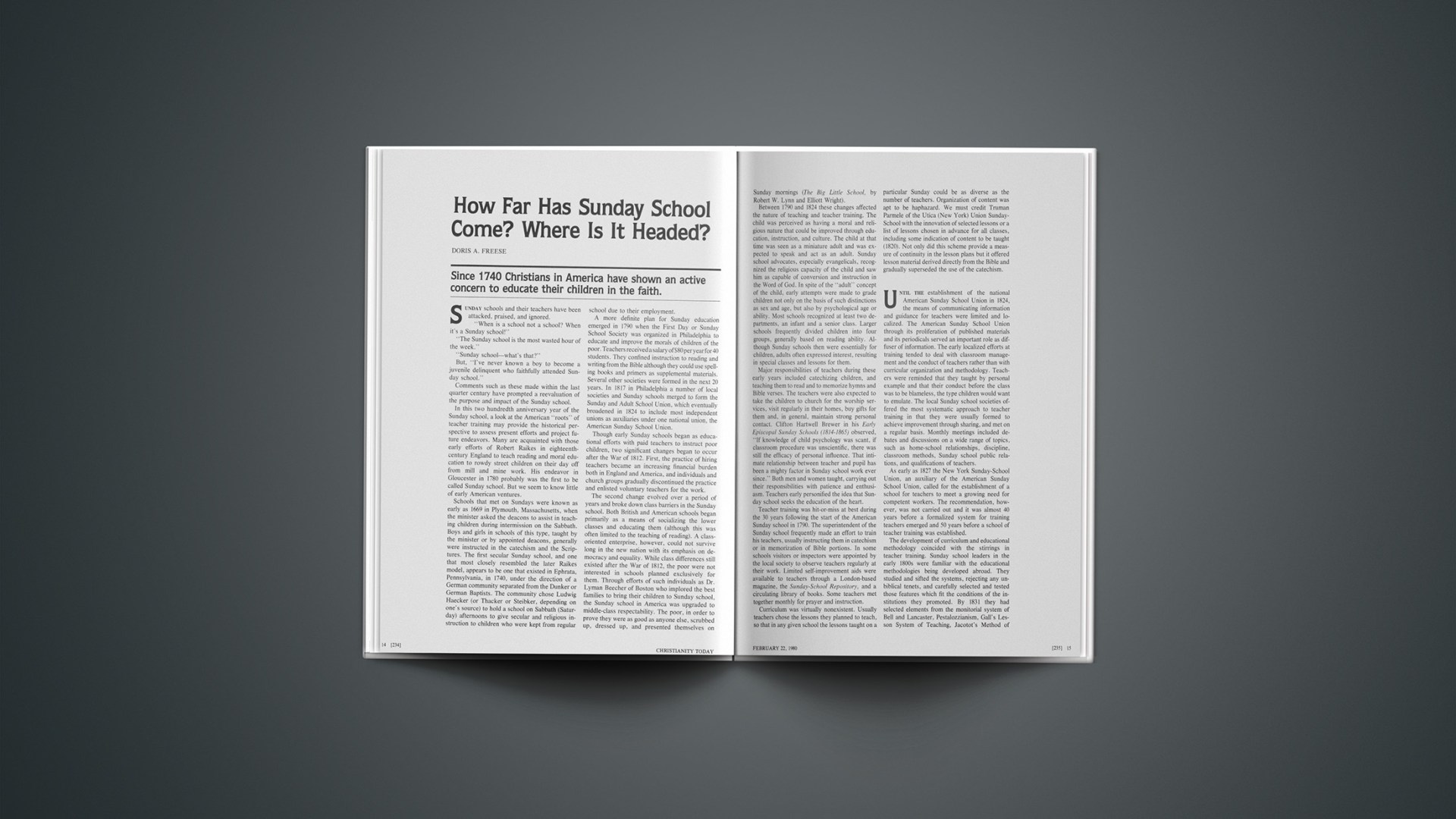
How Far Has Sunday School Come? Where Is It Headed?

Since 1740 Christians in America have shown an active concern to educate their children in the faith.

Sunday schools and their teachers have been attacked, praised, and ignored.

“When is a school not a school? When it’s a Sunday school!”

“The Sunday school is the most wasted hour of the week.”

“Sunday school—what’s that?”

But, “I’ve never known a boy to become a juvenile delinquent who faithfully attended Sunday school.”

Comments such as these made within the last quarter century have prompted a reevaluation of the purpose and impact of the Sunday school.

In this two hundredth anniversary year of the Sunday school, a look at the American “roots” of teacher training may provide the historical perspective to assess present efforts and project future endeavors. Many are acquainted with those early efforts of Robert Raikes in eighteenth-century England to teach reading and moral education to rowdy street children on their day off from mill and mine work. His endeavor in Gloucester in 1780 probably was the first to be called Sunday school. But we seem to know little of early American ventures.

Schools that met on Sundays were known as early as 1669 in Plymouth, Massachusetts, when the minister asked the deacons to assist in teaching children during intermission on the Sabbath. Boys and girls in schools of this type, taught by the minister or by appointed deacons, generally were instructed in the catechism and the Scriptures. The first secular Sunday school, and one that most closely resembled the later Raikes model, appears to be one that existed in Ephrata, Pennsylvania, in 1740, under the direction of a German community separated from the Dunker or German Baptists. The community chose Ludwig Haecker (or Thacker or Steibker, depending on one’s source) to hold a school on Sabbath (Saturday) afternoons to give secular and religious instruction to children who were kept from regular school due to their employment.

A more definite plan for Sunday education emerged in 1790 when the First Day or Sunday School Society was organized in Philadelphia to educate and improve the morals of children of the poor. Teachers received a salary of $80 per year for 40 students. They confined instruction to reading and writing from the Bible although they could use spelling books and primers as supplemental materials. Several other societies were formed in the next 20 years. In 1817 in Philadelphia a number of local societies and Sunday schools merged to form the Sunday and Adult School Union, which eventually broadened in 1824 to include most independent unions as auxiliaries under one national union, the American Sunday School Union.

Though early Sunday schools began as educational efforts with paid teachers to instruct poor children, two significant changes began to occur after the War of 1812. First, the practice of hiring teachers became an increasing financial burden both in England and America, and individuals and church groups gradually discontinued the practice and enlisted voluntary teachers for the work.

The second change evolved over a period of years and broke down class barriers in the Sunday school. Both British and American schools began primarily as a means of socializing the lower classes and educating them (although this was often limited to the teaching of reading). A class-oriented enterprise, however, could not survive long in the new nation with its emphasis on democracy and equality. While class differences still existed after the War of 1812, the poor were not interested in schools planned exclusively for them. Through efforts of such individuals as Dr. Lyman Beecher of Boston who implored the best families to bring their children to Sunday school, the Sunday school in America was upgraded to middle-class respectability. The poor, in order to prove they were as good as anyone else, scrubbed up, dressed up, and presented themselves on Sunday mornings (The Big Little School, by Robert W. Lynn and Elliott Wright).

Between 1790 and 1824 these changes affected the nature of teaching and teacher training. The child was perceived as having a moral and religious nature that could be improved through education, instruction, and culture. The child at that time was seen as a miniature adult and was expected to speak and act as an adult. Sunday school advocates, especially evangelicals, recognized the religious capacity of the child and saw him as capable of conversion and instruction in the Word of God. In spite of the “adult” concept of the child, early attempts were made to grade children not only on the basis of such distinctions as sex and age, but also by psychological age or ability. Most schools recognized at least two departments, an infant and a senior class. Larger schools frequently divided children into four groups, generally based on reading ability. Although Sunday schools then were essentially for children, adults often expressed interest, resulting in special classes and lessons for them.

Major responsibilities of teachers during these early years included catechizing children, and teaching them to read and to memorize hymns and Bible verses. The teachers were also expected to take the children to church for the worship services, visit regularly in their homes, buy gifts for them and, in general, maintain strong personal contact. Clifton Hartwell Brewer in his Early Episcopal Sunday Schools (1814–1865) observed, “If knowledge of child psychology was scant, if classroom procedure was unscientific, there was still the efficacy of personal influence. That intimate relationship between teacher and pupil has been a mighty factor in Sunday school work ever since.” Both men and women taught, carrying out their responsibilities with patience and enthusiasm. Teachers early personified the idea that Sunday school seeks the education of the heart.

Teacher training was hit-or-miss at best during the 30 years following the start of the American Sunday school in 1790. The superintendent of the Sunday school frequently made an effort to train his teachers, usually instructing them in catechism or in memorization of Bible portions. In some schools visitors or inspectors were appointed by the local society to observe teachers regularly at their work. Limited self-improvement aids were available to teachers through a London-based magazine, the Sunday-School Repository, and a circulating library of books. Some teachers met together monthly for prayer and instruction.

Curriculum was virtually nonexistent. Usually teachers chose the lessons they planned to teach, so that in any given school the lessons taught on a particular Sunday could be as diverse as the number of teachers. Organization of content was apt to be haphazard. We must credit Truman Parmele of the Utica (New York) Union Sunday-School with the innovation of selected lessons or a list of lessons chosen in advance for all classes, including some indication of content to be taught (1820). Not only did this scheme provide a measure of continuity in the lesson plans but it offered lesson material derived directly from the Bible and gradually superseded the use of the catechism.

Until the establishment of the national American Sunday School Union in 1824, the means of communicating information and guidance for teachers were limited and localized. The American Sunday School Union through its proliferation of published materials and its periodicals served an important role as diffuser of information. The early localized efforts at training tended to deal with classroom management and the conduct of teachers rather than with curricular organization and methodology. Teachers were reminded that they taught by personal example and that their conduct before the class was to be blameless, the type children would want to emulate. The local Sunday school societies offered the most systematic approach to teacher training in that they were usually formed to achieve improvement through sharing, and met on a regular basis. Monthly meetings included debates and discussions on a wide range of topics, such as home-school relationships, discipline, classroom methods, Sunday school public relations, and qualifications of teachers.

As early as 1827 the New York Sunday-School Union, an auxiliary of the American Sunday School Union, called for the establishment of a school for teachers to meet a growing need for competent workers. The recommendation, however, was not carried out and it was almost 40 years before a formalized system for training teachers emerged and 50 years before a school of teacher training was established.

The development of curriculum and educational methodology coincided with the stirrings in teacher training. Sunday school leaders in the early 1800s were familiar with the educational methodologies being developed abroad. They studied and sifted the systems, rejecting any unbiblical tenets, and carefully selected and tested those features which fit the conditions of the institutions they promoted. By 1831 they had selected elements from the monitorial system of Bell and Lancaster, Pestalozzianism, Gall’s Lesson System of Teaching, Jacotot’s Method of Universal Education, Owen’s infant schools, and early aspects of Froebel’s Theory of Spontaneity. At the same time, Sunday school curriculum began to evolve. The American Sunday School Union published the Uniform Limited Lessons, which allowed for some uniformity of teaching within schools. They were supplemented by two systems of helps developed by the Rev. Albert Judson and Henry Fish to guide teachers in using the lessons.

Between 1824 and 1832, the first state conventions for Sunday school teachers were held to share ideas for mutual improvement. Interest at the state level generated a desire for a national convention. The first one met in New York City in 1832, attended by 220 delegates from 14 states and territories, to discuss questions on such topics as frequency and length of sessions of Sunday schools, visitation, organization, plans of instruction for schools, libraries, duties of superintendents and teachers, plans for training students to become teachers, discipline, and adult classes. A second national convention in 1833 pursued the same topics. The third convention did not meet until 1859; the fourth came in 1869 following the Civil War, after which the conventions met triennially. The national convention was eventually to serve two purposes: for inspiration and for instruction.

Inspiration took the form of oratory, slogans, music, parades, banners, and other forms of “boosterism.” Instruction resulted in the division of the delegates into sections or areas of interest for reports, addresses, question-answer sessions, demonstrations, and discussions.

In a major step, the 1872 convention adopted the International Uniform Sunday School Lesson System, a plan by which the same lesson was taught at every age level on a particular Sunday. These lessons reigned in evangelical Protestantism for 40 years to the extent that one could visit a Sunday school in any part of the world on a given Sunday and study the same Bible lesson and Golden Text. By 1890 at least 10 million Sunday school teachers and pupils were using the lessons; in 1905 there were 17 million.

In 1857 the first “normal” (teacher training) class was organized in Joliet, Illinois, by the Rev. John Heyl Vincent, a pastor of the Methodist Episcopal Church. He later spearheaded adoption of the International Uniform Lessons in 1872 and founded the Chautauqua Institute (New York) in 1874 to train Sunday school teachers. Vincent’s first normal classes, patterned after the normal schools training of public school teachers, were organized to train his own Sunday school teachers in biblical history, geography, literature, teaching, church history, and Sunday school work.

Local, county, and state conventions generated enthusiasm for the Sunday school and served as a grass roots experiment in organization and methodology, where educational ideas were demonstrated. Also, the concept of the Sunday school institute for teacher training emerged at local, county, and state levels, but the idea required a more extensive diffusion before Sunday school leaders and workers accepted it. The national conventions, beginning with the 1869 convention, served this purpose. They became the democratic expression of the lay worker as well as the means of diffusing methodology, curricular ideas, and teacher training forms.

The 1872 convention marked a major step in the development of curriculum with inauguration of the International Uniform Lesson System. A wave of teacher training plans and efforts followed, along with lesson helps to guide teachers.

Inadequacies in the International Uniform Lessons surfaced when teachers of young children found the lessons difficult to adapt to children’s needs and abilities. Within the Sunday school ranks primary teachers’ unions began to spring up and primary teachers devised their own lessons to teach young children. In 1895 the Lesson Committee of the International Sunday School Convention permitted a supplemental primary course, followed by a beginner’s course in 1902, and a graded series in 1908.

By the early twentieth century, or roughly 100 years from the inception of the Sunday school, several key stages in the preparation of teachers had evolved. (1) Teacher training developed into a variety of definite major forms: weekly teachers’ meetings, normal classes, preparatory normal classes, seminary classes, teacher institutes, and convention workshops. (2) The conventions and institutes served as central clearing houses for training and curriculum. Ideas presented and demonstrated at these gatherings were disseminated to the larger Sunday school teaching force through books, manuals, journals, and periodicals. Also at these conventions teaching supplies and equipment were exhibited and sold. (3) Curriculum and lesson helps provided tangible assistance for teachers. Graded lessons were developed to offset the inadequacies of the International Uniform Lessons. (4) Other materials in the form of teacher training books were produced in at least three classifications: Sunday school organization and general practical helps for teachers, practical helps for teachers of young children, and brief manuals for teachers of normal classes.

Every Sunday school generation thinks its era is the most difficult, particularly when it comes to the ongoing task of training teachers. The early Sunday school leaders groped for a curricular principle as they examined popular educational methodologies. They struggled with the best way or variety of ways to train teachers. At the same time, the public schools were forging their methodologies and child psychology was in its embryonic states. The public school’s advantage lay, however, in trained personnel—or so Sunday school leaders thought. Therefore, Sunday school leaders showed a strong desire to emulate the public school’s concept of training teachers and to build into the Sunday school staff a similar quality of teaching.

As satisfied or dissatisfied as one may be with today’s public education, a modem counterpart exists. Christian educators and curriculum writers currently are wrestling with the educational theories and methodologies of Benjamin Bloom, Jerome Bruner, Jean Piaget, and Lawrence Kohlberg. They are also examining and testing open classrooms, flexible space, educational objectives, and pupil-teacher relationships. The preparation of Sunday school teachers occurs at several levels: regularly scheduled or sporadic meetings in the local church, yearly conventions or seminars (though we no longer have a national Sunday school convention), and self-helps in the form of books, cassettes, filmstrips, and aids within the published materials.

Are we doing enough to prepare teachers? Probably not. Was enough done in those early years? Even at the height of the International Uniform Lesson era, when materials and training formats were abundant, Arlo Ayers Brown reflected in his History of Religious Education in Recent Times, “… we were compelled to note that this era of enthusiasm and great beginnings failed to measure up to expectations.” At heart we are dealing with a voluntary, lay, fluid, teaching force, which makes training a never-ending task. The early Sunday school leaders attempted to tackle the problem in varied and creative ways as they prepared teachers to teach the Word of God to children, youth, and adults. They shared the Apostle Paul’s urgency when he reminded Timothy of his responsibility, “And the things which you have heard from me in the presence of many witnesses, these entrust to faithful men, who will be able to teach others also” (2 Tim. 2:2, NASB). Can we do less?

“Spiritual Foster Care” For Youth: A Proposal

Our Youth for Christ program has worked with more than 500 delinquent youths in Flint, Michigan. They are referred to us by the court and we try to provide foster homes for them. Before they get into serious trouble, their parents often turn to the church in their search for help. The question is why their contact with Christians has not helped to keep them from involvement in crime. To answer that, let me sketch a general scenario of what often happens.

When new people come to church we’re glad to see them. We greet them and try to show we are warm and friendly. But in many cases no interest is ever developed on a personal level; we keep them at arm’s length. Likewise, the street kid—looking for some love and concern from an adult—arrives in Sunday school and the teacher is pleased to see him. Our experience has taught that many of these youths learn the gospel and make a profession of faith in Christ.

However, serious conflicts soon arise between newly found Christian values and standards at home. How do you honor your mother when she is a prostitute and abuses you? How do you “turn the other cheek” when doing so would bring bad trouble on the street? Why not steal when you’re hungry?

To resolve these conflicts, the youth puts more pressure on his Sunday school teacher, or youth counselor. He wants and needs time and attention. Too often, about this time the Sunday school teacher’s interest begins to wane; there are other kids in class with whom he enjoys working, and they don’t have serious social problems; and there is his own family as well. Result? A disillusioned, drifting youth who thought he had at last found an adult friend who really cared. Soon he’s back on the street, falling into habitual, serious crime.

What can be done about this? A local church “spiritual foster care” plan could help. It works like this: Church families volunteer to be spiritual foster parents, and when a child or youth such as I have described comes into Sunday school, he or she is assigned to one of the volunteer families. These families commit themselves to pray for this youth every day, see him on a regular basis other than at church, meet with his parents and family occasionally, help him get involved in youth programs at church, and nurture him by including him in regular family activities, mealtimes, recreational outings, trips, and so on.

In addition to helping the youth, these spiritual foster parents and their children would discover the joy and satisfaction of reaching out to someone on a very personal level. Their church would make a difference in the lives of hurting people, and young people’s lives would be changed—to say nothing of reducing crime and delinquency in the community.

LYNN A. EASTMAN

Executive Director

Victorious Christian Youth

Flint Mich.

Carl F. H. Henry, first editor of Christianity Today, is lecturer at large for World Vision International. An author of many books, he lives in Arlington, Virginia.


Ideas

Sending Jesus Home: A Bicentennial Evaluation

We have to be brave enough to face up to what we really are accomplishing in Sunday school.

When an institution reaches its two hundredth birthday, it’s appropriate to celebrate and evaluate. The bicentennial of the Sunday school offers such an opportunity. Although today’s Sunday school bears little resemblance to the original model designed by Robert Raikes in England in 1780, we can look back with appreciation for what he and his successors have accomplished. Raikes took vagrant kids off the streets and gave them some much-needed elementary schooling on Sundays. He aimed to do something about a festering social sore, and he succeeded, even though he was opposed by entrenched interests. He was not trying to do something for the churches, but for the community as a whole. He was far ahead of the religious, educational, and business establishments. We celebrate him as the founder of what later became church-related Sunday schools because enough forward-thinking people in England and America saw that what Raikes had begun could work very well for teaching religious subjects. Therefore, our heritage is worth acknowledging. Out of Robert Raikes’s social concern came an institution that now reaches millions of people.

Raikes would be hard-pressed, however, to recognize the changes that have come about. In rural and inner-city environments a few courageous Christians try to reach out to the poor, as Raikes did; but when it comes to educating the socially disadvantaged, churches are not leading the way. Notable exceptions have arisen, but by and large, Sunday school today serves only children who can read and write, and who have picked up certain minimal social graces so they do not present disciplinary problems. Unlike the “schools” Raikes started, today’s Sunday school is thoroughly sanitized and civilized. The illiterate and the unkempt generally do not find their way into First Church’s classrooms.

That is not all the fault of First Church. Serious educational and social problems prevent the traditional Sunday school from offering religious education to culturally deprived children. Many of these children attend public schools, where, for various reasons, they do not learn to read or to accept discipline as a part of life. At home, they receive little encouragement to attend Sunday school.

Apart from social changes, Raikes would no doubt be startled by the significant numbers of adults attending Sunday school today. Sunday school is no longer a children’s institution. In many churches, adults (college-age and older) outnumber children. What might startle him even more would be the thousands of volunteers who make it work. Probably there is no other institution involving so many people on a regular basis that is totally dependent on volunteers.

But what about the next 200 years? Where should Sunday school go from here? No one claims success in every class every week. Countless hundreds of persons, young and old alike, are bored stiff by irrelevant lessons taught by well-meaning but often unprepared teachers. Samuel and David and Jesus and Paul go by year after year like a dull blur. Little moralistic homilies go in one ear and out the other.

Raikes probably would ask what we’re doing for our pupils after class lets out. Are we getting into homes? Are we calling on people? Are we finding out which kids have serious social and moral problems that prevent even the best Sunday school class from making a dent in their lives? Are we acknowledging the intense pressures of the everyday world that so often override the input of 30 or 40 minutes of Bible lecture and discussion? How can that brief period of time be used to bridge the gap between the seemingly unreal world of Bible times and the real world of increasing energy costs, premarital sex, and divorce, for instance?

Somehow, after we’ve had more and better teacher training workshops, attractive and relevant teaching materials and methods, shiny overhead transparencies and clever handcrafts, we have to be brave enough to face up to what we really are accomplishing in Sunday school. It’s not enough to say we’ve “covered the lesson.” It’s not enough to say we’ve got a fully integrated Bible knowledge curriculum. It’s not enough to say our church buses bring in more kids than all the other church buses in town. Are we seeing conversions to faith in Christ? Are we seeing Christian growth in terms of identifiable behavior changes for the better? Are we seeing commitment to responsible church membership? Are we penetrating those millions of homes where the Sunday newspaper, not the Sunday school curriculum, is the standard text? Are our high school young people participating in the life and ministry of the church after mom and dad quit forcing them to go to Sunday school?

The course of Sunday school has radically changed in the last two centuries. We celebrate and honor what Robert Raikes began. We call for renewed commitment, discipline, and intelligent innovation to make this valued institution an increasingly significant tool for spiritual growth and social betterment in the years to come.

A recent resolution presented to the governing board of the National Council of Churches used vitriolic language in accusing Israel of systematic torture, discrimination against minorities, and South African-style apartheid policies. True, a vote on the resolution was avoided by referral to a special panel, but the fact remains that certain church leaders apparently felt the climate was right for such a resolution to be presented. (The National Council of Churches scheduled hearings this month in New York City and Washington on the Arab-Israeli conflict.)

A striking example of the “let’s get Israel” syndrome can be found in recent speeches by former U.S. Attorney General Ramsey Clark. He returned from a fact—finding trip to the Middle East-financed by the Women’s Division of the United Methodist Church’s mission agency—deeply troubled by what he called “the implications of a theocratic state.” which he described as “a combination of political and religious power by a single hand.” Was he talking about the Ayatollah Khomeini’s Iran? Or did he have in mind the Arab countries whose constitutions declare Islam to be the official religion of the state? No, his fears were reserved for Israel, the one country in the Middle East that, for all its faults, can be described as a democratic society.

A conference held last May offers another example of the “let’s get Israel” syndrome. Only persons who were known to be highly critical of Israel were invited to speak. Some of them used the occasion to repeat charges of systematic torture in Israel, giving the impression that these allegations had been confirmed by the U.S. State Department, while in truth they had been discredited by various sources, including the State Department. These false allegations went unchallenged and subsequently found their way into several denominational magazines.

Extremely perplexing is the film called Middle East Mosaic, produced in conjunction with the 1979–80 study materials of the National Council. It did not contain a single reference to Israel or the Jewish people. One gets the impression from this that modern Israel basically is an intruder in the Middle East.

Consider also the historical amnesia that leads to simplistic answers to complex issues. For instance, last year the big squabble was over the validity of the U.S. “no talk” policy regarding the Palestine Liberation Organization. Some would have us think this was a Jewish invention. It’s conveniently forgotten that for three decades Israel repeatedly sought face-to-face negotiations with the Arab League nations that had waged war against it. Such appeals were met with a trinity of negatives: “no recognition, no reconciliation, no negotiation.” Thorny West Bank issues are likewise reduced to Israeli acquisition of land “by force,” without reference to Jordan’s annexation of that territory after the 1948 war, an act considered illegal by virtually all nations, including the Arab countries.

In this kind of slanted, distorted opinion-making, delegates to church assemblies often are asked to vote on resolutions dealing with very complex Middle East political issues. It is not uncommon for resolutions to be pushed through with a minimum of debate, because in an incredibly simplistic fashion the whole matter is portrayed as a clear imperative of Christian love, justice, and human liberation.

In fact, in some quarters it seems that the PLO has become the great new cause for the writing of “prophetic” resolutions. Unless recent developments in Iran and Afghanistan lead to some critical second thoughts, we can expect a whole series of pro—PLO church pronouncements on Middle East issues, spiced up with a few pious phrases about the living God of history, who is always on the side of revolutionary movements, and with a vague reference to Israel’s security thrown in for good measure.

Delegates to church assemblies need to do some careful homework, because too often some well-meaning Christians, sincerely desiring to see more justice done in the world, have uncritically supported revolutionary movements that in the end have led to worse oppression than before. Peace in the Middle East surely is a legitimate concern of Christians. So is the plight of the Palestinian people, many of them still living in refugee camps. They have too often been exploited in the game of international politics. However, those who in classic scapegoat fashion hold Israel solely to blame, are playing one more cruel game with the misery of the homeless Palestinians.

In fact, some resolutions are presented to church bodies in order to score propaganda points. Delegates should not be deceived. Such resolutions do not contribute to world peace, nor to a climate of useful negotiations. Rather these resolutions and accompanying pronouncements usually are phrased in questionable ideology under the cover of even more questionable theology.

American churches, with their lines of communication to the Arab nations as well as to the Jewish community, could have played a reconciling role in the Middle East conflict. To our shame we must confess this has not been done. Therefore, in the future it would be more appropriate to issue fewer pompous statements purporting to solve the problems, and instead sit down together as Christians, before God and the world, to search our hearts and ask why we have failed. Such an item on the agenda of church assemblies would do more to enhance the credibility of the churches than all of the pronouncements offered as “prophetic statements,” but which in reality often are nothing more than the result of committee politics.

ISAAC C. ROTTENBERG

Isaac Rottenberg is presently educational consultant for the National Christian Leadership Conference for Israel; he is also a lecturer and writer.

Eutychus and His Kin: February 22, 1980

Our Sunday Storm Amid Calms

For two centuries the Sunday school has been on the scene. Christian educators have instructed us how to use that hour profitably. We have curricula and visual aids that are wonderful. Planning for Sunday school is as easy as pie. (Nobody actually knows how easy pie is, which is why I used the cliché. I get enough complaint letters now.)

In recent years, the liturgists and renewal experts have shown us how to use the worship hour to best advantage as well. We have learned to balance praise with prayer, standing with sitting, introits with extroits (not to mention Detroits). Planning the morning worship hour is as easy as cake. (Caught you, didn’t I?)

Now, I think it is time for some genius to tell us how to handle the time period between these two main events. I am talking about that ghastly time when the children, newly released from their curriculum confinement, burst into the church sanctuary, waving lesson sheets and chewing on candy. That time when the soloist gathers herself around the piano to prepare the “special music” for the morning service. That time when strange sounds are heard creeping out of the choir room where the brave volunteers are making a noble effort to conquer the John Peterson anthem they have been working on for three months.

Yes, this is that indescribable time (although perhaps Poe and Kafka could describe it) when the ushers run to and fro upon the earth, searching for the offering plates. That time when nobody can find the key that opens the door to the sound equipment. That time when the Sunday school superintendent blanches as he reads the morning attendance report, and then, pocket calculator in hand, figures out devious ways to make it look good.

We need some spiritual genius to tell us how to use this storm between two calms. It is the time when the pastor most feels like resigning and taking an easier job, like herding bison from a pogo stick. Of course, we could sit calmly and meditatively, and benefit from the organ prelude. We might even look at the bulletin and read the Scripture selections for the morning. Or, we could pray for the pastor and the congregation. But these are only suggestions; I’d be happy to hear your ideas. Meanwhile, I’ll just keep carrying my earplugs to church.

EUTYCHUS X

Much Roar and Smoke

Certain denigrations of my book’s factual accuracy, and not incidentally my own integrity as well, are being widely distributed, suggestions such as that I took absolutely no notes through the course of all those interviews (“The Graham Image: A Parable of America’s Blindness?” Nov. 16, 1979).…

In fact, those interviews resulted in several dozen notebooks of raw notes. The typed transcription of those notes runs to some 240 pages. Further, a well-nigh microscopic review of the book’s factual integrity involved over 60 pages of citations of sources on uncertain points.

It seems marvelously transparent—that old defensive device of booming away with much roar and smoke at the trivial and peripheral, in the hope that it might possibly work somehow to discredit the truly central and meaningful. Indeed, what is most significant are those far more pertinent factual elements and details of the story which you have chosen not to address.…

You said the book “betrays an essential misunderstanding of evangelicalism and the gospel.” Come, now. Neither the gospel nor evangelicalism has been appropriated quite yet as the exclusive franchise of any particular community of the faith—not even yours—to define and to arbitrate and to preside over—certainly not to the extent that anyone can presume to decree, as you did of my book, that it “simply never enters empathetically into the life and thought of mainstream evangelicalism,” or “biblical Christianity’s consuming desire that everyone know Jesus Christ.” It most strenuously does.

MARSHALL FRADY

Atlanta, Ga.

Encouraging

Your entire issue of January 4 merits the attention of every pastor. The recapitulation of historical events of the 1970s could hardly be surpassed.

Carl Henry always stimulates our thought. His article “Evangelicals: Out of the Closet but Going Nowhere?” provided me with nuggets which will be incorporated into many of my forthcoming messages. I particularly appreciated his recognition of the role of the university students on the evangelical horizon. Thank you for moving us on to cultural identity in today’s world.

REV. DAVID S. GOTAAS

Winnetka Bible Church

Winnetka, Ill.

I found Carl F.H. Henry’s article to be very informative and in many ways encouraging. I think his well-balanced suggestions for us as Christians to concern ourselves with social needs and problems as well as spreading the gospel are a definite advance in the right direction.

The Bible speaks to us many times about ministering to the whole person. This article has shown very clearly the need for such ministering as we move into the next decade. All too often, the church has lost credibility because of its “other-worldliness” and lack of concern for people in this world.

KRIS ERICKSON

St. John’s College

Winfield, Kans.

As a recent graduate of Fuller Theological Seminary, I was surprised to discover in Carl Henry’s article that my alma mater is not only part of the “destructive trends” of the 1980s, but guilty of “theological dilution.”

The Fuller of my experience has been and continues to be a place where the body of Christ joins together to learn in an atmosphere that is both open and submitted to Scripture. People there are more interested in learning to live in obedience to God and properly understanding his Word than defining other people out of the kingdom.

Perhaps those who are so concerned about inerrancy ought to become equally concerned about taking the apostle Paul seriously when he speaks of those who would divide the church (1 Cor. 3:16–17).

JEFF BAKER

Santa Barbara, Calif.

Professional Task

I was very happy to see Ed Dayton’s article “The Road from Urbana” in the January 4 issue. Ed has been doing a lot of thinking about candidate preparation for overseas work.

Many student volunteers are not aware that being a missionary church planter or educator is really a professional task that requires a corresponding preparation. They think that missionary work is simply full-time witnessing, which in turn implies that intensity of faith and willingness to share are the two prerequisites. These are essential, but anyone who would participate with Christ in laying the foundations for his church across cultures needs the kind of in-depth development about which Mr. Dayton speaks in his article.

The process for getting from Urbana to the mission field may sound dishearteningly long, but the road itself can be filled with productive and satisfying service for Christ.

MICHAEL POCOCK

Candidate Secretary

The Evangelical Alliance Mission

Wheaton, Ill.

‘Slow Train’ Reviews

The reviews by Noel Paul Stookey and David Singer of Bob Dylan’s Slow Train Coming album (Jan. 4) were on target. The album clearly establishes Dylan’s Christian identity. For a new Christian, he reflects a remarkable maturity that is refreshing considering so many surface lyricists in Christian music today.

It is more than coincidence that the Dylan reviews occur in the same issue with the articles on “giving substance to the surge.” Bob Dylan brings to the Christian community an identity that not only represents a revolutionary subculture of the 1960s and 1970s, but also a powerful influence that will give outreach in the 1980s to this subculture.

DAVID C. BAIRD

Ebony, Va.

The gap from the 1960s to the 1980s has been bridged by a peculiar communion between Bob Dylan’s Slow Train Coming and many of Dylan’s “followers” turned Christian. I hope this record gives others like myself a chance to thank God for the change in their lives and the freedom from that subculture of which Dylan was a leader.

JOHN VINCENT

Trinity Evangelical Divinity School

Deerfield, Ill.

Editor’s Note from February 22, 1980

In 1980 we celebrate 200 years of Sunday school. From Robert Raikes’s early efforts to teach underprivileged children the rudiments of reading and moral education, Sunday schools have grown to become a worldwide movement and the major instructional arm of the Christian church. Doris Freese sketches the history of Sunday schools, and in particular their less well-known development in America during the nineteenth century. Jo Berry addresses what most would agree is by all odds the greatest problem in operating an effective Sunday school: how to get and keep a capable staff. Our CHRISTIANITY TODAY-Gallup Poll continues with a study of the Pentecostals and charismatics.

Other features of this issue include a short piece describing an innovative “spiritual foster care” program for meeting the problems of delinquents through the church; an account of the remarkable ministry of Bakht Singh in India; a helpful word about tax benefits for pastors at a time when this is an existential issue; and a brief news item from Britain of dire developments for evangelicalism.

In spite of all we hear about the resurgence of evangelicalism, fewer and fewer Britons acknowledge the divinity of Christ. North American evangelicals, too, must note the drift of American churches away from solid commitment to orthodox doctrine and evangelical practice. The CHRISTIANITY TODAY-Gallup Poll has pinpointed the inability of American Christians in evangelical churches to distinguish an orthodox and biblical view of Jesus Christ from that of a Jehovah’s Witness or a Mormon or a traditional liberal. The task of the church grows larger.

History
Today in Christian History

February 22

January
February
March
April
May
June
July
August
September
October
November
December
<>

February 22, 1906: Black itinerant evangelist William J. Seymour arrives in Los Angeles to lead a Holiness mission. The group grew larger as word spread of its revival meetings and speaking in tongues, and it eventually moved to a rundown building on Azusa Street. The church's revival is often cited as one of the birthplaces of Pentecostalism (see issue 58: Pentecostalism).

History
Today in Christian History

February 21

January
February
March
April
May
June
July
August
September
October
November
December
<>

February 21, 1142: Medieval French philosopher, teacher, and theologian Peter Abelard dies. Perhaps best known for his (chaste) love affair with nun Heloise, Abelard made his most important contribution in establishing a critical methodology for theology. Irritated with some of the unreasoning pietism of other monks, he wrote Yes and No, compiling the (sometimes conflicting) sayings of the Bible and church fathers on various controversial subjects (see issue 30: Women in the Medieval Church).

February 21, 1173: Pope Alexander III canonizes Thomas a Becket three years after the Archbishop of Canterbury's martyrdom at the hands of King Henry II's knights.

February 21, 1431: Pierre Cauchon, bishop of Beauvais, begins his interrogation of young Joan of Arc. She was eventually condemned as a heretic and burned at the stake (see issue 30: Women in the Medieval Church).

February 21, 1801: John Henry Newman, Anglican leader of the Oxford Movement, is born in London. The movement sought to reform the Church of England in a "high church" direction, but Newman left the church in 1845 to become a Catholic—a choice he explained in his Apologia pro Vita Sua (1864).

February 21, 1945: Eric Liddell, the Scottish Olympian whose story is told in the film Chariots of Fire, dies of a brain tumor. In 1925, he had joined the staff of the Anglo-Chinese Christian College in Tientsin, China (his birthplace). He was captured by the Japanese in 1942 and died just before his scheduled release.

February 21, 2018: Billy Graham, the most well-known and effective evangelist of the twentieth century, dies at 99. “America’s pastor” preached to millions and saw throngs come to Christ during his evangelistic “crusades” through the United States and across the globe. Graham also advised numerous American presidents and was the driving force behind establishing Evangelicalism as a movement within American Protestant Christianity and beyond.

History
Today in Christian History

February 20

January
February
March
April
May
June
July
August
September
October
November
December
<>

February 20, 1469: Thomasso de Vio Cajetan, the most learned of the Roman Catholic dignitaries sent to silence Martin Luther in the early years of the Protestant Reformation, is born. He was also one of the cardinals who convinced Pope Clement VII to reject Henry VIII’s request to divorce Catherine of Aragon (see issue 34: Luther’s Early Years).

February 20, 1895: Abolitionist Frederick Douglass, the first African-American to hold high political office, dies. After escaping to freedom in 1838, he became the most prominent black abolitionist. Critical of the “Christianity of this land,” which accepted (or at least tolerated) slavery, he considered himself a devotee of “the pure, peaceable, and impartial Christianity of Christ” (see issue 62: Bound for Canaan).

History
Today in Christian History

February 19

January
February
March
April
May
June
July
August
September
October
November
December
<>

February 19, 843: Empress Theodora reinstates icons once and for all in the Eastern churches, effectively ending the medieval iconoclastic controversy. A council in 787 had allowed the veneration of icons, but opponents of images still controlled most of the government and much of the church leadership. The controversy continued, however, and was one of the reasons for the Great Schism between Catholics and the Orthodox in 1054 (see issue 54: Eastern Orthodoxy).

February 19, 1377: John Wycliffe stands trial in London’s St. Paul’s Cathedral for his criticism of the church. He argued against the sale of indulgences, the worship of saints, the veneration of relics, the “emptiness” of some church traditions, and the indolence of clerics. In spite of five papal bulls ordering his arrest, he was never convicted as a heretic (see issue 3: John Wycliffe).

February 19, 1401: William Sawtrey, an English priest who followed the teachings of John Wycliffe, is burned for heresy, becoming the first “Lollard” (critic of the church) martyr in England (see issue 3: John Wycliffe).

February 19, 1473: Astronomer and cleric Nicolaus Copernicus, whose “heliocentric” concept of the solar system became the foundation of modern astronomy, is born in Poland. Both Martin Luther and the Roman Catholic hierarchy condemned the theory (his revolutionary book was banned until 1758), but Copernicus remained a faithful member of the Catholic Church. He was even a member of the clergy at Frauenburg Cathedral, where his uncle was bishop. “[It is our] loving duty to seek the truth in all things, in so far as God has granted that to human reason,” he wrote (see issue 76: Christian Face of the Scientific Revolution).

February 19, 1569: Miles Coverdale, translator and publisher of the first complete English Bible, dies. Parts of his Bible were revisions of Tyndale’s, but unlike his predecessor (with whom he once worked), he included no contentious prefaces or notes; instead, he penned an obsequious dedication to the king (see issue 43: How We Got Our Bible).

February 19, 1812: Congregational missionaries Adoniram and Ann Judson set sail from Massachusetts for Calcutta, India. From there, they went to Burma and became two of the most famous American missionaries of their day (see issue 36: William Carey).

History
Today in Christian History

February 18

January
February
March
April
May
June
July
August
September
October
November
December
<>

February 18, 1546: German reformer Martin Luther dies in Eisleben. In one of his pockets he had placed the beginning of a projected manuscript against Roman Catholics. In another pocket was a slip of paper reminding him, “We are beggars, that’s the truth” (see issue 39: Luther’s Later Years).

February 18, 1564: Michelangelo Buonarroti, the Italian Renaissance artist whose works include the frescoes in the Sistine Chapel, dies.

February 18, 1678: Puritan preacher John Bunyan publishes The Pilgrim’s Progress, the best-selling book (apart from the Bible) in history. The allegorical tale, which describes Bunyan’s own conversion process, begins, “I saw a man clothed with rags … a book in his hand and a great burden upon his back” (see issue 11: John Bunyan).

February 18, 1688: Quakers in Germantown, Pennsylvania, issue America’s first formal protest of slavery.

History
Today in Christian History

February 17

January
February
March
April
May
June
July
August
September
October
November
December
<>

February 17, 661: Finan, bishop of Lindisfarne (an island off the eastern coast of England) who throughout his life sought to preserve Celtic customs against Roman influence, dies. Three years later, at the Synod of Whitby, Celtic Christians agreed to abide by Roman traditions. “Peter is guardian of the gates of heaven, and I shall not contradict him,” said the Celtic King, Oswy (see issue 60: How the Irish Were Saved).

February 17, 1858: Waldensians, ancient “Protestants” from the Italian Alps who survived through persecution for 800 years, are finally guaranteed civil and religious rights. They began with the teaching of a wealthy merchant named Pater Waldo in the late 1100s; thus they are considered “the oldest evangelical Church” (see issue 22: The Waldensians).

February 17, 1889: Former White Stockings baseball player Billy Sunday preaches his first evangelistic sermon in Chicago. By the time he died in 1935, he had preached to an estimated 100 million people, and about 1 million “walked the sawdust trail” to become Christians at his invitation.

February 17, 1898: Francis Willard, crusader for prohibition and women’s suffrage, dies. She served as dean of Northwestern Women’s College before becoming president of the Women’s Christian Temperence Union.

Apple PodcastsDown ArrowDown ArrowDown Arrowarrow_left_altLeft ArrowLeft ArrowRight ArrowRight ArrowRight Arrowarrow_up_altUp ArrowUp ArrowAvailable at Amazoncaret-downCloseCloseEmailEmailExpandExpandExternalExternalFacebookfacebook-squareGiftGiftGooglegoogleGoogle KeephamburgerInstagraminstagram-squareLinkLinklinkedin-squareListenListenListenChristianity TodayCT Creative Studio Logologo_orgMegaphoneMenuMenupausePinterestPlayPlayPocketPodcastRSSRSSSaveSaveSaveSearchSearchsearchSpotifyStitcherTelegramTable of ContentsTable of Contentstwitter-squareWhatsAppXYouTubeYouTube