Evangelicals: Out of the Closet but Going Nowhere?

Evangelicals have failed to penetrate the public mood and conscience.

Are evangelical Christians facing an identity crisis at just the time America is experiencing a religious awakening?

On one hand we see the extended impact of the Graham crusades, burgeoning enrollments in evangelical colleges and seminaries, and the cumulative influence of magazines like CHRISTIANITY TODAY. In addition, we see the stimulus provided by the World Congress on Evangelism and the Lausanne Congress on World Evangelization.

But on the other hand, will evangelical indecision and disagreement nullify these spectacular advances?

We can expect prophecies of such a fallout from certain quarters. Humanists and secularists consign biblical faith to cultural obsolescence. Others see its decline as a corollary to a neo-Protestant renewal of ecumenical fortunes.

But prophecies of an approaching evangelical upheaval come also from within the so-called evangelical establishment. The editor emeritus of CHRISTIANITY TODAY, for example, tells us in The Battle for the Bible that a massive revolt against biblical inerrancy is sheltered by evangelical colleges and seminaries, and that many institutions firmly committed at midcentury to a consistent evangelical faith now have theologically divided faculties and accommodate destructive critical views.

The controversy over the Bible will not go away. It seems, rather, to be building toward a day of institutional upheaval. On one hand, the new International Council on Biblical Inerrancy is preparing a massive program of literature on the subject of scriptural inerrancy. On the other hand, stung by innuendos about false evangelicals, a cadre of mediating scholars from various conservative campuses is preparing a major Bible commentary series that combines extensive biblical criticism with broad evangelical positions.

A second internal controversy surrounds the nature of legitimate evangelical social involvement. Some young evangelicals, critical of secular capitalism or of mounting militarism, have been alienated by a swift branding of their views as communist or socialist. They are turning for support outside the evangelical arena to avowed ecumenical leftists whose theological deficiencies they reject but whose social protest they share. Evangelical leaders themselves are increasingly divided to the point of controversy over the issue of evangelical social concern and political involvement. In the absence of powerful intellectual analysis by institutional leaders and other spokesmen who hold the reins of evangelical power, a restless vanguard tends to divide and subdivide into conflicting camps prone to question each other’s biblical adequacy and even authenticity.

Advances Since the 1950s

This time of ferment is all the more foreboding because of the evangelical movement’s remarkable growth and impact since midcentury. Unbiased observers of the religious scene agree that since 1950 evangelical Christianity has come out of the American churches and tabernacles onto the streets and into the marketplace with phenomenal energy, and it has moved notably beyond radio into television.

Much of this momentum from the subculture to cultural centers came initially through the countercultural Jesus movement, which has now passed its peak, but which made a public issue of many prevalent values. Thousands of high school, college, and university students came to personal faith in Christ despite the fact that radical secularism held center stage on most campuses. While ecumenical student work dwindled, evangelical collegians emerged as probably the most vigorous vanguard in the American religious arena, and they have entered conservative seminaries by the thousands to prepare for pastoral, missionary, and educational careers. Today denominations within the National Council of Churches sponsor less than 8 percent of the U.S. missionary task force.

American evangelicals meanwhile are intensifying their world missionary concern by focusing on the more than 16,000 subcultures where no Christian church yet exists. The charismatic movement has ventured into evangelism by daily television programs centered upon personal experience, along with a sometimes not-so-soft-sell promotion of tongues, multiplied miracles, and even fresh revelation. In the big American cities the churches that thrive tend to be evangelical ministries that involve outreach enlisting a dedicated laity.

The advance of evangelical interests since 1950, however, is not due solely to the young. Evangelical religion also has won a kind of cultural respect even among many Americans whose basic commitments are secular. Evangelical vocabulary has gained public acceptance and intelligibility, even if the mass media secularize and corrupt the terms; the Washington Post, for example, reported, “Down in the hollows of Briar Mountain (Virginia) … the ‘likker’ business is being born again.”

In the face of idleness and theft among employees, many employers welcome evangelical workers, whom they can trust to give an honest day’s work and not to pilfer from their employers. In a day when problems of sex and drugs plague high school campuses, even some parents having no religious preferences are sending their children to Christian schools as a means of preserving family respectability.

The wave of interest in Asian cults (whether Zen, transcendental meditation, or others) has lent to evangelical Christianity a new aura of acceptability among parents who prefer that their teen-agers take up with the Jesus movement or with the charismatics rather than join the Moonies, because these evangelical movements promote love of family rather than alienation, and at least reflect the American religious heritage. Evangelical Christianity has gained wide public acceptance even in a secular society that hesitates to make a biblical religious commitment.

Advances More Apparent than Real

But all this is far from being an effective evangelical penetration of public mood and conscience. A close look at politics, business education, and mass media shows this.

Admittedly, we have an evangelical in the White House—an evangelical with moral sensitivity, whose simple faith in the Bible sometimes motivates bold personal initiatives. But that devotion is not without a theological ambiguity that reflects the doctrinal imprecision found in many professedly evangelical churches where the end results are problematical. Nor is the presidency devoid of concern for personal image and political ambition. For all that, Carter has brought more spiritual lucidity to the White House than many of his predecessors, though his retinue leaves much to be desired.

We must also concede that competent evangelicals are found in the world of business, but their influence registers far more aggressively in personal evangelism than in moral analysis that shapes ideals in the world of economics.

Further, while we have evangelical professors in prestigious colleges, the most influential classroom thrust on mainstream campuses today comes from radically secular humanists who disown supernatural beliefs.

We also have evangelical personalities and programs in the mass media, but the main media mood reinforces the tide of contemporary permissiveness, giving the impression that biblical values are archaic.

Lack of wide-scale penetration of our society by evangelicals suggests that we need to implement two priorities. First, the evangelical movement must place worldly culture on the defensive. It will remain on the margin of national life and public conscience until it does this. Evangelicals need publicly to argue the case that present cultural commitments lead to a life that is neither wise, good, nor happy; that the biblical alternative can offer people and nations a profound vision of truth, fresh resources of moral and spiritual power and a devotion to justice and decency, and that it can give an aimless and declining society new direction and hope.

Second, no less do we need a well-formulated statement of evangelical goals in contemporary society, and an elaboration of strategy and tactics for moving beyond principles to policies and programs that enlist the movement’s resources for specific objectives. This does not devalue the need for increased devotional life. Sustained prayer has gone out of many churches, and is all too meager in the frenetic home life of our century. Further, the great Bible conferences of a generation ago have all but vanished as evangelicals have channeled their energies into this or that cause. We must admit that no extension of evangelical influence will long survive the loss of devotional realities. But devotional vitality of itself will not compensate for the lack of orderly vision and cooperative engagement.

Destructive Trends

In the absence of such evangelical advance, the mounting signs of trouble within the evangelical movement are too disturbing to disregard.

1. Southern Baptists. This largest predominantly conservative denomination in the United States, with 13 million members, not only faces a decline in the number of baptisms, but is now also losing 1,000 pastors from the ministry annually. Further, biblical criticism and theological dilution in many seminaries and colleges have become a denominational issue. Forces either supporting or opposing biblical inerrancy vie for denominational leadership.

2. Authority. Evangelicals must cope with the possibility, according to Harold Lindsell, that not more than a handful of their interdenominational seminaries and colleges remain truly committed to full biblical authority. They must weigh the consequences of the theological dilution of their most prestigious divinity school, Fuller Theological Seminary, and of other evangelical enterprises.

3. Mass evangelism. The Graham crusades continue to garner the largest public display of evangelical cooperation. But they have yet to achieve their initially announced goal of permeating American churches with evangelistic vitality that restores the initiative of community evangelism to the local church. Moreover, the loss in follow-up of those making public decisions remains a matter of deep concern among sponsoring committees almost everywhere. Admittedly, this evangelistic thrust produced a greater evangelical impact during the past generation than any other single element. But it failed to penetrate the core of mainline World Council denominations. Methodists, for example, have lost more than one million members in the last 10 years; one member of the General Council of Ministries sees the prospect of losing another million in the next decade.

4. Mass Media. TV and radio have been used most prominently by charismatic Christians who present the claims of the Bible mainly in terms of inner experience; but they tend to neglect a systematic presentation of Christian truth. Many listeners are confused by the proffered prospect of constant miracle and by the erroneous impression that tongues-speaking validates an authentic Christian experience.

5. Secular education. Public high school, college, and university classrooms remain predominantly committed to radically secular views of man and the world. Many campuses are more open to evangelical Christians not because of their theology, but because in today’s proliferation of religious cults evangelicals seem less extreme. Their views are largely ignored in the current environment of naturalistic evolutionary assumptions about life and the world. The campus, along with television, tends to shape a natural climate of thought that places inherited Judeo-Christian values on the defensive. Parental influence that Protestant and Catholic Christians—and for that matter, orthodox Jews—exert on children in the home is swiftly challenged and eclipsed by community influences.

6. Politics. Evangelicals have no philosophy of social and political involvement; rather, they tend to be cynical about the role of law in society, and pay little attention to governing policies and specific programs that channel political power in support of social righteousness. We can trace this failure to four causes: a tendency to regard evangelism as the only morally significant force in national life; a stream of theology resigned to inevitable historical decline until Christ’s return; a disposition to view world political power as ultimately in the service of Satan rather than God; and a broken confidence in divine providence in the life of the nations.

7. Literature. The surge of evangelical materials that brought a wide new market to religious publishing houses and bookstores seems to be leveling off. To be sure, CHRISTIANITY TODAY is enjoying its highest circulation; its content now serves a broader range of lay readers while it seeks under editor Kenneth Kantzer to maintain the magazine’s distinctive role as a thought-journal. Other magazines, like Moody Monthly, Christian Herald, and Eternity, continue to be widely read. But readers face rising subscription rates due to increased printing and postal costs. They also have less to spend due to inflation and to budget cutbacks rising from a simplified lifestyle. Bonuses often artificially balloon the number of subscribers by temporarily attracting readers with no real sympathy with for magazine.

Tyndale House Publishers, with large overruns of the Living Bible, has been forced to cancel its projected Tyndale Encyclopedia of Christian Knowledge despite an extensive financial outlay. Other publishers have been caught with large overruns of volumes intended to exploit the “born again” motif. Publishing costs are driving up book prices; in inflationary times, scholars are beginning to show interest in books with permanent value. By contrast, for the most part lay theological interest tends to remain more at a popular than an instructional level.

Some book clubs thus simply reconcile themselves to a perpetual demand for accounts of spiritual rescue from a sordid life of drugs, crime, or sexual permissiveness.

Present Strengths that Justify Hope

Despite such lacks, one must not overlook the dramatic, even surprising penetration of evangelicals into areas of personal and public concern.

1. Humanitarian interest. A decade ago few dreamed that evangelicals would ever respond as compassionately to pleas concerning world hunger and poverty as to pleas for evangelism. But in 1978 Christians gave $58 million to World Vision International for famine relief, child care, and development; this equals the amount they gave to the Billy Graham Evangelistic Association for evangelistic purposes. Now the World Relief Corporation of the National Association of Evangelicals with 30,000 related churches is projecting a broadly similar humanitarian program under the aegis of World Evangelical Fellowship, Evangelical Foreign Missions Association, Interdenominational Foreign Mission Association, and the recently integrated Development Assistance Services. World Relief Corporation has already been sharing in the resettlement of refugees with a program that by the end of 1981 may involve one in five NAE churches. Yet for all their commendable funding of Graham Association enterprises and World Vision projects, America’s 40 to 50 million evangelicals averaged less than a dollar per person to each organization.

2. Political interest. A vanguard of young evangelicals has entered the legal profession. Specializing in political science, they are gaining valuable experience at various levels of state and national government, and are increasingly giving leadership. For many evangelicals the right-to-life movement provides a one-issue banner under which to learn the public use of political power for registering moral conviction. But as a whole, evangelical interest in politics involves little more than pulpit exhortation and support of single issues and personalities.

3. Scholarship. An emerging network of evangelical scholars is increasingly gaining recognition in the world of liberal learning that has lost consensus concerning God, truth, and values. Many publishers are issuing scholarly Bible commentaries and major theological works (some are retailing at less than four cents a page); the public media are beginning to recognize these works.

Leading evangelical seminaries continue to funnel competent graduates into mainline universities for doctoral studies. These scholars are particularly moving into linguistic and Near Eastern disciplines, pursuits that nonevangelical scholars seem to be forsaking. Trinity Evangelical Divinity School alone has 26 graduates from its Old Testament department working on doctorates in European and American universities. Some evangelical colleges report a lessening of the Jesus movement outlook that dominated campuses for much of a decade; more reflective engagement is taking hold as courses in philosophy and theology once again command interest. But evangelicals have shaped no great nationally recognized university, and collegiate interests are correlated more and more with evangelistic enterprises than with comprehensive liberal arts learning.

4. Local evangelism. The phenomenon of lay witness for Christ that emerged during World War II has escalated through church growth movements. It has produced many evangelistic programs geared to involve every church member. While the National Council of Churches tried to capture lay activity for social change, evangelicals preserved it for evangelistic outreach. Here lay interest has been particularly valuable since clergymen number less than one out of every 200 American Christians, and thus find little opportunity for personal evangelism. Though even the most active programs for lay witness enlist only a minority of evangelical church members, they have brought remarkable evangelistic vitality to local congregations. Many churches consider lay witnessing the next major framework for evangelical advance.

Focus for the ’80s

Beyond Present Gains to New Achievements

Such encouraging signs suggest the next steps the evangelical movement should take under the Holy Spirit’s guidance. By these steps it can move into broader usefulness in the only world it can serve.

1. Missions: Beyond present missionary gains to untouched major groups. We need to reorient world missionary objectives in terms of geography and ideology. As Ralph Winter emphasizes, national Christians everywhere need help in reaching across cultural lines to the hidden peoples. Just as Wycliffe Bible Translators try to make Scripture available in every known dialect, so the missionary task force must try to evangelize not simply where churches already exist, but especially in cultures yet unreached.

But the call to deal with resistant groups leads us to a concern over resistant forces often linked to such groups. The Christian mission must appraise powerful forces that reorient the national and international loyalties of great masses of people. We must vigorously challenge pagan misstatements of the Western biblical heritage. These emerge in the radical secularism now creating the climate of major universities.

Marxist theologies of revolution and liberation pose another concern. We must patiently weigh the opportunities as well as the difficulties of Christian evangelism in Communist lands. Fully as important, we need accelerated spiritual engagements in the Muslim world, which sweeps more and more African and Asian nations into its orbit and is hostile to the very idea of religious freedom.

2. Discipleship: Beyond lay evangelism alone to responsible church membership. The church growth movement must stress this goal along with evangelism if it is to meet the requirements of biblical discipleship. As people discover their gifts and abilities, they should be given opportunity to use them. Ordinary men and women should help in local church life and leadership. The 1981 American Festival of Evangelism to be held in Kansas City will emphasize such a balance.

3. Apologetics: Beyond experiential emphasis alone to demonstrate that belief in Christ is intellectually credible. Some observers fear that present existential, experiential, and charismatic emphases may lead to an equally objectionable overcorrection in the form of arid orthodoxy. While that may be a possibility, it is not presently a threat. What must we do? We must stress something more than that Christianity is a faith; the intellectual world today grants that it is, and catalogues it with dozens of other religious faiths. The question today concerns the intellectual credibility of Christian commitment.

So evangelicals should present evidence and warrants that accompany faith in the self-revealing God and Savior of sinners. Christianity insists that reason is on the side of biblical teaching, that spiritual commitment does not ideally build on contradiction, and that all the reasons cited against faith in the living God are but rationalizations. The world needs to hear this claim and be confronted with its persuasive supports, particularly in an unreasoning and existentially-oriented age. It is noteworthy that the Society of Christian Philosophers has recently been formed with the American Philosophical Association.

4. Bible: Beyond controversy over the Bible to an unleashing of its authority. The Bible must come to new centrality in the churches, not as an object of controversy, but because of its comprehensive truth, transforming power, and stimulus to witness and world engagement. We must not allow present debate over inerrancy to conceal two equally important facts: First, no movement can hope to speak convincingly to the world if its leaders constantly question the integrity of its charter documents. Second, no movement will unleash the power of the Word in the public realm if it uses its energies only to defend scriptural authority and inerrancy. In a society that has lost intellectual discrimination and moral power, the Bible must be known not only for new translations but also for its abiding truth and life-giving power.

5. Public Affairs: Beyond preaching on private affairs alone, to Bible exposition declaring that the Lord of nations holds society accountable and offers hope in public affairs. Evangelical churches renowned for forceful pulpit ministries are disconcertingly few. Evangelical proclamation, even what passes for Bible exposition, is inexcusably thin and powerless. While the great biblical realities are proclaimed, often they seem to be exhibited like archeological ruins unearthed from the ancient past.

Further, sermons apply biblical truth mainly through a plea for internal decision and existential response. They virtually ignore God’s external activity amid the tumult of our times. But he is the God of nature and of nations, who works decisively in present-day history. Consequently, he addresses the mind and conscience of those outside the churches, too, and holds them accountable worldwide. Biblical truth becomes introverted when the pulpit does not show how it arches forward into our age, to speak to our society. The text is seldom allowed to open for public no less than private affairs a hopeful way into the future.

6. Stewardship: Beyond generosity to voluntary sacrifice (without legalism) in the use of resources. American evangelicalism is being spiritually thwarted by its affluence. No group of Christians has been more generous: few groups have more to learn about sacrifice.

Yet some are implying that only one lifestyle—one not too far above the poverty level—is authentically Christian. Others, equally extreme, concentrate only on the new birth and personal evangelism, totally ignoring economic issues. Some discussions appear legalistic, proposing graduated tithing or particular abstentions or negations. However, not one but a number of lifestyles are compatible with Christian conscience.

Yet, obviously, some lifestyles are clearly non-Christian if marked by greed, extravagance, self-gratification, or lack of compassion for the needy. It is probably safe to say that evangelical lifestyle in America today often compromises the biblical doctrine of stewardship, and needs to be adjusted in view of humanity’s severe difficulties. Evangelicals too readily forget that many of our economic blessings are a fruit of biblical virtues and, therefore, as the gift of God are at his disposal and not simply something we have achieved by ourselves.

Many congregations are still much too building-oriented rather than people-oriented. Even so, homes and possessions could be used for spiritual ends to a much greater degree. If each of us added to his present commitments a sum equivalent to less than the cost of a tankful of gasoline, we would more than double evangelical giving for evangelism and humanitarian effort.

Inflation and shortages of energy are forcing changed patterns of living upon both Christians and non-Christians. The real test of spiritual commitment is in voluntary obedience to Christ rather than in obligation or necessity in altering one’s lifestyle.

7. Pastoral concerns: Beyond general interest in counseling to practical church programs that cultivate emotional balance, psychological wholeness, and wholesome family relationships. Suppose a Christian under emotional stress walked into a Christian group. How could its members help him? Ordinary laymen should be able to minister to one another at least on an elementary level, through cell groups, for instance. And a church must find a way to put to work those to whom God has given counseling gifts, perhaps even using them to establish a clinic overseen by a specialist and offering help to those with somewhat more complex problems. All thoughtful help need not come from the pastor.

8. Ecumenism: Beyond a defensive attitude toward World Council Churches ecumenism to vigorous advocacy of a convincing Bible ecumenism. Especially in these days of a moribund WCC, the declaration of biblical thinking is critical. This should be applied to practical areas so evangelicals can act in unity around a core of accepted biblical essentials while being magnanimously tolerant of secondary differences.

9. Summary: Beyond vast potential to orderly vision and coordinated strategy in accord with God’s worldwide sovereignty. Seldom in history has the evangelical movement had such potential for world impact. It has resources in people, in possessions, and in established institutions and widely dispersed movements. These constitute a vast reservoir of spiritual hope and moral power. Yet what is often missing is a comprehensive sense of evangelical family, of unified mission and coordinated strategy, of the Spirit’s overwhelming empowerment, of confidence that God and not earthly Caesars govern the daily fortunes of history.

Worse yet, life in the big inner cities seems daily to be turning more pagan, while evangelicals tend to withdraw to the fringes of involvement. Organizational complexes such as at Wheaton, Illinois, can easily spawn misleading impressions of prominence and priorities, even as modern ecumenism discovered at 475 Riverside Drive in New York.

Beyond the Visible to the Active

Our task remains that of lighting and salting an otherwise darkening and putrifying world. In a generation for which SALT has become an acronym for Soviet-American adjustments in a vicious arms race, and LIGHT is a phenomenon that scientists computerize in interplanetary correlations, even Christians easily forget that lighting and salting is their mission to the world.

We are not charged, of course, with launching millennial solutions—we are not in the business of shaping utopian programs. That is God’s work, and not even he is presently engaged in that. But at this point in history, God has a purpose for both church and civil government. We control neither but are called to make responsible Christian choices and obedient commitments while we leave the rest to divine providence. That course will deliver us from both lethargy and social enthusiasm.

Each of us can exercise influence through lifestyle, through evangelistic engagement, through political participation. In many parts of the world lifestyle is not a matter of decision but of survival, and political policy is a matter of dictatorial determination and not of national option. We in America are free to demonstrate what the lordship of Christ implies for the whole of life, free to do so at a moment in history when such freedom is ebbing away. It is high time to realize that fulfilling Christ’s mandate lies not in international talkathons. It lies, rather, in individual response to opportunities for decision and deed that crowd our calendars day after day after day.

Evangelicals seem to be in a holding pattern, sometimes approaching a long-awaited landing, then circling round and round a cooperative objective, even at times moving exasperatingly away from it. We perform a series of maneuvers whose outcome is complicated by gathering storms that may divert us to an unforeseen and unintended destination.

Major dialogues are being held, some polarized on the far right, some characterized by confusing pluralism, some concerned with institutional image and opportunity. All too few manifest a call to intellectually powerful analysis of the cultural crisis and the task it implies for vital evangelical impact.

Evangelical Christianity in our generation has come out of the closet. It has yet to discover what it means to come confrontationally and creatively into the culture.

Carl F. H. Henry, first editor of Christianity Today, is lecturer at large for World Vision International. An author of many books, he lives in Arlington, Virginia.
Ideas

Gaining Perspective after a Decade of Change

The spiritual dimension has come more clearly into focus.

Remember 1970? Regular-grade gasoline was going for about 34.9 cents a gallon, and gold was priced officially at $35 an ounce. A scant decade later, we are paying 300 percent more for gasoline that we must pump ourselves, and an ounce of gold is being traded for nearly 1300 percent more. Add to these headaches the continuing crises in morality, authority, and world order. It appears certain that we face bleaker times and stiffer challenges.

Yet we should guard against gloom-and-doom pessimism. There were some surprises in the past decade: not everything turned out as badly as might have been expected. For example, when on Yom Kippur in 1973, Syria and Egypt—supported by Soviet airlifts—attacked Israel, some thought Armageddon seemed imminent. Instead, later on came Anwar Sadat’s historic visit to Jerusalem in 1977, President Carter’s mediation, the prayer-punctuated Camp David meetings, and peace between Israel and Egypt.

China, seemingly a hopeless ideological recluse among the major nations, opened its door a crack in 1971, Richard Nixon pushed it open wider the following year, and eventually, in 1979, full diplomatic recognition was given by the U.S. China’s door may also be open to some new spiritual approaches from Christians.

These were just two of many surprising developments in the last decade. To help us put the 1980s in some perspective, it is instructive to recall a few of the major events of the 1970s. The decade began with the United States still at war in Vietnam, but hordes of our young people were protesting and burning American flags in the streets. Huge numbers of young people were involved in radical-left politics, free sex, dope, and other pits; an entire generation seemed lost.

But in 1971, to everyone’s amazement, the so-called Jesus movement spread rapidly among the young. It emerged from the debris of Haight-Ashbury in San Francisco, Sunset Strip in Hollywood, and a dozen other unlikely places. With King James Bibles, evangelistic tabloids, jeans, guitars, and contemporary sounding music with lyrics biblically right-on, the youthful Christians came bounding into the 1970s with joy, enthusiasm, love for others, and unabashed openness in sharing Christ.

Although the Jesus movement matured and disappeared as a phenomenon, reflecting shifts in the youth culture at large, it left its mark on many churches, as evidenced by “body life” services, music that is abreast of the times, heavier sermonic emphasis on experience, and the like.

Renewed evangelistic fervor was one of God’s gracious “surprises” of the decade. More than 75,000 attended Explo ’72 in Dallas, essentially an evangelistic training conference for youth sponsored by Campus Crusade for Christ, and two years later more than 300,000 registrants attended a similar event in Seoul, Korea. Some 2,000 young people, mostly from America and Europe, converged on Munich to proclaim Christ during the 1972 Olympic Games; 4,000 showed up four years later at Montreal.

Jesus camp-out rallies caught on; by 1976, 40,000 people were attending the rallies held annually in Pennsylvania, and similar ones elsewhere attracted large crowds. Youth With a Mission and other groups spearheaded coast-to-coast witnessing in connection with the nation’s bicentennial. Campus Crusade escalated its Here’s Life campaign to include the entire world, and launched a drive in 1977 to raise $1 billion to finance it. Seventeen thousand students flocked to Urbana 76, Inter-Varsity’s triennial student missionary convention.

Overseas, hundreds of thousands gathered in Seoul in 1973 to hear Billy Graham preach, and up to 250,000 at a time jammed into a stadium the following year in Rio de Janeiro. In 1976, the evangelist preached at a series of meetings in Hungary—his first major preaching mission in a Communist country. In 1978 he preached for ten days in large meetings throughout Poland.

A number of congresses on evangelism were held throughout the world. Many were spawned by the International Congress on World Evangelization in Lausanne, Switzerland, in 1974. Among other things, Lausanne represented a response to watery or aberrant positions on evangelism and salvation by the World Council of Churches, and it served as a catalyst for global evangelical unity.

The conversion of Watergate figure Charles Colson in 1973 and the candidacy of born-again Jimmy Carter for President in 1976 landed the gospel on page one. Books like Hal Lindsey’s The Late Great Planet Earth and Colson’s Born Again helped make the 1970s a boom period for evangelical publishing. Christian radio was bigger than ever, and Christian television stations—served by communications satellites in space—were being established at the rate of one a month as the decade closed.

One of the most remarkable developments of the entire decade was the election in 1978 of Polish Archbishop Karol Wojtyla as Pope, the first non-Italian to hold the post in centuries and an experienced hand at dealing firmly with Communist authorities on matters of religious freedom. John Paul II inherited from Paul VI a church beset by myriads of problems, all highlighted in the 1970s: declining attendance, lagging finances, serious shortages of priests, rebellion on the right by traditionalists, revolutionary fervor on the left by liberation theologians, and widescale unrest in the middle over the Vatican’s unbending stance on such issues as contraception, divorce, and the role of women in the church.

Yet there were encouraging signs of renewal. The Catholic charismatic movement, which emphasizes the establishment of a personal relationship with Christ as Savior and Lord, had fewer than 50,000 adherents at the beginning of 1970, mostly in the United States. Ten years later there were millions worldwide, and one of its own members, Cardinal Leon Josef Suenens of Belgium, was installed as the Vatican’s liaison with the movement.

Meanwhile, evangelical churches posted record gains at home and overseas, but the decade was a period of deep trouble for some of the major denominations. United Methodists were stunned when they discovered in 1976 that their church had sustained a ten-year loss of one million members. Southern Baptists brooded over the sharp decreases in the number of baptisms of converts from outside their church family.

Strong conservative tides began flowing. Denominational social action departments, long in the public eye and a source of constant irritation, were reined in. Evangelical caucuses gained in number and influence. Controversy shifted from the social arena of the 1960s to the theological realm. This time there was schism. A struggle over doctrine and structure in the Presbyterian Church in the U.S. (Southern) in 1972 resulted in the formation of the Presbyterian Church in America. Following six years of bitter strife over the inspiration of Scripture and the use of ecclesiastical power in the Lutheran Church-Missouri Synod, the Association of Evangelical Lutheran Churches was established to house many of those who had walked out or been tossed out. From the controversy over women’s ordination and prayer book revisions in the Episcopal Church came the Anglican Church of North America.

Abortion, homosexuality, the role of women, and Scripture were the big issues of the decade. Protestant forces were split pro and con over abortion. Although denominational staff personnel tended to be involved in proabortion activities, many in the grassroots joined Catholics in fighting permissive abortion. A U.S. Supreme Court decision in 1973 overturned many states’ statutes and opened the way for public financing of abortion; since then, the abortion battle has been fought largely on political terms.

Homosexuality was heatedly debated in the United Methodist, United Presbyterian, and Episcopal churches. Advocates of prohomosexual positions—including the removal of barriers to the ordination of avowed homosexuals—received setbacks, but they gained greater visibility, and they can be expected to press their causes with increased vigor in the years ahead.

Internal troubles kept the pot boiling at National Council of Churches headquarters throughout much of the decade, but the NCC in its social action resolutions and activities managed to keep the heat on others as well—creating further distance between it and many grassroots church members. The financially ailing World Council of Churches suffered loss of friends and contributions for its imprudent granting of funds to some guerilla groups that used violence in fighting racism.

New religious sects, or cults, and the activities of their opponents commanded much attention during the decade. Cult foes gained immeasurable support for their cause as a result of the People’s Temple-related murders and suicides of more than 900 persons in Guyana in 1978. Despite our justified abhorrence of cult beliefs and practices, we must remember that many people joined cults because they were seeking love and spiritual fulfillment. We must also realize that crackdowns against the cults—a possibility in the 1980s—could eventually jeopardize the religious freedom of others as well.

Although the past decade had some distressing days, and some setbacks for Christian causes, overall it contained much for which we can be thankful. God calls his people today to look back with praise and to look ahead with eager anticipation, not because Christians are hopeless idealists, or because they can predict the future, but because they know the 1980s are the next step in God’s plan to culminate all things in the exaltation of his Son, our Lord Jesus Christ.

Eutychus and His Kin: January 4, 1980

The Cold Facts

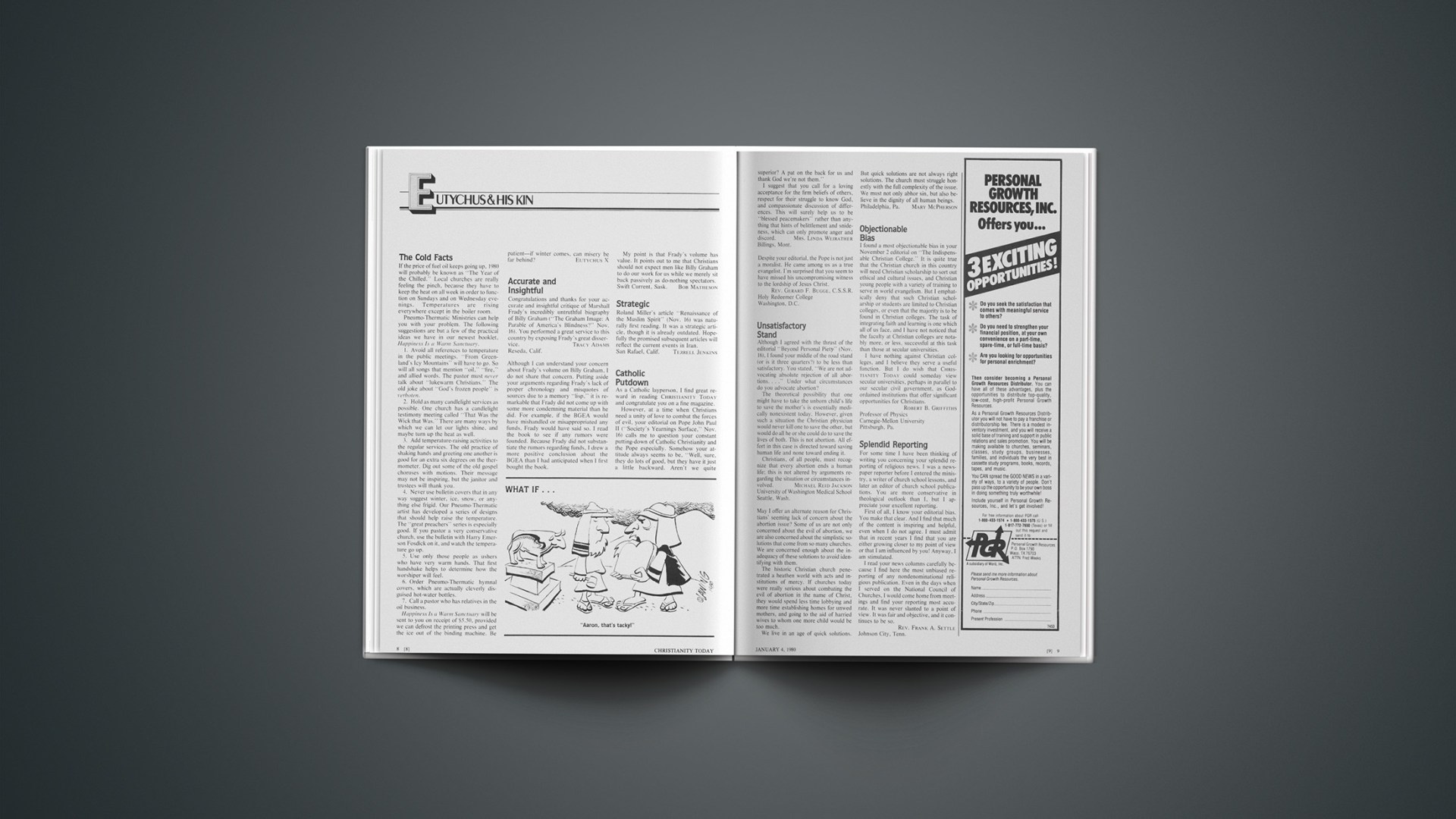
If the price of fuel oil keeps going up, 1980 will probably be known as “The Year of the Chilled.” Local churches are really feeling the pinch, because they have to keep the heat on all week in order to function on Sundays and on Wednesday evenings. Temperatures are rising everywhere except in the boiler room.

Pneumo-Thermatic Ministries can help you with your problem. The following suggestions are but a few of the practical ideas we have in our newest booklet, Happiness Is a Warm Sanctuary.

1. Avoid all references to temperature in the public meetings. “From Greenland’s Icy Mountains” will have to go. So will all songs that mention “oil,” “fire,” and allied words. The pastor must never talk about “lukewarm Christians.” The old joke about “God’s frozen people” is verboten.

2. Hold as many candlelight services as possible. One church has a candlelight testimony meeting called “That Was the Wick that Was.” There are many ways by which we can let our lights shine, and maybe turn up the heat as well.

3. Add temperature-raising activities to the regular services. The old practice of shaking hands and greeting one another is good for an extra six degrees on the thermometer. Dig out some of the old gospel choruses with motions. Their message may not be inspiring, but the janitor and trustees will thank you.

4. Never use bulletin covers that in any way suggest winter, ice, snow, or anything else frigid. Our Pneumo-Thermatic artist has developed a series of designs that should help raise the temperature. The “great preachers” series is especially good. If you pastor a very conservative church, use the bulletin with Harry Emerson Fosdick on it, and watch the temperature go up.

5. Use only those people as ushers who have very warm hands. That first handshake helps to determine how the worshiper will feel.

6. Order Pneumo-Thermatic hymnal covers, which are actually cleverly disguised hot-water bottles.

7. Call a pastor who has relatives in the oil business.

Happiness Is a Warm Sanctuary will be sent to you on receipt of $5.50, provided we can defrost the printing press and get the ice out of the binding machine. Be patient—if winter comes, can misery be far behind?

EUTYCHUS X

Accurate and Insightful

Congratulations and thanks for your accurate and insightful critique of Marshall Frady’s incredibly untruthful biography of Billy Graham (“The Graham Image: A Parable of America’s Blindness?” Nov. 16). You performed a great service to this country by exposing Frady’s great disservice.

TRACY ADAMS

Reseda, Calif.

Although I can understand your concern about Frady’s volume on Billy Graham, I do not share that concern. Putting aside your arguments regarding Frady’s lack of proper chronology and misquotes of sources due to a memory “lisp,” it is remarkable that Frady did not come up with some more condemning material than he did. For example, if the BGEA would have mishandled or misappropriated any funds, Frady would have said so. I read the book to see if any rumors were founded. Because Frady did not substantiate the rumors regarding funds, I drew a more positive conclusion about the BGEA than I had anticipated when I first bought the book.

My point is that Frady’s volume has value. It points out to me that Christians should not expect men like Billy Graham to do our work for us while we merely sit back passively as do-nothing spectators.

BOB MATHESON

Swift Current, Sask.

Strategic

Roland Miller’s article “Renaissance of the Muslim Spirit” (Nov. 16) was naturally first reading. It was a strategic article, though it is already outdated. Hopefully the promised subsequent articles will reflect the current events in Iran.

TERRELL JENKINS

San Rafael, Calif.

Catholic Putdown

As a Catholic layperson, I find great reward in reading CHRISTIANITY TODAY and congratulate you on a fine magazine.

However, at a time when Christians need a unity of love to combat the forces of evil, your editorial on Pope John Paul II (“Society’s Yearnings Surface,” Nov. 16) calls me to question your constant putting-down of Catholic Christianity and the Pope especially. Somehow your attitude always seems to be, “Well, sure, they do lots of good, but they have it just a little backward. Aren’t we quite superior? A pat on the back for us and thank God we’re not them.”

I suggest that you call for a loving acceptance for the firm beliefs of others, respect for their struggle to know God, and compassionate discussion of differences. This will surely help us to be “blessed peacemakers” rather than anything that hints of belittlement and snideness, which can only promote anger and discord.

MRS. LINDA WEIRATHER

Billings, Mont.

Despite your editorial, the Pope is not just a moralist. He came among us as a true evangelist. I’m surprised that you seem to have missed his uncompromising witness to the lordship of Jesus Christ.

REV. GERARD F. BUGGE, C.S.S.R.

Holy Redeemer College

Washington, D.C.

Unsatisfactory Stand

Although I agreed with the thrust of the editorial “Beyond Personal Piety” (Nov. 16), I found your middle of the road stand (or is it three quarters?) to be less than satisfactory. You stated, “We are not advocating absolute rejection of all abortions.…” Under what circumstances do you advocate abortion?

The theoretical possibility that one might have to take the unborn child’s life to save the mother’s is essentially medically nonexistent today. However, given such a situation the Christian physician would never kill one to save the other, but would do all he or she could do to save the lives of both. This is not abortion. All effort in this case is directed toward saving human life and none toward ending it.

Christians, of all people, must recognize that every abortion ends a human life; this is not altered by arguments regarding the situation or circumstances involved.

MICHAEL REID JACKSON

University of Washington Medical School

Seattle, Wash.

May I offer an alternate reason for Christians’ seeming lack of concern about the abortion issue? Some of us are not only concerned about the evil of abortion, we are also concerned about the simplistic solutions that come from so many churches. We are concerned enough about the inadequacy of these solutions to avoid identifying with them.

The historic Christian church penetrated a heathen world with acts and institutions of mercy. If churches today were really serious about combating the evil of abortion in the name of Christ, they would spend less time lobbying and more time establishing homes for unwed mothers, and going to the aid of harried wives to whom one more child would be too much.

We live in an age of quick solutions. But quick solutions are not always right solutions. The church must struggle honestly with the full complexity of the issue. We must not only abhor sin, but also believe in the dignity of all human beings.

MARY MCPHERSON

Philadelphia, Pa.

Objectionable Bias

I found a most objectionable bias in your November 2 editorial on “The Indispensable Christian College.” It is quite true that the Christian church in this country will need Christian scholarship to sort out ethical and cultural issues, and Christian young people with a variety of training to serve in world evangelism. But I emphatically deny that such Christian scholarship or students are limited to Christian colleges, or even that the majority is to be found in Christian colleges. The task of integrating faith and learning is one which all of us face, and I have not noticed that the faculty at Christian colleges are notably more, or less, successful at this task than those at secular universities.

I have nothing against Christian colleges, and I believe they serve a useful function. But I do wish that CHRISTIANITY TODAY could someday view secular universities, perhaps in parallel to our secular civil government, as God-ordained institutions that offer significant opportunities for Christians.

ROBERT B. GRIFFITHS

Professor of Physics

Carnegie-Mellon University

Pittsburgh, Pa.

Splendid Reporting

For some time I have been thinking of writing you concerning your splendid reporting of religious news. I was a newspaper reporter before I entered the ministry, a writer of church school lessons, and later an editor of church school publications. You are more conservative in theological outlook than I, but I appreciate your excellent reporting.

First of all, I know your editorial bias. You make that clear. And I find that much of the content is inspiring and helpful, even when I do not agree. I must admit that in recent years I find that you are either growing closer to my point of view or that I am influenced by you! Anyway, I am stimulated.

I read your news columns carefully because I find here the most unbiased reporting of any nondenominational religious publication. Even in the days when I served on the National Council of Churches, I would come home from meetings and find your reporting most accurate. It was never slanted to a point of view. It was fair and objective, and it continues to be so.

REV. FRANK A. SETTLE

Johnson City, Tenn.

Editor’s Note from January 04, 1980

“It was the best of times and the worst of times,” wrote Charles Dickens as he began his famous novel on revolutionary France. So it is today for evangelicals facing the eighties in our troubled world. As I write this note, 50 Americans still sit in despair of their lives from threats of the Ayatollah Khomeini and the mob action of Iranian students. Yet, in memory, the United States has never had such solid support from nations all around the world.

Evangelicals have no cause for either abject pessimism or undue optimism. On the mission fields of the world some doors are closing: Iran, Afghanistan, Pakistan, most countries where Islam is in the ascendency, and in Cambodia, Laos, Vietnam, and certain parts of Southeast Asia; but other doors remain wide open: most of South and Central America, Japan, Taiwan, the Philippines, other areas of Southeast Asia and Oceana, most of sub-Saharan Africa, southern Europe—and now, although only a crack in the door, eastern Europe and even China.

On the home front, likewise, we see no cause for either despair or triumphalism. The confusion of American values with values that are truly biblical and, therefore, genuinely Christian, the hypocrisy of the church, the woeful ignorance among professing Christians of the most elementary doctrines of the orthodox faith, the crass materialism of lip-serving evangelicals, and the careless disobedience of the “born-again” all remind us sadly that we do not live in the church glorious but rather trudge along wearily, albeit joyfully, under the shadow of the Cross. But there is hope—as well as joy—in spite of the resurgence of Islam, militant Communism, and the increasing nationalism of the Third World. I believe the cause of Christ and his church is on the very threshhold of unbelievable advance both at home and abroad. Out of the despair of this world can spring hope and faith in Christ.

In this first issue of the new year and the new decade, Billy Graham and Carl Henry analyze realistically the liabilities and assets of evangelicalism and help us plot a strategy for the eighties.

History
Today in Christian History

January 4

January
February
March
April
May
June
July
August
September
October
November
December
<>

January 4, 1581: James Ussher, Archbishop of Armagh, Ireland, is born. Famous for a chronology of the Bible that was repeatedly printed in King James Versions, he was so highly esteemed that Oliver Cromwell gave him a state funeral and had him buried in Westminster Abbey.

January 4, 1965: T.S. Eliot, the most influential English writer in the twentieth century and a devout Christian who wove his religious convictions into his work, dies.

Culture
Review

Not Buying into the Subculture

Slow Train Coming reveals that Bob Dylan’s quest for answers has been satisfied

Christianity Today January 4, 1980

From the January 4, 1980, issue of Christianity Today:

Slow Train Coming

Slow Train Coming

January 17, 2026

Yes, it's true. Singer and songwriter Bob Dylan is professing Jesus Christ as Lord. He is doing it quietly through his new album, Slow Train Coming. Like most of what he does publicly, he is keeping the message foremost, disdaining the subculture's cult of conquered heroes and forsaking the notoriety of the born-again "club." He remains true to the prophetic posture that has earned him the respect and attention of his peers in the popular music arena.

Many of the songs he has written were made popular through the musical talents of others (for example, Stookey notes the significance of Dylan's "Blowin' in the Wind," but it was Stookey's own group, Peter, Paul, and Mary, that propelled that ballad into the ratings).

It is the sage-like message of Dylan's lyrics, the thoughtful, conscious, driven critiques of shallow dehumanizing vogues and bandwagon motifs to which victims and victimizers alike have responded. Dylan's uncompromised sensitivity and courage leave him free to name the self-debasing methods with which Americans have dulled their collective consciences in pursuit of prosperity, power, and the materialistic version of the "American dream."

But before Slow Train Coming, no roots anchored his apocalyptic appraisals of the answers. Dylan could clearly see the light and the human nakedness illuminated by that light, but he was either unable or unwilling to acknowledge its source. While he sang of the rampant frivolity and foolishness of human endeavors, his songs still sought for meaning.

In Slow Train Coming that quest has been satisfied. Rolling Stone magazine, not wanting to disown Dylan, labeled the album "artistically ambiguous," apparently ignoring stanzas like "There's a man on a cross and he they crucified for you. / Believe in his power, that's about all you've got to do." And, to make it personal, he sings, "What you've given me today is worth more than I can pay / And no matter what they say, I believe in you."

The album begins with the only alternatives open to each of us, reciting a litany of personality types and professions set with the refrain, "Well, it may be the devil or it may be the Lord, but you're gonna have to serve somebody." In the album's love song he reiterates, "Now this spiritual warfare, flesh and blood breakin' down, / You either got faith or you got unbelief and there ain't no neutral ground." Dylan takes clear cues from Scripture about Satan's active involvement in our depravity: "The enemy is subtle, how be it we're deceived / When the truth is in our hearts and we still don't believe. / Shine your light, shine your light on me. / You know I just can't make it by myself, I'm a little too blind to see."

Throughout the record there runs a theme of "Gonna change my way of thinkin', bring myself a different set of rules, / Gonna put my best foot forward and stop bein' influenced by fools." He identifies the fools as "my so-called friends" who "have fallen under a spell, / They look me squarely in the eye and they say, well, all is well."

The title song previews the coming judgment. "Can't help but wonder what's happening to my companions, are they lost or are they found? / Are there earthly principles they are goin' to have to abandon?" He then alludes to Revelation 9:6: "Can they imagine the dark ages that will fall from on high / When men will beg God to kill them and they won't be able to die." Slow Train Coming is not only about the end times, nor does it only point to personal judgment; God's judgment and man's sin are keyed to current conditions. "All that foreign oil controlling American soil," and, "Sheiks walkin' around like kings … deciding America's future from Amsterdam and Paris … people starvin' and thirstin', grain elevators are burstin'."

Perhaps the most refreshing quality of this, Dylan's first postconversion album, is that he has not bought into the Christian subculture's status quo. His gift to us remains his once-removed prophetic insight. He is able to see the sticky sweet personalization puffery of some segments of American Christianity: "Spiritual advisers and gurus to guide your every mood. / Instant inner peace in every step you take, got to be a prude … / Do you ever wonder just what God requires? / You think he's just an errand boy to satisfy your wandering desires" is sung in the context of "adulterers in churches, pornography in schools, / You got gangsters in power and lawbreakers makin' rules. / When you gonna wake up? When you gonna wake up'? / Strengthen the things that remain."

Dylan has packed the album with a plethora of human foibles and fantasies, all cloaked in the latest societal garb (there is at least one with which each of us can identify) and exposed in the searing light of biblical metaphor. He at once shows us who we are and calls us to "the man who died a criminal's death."

The voice and especially the music are in the best Dylan style. But they are only the vehicles to carry a message that goes beyond the searching of an earlier quest for the source of all answers.

This article originally appeared in the January 4, 1980, issue of Christianity Today (we did not have star ratings for album reviews at the time). At the time, David Singer was the magazine's art director. He is now publications director for the American Bible Society.

Copyright © 2001 Christianity Today. Click for reprint information.

Related Elsewhere

Christianity Today's other articles on Bob Dylan include:

Watered-Down Love | Bob Dylan encountered Jesus in 1978, and that light has not entirely faded as he turns 60. By Steve Turner (May 24, 2001)

Bob Dylan: Still Blowin' in the Wind | Christianity Today reviews Dylan's work before the singer's conversion to Christianity. By Daniel J. Evearitt (Dec. 3, 1976)

Bob Dylan Finds His Source | A call into the bars, into the streets, into the world, to repentance. By Noel Paul Stookey (Jan. 4, 1980)

Has Born-again Bob Dylan Returned to Judaism? | The singer's response to an Olympics ministry opportunity might settle the matter once for all. (Jan. 13, 1984)

History
Today in Christian History

January 3

January
February
March
April
May
June
July
August
September
October
November
December
<>

January 3, 1521: Pope Leo X creates a bull of excommunication for Martin Luther that would have deprived him of civil rights and protection, but before its execution, Holy Roman Emperor Charles V allows Luther the opportunity to recant his beliefs at the Diet of Worms. When Luther instead affirms his beliefs, the bull is carried out (see issue 34: Luther’s Early Years).

January 3, 1785: The Methodist “Christmas Conference” concludes at Baltimore, Maryland, having created the Methodist Episcopal Church in America and elected Francis Asbury and Thomas Coke its two first “general superintendents” (see issue 2: John Wesley and issue 69: Charles and John Wesley).

January 3, 1840: Joseph de Veuster, who, as Roman Catholic Missionary Father Damien gave his life ministering to lepers in Hawaii, is born in Tremelo, Belgium.

January 3, 1892: Literature professor J.R.R. Tolkien, author of the Lord of the Rings trilogy and a devout Catholic, is born in Bloemfontein, South Africa (see issue 7: C.S. Lewis).

History
Today in Christian History

January 2

January
February
March
April
May
June
July
August
September
October
November
December
<>

January 2, 1909: Aimee Semple and her husband, Robert, are ordained by Chicago evangelist William H. Durham. Aimee, who married Harold McPherson after Robert died, would become the founder of the International Church of the Foursquare Gospel and one of America’s most popular preachers of the twentieth century (see issue 58: Pentecostalism).

January 2, 1921: Pittsburgh radio station KDKA broadcasts the first religious program over the airwaves: a vesper service of Calvary Episcopal Church. The senior pastor, unimpressed by the landmark broadcast, didn’t even participate in the service, leaving his junior associate to conduct it. The two KDKA engineers (one Jewish, the other Catholic), were asked to dress in choir robes to be less obtrusive. Today religious broadcasting is a multi-billion dollar industry.

History
Today in Christian History

January 1

January
February
March
April
May
June
July
August
September
October
November
December
<>

January 1, 379: Early church father Basil the Great dies. Founder and financial supporter of a monastery in Annessi, which became a complex of hospitals, hostels, and schools, he also succeeded Eusebius as bishop of Caesarea. He is also known for his theological work explaining the Trinity and for healing the Antioch schism in the eastern church. His monastic rule remains the basis of the Rule followed by the Eastern Orthodox religious today.

January 1, 1484: Swiss reformer Ulrich Zwingli is born at Wildhaus, Switzerland (see issue 4: Ulrich Zwingli)

January 1, 1622: The Roman Catholic church adopts January 1 as the beginning of the year, rather than March 25.

January 1, 1643: English mathematician and physicist Sir Isaac Newton is baptized at St. John's Church in Colsterworth, England. Deeply interested in religion throughout his life, Newton (known especially for formulating the laws of gravitation) acknowledged Jesus as Savior of the world, but not God incarnate.

January 1, 1802: In a letter to the Danbury (Connecticut) Baptist Association, Thomas Jefferson uses the famous metaphor, "a wall of separation between Church and State." A recent exhibit at the Library of Congress has sparked argument over whether Jefferson used the term merely for political reasons or whether he meant it to explain the First Amendment (for more on America's Founding Fathers, see issue 50: American Revolution).

January 1, 1863: American President Abraham Lincoln frees all slaves in Confederate states by issuing the Emancipation Proclamation. Churches throughout the North held candlelight vigils commemorating the event (see issue 33: Christianity and the Civil War).

January 1, 1937: Presbyterian scholar J. Gresham Machen, fundamentalism's most gifted theologian, dies (see issue 55: The Monkey Trial and the Rise of Fundamentalism).

Pastors

Reflections of a Preacher’s Kid

You hear criticism about PKs resenting how they were raised and what it did to them. Tim Stafford looks at what his father did right.

You hear a lot of criticism these days about how preachers’ kids turn out. The refrain is often heard that the preacher was so busy delivering mimeographed sheets to Sunday school teachers that he had no time for his family. We, of course, deplore that phenomenon. But few talk about the bright side of the picture. There are a lot of PKs kicking around who feel their dads contributed quite a bit to their .lives. While many readers of LEADERSHIP represent various aspects of ministry, they share common ground in their struggle with the demands of family while bearing the heavy weight of church leadership. How can they balance these? Is there an inevitable guilt trip?

Tim Stafford is one of those PKs who is not grumbling in his beard about the failures of his father. We’ve known Tim for almost a decade as a Campus Life editor, and in the last few years as a frequent contributor to Christianity Today. Tim has always expressed special affection and appreciation for his dad. Most recently, Tim has been developing a Christian youth magazine in Kenya which will be turned over to nationals (an interesting story in itself). We asked Tim if he’d be willing to tell us what he believes his dad did right! It turns out that there were several things. . ‘. .

I have been asked to write about what my father, a pastor, did right. Let me make clear from the beginning that I am not creating a clergical version of the Waltons. My father is brilliant, moody, eccen- trie, nervous, frighteningly perceptive, and occasionally, flamboyantly wrong. He would never make it on TV as the wise, slow-talking Father Knows Best. He grew up without a father in the poor streets of San Francisco, moving frequently to escape rent. Most of his models of family life were bad. Yet somehow, through God’s goodness, he has been a good pastor and a wonderful father. I am one of four children who like and love him, our mother, each other, and God.

I don’t want to export the eccentricities of my family to yours. Nor do I want to rehash common Christian wisdom about raising kids. Most of it, which applies to pastors just as to everyone else, can be found in bookstores. I merely hope to point out some of the special difficulties pastors and their kids face, and suggest how my father succeeded, or partly succeeded, in dealing with them.

Certain difficulties come with the job?like money. It’s a small problem, really, because American pastors generally live quite well. But it is a problem that can seem very great to a child. Pastors’ kids often feel poor. Sometimes they pick up those feelings from their parents, who tend to be well-educated, ambitious, verbal people who might make more money in other jobs. Some parents, conscious of their sacrifice, mention it. Their children, who may not recall a word of the good spiritual counsel they are getting, remember the remarks about money.

Living in the neighborhood which the congregation also inhabits doesn’t help. Since it is usual for a pastor to be paid on the low side of the bell curve, a pastor’s kids grow up surrounded by people who have slightly nicer cars and bigger houses than they do. Money to a kid, in case you’ve forgotten, conveys status. When you are 14, status is virtually all there is.

As a child, I was reasonably normal, and I felt our lack of status. But, remarkably enough, I never felt that we were truly poor, although sometimes we were. Looking back, I can see that. One time we searched the house for hours to find pennies that had rolled under furniture and into corners so we could buy a bag of flour. I remember amusing stories, often told, about those times when we wondered what to do about the dozen or so meals left before the end of the month. There were stories like the one about arriving at seminary after a 2,000 mile drive with a sick child, five dollars, and no rich uncle to cable for money. I can remember the many times I had to get out to push the old car out of the parking space?it didn’t go into reverse, and we had no money to pay a mechanic. But I cannot remember ever feeling poor.

When I reflect on my childhood, I realize that my parents must have sometimes felt miserably poor at times and perhaps even afraid. But I didn’t catch a hint of that, mainly, I suppose, because they kept their mouths closed. They made money a game and a joke, and we laughed rather than cried.

More than that, they took an aggressive posture. We enjoyed, we believed, the finest things of life:

books, music, camping, listening to baseball games. We thought we were better off than people who had to buy big cars and steaks to enjoy life. Giving helped too. An early, vivid memory of mine is of my mother late one night writing out checks to various charitable and Christian organizations. “Tithing makes me feel so rich,” she said to me as she looked up. “We have all this money to give away.”

Time is another pastoral pitfall. Pastors don’t have much of it to spend with their families. Often it’s their fault?they insist that the church needs them, as it needs God, to sustain its every breath. Still, there are special problems, perhaps best symbolized by “night meetings.”


If kids understand money all too well, they understand time all too little. I remember my father complaining that he had a meeting every night of the week. I don’t remember understanding what he was complaining about.

All the books say that parents must spend time with their children, and I believe that is true. There is no substitute for setting your priorities straight and saying no to things that interfere with them. But I would like to add one small note. From these books I have gotten the impression that fathers should eliminate all the important and interesting activities they enjoy and bore themselves silly by watching every Little League game that Johnny plays in. Father should descend to the level of a child in order to relate to his own child as a buddy and close friend.

That may be what the books say, but that wasn’t the way it was with me. My father did take my brother and me out a time or two to throw the old pigskin around, but he didn’t do it very often. He didn’t join the neighborhood football games; we probably would have been embarrassed if he had. He never played Monopoly with us. He encouraged us in our chosen vocation of fishing, but he never bought a rod and reel himself. I always had the impression that we were kids, allowed the kiddish dignity of going about our kiddish affairs in all seriousness, without adult interference.

I am not certain I can recommend my father’s lack of involvement in our interests, but I strongly recommend his alternative?involving us in his. He allowed us to enter his world when we were interested in doing so; he would even talk theology with us. He and I trekked hundreds of miles in the back country of the Sierra Nevada together, not so much (I believe) because he was being a good father but because he wanted to go. We talked about the baseball standings because he was avidly interested. He also liked taking us to meetings with him. I remember particularly one Sunday night when after the evening service, I went with my father to a hotel restaurant to join a small circle of pastors chatting with Addison Leitch, one of my father’s most admired seminary professors. I didn’t know what they were talking about, but to this day my memory can bring back the rich pleasure of being allowed in adult male company as a sort of equal.

I should point out that my father had interests broad enough to involve a small boy or girl. He was not consumed by committee meetings. He preferred baseball. He found time for many things? things his children could enjoy.

My father’s practice of letting us into his world betrays a much deeper attitude that pervaded my upbringing: my parents respected us. We were never their equals in authority, but we were their equals in our humanness. We were not expected to agree with everything they thought or said politically, theologically, or any other way. In fact, I think they would have been disappointed if we had. We obeyed family rules, but we didn’t have to like them. It was, I think, a token of his respect that my father did not bore himself in order to spend time with me. He sought common ground. He would do the same with any friend.

A difficulty only preachers’ kids encounter is professional holiness. It is the duty of every pastor to convert the heathen, particularly those living within his doors, to live an exemplary life, and make sure that his family does the same. The kids are well aware that their father is watching them, coaxing them to goodness. They also know that the rest of the world, while coaxing in a different direction, is watching.

Preachers’ kids can’t win. If we are good, it is no virtue. Whatever we do right, we have been trained or forced to do; whatever we believe, we were taught to believe. (“All right,” my brother once exploded in college, “I don’t drink just because that’s what my parents taught me. And you do drink just because that’s what your parents taught you. Now can .we talk about it intelligently?”) I remember trying to convince an incredulous friend that I went to church because I liked to, not because my father would beat me if I didn’t. The only way to get any credit for individuality, in fact, is to be bad, and even that is tainted. Everybody knows that preachers’ kids don’t have to work at sin. They come by it naturally.

Then there is the shame of being tainted with holiness. This may be only another proof of the depravity of man, but I am inclined to think it has more to do with blending. When you are 14 years old you don’t want to stand out. It is bad to be too smart, and worse to be. too good. Preachers’ kids long to have fathers whose professions are unmarked by any signs of distinction. They dream of a parent in real estate. If they are to have any distinction, please God, let it be something they have earned themselves. Let them never be Somebody’s son . . . especially a Holy Somebody’s son.

Yet despite the pressure of professional holiness none of the four kids in my family went through a significant period of rebellion. For that I must give a small share of credit to covenant theology. Inherent in Presbyterian belief is the idea that a child, if raised in the nurture and admonition of the Lord, is not a small representative of Satan in urgent need of reclaiming, but a beginning Christian. Though it is necessary for the child, as for all Christians, to grow in grace and the knowledge of the Lord, to continue to renounce sin, and to throw himself on the mercy of God, a proper Presbyterian parent does not look on his child as an outsider to God’s grace. He believes that the Holy Spirit can be as unobstructed in a child’s life as in his own.

This does a lot to reduce tension in the home. It unifies the family in the sphere of God’s grace, and it reduces the pressure on the child to make a radical reversal in order to avoid falling into hell. It merely calls on the child to continue in the direction he was taught as a child and to make it his own as an adult.

The theological merits of these ideas are arguable, as students of church history can assure us, but on practical grounds I appreciate them very much. 1 never felt pressure from my parents to be holy. (My dad hated the holy image of a pastor himself.) They didn’t see every misdeed as proof that we were ir dramatic need of conversion. Outside I got pressure about being a preacher’s kid, but never in my own home.

I know that people respond to different thing’ and that what is helpful spiritual guidance for on< person is not helpful to another; some people neec gentle prodding toward godliness, and others neec to be hit on the head. Still, I think it is reasonable t< say that a child raised in a pastor’s home is likely to know the gospel and to be aware of his need for Savior. He rarely needs to have the lesson bangei home. In fact, since nearly every teenage kid would do anything to avoid being an exact replica of hi parents, pressuring him may make the decision

much more difficult for him; to say no is the onl way he can prove that he is an individual. In my own life, at any rate, it was a great bonus that I was given spiritual freedom. We were never expected to be any better than anyone else’s kids. We were never threatened with what the neighbors would think. This gave us freedom to make God our God, not the God of our father, and to find our own path to personal holiness.

I have mentioned three difficulties unique to a pastor’s job. Now I want to discuss a thornier difficulty: the pastor himself. I know it is impossible to typecast pastors; yet, I believe that the ministry draws certain kinds of people and shapes them in particular ways. Pastors are, for the most part, competitive, intelligent, idealistic, lonely, and in need of reassurance. They are public people who both love and hate the limelight.

The demand to’ be a star, which American churches make and many pastors give in to very easily, is the hardest part of being a pastor or a pastor’s child. Think about it a little from the child’s point of view.

How many children actually watch their father perform? Only the children of actors, politicians, and preachers. For most kids, their father, when he is home, is a father only. He disappears to perform.

Imagine yourself at the time of adolescence. You are unimaginably proud of your father and yet have come to suspect that he is vincible. Imagine that you have to go with your friends to a movie theater to see a film in which your father is acting. Imagine listening to them discuss his performance afterwards.

Or imagine that you, as a child, are asked to sit in the office while the boss gives your father a job review. You watch him politely exposed, praised, scolded. Then you ride home in the car with him and wonder what to say.

That’s only part of the problem. If your father is the public’s person, then it is difficult to have him for your own. He can become more of a symbol, a totem, than a person. You are never quite sure what is real and what is not. He becomes an idealized version of a father. Or he becomes a hypocrite in your eyes, unable to make his private and public lives match.

Some pastors I know can handle the problems, and their children idolize them. Yet if asked to tell what place they fill in their father’s life, I doubt they could name one. These children are usually “good” children, but they have a very difficult time finding a niche of their own. To grow up in the shadow of this kind of a great man is as hard as sculpting in the same room with Michelangelo. Other fathers can’t handle it, and their children reject them outright. The kids cannot cope with the discrepancy between the public figure and the figure at home. They run away, live blatantly sinful lives, and in some cases, do what they can to punish themselves for the guilt they feel in the shadow of hypocrisy.

The vast majority of pastors and pastors’ kids are somewhere in the middle, trying to live with the demands of public life and the secrets that must stay hidden.

What can the father do to help? I doubt there is any full solution; this problem comes with the profession. But I think the burden is eased to the extent that a father lets his children understand how he feels.

My own father had to learn to do this. I suppose he still is learning. Perhaps the gradualness of his learning was an advantage. I doubt any child can take sudden, compulsive candidness from his own father.

When I was growing up, my father was not, as they say, “in touch with his feelings.” But I think he was enough in touch that we all had a sense of pity mixed in with our pride; we knew his job was not easy for him, though I doubt he ever exactly told us so. Then, when we were all nearly grown, he went through a series of crises. He learned how to express how he felt to us. It was a wonderful release, for me as well as for him. I began to be able to freely enjoy his abilities without worrying so much about his weaknesses. I understood better that he was only human, a fellow man. It opened the way for a peer closeness with my father, which is, I think, the joy of very few sons.

I don’t suggest compulsive candidness. But I do suggest that there is a time and a place for confessing doubt, even to your own family, and I am afraid there are many pastors who have never confessed it to anyone. The only way my father, as a public person, can also be specially mine is if he shares the true feelings of being a public person with me.

My father is not an old man, and this article is not a memorial. Our relationship is still growing, but not because our personalities match. He is a man of almost boundless and restless interest in life, particularly the behavior of human beings, and he loves to share that. I pay him, in return, the greatest compliment I have to offer by asking his advice. We are friends, and I think we feel the fellowship of the kingdom of God.

I don’t believe he set out thinking that raising children was his most important task. Like a lot of pastors, he was preoccupied with church buildings and good sermons. But lately, as a fairly successful pastor, he has been reviewing his career. He says what I doubt would have occurred to him years earlier: that the most significant accomplishment of his life has been the raising of four Christian children. If so, his success was due not so much to the quality of books read or seminars attended on good parenting as much as to the fact that he was, and is, intensely honest, essentially humble, and fundamentally respectful in all his dealings with all kinds of people?even his own children. He is also, I might add, a very interesting person to live with.

Copyright © 1980 by the author or Christianity Today/Leadership Journal. Click here for reprint information on Leadership Journal.

Apple PodcastsDown ArrowDown ArrowDown Arrowarrow_left_altLeft ArrowLeft ArrowRight ArrowRight ArrowRight Arrowarrow_up_altUp ArrowUp ArrowAvailable at Amazoncaret-downCloseCloseEmailEmailExpandExpandExternalExternalFacebookfacebook-squareGiftGiftGooglegoogleGoogle KeephamburgerInstagraminstagram-squareLinkLinklinkedin-squareListenListenListenChristianity TodayCT Creative Studio Logologo_orgMegaphoneMenuMenupausePinterestPlayPlayPocketPodcastRSSRSSSaveSaveSaveSearchSearchsearchSpotifyStitcherTelegramTable of ContentsTable of Contentstwitter-squareWhatsAppXYouTubeYouTube