Ideas

Christian Colleges Are in Crisis. Here’s What That Means for the Church.

If we save them, our schools can be beacons of light for the Christian community.

Christianity Today September 10, 2020
Chris C. Hardy / Lightstock

Whether you describe it as a decadent society or a decaying culture or a democracy dying in darkness, 2020 has given us a taste for what Cormac McCarthy once described as “the frailty of everything revealed at last.” We have been frail for a very long time, but what we could deny before has been made glaringly manifest through a pandemic, racial injustice, social unrest, mass unemployment, and a highly contentious presidential election that earnest folks on both sides have described in existential terms. The foundations of our society are not quite destroyed, but they are cracking, and those cracks raise the psalmist’s question, “What can the righteous do?” (Ps. 11:3).

Part of the answer, I believe, is to support and rely upon Christian colleges and universities to serve as institutional anchors—spaces of transformation and education, discipleship and scholarship, cultural edification, and exhortation.

The default evangelical response to cultural decay has been to redouble our culture war efforts: elect people who will better pursue our agenda, boycott and denounce attacks on our values, and so on. And while I would be the last to dismiss the importance of Christian political participation and cultural criticism, I do worry that these focuses can distract us from the more basic work that needs to be done. We need to shore up the ruins.

When many evangelicals lack a robust idea of sex, marriage, and the human body as God designed them, it does little good for us to criticize the normalization of alternative lifestyles. When evangelical consumers and evangelical entrepreneurs are driven by the same basic belief in autonomous individualism as their secular counterparts, we can’t be surprised when sacrificing for our neighbors feels like an infringement upon our rights. When white evangelicals have little grasp of history or the trauma of generations of institutionalized racism, we should not expect racial reconciliation to occur. When evangelicals have abandoned the possibility of truth and the common good for identity politics, it is not surprising that the world does not take our moral authority seriously.

To shore up the ruins is not to retreat from society into private enclaves but to recognize that our house is not in order. Our walls will not stand. We need catechesis and discipleship, not quick culture war and political victories, or we risk letting the entire house crumble while we stand in the front yard waving memes at our digital neighbors.

The work of shoring up the ruins must be primarily done in local churches and within families and communities. However, Christian colleges and universities are uniquely positioned to be a major institutional framework for the catechizing and discipleship. They can and do equip and assist local churches, families, and communities in their work.

This is why I am particularly troubled by the significant challenges facing Christian higher education. At precisely the time the church in America needs cultural institutions that preserve what is good, transform lives, and prophetically challenge secular ways of being in the world, our schools are experiencing declining enrollment and layoffs. Sixty-five percent of our schools have seen a decline in enrollment between 2014-2018 and in the last decade, 944 faculty and staff positions have been eliminated. We are under pressure to reduce our education to efficiently targeted career training and certification rather than the cultivation of wisdom (a goal with a much harder to measure return on investment).

I do not believe that Christian higher education can save us. It can’t. But having spent 13 years teaching, the majority of which took place within Christian universities, I have personally witnessed the tremendous power of these institutions to transform the lives of students, to produce scholarly and popular work that builds up the church, and to be spaces of cultural renewal and preservation. Our schools, properly funded and supported, can be beacons of light for the church during a time of crisis. Or they too can crumble into highly efficient, baptized career and bureaucracy training centers.

If the phrase our schools rubs you the wrong way, I’d like to suggest that we have hit upon one of our problems. Evangelicals struggle to create and sustain lasting, influential cultural institutions because we too often think in terms of individual good rather than corporate or common good.

Even if you never went to a Christian college or university, you are currently benefiting from the work of these institutions. Your pastor benefits from the theological work produced by scholars at Christian schools. Your church benefits from the cultural criticism done at these schools. Christian businesses and professionals benefit from learning how to integrate faith into their professions. Christian artists and musicians benefit from apprenticeship. Our politicians and community leaders benefit from theories of government and justice handed down and built upon in Christian schools.

When Christian colleges and universities are well supported, they can afford to give scholars time to mentor students and produce works that edify the church. And those scholars need the support of schools because even when they manage to write a popular book, it rarely pays enough to make up for the time it took to research and write the book.

Our schools, properly funded and supported, can be beacons of light for the church during a time of crisis.

Or we could rely on thought leaders and influencers to produce research, make ethical judgments on biotechnology, develop political theologies, and perform cultural analysis. But when we rely almost exclusively on online personalities for our cultural and theological wisdom, we should expect to have our ears tickled. One of the significant advantages of the academic environment is accountability. My colleagues at my institution and across Christian higher education hold me accountable for my ideas and my research. If I begin to produce research that panders to my audience’s biases, I expect my colleagues to challenge me.

Of course, we could just demand that our pastors offer commentary, advice, and analysis on every aspect of culture. But to do this is unfair to our pastors. It places an unreasonable burden upon them and distracts from their calling to a local congregation.

We should want Christian colleges and universities to be successful so that they can do critical work assisting local churches and communities in strengthening our foundations and providing lasting, meaningful relief from some of the crises that plague our time.

For example, as our society struggles mightily to maintain the basic level of public discourse necessary for a democracy, Christian schools can provide room for robust and charitable debate over ideas that matter, as I have previously argued at CT.

Our schools can also do vital work researching and telling the history of racism in America and in our own churches. Whatever your views are on racial division in 2020, the fact is we cannot heal—we cannot even repent—until we understand what our nation, our denominations, our churches have done. That work must be done fearlessly, unmolested by the political correctness of the Left or the Right and motivated by the same spirit of unity that brings us together at the Lord’s Table.

And as technological advances continue to complicate, invade, and restructure our lives and habits, we need institutions of Christian higher learning that can cultivate more humane habits in students and produce cultural criticism that equips the church for discernment. I don’t think we are remotely ready for the ethical and spiritual challenges our current technology has created, let alone the technology just around the corner.

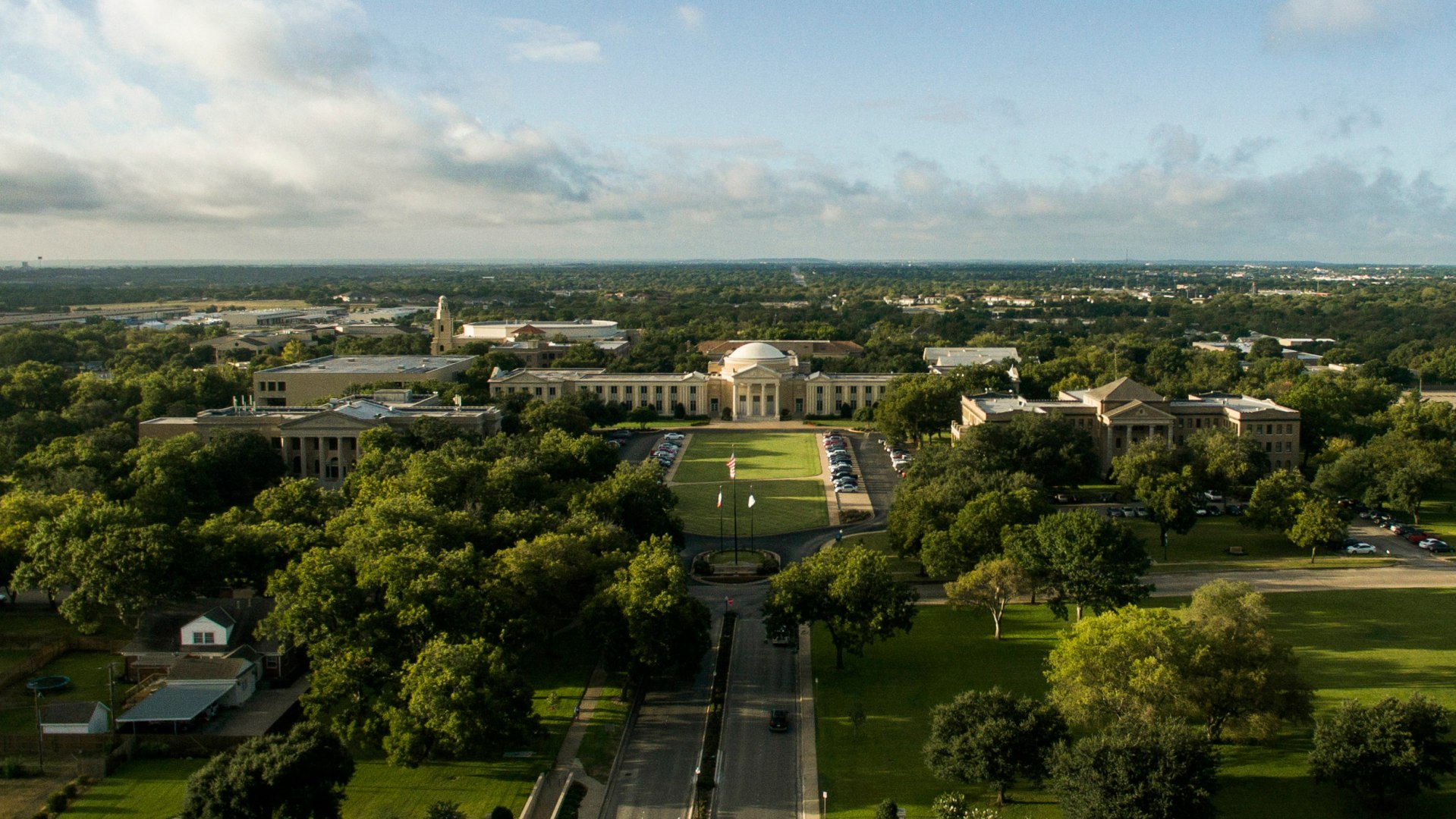
Perhaps closest to my own heart, Christian liberal arts schools like my own Oklahoma Baptist University resist many of the worst pressures of the contemporary age through careful, charitable, humble study of great works of literature, art, music, history, science. By learning to attend to and delight in what is beautiful, good, and true, we deny the primacy of novelty. We reject what C. S. Lewis called the “chronological snobbery” that sees everything new as superior to the old. We grow respect for the wisdom of those who have come before us. And we are rightfully humbled.

I’m not going to say that every Christian college and university is doing this kind of work. They aren’t. And even the ones that are can do better. But they can’t do anything without support. And this year, while billions of dollars will be spent on an election, with a non-trivial amount coming from evangelicals, some Christian schools may close.

So, even if a Christian college isn’t your alma mater, it is your school; they are our schools. At their best, they serve the church. And the sooner we can accept our shared responsibility, the sooner we can do the necessary work of shoring up the ruins.

The crises that face us cannot be overcome by politicians (although they can be made much worse by them) or by culture-war skirmishes. They can be addressed only by grounding ourselves in the truth. That work will be done primarily in the local church, but our Christian colleges and universities have a tremendous role to play by providing resources, mentorship, and scholarship.

O. Alan Noble, PhD, is an associate professor of English at Oklahoma Baptist University, editor-in-chief of Christ and Pop Culture, and author of Disruptive Witness: Speaking Truth in a Distracted Age, (InterVarsity Press, 2018).

Speaking Out is Christianity Today’s guest opinion column and (unlike an editorial) does not necessarily represent the opinion of the publication.


Ideas

In This Fraught Racial Moment, We Need a Refresher on Human Depravity

Contributor

We also need a reminder of God’s radical grace.

Christianity Today September 10, 2020
Illustration by Rick Szuecs / Source images: Tobias Wortmann-Abbas / EyeEm / Adene Sanchez / Getty / Kumiko Shimizu / Unsplash

As a renewed focus on race and justice have dominated the national conversation over the past few months, I’ve watched with sadness as the response among some white Christians has fallen along ideological and political lines. Some conservatives belittle the reality of racism. They acknowledge that racism is a sin, but they see it as mostly a relic of the past or merely the wrong actions of a small, dwindling group of people. On the other hand, some moderate or progressive Christians are overcome with guilt and shame, quick to condemn others, and often unsure of how the gospel of Jesus should impact conversations about our own racial bias and sin.

The failure of white Christians on the Left and the Right to grapple with the sin of racism is rooted in our broader failure to understand the profundity and complexity of human depravity. We fail to acknowledge our depth of sin, so we fail to see the dizzying heights of grace.

Over these past few months, I have frequently thought of an oft-quoted line from the late pastor Jack Miller: “You’re a lot worse than you think you are, but in Jesus you’re far more loved than you could ever imagine.” If we want to come to terms with the horror of white supremacy and racial bias in our country and in ourselves, we must hold to both of these realities simultaneously.

American evangelicals often view sin primarily as the sum of individual, conscious, immoral choices. Historically, however, the church has viewed sin not merely in terms of volitional decisions but also as the disordered state of our hearts: the subtle idolatry that we bear often without noticing it, the way we love the wrong things and fail to love what is most lovely, and the way we worship ourselves and set ourselves up as God. Like all sin, racism is fundamentally a disordered orientation toward the world. In this way, it isn’t chiefly chosen but is habituated and practiced in ways that are as subtle as they are destructive.

In a recent article for the Religion News Service, James K.A. Smith writes that racial bias “is absorbed through practices we never think about.” He notes that, although white evangelicals may recognize racism as a “false doctrine,” they miss how racism functions “as perceptual vice: a disordered habit of seeing others. Such vice is carried in our bodies more than it is articulated by our intellect.”

When white Christians react to the accusation of racism and racial injustice with self-defensiveness and denial of our culpability and complicity, we are not simply failing to be “woke”; we are failing to take sin as seriously as God does. When we reduce sin to a merely conscious, rational, or cognitive choice, we fail to understand what all sin (including racism) actually is. We fail to see how sin—inherent disorder—is endemic not only in certain individuals but also in cultures, societal structures, and institutions. And we fail to see that our own quest for righteousness is hopeless.

If we have a diminished notion of sin, we inevitably have a diminished vision of the redemption of Jesus. But if as white Christians our sin of racism is worse than we think, then redemption is also bigger than we think. Racial bias and white supremacy are not more powerful than the death and resurrection of Jesus. Grace allows us to give up the mad task of justifying ourselves.

White Christians cannot confront the horror of racism in America unless we believe ourselves to be beloved and forgiven in Jesus. We bear the individual and cultural disorder caused by 400 years of oppression through slavery, Jim Crow, lynching, redlining, and inequality. We continue to reap what our history and idolatry have sown in our institutions, churches, cultures, habits, and dispositions. That burden of guilt and shame is frankly too much for a human being to carry without being crushed. We have only one hope: that in Christ, we are far more loved than we could ever imagine.

If some denigrate and deny the severity of racial injustice, others offer no possibility of redemption to the oppressor. Michael Emerson argued recently that “justice without Jesus” results in “embittered ex-Christians joining others bent on bringing justice to the world, no matter the means.” We are charged only to “do better,” without any assurance of grace for our individual and collective failure. We are left with the impossible task of working off an unpayable debt and breathlessly clawing our way onto the right side of history.

As white Christians, we can admit that we are “worse than we think” only if we know that Jesus’ work is sufficient even for racists and for our long, horrific history of white supremacy. It is solely out of this certainty that we as believers can freely embrace repentance.

What does repentance look like? At times, it will mirror the antiracism efforts that many in the secular world champion: learning from people of color, confronting our own bias, seeking justice system reform, pursuing educational equity, or supporting financial empowerment for people of color. But although repentance may resemble secular calls for antiracism, the hearts of these efforts differ. White Christians can embrace antiracism not as an anxious attempt to make penance for our sin or to shore up our righteousness through our own efforts. We embrace it instead out of a rooted place of belovedness—a belovedness given to us by Jesus, who makes all things new, including our structures, institutions, laws, culture, habits, and dispositions.

In this way, the conversation about race in the church should radically differ from that of the world. White Christians can freely admit the realities of racism. We can be the first to admit that we are worse than we think and that our sin of racism angers God far more than we would dare imagine.

But as a church community, we should also not give up on the idea of grace—even if it has at times been used to excuse apathy. Jesus’ death and resurrection destroyed the power of racism. He not only brings justice to the oppressed but also promises that oppressors can be made new and that shame can give way to honor, guilt to forgiveness, and idolatry to repentance.

Tish Harrison Warren is a priest in the Anglican Church in North America. She is the author of Liturgy of the Ordinary: Sacred Practices in Everyday Life and Prayer in the Night: For Those Who Work or Watch or Weep (IVP, Jan 2021).

News

Train Up a Teen: Young Evangelicals Mostly Keep Their Parents’ Faith

Pew Research finds that even the most devout young believers don’t agree with Mom and Dad on everything. Christian parents weigh in on the challenges of teenage discipleship.

Christianity Today September 10, 2020
Elisa Schulz / Lightstock

A majority of American teens still follow their parents’ lead when it comes to religion. The trend holds whether families are religious or not—but it’s especially good news for evangelical Protestants, who care the most about their children sharing their beliefs.

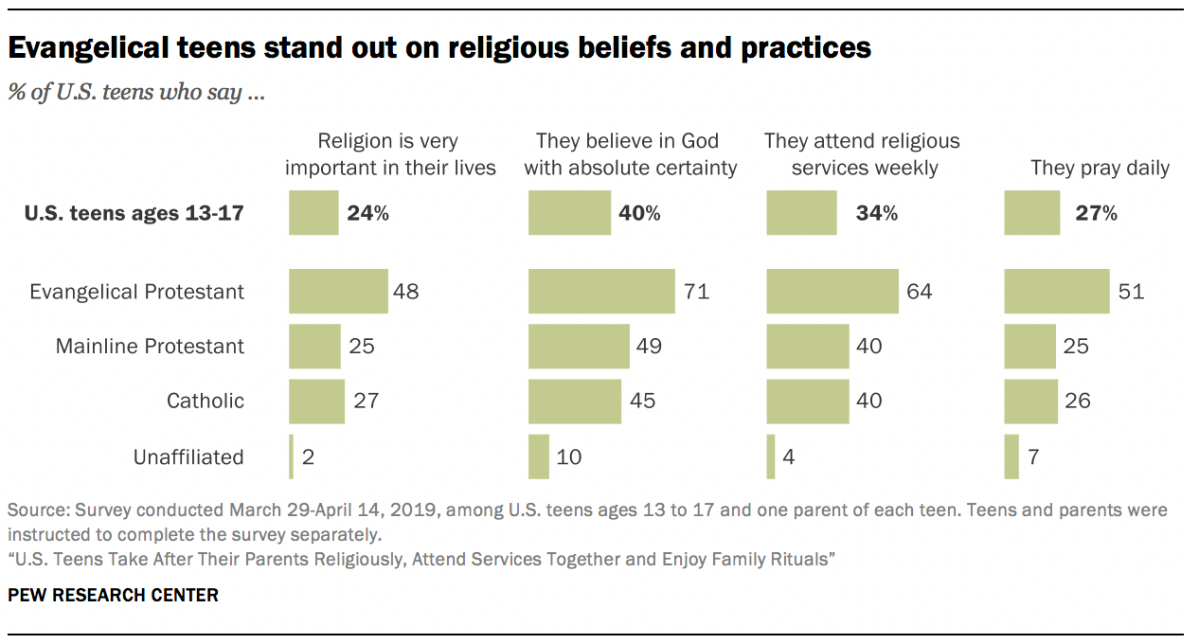
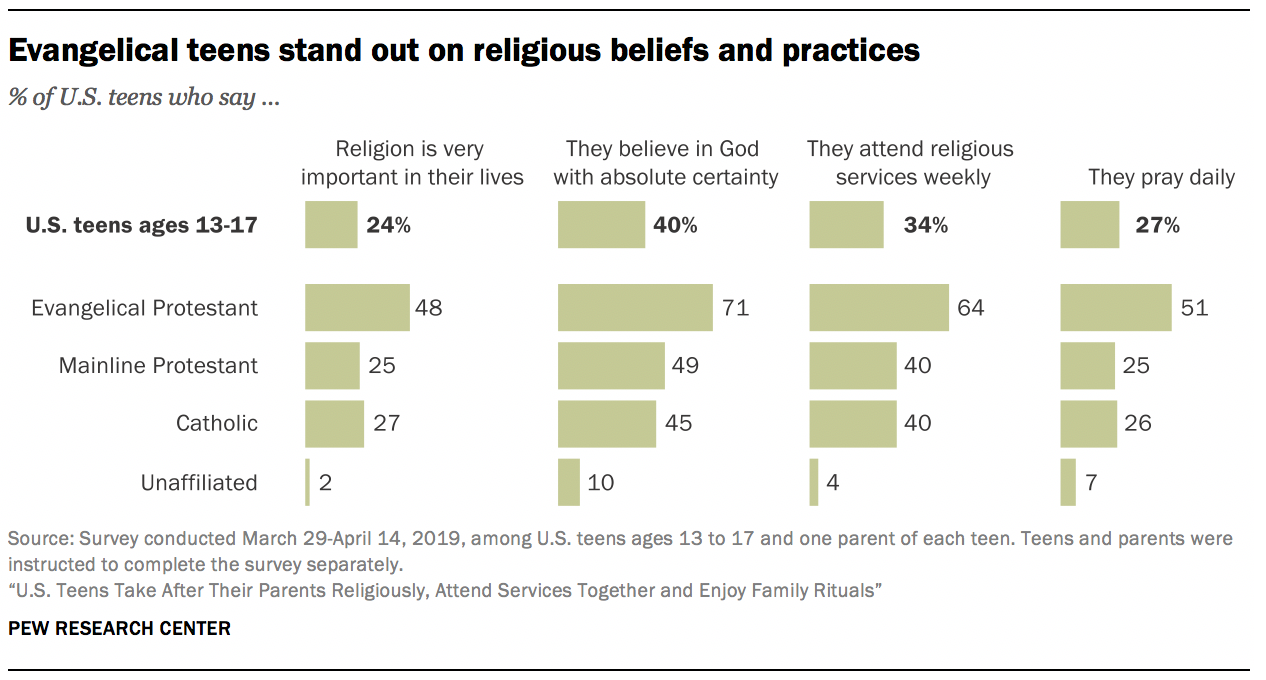
Evangelical teens, like their parents, stand out as the most confident and active in their faith when compared to their peers, according to a new Pew Research Center report on the religious practices of 13-to-17-year-olds.

The religious makeup of today’s teens mostly resembles the population overall. About a third are “nones” (identifying as nothing in particular, atheist, or agnostic), the largest category. After that, about a quarter identify as Catholic and 21 percent as evangelical.

Even as teens, over half of evangelicals surveyed say they attend church at least weekly (64%), pray at least daily (51%), and belong to a youth group (64%), compared to a minority of teen respondents from other traditions. (It’s not just parental pressure. In the survey, two-thirds of evangelical teens say they attend church because they want to go, not to appease Mom and Dad.)

Family plays a big part in young evangelicals’ devotional lives. The vast majority say they enjoy religious activities with their families (88%), with 55 percent reading the Bible together, 80 percent saying grace at family meals, and 88 percent talking about religion, Pew found.

These practices correspond with a greater assurance in their religious beliefs. While nearly all teens who belong to a Christian tradition said they believe in God, 71 percent of evangelicals said they are “absolutely certain” in their belief, compared to just under of half of mainline (49%) and Catholic teens (45%). Evangelicals were also the only group among teens to agree that there is only one true religion.

But not all families fall on the same spiritual page once kids hit the teen years. Twelve percent of teens with evangelical parents don’t affiliate with a religion. Overall, about half of today’s youth say at least some of their beliefs differ from their parents, even if they still identify with the same tradition. The most common way teens see their convictions contrasting with Mom and Dad’s has to do with level of certainty: 14 percent say that they have more questions or are more unsure.

According to Pew, two-thirds of teens who don’t have “all the same” beliefs as their parents say their family knows about the differences, while a third say they don’t. Teens forming their own religious views and approaches as they grow up can be confusing for others under the same roof. Pew found that parents who misjudged their kids’ convictions were more likely to overestimate how important their faith was to them.

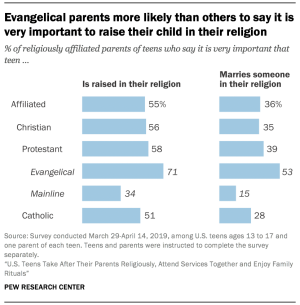
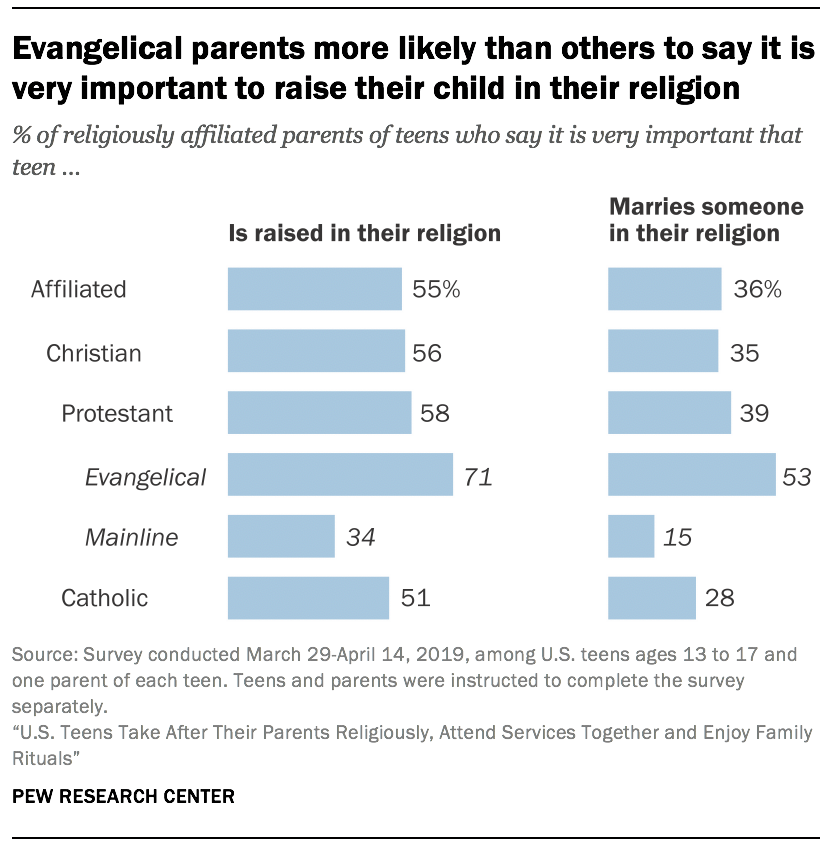
It can also be a sensitive topic for parents to broach. About seven-in-ten evangelical parents consider it “very important” to raise their children in their faith. They make it more of a priority than any other major tradition—half as many mainline Protestants say the same. But as much as they model their faith, surround them with Christian community, and pray for their kids’ salvation, evangelical parents also know their sons and daughters—God-willing, Spirit-empowered—will eventually have to come to understand the gospel for themselves.

CT asked parents of teenagers how important it is for their teenagers’ beliefs to align with theirs and how they approach the children’s faith at this stage. Here are their responses.

Dorena Williamson, speaker, author, and co-founder of Strong Tower Bible Church in Nashville:

I approach my kids’ faith with an understanding that it is not easy growing up with parents who work vocationally in church. I too was a PK (pastor’s kid) and know authenticity is key. I look for ways to encourage their faith in the atmosphere set at home. I always pray over them, seek out music they enjoy, and form conversations about current issues important to them. Hopefully, this communicates that I care about their interests. I don't expect my kids’ faith journey to mirror my own. These times hold new challenges and possibilities, and they have their own path to walk. At this stage in their spiritual lives, I pray they love God wholeheartedly and seek to love their neighbor. I know that is pleasing to God and a legacy that will endure.

Beth Felker Jones, professor of theology at Wheaton College:

My biggest prayer for my older kids is that they would love Jesus and throw their lives in with him. I don’t believe this is something I can control, because it can only come as a gift, but I pray for it and try to make way for it by talking with them about faith and making sure they have a strong group of adult Christians in their lives. I expect my teens to come to church and youth group, to pray with our family, to read Scripture. I hope they can talk freely with me and their father about questions of faith.

I don’t think parents can turn kids into our clones, and when it comes to nonessential matters, I try to hold very lightly any hope that they would perfectly agree with me. If they become adults who live with and for Jesus, my prayers would be answered, and I would do my very best not to obsess about whether they go to a different kind of church than I do or have different beliefs about what baptism means. And this is something I try to communicate directly to my teens: I don’t hope to make them like me. I do hope they’ll love Jesus and become like him.

John Starke, lead pastor at Apostles Church Uptown in New York:

Often when we talk about wanting our kids to align their beliefs with ours, that means a kind of cultural form of beliefs, rather than a biblical faith, and it tends to be a cloistered faith, rather one of understanding. At the same time, we believe in a heaven and hell, that God calls for repentance, and that our culture seduces us towards disbelief and rebellion. My hope is that they are given mercy and experience grace through faith.

We want them to understand our faith, recognize its cultural counterfeits, but also sense the freedom to ask difficult questions and fumble through “trying the faith on” as they grow up. I would want my kids to feel that they share our faith in common, since that would probably feel most secure and safe for them as individuals as they mature and grow into their own identities apart from us and as they grow and form their own faith in Christ.

Jen Michel, author of Surprised by Paradox, Keeping Place, and Teach Us to Want:

We’ve wanted to give our children the richest Christian formation possible in our home, and of course we’ve done that imperfectly. But as our children now leave home, one-by-one, we realize that the faith they take with them must be theirs, not ours.

I was just writing a very belated graduation letter to my 17-year-old son (soon to be 18). He would not call himself a Christian, and that’s very hard. I want him to know the reality of Jesus, but I also fully believe that he needs more than an inherited faith. By contrast, our daughter, now a sophomore in college, is walking with Jesus and serving in ministry on her college campus. That’s been a great joy, and we thank God.

Melissa Cain Travis, assistant Professor of apologetics at Houston Baptist University:

I consider it a particularly positive sign when my teenage sons raise theological disagreement with me; it means they're thinking deeply and critically about Christian doctrine! This is far better than disinterest, and it sparks rich (and sometimes very long) conversations in which I am able to demonstrate intellectual respect for them while offering gentle guidance.

I work to foster a mere Christianity ethos in our discussions but make it clear that secondary theological issues deserve careful consideration. It truly pleases me when my sons arrive at different yet well-thought-out conclusions on the non-essentials. In those instances, I simply make sure that they understand the merits of my perspective.

Kara Powell, executive director of the Fuller Youth Institute:

My kids’ relationship with Jesus is very important to me. As the mom of a 19-, 17-, and 14-year-old, most days I pray more for their faith than anything else. To be honest, a big part of me wants my kids to believe like me and worship like me (and vote like me, eat like me; the list could go on and on). But when I peel back the layers, what I ultimately long for is that my kids will know Jesus loves them and will love him in return. I want them to know that Jesus offers the best answers to their questions of identity, belonging, and purpose.

As our kids are owning their faith, the way they experience God’s love, and express their love in return, already looks different than mine. Based on research for our book Growing With, I try to ask each of my kids two questions: “What do you no longer believe that you think I do?” And, “What do you now believe that you think I don’t?” I want us to be able to discuss anything about Jesus and faith, especially when we disagree. With our two high-school-aged daughters … they’re more progressive on a handful of cultural issues and even more passionate about justice. When those differences emerge in our conversations, I’ve intentionally suggested, “When you’re older, you might want to look for a church that reflects what you believe.” Ultimately, I want my kids to love the church, not my church.

Amy Whitfield, host of SBC This Week and an associate vice president with the SBC Executive Committee:

Our shared faith in Christ, along with involvement in our local church, is incredibly important in the life of our family. As our teenagers have grown older, discipleship is definitely part of our parenting, but the role that faith plays in our relationship does change. When they were younger, we took a very proactive leadership role, standing out in front and systematically pointing them to the truths of the gospel. Now, as they grow spiritually, we are beginning to walk alongside them as older brothers and sisters in Christ, encouraging their personal study of the Bible and helping them understand and apply it to their lives.

Pastors

I Was a Pastor’s Wife. Suicide Made Me a Pastor’s Widow.

What I learned about mental health and ministry following my husband’s tragic death.

CT Pastors September 10, 2020
Courtesy of Kayla Stoecklein

I was 19 when I met Andrew and quickly fell in love. He was a pastor’s kid who felt called to ministry, and it didn’t take long for me to realize that life with him meant life as a pastor’s wife.

I grew up attending church every Sunday, but wasn’t until I spent time with Andrew’s family that I caught a glimpse of what life was like in the trenches of ministry. As I leaned in, listened, and learned, I saw that although serving in ministry can be meaningful and beautiful behind the scenes, it can also be stressful, disappointing, discouraging, and lonely.

In 2015, Andrew became the lead pastor of his parents’ church, and I quickly found ways to fill my new role as lead pastor’s wife. I served on the women’s ministry team, set up for the MOPS group on Wednesdays, and arrived on time for the very first service every single Sunday.

Ministry was everything. Our entire world revolved around the local church and the calling God had placed on Andrew’s life. His calling became my calling; his passion, my passion; his purpose, my purpose.

Then on August 25, 2018, after battling through a season of burnout, depression, and anxiety, my beloved husband Andrew tragically died by suicide.

Life as I knew it changed forever and I was handed a brand-new life as a widow and single mom to our three young boys. All of a sudden ours was the sad story on the internet. I watched as images of my life and pictures of my family made headlines all around the world. We were thrust into the spotlight in an instant.

While the world was watching, leaning in, listening close, I chose to speak. I wouldn’t let suicide get the last word. Just three days after he went home to heaven, I wrote him a letter and posted it to our family blog. “Your name will live on in a powerful way,” I pledged. “Your story has the power to save lives, change lives, and transform the way the Church supports pastors.”

It was through that letter I first began to see God’s hand at work, redeeming what was lost and even saving lives from suicide. We received hundreds of letters, gifts, donations, books, blankets, and bouquets from complete strangers. The love was loud.

What I noticed early on and what I’ve learned these last few years is that Andrew’s story isn’t uncommon. This week marks National Suicide Prevention Awareness Week, and sadly, year after year the American church loses more of its leaders to suicide.

Many pastors and people serving in ministry positions struggle with their mental health. And sadly, they don’t always feel like there is space for them to share their struggles with their peers or congregants. Fear of losing their job, fear of losing their platform, fear of losing their voice, fear of losing respect from their peers is all a very real reality. From my experience with Andrew, I’ve learned how important it is for the church to set up leaders to respond when they inevitably find themselves in a season of ministry fatigue.

Every pastor needs a safe circle of people with whom they can be vulnerable. They need close friends and a trusted community where they can let their guard down, take off their pastor hat, and just be themselves. Andrew would often say, “It’s lonely at the top,” but it doesn’t have to be. We were never created to do life alone; it doesn’t work.

Related to this loneliness is a heavy burden of responsibility. Andrew would often refer to himself as the “linchpin,” the person holding everything together. I would constantly, lovingly, point him back to Jesus and remind him who the linchpin really was. When serving in a ministry position it is crucial to carry the mantel of leadership as a team. If we don’t allow others to share the burden with us, we will crumble under the pressure of it all.

The burden feels especially all-consuming when the demands of ministry seem relentless. It took years as pastor for Andrew to find even one day a week to rest. If we don’t create margin for rest, we will be running on empty. We have to be intentional about turning off our phone, logging off our e-mail, or staying away from our computer for the day. Rest is the key to success.

The truth I’ve found through my former role as a pastor’s wife is that pastors are people too. They aren’t superhuman; they are human. They aren’t invincible; they are just broken vessels giving it their best shot to be a bright light in a really dark and desperate world. But to keep shining bright and leading from a place of strength, pastors must be deliberate about how they care for themselves too. Pastors need community, they need to share the heavy weight of the mantle, and they need to give themselves permission and margin to heal and rest.

For leaders who have pledged to the church and to God to serve no matter the cost, it can be hard—or even unthinkable—to say the personal cost has become too high. But the truth is, your life and your health are more important than your ministry. If your ministry is killing you, if it’s destroying your family, if it’s exacerbating your depression, it is time to tell somebody and take a break.

Again, this is hard for any of us to do, but it’s particularly hard for those who see themselves as fulfilling a lifelong, all-encompassing call to sacrificial leadership. But in leading like Christ, our pastors need not lead as Christ. The ultimate sacrifice has been made for us. Pastors should be free to share their pain and struggles, knowing they were never meant to carry them on their own.

Kayla Stoecklein is an advocate for those confronting mental illness and the mom of three young boys. Join her at kaylastoecklein.com and on Instagram @kaylasteck. Her first book, Fear Gone Wild, was published this week.

News

Died: Stuart King, a Pilot Who Survived D-Day to Help Found Mission Aviation Fellowship

How could aircraft serve Christian ministries and humanitarian missions? The Brit was part of a cohort of aviation enthusiasts devoted to finding out.

Christianity Today September 10, 2020
Portrait Courtesy of Mission Aviation Fellowship

Stuart King, cofounder of Mission Aviation Fellowship (MAF), has passed away at the age of 98. A Royal Air Force engineer who fought for Britain in World War II, King devoted his life after the war to taking light aircraft to the remotest parts of Africa.

King’s life and ministry were recognized by Archbishop of Canterbury Justin Welby.

Today, MAF flies to more than 1,400 remote locations in 26 developing countries—more destinations than the six largest airlines in the world, combined—to support more than 2,000 missionary and humanitarian aid organizations, including the United Nations Children’s Fund, World Health Organization, the Red Cross, Medair, Tearfund, and Samaritan’s Purse.

MAF-UK began in 1948, when King, who landed on Normandy on D-Day, and former RAF squadron leader Jack Hemmings flew across Libya, Egypt, Sudan, Kenya, and the country now known as the Democratic Republic of Congo. In a six-month survey, they studied how aircraft could serve humanitarian needs across the continent. The pair flew in the small Miles Gemini with just bare essentials—a map and compass.

At the end of the trip, they crash landed into a banana tree and finished their trip on foot. They were convinced, nonetheless, that airplanes would provide a great service in the region where roads were few and far between.

In 1950, King launched an MAF site in Sudan, where he met his wife, Phyllis, who was serving there as a missionary. In 1958, he flew his family on a 12-day journey there from the UK on a Cessna 180.

“We stopped at many bizarre and outlandish places along the West African coast, spending nights in strange hotels or little rest houses,” King recalled later in his book Hope Has Wings. “We’d wash the children’s nappies at night and spread them over our knees during the next day’s flight, turning on the cabin warm air to help speed the drying.”

Over the next several decades, King helped the organization expand across the world, modernizing MAF’s aircraft and increasing its capacity. He copiloted other survey trips to Kenya, Ethiopia, Chad, and Tanzania. After more than a dozen years in Sudan, in 1973, King returned to the UK to lead MAF-UK and became the president emeritus in 1987.

King received a number of awards throughout his life, including the French government appointing him the rank of Chevalier in the Ordre National de la Légion d’Honneur in 2016 for his military service in helping liberate France during WWII.

He also received an award of honor in 2019 from the Honourable Company of Air Pilots. In their remarks honoring King, the organization highlighted MAF's partnership in enabling a variety of ministry and humanitarian endeavors, its high standards for pilots and for aircraft maintenance, its intentionality in hiring locals, its refusal of bribes, and its sound financial management.

“Although Stuart is no longer out there conducting operations, it is his vision and his integrity that created the ethos and the professionalism that is MAF today, and it is his fundamental Christian values which guide it to remain the kind of organisation he founded,” it stated.

King was preceded in death by his wife, Phyllis, and leaves behind three children, seven grandchildren, and six great-grandchildren.

History

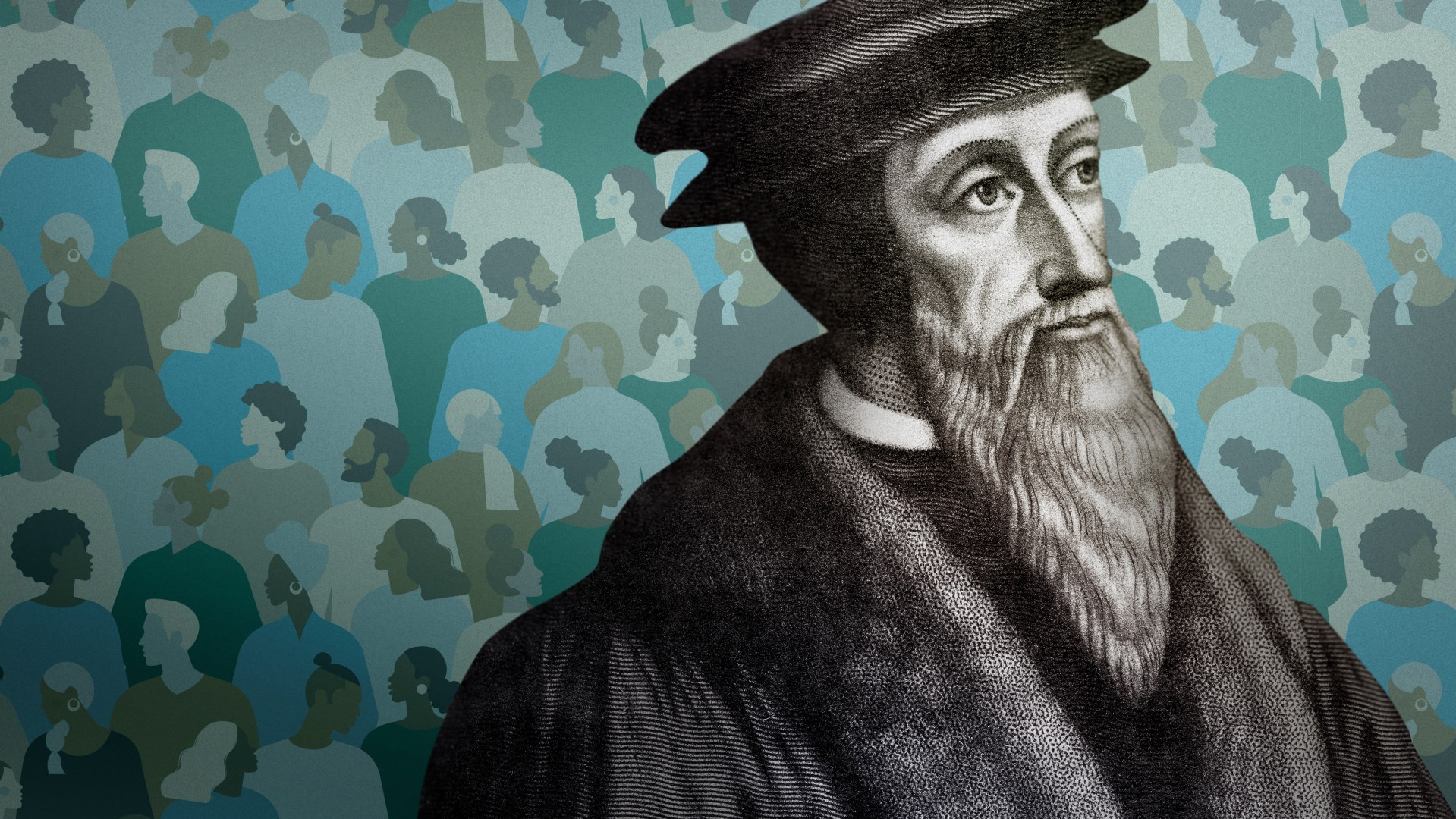
John Calvin: Justice Is a Form of Worship

According to the Reformer, pursuing the good of others is a way to love God.

Christian History September 10, 2020
Source Images: Lyubov Ivanova / Traveler1116 / Getty

In this series

Social justice is a fiercely debated concept among evangelicals today . Some believe it reflects “dangerous ideas” in secular culture or even “godless ideologies” rather than biblical Christianity. The notion is understood variously, and debate abounds as to whether Scripture ranks it as a “gospel issue.” Even the simpler term justice is subject to “competing visions.” Yet one thing is certain: Calls for justice in our society seem to only be increasing, and while some evangelicals have been struggling for justice for decades or even generations, today more and more are championing justice in some form.

Nevertheless, concerns remain for some. Is the gospel primarily about individual salvation, and do justice efforts detract from personal piety and evangelism? Just how important is justice to the Christian faith? John Calvin, a leading Protestant Reformer whose writings still influence theology and practice today, can help us think through such questions. For Calvin, justice is not a distraction from or tangential to the Christian faith but is integral to it.

While this might surprise some people today, John Calvin believed that we must act justly in order to live piously. Justice not only reveals personal piety but also is a means of living piously. What is more, justice is the meat and potatoes of what it means to love others. Many modern evangelicals don’t think along such lines. Perhaps a 16th-century French refugee who trained in law and served as a pastor can help us see more clearly the biblical portrait of the Christian life.

The Substance of the Christian Life

Many Christians rightly understand that the essence of godly living is captured in the maxim “love God, love others.” This is, after all, Jesus’ summary of the Law and Prophets (Matt. 22:36–40). Calvin agrees that such double love is what ultimately pleases God, and the Ten Commandments best summarize such a life. Though certain Old Testament laws (mainly ceremonial) have been fulfilled in Christ, the Christian life is detailed in the Ten Commandments and many of the Mosaic precepts that expound them. Commenting on the law in his magnum opus, The Institutes of the Christian Religion, Calvin writes,

First, indeed, we should be entirely filled with the love of God. From this will flow directly the love of neighbor. This is what the Apostle shows when he writes that “the aim of the law is love from a pure conscience, and of faith unfeigned” [1 Tim. 1:5]. You see how conscience and sincere faith are put at the head. In other words, here is true piety, from which love [for neighbor] is derived.

Calvin equates heartfelt love for God with faith and piety . Law-keeping, therefore, is no coldhearted service toward God that springs from a mere sense of duty. Rather, obedience that pleases God flows from sincere love for him. And love for God is the source of love for others. To refer to this second love, Calvin frequently uses the term “charity” (caritas in Latin). Thus, while Calvin understands love as the substance of the law, he also believes the essence of the law is described with more specific terms like “piety” or “faith” and “charity.”

For Calvin, the Christian life is profoundly active. Loving God and neighbor doesn’t entail simply refraining from evil—such as idolatry, adultery, theft, and so on. Loving God and others has as much to do with actively pursuing and performing what is spiritually good as it does with abstaining from evil. When we read divine commands, Calvin informs us, we must consider both the matter it treats and its opposite to fully understand what pleases God. The prohibition against murder, for example, requires more than not harming others physically.

As Calvin states in his Institutes, “The commandments and prohibitions always contain more than is expressed in words.” We must look beyond the mere words of the biblical text in order to understand the whole meaning of a precept. As Calvin scholar John Hesselink explained, “if interpreted literally” the commands are “limited in scope”; but as Calvin universalizes the commands and interprets them positively, they assume “tremendous breadth and depth.” If we think the Ten Commandments teach us only what not to do, then we have not grasped their true meaning.

The Order of Loves

Just as Jesus prioritizes love for God when summarizing the Law and Prophets, so does Calvin when expositing “the Decalogue,” or the Ten Commandments. Knowing and glorifying God is the ultimate goal of life. The first four commandments which summarize duties of personal piety, take priority because God created and redeemed us so we may worship him. And as Calvin exclaims in a sermon on the Decalogue, “the worship of God” is treated before commandments 5 through 10, commands on how to love others, “because it is impossible for men to act as they should toward their neighbors unless they are led by the fear of God.”

Although the first table of the Decalogue (Ex. 20:1–11) takes priority, the second table (Ex. 20:12–17) is by no means optional for believers and is in fact a way of worshiping God. Calvin even asserts that God tests our obedience to him in giving us the second table. Observing the second table, then, is one way we prove our faith. In a sermon on the Ten Commandments, Calvin exclaims that while we must first yield to God the worship he deserves, we must “live in such justice and equity with our neighbors that we demonstrate thereby that we are true children of God.”

The reason obedience to the second table proves the existence of piety and faith is that, as Calvin states in the Institutes, “the intention of the heart” is not always visible, and hypocrites “continually [busy] themselves with ceremonies.” As Reformation historian Elsie Anne McKee explains, “The order of precedence” in Calvin’s understanding of worship is “inward faith, outward acts of worship (ceremonies), and then love [that is, obedience to the second table]. Unhappily, ceremonies are always susceptible of distortion and hypocrisy. Thus, in some instances, love toward neighbor may better evince faithful worship of God than liturgical or devotional practices.”

This does not mean that personal piety is supplanted. After all, we cannot rightly love our neighbors unless we first love God. The two tables are inseparable, though distinguishable. Yet Calvin makes a provocative point while preaching on the Ten Commandments: People who suppose they can observe only the first table without also observing the second do not actually keep the first table. Or, as he writes in the Institutes, “Our life shall best conform to God’s will and the prescription of the law when it is in every respect most fruitful for our brethren” (emphasis added).

Loving others is a way of living piously toward God. Calvin even suggests that the good works that prove our righteous standing before God refer specifically to deeds of charity toward others and not acts of piety toward God. Although charity is subordinate to piety, “the observance of justice and equity towards men is … the means which we are to employ in testifying a pious fear of God, if we truly possess it.” Thus, while Calvin prioritizes piety, he sees charity as an indispensable means by which we express our love for God.

The Meaning of Neighborly Love

So what exactly does Calvin mean by charity, love for neighbor?

To modern ears, charity often connotes monetary donations. While Calvin certainly includes almsgiving as part of charity, he means far more than that. Translators rightly render Calvin’s use of caritas as “love,” yet Calvin’s notion of neighborly love is not merely sentimental, involving only warm feelings toward others. His understanding of the term has a wide-ranging meaning and cannot be reduced to either mere feeling or affectionless giving. As McKee states, “Caritas [for Calvin] is not only kindness or sharing, whether alms, hospitality, or vocational service; caritas is also justice—legal and personal.” For this reason, Calvin frequently refers to the second table, which summarizes love for neighbor, with justice and sometimes with terms like equity and kindness.

We see this in Calvin’s lectures on Ezekiel 18, a passage that emphasizes “justice and judgment.” According to Calvin, these are aspects of charity, or general duties of the second table. Calvin explains, “To do judgment and justice is nothing else than to abstain from all injury by cultivating good faith and equity with our neighbors: then to defend all good causes, and to take the innocent under our patronage when we see them unjustly injured and oppressed” (emphasis added). Obeying the second table, therefore, means actively seeking the good of others in addition to refraining from harming them. This is the essence of charity for Calvin.

More specifically, Calvin teaches—in his various treatments of the Decalogue—that neighborly love, or justice, consists in:

Rendering honor to authority figures, which includes respecting and obeying our parents and others in authority over us. Paying such honor, when it is due, preserves the order of society.

Promoting our neighbors’ physical and economic well-being. This includes seeking peace, helping others in physical and financial need, and openly opposing injustice.

Protecting our neighbors’ reputation, which includes affirming the truth about God and others, promoting and maintaining unity with others by our speech, and opposing slander and lies.

Preserving chastity. This includes not only upholding sexual propriety but also fighting for the rights of those who have been victimized by sexual misconduct.

Promoting our neighbors’ spiritual well-being, which includes praying for others (both Christians and non-Christians), warning others of their sin, and proclaiming God’s truth to others.

Calvin’s understanding of justice is profoundly social—that is, biblical justice ought to permeate society. And again, biblical justice includes far more than refraining from harming others. It requires intentional action toward just outcomes.

While it is impossible to retrieve all the ways Calvin believed Christians could or should exercise justice, it is clear that he understands justice—that love we extend to others—in broad terms. In his commentary on Hebrews 6:10, where he describes the good works or “labor of love” that God rewards, Calvin writes,

We are not to spare labor, if we desire to perform our duty towards our neighbors; for they are not only to be helped by money, but also by counsel, by labor, and in various other ways. Great sedulity, then, must be exercised, many troubles must be undergone, and sometimes many dangers must be encountered. Thus let him who would engage in the duties of love, prepare himself for a life of labor.

Loving others requires hard work and commitment, says Calvin, and it is quite extensive, taking on many forms. Charity, then, seems to be any assistance given to others in need, whether physically or spiritually, and any act that appeals to their rights.

The Reasons for Love and Justice

Calvin wants us to understand not just that love for God and love for neighbor are inextricably connected and that justice is integral to the double love. He also wants us to understand the reasons Christians are obligated to love and help others by seeking just outcomes.

First, God has united all humans together with a common bond, since all people are created in his image. In fact, we act “contrary to nature” if we “hate our [own] flesh,” Calvin preaches. The natural bond between all humans is the most basic reason we should seek each other’s well-being. Yet there is an even stronger reason why believers should exercise charity and justice: “they must remember that they are members of our Lord Jesus Christ and that there exists a more strict and sacred bond of nature which is common in all human beings.” For Calvin, therefore, there is an anthropological reason and a Christological reason, by nature of the Incarnation, why believers should exercise love toward others, both inside and outside the church.

Yet he also lists a theological reason. Commenting on Exodus 23:4—which commands Israelites to attend to their enemy’s wandering or struggling livestock—Calvin states that believers should “imitate their heavenly Father” by bestowing kindness upon both the worthy and unworthy. We should extend kindness indiscriminately because God has done so toward us and because loving our neighbor is a means whereby we express our love for God. In pursuing love and justice, we not only honor our fellow humans and demonstrate our piety but also become more Christlike and Godlike.

In an age when many Christians separate justice from piety, assume it’s sufficient to merely refrain from harming others, or reduce worship to songs of praise, Calvin would have us think again. For him, worship, piety, neighborly love, and justice are inextricably connected. Calvin gave justice significant attention in his understanding of what it means to love God and others. What might it look like if we did too?

Kevin P. Emmert (PhD, London School of Theology) is an academic book editor and former CT theology editor. He lives in Wheaton, Illinois, with his wife, Ashley, and two sons, Jack and Charlie. You can follow him on Twitter @Kevin_P_Emmert.

News
Wire Story

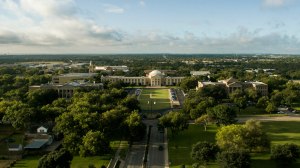
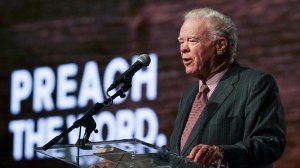
Southwestern, Baylor Sue Foundation that Shifted Support After Paige Patterson’s Firing

The schools were stated beneficiaries but say they lost their input in recent restructuring.

Christianity Today September 9, 2020
Courtesy of Southwestern Baptist Theological Seminary

Two Baptist schools in Texas have sued a charitable foundation they say is trying to misuse millions of dollars in assets.

Baylor University and Southwestern Baptist Theological Seminary filed suit Tuesday against the Texas-based Harold E. Riley Foundation and its board of trustees.

According to the lawsuit, the foundation was set up in 2002 by Riley, a wealthy businessman who died in 2017, for the benefit of the two schools. The schools were granted the freedom to name a majority of the foundation’s board and the foundation’s stated charitable purpose was to provide support for the schools.

In 2018, that changed, according to the suit.

The lawsuit alleges that the foundation’s board of trustees rewrote its bylaws—without notifying Baylor or Southwestern—and changed the charitable purpose of the foundation. As part of the changes, the two schools were also stripped of their ability to name board members.

“In short, Defendants have attempted to remove the Foundation’s only Beneficiaries from any governance roles while simultaneously restructuring the very nature of the Foundation,” according to the suit.

The changes were made without input from either school, according to the lawsuit. Baylor and Southwestern also claim the meetings where the changes were made were invalid.

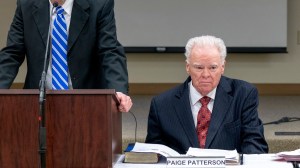
According to the suit, the changes to the foundation were made a few days after Paige Patterson, former president of Southwestern, was fired by the seminary’s board. Foundation President Mike C. Hughes, who served as vice president for advancement at Southwestern under Patterson, is named as a defendant in the suit.

Complicating matters, the foundation’s offices are located on the campus of Southwestern and its board members include people with close ties to Patterson.

The seminary sees the changes at the foundation as part of a pattern to undermine support for the school after Patterson’s departure.

“This is but the latest in a two-year pattern of attempts to divert support away from the seminary to other causes. We have sought relief with heavy hearts but firm resolve to expose and stop ongoing efforts to cause harm to our students and generous ministry partners,” Colby T. Adams, vice president of strategic initiatives at Southwestern, told Religion News Service in an email.

Neither Patterson nor Hughes immediately responded to a request for comment.

The suit alleges that the board sold off more than 700,000 shares in Citizens Inc., the company founded by Riley, but shared only a fraction of those proceeds with the schools.

Before the changes in 2018, a spokesman for Baylor said, the school had received $1.125 million from the foundation. Since 2018, it has received $250,000.

Board members are also accused of attempting to appoint foundation board members and their friends to paid positions on the board of Citizens Inc., in violation of the foundation’s own rules, according to the suit.

According to a separate lawsuit filed in Colorado, the foundation has the right to appoint a majority of members to Citizens’ board of directors because it owns Class B stock in the company. Earlier this year, according to the suit, the foundation board attempted to name Patterson and Hughes to the Citizens board. The foundation board also attempted to name three others to the Citizens board, all with ties to Patterson: David August Boto, a former vice president of the Southern Baptist Convention’s executive committee; Charles Hott; and J. Clinton Pugh.

That Colorado lawsuit claims that other board members of Citizens, who include former Oklahoma Gov. Frank Keating, “sought to impede Plaintiff’s voting rights and made up procedural requirements to wrongfully delay the five New Class B Directors’ appointments.”

Citizens Inc. did not immediately respond to a request for comment.

The two Texas schools say they want the foundation to return to its original purpose.

Adam W. Greenway, president of Southwestern Baptist Theological Seminary, said that Harold Riley and his family were longtime supporters of the school. He said the suit aims to ensure that the foundation serves Riley’s intentions as a donor.

“We have recently become aware of inappropriate manipulation related to board governance and apparent misapplication of funds by self-appointed rogue leadership of the foundation established in Mr. Riley’s name,” Greenway said in a statement. “We believe these individuals are attempting to undermine and overturn Mr. Riley’s expressed directives and are in violation of their fiduciary duties.”

Baylor President Linda A. Livingstone said Riley was a generous donor to the school and provided scholarships to students at Baylor’s Hankamer School of Business as well as support for Baylor’s library and athletic program. Riley also supported George Truett Theological Seminary at Baylor.

“It is frankly disheartening to have discovered that Mr. Riley’s legacy and the educational funding for future generations of Christian leaders appear to have been misused for purposes other than those identified by Mr. Riley,” Livingstone said in a statement.

Under the lawsuit, the two schools seek the removal of the foundation’s current trustees and a freezing of the foundation’s assets until the foundation’s original charitable purpose is restored.

“It is the strong desire of both Southwestern Seminary and Baylor University that this matter be resolved without the necessity of a trial,” Greenway said in a statement. “It is our further hope that we can settle this issue in the spirit of Christian charity by returning direction and control of the foundation to its beneficiaries and restoring the member status of both Southwestern and Baylor.”

News

Old Scars and New Wounds: Christians Comfort Lebanon’s Trauma

One month since the blast, emotional support comes from evangelicals, refugees, children, and other unexpected sources.

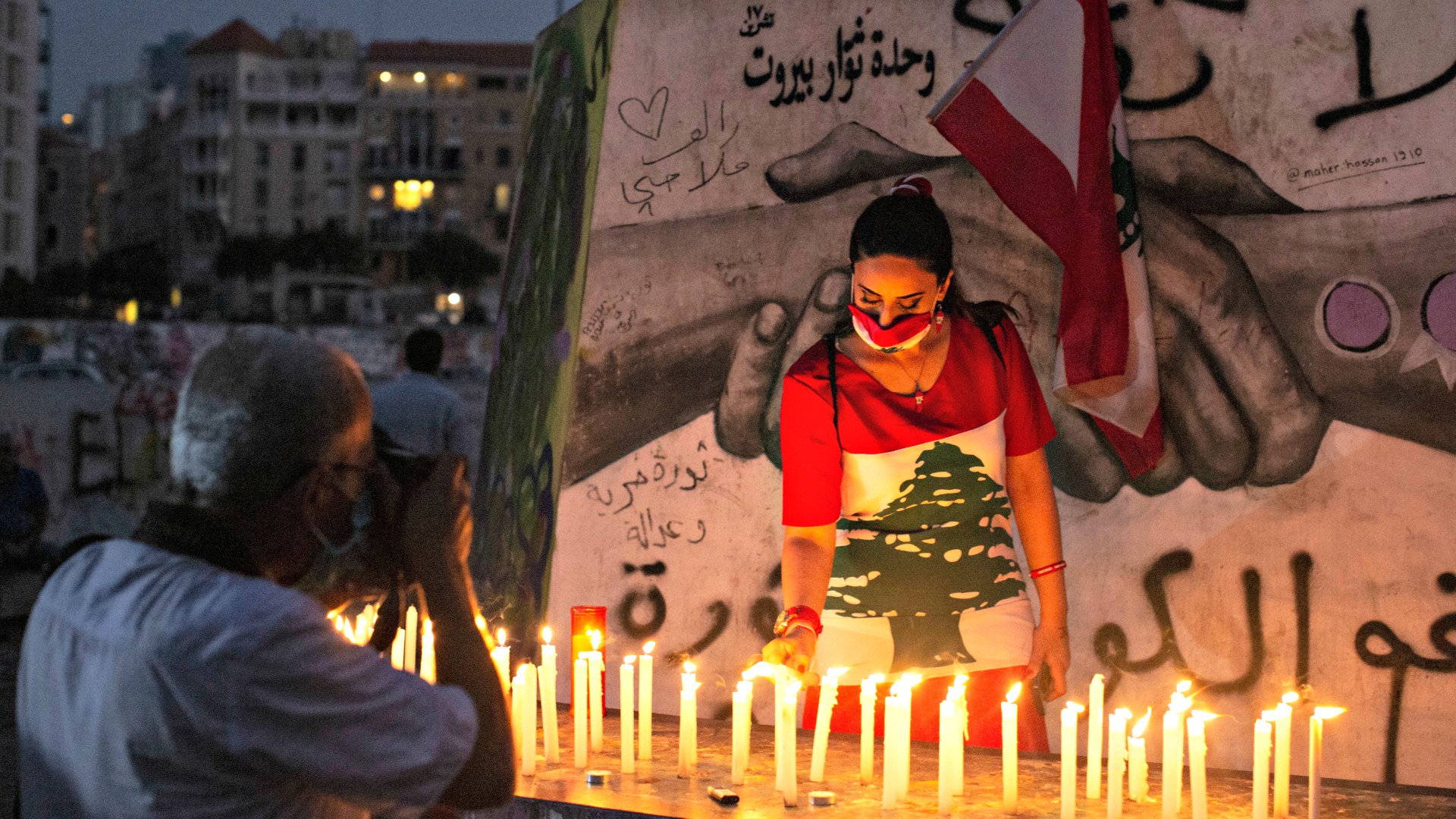
A woman wearing a Lebanese flag-themed dress participates in a Beirut vigil to mark one month since the huge explosion in the capital’s port.

A woman wearing a Lebanese flag-themed dress participates in a Beirut vigil to mark one month since the huge explosion in the capital’s port.

Christianity Today September 9, 2020
Sam Tarling / Getty Images

To a traumatized child, a teddy bear can make a big difference.

But as the handful of Lebanese evangelicals trained in counseling are emphasizing in the aftermath of the Beirut explosion, so can an ordinary individual.

“I don’t think the sit-with-a-psychologist model works with a communal culture,” said Kate Mayhew, country representative for the Mennonite Central Committee (MCC) in Lebanon.

“A lay person might be fearful of doing harm. But there is a lot they can do.”

There is a lot that needs to be done.

An impact assessment conducted by Strategy& in the worst affected neighborhoods of Beirut found that 3 in 4 respondents were suffering anxiety two weeks after the blast.

Nearly 7 in 10 were experiencing disturbing dreams, and 6 in 10 reported difficulty doing household chores.

And according to UNICEF, 50 percent of its respondents said their children were showing signs of trauma and extreme stress.

In the poverty-stricken Karantina district directly in front of the port, one child clutched a bag of distributed bread to his chest, rocking back and forth. Though by then such food was readily available, he was imitating the adults who fought and scrambled to grab their share in the first chaotic days of emergency response.

“He was the hungry kid, the frightened kid, and the active kid all combined in one,” said Mayhew. “He desperately wanted to show his parents he could also provide for his family.”

An MCC partner organization was already on the scene, having set up a mobile clinic and counseling sessions for the adults. Eventually they noticed the kids milling around, otherwise neglected by everyone.

So they created a camp-like setting in the neighborhood park. Rotating 40 children between eight stations, they played games, danced to music, and did artwork—activities experts say are essential for the emotional and spiritual processing of trauma.

And then each kid got a teddy bear.

“These kids are definitely traumatized, and lost so many of their toys,” said Joy El Kazzi, child protection officer for MCC. “It was great to see them able to smile.”

But as a Lebanese, Kazzi was in the minority. Most of MCC’s first responders were Syrians—refugees from war who experienced trauma themselves.

Long committed to psychological service, in 2012 MCC refocused its trauma training on Syrian refugees. After the explosion, the Syrians were prepared to help this new wound of their hosts.

But many Beirut residents were not ready to receive it—from anybody.

Evangelical churches and ministries were among the thousands of Lebanese volunteers who pitched in to sweep shattered glass, repair windows, and offer food to the broken city.

But as Anthony Ziade of City Bible Church conducted over 50 needs assessments in the immediate vicinity of his downtown congregation, only three people ticked the box for counseling.

“If you see a psychologist, it means you are sick,” he said. “No one will do that; it is the reality here.”

There is no similar stigma about receiving charity—Ziade agreed with 25 households to cover their basic repairs.

It is an honor and shame society, explained Smyrna Khalaf, a licensed marriage and family counselor and a professor at Arab Baptist Theological Seminary.

“Lebanese, especially men, want to look like they can handle things,” she said. “Women are less reluctant to admit their weaknesses, and seek help.”

But there is another factor involved, peculiar to Lebanon, said Celia Khater, chief counselor at Beirut Baptist School (BBS).

Lebanese pride themselves on their resilience.

Since 1955, BBS has emphasized both mind and spirit, so there is a greater appreciation for psychology among the 1,000 students and their parents. But when her team of three counselors reached out to the families to offer support, only a dozen or so responded.

Generation after generation of Lebanese have experienced war. And since October 2019, they have endured a popular uprising, the COVID-19 crisis, and economic collapse.

And now the explosion.

“Stability is the most important thing in the lives of children, but this year we didn’t even have one week of it,” Khater said.

“I expected more calls, but the Lebanese culture says ‘Khalas [enough], we can manage.’”

Given that 1 in 4 Lebanese have or have had a mental disorder, they do amazingly well.

“People are managing now, but scientifically the long-term impact starts one month later,” said Mia Atoui, co-founder of Embrace, a secular organization dedicated to raising awareness of mental health issues in Lebanon.

“Symptoms will fade for many, but hundreds will need ongoing psychological support.”

Including their children. Those who suffer an adverse traumatic experience in Lebanon are eight times more likely to develop a mental disorder as adults.

Khater is counseling one BBS preschooler constantly breaking all his toys. Pressed for the reason, he responds with two words: “The explosion.”

“I wish we had a well-trained team of Christian counselors, ready to help in times of trauma, whose names are known,” she said.

“The secular world has its own organizations, but we as a Christian community do not.”

The above statistics were compiled by IDRAAC, the Beirut-based secular organization founded in 1997 as the first mental health initiative in the Arab world.

After the explosion it opened a hotline, as did the American University in Beirut Medical Center. Embrace has operated an emotional support and suicide prevention hotline since 2017, in cooperation with the Ministry of Public Health. Such groups prioritize public awareness campaigns, to remove the mental health taboo from society.

“The priority for the church is to preach Christ,” said Tony Skaff, pastor of Badaro Baptist Church, who believes the techniques of psychology can be helpful though they will fall short of full healing, without the gospel.

“But these secular organizations push me. I wish that we could have helped them first.”

Unaware to many, there is a Christian ministry on standby.

“Sometimes there is not enough information,” said Maya Saleh, trauma healing coordinator for the Bible Society of Lebanon. “But we are not unknown.”

Since 2015, her team has conducted trainings through the Bible-based Trauma Healing Institute, affiliated with the American Bible Society. There are around 300 facilitators, 25 of whom have told Saleh they can be on call.

After the explosion, she offered them to several dozen churches and faith-based organizations in Beirut, to train others or to assist with healing groups. Last week, they reached 28 children in Ashrafieh, one of the neighborhoods hardest hit by the blast.

Some children had witnessed blood dripping down the faces of their loved ones.

The Strategy& assessment found 31 percent of Beirut families were “severely impacted.” This included 16 percent suffering a serious injury, 7 percent forced to relocate, and 5 percent grieving the death of a relative.

But given that Lebanese have endured historic trauma, they are well prepared to minister to others. That is the hope of Resurrection Church of Beirut (RCB), and filters into their team of about 50 clean-up volunteers—37 of which received basic training in psychological first aid.

“Most people are not aware they need mental health care,” said Khalaf, an RCB member. “But in cleaning their homes and giving supplies, you listen to their story and offer support.

“It is not formal, but it is therapeutic.”

She explained that the signs to listen for are mood changes, restlessness, anxiety, and a desire to be left alone.

They tell people this is normal, and answer many spiritual questions.

They also gently inform of therapy options. But in most cases, Khalaf said, if people are helped in the beginning, they won’t need much ongoing care.

“A meaningful response to an explosion of this volume—that brings healing to the soul—doesn’t require a curriculum, but a person and a community,” said Hikmat Kashouh, pastor of RCB.

“Our civil war experiences help us stand with the traumatized, as those with old scars can tend to new wounds.”

Sometimes, it is the children who do the healing.

During the cooped-up months of COVID-19, evangelical satellite TV provider SAT-7 launched its Allo Marianne program. Aiming to provide a safe space for children to express their emotions, they had no idea how necessary the show would become.

After the explosion, host Marianne Awaraji encouraged viewers to draw, to ask questions, and to worship. She also asked them to pray for their friends in Beirut.

The lines were flooded with callers throughout the Arab world—praying for their friends at SAT-7.

“Our goal at SAT-7 is to always support the kids,” Awaraji said.

“But now, they felt it was their turn to support us.”

Back in Karantina, however, few families would still have satellite TV. And one month since the explosion, there remain far too few Lebanese therapists to meet the mental health needs.

But with the minimum training, MCC’s Mayhew reminded, anyone can help.

“Emotional scars are just as serious as physical scars,” she said.

“And restoring people to wholeness is part of the gospel, as people created in the image of God.”

News
Wire Story

Bethel’s Sean Feucht Rallies ‘Worship Protest’ in Seattle

The tour, held in defiance of COVID-19 regulations, continues in Colorado, Minneapolis, and Kenosha, Wisconsin, in the week ahead.

Christianity Today September 9, 2020
Julia Duin / RNS

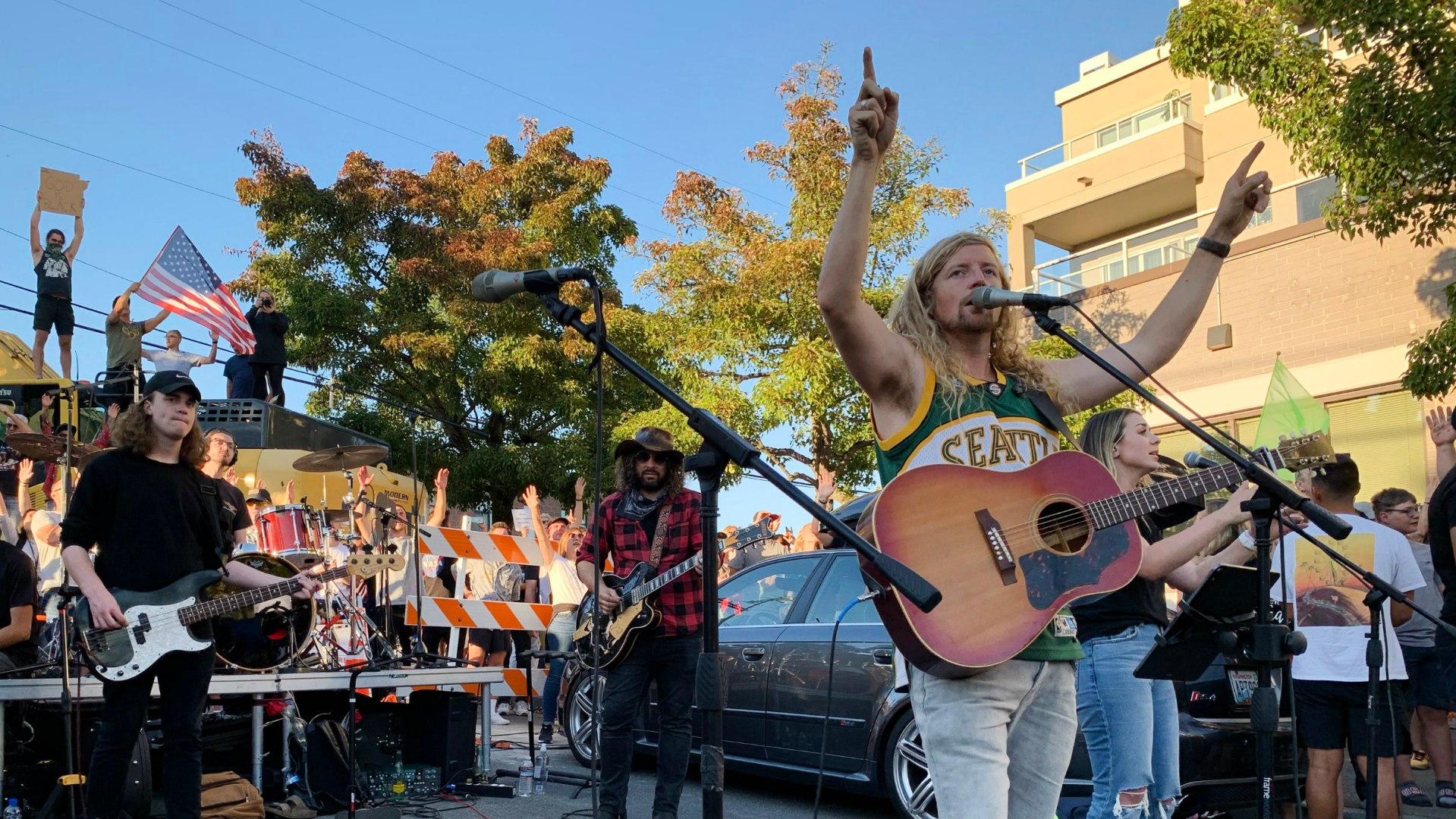
A battle of wills between a California musician known for a series of open-air Christian worship concerts around the country and the city of Seattle, which denied him a park venue for a Labor Day concert, ended with a two-hour “worship protest” being held one block north of the park.

A group of local pastors located an alternate site on a blocked-off portion of Meridian Avenue North only hours before the 6 p.m. concert was set to begin. They got permission to hold the rally with the proviso that it be called a “worship protest.”

Sean Feucht, 37, the rally organizer, laughed about the conflict with city officials while welcoming the crowd of 800 to 900 people.

“Welcome to Seattle’s largest worship protest,” he said at the beginning of a two-hour set. “Turn to each other and say, ‘Welcome to the protest.’ In this city, that makes it a legal gathering.”

Feucht had originally planned to hold a sunset concert at the picturesque 20-acre Gas Works Park on Seattle’s Lake Union. The concert was part of the #LetUsWorship movement, a series of protests against COVID-19 bans on singing and large group meetings in churches.

The musician held a similar event in August in the city’s CHOP (Capitol Hill Organized Protest) district, where the fact that few worshippers had worn masks raised eyebrows at Washington Gov. Jay Inslee’s office.

The governor has allowed outdoor worship gatherings of up to 200 people as long as masks are worn even while singing, people stay 6 feet apart, and there are no choirs or musical performances involving more than two people.

Feucht’s concerts, which have drawn thousands of spectators and worshippers at 21 gatherings around the country, ignore all those guidelines.

The events, a mix of Christian concert, healing service, guerrilla street theater and spectator mosh pit, feature the kind of public singing forbidden under many COVID-19 regulations. Earlier this summer, Bethel Church in Redding, California, where Feucht is a volunteer worship leader, issued a statement expressing concerns after an event in that city. The church had been concerned about the event and had been assured that a plan with COVID-19 precautions was in place.

“We agree that the plan did not get implemented to the level it needed to be at this gathering, and that is something that should’ve been addressed more seriously,” the statement said.

No one in Feucht’s five-piece band, nor his three female vocalists or a six-man video team, was seen wearing masks at his two Seattle concerts, where spectators were packed close together, making social distancing impossible.

On Friday, the city decided to shorten Labor Day hours at 16 of the city’s parks and to shut down Gas Works totally for the entire day. Although the city didn’t give a reason for the total closure, local media pointed to Feucht’s rally as the reason.

City workers erected a 6-foot fence for several blocks around the park, complete with large red signs announcing the closure.

“We want to come and bless this city,” Feucht told reporters before Monday’s concert. “We’ve not had one COVID case tracked back to our concerts. This is about blatant discrimination against Christians. They’re not doing this with other demonstrators.”

It was all, he said to the crowd minutes later, about the freedom to worship.

“Politicians can write press releases, they can make up threats, they can shut down parks, they can put up fences,” he said. “But they can’t stop the church of Christ from worshipping the one true God. We are here as citizens of America and of the kingdom of God and we will not be silenced.”

The hastily arranged set-up at a construction site on the dead-end street across from the park proved ideal for a concert. Flanked by a marine supply store on one side, an apartment complex on the other and a huge yellow bulldozer in the back of the set, the street and adjoining parking lot provided more than enough space for hundreds of worshippers to gather, sing and dance.

“We’re here as a peaceful protest,” said Megan Delahunty, 28, of Seattle. “They’re trying to shut down churches and in California, they’ve even banned singing (in churches).” In July, three organizations sued California over this ban.

“It’s obvious what their intent is,” she continued. “As goes California, so goes the world. There’s no reason to be silent. We’ve been silent for too long.”

Unlike the CHOP gathering, which attracted dozens of protesters who tried shouting down the concert, poured super glue onto one of the musicians’ keyboards and tried cutting off power to the concert generators, there were almost no naysayers at Monday’s concert.

Jade, 38, a man who refused to give his last name and who identified himself as a gay “nonaffiliated” Christian, brought a pack of 50 masks and tried passing them out to the crowd. As of a half-hour before the start, no one had taken any. “Passersby seemed to think God would keep them safe,” he said. “But I’ve seen a lot of hugging go on. This is a big deal for me.”

But Trevor, 42, a homeless man living in Gas Works Park who also would not give his last name, sided with Feucht’s crowd. “I think it’s horrible that people went to pray and the park got shut down,” he said. “People come here all day and drink, and no one shuts them down. And for the most part, people don’t wear masks here.”

The concert, which was livestreamed on multiple platforms, was about 90 minutes of singing and a half-hour of preaching and taking the offering. Feucht, who was dressed in a green-and-yellow Seattle SuperSonics jersey, beige cutoffs, and Birkenstocks, didn’t reveal how much it is costing him to mount nightly concerts in several dozen cities around the country before the November election.

But he did say a $50,000 check paid for the prior night’s open-air concert on the steps of the California state Capitol in Sacramento. That event, for which Feucht had a permit, attracted thousands in searing temperatures to hear him.

Feucht got the idea for the worship events in the spring, after a failed campaign for Congress.

Unhappy about losing the primary election, Feucht said, he was casting about for another purpose in life when COVID-19 hit the country and California began sanctioning worship meetings of all kinds.

In early July, after California Gov. Gavin Newsom had just laid more restrictions on churches, Feucht said he had to stand up to it all. He organized an impromptu July 9 concert on San Francisco’s Golden Gate Bridge that attracted 400 people for a worship service.

Feucht tried staging a second event, in San Diego, and it attracted 5,000. He knew he was onto something.

“So we declared a new Jesus movement,” he said on a recent podcast with lifestyle supplement entrepreneur David Harris Jr. “We feel this call to target cities under extreme turmoil, despair and brokenness. That’s why we’ve gone into downtown Portland a block from the riots; we’ve gone into CHOP in Seattle. God’s really writing a different story there. There’s a lot of people wanting to experience God in these cities.”

On Friday, Feucht and his team will head on the road for 14 more rallies, starting in Fort Collins, Colorado, and followed by concerts in Colorado Springs, Minneapolis and, on September 16, Kenosha, Wisconsin, site of recent riots involving the police shooting of 29-year-old Jacob Blake, a black man.

Feucht’s last rally will be on October 25 on the Mall in Washington, D.C.

Feucht isn’t saying what he intends to do after the presidential election, choosing instead to stage as many concerts as possible as long as the weather holds out across the country. Near the end of Monday night’s concert, he called up two police officers and had the crowd pray for them.

“We’ve seen people saved, healed, baptized and it’s probably a long time since the police have felt encouraged,” he said. “There’s a lot to celebrate tonight.”

Books
Review

Monuments Can Be Destroyed, but Not Forgotten

Our most controversial stone statues carry layers of communal history that aren’t easily cast aside.

Christianity Today September 9, 2020
Illustration by Rick Szuecs / Source image: Bruce Yuanyue Bi / Getty

In the Hebrew Scriptures, stone monuments are earthen witnesses to a sacred covenant. When Jacob contractually maneuvered himself out from under his father-in-law Laban, he set up a pillar in the highlands of Gilead. It was supposed to be a reminder of a legal separation, but the fragility of the peace was underscored by the dueling names given to the monument: Jacob’s in the Hebrew tongue, Laban’s in Aramaic. The monument was barely dedicated before it became an object of linguistic civil war.

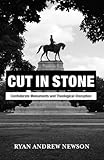
Cut in Stone: Confederate Monuments and Theological Disruption

Cut in Stone: Confederate Monuments and Theological Disruption

Baylor University Press

240 pages

$30.07

What’s old is new again. Disputes over historical markers and their meanings are simply the continuance of culture war by other means. Theologian Ryan Andrew Newson wrote his new book Cut in Stone: Confederate Monuments and Theological Disruption in the wake of the 2017 protests and counter-protests in Charlottesville, Virginia. Thousands of organized white nationalists infamously marched through the University of Virginia campus chanting language—“White Lives Matter!” “Blood and Soil!”—charged with centuries of racial supremacy. The material cause for the march was the threatened removal of a statue of Confederate General Robert E. Lee. Erected in 1924, the statue presented a genteel, handsome Lee—hat in hand, martial but not militaristic. The stone general is resigned but undefeated, like the Lost Cause he represents.

The statue lasted decades in the city center without scrutiny, but in the 21st century, it struck some as strange to venerate the leader of a rebellion devoted to the preservation of chattel slavery. Newson’s book delves into the history of Confederate monuments like this one, asking what sort of political ideology—or theology—underwrites them. What did these monuments—often constructed many decades after Lee resigned at Appomattox—mean for the communities that created them? What gave them their near-sacred value? And what is the appropriate political and theological response to markers of a contested American legacy? Can you—should you—erase a moral tragedy?

Remembering a Tragic History

When they were originally constructed, monuments to Confederate leaders and soldiers were remarkably free of cultural guilt. Hundreds of statues appeared in over 30 states in the aftermath of Reconstruction, as the South began to rehabilitate its image—and historical memory. As Newson points out in fascinating detail, the Confederacy was re-memorialized decades after its military defeat. Monument construction was most intense from 1890 to 1950, a span of time that unsurprisingly coincides with Jim Crow.

Other defeated nations and causes have wrestled with how to remember a tragic history. Germany after the Second World War underwent a therapy of historical penance that continues even today. The Confederacy, however, did not. Its monuments served a “palliative” purpose, Newson argues, aiming to “alleviate collective suffering without addressing the root cause of the pain.” So the stone figures stood as reminders of the genteel honor and heroic manhood of figures such as Lee, Stonewall Jackson, and Jefferson Davis—eliding their militant defense of chattel slavery. With these symbolic moves, the memory of slavery was quickly shunted into the distant past, even as its system of involuntary unpaid labor shifted from the plantation to the chain gang in the late-19th century and the systemic incarceration of African Americans in the 20th.

As a historical project, Cut in Stone focuses on the Reconstruction-era South, but Newson’s theological analysis touches more broadly on the nature of historical memory and the moral obligations of a political community that is still haunted by the sins of its fathers. Newson’s book was published in the middle of the summer of 2020—a wry moment of providence if ever there was one. While Charlottesville in 2017 provides the backdrop to the book, more recent events have made its subject matter even timelier.

I was invited to review Newson’s book the day that statues of Christopher Columbus were removed from Grant Park and Arrigo Park in my hometown of Chicago. A week prior, a confrontation between protesters and police had centered on the statue in Grant Park. As protestors attempted to topple Columbus by force, multiple people on both sides of the conflict were injured.

In the early-20th century, the monuments had been commissioned by Italian-American communities in Chicago to memorialize the Genoese explorer, who at that time evoked a spirit of exploration and American destiny. Forgotten for centuries was Columbus’s brutal subjugation of indigenous peoples—not to mention the mercenary motivations of his transatlantic voyages.

There’s a reason political communities—and movements—make myths about themselves. And not all of them are formed in malice or bad faith. We typically retell the story of the civil rights movement in heightened rhetoric that foregrounds its best ideals while leaving other details—including the moral peccadillos of its leaders—in the shadows. Only recently have we begun to tell the stories of grassroots figures like Ida B. Wells and Fannie Lou Hamer in addition to chronicling the (sometimes problematic) charismatic male leadership of Martin Luther King Jr. and Malcolm X. When a narrative has been told for decades, or centuries, it takes of lot of intention to reorder historical memory.

In Charlottesville and Chicago, historical myths finally cracked. The stone figures of Lee and Columbus, for different reasons, were not mere historical memories, but witnesses to some deeper sense of national or ethnic identity.

One of the blind spots of modern liberalism—the political philosophy, not the ideology—is its studied obliviousness to the sacral elements of social life and national identity. There’s a reason that the debate over stone structures reaches the fevered pitch that it does. You find out what a community reveres when the removal of its earthen symbols triggers charges of disrespect, violation, and even blasphemy. You find out what a revolution really seeks when you notice what the iconoclasts want to destroy.

Newson is appropriately circumspect when asking what the proper social or theological response ought to be toward Confederate monuments. There is no way to continue honoring the noblesse oblige of figures like Lee and Jackson without resorting to a moral naivete that is willfully ignorant of American history. The instinct to topple national idols is understandable. But does destruction lead to erasure? Is there a reason to remember the tragedies of American history in a way that acknowledges the complications of the past without giving honor where shame is due?

Handle with Care

This is where the virtue of prudence comes in handy, as virtues do. How do we distinguish among the different symbols—what they portray and what they represent for a variety of communities? If we decide collectively that honorific statues of Confederate military leaders should be removed, or perhaps limited to museum exhibits, should we do the same for Christopher Columbus, Thomas Jefferson, George Washington, or even Abraham Lincoln? All of these figures have come under scrutiny, often for good reasons.

On July 24th, the day Columbus came down in Chicago, one of the protestors made the statement that the statue symbolized negative values that the city needed to “acknowledge,” but also “divorce ourselves from.” The monument, she said, had “nothing to do with where Chicago is going and our future.” But that’s the tricky, sometimes awful thing about sacred symbols: Even though they are only made of stone, they carry layers of communal history that aren’t easily cast aside. Is it important to remember what Columbus represented to Italian-Americans at a time when they were also the victims of white supremacy? How does that piece of history need to be preserved once the idol has been toppled?

Chicago mayor Lori Lightfoot explained that the removal was “an effort to protect public safety and to preserve a safe space for an inclusive and democratic public dialogue about our city's symbols.” Which seems quite responsible in such tenuous and terrifying times. Putting a hold on things—providing space for deliberative liberalism to do what it does best—seems prudent.

And yet few, on the left or the right, seemed disposed to mimic the mayor’s temperament. Charges of lawlessness were thrown from one side, and charges of brutality and moral complicity from the other. Few seemed satisfied with the mayor’s actions—or if they were, they were reluctant to say it publicly.

Newson’s historical and theological analysis reminds us that a statue is rarely just a statue; stone pillars are usually consecrated to a cause—for better or worse. And while the past few summers of culture-warring haven’t come close to resolving every question of whether our most controversial monuments should stay up, come down, or go elsewhere, Cut in Stone provides a helpful framework for understanding the political and theological principles at stake.

Clearly, sacred objects ought to be handled carefully. And yet, sometimes their destruction—as with golden calves or stone tablets—is the more meaningful response. If Moses smashed stones etched by the divine hand in response to national idolatry, then what kind of iconoclasm calls to us today?

David Henreckson is the director of the Institute for Leadership and Service at Valparaiso University. He is the author of The Immortal Commonwealth: Covenant, Community, and Political Resistance in Early Reformed Thought.

Apple PodcastsDown ArrowDown ArrowDown Arrowarrow_left_altLeft ArrowLeft ArrowRight ArrowRight ArrowRight Arrowarrow_up_altUp ArrowUp ArrowAvailable at Amazoncaret-downCloseCloseEmailEmailExpandExpandExternalExternalFacebookfacebook-squareGiftGiftGooglegoogleGoogle KeephamburgerInstagraminstagram-squareLinkLinklinkedin-squareListenListenListenChristianity TodayCT Creative Studio Logologo_orgMegaphoneMenuMenupausePinterestPlayPlayPocketPodcastRSSRSSSaveSaveSaveSearchSearchsearchSpotifyStitcherTelegramTable of ContentsTable of Contentstwitter-squareWhatsAppXYouTubeYouTube