Books
Excerpt

My Generation Prized ‘Authenticity.’ Why I’ve Come to Love Wearing a Mask.

I’m only my truest self when I’m playing the role of disciple.

Gijs Coolen / Unsplash

When I was 15, I wanted very much to be real. Most of us did then: It was 1996, and we still believed in grunge. We wore flannels and Doc Martens and turned up our noses at anything that smacked of trying too hard, because trying wasn’t authentic. We thought social conventions were boring and fake, and that people should just be themselves instead of trying to be like everybody else. In my quest to be real, I eschewed makeup and fashion and pop music. When I came downstairs in the morning to go to school, barefaced, basic, my hair still in the damp braid I’d put it in the night before, my sister, destined to be a successful millennial, would raise her eyebrows and say, “You’re not wearing that to school, are you?”

Where Goodness Still Grows: Reclaiming Virtue in an Age of Hypocrisy

Where Goodness Still Grows: Reclaiming Virtue in an Age of Hypocrisy

Thomas Nelson

224 pages

$12.32

What was harder was figuring out how to be an authentic Christian. Within my church’s youth group, none of us wanted to be hypocrites in any way, especially when it came to faith. We were savvy and skeptical, independent minded, anticonsumerist, true to our true selves. What made our faith real was that we had chosen it ourselves, and it came from deep personal experience. We weren’t faking it.

But also it seemed like a lot of us were faking it.

Nowadays, instead of what we call authenticity, I’ve come to value masks and costumes, rituals and pageantry and ceremony—what theologian Kevin Vanhoozer calls “the drama of doctrine.” If we have any hope of a spontaneous, authentic spiritual expression at some point in our lives, it will only be born of the continual practice of choosing what is loving and right, cultivating the habits of virtue so that they may become natural, or second nature. Then, as Plato says, the mask, if worn long enough, may become the face. Or as my grandma used to say, if you keep making that face, it might get stuck that way.

Vanhoozer says that we ought to understand what it means to be a person differently than modern thinkers like Descartes did. When Descartes said, “I think, therefore I am,” he implied that to be human was mostly about having a brain—being an independent, disembodied mind whose existence depends on reason. But Vanhoozer argues that to be human is to be a person in conversation with others. I am a “communicative agent” called into existence by God, one “who can enter into dialogical relationship.” My selfhood is grounded in my divine creation and calling but exists in and is constructed by my conversations with others. My identity depends on how I respond to my “divine casting call,” how I embody the role I’ve been given, and how I engage with those around me.

I believe I am called to actively live into an identity that is my true one. There is nothing fake about assuming this role—fitting into its costumes, learning its lines, reciting them, or improvising them. Instead, my best chance for authenticity is born from embracing that role. The part I’ve been called to play is that of disciple, and, like a method actor, I must live into the role as best I can. I can’t expect the right response to emerge spontaneously—I have to practice and memorize until, yes, the lines become so familiar to me that I can speak them without even thinking about it.

How do we learn our parts? We study Scripture, allowing our minds to be shaped by the eschatological realities it teaches so we learn to see ourselves and our world correctly. We learn to see how we fit into the drama of redemption. Doctrine strips us of the false masks we give so much time and effort to maintain, allowing us to see ourselves truly as people who are called, known, and loved by God. Christ is in us, and the more we embrace that identity, the closer we come to living authentically.

So, actually, it’s not authenticity I oppose. What can move authenticity from being an adolescent virtue to a mature one is understanding that to be authentic is not to tap some inner well of individuality and spew emotion from there; to be authentic is to practice playing the disciple role I’ve been given in God’s drama until I inhabit it fully. I will inhabit it differently than anyone else, but I don’t seek to be unique; I seek to be conformed. When I am conformed to the image of Christ, I am more myself than I could ever be otherwise.

Taken from Where Goodness Still Grows: Reclaiming Virtue in an Age of Hypocrisy by Amy Peterson. Copyright © 2020 by Amy Peterson. Used by permission of Thomas Nelson. www.thomasnelson.com

Books

New & Noteworthy Books

Compiled by Matt Reynolds.

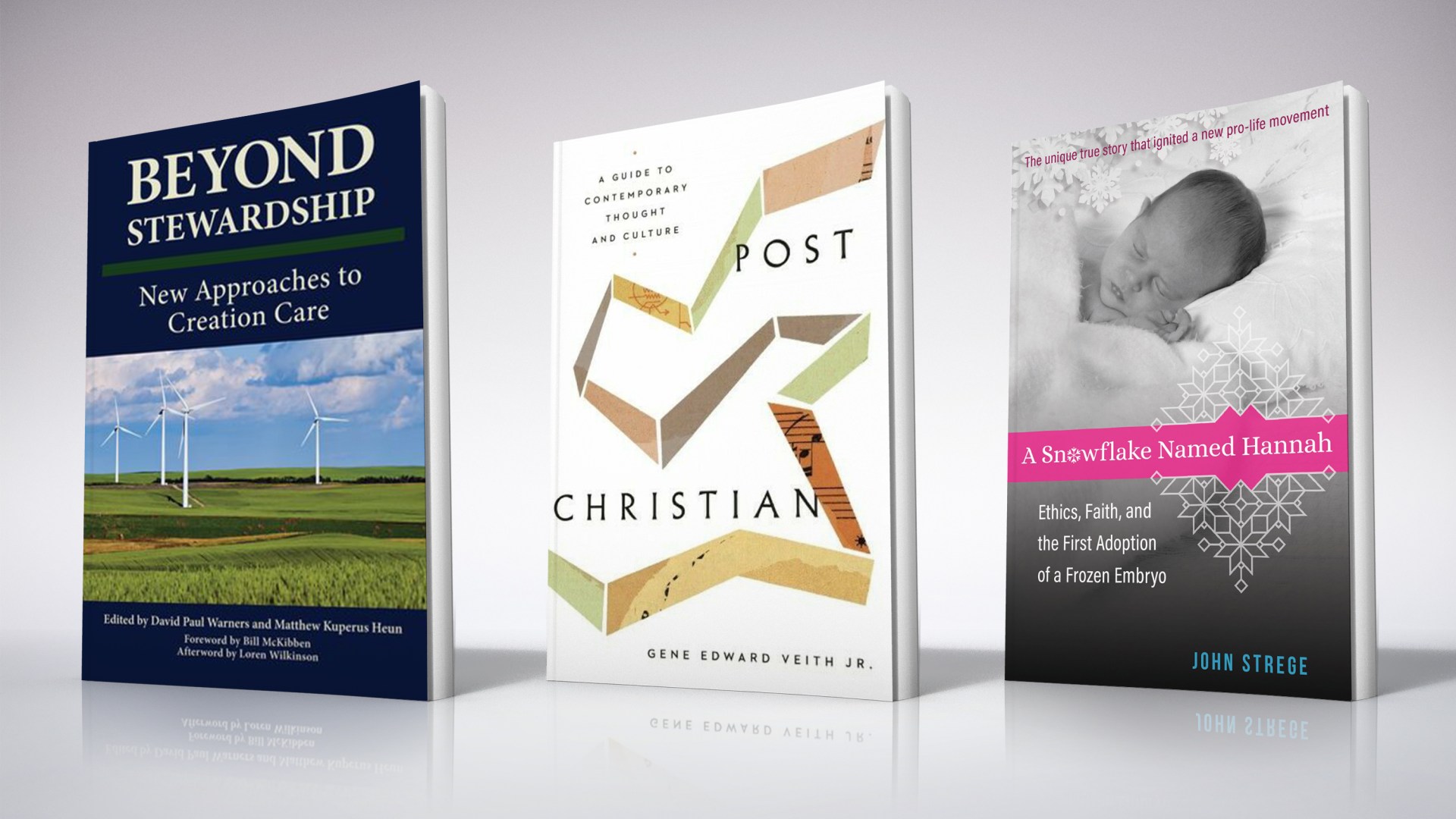
Beyond Stewardship: New Approaches to Creation Care

Edited by David Paul Warners and Matthew Kuperus Heun (Calvin Press)

Movements of Christian concern for the environment generally rally around the ideal of stewardship. They do this, in part, to guard against distorted interpretations of God’s call in Genesis 1 to “subdue” the earth and exercise “dominion” over its creatures. The contributors to this volume investigate whether “stewardship” language has its own underappreciated flaws. As editors David Paul Warners and Matthew Kuperus Heun write in their introduction, “If we understand that humans are simply stewards, the richness of our ‘job description’ is lost, and we become merely managers of the creation. We narrow the scope of our responsibility and absolve ourselves of many other tasks.”

A Snowflake Named Hannah: Ethics, Faith, and the First Adoption of a Frozen Embryo

John Strege (Kregel)

John and Marlene Strege wanted to have a child (infertility issues had interfered). They also wanted to take a stand for human dignity at a moment when scientists were seeking access to frozen human embryos for their research potential. The steps they took in response led to Hannah, recognized as the first frozen embryo to be adopted. As John, a writer for Golf Digest, explains in this memoir, “Our adoption of frozen embryos evolved into a cause greater than ourselves by igniting a pro-life movement of a different sort, and a necessary one as science began to outrace ethical considerations.”

Post-Christian: A Guide to Contemporary Thought and Culture

Gene Edward Veith Jr. (Crossway)

When Gene Edward Veith watched two hijacked planes slam into the World Trade Towers on September 11, 2001, he figured that postmodernism had exhausted itself as a viable belief system. The carnage in downtown Manhattan looked more like an objective reality than one socially constructed “perspective” among many. In Post-Christian, Veith, provost at Patrick Henry College, revises his earlier stance, arguing that postmodernism has reasserted itself in new guises, growing more aggressively intolerant of Christian truth claims along the way. The good news, he claims, is that increasing numbers of people are alarmed by the movement’s drift into “self-contradiction and catastrophe.”

Books
Review

Be Careful About Reading the Bible as a Political Guide

Without a mature understanding of God’s purpose for governments, we’ll default to the commonplace views of our culture.

Illustration by Mallory Rentsch

When it comes to determining how the Bible addresses political issues, its many related verses can feel like a massive sack of Legos. One person opens the sack and builds a car, another a brontosaurus, another an old Western town. With enough skill, you can build whatever you want.

Bible and the Ballot: Using Scripture in Political Decisions

Bible and the Ballot: Using Scripture in Political Decisions

Wm. B. Eerdmans

328 pages

$16.67

Want to make the Bible say welfare policies are bad? Find a proverb on laziness leading to poverty (Prov. 10:4). Want to say the opposite? Find another calling people to “defend the rights of the poor and needy” (Prov. 31:8–9).

The point is not that Proverbs contradicts itself. All these passages say something true. But we lack clear rules for knowing how any one of them should guide today’s public policy. Further, we too often witness people and parties exploiting the Bible for their purposes.

Longtime Westmont College professor Tremper Longman III brings his Old Testament expertise to bear in The Bible and the Ballot: Using Scripture in Political Decisions. The book offers counsel on how to read Scripture politically, followed by what Longman believes the Bible teaches on ten public policy issues of our day: nationalism, religious liberty, war, abortion, criminal justice and capital punishment, immigration, same-sex marriage, the environment, poverty, and racism.

Institutional Awareness

Most of what Longman offers about how to read the Bible politically is sensible. He argues that the Bible does not provide us with specific public policies, only general principles we should take seriously. I agree entirely.

Longman offers good, solid principles of interpretation. They include paying attention to a book’s genre and original context and taking account of continuities and discontinuities between the Testaments, especially the way in which a Christian reading of the Old Testament recognizes Christ’s fulfillment of all things.

Yet Longman’s approach is insufficient because it lacks institutional awareness. Let me explain. Suppose I place a list of evening “to dos” for my wife on my desk at work, but my assistant thinks it’s for him. Why am I returning a new pair of oven mitts to Bed Bath & Beyond? he wonders. The confusion arises because my wife and I inhabit one institutional structure, my assistant and I another, and interpreting such a to-do list means minding those structures.

Longman rightly observes that the rules binding Old Testament Israel cannot transfer directly to the New Covenant church. Yet we also need to ask which to-do lists the Bible gives to the governments of the nations. What is their purpose? What authority do they receive? The Old Testament prophets indict the nations for injustice. In Israel’s case, however, the indictment is for injustice plus idolatry. That’s significant because, in covenantal terms, the United States and Kenya stand closer to ancient Egypt and Rome than to ancient Israel and the church. By the same token, we must distinguish between church authority and individual Christians, who can work in government.

In short, reading the Bible politically requires institutional awareness, not just a few principles of interpretation. When we encounter Proverbs’ instructions regarding the poor, for instance, we need to read them through that institutional filter, just as my assistant needs to interpret the “to do” list through the filter of “Is this for me or for your wife?”

Without institutional and covenantal sensitivity, we pick up our Bibles and default to what feels right in our time and place. For instance, Longman feels politically burdened by Israel’s civil laws concerning foreigners. Why not by its moral laws concerning adultery or honoring one’s parents? Perhaps because it’s literally unimaginable today that the government might draw from Israel’s laws on sexuality.

Longman denies that his own previously held political views influenced his reading of Scripture. Indeed, he observes that Scripture changed his views on some matters as he studied for this book. Which is well and good. But with few exceptions, his views fall left of center (by 21st-century American standards) on nearly every issue. He’s reluctant about war. He would accommodate undocumented immigrants. He fears climate change. He pushes hard on caring for the poor. He calls for race reparations. He questions the justice of capital punishment due to racial disparities. He says the church shouldn’t impose its sexual ethic when it comes to same-sex marriage. And he seeks a “third way” on abortion, arguing that “there may be wisdom in making abortion rare and safe,” with the implication that it’s also legal, as Bill Clinton’s infamous triplet had it.

It concerns me when any Christian’s political positions match, point by point, a well-defined constellation on America’s left–right spectrum. You see the first two or three stars, and you know where the rest will flash. Perhaps this is my own idealism, but I’d like to think that working from Scripture would yield some unexpected combinations, like someone who is staunchly pro-life and pro-reparations, or pro-traditional marriage and pro-environment.

Troubling Chapters

Longman’s chapters on religious liberty and abortion are worth unpacking at greater length. Starting with the former, Longman observes that “Christianity was birthed in a culture that had virtually no religious liberty.” From this, he concludes that religious liberty, “in short, is not a biblical principle.” Why the first-century Roman government’s position counts as the Bible’s is unclear.

Later: “Neither the Old Testament nor the New Testament suggests that religious liberty is a right or even necessary for God’s people. What the Bible insists on is that God’s people stay faithful in the midst of whatever circumstances they encounter.” The latter sentence is both true and important. Yet one wonders whether Longman has considered the biblical argument for religious freedom. It’s not a difficult case to make. First, God authorizes governments to prosecute crimes against human beings, but nowhere (except in the nation of Israel) does he authorize them to prosecute crimes against himself—idolatry, blasphemy, false worship, and so on. After all, there could be no proportional punishment, and certainly no way to compensate him.

Second, governments exist for the common-grace purpose of creating platforms of peace and order on which the storyline of redemption can proceed. There’s a reason God’s covenant with Noah, which authorizes coercive authority (Gen. 9:5–6), precedes his call to Abraham (Gen. 12). Paul reaffirms this. In Acts 17, he tells us that God established the boundaries of the nations “that they should seek God, and perhaps feel their way toward him and find him” (v. 27, ESV). In 1 Timothy 2, he tells us to pray for kings and authorities so that we may live peaceful lives pleasing to God, “who wants all people to be saved and to come to a knowledge of the truth” (v. 4). Governments exist, ultimately, to serve the purposes of worship. We need safe streets so that we can get to church. Common-grace platforms serve special-grace purposes, like teaching your children to read so that they can read the Bible.

The abortion chapter might be even more worrisome. Longman believes “the Bible does not speak to the issue of when life begins and only indirectly to the status of the fetus in the womb.” Then he walks through each passage suggesting otherwise—including “you knit me together in my mother’s womb” (Ps. 139:13)—and argues that they don’t mean what pro-life Christians assume they mean. Instead, he believes that “a fetus is the potential of life rather than a human person with all the rights of a birthed child.”

What’s left unstated is why he would assume “the fetus” is not a person, a human being, a God-imager. On what basis does he de-personify or de-humanize the child in the womb? The Bible doesn’t do that. It treats the unborn and the born as one thing—a human person.

Whether intentionally or not, Longman has smuggled in modern constructs of “personhood.” Pro-choice ethicists like Peter Singer grant that an unborn entity possesses human DNA. But these writers create the philosophical category of person to maintain distinctions between the unborn entity and a rights-possessing human. Being a person requires “viability,” “sentience,” or something similar. Once you dehumanize people, killing them is easier. (Historically, this has been the strategy of regimes bent on wiping out a class of people.)

Longman affirms that abortion is “sin,” but he explicitly denies that it entails breaking the sixth commandment against murder. Apparently, the offense is less significant, which is why we can feel slightly less bad about abortion and can focus on keeping it “safe.”

Inconsistent Guidance

Longman is correct in claiming that the Bible offers no “one size fits all” formula for engaging culture. Yet the Bible does offer a coherent political theology—that is, a coherent theology of justice and law, religion and government.

Longman’s apparent failure to work out this theology leaves his counsel, at best, inconsistent. On certain issues (immigration or the environment), he draws pretty directly from the Old Testament. On others he sounds like a philosophical liberal (same-sex marriage and abortion) or a quietist (religious liberty). In one moment, he rejects the view that God governs the civil realm and the church by different norms, saying this led to complicity with nazism. But his rationale for granting legal status to same-sex marriage strongly resembles this “two-kingdoms” view he claims to disavow. He looks askance at “morals legislation” in the chapter on religious liberty but makes moral arguments elsewhere. He should know, of course, that every law depends upon a moral evaluation.

You will learn much about the Bible from The Bible and the Ballot, especially when it comes to Scripture’s witness on caring for the poor. But for guidance on applying the Bible to public policy, it’s probably best to look elsewhere.

Jonathan Leeman is the editorial director for 9Marks and an elder at Cheverly Baptist Church in Bladensburg, Maryland. He is the author of How the Nations Rage: Rethinking Faith and Politics in a Divided Age (Thomas Nelson).

Books
Review

Religious Parents Are Remarkably Similar, Even When They Belong to Different Religions

In over 200 interviews, sociologist Christian Smith and his colleagues discovered a striking degree of consensus on the fundamentals of bringing children to faith.

Brimstone Creative / Lightstock

What are the beliefs that guide religious parents as they attempt to pass their faith down to their children? When sociologist of religion Christian Smith, collaborating with doctoral students Bridget Ritz and Michael Rotolo, interviewed over 200 of America’s more religious parents, his team expected to find diverse answers to this question. Instead, they discovered surprising uniformity.

Religious Parenting: Transmitting Faith and Values in Contemporary America

Religious Parenting: Transmitting Faith and Values in Contemporary America

Princeton University Press

312 pages

$26.42

Although there are many differences between, for example, a white, conservative Protestant and a Thai Buddhist immigrant, when asked about their beliefs regarding the meaning of life, how the world works, their hopes for their children, and how all that informs their approach to parenting, the answers were remarkably similar. It was as if they had been indoctrinated in a particular way of thinking. There were occasional disagreements, of course, but mainly over matters the parents themselves considered secondary.

In Religious Parenting: Transmitting Faith and Values in Contemporary America, Smith and his co-authors summarize the de facto American religious parenting catechism this way:

Parents are responsible for preparing their children for the challenging journey of life, during which they will hopefully become their best possible selves and live happy, good lives. Religion provides crucial help for navigating life’s journey successfully, including moral guidance, emotional support, and a secure home base. So parents should equip their children with knowledge of their religion by routinely modeling its practices, values, and ethics, which children will then hopefully absorb and embrace for themselves.

Each chapter summarizes a key cluster of parental beliefs (“The Purpose and Nature of Life,” “Religion’s Value and Truth,” “Children, Parenting, and Family,” and “The Whys and Hows of Religious Transmission”). Within each summary, the authors dive into more specific ideals and practices, illustrating the high degree of consensus with extensive quotes from their interviews.

The book concludes with a chapter that draws on the surprising uniformity in how Americans think about religious parenting to propose a revised understanding of how cultural influence works. As it turns out, ideas really do matter, but the beliefs and assumptions that parents actually live by are much harder to change and often less orthodox than religious leaders might hope.

From the perspective of congregations and religious traditions, the book’s findings are a mixture of good and bad news. Religious parents take their responsibilities seriously and do not believe in delegating their children’s faith formation solely to local congregations. (This contradicts some claims made by leaders in the evangelical family-ministry movement.) Parents appreciate congregations that provide appealing youth programs and some instruction in the faith, but they do not expect much beyond that. As a result, many religious parents don’t invest much in their congregations.

In the interviews, some parents mentioned the importance of prayer, the Bible, or distinctive doctrines relating to salvation and the afterlife, but for the most part their concerns were rooted in the here and now. As the book’s findings suggest, parents tend to value religion for its assistance in navigating the journey of life, being happy, having “good values,” and becoming one’s “best self.”

More than anything, parents seem to fear that their children will come under the influence of bad messages or bad people, or that they will rebel against their religious upbringing because the parents push too hard. So parents tend to ease off—focusing, for instance, on setting an example rather than actively initiating conversations about faith.

Perhaps because they were so fascinated by the commonalities they found, the authors were too often guilty of neglecting to inquire further into underlying theological beliefs. After all, their theory of culture would suggest that even if religious parents don’t readily converse in well-articulated theological concepts, this doesn’t mean that theology is absent from the way they think and act.

Smith and his colleagues have given us a revealing picture of what parents in the pew actually believe. There is a broadly consistent American culture of religious parenting, and this book tells us what it is like. The next step is figuring out how the church can help parents build on its strengths while correcting some of its weaknesses.

Thomas E. Bergler is professor of ministry and missions at Huntington University in Huntington, Indiana. He is the author of The Juvenilization of American Christianity (Eerdmans).

Books

The Many Faces of Narcissism in the Church

Sometimes it appears in the pulpit, and sometimes it festers behind the scenes.

Illustration by Mallory Rentsch / Source Images: Xtian Designs / Lightstock / Dlerick / Getty Images

Like all the signature vices of humanity, narcissism has existed since time immemorial. But according to Chuck DeGroat, who has long counseled pastors with narcissistic personality disorder (and the congregations they have afflicted), the problem has reached epidemic proportions in today’s churches. DeGroat, a professor of pastoral care at Western Theological Seminary, shares the lessons he’s learned in his latest book, When Narcissism Comes to Church: Healing Your Community from Emotional and Spiritual Abuse. Benjamin Vrbicek, a pastor in Harrisburg, Pennsylvania, interviewed DeGroat about developing a biblical understanding of narcissism and recognizing how it operates within the church, among leaders and laity alike.

When Narcissism Comes to Church: Healing Your Community From Emotional and Spiritual Abuse

When Narcissism Comes to Church: Healing Your Community From Emotional and Spiritual Abuse

IVP

200 pages

$7.09

What motivated you to write this book?

The real impetus came from pastors, counseling practitioners, and laypeople affected by narcissism. I’ve heard about it from people who had served under a toxic lead pastor, from wives married to emotionally abusive husbands, and from folks serving in organizations marked by a narcissistic culture. All of them, in one way or another, challenged and sometimes begged me to write, and I continually resisted. But as I became more and more convinced of the utter epidemic of narcissism in the church, I decided to move forward.

What is a lay-level definition of narcissism, and what are the typical expressions in local churches?

When we think of narcissism, we typically think of the characteristic grandiosity, an excessive need for admiration, an inflated ego and sense of self-importance, troubling relationships, and—an especially key one for me—lack of empathy. We see pastors who love the stage but manipulate and sometimes abuse people. Often we see very gifted leaders who seem to have inspiration and impact, but who are shepherds who wreak havoc on the flock.

But we’ve also got to remember that there are narcissists who exist behind the scenes, who might not need the stage but who require excessive attention and admiration from spouses, who play the victim and manipulate in subtle ways. In fact, in this book I offer what I call the “nine faces of narcissism.” I think that will be an important contribution that helps people see the many nuances of how narcissism is expressed.

Do narcissistic pastors generally have any awareness of their own narcissism?

I think that those humble enough to be curious about the possibility of narcissism are unlikely to be pathologically narcissistic. It’s laudable when a pastor is willing to embrace candid feedback from members of the congregation about their experience of him or her, whether it is positive or negative. Leaders with a diagnosable form of narcissism are most definitely not curious about how others experience them or humble enough to own it.

I often tell people that even if, according to a psychological assessment, you are elevated on the narcissistic spectrum, that does not necessarily mean that you are pathologically narcissistic. Psychologists talk about “healthy narcissism” in children, in particular, which is evidenced in healthy self-confidence and engagement in the world. There are many healthy leaders whom someone might be tempted to call narcissistic but who are basically secure and healthy human beings.

Stereotypical implosions of a pastor and a church might involve the pastor running off with money or the secretary. To what extent do you think narcissism functions beneath more obvious, visible culprits of church dysfunction?

Narcissism comes in many different packages. Some narcissistic pastors seem humble, even godly. Some use language that seems to convey a sense of self-awareness or sorrow over sin. But true narcissists use whatever tools they can find in their toolbox to manipulate and confuse.

I often think of a narcissistic pastor who served in a rural setting in a very small church, who by all accounts was diligent and godly but who constantly compared his church to other churches with an attitude of judgment, lauding his church’s orthodoxy while quietly condemning other local pastors. His excessive self-admiration came through private judgmentalism, and he demonstrated a lack of empathy in his incapacity to build relationships with others.

We tend to focus on any narcissism in the lead pastor because that position tends to be most visible. Can this focus cause us to overlook narcissism among influential laity?

I’ve seen powerful laypeople undermine churches on their own. I’ve seen them control leadership decisions and candidacy processes. In one church, a particularly powerful person behind the scenes seemed to pull the strings of all the mechanisms of the church, and most parishioners lived in fear of her. I think this can be particularly insidious, and it brings great harm to the church.

How can the church better take the plank of narcissism out of its own eyes?

Humility, humility, humility. Are we willing to hear how others experience us? Are we willing to self-evaluate? I recall the story of a larger suburban church that was not well-loved by the smaller churches in the area, but when a new and humble pastor took the lead position, he made it a point to meet each local pastor, one by one, in order to gain a better understanding of how his church had impacted them. It was beautiful and humble.

Some clinicians are skeptical about the prospect of substantial change for someone with narcissistic personality disorder (NPD). The subtitle of your book holds out hope for healing. Does the healing you envision for the broader community also involve the healing of individuals given to narcissism?

I am skeptical, too. But because I believe in the dignity of every image-bearer and because I believe that sin—even sin that manifests itself through personality disorders—is not the core of a person, I do remain hopeful. I have fewer stories of hope, to be sure. Many are unwilling to do the hard work of removing the mask and becoming vulnerable. But I can’t abandon hope.

I rarely read unsolicited books people give me with the same urgency as they are presented to me. How would you suggest a parishioner best share your book with church leaders?

I certainly don’t think the “read this—it might be about you” approach will be helpful! I do, however, believe that you’re living under a rock if you’re not aware of the many stories of toxic pastoral leadership and abuse in the church. If I could be bold and hopefully not narcissistic, I think it would be a responsible thing for every pastor, every leadership team, and as many laypeople as possible to read this book to better understand themselves and the systems they exist within. I’m hoping it will help people better understand how narcissism plays itself out more privately in abusive relationships as well as in more public ways.

Considering the gravity of the abuse that’s come to the light over the past five years, the outlook could seem bleak. But to me, your book exists as a sign of hope. What encourages you?

What encourages me most is that women and men of courage are stepping forward to say, “This is not Christ’s vision of the church, of leadership, of relationships.” They are demanding more of us as leaders. They genuinely long for Christlike humility. And they are willing to do the hard work of dismantling toxic systems and relationships, of naming harmful realities, of moving toward hope and truth in love. It also helps that I travel broadly and meet pastors of great integrity and churches serving the kingdom humbly. Lesslie Newbigin once said that because of his faith in Christ he was “neither an optimist nor a pessimist.” That is a sentiment worth hanging onto.

News

Despite a Murder and Visa Denials, Christians Persevere in Turkey

(UPDATED) After Andrew Brunson’s release, foreign evangelists find it increasingly difficult to stay and serve.

Source Images: Congin Kim / Annie Spratt / Unsplash

Editor’s note: This print piece has been updated with the Association of Protestant Churches’ 2019 human rights report, released March 5.]

Five days after her husband’s murder, Jung Kyung-In named her newborn daughter “God’s Goodness”—in Turkish, not Korean.

Jung moved to Turkey with her husband, Kim Jin-Wook, in 2015. The Korean Christian couple found a place to live in an impoverished district of Diyarbakir in southeastern Turkey, 60 miles from the Syrian border. Kim worked selling spices, but his real calling, as he understood it, was witnessing to the gospel. He took the Turkish name “Peace,” and his Christian friends in Turkey say he was a great evangelist.

“He shared the gospel in every corner of Diyarbakir without hesitation,” said Ahmet Güvener, pastor of the Diyarbakir Protestant Church, which has about 70 members. “He was not aggressive, but clear, and I think local people were uncomfortable with this.”

One day in November, Kim told Jung he was going out to evangelize. He was attacked on the street, stabbed twice in the chest and once in the back. Kim, 41, died of his wounds in a city hospital.

Authorities arrested a 16-year-old boy for the crime. He has allegedly confessed to the murder, saying he was trying to steal Kim’s phone.

Despite her grief, Jung saw this as an opportunity to testify. She wrote a letter to the boy accused of killing her husband.

“I do not understand why you did this, but I cannot be angry at you,” she wrote on her phone. “Many people want the court to give you a heavy punishment. But I and my husband don’t want this. We pray that you become worthy of heaven, because we believe in the worth of people. God sent his Son Jesus, who forgave those who persecuted him. We also believe in that and we pray that you would also repent of your sin.”

Jung read the letter aloud to the local media. Her testimony was viewed online more than 22,000 times.

Turkish officials released American minister Andrew Brunson from prison a year and a half ago, under pressure from President Donald Trump. Since then, Turkey has not arrested any more foreign Christians. That doesn’t mean things have gotten better for the churches in Turkey, though. Some believe Kim’s murder was a covert continuation of an anti-Christian policy. Güvener suspects it wasn’t a simple mugging, but an assassination.

The 2019 Human Rights Violations Report, prepared yearly by Turkey’s Association of Protestant Churches (APC), noted Kim’s murder. But it stated that hate crimes against Christians decreased overall.

Hate speech, however, continued to rise.

Data Source: Association of Protestant Churches / Source Images: AFP / Getty Images / Congin Kim

Turkey is officially secular. Its constitution forbids religious discrimination and permits conversion. But the nation’s Muslim majority can be hostile toward non-Muslims. In a town near Ankara, billboards warned children not to befriend Christians or Jews.

The Diyarbakir Protestant Church regularly receives threatening phone calls, and one time young men gathered and pelted the church with stones. According to Güvener, police have taken no action.

Güvener started his church in 1994 but couldn’t get it legally registered as an association until 2003, when pressure from the European Union led the Turkish government to change the law.

Today, there are about 7,000 Christians in 150 congregations affiliated with the APC. About 16 percent are house churches that are not technically allowed to meet. This has not typically been a problem but can put them in a precarious position.

The yearly report noted that three congregations were able to register as “religious foundations.” While this path represents a positive development, the state has still not granted the APC an official religious legal identity.

Bruce Allen, executive international director of Forgotten Missionaries International, told Mission Network News he thought boys were being used as part of an organized harassment campaign. “If minors are caught, their sentencing is typically less severe than sentencing for adults,” he said. That would also be true of murder charges. Based on reports from his contacts inside Turkey, Allen speculates that minors have been used in “a number of assassination attempts against Christians.”

In 2006, a 16-year-old boy murdered a Catholic priest in Trabzon, in northeast Turkey, on the coast of the Black Sea. A year later, five Turks under 21 murdered two converts and a German Christian working at a publishing house in the southeastern city of Malatya. The day after Kim was killed, another Turkish evangelist received death threats, according to Allen.

Some observers are cautious about that interpretation, though. “In this case, I don’t yet see evidence of a wider organization behind the murder, but there is certainly wider hate,” said Mustafa Akyol, senior fellow on Islam and modernity at the Cato Institute. “When certain minorities are demonized by ideological narratives, some extremely fanatic people act on these perceptions.”

For now, the APC is withholding judgment and asking questions.

“It is difficult to believe this is a random murder,” said Soner Tufan, spokesman for the APC. “But nobody can say it was because of his Christian activities, because we have no proof. Still, we have questions, and we want answers to these questions.”

There are other signs of increased pressure on the churches since Brunson’s release. The APC is concerned about a wave of visa denials and a dramatic increase in deportations.

The APC report specifically documented 35 foreign Protestants barred from entry—among them 17 Americans and 3 Koreans—affecting over 100 individuals when family members are counted. It’s a sharp increase that seems to have followed Brunson’s return to the US.

Three foreign pastors were deported from Izmir, the city where Brunson ministered, after Brunson was released. Brunson has been trying to advocate for them and others, and has submitted a list of names to the US Commission on International Religious Freedom (USCIRF), hoping it can intervene.

Blocking foreigners from entry into the country is a way of depriving Christian churches of educated leaders. Turkey strictly regulates religious education in the country, which has led to the closure of the historic Greek Orthodox Halki seminary.

“The service and support of foreign pastors and lay persons [is] crucial,” said USCIRF chair Tony Perkins. “The Turkish government should end these expulsions and allow Christians to train and educate their future religious leaders.”

While many foreigners have not been given a reason for why their visas were canceled or denied, World Watch Monitor reported that some were informed they, like Brunson, are considered a threat to national security.

“Some foreign Christians think that Turkey is getting worse,” Tufan said. With Kim’s murder, they have begun to wonder if “being here is taking a risk to die.”

Many Christian workers are nonetheless committed to staying in Turkey. Seyfi Genc, a writer for Hristiyan Haber—“Christian News” in Turkish—said the foreign Christians’ commitment to the gospel and to Turkey is incredibly moving.

“I know one,” Genc said, “who prepared his gravestone—in Turkish!”

Genc attended Kim’s memorial service in Istanbul, bearing witness to the man who committed to being a witness for Jesus. Four hundred people attended, Genc reported, half Turks and half Koreans.

In Diyarbakir, where Kim lived, there was another memorial service with about 180 Christian Turks and Koreans. Güvener spoke, reminding those gathered that they should not be surprised to suffer persecution.

“The history of the church is written in blood,” Güvener said, “and if we think these events are strange, we are alienated from the life of Christ.”

He reminded the Christians that their debt had been paid, but now there is something they owe: “We owe it to Mr. Kim’s death for the kingdom and love of God,” he preached. “We need to carry on the unfinished task in Diyarbakir and continue to share the good news.”

Jayson Casper is Middle East correspondent for Christianity Today .

News

Christian Martyr Numbers Down by Half in a Decade. Or Are They?

New report shows dramatic change, but some are skeptical.

Source Images: Classen Rafael / EyeEm / Getty Images

The number of Christian martyrs worldwide has fallen by half in a decade, according to the Center for the Study of Global Christianity at Gordon-Conwell Theological Seminary. Although 800,000 Christians were killed in the 2010s, that was significantly lower than the 1.6 million Christians killed in the 2000s, according to the center’s most recent report.

When it comes to tracking global trends in Christianity, the center leads the field. Since it was founded as the World Evangelization Research Center in Kenya in 1965, and then relaunched as the Center for the Study of Global Christianity in 2003, CSGC has monitored a range of global trends, including changes in denominations, populations, conversions, and martyrs.

The good news about the decline of martyrs will be met, however, with skepticism. CSGC’s calculations result in a much higher total than those of other groups that track these numbers. Open Doors, for example, reports 4,305 Christians were martyred in 2019. A researcher with the International Society for Human Rights estimated the number is about 10,000 annually.

CSGC puts annual deaths at approximately 90,000.

The difference is due to competing definitions. Open Doors and others define persecution as “any hostility experienced as a result of identification with Jesus Christ.” CSGC, by contrast, defines martyrs as “believers in Christ who have lost their lives prematurely, in situations of witness, as a result of human hostility.”

The critical question is why a person was killed. Whereas many evaluate the motive of the persecutors, CSGC’s definition prioritizes the motive of the person who is killed.

“For us,” said Todd Johnson, codirector of CSGC, “the important thing is they are killed for their faith in a situation of witness.”

From that perspective, CSGC considers Christians killed in civil wars, including the violent conflicts in the Democratic Republic of the Congo and South Sudan, to be martyrs. The ends of the Second Congo War in 2003 and the Second Sudanese Civil War in 2005 account for a significant portion of the decline in CSGC’s martyr count.

According to Johnson, the CSGC definition is the traditional way Christians have looked at martyrs. Jim Elliot and the four other missionaries killed by the Waorani tribe in Ecuador were attacked because the natives feared they were cannibals, but it was the faith of the missionaries that put them in such a dangerous situation. Dietrich Bonhoeffer’s executioners weren’t targeting Bonhoeffer because of his Christian faith. The Nazis killed him for participating in a plot to kill Adolf Hitler, a dangerous task he undertook because of his Christian commitments. Same with Martin Luther King Jr. and Joan of Arc.

And if this is true of individuals, can it also be true of whole communities, like the 1.5 million Armenians slaughtered by the Turkish government a century ago?

At Bicknell Park in Montebello, California, a monument stands in memory of the victims of one of the worst genocides of the 20th century. A plaque explains that the “Armenian Martyrs Memorial Monument . . . is dedicated to the 1,500,000 Armenian victims of the Genocide perpetrated by the Turkish Government, 1915–1921, and to men of all nations who have fallen victim to crimes against humanity.”

“Which of these is greater evidence of evil?” Johnson asked. “When one person is killed, it’s evil. But when a million people are killed, it’s another kind of evil. I think they both need attention.”

Some religious freedom experts say this definition of martyr is too loose. Judd Birdsall, a former US diplomat who served at the State Department in the Office of International Religious Freedom, has frequently spoken out against CSGC numbers. Birdsall appreciates how CSGC brings attention to violent situations but worries that bestowing the term “martyr” on so many victims will diminish the term’s significance.

“Christians understand that ‘martyr’ is a really powerful posthumous title,” he said. “A broad definition that results in something like 100,000 deaths per year being classified as martyrdoms greatly cheapens the term.”

Birdsall says the extremely high numbers can undermine important work on behalf of the persecuted. They can make people doubt the veracity of persecutions—or lead to misunderstandings.

Some, for example, have cited CSGC to claim that Christian persecution is worse that it’s ever been. In 2016, Pope Francis said, “When we read the history of the early centuries, here in Rome, we read about so much cruelty to Christians. It’s happening today too, in even greater numbers.”

Mark Rutland of the missions group Global Servants made similar comments three months later: “The brutality of the first-century Roman persecution was real and those early martyrs should be honored, but in all of human history, the most dangerous time to be a Christian is actually right now.” Both comments were based on conclusions drawn from CSGC reports.

Johnson stands by the CSGC data but acknowledges it’s wrong to conclude that persecution is worse now than at any period in history. “The numbers are high, but much lower than they were in the 1970s. It’s bad now and it’s pervasive, but compared to what was happening 40 years ago, things are much better statistically,” he said.

Birdsall worries touting such high numbers could actually make conflicts worse.

“It’s certainly important to quantify the fatalities in a given armed conflict and to explore the complex ways religious narratives and religious affiliations may have been used in mobilizing, or mitigating, that conflict,” he said. “My fear is that by giving thousands of victims the potentially polemical status of ‘martyrs’ we risk further sacralizing violent conflict and exacerbating sectarian tensions.”

Christians have, of course, always venerated martyrs. As Christianity spread in the Roman Empire, believers expected persecution. According to Ed Smither, dean of the College of Intercultural Studies at Columbia International University, early church leaders celebrated the lives and legacies of martyrs during corporate worship. Augustine preached sermons about two North African women, Perpetua and Felicitas, who were killed for converting to Christianity in A.D. 203. He urged listeners to imitate their heroic faith.

Gina Zurlo, who codirects CSGC with Johnson, said the center also wants to spur believers to action.

The researchers at Gordon-Conwell are also just not convinced, in the end, that their numbers are wrong.

“Everyone tells me the numbers are too high, but I wonder if they’re not high enough,” Johnson said. “It’s a difficult thing to do this. It’s not an exact science. I don’t think we’re overestimating.”

Megan Fowler is a contributing writer for Christianity Today .

Our March Issue: Us vs. Us

How to let go of our precious personal versions of orthodoxy.

Illustration by Mallory Rentsch / Source Images: Rod Long / Unsplash / Urfinguss / Getty Images

Late last year, minutes after we published an online editorial by then-editor in chief Mark Galli about President Donald Trump’s fitness for office, the phones in CT’s offices began ringing off the hook. They did not stop for days. Written responses, numbering in the tens of thousands, poured in by mail, email, social media, and online forms. They were both negative and positive toward the editorial’s position. Many readers mentioned being moved to tears of joy.

As is often the case, however, those motivated enough to pick up the phone were overwhelmingly upset. Their recorded messages fell largely into two categories. Many spoke “from one Christian to another,” admonishing CT with the spirit (if not always the gentleness) of a pastor correcting a wayward member of the flock. But others spoke more like a judge at a sentencing hearing, declaring Galli, or every employee of CT, to be an apostate worthy of varying punishments (sometimes articulated with admirable creativity!).

What struck me most were lines that broached questions of orthodoxy; “I would not even call you a Christian,” one caller said. “Honestly, I don’t even think there are many real Christians left in the church anymore.”

Orthodoxy is essential. It is the rails on which religion runs. At the same time, two millennia of Christian infighting clearly demonstrate how fraught it is to browse the catalogs of Scripture and church history trying to assemble right doctrine. It gets even thornier when we stretch orthodoxy beyond the confines of doctrine and apply it to the gray areas of our everyday social and civic lives, as we inevitably will.

It’s not news that, no matter our personal views, we tend to sanctify them and condemn everyone else’s. Nor is it unique to Christianity—entire regions of the world are tinderboxes where the faithful are poised to strike against the faithful. And when we’re not sure where to limn the borders of social or civic orthodoxy, we’re tempted toward extremes: either contracting the limits to exclude nearly everyone, or expanding them so broadly that limits become meaningless.

Our cover story this month, about an Old Testament prophet’s unexpected answer to this conundrum, was in the works long before Galli’s editorial was written. It’s certainly not the first time the case for communal confession has been made in our polarized era. But it is a case worth making again and worth careful reading, reflection, and discussion. One of communal confession’s many powers is to check our affection for our imperfect personal versions of orthodoxy, reminding us that the boundaries around holiness are narrow indeed and that, apart from grace, we are, every one of us, stuck outside looking in.

Andy Olsen is managing editor of Christianity Today. Follow him on Twitter @AndyROlsen.

Testimony

I Assumed Science Had All the Answers. Then I Started Asking Inconvenient Questions.

My journey from atheist dogma to Christian faith was paved with intellectual and spiritual surprises.

Stephen Voss

I had an unusual childhood for an American. Members of my extended family were union organizers and left-wing radicals, and my parents had even been members of the American Communist Party. My indoctrination in the dogmas of communism and atheism was deep and long lasting. At the same time, my father gave me a love of science and reason, and he taught me the importance of asking questions. These gifts, along with my training in scientific thought and research, eventually cracked open the prison cell that held my soul captive during those early years.

The Works of His Hands: A Scientist’s Journey from Atheism to Faith

The Works of His Hands: A Scientist’s Journey from Atheism to Faith

Kregel Publications

256 pages

$15.05

Breaking free was a slow process, akin to chipping away at a dungeon door with a dull spoon. Early on in life, my curiosity led me to ask questions. I saw contradictions in some of what I had been taught. If humans were a blind product of evolutionary chance, with no special purpose or significance, then how could the stated goals of socialism—to advance human dignity and value—make sense? And if religion, particularly Christianity, was really such a terrible historical evil, then why were so many Christian clergy members involved in the civil rights movement?

As I studied science and began my research career in biochemistry and molecular biology, I formed a passionate attachment to a life of knowledge rooted in the scientific worldview. I found comfort and joy in the beauty, complexity, and wisdom of the scientific description of reality. But I also began wondering whether there might be something more to human existence than science and pure reason.

Surprising Discoveries

At this point, the question of faith was off the table. I knew that evolution was true and the Bible (which I hadn’t actually read) was false. I knew that a supernatural god living in the sky was a fairy tale. I knew that science held the keys to unlock all mysteries. Or did it?

I was disturbed to learn that, according to science, some things are actually unknowable. It is impossible to know, for instance, the position and speed of an electron simultaneously. This is a critical feature of quantum mechanics, even though it makes little rational sense. If the uncertainty principle is true (and it must be, since so much modern technology is based on it), then how valid is the idea of a purely deterministic and predictable world?

I also began to contemplate other questions. Where did the universe come from? How did life begin? What does it mean to be a human being? What is the source of our creativity—of art, poetry, music, and humor? Perhaps, I thought, science cannot tell us everything.

Now I was beginning to seriously wonder about the whole religion thing. I met Christians who were smart and scientifically minded, and for the first time I attended a church service. I was surprised at what I found. Nobody glared at me with suspicion, and I heard no thundering condemnation of sinners. The pastor spoke about the power of love. The people next to me shook my hand and wished me peace. It was all quite beautiful, and I decided to return.

Then I read the Gospels and had another shock: I found them beautiful and inspiring. So far as I could tell, they carried the ring of truth. And the Book of Acts struck me as actual history, not at all like a fictional account concocted to enslave the masses—the kind of reading my Marxist upbringing would have conditioned me to affirm.

The door to my prison cell was swinging open, and I stood there gazing out onto a new world, the world of faith. Yet I was afraid to fully leave. Suppose I was being fooled, misled into a trap? I remained stuck in that place of indecision for several years. And then the Holy Spirit pulled me over the threshold.

It happened one day while I was traveling alone on the Pennsylvania Turnpike in the rural middle part of the state, with a long way to go. Turning the radio on, I heard the unmistakable voice of an evangelical Christian preacher, the kind I used to mock and avoid. But this preacher was really good. I have no idea what he was saying, but his voice and inflection were mesmerizing and I listened for a few minutes before turning the radio off. Driving in silence for a while, I began wondering how I would sound if I ever tried preaching—after all, I always liked to talk. I laughed a bit, thinking about what I could possibly say. The first thing that came to my mind was something about science—how, if there were a God, he might have used science to create the world.

And then something happened. I felt a chill up and down my spine and could hear myself speaking in my mind—preaching, in fact. I could see an audience in front of me, people in an outdoor stadium, dressed in summer clothing. I pulled the car over to the right lane and slowed down. It was not a vision exactly, but it was intense. I knew I wasn’t making the words up—I was listening just as much as the audience.

I talked about knowing that Jesus loves me. With a voice full of passionate emotion, I assured the crowd that whatever their sins might be, they were no worse than my own, and that because of Christ’s sacrifice on the cross we could all be saved. I explained that God’s love is more powerful than any other kind and that anyone can have it without deserving it.

At some point during this experience, I had pulled over onto the shoulder of the road, where I sat behind the wheel crying for some time. I had never considered the things “I” had been saying. Some of the concepts were unfamiliar. The only explanation I could fathom was that the Holy Spirit had entered into my life in dramatic fashion. “Thank you, Lord,” I said out loud in between sobs. “I believe, and I am saved. Thank you, Lord Jesus Christ.”

Joy and Release

When I recovered my composure, I was aware of a great feeling of joy and release. I had no more doubts, no trace of hesitation—I had crossed over, stepping over the ruins of my prison cell into my new life of faith. From that day onward, my life has been devoted to the joyful service of our Lord.

Today, I am an active member of my church and have served as lay leader for several years. I am a fellow of the American Scientific Affiliation, the largest organization of Christians in the sciences, and the vice president of its metropolitan Washington, DC, chapter. I also serve as editor in chief of the ASA’s online magazine God and Nature. I assist my wife, who is codirector of a local charity that distributes food to the needy. I am an active online evangelist.

Along the way, I made many discoveries. I learned about the power of the Bible as a guide from God to the central questions of our existence. I learned that the true purpose of science is to describe how things are, not to engage in misplaced speculation about why the world is the way it is. I learned that modern atheist taunts about the purposelessness and meaninglessness of the universe and our own existence are not only false but destructive. Most importantly, I learned that nothing I have learned came through my own merit, but only from the grace of our Lord, whose love and mercy are beyond understanding.

Sy Garte is a biochemist who has taught at New York University, the University of Pittsburgh, and Rutgers University. He is the author of The Works of His Hands: A Scientist’s Journey from Atheism to Faith (Kregel Publications).

Ideas

The Old Testament Twins We’ve Forgotten

Columnist; Contributor

Jacob and Esau get all the attention. Yet it’s another pair of brothers who reveal the heart of the biblical story.

Source Image: Wellcome Collection

There are two pairs of twins in Genesis, but most of us only notice the first. Jacob and Esau get the headlines: the smooth wheeler-dealer who becomes the father of the Israelites and his hairy, oafish twin who gets tricked out of his birthright for a bowl of soup. By contrast, Perez and Zerah (Gen. 38) fly under the radar. They don’t appear in kids’ Bibles, or even sermons. Yet in many ways, they summarize the biblical story more crisply than any other siblings in Scripture.

The twins are born to Judah and Tamar, the product of an incestuous relationship between a father and his daughter-in-law, whom he thinks is a prostitute (another story omitted from kids’ Bibles). Judah will become the tribe of kings, so it matters greatly which twin gets the inheritance. During childbirth, one brother’s hand emerges first, and a scarlet thread is tied around his wrist to confirm that he is the heir. But when he withdraws his hand, his brother barges past and is born first. The line-jumper is named Perez, which means breach or breakthrough. The one with the scarlet cord is called Zerah, which means dawn or rising. In those two names is found the heart of the gospel.

The world looks for a Zerah. We want a king who rises up and shines like the dawn. We want the firstborn, with a mark of royalty on his fist. But God chooses Perez, the boy of the breach, the child of breakthrough. He wants the sort of king we never would choose: a younger, weaker boy, without the obvious signs of kingship, who only triumphs because God breaks through on his behalf.

This is the plotline of Genesis. Again and again, the “rising” that looks impressive loses out to the “breakthrough” that doesn’t. Human power rises up like the Tower of Babel and comes to nothing. Meanwhile, God makes a breach using an elderly couple in a tent. Older brothers (Cain, Ishmael, Esau, Reuben) fall; younger brothers (Seth, Isaac, Jacob, Judah) receive an inheritance. Natural fertility, based on the “rising” of human flesh, leads nowhere. The promises come through the women who wait for a breakthrough: Sarah, Rebekah, Rachel, and Tamar herself.

The life of David, likewise, is a Perez-versus-Zerah story. There are Zerahs everywhere: the seven older sons of Jesse who look impressive; King Saul, who rises head and shoulders above everyone else; Goliath, who rises nine feet tall and grasps the obvious symbol of victory in his fist. But they are each overcome by the last-born, harp-playing, stone-throwing shepherd boy, as he trusts the God of Perez to break through for him. David remembers this lesson as he ascends to the throne. He defeats the Philistines and names the battle site Baal Perazim, exclaiming, “As waters break out, the Lord has broken out against my enemies before me” (2 Sam. 5:20). Soon after, when one of his men touches the ark of the covenant and is immediately struck dead, the fear of God falls on David, who names the place Perez Uzzah, because “the Lord’s wrath had broken out against Uzzah” (6:8).

All of this helps to explain why Matthew’s genealogy of Jesus only names one person—Zerah—who is not an ancestor. Family trees don’t usually work this way. After all, there is no Ishmael in the genealogy, no Esau, no Reuben, Levi, or Ephraim. But Matthew feels compelled to record that Judah was “the father of Perez and Zerah, whose mother was Tamar” (Matt. 1:3). Jesus is a Perez rather than a Zerah. He does not have the obvious sign of royalty on his fist. He does not rise taller than everyone else. He wasn’t even conceived through the ordinary rising of human flesh, but only through the Lord who bursts forth, the God of breakthrough.

Ultimately, in one of those beautiful ironies only a sovereign God could orchestrate, Jesus is worshiped around the world for his rising, for bringing about the dawn of a new world. His fist now holds the symbols of royalty. But even his zerah is a perez. His rising is a breakthrough, a breach in the walls of death and hell, a bursting forth of the Lord against his enemies. Praise be to the boy of the breach.

Andrew Wilson is teaching pastor at King’s Church London and author of Spirit and Sacrament (Zondervan). Follow him on Twitter @AJWTheology.

Apple PodcastsDown ArrowDown ArrowDown Arrowarrow_left_altLeft ArrowLeft ArrowRight ArrowRight ArrowRight Arrowarrow_up_altUp ArrowUp ArrowAvailable at Amazoncaret-downCloseCloseEmailEmailExpandExpandExternalExternalFacebookfacebook-squareGiftGiftGooglegoogleGoogle KeephamburgerInstagraminstagram-squareLinkLinklinkedin-squareListenListenListenChristianity TodayCT Creative Studio Logologo_orgMegaphoneMenuMenupausePinterestPlayPlayPocketPodcastRSSRSSSaveSaveSaveSearchSearchsearchSpotifyStitcherTelegramTable of ContentsTable of Contentstwitter-squareWhatsAppXYouTubeYouTube