Books

Christian Parents’ Mistakes Aren’t the End of the Story

Q&A with author Kara K. Root about anxiety, trust, and raising kids well.

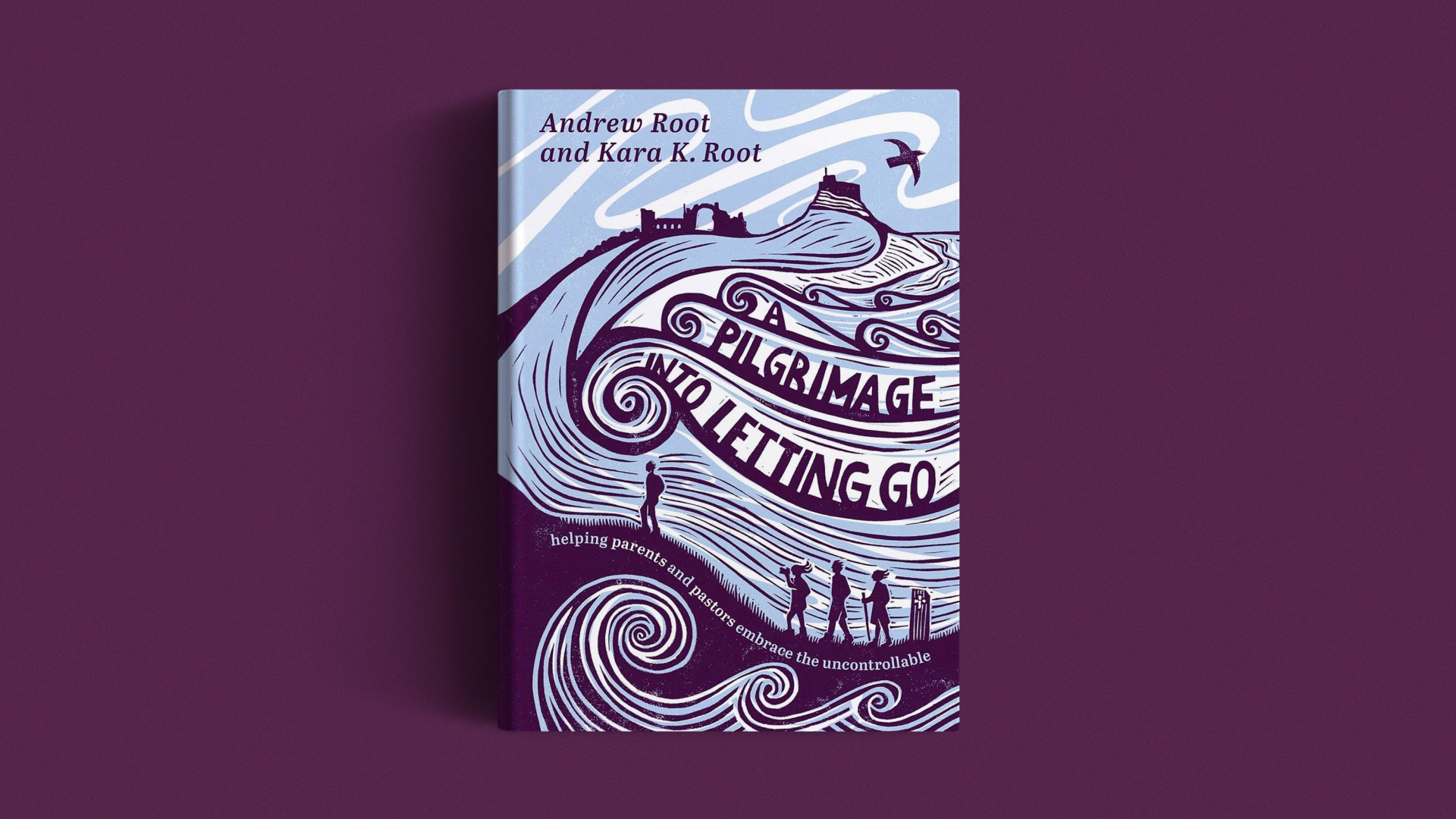
The book cover on a purple background.
Christianity Today September 11, 2025
Illustration by Elizabeth Kaye / Source Images: Getty, Brazos Press

A few weeks ago, the morning after some squabble I now can’t recall, my eldest daughter and I were alone in the car. A tense silence was still hanging heavy between us. “I’m sorry for how I acted last night,” I said. “It’s your first time to be 14, and it’s my first time to be a mom of a 14-year-old, and sometimes I really mess that up. I spent a lot of years learning how to take care of everything for you. Sometimes it’s hard to remember that now it’s time to learn how to let go.”

As the tension between us dissipated, I caught a fleeting glimpse of the little girl who used to exasperate me by tossing squished grapes off her highchair. How quickly she was gone, replaced with this young woman who is both deeply familiar and not wholly knowable. It is good that she’s not mine to control, I thought. She is meant for more than I can control.

But this shimmering recognition—this settled trusting in God’s plan and provision for both of us—isn’t the territory where I normally reside, despite my best intentions. Organization and direction come easily to me. I can always try a little harder, prepare a little better, worry a little more. And I can always imagine that this will give me the sense of sufficiency and security I desire.

Of course, I recognize the sinfulness in all this. I know how parental anxiety and attempts to control the uncontrollable contribute to our culture’s well-documented childhood anxiety epidemic. Yet every day, like the apostle Paul, I do what I do not want to do (Rom. 7:15). I manage, cajole, suggest, engineer, and solve for the best possible outcomes that I believe only I can see on the horizon ahead. 

But God’s horizon is further still, and sometimes I manage to remember it. That’s one of the central messages that Kara Root, a pastor and spiritual director, shares in A Pilgrimage into Letting Go: Helping Parents and Pastors Embrace the Uncontrollable, the new book she coauthored with her husband, Andrew Root, which published this week. 

This interview has been edited and condensed.

I was excited to come across your book because I both work at a church and am the mother of teen girls, and I found it ripe for discussion. There’s the deep dive into the life of Saint Cuthbert and the travelogue of your family’s 63-mile pilgrimage to Scotland and England. But my favorite part was your diagnosis of what I see as one of the main challenges facing modern parents and pastors: the way our anxiety causes us to grasp ever more tightly for control over those we love. You’ve named at least one facet of this thing we’re all living with—but why do you think modern Westerners are particularly prone to leaning into control as a way of dealing with the unpredictability of life?

It’s hard to answer that in a short way after answering it the long way in the book! I think we often see control as our only tool. It’s given to us at every turn as our remedy, especially on social media. We have a puppy, and I looked up one thing about dogs. Now the algorithms are sending me a million things about how to train your dog, how to calm your dog, how to take control of this or that. It’s very easy to go down any little rabbit hole and try to fix whatever it is that you think is wrong. If we think we have the capacity to control and fix it, maybe it will make us feel more existentially secure.

And everything is moving faster—under pressure to be bigger and more and better—so we’ve got that pressure internally as parents too. We’re always grasping for resources, feeling like if we just had enough knowledge, enough capacity, enough confidence, enough whatever, then we could manage, and we could avoid whatever it is that that scares us, perhaps fear of failure at being a parent. And there’s no signpost you can reach that lets you say, Well, I’ve arrived, or I am now functioning as a good parent. We’re always turning back onto ourselves.

My son just left home to do a study abroad in Scotland as a college junior, and I know he can do this. Yet here I am in another country giving him a checklist and waking up in the middle of the night just texting, How’s it going? How’s the packing? I don’t need to be doing that—but I find that anxiety propels me. In one sense, we are letting go of control. We let him figure it out and get on the plane and go by himself. But inside, I’m still grasping for control. That struggle doesn’t stop.

It’s as if I think that being in control will let me prevent something bad from happening or ensure a great experience. But really, we have no control of anything—but we’re held in the care of a loving God, so when things go wrong, that’s not the end of the story.

Do you see any difference between Christians and our secular neighbors on this? Or put another way, when faced with an unpredictable situation, is the average American Christian likely to respond more similarly to her secular American neighbor or to her African Christian sister?

I’m taking a leap here, but I’d say our secular American neighbor. The culture we’re swimming in, the air we’re breathing, is full of this sense of control and anxiety about little things. 

I’m in Copenhagen right now, and we drove into town at 4:00 p.m. Everybody’s just sitting around along the riverbanks and in the parks because this is the time of day that you get off work and you sit around with your neighbors, coworkers, and friends. It’s a different way of life.

This is not an African sister. This is a Danish sibling. But how interesting to grow up in a culture that prizes connection, belonging, and prioritizing something like watching the sunset together. Whereas for us, it feels like we’re going to get behind somehow if we spend time that way—we’re going to lose our way. And plus, who has time for the sunset when you’re running to soccer practice and violin lessons and youth group and whatever else?

That strikes me as right, but it makes me wonder: What does it say about us that our culture is forming us more than our faith and the work of the Spirit are? 

Part of it, I think, is our sense of American exceptionalism—the idea that certain things can’t or don’t happen to us. It’s easier for us to live in this denial of our mortality because we have more ways to feel secure. Although it’s interesting that, as things in our lives or our society crumble, it seems like our existential fear is heightened.

I have a friend who teaches English to immigrants from all different places, and she tells me that they seem to be able to be less anxious even in the midst of objectively higher risk. Many have been through terrible things, and they know you have to keep living in the midst of them—and that life is more than those terrible things. We still have people we love and moments we share. 

But as Americans, I think much of our sense of well-being relies on external structures that we’ve created either for ourselves or that have been given to us, and I think the church does that too. Many people want to go to a church that looks like it’s successful and busy—maybe too busy even for them to do all the things that the church is doing. 

There’s also a weird sense of shame if we’re not doing all that we could be doing: I could be doing so much more reading. I could be learning another language. I could be learning to invest. It always feels like we’re wasting our time.

But that’s this bizarre pressure that we put on ourselves, and we import that into the church and reduce our faith to an optimization tool. We think about how much more we can optimize with God on our side or how Christianity can give us better tools to accomplish what we already wanted to do. But actually, Christianity is saying that’s not what life is about. It’s about something completely different.

What does that say, then, about the formative power of our faith and the work of the Spirit? I work at a church, and I know our best intentions are to love and lead all people to deeper life in Jesus Christ. Any program we have is geared toward that objective. But so often it seems like we’re going somewhere we don’t intend to go. What’s happening there? 

Well, I think part of it is this idea that we can even lead people into deeper relationship with Jesus Christ. The way that that’s phrased very much puts it on us and puts the control in our hands. 

I’m a pastor, and the core sort of narrative that has formed in my congregation is one of trust that we all already belong to God and to each other. That’s the foundational reality of the universe that we can’t change. But we ignore it all the time. We fight against it all the time. 

In Jesus Christ, we’ve been reconciled to God and other people, though, and so the people we’re journeying with are siblings, not competition. They’re not targets of our need to convert or whatever else. They’re living in the world that God loves, just as we are.

What would it look like if we could surrender ourselves into that reality and actually live like that’s true,  like God is already active, already doing something in our lives and in the lives of the people around us? And what if we walk through this world with this anticipation? What’s God going to do today? What’s going to happen here?

That’s really different from putting that pressure on ourselves. Is it my job to make sure that people’s lives are open to the work of Christ? Is it my job to make sure that there’s something transformative that happens in the children’s ministry or in the sermon or whatever else? No, that’s not my job. That’s the Holy Spirit’s job. The idea that we or our church is somehow in charge is so ridiculous in the course of history.

The church has been through so much, and it’s going to go way past us. We just get this one little moment to receive it and watch and join in what God is doing. But if we’re so focused on trying to make something happen, we could be missing God doing something right now. 

Turning more specifically to parenting, so much of raising kids well and being in local church ministry for that matter is mundane and routine, not a spontaneous mountaintop experience. I know experiences like that can’t be forced. But you write about seeking those moments—they’re called moments of resonance in the book—by setting a table and inviting a posture of openness to be met by something beyond what we are capable of producing. I love that and have had those moments, but also, what does it look like practically to do this day in and day out when life is sloggy and unexciting? Is there a place for formational practices here? 

Often that kind of experience happens where we’re not looking for it. You’re in the middle of an ordinary Thursday, and sometimes every moment is excruciating. Maybe the kids are fighting over music in the back seat of the car. But parenting also goes by so fast, and sometimes it just strikes me, as they’re bickering, that I get to be their mom. We can’t force mountaintop experiences, but we can try to be present in the moments that we have. We can practice, maybe at the end of the day, noticing what we might have missed along the way and thinking about what we can be open to tomorrow.

When my daughter was preparing for kindergarten, she was so excited. Her big brother had already been in school two years; she was ready. She had her clothes picked out in July. But the moment she crossed the threshold of the classroom, she just melted down. There were so many kids—it’s chaos, and it’s overwhelming. She was inconsolable. I just couldn’t calm her down. 

I took her out in the hallway, and I was doing the thing of trying to get her to change, trying to control her. Nothing I did was working. I wasn’t meeting her in this moment. But then in desperation, not because I had any great faith, I knelt down and looked in her little face, and I said, “Maisy, God has a surprise for you today.” 

She stopped crying for a minute, and her eyes got really big, and she said, “Really?” And I told her yes and that at pickup I wanted her to tell me what God’s surprise was. 

I walked out the building thinking, Okay, God, you better show up. I just told her you were going to be there. All day long I’m praying and nervous. But then I picked her up, and she came running over and said, “Mom, you were right. God did have a surprise for me.” I can’t even remember what it was now, but it became our daily liturgy to talk about God’s surprise.

It was always something ordinary. It was ordinary life. And it took me a while to realize we can always expect this presence of Christ in our moments. God feeds me when God promises to feed me, but we have to train ourselves and each other to notice these gifts. It’s about belonging to God and belonging to each other. God wants to give me something every day and care for me, but also we belong to each other. I’ve experienced the presence of God in how we care for one another.

If we stop asking what we need to do to fix this moment, we can instead notice God in this moment.

Yeah, if we trust that God’s really real, we can. But I don’t know that we do. I actually think that’s our main problem in church. We believe God’s real. We’d like to think God’s real. That’s how we aspire to live. But we don’t live like God’s real. We live like it’s all up to us. 

What would it look like to actually trust this real, living God—to trust that God is going to do something, is already doing something?

As a mom with two teen daughters who has entered a season where family conflict too often seems to be the norm, I appreciated your idea of “points of aggression” as a way of explaining what’s happening under the surface in our relationships: When everything and everyone is a challenge to be managed or optimized, our relationships with our children and our churches get distorted. I see that play out in a lot of ways, but I also find myself wanting to ask how that works with our real needs for healthy authority. What does healthy authority—whether parental or spiritual—that avoids these points of aggression look like in families and churches? What are some concrete differences you’d expect to see?

Part of our anxiety, including in parenting, is that we are so afraid of disappointing people. Our feelings have been given a lot of power in today’s world. But we have to say no to be able to say yes. Just holding that boundary provides a sense of safety and security for kids. It tells them there are reliable ways to be in the world—that it’s not up to them to figure everything out.

One of the difficulties in parenting today is this idea that we have to create our own identities and curate ourselves in the world. We’ve put that on kids from a very young age. This may be changing in younger generations, but many parents will say, We’re not going to tell you what to think or what to believe or what to do. You have to be you. But sometimes children just need someone to tell them what to do. 

Every time our kids would say they didn’t want to go to church, we’d tell them that’s what we do. Our family goes to church. It’s who we are. 

If you don’t set that kind of boundary, if you ask them to create their own identities, you’re asking kids to do more than what is their rightful work as kids. And I think what we intend to be gentleness and grace is going to devolve into aggression. It’s like that in our culture. We live in a very unforgiving and merciless society. 

But what the Christian story has that the rest of culture doesn’t is mercy and forgiveness. What’s beautiful about the Christian story and about Christian parenting is not that you’ll avoid all these mistakes. It’s that those mistakes aren’t the end of the story. God is already holding us. We get to come back again, and our relationships become stronger because of the apology and the forgiveness and the rootedness with one another. 

Thinking back in your family’s life, you’ll see those moments that on the front end or in the middle felt like disasters but ultimately made you stronger down the road. And God’s never done with us. That’s the beauty too. God is always going to do something, through everything that happens. Are we willing to participate in that, or are we going to resist or ignore it?

One thing that’s different about being a Christian is a sense of eschatology too—that we have a God who promises that the end is complete love and connection. And so if we’re in a situation that’s not okay, we know it’s not the end yet. Any one bad moment is not the defining moment. We trust ourselves into this bigger story. We have a further horizon. And I think our culture has made every decision, every moment, so fraught—as though somehow we can control it all. But the truth is we’re held in God no matter what. Whatever happens, even if it’s not what thought you wanted to have happen, it’s not the end of the story.

I see that so often in so many things. Everything becomes higher stakes if you lack this longer horizon. And this is where we often see how formation matters. I’ve also said to my children that we go to church—or do other things—“because this is what our family does.” I have used that same line many times. Sometimes I wonder why we’re doing it. But then in difficult moments I see the effects, and I realize that these practices have formed my children in a particular way.

Our faith is a very corporate thing. We read Scripture together, and we practice faith together, and we show up at church together because this community helps us to be the church. We’re not the church by ourselves. And some days you’re going to be the one feeling it, and other days you’re totally not, but someone else is going to be holding you up in faith. We need each other, and kids need to see that life in community along the way. They need to understand that they’re part of this community that believes and this community is holding them.
News

Suspect in Charlie Kirk Assassination Arrested

Two days after the conservative activist was fatally shot, authorities apprehend a 22-year-old Utah man.

Charlie Kirk in a black T-shirt holding a microphone at an outdoor event.

Turning Point USA founder Charlie Kirk

Christianity Today September 10, 2025
Andri Tambunan / AFP via Getty Images

Key Updates

September 12, 2025

Utah authorities named the suspect in conservative activist Charlie Kirk’s assassination as Tyler Robinson, 22, and said they had taken him into custody in St. George, Utah.

A judge ordered him held without bail on suspicion of aggravated murder, felony discharge of a firearm causing serious bodily harm, and obstruction of justice, with prosecutors promising formal charges soon.

Utah Gov. Spencer Cox said a family member reported the suspect to a family friend, who reported Robinson to Utah law enforcement. Sources told the Associated Press that the suspect’s father had recognized him from photos released and asked a youth pastor for help convincing Robinson to turn himself in. Cox praised the family who “did the right thing” to help with the arrest.

Cox said the suspect had grown “more political” and that the family member said Robinson brought up at a recent dinner that he opposed Kirk’s views, that Kirk was “full of hate,” and that Kirk was coming to Utah Valley University. 

The family member said Robinson had “implied” he committed the crime, according to Cox. The suspect’s roommate had also shared with law enforcement Robinson’s Discord messages about retrieving his rifle. 

Investigators found several online trolling references engraved on bullet casings found with the gun used in the assassination, such as, “notices bulges OwO what’s this?” and “If you read this, you are gay lmao.” One casing read, “Hey fascist! Catch!” along with up, right, and three down arrows, likely a gaming reference.

The governor said surveillance footage showed Robinson’s car arriving on campus about four hours before the shooting, and that he blended in among students because of his age.

At the press conference the Utah governor addressed the nation’s young people, saying he knew many of them admired Kirk and many hated him.

“You are inheriting a country where politics feels like rage. It feels like rage is the only option,” said Cox, a Republican who belongs to the Church of Jesus Christ of Latter-day Saints. “We can choose a different path. Your generation has an opportunity to build a culture that is very different than what we are suffering through right now.”

He quoted something Kirk had previously said: “Turn off your phone, read Scripture, spend time with friends.” He added later that having the video of the killing available to view was not good for humans: “Log off, touch grass, hug a family member.”

“We can return violence with violence, we can return hate with hate. That’s the problem with political violence, it metastasizes,” Cox said. “At some point we have to find an off-ramp or it’s going to get much, much worse. … History will dictate if this is a turning point for our country. Every single one of us gets to choose right now if this is a turning point for us.”

September 10, 2025

Christians and politicians called for prayer after conservative activist Charlie Kirk was shot Wednesday afternoon.

Within hours, they learned Kirk, the 31-year-old executive director of Turning Point USA, had died, and their prayers for recovery turned to mourning the leader and decrying the violence that killed him.

Kirk had been speaking from a tent to thousands of students gathered in the courtyard of Utah Valley University when a single bullet sailed toward him and appeared to hit him in the neck before he collapsed.

The shooter fired from the student center building, about 200 yards away, per university reports. By Wednesday evening, police had questioned and released two individuals but had not publicly identified a suspect.

President Donald Trump and Vice President JD Vance memorialized Kirk, one of the best-known young conservative voices in the country and a friend of the administration, with the president saying on Truth Social, “No one understood or had the Heart of the Youth in the United States of America better than Charlie.”

“Charlie was killed while working to peacefully persuade others,” wrote pro-life activist Lila Rose. “May his witness call us to reject hatred and violence and to embrace the power of truth spoken in love.”

The fatal shooting comes amid a sense of swelling political violence in the US, including the murder of a Democratic lawmaker in Minnesota in June and an assassination attempt against Trump during a Pennsylvania campaign rally last year. Texas pastor Jack Graham, an evangelical adviser to Trump, called Kirk a “martyr.”

Kirk was an evangelical Christian, and his wife, Erika, runs a Christian clothing brand and Bible-reading project called Biblein365. She posted from the Psalms on X: “God is our refuge and strength, a very present help in trouble.”

On social media, where Kirk had millions of followers, his death stirred responses from Christians who appreciated his politics as well as those who disagreed.

They called his killing gruesome and horrific. They asked for prayer for his wife and two kids, sharing photos and video clips of the young family. And they expressed feeling unsettled by the current political climate, rhetoric, and violence.  

In a survey last year, the majority of American voters (66%) agreed that the threat of political violence was a major problem in the US, with Trump supporters most concerned (74%).

Kirk’s movement of young conservatives took off during Trump’s first term, expanding to around 800 campuses including dozens of Christian schools.

Many college chapters held vigils in Kirk’s memory Wednesday night, gathering with candles and posters. Supporters saw him as a hero for free speech on campus; students shared about how they took interest in conservative politics and spoke out about their faith as a result of Kirk’s dialogues.  

At Liberty University in Virginia, where Kirk was scheduled to speak at convocation next month, hundreds gathered to hear from student leaders as well as chancellor Jonathan Falwell. They grouped together to pray on the steps and lawn in front of the student union, while a vocalist sang “Amazing Grace.”

Turning Point USA is popular but has also been divisive. On its website, the organization urges conservatives to “take up arms in the culture war.” Some professors reported harassment after it launched a watch list to expose “leftist propaganda” in college classrooms.

Kirk had partnered with Jerry Falwell Jr. to form the Falkirk Center for Faith and Liberty at Liberty before Turning Point USA began its own faith arm in 2021. TPUSA Faith sets out to “unite the Church around primary doctrine and to eliminate wokeism from the American pulpit.” It offers biblical citizenship classes, courses for pastors, and church events.

Utah Valley University in Orem had been the first stop of Kirk’s “American Comeback Tour,” with events across 10 cities in September and October.

The university told The New York Times that six officers from the college’s police department worked the event, in addition to Kirk’s security team. Police chief Jeff Long said, “You try to get your bases covered, and unfortunately, today, we didn’t. Because of that, we have this tragic incident.”

The leaders of the school’s TPUSA chapter donned American Comeback T-shirts and MAGA hats as they promoted the event for weeks with posters, videos, and a giant cutout of Kirk’s head.

Kirk was manning his “Prove Me Wrong” table, answering questions from the crowd on the Orem, Utah, campus. According to news reports and footage taken during the incident, he had been responding to a question about mass shootings when the bullet fired.

“Charlie Kirk got Gen Z off the sidelines. We owe him much,” wrote Southern Baptist pastor Dean Inserra following Kirk’s death.

This is a breaking news story and will be updated.

Books
Review

Don’t Erase Augustine’s Africanness

A new book recovers the significance of the church father’s geographic and cultural roots.

The book cover on a yellow background.
Christianity Today September 10, 2025
Illustration by Christianity Today / Source Images: Getty, Liveright Publishing

Here is an intriguing question. For several centuries, the study of early Christianity has attracted the interest of multiple thousands of scholars, most of whom have applied the highest critical standards. Given the overwhelming mass of books that resulted from this project and the limited nature of the available source material, what on earth remains to be said?

To see one notable answer to that question, consider the work of the scholar Catherine Conybeare, who places those early Christian studies in a very broad historical context—in terms of not just political and social trends but the imaginative study of the senses and emotions. Like many contemporary scholars, she studies such matters as touch and aurality, matters earlier generations would have thought impervious to reconstruction. Her well-known book The Laughter of Sarah concerns the role of delight in Jewish and Christian exegesis.

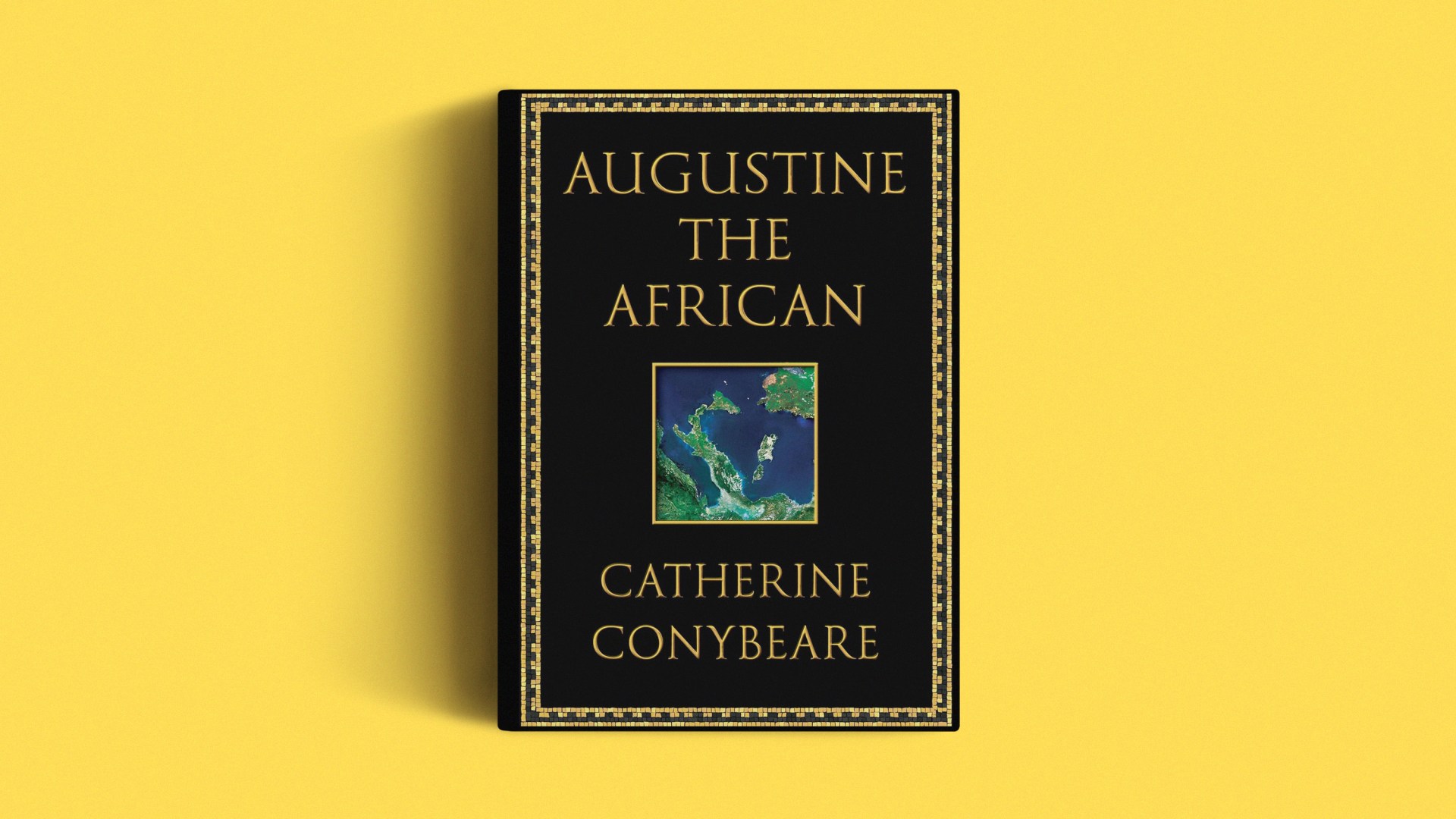
In her new book, Augustine the African, Conybeare brings her interpretive toolkit to bear on the great church father, emphasizing the importance of his geographic and cultural origins. We already know, of course, a great deal about Augustine’s life and his theological reflections. But Conybeare shows how creative scholars can return time and again to a mine of material that still appears to be inexhaustible.

Intellectually, we may know Augustine came from Roman Africa, with its vital center at Carthage. But what difference, if any, did that make to his life and thought? How might these have differed if Augustine had been the product of Spain or Sicily?

For Conybeare, these origins were crucial. Augustine was absolutely grounded in a culture located in what we would today call the nation of Tunisia and its border fringe of Algeria, the region where his life began and ended.

At every stage, Augustine’s life and career must be understood in that African imperial context, with all its implications of hybridity, of ethnic and linguistic complexity, of aspiration and discrimination. These themes pervade Augustine the African. Based on impeccable scholarship and lucid writing, Conybeare’s book reshapes our understanding of that one (crucial) saint, and her insights extend to many other figures of the early church. The book deserves a very broad audience, not least because it recounts such a fascinating life story. Adding immensely to the book’s value, this study of the saint’s “erased Africanness” speaks into ongoing conversations about the long-lasting heritage of empire and colonialism.

I offer a paradox. As a part of the empire, Roman Africa was utterly distinctive but also quite typical. Yes, the particular mixture of cultures in Augustine’s Africa was peculiar to that region, but at the same time, it was one example of a much larger story.

When we think of the Roman Empire, we generally think of a society ruled by, well, Romans, those conquering military foreigners who built their spectacular cities, roads, and fortifications. Our minds might even replay the legendary scene in Monty Python’s Life of Brian, where a bumbling Jewish revolutionary protests, “What have the Romans ever done for us?”—right after conceding “the sanitation, the medicine, education, wine, public order, irrigation, roads, a fresh water system, and public health.” Our vision of Roman oppressors confronting insurgent natives owes much to our knowledge of first-century Judea.

But matters had changed fundamentally by the time Augustine was born in 354, and that was nowhere truer than in defining the category of “Romans.” Through the long centuries, local elites had come to identify ever closer with Roman ways, lifestyles, and culture, culminating in 212 with the extension of citizenship to all free men within the empire. (The decree came from the Roman emperor Caracalla, best known to modern audiences from the film Gladiator II).

Whatever their indigenous roots, the people of London and Córdoba, Milan and Cologne, Marseille and Carthage, were all Romans, and that status belonged to them just as much as to anyone born on the river Tiber. That did not of course mean that older cultures and languages vanished overnight, but they were increasingly marginalized. Romanitas, Latin for “Roman-ness,” was a matter of wealth, education, and social class. Whenever we look at early Christian leaders from Gaul or Spain, we have to place them in that context of an acquired culture and an ambiguous relationship to the indigenous past.

In that sense, Augustine’s North Africa was a microcosm of the wider Roman world. Here, Latin-speaking “Roman” elites—who might or might not have any Italian ancestry—lived alongside the speakers of Berber tongues, who today are more respectfully known as the Amazigh people.

Augustine himself personified that cultural mingling, as the son of a Roman father, who was likely the descendant of freedmen, and the famous Monnica, who was (almost certainly) of Berber stock. The family would assuredly have spoken Latin at home, and the saint never learned Berber—but when Monnica or Augustine told a slave or peasant to do something quickly, they presumably deployed at least a few select words of the older language.

For Conybeare, that mixed background repeatedly formed Augustine’s life and career. Although he lived in Milan and Rome, he actually did much of his writing in North Africa, notably at Hippo Regius, where he served as bishop from 396 until his death in 430.

Hippo itself offers a nice epitome of Augustine’s Africa, both its indigenous foundations and the colonial and imperial structures successively erected upon them. The city’s name is of Punic (Phoenician) origin, reflecting one early wave of colonizers. It later became a seat of the (Berber) Numidian kings, whom the Romans had conquered in the first century BC—hence the royal status implied by “Regius.” The Romans then reconstructed the city as a settlement for their own ethnic stock—literally, it was a colonia—but it can never have been far removed from those older native peoples and their cultures.

Augustine was highly conscious of that African background, and he describes contemporaries in terms of “we Africans.” In Italy, his closest friends shared that provincial background. Even so, he never had any doubt about his Roman status or his claim to the glories of a millennium of Latin culture and thought.

He lived, after all, five full generations after the edict of Caracalla. We can imagine Augustine’s shock and disappointment when he arrived in Italy and found himself mocked for his provincial accent, which in practical terms made it impossible to work as a teacher of rhetoric. Overnight, the faithful Roman became an outsider.

Much of Conybeare’s book explores that culture clash, with all its implications both psychological and theological. She does this brilliantly, forcing us to appreciate how Augustine’s theology grew out of “his own sense of himself as displaced and wandering.” Perhaps only someone as agonizingly cut off from full Roman status could write the woeful cry of mourning for the fallen imperial capital that inspired his City of God.

The problem of defining the universal as opposed to the local and provincial profoundly affected Augustine’s theorizing about the nature of the universal church and its ecumenical values. This issue became sharply evident in his debates with the Donatists, who questioned the validity of sacraments performed by priests who had compromised with Roman persecutors. Conybeare adeptly describes the savage feuds and schisms that were so pervasive within African Christianity. So often, her book compels us to reconsider everything we thought we knew about Augustine’s thought through that African lens.

Although this goes beyond even the ambitious scope of her fine book, I would add two footnotes that grow directly from Conybeare’s material. The first concerns the fate of Christianity in North Africa, in what for several centuries had been a critical hearth area of the faith. After the Islamic conquest in the late seventh century, Christianity vanished almost wholly from the region, probably because the “Romans” and Latin speakers fled, leaving behind the Berber peasants and nomads, whom that faith had touched only lightly. That does cast a rather grim light on the nature and extent of Christian evangelization in Augustine’s time.

Also, the essential work of placing Augustine in his African setting should never obscure how his life played out just as fully within the vast Roman Empire. When Augustine lay dying, his city of Hippo was being besieged by the Vandal people, who not only captured it but also went on to seize Carthage and to sack Rome itself in 455. Those Vandals came from what we would now call Poland, where they stayed until a series of messy interactions with Roman governments and armies led them to march through Germany, France, and Spain on their way to North Africa. That Vandal intrusion, which devastated the older Latin Catholic world, demonstrates the inseparable connection between the African and Roman realities.

Augustine famously distinguished between the glorious and unchanging city of God and the turbulent and sinful earthly city where we find ourselves in the present life. Conybeare’s book amply reminds us just how wrenchingly complex and conflicted that earthly city actually was—and how longingly Augustine turned to the city that is to come.

Philip Jenkins is distinguished professor of history at Baylor University. His latest book is Kingdoms of This World: How Empires Have Made and Remade Religions.

Church Life

What I Learned Living Among Leprosy

My 16 years at a rural hospital in India showed me what healing and restoration in Christian community look like.

Collage of old photos on a vintage scrapbook on a piece of patterned clothe
Christianity Today September 10, 2025
Illustration by Abigail Erickson / Source Images: Getty, photos courtesy of Ann Harikeerthan

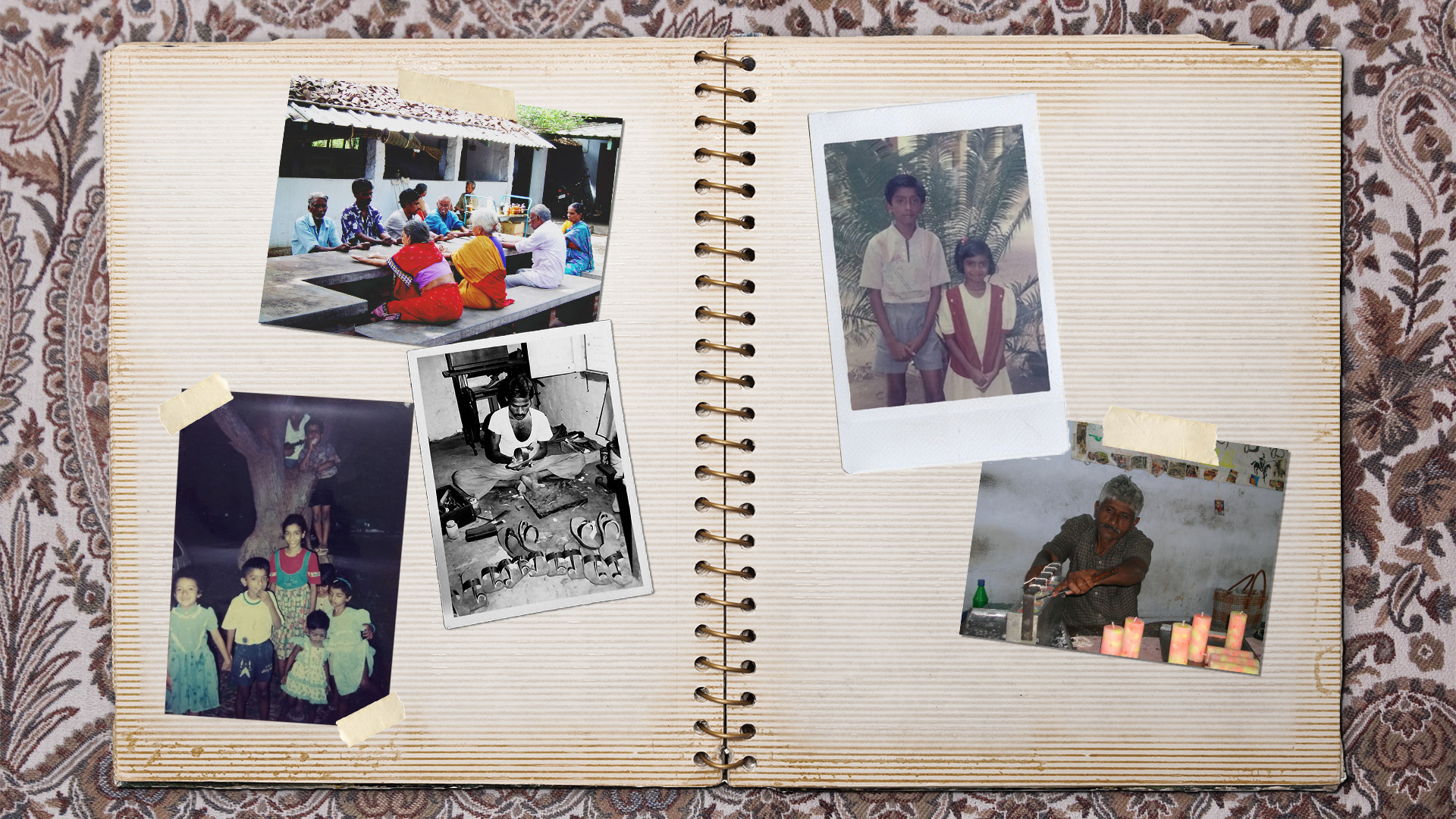
In 1994, my mother began working as a doctor at a rural hospital run by the Christian Medical College in Vellore, India. I would play elaborate games on the spacious hospital grounds with fellow neighbors’ kids and my big brother, John. We imagined that we were traveling through land, sea, and space in a rusty truck by the hospital’s parking shed, and we raced each other on bicycles.

As I played these games, I didn’t always notice the men and women who also lived on the campus grounds. Sometimes, these uncles and aunties would stop to chat with us, and I would gaze curiously at their flat noses, their missing fingers, and the crutches and wheelchairs they used to get around. 

At the time, I had no clue these uncles and aunties were leprosy patients. They never mentioned their ailments but spoke affectionately to me, calling me “en rasathi” (“my princess” in Tamil) or asking, “Chellam, saptiya?” (“Sweetheart, did you eat?”).

The realization that these aunties and uncles were living with leprosy dawned on me one Sunday after church, when I saw people sitting in line by the church gate. They were dressed in tatters and held out aluminum bowls between deformed limbs as they begged for coins. Because they appeared to have leprosy, they had been sent out of their villages and had to beg for money because no one would give them work.

But the aunties and uncles I spoke with on the hospital grounds looked and felt different. Although they also lived with leprosy, they wore saris or shirts with pants or dhotis, which signified that they were well-groomed in South Indian culture. They made a living from the work they did in Ulcer Ward, the hospital’s leprosy rehabilitation center, or on the hospital campus. They did not seem dissimilar to other adults I knew. They were people whom my family and I could depend on and build relationships with.

My 16 years of living with and loving people with leprosy has taught me that healing is an inherently communal act. I learned that leprosy patients could experience belonging in loving Christian communities that could treat deep-seated emotional wounds, which medicines and surgeries are unable to fix.

At the age of five, I visited Ulcer Ward with my mom to see Karunayan Uncle, who held my foot in his paw-shaped hands, placed it on a piece of paper, and clumsily clutched a pencil between his curled thumb and index finger to draw a perfect outline. When we returned a few days later, Karunayan Uncle gave me a pair of custom-made sandals with brown leather straps and specially fitted rubber soles—something that he had created to prevent leprosy patients from injuring their feet.

Other Ulcer Ward residents provided for the medical community’s larger needs. Prakasam brought us meat and eggs every week. Balasamy swept dead leaves off the ground we played on. Many of them made candles we would light during frequent power blackouts.

But one agonizing experience helped me to understand why the people at Ulcer Ward needed us. When I was around ten years old, a pale patch appeared on my cheek. A nanny caring for my neighbor, Rahul, noticed the spot and warned Rahul not to touch me, although he disregarded her advice and told me what she had said.

“You live so close to [Ulcer Ward],” my own nanny said to me, barely concealing her aversion. “It must be leprosy.”

That evening, my mom explained that the people living at Ulcer Ward were currently undergoing treatment for or were cured of leprosy. They could not pass on the infection. But she took me to her pediatrician colleague anyway, and they found out I was mildly malnourished. After I spent a few weeks on a better diet, the patchy skin on my face disappeared.

This incident disturbed me. What if Rahul and other kids had decided to shun me? I could only imagine how the uncles and aunties at Ulcer Ward felt, knowing their families would not hug them, hold their hands, or kiss their cheeks.

As a teenager, I began noticing more of the suffering these aunties and uncles experienced. They could not feel physical pain and did not notice when they hurt themselves, so they often developed ulcers.

This was the reason behind the rehabilitation center’s name, as many who lived there had chronic ulcers that refused to heal and needed to be dressed every other day. I would imagine their wounds on my body and the pain they could not feel and pray for God to heal them.

Years later, as a doctor interning in that very hospital, I cared for the patients at Ulcer Ward. I dressed wounds, offered words of encouragement, and heard stories of hurt and hope.

More than two millennia ago, Jesus did what we put into practice at Ulcer Ward. He demonstrated that healing stigmatizing diseases like leprosy is not just about treating the body; it also requires communal restoration.

One story depicts Jesus reclining at the table in the home of a man known as “Simon the Leper” in Bethany (Mark 14:3). Simon was likely a man healed of leprosy who was once deemed untouchable in society. Yet Jesus spent time with and possibly shared a meal with him.

Another story shows Jesus declaring his willingness to heal a man with leprosy after he begs Jesus to make him clean (1:40–42). Although Jesus could have healed this man from afar, as he did for ten people with leprosy (Luke 17:11–19), he did two incredible things in this encounter.

First, Jesus touched the man with leprosy—something many people then and now would consider taboo. Second, Jesus told the man to go show himself to the priest (Mark 1:44). Upon receiving Jesus’ healing touch, the man could now reintegrate into society by seeing a priest who could pronounce him “clean” (Lev. 14:20, 31).

As Jesus’ actions reflect, a person with a stigmatizing illness requires a communal response to heal from physical and emotional wounds fully. Touching a person whom society has deemed untouchable is one of the clearest ways of saying, “I accept you for who you are.”

Much of what Ulcer Ward was like grew out of physician Paul Brand’s vision, said Anand Zachariah, a doctor at Christian Medical College who also grew up on the hospital campus. Brand, a missionary surgeon from the UK who grew up in India, discovered that people with leprosy lost their limbs because of their loss of ability to feel pain, rather than because of rotting flesh. Brand and his team pioneered and performed countless reconstructive surgeries at the rural hospital my mom and I worked in.

Brand also ensured that the rehabilitation centers he established for leprosy patients would educate them on how to care for their numb limbs as they healed from surgery. But his rehabilitation plans went beyond physical care to addressing spiritual and emotional needs as hospital staff encouraged Christians in the medical community to accept, welcome, and love the leprosy patients in their midst.

The uncles and aunties I grew up with at Ulcer Ward have since reintegrated into society. Many returned to their villages when their families agreed to take them back, and others who were unable to return because their families would not accept them now live in elderly care homes.

Leprosy is not as common in India today as it was in the past. Thanks to early intervention and rehabilitation, the disease does not result in physical disabilities as severe as they once were. Yet over half (60%) of the more than 200,000 new cases reported worldwide each year are from my country, and stigma against people with leprosy continues to persist in society, as well as within the church.

Churches in India often segregate people by language, occupation, caste, and wealth. Some churches only welcome people of one caste; in other congregations, poor people sit on the floor while the rich sit on chairs. Some Christians continue to shun people with leprosy and do not permit them to worship in the same space.

To become places of hospitality and welcome—as Ulcer Ward was for people recovering from leprosy—Indian churches can care for people who live with stigmatizing diseases as Jesus did, by having meals and worshiping God together. Churches can help people with leprosy gain sustainable livelihoods by hiring them or funding vocational training.

I live more than 900 miles from Vellore now, but I visited the city in late August and met with former Ulcer Ward patients.

Gopalan Uncle, a man in his 70s, continues to develop ulcers on his feet and finger stumps because leprosy irreversibly damaged the sensory nerves in those regions. But the staff at Ulcer Ward never treated him any differently. “They slung their arms around my shoulders or held my hands and sat next to me, chatting with me for hours,” he recalled.  

Lakshmi Auntie, who is in her 50s, teared up as she recounted how her family abandoned her when she was first diagnosed with leprosy. Doctors amputated her right leg three decades ago because the ulcers on her leg kept getting infected, and she spent months bedridden at Ulcer Ward while recuperating. Today, she wears a prosthetic limb and uses crutches or a wheelchair to get around. “The staff at Ulcer Ward cared for me better than my family ever could,” she said.  

As I shook their hands to say goodbye after our three-hour-long conversation, Gopalan Uncle said, “Go wherever Jesus leads you.” Lakshmi Auntie placed her hands on my head and prayed a blessing over me: “May God give you a long and healthy life, always surrounded by family who loves you.”

Ann Harikeerthan is a medical writer at Christian Medical College in Vellore, India.

Ideas

The Myth of Tech Utopianism

Staff Editor

What a book on feminism helped me realize about our digital age.

Christianity Today September 10, 2025
Animation by Elizabeth Kaye / Source Images: Unsplash

After 18 years and many failed attempts, the US and Britain laid down the transatlantic telegraph cable successfully in 1858. The first message on August 16 from Queen Victoria to President James Buchanan expressed her congratulations for his presidential win.

Buchanan replied in a message that took more than 16 hours to transmit through thousands of miles of copper cables: “May the Atlantic telegraph, under the blessing of heaven, prove to be a bond of perpetual peace and friendship between the kindred nations, and an instrument destined by Divine Providence to diffuse religion, civilization, liberty, and law throughout the world.”

We have long supposed technology can usher in utopia. Although it promises “perpetual peace,” the telos of modern technology more often detaches us from our bodies, our places, and our communities. Especially in artificially intelligent forms, technology makes us more machine than man, more functionality than being.

Take for instance, a recent argument by Mary Harrington in her book Feminism Against Progress, which shows the underbelly of such promised tech utopias. She argues the modern feminism that has won out is a feminism of freedom (where women grasp unfettered autonomy) rather than a feminism of care (which flourishes within local, embodied, and social relationships).

This feminism of freedom sees women and men as “fungible, interchangeable work units,” defined not by their God-given personhood, nor by their embedded place among families and society, but by their economic output. It’s an argument educators like Alan Jacobs and Alan Noble have also made.

It’s only a short leap to see that if men and women are interchangeable, if we are defined more by our late-modern capitalistic output than by our sexed bodies, our common human limitations, and our social relationships, then technology can serve the role of savior.

Technology promises liberation from the pesky challenges of being human (such as motherhood, argues Harrington) in favor of “Meat Lego Gnosticism,” where we can disassemble and reassemble ourselves like fleshed Lego bricks to find an authentic, self-made individuality. Such liberation promises utopia in terms of equality, freedom, and a lack of consequences, but it ends up more akin to Frankenstein’s monster.

We increasingly look to new technologies to eradicate what we’ve construed as the problem of being human. We need simply look at the headlines to see how we look to technology to save us.

But false gods demand sacrifice. We are sacrificing our young people in what appears to be a rise in suicides after they use AI chatbots for therapy or companionship. We can also consider the uptick of gender dysphoria and affirmative models of care even while the 2024 Cass report showed that transgender medical technologies should be used much less frequently. We are sacrificing the poor: Harrington observes the forced hysterectomies of sugarcane workers in India for the sake of productivity.

We know from Old and New Testament stories that false gods end up distorting humanity; they promise liberation but enslave us. Psalm 135 reminds us that idols “have mouths, but do not speak;  they have eyes, but do not see;  they have ears, but do not hear, nor is there any breath in their mouths. Those who make them become like them; so do all who trust in them” (v. 16–18, ESV). While the tendency to idolatry is old, our new technologies make their promises seem attainable.

But why, then, is this so appealing?

In Acts 8, we read of a famous magician, Simon. People know him as “the Great Power of God” and treat and worship him as a god (v. 10). Yet when the men and women of Samaria believe Philip’s preaching of Christ and his kingdom, they convert, leaving magic behind. (Interestingly, Simon, too, is baptized). When Peter and John arrive in Samaria, they lay hands on and pray for these new believers to receive the Holy Spirit.

False gods also require our resources. We are marshaling vast sums of economic resources for technological “progress” (Nvidia recently became the first $4 trillion public company, to cite just one example) without much, if any, ethical regulation.  

Simon sees power. He offers money to the apostles so he, too, could bring the power of the Holy Spirit. We know the rest of the story: The apostles soundly rebuke him and tell him to beg God’s forgiveness. But Simon has a longer story in some early church writings.

Church father Justin Martyr links Simon with early Gnostic heresies, describing him as a god with a prostitute companion. Dante places him in the eighth circle of hell—where different types of fraud are punished. Although scholars debate whether the Simon of Acts 8 is the same Simon to whom the early church leaders responded with such vitriol, what is clear is that both Simons are guided by similar motivations: the elevation of the self above the true God, the idea that they can transactionally obtain the power of God, and a desire to harness that power for personal gain. Simon believed money could make him into a god. With this power, he likely believed he’d cement control, security, success, and perhaps an eternal legacy.

Although we may have stopped trying to buy the Holy Spirit as Simon did, we still attempt that transaction’s end goal: to make ourselves gods, limitless, unattached, powerful, and self-determining. Technology is our modern-day magic. Except now we offer ourselves as the payment to our technologies, in whose image we are increasingly being made.

Most technologies are not morally neutral. The media theorist Marshall McLuhan noted in his book chapter “The Medium is the Message” the example of an electric light bulb. In contrast to many other objects, it is “pure information” and “a medium without a message.”

But generally, he argues, the idea of a neutral tool doesn’t hold up, because “it is the medium that shapes and controls the scale and form of human association and action. … Indeed, it is only too typical that the ‘content’ of any medium blinds us to the character of the medium.”

In other words, it is not just what sort of content an AI chatbot puts out that is something to evaluate but the very existence of the AI chatbot (the medium) that influences how we process information, how we experience relationships, or what we think love is.

To presume that our current digital technologies are simply neutral tools is to naively underestimate both the power of sin and the power of God. Writer Paul Kingsnorth calls this pervasive power “the Machine,” which is “a tendency within us, made concrete by power and circumstance which coalesces in a huge agglomeration of power, control and ambition.”

We are often blind to our complicity. McLuhan also notes our self-deception when we believe only content matters without understanding how the medium is the message; then we operate “in the true Narcissus style of one hypnotized by the amputation and extension of his own being in a new technical form.”

Mammon, or Simon, or “the Machine,” or “Meat Lego Gnosticism”—all whisper the same lie in a different dress for every age. You will not surely die. You will be like God.

The question for those who claim the name of Christ is this: Will we continually sacrifice ourselves for the vision of a disembodied technologically achieved utopia? Or will we instead find our greatest security in the God who gave up the power and riches of heaven to take on our human flesh and who bore our god-hungry sin upon his cross?

Ashley Hales is editorial director for print at Christianity Today.

News

The Hymns Still Rise in Rwanda, but They Do So Quietly Now

Why one-size-fits-all regulations are sending churches underground.

A local church in Nyamata, Rwanda.

A local church in Nyamata, Rwanda.

Christianity Today September 10, 2025
UCG / Contributor / Getty

On a sun-warmed ridge at the edge of Kigali, Rwanda, where the paved road gives way to red clay and goats roam between kitchen gardens, pastor Kamanzi folds his hands beside a chipped water tank and listens. From the living room, ten voices in low unison sing “Yesu Ni Wanjye,” barely louder than the creaking of banana leaves in the wind. No drums thump. No amplifiers hum. There are just whispers, because anything louder invites trouble.

Kamanzi’s house is solid but plain: glazed brick, iron windows, tiled floors swept clean that morning. I have also swept clean this story for pastors’ safety. Due to the autocratic political environment in Rwanda and personal risk to church leaders involved in advocacy, I have at times withheld or changed names, such as Kamanzi’s, and identifying details, such as church locations. I cross-verified all reported statements and facts with publicly accessible documentation and human rights organizations.

Inside the 2,180-square-foot house, a single bulb swings overhead. A plastic table holds an open Kinyarwanda Bible, a bowl of sugar cubes, and an envelope stamped “Loan Installment Due.” A threadbare curtain, sewn from three different fabrics, divides the room in two. Behind it, a mosquito net hangs limp above the bunk bed where Kamanzi’s sons sleep.

Kamanzi built his church from nothing, selling his old house, taking loans, laying tiles, installing toilets, even muffling the ceilings with foam. He thought he had followed every rule the Rwanda Governance Board (RGB) has thrown at his church since 2018. Yet in March, an anonymous complaint about noise sealed its gates. “They shut us down despite the evidence of all the improvements we’ve made,” Kamanzi said, his eyes darting to the window. “Now we worship here in shadows, praying no one reports us again.”

Kamanzi’s story echoes across Rwanda, where the government’s blanket regulations, meant to curb rogue preachers and ensure safety, push thousands of churches into hiding. The RGB enforces Law No. 72/2018 and its 2025 updates, demanding theological degrees, soundproof buildings, parking lots, and hefty fees from every pastor and branch. Officials hail these measures as protections against exploitation. Critics call them a chokehold on faith.

As of August 2024, the inspections had hit 14,000 prayer houses, closing 9,800 for noncompliance with building codes, hygiene regulations, and noise rules. By June 2025, over 7,700 remained shuttered, unable to reopen due to stricter 2025 regulations and leaders scrambling or going underground.

President Paul Kagame drives this crackdown, viewing unchecked churches as manipulative and accusing some of “squeezing money” from the poor. In a 2024 speech, he doubled down on exploitation concerns: “These unscrupulous people who use religion and churches to manipulate and fleece people of their money and other things, will force us to introduce a tax.”

Kagame’s vision aligns with Rwanda’s post-genocide rebuilding, prioritizing order over unchecked growth. The 1994 genocide by Hutu extremists killed 800,000 people in just 100 days, targeting mostly the Tutsi ethnic group but also some moderate Hutu and Twa people. That trauma continues to shape how Rwandans understand community, politics, and faith.

The RGB, under CEO Doris Uwicyeza Picard as of March, rolls out these church restrictions through meetings and online systems. Summarizing a March 21 consultation session with Picard and church leaders, the RGB promised efficiency: “RGB will put in place all means through online system that will facilitate Faith Based Organisations to get services related to getting all required documents including registration and compliance certificates.”

The board’s former CEO, Usta Kaitesi, who oversaw earlier enforcements, emphasized accountability in 2024. In a post by Christian Daily, she defended the reforms: “There should be an intentional willingness to comply with the law.” She argued the initial requirements applied only to senior clergy, but the 2025 updates extended to all leaders.

Many churches, like pastor Kamanzi’s, had made the necessary adjustments. But the March regulation No. 01/2025 enacted by the Rwanda Governance Board (RGB) now required all church branches to secure 1,200 hours of theological training (roughly one year of study) for every pastor and branch leader, at least 1,000 supporting signatures from local residents, and a fee of 2,000,000 Rwandan francs (approximately $1,400 USD) to register each new church or mosque.

Kamanzi said the abruptness of these changes felt the most suffocating. “The new requirements were introduced with no transition period for existing branch pastors to obtain the required education,” he explained.

Previously, such qualifications applied only to leaders who oversaw several congregations, not to those tending a single flock. For many churches, especially rural or newly compliant ones, the goalposts moved just when they thought they had finished the changes.

Buildings must prove exclusive worship use, meet district codes, and include soundproofing, even in remote areas with no neighbors. Foreign theology degrees need equivalence certificates. RGB officials frame this as safeguarding believers, stating in the March meeting summary that regulations will “enhance good leadership” and promote “transparency and accountability in Faith Based Organisations.”

These rules apply uniformly, whether a church sits in Kigali’s bustling neighborhoods or on a remote hillside with no neighbors to disturb. This one-size-fits-all approach, while aimed at standardization, often ignores the realities of rural congregations, pushing them toward closure or secrecy.

Some pastors cheer these changes, seeing them as a cleanup of charlatans. Laurent Mbanda, Anglican archbishop of Rwanda, urged compliance: “If we had taken the requirements more seriously and taken responsibility, we would have made significant progress in complying with the standards.” Esron Maniragaba, president of the Evangelical Free Church of Rwanda, welcomes infrastructure upgrades: “Government efforts to have churches build better structures are welcome to all of us.”

Fred Kayitare, pastor at Harvesters Church in Kigali, embodies this support. After planting his church without formal training, he pursued a theology degree and sent four others from his congregation for theological training. Kayitare “totally agreed” with the theological training requirements and said, “I am the living example. I planted a church before I attended theological college. I can witness the change and transformation I acquired from school. I’m another person now. And everyone at our church who knew me before can witness that.”

Recent graduations highlight compliance efforts. On August 2, 100 students from Africa College of Theology (ACT) in Kigali earned degrees in theology and leadership, “pledging to be responsible, inspiring religious leaders,” according to AllAfrica. A week later, Bible Communication Center Rwanda celebrated its 11th graduation, equipping more pastors with accredited training. In February, 46 leaders graduated with global diplomas from a partnership with Erskine Theological Seminary, focusing on practical ministry skills. These ceremonies show churches adapting, with ACT alone training hundreds since 2018 to meet RGB demands.

Yet opposition swells. Church leaders say the regulations don’t feel like protection. They feel like punishment.

Tomorrow, AJ Johnson will provide the second part in this series showing how Rwandan leaders and overseas communities are pushing back.

Inkwell

An Education in Delight

In an age of AI, truly human teaching invites students to know for themselves.

Inkwell September 10, 2025
"Concert in the Classroom" by Charles-Bertrand d'Entraygue

Sometimes when people ask me what I do, I mention that I’m a writer. When this happens, I usually get questions about the kind of writing I do or where I see myself going with it. But last spring, when I said offhandedly to a friend’s husband that I write poetry, his first question was “Have you thought about using AI for that?”

I was a little taken aback, but recounting the story to my friends later, I laughed. “Writing is the point,” I said. “Does he get that writers write because they like it?”

A few months later, after I had started teaching, someone told me that my high school students are probably all using ChatGPT to write their essays. With some hesitation, I responded, “Well, I know how each of them thinks pretty well by now. I think I’d catch it if anything switched.”

Then, during a conversation with a college professor, I asked what I could do to get my students ready for the next step. Teach them to write strong essays? To be ready to dive into difficult texts? He replied, “I’d take students who could read more than a paragraph and understand what was going on.”

My first reaction to all of these incidents was confusion. After all, I only graduated from college myself a year ago. Two years ago, my classmates and I were joking about artificial intelligence in college settings—“Hey, did you hear there are kids who need ChatGPT to write their papers for them?”—and professors were mentioning new programs that could detect AI usage. Now it suddenly seems like AI is everywhere, and everyone has an opinion about it. 

“AI is changing everything,” “AI is changing nothing,” “We have to learn how to use it,” “We have to learn how to stop students from using it,” “Nobody can read or write anymore,” “Reading and writing can be outsourced to AI without much changing”—and on and on, such a volley of different opinions that you feel, in Tennyson’s words, “stormed at with shot and shell.”

Meanwhile, it’s hard for me to understand how, one year after receiving my cap and gown, people could be writing doomsday pieces about an educational landscape that looks so different from my own experience as a student. I was just there, I keep thinking. And it wasn’t like that.

Granted, I went to a small Christian liberal arts college, which meant that my peers and I made up a self-selecting group of students. Still, during prospective student weekends, we emphasized things like our discussion-based model or affordable tuition. We didn’t tell prospective parents and high schoolers, “Our students actually read and write here,” because that would’ve seemed, well, obvious. What distinguished us were the kinds of things we read and wrote, not the mere fact that we did so.

But things have changed fast. People in Christian and secular circles have pointed out how college and high school students now struggle to focus in class, lack basic reading comprehension skills, and churn out most of their assignments with ChatGPT. With younger students, teachers are talking about how hard it is to teach kids who have “tech tantrums” when they can’t have access to devices or who simply can’t focus enough to retain information.

Put simply, the way things are now just isn’t working. 

Even in my own life, I’ve noticed a shift and can sympathize with the struggle to focus. “The written word is weak,” writes Annie Dillard. “Many people prefer life to it. Life gets your blood going, and it smells good. Writing is mere writing, literature is mere. It appeals only to the subtlest senses—the imagination’s vision, and the imagination’s hearing—and the moral sense, and the intellect.”

In the past year, I’ve had difficulty maintaining those subtler senses. It’s been difficult to reach for a novel instead of my phone. To prioritize conversation with friends in real life over witty quips online. To sit down with pen and paper and write something without feeling like I’m fighting to pull each slow thought to the surface of my mind and yank it into articulate speech. 

Reading and writing in the digital age, I’ve realized, are just hard. But we aren’t turning to blood-quickening real life instead; we’re turning to the digital world of the smartphone and social media, and now, to artificial intelligence.

Even a year or two ago, I found both life and literature more enthralling. When I was a college student, I got excited about stuff all the time, whether it was assigned readings, writing papers, or class discussions. If anyone had suggested using AI to summarize my readings or generate a paper, I would’ve asked, “Where’s the fun in doing it that way?” 

I used to think that was just my personality. But as I’ve been fighting to keep that excitement sharp and close at hand, it’s dawned on me that so much of my delight in learning stems from my circumstances.

I was raised in a home where books were everything, and I started reading at the age of four. In my mind, there have always been books, and not just first readers but proper “grown-up” chapter books. Both of my parents read aloud to us, Mom in the morning and Dad before bed. We read classics, philosophy, poetry, and books on natural science. Books—and their corollaries, writing and logic—defined my high school years.

By the time I left for college, I had read Aristotle, Dante, Milton, and Melville; I was familiar with Kant, Nietzsche, and Descartes; I’d studied Horace, Virgil, and Caesar in the original Latin; I’d been through most of Shakespeare’s plays, knew my logical forms and fallacies, and had written papers arguing with George Berkeley (over universals) and T. S. Eliot (over Hamlet). Whatever Christians or non-Christians mean by an educational revival, I could have been their poster child.

But now, a year out from my own graduation, I’ve found myself asking all the same questions as everyone else about how to keep up my own reading life but also about how AI is changing the landscape of teaching. What is education for? What do new technologies say about education and about those of us who use or don’t use them? What’s the good that we’re moving toward—a world where we turn the tools of writing over to our machines?

Sometimes I feel a little like Kathleen Kelly from You’ve Got Mail, when her then-boyfriend Frank Navasky tells her that she is “a lone reed, standing tall, waving boldly in the corrupt sands of commerce.” I’m trying to stick up for the written word over the big bad Fox Books of AI, but sometimes I catch myself asking, What’s the point? And more importantly, what do I actually think is worth pursuing?

America is caught in a conversation about what it means to be human. It’s an old conversation, but one that the internet age has intensified. From Tiktok filters to chatbot followers, those of us who grew up online are constantly asking, What’s real? What’s not real? What’s human?

I’m in the middle of the conversation myself. As I’ve tried to articulate my own thoughts on education, I keep coming back to the clarity of my parents’ vision. They seemed to have decided what they wanted for us and pursued it, years before the classical Christian education revival became as widespread as it is now. 

I sat down with my mom and asked her, “Why did you educate us like this? What inspired you?”

Two things, she told me. First: Books. She talked about Little Women and said, “I knew Jo was interesting because she read books. So I decided that in order to be an interesting person, you had to be well-read.”

She talked about growing up in a house full of books, how both her parents believed in being self-learners, always reading history or theology on their own. “Staying up late was encouraged,” she said, “As long as we were reading.”

She was a latchkey kid in small-town Nebraska, and she and my aunt would bike all over town during the summer. I thought of my own memories of summers at Grandma’s house, of my cousins and I running across the street to climb the trees outside the high school or walking to the dollar store on our own, wrapped in the summer heat and the smell of cattle.

“Books and real things,” my mom said. “That’s what I had as a kid. So I think I always knew that’s what children need.”

In Poetic Knowledge, James S. Taylor says that education “introduce[s] the young to reality through delight.” Education itself puts us in contact with reality, our minds and bodies involved with the real world. 

If technology is going to play a role in education, we need to frame it in light of this principle. If it puts us in contact with reality, it can stay; if it widens a gap between the real world and our minds or bodies, we should think twice before giving it too much power. 

But too often, our approach to education in the 21st century is like our approach to everything else, whether streaming movies or shopping on Amazon or swiping right on dating apps. It’s a consumer mindset. We want things easy and fast, and we want the best possible product. Education becomes another click-and-swipe system where we hope that putting a kid in a desk at “the right school” (or at home) will produce a super-child, “a child who can change the world.”

“A lot of people get anxious about their kids,” my mom said. “But educator Charlotte Mason would say, ‘Mothers need to have a thinking love.’” In other words, parents—and teachers, and those of us who are cultivating our own literary lives—can’t abdicate our choices to whatever click-swipe system, hoping for a perfect product. It’s not enough to just want fast and easy; we need to have this thinking love. A truly human education invites students to know for themselves. 

Later, I thought back over my mom’s advice and sketched a few principles on my piece of paper. Walk to the dollar store in the heat. Read books out loud. Make your home or classroom a hearth for ideas. Find stories that resonate with you and live into them. 

It’s not a perfect solution, and it won’t guarantee perfect students. Rather, it’s an attempt to try and live out Taylor’s idea, to introduce and reintroduce ourselves to reality through delight. Insofar as I’m able, I’ve decided, I won’t allow things into my classroom—or my own life—that undercut that delight in reality. No gaps between mind and body and the beautiful world.

There’s another quote from Charlotte Mason that I heard often when I was growing up: 

The question is not,––how much does the youth know? when he has finished his education––but how much does he care? And about how many orders of things does he care? In fact, how large is the room in which he finds his feet set? And, therefore, how full is the life he has before him?

This is the goal of a truly human education: that you care about a large order of things, because this is what it means to be human. It means learning to know things for ourselves and to appreciate these subtler senses: the moral sense, the intellect, the beauty of literature. 

It means falling in love with life, which “gets your blood going,” without any gaps between ourselves and the world. It means wonder. Most of all, it means love.

Olivia Marstall is an essayist and poet who has been published in Veritas Journal and The Clayjar Review. She also teaches humanities at a classical school and has begun an MFA through the University of St. Thomas. Read more of her writing on literature, attentiveness, or the spiritual life at her Substack, A Stream of Words.

News

In Rural Uganda, a Christian Lab Tech Battles USAID Cuts

Orach Simon tests blood and finds hope amid suffering.

A Christian lab tech pricking fingers at a clinic in Uganda.
Christianity Today September 9, 2025
Illustration by Christianity Today / Source Images: Photography by Morgan Lee

More than 30 women and children sit on plastic chairs under the awning at Goro Medical Center (GMC), a clinic in rural northern Uganda. Some nurse infants. Others stare into the distance as their immune systems fight high fevers.

As the sun moves overhead, a baby shrieks. The other patients wait silently for Orach Simon, a lab technician, to test their blood for malaria, syphilis, or hepatitis. Orach and the other lab tech, Atimango Mercy, often stay late. They have both come in to work while sick with malaria.

Patients enter the clinic, walk behind a blue sheet, sit on a green plastic chair, and offer Orach their ring finger. He logs each test result in a large red book that lies open on the adjacent counter, beneath a 2024 calendar that he uses for 2025. 

Orach longs for air conditioning. It’s often over 100 degrees Fahrenheit, and temperatures over 95 can destroy test kits. As he serves his long stream of patients, Orach wrestles with what it takes to keep GMC’s doors open—and to support his wife, one-year-old daughter, parents, and younger siblings.

Last September, government registration challenges closed the clinic, but it reopened late last year. Now Ugandans who frequented government-funded health centers once supported by $270 million in US funding are coming to GMC. For years, many of the 1.4 million Ugandans who are HIV-positive received antiretroviral treatment and basic health care at government-run health centers. Now, many come to the clinic when they’re sick, and GMC has tripled the amount it spends on drugs.

GMC sits in Nwoya District, a swath of farmland and bush covering roughly 1,800 square miles, larger than the state of Rhode Island and home to more than 220,000 people as of the 2024 census. Anaka Hospital and three government-run health care centers serve the whole community. Health care centers like GMC provide outpatient, inpatient, maternity, and lab services.

Few patients can see physicians. Each health care center has a clinician, such as a nurse of clinical officer, who serves as a de facto doctor. Meanwhile, Anaka has struggled to hire and retain staff. In 2019, the Daily Monitor reported Anaka operating with less than half the expected staff and no specialists. In July, Anaka handled 10,000–14,000 outpatients monthly while struggling with hazardous-waste removal after USAID exited.

Gulu, a city 30 miles away, has three hospitals. But few people have money to pay for a boda-boda (motorbike) ride to the city, making its medical services largely unreachable for locals.

Orach, 30, was born in Pader, a district to the east of Gulu, in the mid-1990s, at the height of Acholi warlord Joseph Kony’s violent assault on his own people. Though Kony claimed the Lord’s Resistance Army (LRA) fought on behalf of the Acholi people’s interests, the witchcraft-obsessed militant and his army regularly kidnapped children from across northern Uganda and forced them to commit atrocities. Orach walked several miles from home each night to hide from the LRA.

After the LRA kidnapped two of Orach’s cousins, he and his family fled to a camp for internally displaced people in the south.

“You were tired, but if you wanted to rest, they would kill you,” he said, remembering the journey.

In the camp, ten-year-old Orach visited an aunt with tuberculosis. He wept and decided to become a doctor. His parents, subsistence farmers, saved what they could to send him to school. But the money only went so far. Orach couldn’t afford medical school, so he trained as a lab technician instead: “I became stressed, disappointed, and sad, but I managed to cool down using Bible verses and advice from a close friend. A problem shared is a problem solved.”

In 2019, Orach graduated and accepted a job as a lab tech in South Sudan, eager to help support his family. His employer paid for a car to drive him to Jonglei State, about 300 miles north of Gulu. But once Orach got there, “I suffered.”

Jonglei, plagued by conflict since South Sudan gained its independence in 2011, restricted Orach’s freedom. Rebel checkpoints choked travel. Immigration authorities demanded monthly bribes to let him stay in the country. His boss, though kind, did not always pay him. Orach cried every night, grieved by how little he could send home.

Raised Catholic, Orach joined a Pentecostal church that became his lifeline. Church members prayed for him, taught him Arabic, and welcomed him like family. “Their love touched me,” he said. But fear was constant. Once, he saw a gunman shoot a Ugandan vendor dead after a petty dispute over soap. “My life could end like that,” he realized.

In 2022, he finally left. On the drive toward the Ugandan border, he passed bodies still lying in the road after an ambush. At the crossing, police took the little money he had left. He stepped onto home soil broke but alive.

The next year, Orach found his way back to a microscope in Nwoya, working for GMC. Although the clinic would never make him a doctor, it could make him essential to people with no doctors.

Thomas Charities, a ministry focused on treating those suffering from malaria, opened the 12-bed clinic that year. Orach started working there in 2023 and said he feels joy when a diagnosis helps his patients. Most nights he sleeps in a grass-thatched hut about a ten-minute walk from the clinic and attends St. Luke’s Church.

Once or twice a month, he pays for the six-hour boda-boda ride back to see his wife and son. Other weeks, he goes to visit his parents, who live a similar distance away. His dad is too old to farm now, and his mother is sick. He also sends money to them: “I pray that God finds ways for me to take care of my family better.”

And he talks to God about his hopes for health care in the area: “People are suffering.”

Ideas

The AI Bible: ‘We Call It Edutainment’

Staff Editor

Max Bard of Pray.com details an audience-driven approach to AI-generated videos of the Bible, styled like a video game and heavy on thrills.

Satan, Jezebel, and the Nephilim from AI Bible

Scenes from the AI Bible showing Satan, Jezebel, and the Nephilim.

Christianity Today September 9, 2025
AI Bible / Pray.com

When generative artificial intelligence programs like ChatGPT first became widely available in late 2022, many people—including me—marveled at their ability to conjure detailed images from just a few lines of text. Sure, the AI tools struggled to create fingers. But they needed mere seconds to work up images that would take many of us painstaking days to make in Photoshop.

Since then, the capacity of large language models (LLMs) to create imagery, then silent video, then video with sound has rapidly improved. “We can talk!” exclaimed convincing AI-generated characters in a clip that made the rounds online earlier this year.

With this kind of technology on offer, it was inevitable that people would apply it to the Bible—and so they have. AI videos of biblical stories are proliferating, as 404 Media reported in June. Prominent among them is The AI Bible, which has over a million subscribers on YouTube and TikTok combined, and 1.2 million on Instagram.

The AI Bible is a project of Pray.com, a popular app with offerings including bedtime stories, meditations, a reading of the Bible by actor James Earl Jones, Prayer Therapy with TV personality Dr. Phil, and Sleep Psalms with pastor T. D. Jakes. I spoke with Max Bard, vice president of content at Pray.com. This interview has been edited and condensed.

Let’s start with a general introduction for readers who may not be familiar with this project. What is The AI Bible?

In a nutshell, The AI Bible is a series of channels on Instagram, TikTok, YouTube. It’s a project that we’ve created to glorify God using AI, mainly image and video generators. We’re using AI to bring these Bible stories to life like no one’s ever seen before—in these cool, cinematic-looking, and engaging videos with vivid storytelling. That’s what you’ll see on the Instagram and TikTok and YouTube channels.

Since this technology is still so novel, I’d like to take a minute to talk about process. What model do you use to create these videos? And how does the prompting work? Do you simply feed it a passage of Scripture and ask for a movie, or do you give guidance on the story and character design? Or maybe you write a whole script?

It’s a pretty extensive process. When Pray.com started making subscription content back in 2019, it was all audio content. So we had about 5,000 audio stories that we had already produced, and we took those stories and layered video onto that. So a lot of The AI Bible videos on YouTube—the longer form, 10-minute type—were derived from our audio content that we had already produced. It was a way for us to be able to quickly make some videos right off the bat.

All the newer stuff that we make currently has a long process that involves platforms like ChatGPT and Claude, which helps us with outlining what the stories will be. We’ll decide, Okay, we’re going to do the story of Adam and Eve. And then from there it’s like, Okay, how do you structure that into a video?

We have scriptwriters on our team, and one of them is a pastor, so he’ll write the whole script first. That’s the first process. The second process is taking that script and storyboarding it with visuals. That’s text to image, and for that we use the AI programs Midjourney and ChatGPT.

We’ll storyboard out that whole script, and that will help us create the animation next. So if we have a storyboard of, say, 60 scenes or 60 cuts, then we know exactly what the ending frame of each scene is going to look like compared to the beginning frame. That will help us with things like the coloring of the story and making sure we have the characters consistent throughout the story.

Once we make that storyboard in Midjourney and ChatGPT, then we’ll start using the AI video generators to turn those images into animations. You put the image into the video generator, and you tell the video generator what you want it to do. For example, with camera movement: pushing in, pushing out, wide-angle aerial shots, and that type of stuff. You can also tell the video generator what you want the characters to do: walking forward, their facial expressions, all that type of stuff.

I’m curious about the aesthetics of the videos. You mentioned that they’re cinematic, and I definitely see that. But the look is also very reminiscent of video games, especially in the design of the supernatural elements—like Goliath in the full Bible trailer, or the beasts of Revelation, or the Nephilim in one of your most popular videos. Was that a deliberate choice? And if yes, was there a particular purpose or audience you had in mind?

Yeah, it almost looks like Final Fantasy, the video game. We’ve got a lot of people saying that. When we first started pushing into these AI videos, that was the look that Midjourney and other image generators were creating with us.

We did a bunch of tests, and if you look deep in our Instagram or TikTok accounts, you could see different styles and books that we tried. And we took a data-informed approach and just said, Okay, these videos are getting more shares, more reposts, more comments. Let’s stick with this style and run with it. And that’s the style that you’re seeing right now.

We’re always testing different looks, so that’s why one day you may see a totally random style on our accounts. That’s us testing to see if this is going to resonate with people. We like to test a lot, but we think this current look is working really well and people are enjoying it, engaging with the stories, and wanting to learn more.

How do you decide which passages you’re going to pick to make into videos? I was looking over the YouTube channel and saw a lot of the more exciting parts of the Bible: Creation, Revelation, stories with a lot of action and violence and supernatural elements. But, of course, a lot of the Bible isn’t that exciting. It’s letters, sermons, guidance on how to live. Are we ever going to get an AI Bible video of Jesus preaching the Sermon on the Mount?

Yes, we will. And that’s coming pretty soon. We have some series that will be coming out maybe in the next three to four months that will follow Jesus’ life, Paul’s life, Abraham’s life. Those will be something where it’s likely a weekly drop.

Right now, we have a couple of series that we’ve made in the Pray.com app on David’s life, Jesus’ life, and Joseph’s life. For the AI Bible channel, we’ve already produced a series on Ruth, and we’re going to do a lot more of those where we follow a person from the Bible in a four- or five-episode series.

One video that caught my eye was about Job: “When SATAN Almost Won… The Full Story of Job’s Faith.” It’s 10 minutes long and very vivid, but I was struck by the fact that more than half of those 10 minutes are from Job 1, and then most of the book—about 40 chapters of Job and his friends wrestling through questions about why God permits evil and suffering for people who love him—gets taken down to a single spoken verse.

I’m thinking about people who are less scripturally knowledgeable, coming to a video like this. It’s presented as the “full story” of Job, but it doesn’t include any of the complicated rebuke of Job from God at the end and instead has some stuff about hope. As you’re moving into longer video formats, will they include more of the theology and discourse passages?

Yeah, definitely. Right now, we have a podcast called Bible in a Year. And in that series, there’s three stories of Job that I think are about 60 to 90 minutes. So when you take all those, it’s about 90 minutes of Job’s story that we created. And so for this AI Bible video, we had to chuck it down into 10 minutes. So how were we going to figure that out? And that’s what ended up being the 10-minute piece that you saw.

That’s how we’re testing out these stories on the AI Bible channel—to see what are the stories that resonate most with this audience right now. That’s why all the videos you see are 10 minutes. We’re able to make a video like that in a couple of weeks. The subscribers don’t have to wait a month or two for us to put out a 60-minute video or something that would take us quite a while.

So we’re using the 10-minute format to see which of the stories people most want to hear about—and you’ll see that in the comment section too. They’ll tell us like, Hey, I wish you did this story or that story, and then we’ll say, Okay, can we create this as a 10-minute version, see how it does?

And if it does well, let’s break this out into a five- or six-part series, which is something that we would do with Job and really get in-depth. The one that you’re talking about, there’s very little dialogue. It was a lot of just visuals, music, that type of stuff. When we get into the series, that’s when we start putting the dialogue from the Bible in there and really getting in-depth with these stories.

So what you’re seeing with these little 10-minute vignettes are the quickest way that we can get something out there to the users to see if something like this would work.

A video like that—which loses, frankly, the great bulk of Job’s difficult theological content and message—makes me wonder about your process for content review. What you’re putting out might be effective for testing audience interest, but who is making sure it’s theologically sound and historically accurate and biblically faithful? What is the process there?

We have a bunch of different layers of—call it checks and balances. One of them is we have a few pastors and theologians who look over the scripts, making sure that, like you said, it’s biblically accurate.

Before we even get into the image generation and video generation, that process happens—and the majority of the stories are written by pastors and ministers. That’s a great part of it, because they’re teaching these stories every day. We want to make sure that we’re getting them right and making them in a way that people can learn from them.
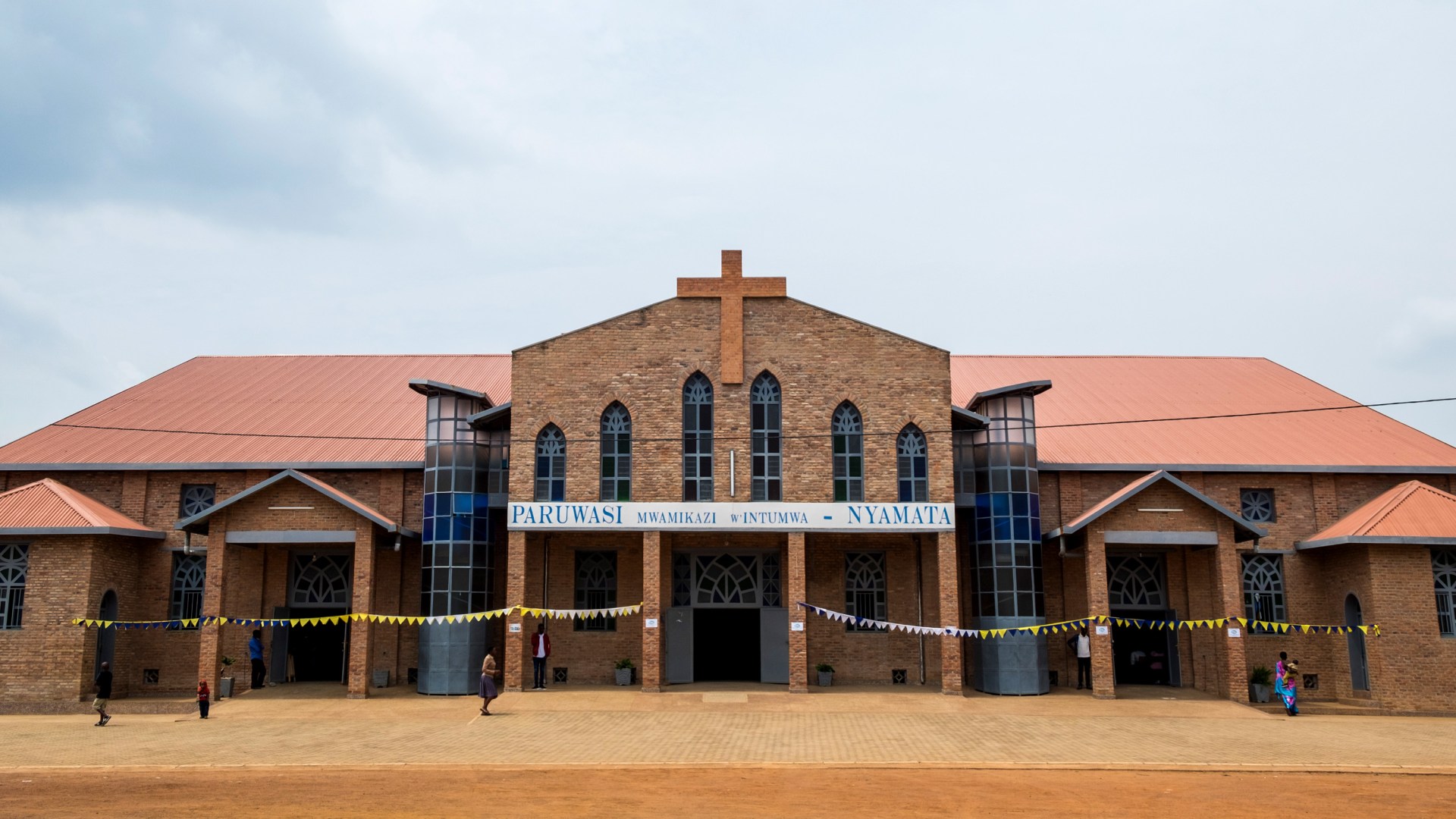
Let’s turn more toward purpose. Do you see The AI Bible project as discipleship or education or entertainment or what?

Yeah, we call it edutainment—education and entertainment. The value is the way that these stories are styled. They have a specific look to them, right? You watch these stories, and you’re like, Oh, this is AI. This is that AI look. That’s the entertainment part that I think people are really fascinated about.

And that fantasy look that you mentioned we see as bringing in a lot of people, some who aren’t even Christian and are really interested in these stories. Like, Oh, I’ve never seen this before. I didn’t even know these things, like that the Nephilim were in the Bible. This is interesting.

We’re getting all these subscribers, people we never would’ve normally reached from the Pray.com app. It’s reaching a younger audience than traditionally we had before, which is great. And I think it’s really opening the Bible up to a lot more people. You don’t have to know the Bible and the stories to enjoy these videos. You can check them out—maybe because you’re fascinated by the way it looks—and see something new, and then it gets you interested in what else happened in the Bible.

That’s what we’re seeing. A lot of people watch these videos and end up downloading our app. They tell us, Hey, I found you guys from a couple of these AI Bible videos. They didn’t even know that we were producing all of this audio content for Pray.com, and they’re finding us because of these video stories.

It sounds like you guys are very data-informed about the move from the videos to the app. Do you have data that would suggest that watching these videos is leading people to more offline involvement in the faith—reading their Bibles more deeply or more often, or maybe committing to life and worship with a local congregation?

The way we find that out is through qualitative feedback like reviews. We partner with pastors on a lot of podcasts, and we’ve had users who listen to the podcast, say, of Jack Graham’s Bible in a Year podcast. He’s a pastor in Dallas, Texas, and we’ve had people that say, Hey, I’ve been listening to your podcast for the past six months, and I just started going to your church.

We’re like, Wow, we’re seeing people taking action in person just by listening to some of these podcasts and going to their churches, which is awesome. We’re seeing a lot of that. We don’t see it in the app through data, because it doesn’t tell us location, but when people say that in reviews, it’s really powerful. This is proving that it’s working.

Just to make sure I understood you about the podcast partnerships and those reviews, is that through the Pray.com app and the audio content there? Or is that about the AI Bible videos in particular?

With the Pray.com app. Not necessarily the AI videos.

Some people don’t even know that The AI Bible is associated with Pray.com. We’re still working on the branding on that. It’s mainly with the Pray.com app—in the iOS App Store reviews or Google Play store reviews—that you’ll see people mentioning that explicitly.

Gotcha. Now, I can imagine someone making the case that The AI Bible is kind of like stained glass windows—and I’ll be interested to know if you’ve used this analogy.

When most Christians were illiterate in the premodern era, one reason they’d build cathedrals with lots of stained glass and mosaics was that people who couldn’t read and couldn’t understand most of the services in Latin could still learn the Bible stories by looking at those images. We’re in an increasingly postliterate era, and I can imagine someone saying, Well, we need to be making the Bible into video so that people who just will not read have a way to learn these stories.

But then I thought, Does the comparison work? Because you can sit in front of a stained glass window or a beautiful painting of the Crucifixion and engage in contemplative prayer. You can study the artwork while you talk to God. But the videos are very high drama. They’re very engrossing. And I see the appeal of that, of course, but it doesn’t seem conducive to contemplative prayer—honestly to any kind of prayer. I’m wondering what you think about that analogy.

Yeah, I see it as it’s another way of storytelling. It’s interesting that you brought that up—that there are a lot of people out there who either don’t or can’t read or maybe physically can’t read because they have a hard time seeing.

Many people who use our app are in that bucket, and we know that because they’ve left the reviews saying they have a hard time reading but enjoy listening to the stories. There are also people that enjoy learning through visual storytelling. That’s what The AI Bible project is all about: learning these stories in a different format that you can literally just watch and be fascinated by all the stories in the Bible that happened.

Some people don’t even know about stuff like the Nephilim, right? To be honest, I hadn’t read the Bible front to back before joining Pray.com, so I didn’t even know a lot of these stories. I’ve learned so much just working at Pray.com. Seeing these stories is exciting, and it makes me more engaged to learn more about the Bible.

It’ll almost be like a History Channel show, where you get these really awesome reenactments and then also commentary from pastors and theologians that helps guide you through these stories. And then you come back to these epic stories, and then you come back to the pastor explaining why it’s important, how you can apply it to your life. That’s where we’re going with this whole project.

Lastly, you’ve mentioned your work with data, and this is something we deal with in journalism too: questions of how to balance your mission with wanting people to look at the work—wanting to get people’s attention. That’s a real tension in lines of work that involve content creation.

I couldn’t help but notice that many of the characters in AI Bible videos—and this is true of the positive male figures, but even more so of the women—they’re very sexy. And some, like Jezebel in the Bible villains video, are showing a lot of skin.

Prior to seeing that video, in a conversation with a theologian, we said, Well, maybe you would show a video like this in a youth group setting and then use it to spark discussion. But I can’t imagine showing Jezebel and what she’s wearing there to a bunch of middle school boys. So I’m curious about the role you all see for that kind of sex appeal in teaching people about the Bible.

There are a lot of different approaches to it, right? We stay as true as possible to the Bible as we can. And so when we’re looking up images of—there’s not a ton of images of Jezebel on Google, but she’s typically wearing this dress, and we just portrayed this same sort of look that she has on a few images in Google and then used AI to bring it more to life.

I can see your point where it may look a little more sexy than I guess you had imagined, but I think in the Bible she was this kind of villain—not the person you would look up to from the Bible. So we took this route. Obviously, we didn’t want to make her way too sexy, right?

But yeah, there were a few people who had your reaction where it’s like, This could be a little too much for middle schoolers, like you brought up. That’s part of our testing process right now: How far do you go on these styles, and where are the pullbacks on it?

addApple PodcastsDown ArrowDown ArrowDown Arrowarrow_left_altLeft ArrowLeft ArrowRight ArrowRight ArrowRight Arrowarrow_up_altUp ArrowUp ArrowAvailable at Amazoncaret-downCloseCloseellipseEmailEmailExpandExpandExternalExternalFacebookfacebook-squarefolderGiftGiftGooglegoogleGoogle KeephamburgerInstagraminstagram-squareLinkLinklinkedin-squareListenListenListenChristianity TodayCT Creative Studio Logologo_orgMegaphoneMenuMenupausePinterestPlayPlayPocketPodcastprintremoveRSSRSSSaveSavesaveSearchSearchsearchSpotifyStitcherTelegramTable of ContentsTable of Contentstwitter-squareWhatsAppXYouTubeYouTube