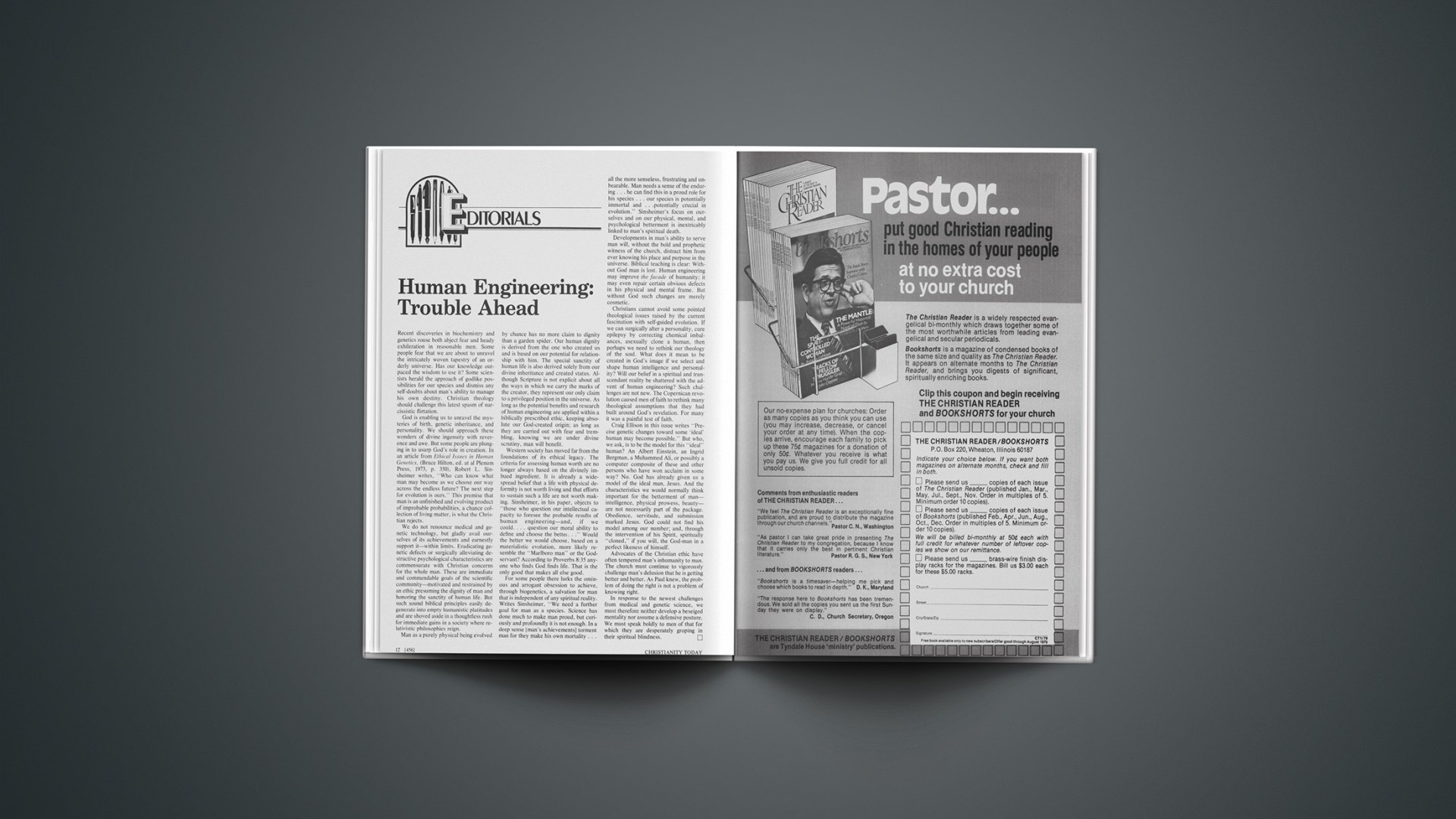

Recent discoveries in biochemistry and genetics rouse both abject fear and heady exhileration in reasonable men. Some people fear that we are about to unravel the intricately woven tapestry of an orderly universe. Has our knowledge outpaced the wisdom to use it? Some scientists herald the approach of godlike possibilities for our species and dismiss any self-doubts about man’s ability to manage his own destiny. Christian theology should challenge this latest spasm of narcissistic flirtation.
God is enabling us to unravel the mysteries of birth, genetic inheritance, and personality. We should approach these wonders of divine ingenuity with reverence and awe. But some people are plunging in to usurp God’s role in creation. In an article from Ethical Issues in Human Genetics, (Bruce Hilton, ed. at al Plenum Press, 1973, p. 350), Robert L. Sinsheimer writes, “Who can know what man may become as we choose our way across the endless future? The next step for evolution is ours.” This premise that man is an unfinished and evolving product of improbable probabilities, a chance collection of living matter, is what the Christian rejects.
We do not renounce medical and genetic technology, but gladly avail ourselves of its achievements and earnestly support it—within limits. Eradicating genetic defects or surgically alleviating destructive psychological characteristics are commensurate with Christian concerns for the whole man. These are immediate and commendable goals of the scientific community—motivated and restrained by an ethic presuming the dignity of man and honoring the sanctity of human life. But such sound biblical principles easily degenerate into empty humanistic platitudes and are shoved aside in a thoughtless rush for immediate gains in a society where relativistic philosophies reign.
Man as a purely physical being evolved by chance has no more claim to dignity than a garden spider. Our human dignity is derived from the one who created us and is based on our potential for relationship with him. The special sanctity of human life is also derived solely from our divine inheritance and created status. Although Scripture is not explicit about all the ways in which we carry the marks of the creator, they represent our only claim to a privileged position in the universe. As long as the potential benefits and research of human engineering are applied within a biblically prescribed ethic, keeping absolute our God-created origin; as long as they are carried out with fear and trembling, knowing we are under divine scrutiny, man will benefit.
Western society has moved far from the foundations of its ethical legacy. The criteria for assessing human worth are no longer always based on the divinely imbued ingredient. It is already a widespread belief that a life with physical deformity is not worth living and that efforts to sustain such a life are not worth making. Sinsheimer, in his paper, objects to “those who question our intellectual capacity to foresee the probable results of human engineering—and, if we could.… question our moral ability to define and choose the better …” Would the better we would choose, based on a materialistic evolution, more likely resemble the “Marlboro man” or the God-servant? According to Proverbs 8:35 anyone who finds God finds life. That is the only good that makes all else good.
For some people there lurks the ominous and arrogant obsession to achieve, through biogenetics, a salvation for man that is independent of any spiritual reality. Writes Sinsheimer, “We need a further goal for man as a species. Science has done much to make man proud, but curiously and profoundly it is not enough. In a deep sense [man’s achievements] torment man for they make his own mortality … all the more senseless, frustrating and unbearable. Man needs a sense of the enduring … he can find this in a proud role for his species … our species is potentially immortal and … potentially crucial in evolution.” Sinsheimer’s focus on ourselves and on our physical, mental, and psychological betterment is inextricably linked to man’s spiritual death.
Developments in man’s ability to serve man will, without the bold and prophetic witness of the church, distract him from ever knowing his place and purpose in the universe. Biblical teaching is clear: Without God man is lost. Human engineering may improve the facade of humanity; it may even repair certain obvious defects in his physical and mental frame. But without God such changes are merely cosmetic.
Christians cannot avoid some pointed theological issues raised by the current fascination with self-guided evolution. If we can surgically alter a personality, cure epilepsy by correcting chemical imbalances, asexually clone a human, then perhaps we need to rethink our theology of the soul. What does it mean to be created in God’s image if we select and shape human intelligence and personality? Will our belief in a spiritual and transcendant reality be shattered with the advent of human engineering? Such challenges are not new. The Copernican revolution caused men of faith to rethink many theological assumptions that they had built around God’s revelation. For many it was a painful test of faith.
Craig Ellison in this issue writes “Precise genetic changes toward some ‘ideal’ human may become possible.” But who, we ask, is to be the model for this “ideal” human? An Albert Einstein, an Ingrid Bergman, a Muhammed Ali, or possibly a computer composite of these and other persons who have won acclaim in some way? No. God has already given us a model of the ideal man, Jesus. And the characteristics we would normally think important for the betterment of man—intelligence, physical prowess, beauty—are not necessarily part of the package. Obedience, servitude, and submission marked Jesus. God could not find his model among our number; and, through the intervention of his Spirit, spiritually “cloned,” if you will, the God-man in a perfect likeness of himself.
Advocates of the Christian ethic have often tempered man’s inhumanity to man. The church must continue to vigorously challenge man’s delusion that he is getting better and better. As Paul knew, the problem of doing the right is not a problem of knowing right.
In response to the newest challenges from medical and genetic science, we must therefore neither develop a beseiged mentality nor assume a defensive posture. We must speak boldly to men of that for which they are desperately groping in their spiritual blindness.