
A Christian TV network and three publishers spend millions to attract new Bible readers.
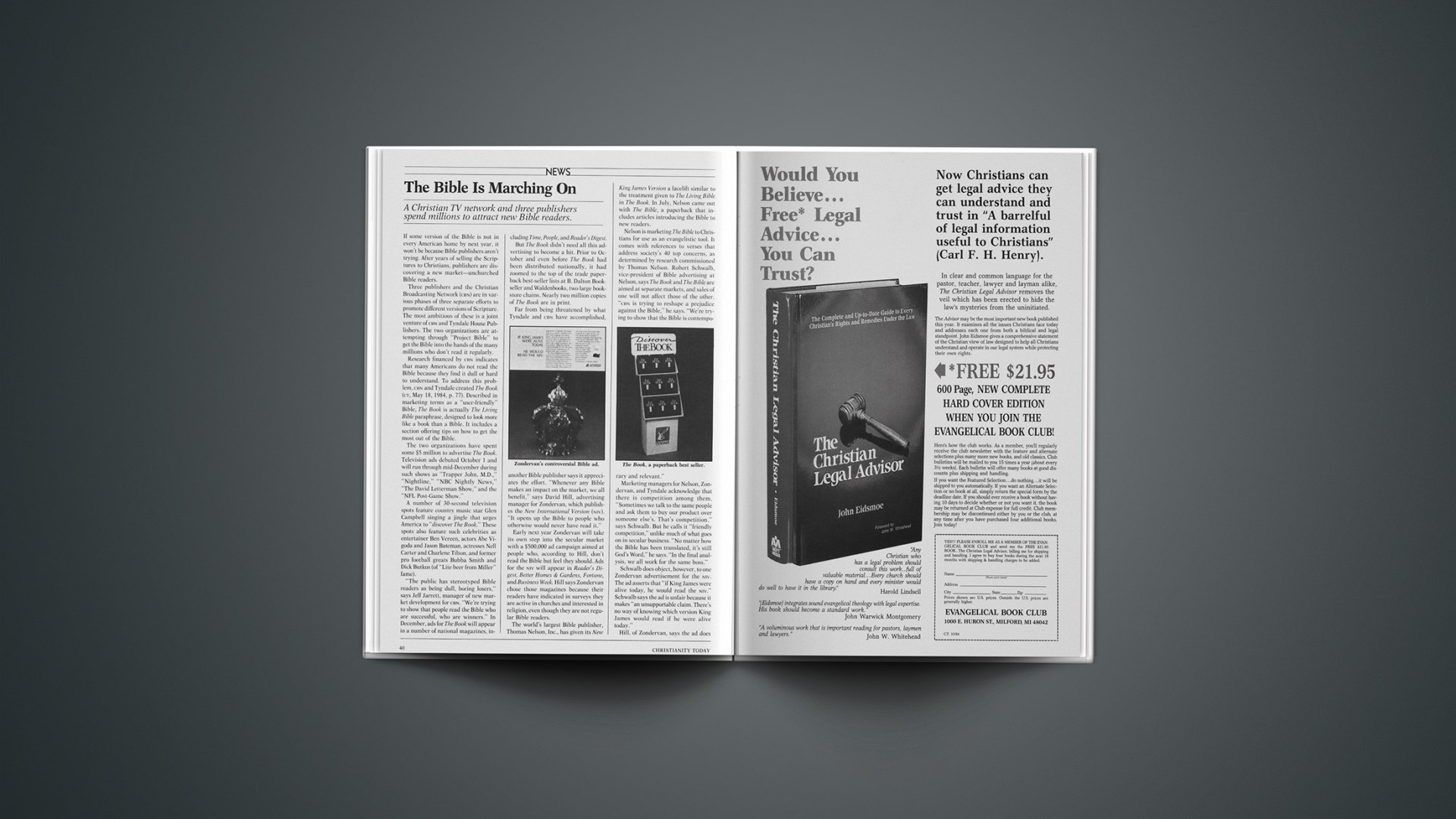
If some version of the Bible is not in every American home by next year, it won’t be because Bible publishers aren’t trying. After years of selling the Scriptures to Christians, publishers are discovering a new market—unchurched Bible readers.
Three publishers and the Christian Broadcasting Network (CBN) are in various phases of three separate efforts to promote different versions of Scripture. The most ambitious of these is a joint venture of CBN and Tyndale House Publishers. The two organizations are attempting through “Project Bible” to get the Bible into the hands of the many millions who don’t read it regularly.
Research financed by CBN indicates that many Americans do not read the Bible because they find it dull or hard to understand. To address this problem, CBN and Tyndale created The Book (CT, May 18, 1984, p. 77). Described in marketing terms as a “user-friendly” Bible, The Book is actually The Living Bible paraphrase, designed to look more like a book than a Bible. It includes a section offering tips on how to get the most out of the Bible.
The two organizations have spent some $5 million to advertise The Book. Television ads debuted October 1 and will run through mid-December during such shows as “Trapper John, M.D.,” “Nightline,” “NBC Nightly News,” “The David Letterman Show,” and the “NFL Post-Game Show.”
A number of 30-second television spots feature country music star Glen Campbell singing a jingle that urges America to “discover The Book.” These spots also feature such celebrities as entertainer Ben Vereen, actors Abe Vigoda and Jason Bateman, actresses Nell Carter and Charlene Tilton, and former pro football greats Bubba Smith and Dick Butkus (of “Lite beer from Miller” fame).
“The public has stereotyped Bible readers as being dull, boring losers,” says Jeff Jarrett, manager of new market development for CBN. “We’re trying to show that people read the Bible who are successful, who are winners.” In December, ads for The Book will appear i a number of national magazines, including Time, People, and Reader’s Digest.
But The Book didn’t need all this advertising to become a hit. Prior to October and even before The Book had been distributed nationally, it had zoomed to the top of the trade paperback best-seller lists at B. Dalton Bookseller and Waldenbooks, two large bookstore chains. Nearly two million copies of The Book are in print.
Far from being threatened by what Tyndale and CBN have accomplished, another Bible publisher says it appreciates the effort. “Whenever any Bible makes an impact on the market, we all benefit,” says David Hill, advertising manager for Zondervan, which publishes the New International Version (NIV). “It opens up the Bible to people who otherwise would never have read it.”
Early next year Zondervan will take its own step into the secular market with a $500,000 ad campaign aimed at people who, according to Hill, don’t read the Bible but feel they should. Ads for the NIV will appear in Reader’s Digest, Better Homes & Gardens, Fortune, and Business Week. Hill says Zondervan chose those magazines because their readers have indicated in surveys they are active in churches and interested in religion, even though they are not regular Bible readers.
The world’s largest Bible publisher, Thomas Nelson, Inc., has given its New King James Version a facelift similar to the treatment given to The Living Bible in The Book. In July, Nelson came out with The Bible, a paperback that includes articles introducing the Bible to new readers.
Nelson is marketing The Bible to Christians for use as an evangelistic tool. It comes with references to verses that address society’s 40 top concerns, as determined by research commissioned by Thomas Nelson. Robert Schwalb, vice-president of Bible advertising at Nelson, says The Book and The Bible are aimed at separate markets, and sales of one will not affect those of the other. “CBN is trying to reshape a prejudice against the Bible,” he says. “We’re trying to show that the Bible is contemporary and relevant.”
Marketing managers for Nelson, Zondervan, and Tyndale acknowledge that there is competition among them. “Sometimes we talk to the same people and ask them to buy our product over someone else’s. That’s competition,” says Schwalb. But he calls it “friendly competition,” unlike much of what goes on in secular business. “No matter how the Bible has been translated, it’s still God’s Word,” he says. “In the final analysis, we all work for the same boss.”
Schwalb does object, however, to one Zondervan advertisement for the NIV. The ad asserts that “if King James were alive today, he would read the NIV.” Schwalb says the ad is unfair because it makes “an unsupportable claim. There’s no way of knowing which version King James would read if he were alive today.”
Hill, of Zondervan, says the ad does not put down the KJV, but merely argues that “the NIV is to the twentieth century what the King James [Version] was to the seventeenth century.”
Doug Knox, vice-president of sales and marketing at Tyndale, says he regards other Bible publishers as allies, not competitors. “Our objective is not really to sell The Book, but to get people reading the Bible.”