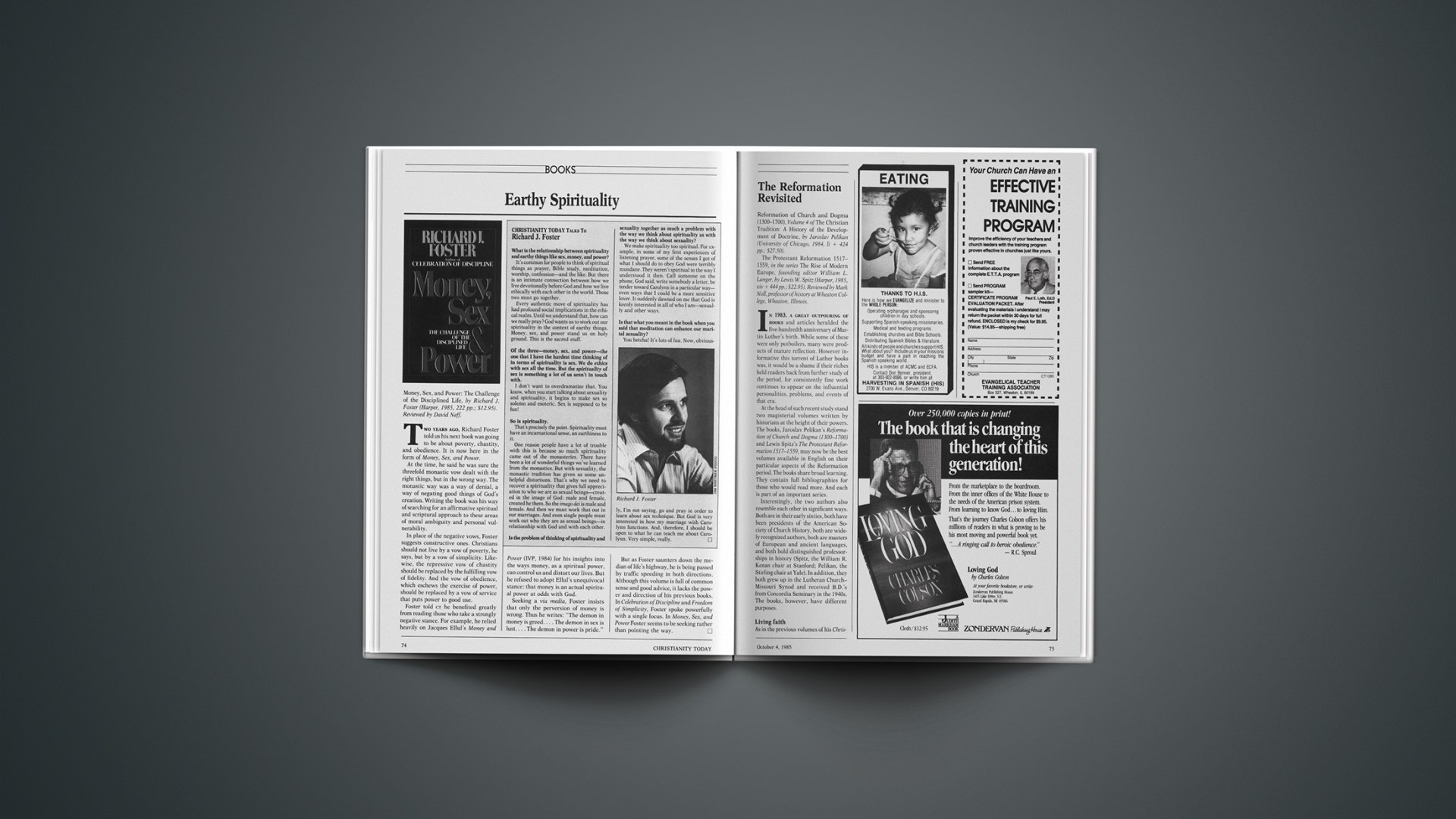

Money, Sex, and Power: The Challenge of the Disciplined Life, by Richard J. Foster (Harper, 1985, 222 pp.; $12.95). Reviewed by David Neff.
Two years ago, Richard Foster told us his next book was going to be about poverty, chastity, and obedience. It is now here in the form of Money, Sex, and Power.
At the time, he said he was sure the threefold monastic vow dealt with the right things, but in the wrong way. The monastic way was a way of denial, a way of negating good things of God’s creation. Writing the book was his way of searching for an affirmative spiritual and scriptural approach to these areas of moral ambiguity and personal vulnerability.
In place of the negative vows, Foster suggests constructive ones. Christians should not live by a vow of poverty, he says, but by a vow of simplicity. Likewise, the repressive vow of chastity should be replaced by the fulfilling vow of fidelity. And the vow of obedience, which eschews the exercise of power, should be replaced by a vow of service that puts power to good use.
Foster told CT he benefited greatly from reading those who take a strongly negative stance. For example, he relied heavily on Jacques Ellul’s Money and Power (IVP, 1984) for his insights into the ways money, as a spiritual power, can control us and distort our lives. But he refused to adopt Ellul’s unequivocal stance: that money is an actual spiritual power at odds with God.
Seeking a via media, Foster insists that only the perversion of money is wrong. Thus he writes: “The demon in money is greed.… The demon in sex is lust.… The demon in power is pride.”
But as Foster saunters down the median of life’s highway, he is being passed by traffic speeding in both directions. Although this volume is full of common sense and good advice, it lacks the power and direction of his previous books. In Celebration of Discipline and Freedom of Simplicity, Foster spoke powerfully with a single focus. In Money, Sex, and Power Foster seems to be seeking rather than pointing the way.