





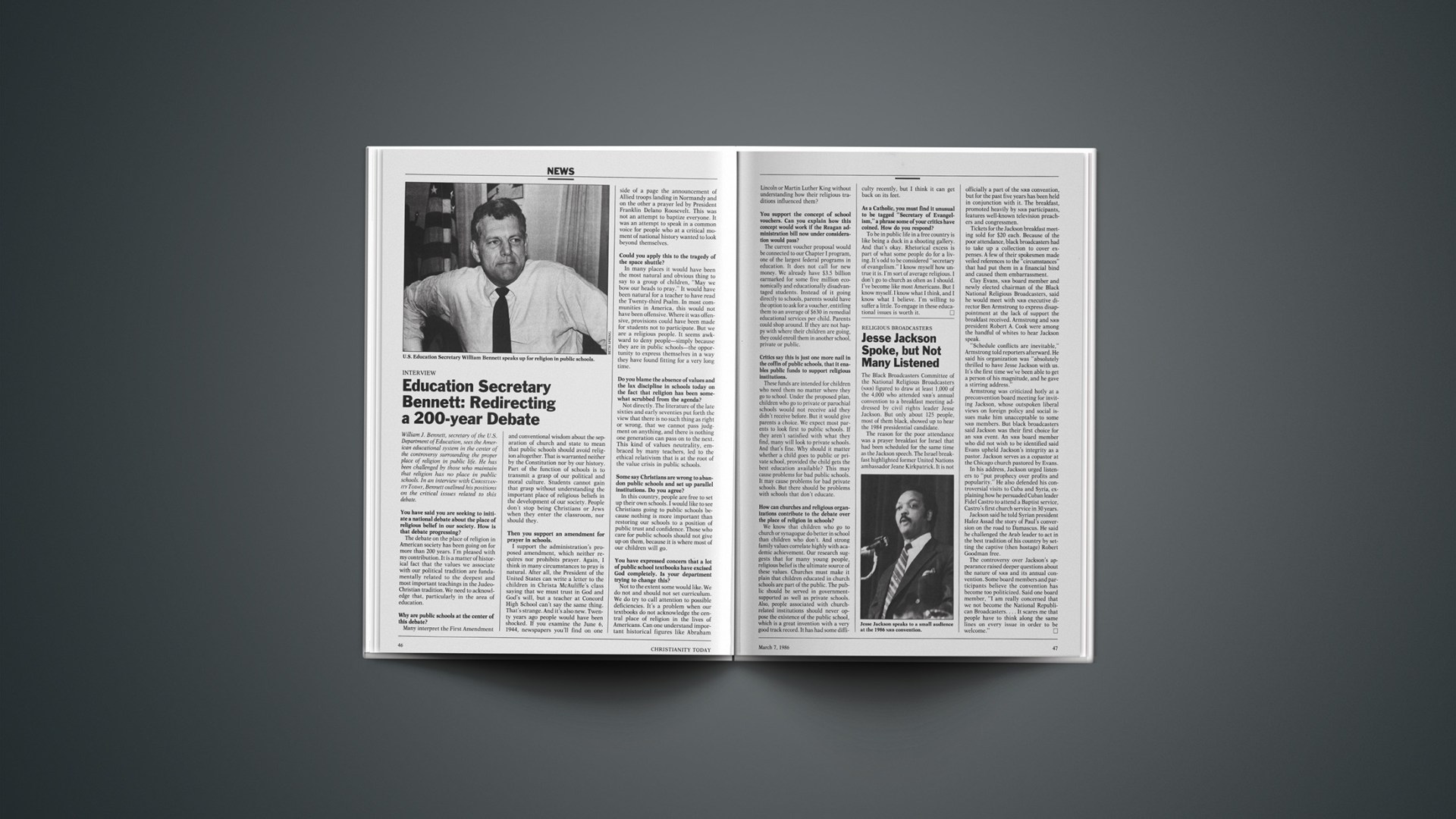

The Black Broadcasters Committee of the National Religious Broadcasters (NRB) figured to draw at least 1,000 of the 4,000 who attended NRB’s annual convention to a breakfast meeting addressed by civil rights leader Jesse Jackson. But only about 125 people, most of them black, showed up to hear the 1984 presidential candidate.
The reason for the poor attendance was a prayer breakfast for Israel that had been scheduled for the same time as the Jackson speech. The Israel breakfast highlighted former United Nations ambassador Jeane Kirkpatrick. It is not officially a part of the NRB convention, but for the past five years has been held in conjunction with it. The breakfast, promoted heavily by NRB participants, features well-known television preachers and congressmen.
Tickets for the Jackson breakfast meeting sold for $20 each. Because of the poor attendance, black broadcasters had to take up a collection to cover expenses. A few of their spokesmen made veiled references to the “circumstances” that had put them in a financial bind and caused them embarrassment.
Clay Evans, NRB board member and newly elected chairman of the Black National Religious Broadcasters, said he would meet with NRB executive director Ben Armstrong to express disappointment at the lack of support the breakfast received. Armstrong and NRB president Robert A. Cook were among the handful of whites to hear Jackson speak.
“Schedule conflicts are inevitable,” Armstrong told reporters afterward. He said his organization was “absolutely thrilled to have Jesse Jackson with us. It’s the first time we’ve been able to get a person of his magnitude, and he gave a stirring address.”
Armstrong was criticized hotly at a preconvention board meeting for inviting Jackson, whose outspoken liberal views on foreign policy and social issues make him unacceptable to some NRB members. But black broadcasters said Jackson was their first choice for an NRB event. An NRB board member who did not wish to be identified said Evans upheld Jackson’s integrity as a pastor. Jackson serves as a copastor at the Chicago church pastored by Evans.
In his address, Jackson urged listeners to “put prophecy over profits and popularity.” He also defended his controversial visits to Cuba and Syria, explaining how he persuaded Cuban leader Fidel Castro to attend a Baptist service, Castro’s first church service in 30 years.
Jackson said he told Syrian president Hafez Assad the story of Paul’s conversion on the road to Damascus. He said he challenged the Arab leader to act in the best tradition of his country by setting the captive (then hostage) Robert Goodman free.
The controversy over Jackson’s appearance raised deeper questions about the nature of NRB and its annual convention. Some board members and participants believe the convention has become too politicized. Said one board member, “I am really concerned that we not become the National Republican Broadcasters.… It scares me that people have to think along the same lines on every issue in order to be welcome.”







