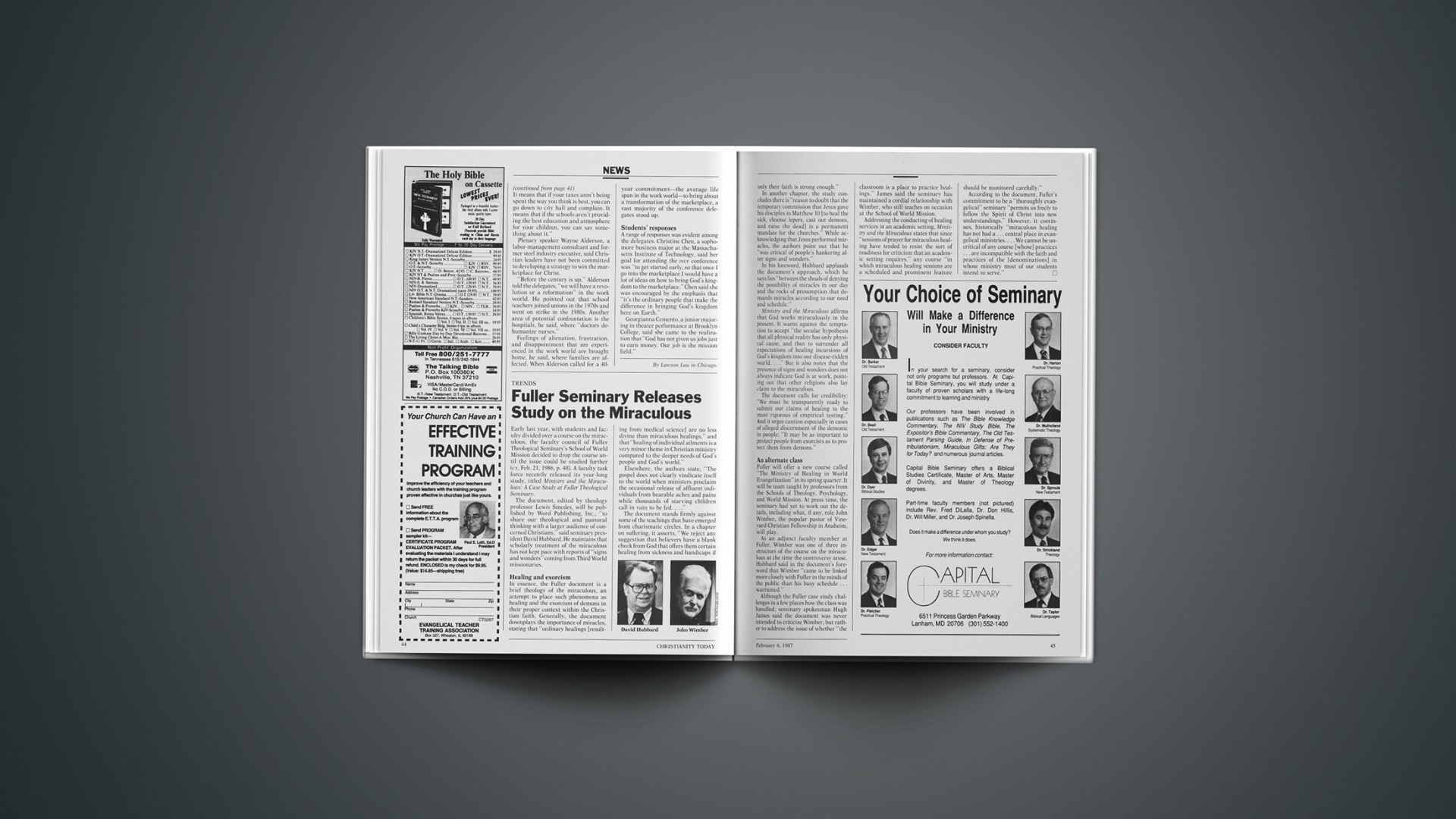

Early last year, with students and faculty divided over a course on the miraculous, the faculty council of Fuller Theological Seminary’s School of World Mission decided to drop the course until the issue could be studied further (CT, Feb. 21, 1986, p. 48). A faculty task force recently released its year-long study, titled Ministry and the Miraculous: A Case Study at Fuller Theological Seminary.
The document, edited by theology professor Lewis Smedes, will be published by Word Publishing, Inc., “to share our theological and pastoral thinking with a larger audience of concerned Christians,” said seminary president David Hubbard. He maintains that scholarly treatment of the miraculous has not kept pace with reports of “signs and wonders” coming from Third World missionaries.
Healing And Exorcism
In essence, the Fuller document is a brief theology of the miraculous, an attempt to place such phenomena as healing and the exorcism of demons in their proper context within the Christian faith. Generally, the document downplays the importance of miracles, stating that “ordinary healings [resulting from medical science] are no less divine than miraculous healings,” and that “healing of individual ailments is a very minor theme in Christian ministry compared to the deeper needs of God’s people and God’s world.”
Elsewhere, the authors state, “The gospel does not clearly vindicate itself to the world when ministers proclaim the occasional release of affluent individuals from bearable aches and pains while thousands of starving children call in vain to be fed.…”
The document stands firmly against some of the teachings that have emerged from charismatic circles. In a chapter on suffering, it asserts, “We reject any suggestion that believers have a blank check from God that offers them certain healing from sickness and handicaps if only their faith is strong enough.”
In another chapter, the study concludes there is “reason to doubt that the temporary commission that Jesus gave his disciples in Matthew 10 [to heal the sick, cleanse lepers, cast out demons, and raise the dead] is a permanent mandate for the churches.” While acknowledging that Jesus performed miracles, the authors point out that he “was critical of people’s hankering after signs and wonders.”
In his foreword, Hubbard applauds the document’s approach, which he says lies “between the shoals of denying the possibility of miracles in our day and the rocks of presumption that demands miracles according to our need and schedule.”
Ministry and the Miraculous affirms that God works miraculously in the present. It warns against the temptation to accept “the secular hypothesis that all physical reality has only physical cause, and thus to surrender all expectations of healing incursions of God’s kingdom into our disease-ridden world.…” But it also notes that the presence of signs and wonders does not always indicate God is at work, pointing out that other religions also lay claim to the miraculous.
The document calls for credibility: “We must be transparently ready to submit our claims of healing to the most rigorous of empirical testing.” And it urges caution especially in cases of alleged discernment of the demonic in people: “It may be as important to protect people from exorcists as to protect them from demons.”
An Alternate Class
Fuller will offer a new course called “The Ministry of Healing in World Evangelization” in its spring quarter. It will be team taught by professors from the Schools of Theology, Psychology, and World Mission. At press time, the seminary had yet to work out the details, including what, if any, role John Wimber, the popular pastor of Vineyard Christian Fellowship in Anaheim, will play.
As an adjunct faculty member at Fuller, Wimber was one of three instructors of the course on the miraculous at the time the controversy arose. Hubbard said in the document’s foreword that Wimber “came to be linked more closely with Fuller in the minds of the public than his busy schedule … warranted.”
Although the Fuller case study challenges in a few places how the class was handled, seminary spokesman Hugh James said the document was never intended to criticize Wimber, but rather to address the issue of whether “the classroom is a place to practice healings.” James said the seminary has maintained a cordial relationship with Wimber, who still teaches on occasion at the School of World Mission.
Addressing the conducting of healing services in an academic setting, Ministry and the Miraculous states that since “sessions of prayer for miraculous healing have tended to resist the sort of readiness for criticism that an academic setting requires,” any course “in which miraculous healing sessions are a scheduled and prominent feature should be monitored carefully.” According to the document, Fuller’s commitment to be a “thoroughly evangelical” seminary “permits us freely to follow the Spirit of Christ into new understandings.” However, it continues, historically “miraculous healing has not had a … central place in evangelical ministries.… We cannot be uncritical of any course [whose] practices … are incompatible with the faith and practices of the [denominations] in whose ministry most of our students intend to serve.”