
All is not fair in time of war. Biblical values must guide our policy.
At press time, the outcome of the Persian Gulf conflict was not clear, but certain biblical values were. Following is a guest editorial by J. Dudley Woodberry of Fuller Theological Seminary’s School of World Mission.
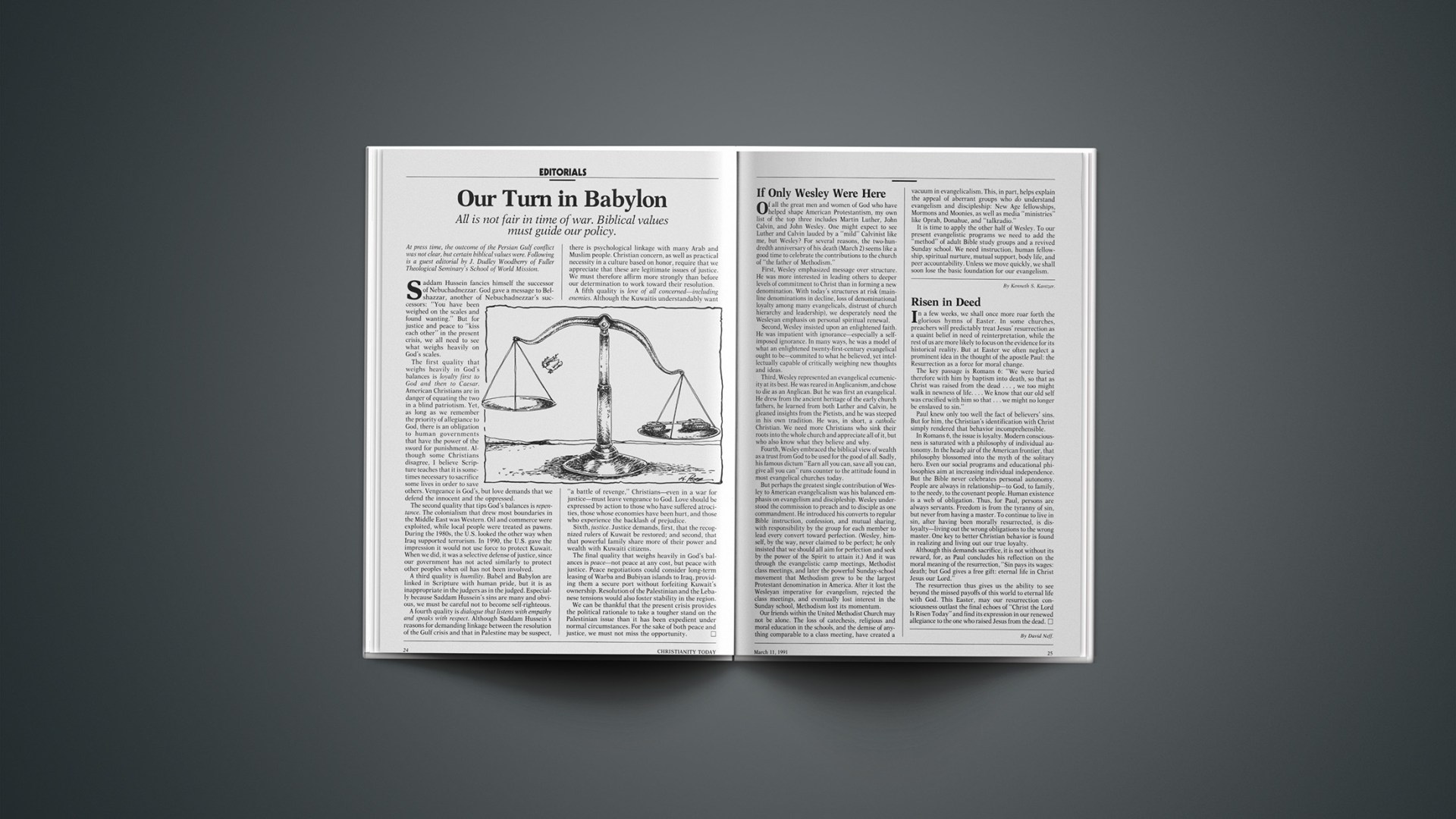
Saddam Hussein fancies himself the successor of Nebuchadnezzar. God gave a message to Belshazzar, another of Nebuchadnezzar’s successors: “You have been weighed on the scales and found wanting.” But for justice and peace to “kiss each other” in the present crisis, we all need to see what weighs heavily on God’s scales.
The first quality that weighs heavily in God’s balances is loyalty first to God and then to Caesar. American Christians are in danger of equating the two in a blind patriotism. Yet, as long as we remember the priority of allegiance to God, there is an obligation to human governments that have the power of the sword for punishment. Although some Christians disagree, I believe Scripture teaches that it is sometimes necessary to sacrifice some lives in order to save others. Vengeance is God’s, but love demands that we defend the innocent and the oppressed.
The second quality that tips God’s balances is repentance. The colonialism that drew most boundaries in the Middle East was Western. Oil and commerce were exploited, while local people were treated as pawns. During the 1980s, the U.S. looked the other way when Iraq supported terrorism. In 1990, the U.S. gave the impression it would not use force to protect Kuwait. When we did, it was a selective defense of justice, since our government has not acted similarly to protect other peoples when oil has not been involved.
A third quality is humility. Babel and Babylon are linked in Scripture with human pride, but it is as inappropriate in the judgers as in the judged. Especially because Saddam Hussein’s sins are many and obvious, we must be careful not to become self-righteous.
A fourth quality is dialogue that listens with empathy and speaks with respect. Although Saddam Hussein’s reasons for demanding linkage between the resolution of the Gulf crisis and that in Palestine may be suspect, there is psychological linkage with many Arab and Muslim people. Christian concern, as well as practical necessity in a culture based on honor, require that we appreciate that these are legitimate issues of justice. We must therefore affirm more strongly than before our determination to work toward their resolution.
A fifth quality is love of all concerned—including enemies. Although the Kuwaitis understandably want “a battle of revenge,” Christians—even in a war for justice—must leave vengeance to God. Love should be expressed by action to those who have suffered atrocities, those whose economies have been hurt, and those who experience the backlash of prejudice.
Sixth, justice. Justice demands, first, that the recognized rulers of Kuwait be restored; and second, that that powerful family share more of their power and wealth with Kuwaiti citizens.
The final quality that weighs heavily in God’s balances is peace—not peace at any cost, but peace with justice. Peace negotiations could consider long-term leasing of Warba and Bubiyan islands to Iraq, providing them a secure port without forfeiting Kuwait’s ownership. Resolution of the Palestinian and the Lebanese tensions would also foster stability in the region.
We can be thankful that the present crisis provides the political rationale to take a tougher stand on the Palestinian issue than it has been expedient under normal circumstances. For the sake of both peace and justice, we must not miss the opportunity.