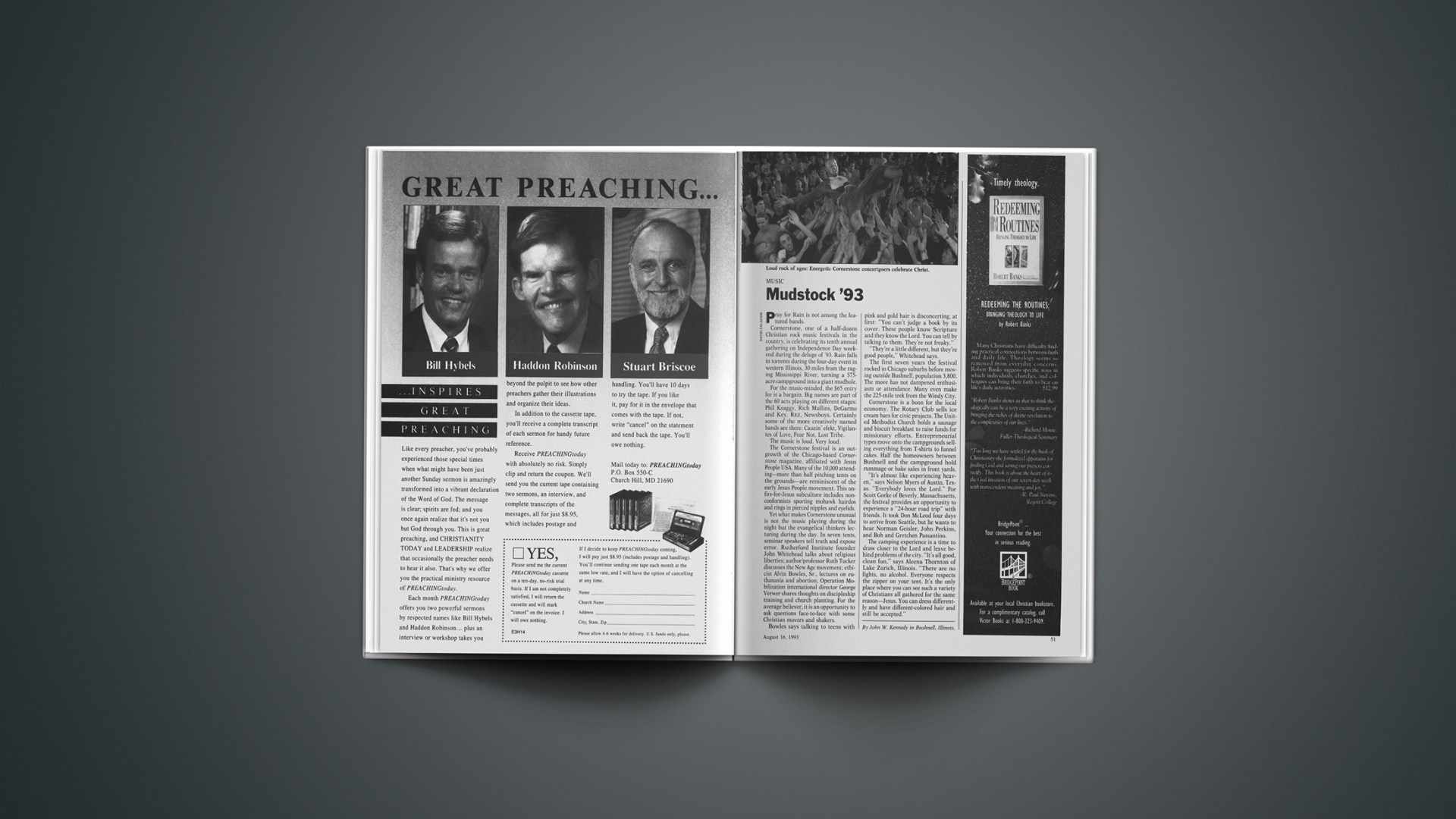

Pray for Rain is not among the featured bands.
Cornerstone, one of a half-dozen Christian rock music festivals in the country, is celebrating its tenth annual gathering on Independence Day weekend during the deluge of ‘93. Rain falls in torrents during the four-day event in western Illinois, 30 miles from the raging Mississippi River, turning a 575-acre campground into a giant mudhole.
For the music-minded, the $65 entry fee is a bargain. Big names are part of the 60 acts playing on different stages: Phil Keaggy, Rich Mullins, DeGarmo and Key, REZ, Newsboys. Certainly some of the more creatively named bands are there: Cauzin’ efekt, Vigilantes of Love, Fear Not, Lost Tribe.
The music is loud. Very loud.
The Cornerstone festival is an outgrowth of the Chicago-based Cornerstone magazine, affiliated with Jesus People USA. Many of the 10,000 attending—more than half pitching tents on the grounds—are reminiscent of the early Jesus People movement. This on-fire-for-Jesus subculture includes nonconformists sporting mohawk hairdos and rings in pierced nipples and eyelids.
Yet what makes Cornerstone unusual is not the music playing during the night but the evangelical thinkers lecturing during the day. In seven tents, seminar speakers tell truth and expose error. Rutherford Institute founder John Whitehead talks about religious liberties; author/professor Ruth Tucker discusses the New Age movement; ethicist Alvin Bowles, Sr., lectures on euthanasia and abortion; Operation Mobilization international director George Verwer shares thoughts on discipleship training and church planting. For the average believer, it is an opportunity to ask questions face-to-face with some Christian movers and shakers.
Bowles says talking to teens with pink and gold hair is disconcerting, at first: “You can’t judge a book by its cover. These people know Scripture and they know the Lord. You can tell by talking to them. They’re not freaky.”
“They’re a little different, but they’re good people,” Whitehead says.
The first seven years the festival rocked in Chicago suburbs before moving outside Bushnell, population 3,800. The move has not dampened enthusiasm or attendance. Many even make the 225-mile trek from the Windy City.
Cornerstone is a boon for the local economy. The Rotary Club sells ice cream bars for civic projects. The United Methodist Church holds a sausage and biscuit breakfast to raise funds for missionary efforts. Entrepreneurial types move onto the campgrounds selling everything from T-shirts to funnel cakes. Half the homeowners between Bushnell and the campground hold rummage or bake sales in front yards.
“It’s almost like experiencing heaven,” says Nelson Myers of Austin, Texas. “Everybody loves the Lord.” For Scott Gorke of Beverly, Massachusetts, the festival provides an opportunity to experience a “24-hour road trip” with friends. It took Don McLeod four days to arrive from Seattle, but he wants to hear Norman Geisler, John Perkins, and Bob and Gretchen Passantino.
The camping experience is a time to draw closer to the Lord and leave behind problems of the city. “It’s all good, clean fun,” says Aleena Thornton of Lake Zurich, Illinois. “There are no fights, no alcohol. Everyone respects the zipper on your tent. It’s the only place where you can see such a variety of Christians all gathered for the same reason—Jesus. You can dress differently and have different-colored hair and still be accepted.”
By John W. Kennedy in Bushnell, Illinois.