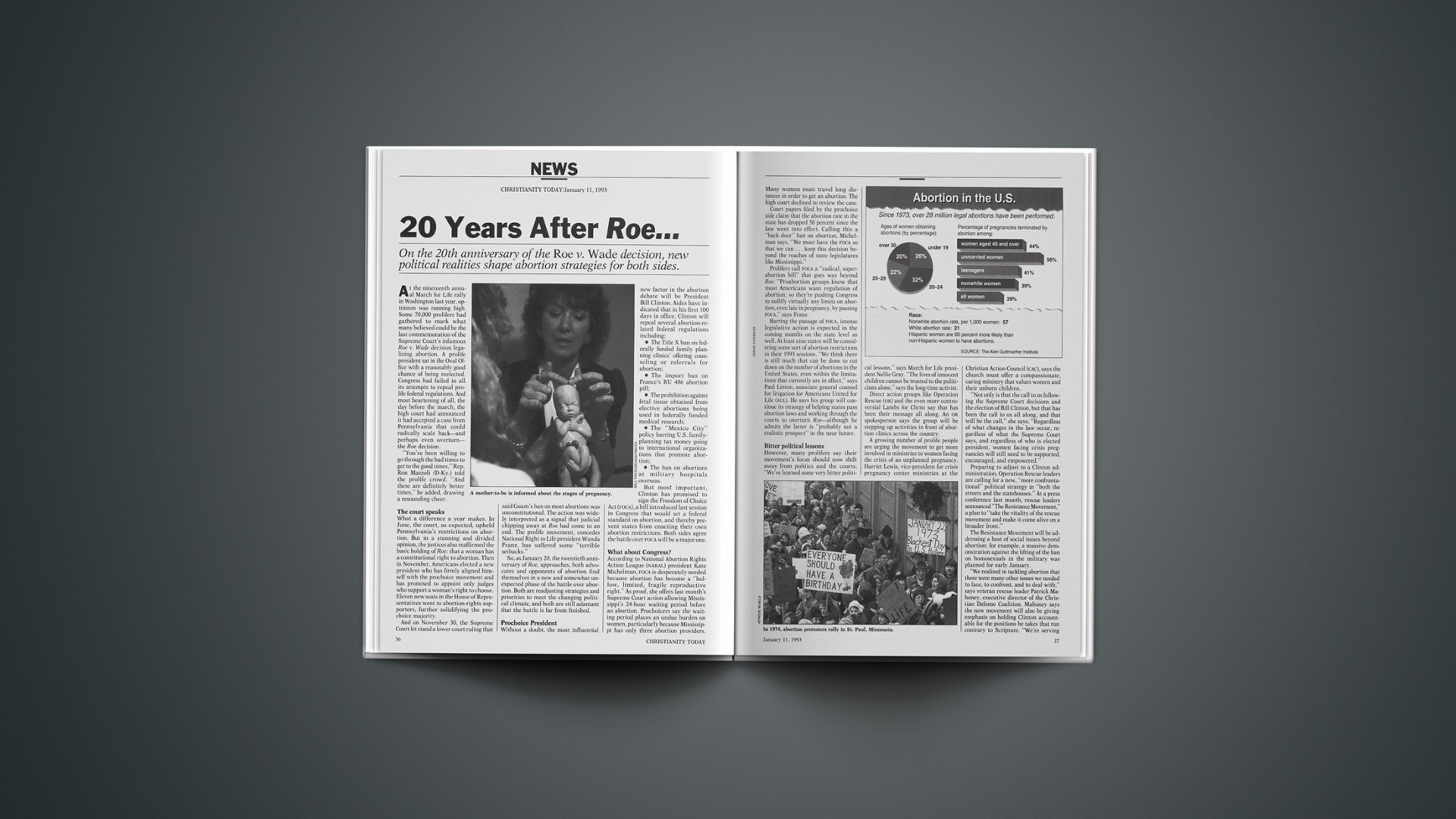

On the 20th anniversary of the Roe v. Wade decision, new political realities shape abortion strategies for both sides.
At the nineteenth annual March for Life rally in Washington last year, optimism was running high. Some 70,000 prolifers had gathered to mark what many believed could be the last commemoration of the Supreme Court’s infamous Roe v. Wade decision legalizing abortion. A prolife president sat in the Oval Office with a reasonably good chance of being reelected. Congress had failed in all its attempts to repeal prolife federal regulations. And most heartening of all, the day before the march, the high court had announced it had accepted a case from Pennsylvania that could radically scale back—and perhaps even overturn—the Roe decision.
“You’ve been willing to go through the bad times to get to the good times,” Rep. Ron Mazzoli (D-Ky.) told the prolife crowd. “And these are definitely better times,” he added, drawing a resounding cheer.
The court speaks
What a difference a year makes. In June, the court, as expected, upheld Pennsylvania’s restrictions on abortion. But in a stunning and divided opinion, the justices also reaffirmed the basic holding of Roe: that a woman has a constitutional right to abortion. Then in November, Americans elected a new president who has firmly aligned himself with the prochoice movement and has promised to appoint only judges who support a woman’s right to choose. Eleven new seats in the House of Representatives went to abortion-rights supporters, further solidifying the prochoice majority.
And on November 30, the Supreme Court let stand a lower court ruling that said Guam’s ban on most abortions was unconstitutional. The action was widely interpreted as a signal that judicial chipping away at Roe had come to an end. The prolife movement, concedes National Right to Life president Wanda Franz, has suffered some “terrible setbacks.”
So, as January 20, the twentieth anniversary of Roe, approaches, both advocates and opponents of abortion find themselves in a new and somewhat unexpected phase of the battle over abortion. Both are readjusting strategies and priorities to meet the changing political climate, and both are still adamant that the battle is far from finished.
Prochoice President
Without a doubt, the most influential new factor in the abortion debate will be President Bill Clinton. Aides have indicated that in his first 100 days in office, Clinton will repeal several abortion-related federal regulations including:
• The Title X ban on federally funded family planning clinics’ offering counseling or referrals for abortion;
• The import ban on France’s RU 486 abortion pill;
• The prohibition against fetal tissue obtained from elective abortions being used in federally funded medical research;
• The “Mexico City” policy barring U.S. family-planning tax money going to international organizations that promote abortion;
• The ban on abortions at military hospitals overseas.
But most important, Clinton has promised to sign the Freedom of Choice Act (FOCA), a bill introduced last session in Congress that would set a federal standard on abortion, and thereby prevent states from enacting their own abortion restrictions. Both sides agree the battle over FOCA will be a major one.
What about Congress?
According to National Abortion Rights Action League (NARAL) president Kate Michelman, FOCA is desperately needed because abortion has become a “hollow, limited, fragile reproductive right.” As proof, she offers last month’s Supreme Court action allowing Mississippi’s 24-hour waiting period before an abortion. Prochoicers say the waiting period places an undue burden on women, particularly because Mississippi has only three abortion providers. Many women must travel long distances in order to get an abortion. The high court declined to review the case.
Court papers filed by the prochoice side claim that the abortion rate in the state has dropped 50 percent since the law went into effect. Calling this a “back door” ban on abortion, Michelman says, “We must have the FOCA so that we can … keep this decision beyond the reaches of state legislatures like Mississippi.”
Prolifers call FOCA a “radical, super-abortion bill” that goes way beyond Roe. “Proabortion groups know that most Americans want regulation of abortion; so they’re pushing Congress to nullify virtually any limits on abortion, even late in pregnancy, by passing FOCA,” says Franz.
Barring the passage of FOCA, intense legislative action is expected in the coming months on the state level as well. At least nine states will be considering some sort of abortion restrictions in their 1993 sessions. “We think there is still much that can be done to cut down on the number of abortions in the United States, even within the limitations that currently are in effect,” says Paul Linton, associate general counsel for litigation for Americans United for Life (AUL). He says his group will continue its strategy of helping states pass abortion laws and working through the courts to overturn Roe—although he admits the latter is “probably not a realistic prospect” in the near future.
Bitter political lessons
However, many prolifers say their movement’s focus should now shift away from politics and the courts. “We’ve learned some very bitter political lessons,” says March for Life president Nellie Gray. “The lives of innocent children cannot be trusted to the politicians alone,” says the long-time activist.
Direct action groups like Operation Rescue (OR) and the even more controversial Lambs for Christ say that has been their message all along. An OR spokesperson says the group will be stepping up activities in front of abortion clinics across the country.
A growing number of prolife people are urging the movement to get more involved in ministries to women facing the crisis of an unplanned pregnancy. Harriet Lewis, vice-president for crisis pregnancy center ministries at the Christian Action Council (CAC), says the church must offer a compassionate, caring ministry that values women and their unborn children.
“Not only is that the call to us following the Supreme Court decisions and the election of Bill Clinton, but that has been the call to us all along, and that will be the call,” she says. “Regardless of what changes in the law occur, regardless of what the Supreme Court says, and regardless of who is elected president, women facing crisis pregnancies will still need to be supported, encouraged, and empowered.”
Preparing to adjust to a Clinton administration, Operation Rescue leaders are calling for a new, “more confrontational” political strategy in “both the streets and the statehouses.” At a press conference last month, rescue leaders announced “The Resistance Movement,” a plan to “take the vitality of the rescue movement and make it come alive on a broader front.”
The Resistance Movement will be addressing a host of social issues beyond abortion; for example, a massive demonstration against the lifting of the ban on homosexuals in the military was planned for early January.
“We realized in tackling abortion that there were many other issues we needed to face, to confront, and to deal with,” says veteran rescue leader Patrick Mahoney, executive director of the Christian Defense Coalition. Mahoney says the new movement will also be giving emphasis on holding Clinton accountable for the positions he takes that run contrary to Scripture. “We’re serving notice on President Clinton that we are going to dog him every step of the way for the next four years.”
Shifting strategies?
A sign of the emerging shift in the prolife movement is the announcement that AUL president Guy Condon is leaving the public-policy oriented group to take over the health care-oriented CAC helm. Condon said, “I’ve undergone a paradigm shift. If we [the prolife movement] are effective in loving women, she [a pregnant woman] will choose life for herself and her baby. Abortion is the most vicious form of misogyny ever. We want to put the abortion industry out of business by the end of the decade.”
Another new strategy has the prolife movement sharpening its persuasion skills. “For a long time I’ve written that the abortion fight will not be won in the Supreme Court or Congress,” says Prison Fellowship founder Chuck Colson. “It will be won in the hearts and minds of people. We’re going to have to find a way to convince people about the dignity and sacredness of human life.”
One person already doing this is Texas consultant Mark Crutcher, who is conducting “Life Activist Seminars” around the country. The purpose is to educate abortion opponents to articulate their position better. “It’s always been my observation that the basic weakness of the prolife movement has been a lack of training … [about] how to go out and express their prolife convictions,” he told Madison, Wisconsin, radio station WNWC. “The election of Bill Clinton could be the best thing that ever happened to us because the prolife movement was stuck in a rut, and it was pursuing policies that were never going to return legal protection to the unborn and their mothers.”
Abortion supporters are preparing to switch gears as well. NARAL’s Michelman says once the right to abortion is secured through FOCA, her group intends to move to a “broader, more comprehensive reproductive health program.” She describes this as an agenda to “make abortion less necessary and to ensure healthy child bearing.”
The Planned Parenthood Federation of America has also signaled a possible shift in emphasis. Next month, new president Pamela Maraldo will take office, replacing Faye Wattleton. Maraldo, a registered nurse and a Roman Catholic, says while the group will maintain its dedication to abortion rights, it will also be entering the debate over a national health-care policy.
Ann Thompson Cook, executive director of the Religious Coalition for Abortion Rights says her group will be “working really hard to make this country see that abortion is an issue of religious freedom.”
Despite new personnel, political climates, and strategy shifts, activists on all sides vow to stay engaged in the battle. “Elections come and go, presidents change, courts change,” says Michelman. “If we’re not vigilant, we will slip back into a dangerous situation.”
And prolifers say they will make that vigilance necessary. “Back in 1973 after the Supreme Court ruled in Roe v. Wade, everyone predicted that we would go away, but we certainly did not,” says Franz. “And we aren’t going to go away this time either.”
By Kim A. Lawton in Washington, D.C.
Language Of Life And Death
For the American media, the issue of abortion has severely strained the commitment to neutrality and fairness. Surveys of print and broadcast media have consistently revealed overwhelming support among journalists for legal abortion. Neutral observers have argued that a prochoice bias has prevailed in the abortion debate, a bias revealed in part through abortion-related terminology.
No one has caused the nonreligious press to grapple with the question of abortion terminology more than Los Angeles Times reporter David Shaw. Shaw’s 1990 series of articles on abortion bias in the media was nominated for a Pulitzer Prize. Shaw wrote that “careful examination of stories published and broadcast reveals scores of examples, large and small, that can only be characterized as unfair to the opponents of abortion, either in content, tone, choice of language or prominence of play.”
There are recent signs, however, that many press organizations are attempting to address the problem. Most of the newspapers and both of the major press services surveyed by CHRISTIANITY TODAY have policies dictating neutral language in reference to opponents in the abortion debate.
The Washington Post, for example, uses neither prolife nor prochoice. The New York Times told CT that it did not use prolife “because of the implication that abortion-rights supporters do not support life,” nor prochoice “because of the implication that abortion foes do not support ‘choice.’ ”
In his articles, Shaw pointed out that many media organizations had recently adjusted or were in the process of adjusting their abortion-language policies with the goal of communicating a neutral position. He reported, for example, that CBS and ABC had virtually abandoned the term prochoice in their evening news shows, while NBC was using it in only about 30 percent of its references to abortion-rights advocates.
This is not to say that the media, in general, have arrived at neutrality. For one thing, the policies in most cases apply to news coverage only. Columnists typically are free to choose their own language, and prochoice commentators far outnumber their prolife counterparts.
A conference on abortion language, sponsored by the Washington, D.C.—based Ethics and Public Policy Center (EPPC), concluded, in the words of EPPC spokesperson Mike Cromartie, that “there’s an extreme visceral bias on this issue.”
Why language matters
Prolife columnist Nat Hentoff of the Village Voice has pointed out, “The polls for years have shown that there’s a large middle ground of people who are not very clear on what they really believe.… The language has had a lot of effect in getting these people in the middle on the side of abortion rights. The emphasis is on choice. And unless you think it through, it’s hard to resist the notion of choice; it’s part of the American legacy.”
Marvin Olasky, associate professor at the University of Texas at Austin and a scholar of the abortion-language debate, said, “The bigger question to me is how you talk about the unborn child. Do you talk about a fetus, an unborn child, or a clump of tissue?”
Olasky says this is the abortion-language question that cuts right to the core of the debate, namely, the question of whether what is inside a woman’s womb is a human life that deserves the law’s protection. Olasky says he has spoken with several journalists who, like him, have been unable to find a neutral term relative to the fetus-unborn child dispute. Hentoff defends the expression “developing human being” as biologically correct.
By Randy Frame.