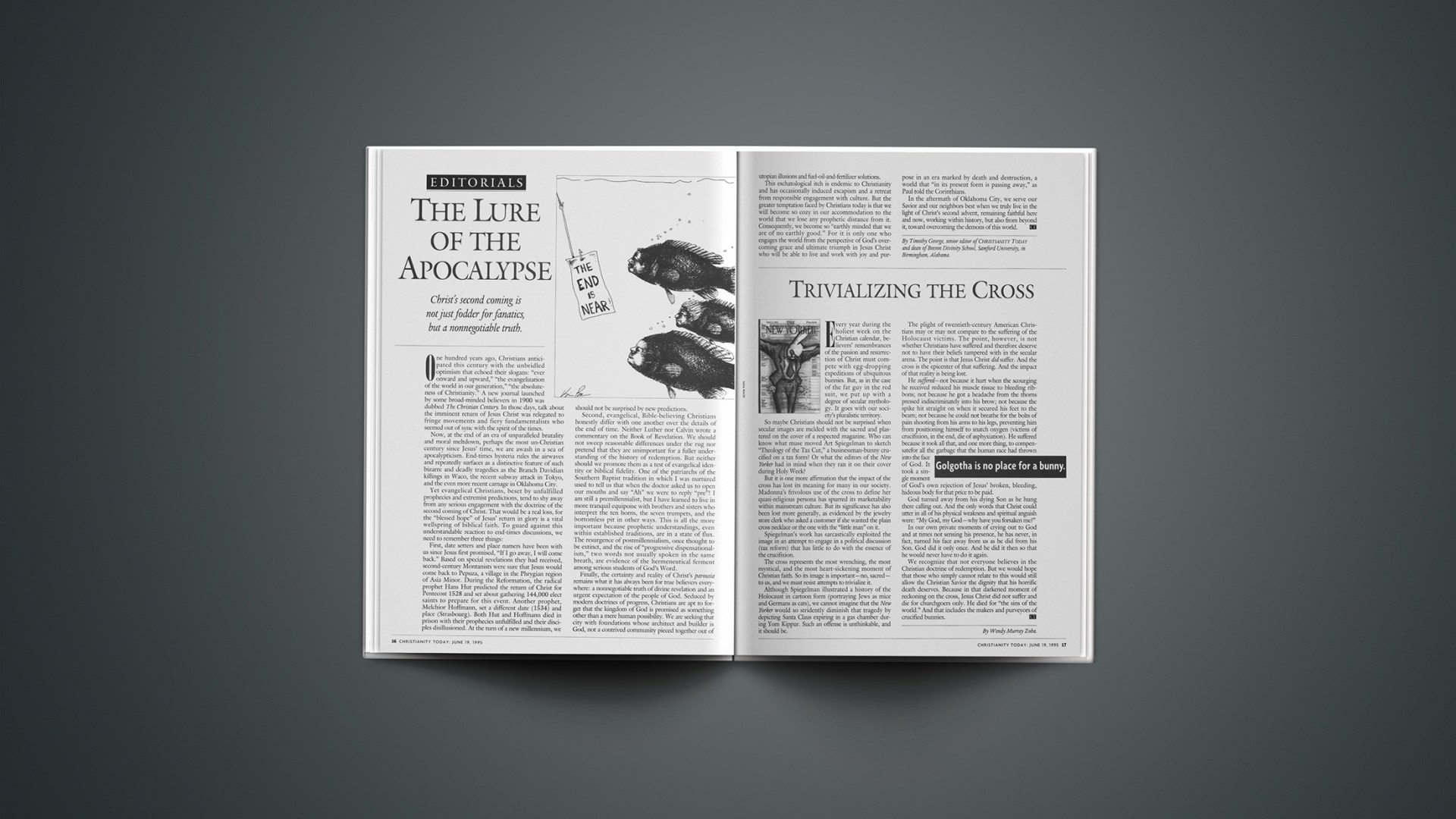

One hundred years ago, Christians anticipated this century with the unbridled optimism that echoed their slogans: “ever onward and upward,” “the evangelization of the world in our generation,” “the absoluteness of Christianity.” A new journal launched by some broad-minded believers in 1900 was dubbed The Christian Century. In those days, talk about the imminent return of Jesus Christ was relegated to fringe movements and fiery fundamentalists who seemed out of sync with the spirit of the times.
Now, at the end of an era of unparalleled brutality and moral meltdown, perhaps the most un-Christian century since Jesus’ time, we are awash in a sea of apocalypticism. End-times hysteria rules the airwaves and repeatedly surfaces as a distinctive feature of such bizarre and deadly tragedies as the Branch Davidian killings in Waco, the recent subway attack in Tokyo, and the even more recent carnage in Oklahoma City.
Yet evangelical Christians, beset by unfulfilled prophecies and extremist predictions, tend to shy away from any serious engagement with the doctrine of the second coming of Christ. That would be a real loss, for the “blessed hope” of Jesus’ return in glory is a vital wellspring of biblical faith. To guard against this understandable reaction to end-times discussions, we need to remember three things:
First, date setters and place namers have been with us since Jesus first promised, “If I go away, I will come back.” Based on special revelations they had received, second-century Montanists were sure that Jesus would come back to Pepuza, a village in the Phrygian region of Asia Minor. During the Reformation, the radical prophet Hans Hut predicted the return of Christ for Pentecost 1528 and set about gathering 144,000 elect saints to prepare for this event. Another prophet, Melchior Hoffmann, set a different date (1534) and place (Strasbourg). Both Hut and Hoffmann died in prison with their prophecies unfulfilled and their disciples disillusioned. At the turn of a new millennium, we should not be surprised by new predictions.
Second, evangelical, Bible-believing Christians honestly differ with one another over the details of the end of time. Neither Luther nor Calvin wrote a commentary on the Book of Revelation. We should not sweep reasonable differences under the rug nor pretend that they are unimportant for a fuller understanding of the history of redemption. But neither should we promote them as a test of evangelical identity or biblical fidelity. One of the patriarchs of the Southern Baptist tradition in which I was nurtured used to tell us that when the doctor asked us to open our mouths and say “Ah” we were to reply “pre”! I am still a premillennialist, but I have learned to live in more tranquil equipoise with brothers and sisters who interpret the ten horns, the seven trumpets, and the bottomless pit in other ways. This is all the more important because prophetic understandings, even within established traditions, are in a state of flux. The resurgence of postmillennialism, once thought to be extinct, and the rise of “progressive dispensationalism,” two words not usually spoken in the same breath, are evidence of the hermeneutical ferment among serious students of God’s Word.
Finally, the certainty and reality of Christ’s parousia remains what it has always been for true believers everywhere: a nonnegotiable truth of divine revelation and an urgent expectation of the people of God. Seduced by modern doctrines of progress, Christians are apt to forget that the kingdom of God is promised as something other than a mere human possibility. We are seeking that city with foundations whose architect and builder is God, not a contrived community pieced together out of utopian illusions and fuel-oil-and-fertilizer solutions.
This eschatological itch is endemic to Christianity and has occasionally induced escapism and a retreat from responsible engagement with culture. But the greater temptation faced by Christians today is that we will become so cozy in our accommodation to the world that we lose any prophetic distance from it. Consequently, we become so “earthly minded that we are of no earthly good.” For it is only one who engages the world from the perspective of God’s overcoming grace and ultimate triumph in Jesus Christ who will be able to live and work with joy and purpose in an era marked by death and destruction, a world that “in its present form is passing away,” as Paul told the Corinthians.
In the aftermath of Oklahoma City, we serve our Savior and our neighbors best when we truly live in the light of Christ’s second advent, remaining faithful here and now, working within history, but also from beyond it, toward overcoming the demons of this world.
******************
By Timothy George, senior editor of CHRISTIANITY TODAY and dean of Beeson Divinity School, Samford University, in Birmingham, Alabama.
Copyright © 1995 Christianity Today. Click for reprint information.
ctjun95mrw5T7016566b