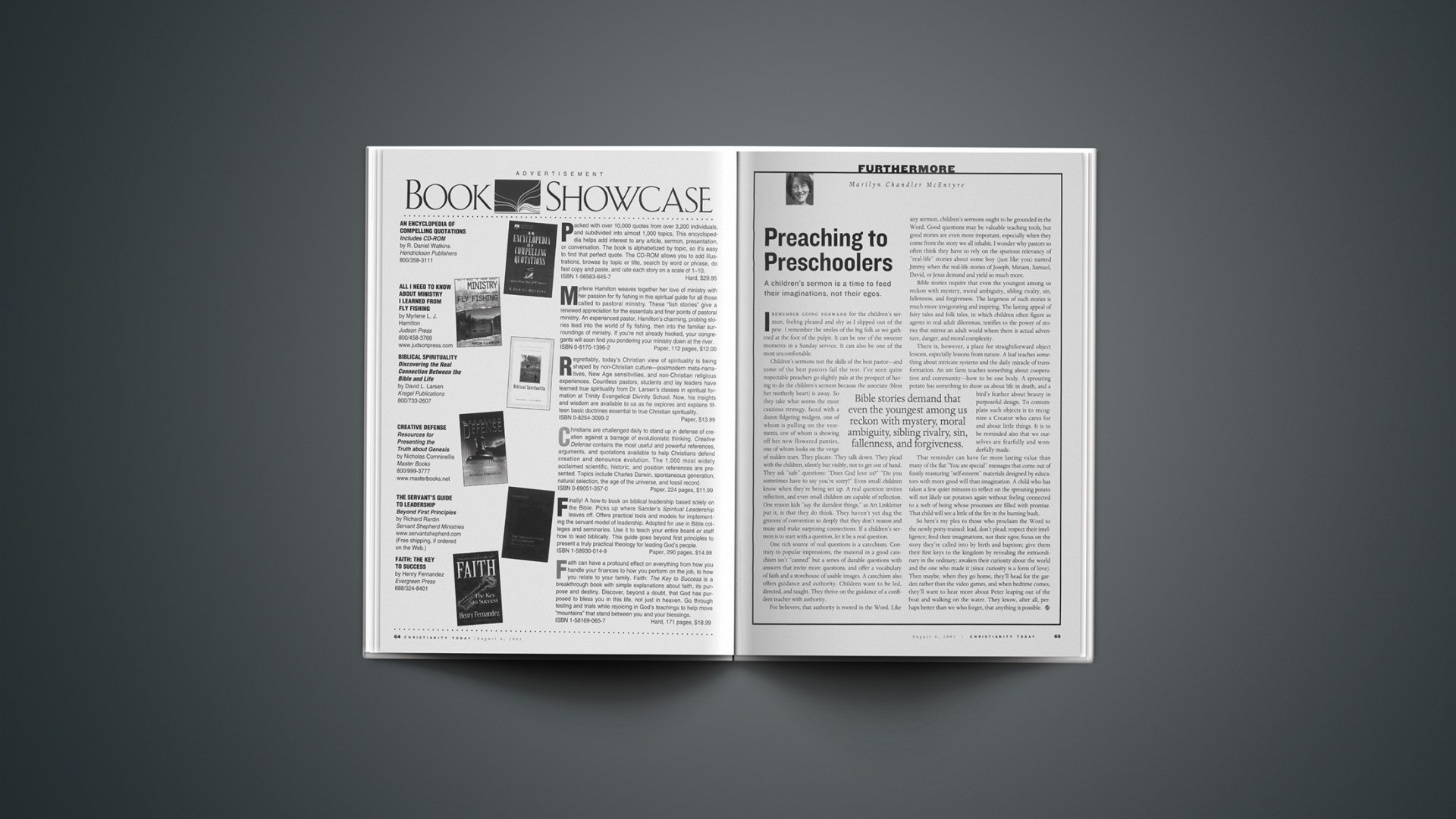

Children’s sermons test the skills of the best pastor—and some of the best pastors fail the test. I’ve seen quite respectable preachers go slightly pale at the prospect of having to do the children’s sermon because the associate (bless her motherly heart) is away. So they take what seems the most cautious strategy, faced with a dozen fidgeting midgets, one of whom is pulling on the vestments, one of whom is showing off her new flowered panties, one of whom looks on the verge of sudden tears. They placate. They talk down. They plead with the children, silently but visibly, not to get out of hand. They ask “safe” questions: “Does God love us?” “Do you sometimes have to say you’re sorry?” Even small children know when they’re being set up. A real question invites reflection, and even small children are capable of reflection. One reason kids “say the darndest things,” as Art Linkletter put it, is that they do think. They haven’t yet dug the grooves of convention so deeply that they don’t reason and muse and make surprising connections. If a children’s sermon is to start with a question, let it be a real question.
One rich source of real questions is a catechism. Contrary to popular impressions, the material in a good catechism isn’t “canned” but a series of durable questions with answers that invite more questions, and offer a vocabulary of faith and a storehouse of usable images. A catechism also offers guidance and authority. Children want to be led, directed, and taught. They thrive on the guidance of a confident teacher with authority.
For believers, that authority is rooted in the Word. Like any sermon, children’s sermons ought to be grounded in the Word. Good questions may be valuable teaching tools, but good stories are even more important, especially when they come from the story we all inhabit. I wonder why pastors so often think they have to rely on the spurious relevancy of “real-life” stories about some boy (just like you) named Jimmy when the real-life stories of Joseph, Miriam, Samuel, David, or Jesus demand and yield so much more.
Bible stories require that even the youngest among us reckon with mystery, moral ambiguity, sibling rivalry, sin, fallenness, and forgiveness. The largeness of such stories is much more invigorating and inspiring. The lasting appeal of fairy tales and folk tales, in which children often figure as agents in real adult dilemmas, testifies to the power of stories that mirror an adult world where there is actual adventure, danger, and moral complexity.
There is, however, a place for straightforward object lessons, especially lessons from nature. A leaf teaches something about intricate systems and the daily miracle of transformation. An ant farm teaches something about cooperation and community—how to be one body. A sprouting potato has something to show us about life in death, and a bird’s feather about beauty in purposeful design. To contemplate such objects is to recognize a Creator who cares for and about little things. It is to be reminded also that we ourselves are fearfully and wonderfully made.
That reminder can have far more lasting value than many of the flat “You are special” messages that come out of fussily reassuring “self-esteem” materials designed by educators with more good will than imagination. A child who has taken a few quiet minutes to reflect on the sprouting potato will not likely eat potatoes again without feeling connected to a web of being whose processes are filled with promise. That child will see a little of the fire in the burning bush.
So here’s my plea to those who proclaim the Word to the newly potty-trained: lead, don’t plead; respect their intelligence; feed their imaginations, not their egos; focus on the story they’re called into by birth and baptism; give them their first keys to the kingdom by revealing the extraordinary in the ordinary; awaken their curiosity about the world and the one who made it (since curiosity is a form of love). Then maybe, when they go home, they’ll head for the garden rather than the video games, and when bedtime comes, they’ll want to hear more about Peter leaping out of the boat and walking on the water. They know, after all, perhaps better than we who forget, that anything is possible.
Copyright © 2001 Christianity Today. Click for reprint information.
Related Elsewhere
A ready-to-download Bible Study on this article is available at ChristianBibleStudies.com. These unique Bible studies use articles from current issues of Christianity Today to prompt thought-provoking discussions in adult Sunday school classes or small groups.
Christianity Today‘s sister publication Leadership has more discussion on preaching and communicating Christian truths.Previous McEntyre columns for Christianity Today include:
Resisting “Relevancy” | The church suffers when pastors confuse anecdotes with parables. (June 28, 2001)
My House, God’s House | Hospitality is not merely good manners but a ministry of healing. (May 9, 2001)
Rx for Moral Fussbudgets | Good guilt entails more than repentance for merely personal sins. (Mar. 19, 2001)
Community, Not Commodity | Let us acknowledge, and even mourn, what we lose when worship meets media. (Jan. 16, 2001)
Nice Is Not the Point | Sometimes love is sharp, hard-edged, confusing, and seemingly unfair. (Nov. 29, 2000)
The Fullness of Time | I’d like life to be a series of pauses like a poem, rather than a fast-paced, page-turner airport novel. (Oct. 12, 2000)
‘I’ve Been Through Things’ | Meditating on “Honor your father and your mother.” (Sept. 6, 2000)
Silence Is to Dwell In | An hour of quiet is a rare gift, hard to come by in an ordinary week, even for those who seek it. (Aug. 10, 2000)