Peggy (Molly Shannon) is a Nice Person. She brings donuts into the office for no reason. She has Cathy cartoons posted in her cubicle. She listens with rapt attention as her socially awkward boss drones on and on about how he’s getting shafted, and to her chirpy best friend Layla (Regina King) who talks dreamily about the boyfriend everyone but her can see is a player.
The love of Peggy’s life is her dog, Pencil. She drives with him in her lap, eats with him in her brightly decorated kitchen, sleeps with him in her cozy bedroom. With Pencil by her side, Peggy leads a happy, if not a tad unexamined, life.

This changes abruptly one day when Pencil begs to go outside in the middle of the night and then doesn’t come back. When she wakes up alone the next morning, Peggy frantically searches for her faithful companion. When she finally finds him seriously ill in her neighbor’s yard, she rushes him to the vet, where he dies soon after.
The remainder of the film chronicles how this deep loss affects Peggy. When her family and friends try to comfort her, offering a work bonus or some Xanax, suggesting she get drunk or have meaningless sex, we can see in Peggy’s vacant expression that these friends don’t get it. Their suggestions of how she cope with her grief show the extent that they don’t understand its depth. And in as much, these people she’s unconditionally supported over the years let her down.

There’s a hint of silver lining when Al (John C. Reilly), the neighbor whose yard in which Peggy found Pencil, offers to take her to dinner. Optimist/delusional Layla gets excited at this turn of events, suggesting that maybe Pencil died so that single Peggy could meet Al. There’s also a romantic possibility in Newt (Peter Sarsgaard), a man from a local rescue shelter who helps Peggy find her next dog, Valentine. Inspired by Newt, Peggy takes her love of animals to the next level by becoming a vegan and getting involved in animal rights activism. Despite her openness to new things and new loves, Peggy finds more disappointment than comfort or hope.
Peggy’s visits to her brother and sister-in-law, Pier (Thomas McCarthy) and Bret (Laura Dern), offer interesting landmarkers of her gradual transformation. This couple, written almost too over-the-top as the Gap-clad, suburbanite, overprotective parents, thinks it sweet when Peggy brings their children gifts of stuffed animals and the movie Babe. But they find it odd and humorous when she rescues farm animals in each of their names for Christmas. In their laughter and odd stares, they too let Peggy down.
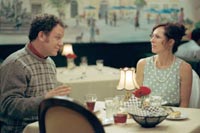
Molly Shannon plays Peggy with deft understatement. When she walks out of the vet office after losing Pencil and gives way to heaving sobs in her car, it isn’t one of those typical Hollywood crying scenes where the heroine is softly lit and somehow gets even prettier for the tears. No, this is a real woman coming unglued—wrinkles, blotchy face, and all—at the loss of her best friend. When she tries to answer Al’s question if she’s ever been married, her awkward over-explanation is pitch perfect (trust me, as a single woman, I’ve been there and stammered through that). Peggy easily could have become a caricature throughout the film, but it’s a testament to Shannon’s nuanced performance that the only times she leans that way is due to scripting and plot development.
It’s the plot development that eventually bothers me about Year of the Dog. As each person disappoints Peggy, we watch her get more extreme in her activism and start to spiral out of control. When something tragic befalls her Valentine, she snaps and her actions step over the line into criminal behavior. Though she’s basically harmless, it seems obvious that this is a woman in need of some psychiatric help, instead of a few pity-laced laughs. Ultimately, she’s played off as a woman who finds her true calling in animal activism. In some ways, your view of Year of the Dog will depend on your politics and perspective—whether you’ll see the film as the making of Crazy Dog Lady or as the story of a bereaved woman finding her true passion in life. Personally, I lean toward the former.

The filming is sparse, with a lot of scenes close up on a character’s face, with plennn-ty of time to watch his or her expression. This is very effective in some scenes, and then gets old in others. A bit more variety and a slightly swifter pace would have been nice. Also, in the scenes where we laugh or are presumably supposed to, I can’t help but feel like we’re always doing so at someone. We laugh at Al’s glass case of hunting knives mounted proudly on his wall. We laugh at Layla’s idiotic but well-intended encouragement to Peggy, in lines such as “even retarded crippled people get married.” We laugh at Newt’s little dog who’s basically in a wheelchair. The humor feels more like ridicule in a few too many places.
By the end, I’m not sure of the overall message. I get that I’m supposed to be moved to go to my local pound and adopt a dog. But is that because all people eventually let us down so it’s safer and wiser to trust animals? If so, how bleak! There’s also a muddled, kind of tacked-on message about the love of people’s lives coming in many forms. The movie’s tag line—”Has the world left you a stray?”—has a clever double-meaning. But I don’t feel as though it delivers satisfyingly on either count. In as much, and with its awkward attempts to be a comedy, I feel the film is more effective at simply leading us astray.
Talk About It
Discussion starters- How do Peggy’s friends try to comfort her after her loss? How are these suggestions helpful or harmful? How does she end up coping? Do you think this is healthy? How have you coped with losses in healthy and unhealthy ways?
- As Christians, what is our responsibility and relationship to animals? What kind of priority should they have in our life—whether domesticated or wild?
- Did you see the film as the making of Crazy Dog Lady or as the story of a bereaved woman who finds her true calling in life? Why do you feel that way?
- Have you ever felt like a stray in life? What made you feel that way? How did others and/or your faith make a difference? How can you reach out to others who might feel like a stray right now?
The Family Corner
For parents to considerYear of the Dog earns its PG-13 rating for a few suggestive references. Though it’s a pretty tame movie, it’s really more of an adult flick about a woman coping with a serious loss. Younger kids might be a bit bothered by the dog’s death as well as some of the animal-rights information that’s shared.
Photos © Copyright Paramount Vantage
Copyright © 2007 Christianity Today. Click for reprint information.