It’s never good news when a drifter comes to a small town. And when his name is the improbably villainous Eli Cottonmouth, it’s hardly the wisest course of action to allow him free reign to do as he pleases. And yet that’s just what happens in Dog Days of Summer, a family feature that aims for magical realism, missing more often than not.
Dog Days of Summer opens with adult Philip Walden paying a visit to the unnamed town where he grew up. In a voiceover, he expresses his disgust over the ramshackle, broken down state of things, and, with trepidation, recalls “the summer I unwillingly grew up.”
That summer kicked off with the arrival of Eli (Will Patton), as witnessed by preteen Philip (Devon Gearhart) and best friend Jackson (Colin Ford). The two boys stare in awe as Eli tumbles out of his ancient-looking car and invite the townsfolk over to look at his amazing model circus.

It’s not long before Eli convinces the mayor to pay him to create a scale model of the town for the upcoming bisesquicentennial. Philip and Jackson, both dealing with troubles at home, glom onto Eli, using his old camera to take pictures of the town for Eli to use as inspiration.
Despite its picture-perfect surface, Philip’s town is anything but idyllic. His father is a minister, but not exactly the heroic kind—more the philandering kind. Jackson’s blind father drinks his life away, mourning the loss of Jackson’s mother to a car crash. Both boys are lost in a sea of adult emotions, with neither the maturity nor the resources to cope. As the boys take pictures for Eli, they watch the lives of those they love unraveling around them, and struggle to hang onto their dream of an uncomplicated life where the sun is always high and the river is filled with fish.
The concept behind Dog Days of Summer is hardly an original one. In fact, most of the story elements are threadbare from familiarity. The framing voiceover hits every cliché in the book, and the character of Eli Cottonmouth lacks any originality.
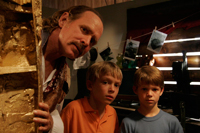
This derivativeness is frustrating because in other places the film demonstrates a willingness to take risks. First time director Mark Freiburger uses some fantastical elements at various dramatic moments, and for the most part they really work. Eli shows the boys a sarcophagus, and when they step in it proves, like C.S. Lewis’s wardrobe, to be larger on the inside than it is on the outside. These scenes elevate the film to something approaching magical realism, but the trite nature of the rest of the movie holds it back from achieving transcendence and offering moviegoers a new, fresh experience.
The biggest problem with Dog Days of Summer is that it’s anachronistic to its core, and not in a good way. The flashbacks to younger Philip are set in what appear to be the late 1980s, at least according to the costume design, but the feel of the town and the behavior of the characters is lifted straight from a collection of stereotypes of a 1950s American small town. The result is a mishmash that fails to connect with the reality of contemporary life.
For example, it’s impossible to swallow that no one in the town would question middle-aged Eli’s interest in two prepubescent boys. They meet him in the middle of the night in perfect innocence, and it’s really hard to take seriously. The filmmakers do want to peel back the hypocrisy that creeps in when a person or a group believe themselves to be paragons of goodness, but the concept of the “perfect little town” is a straw man that only exists in second-rate literature.

Not that Dog Days of Summer needs to take an unflinching look at human depravity to tell a great story. The truth comes in family-friendly guises as well—just ask Harper Lee or Ray Bradbury. The filmmakers seem willing to go deeper into real human pain and face sin and evil head on, given the storylines that they’ve crafted for Philip and Jackson, but by resting on empty, hollow clichés about an America that doesn’t exist anymore, if it ever did, they do a disservice to the characters they’re asking to wrestle with the big questions about life and death.
On the whole, the actors rise above the weaknesses of the material, especially Gearhart and Ford, the young actors playing Philip and Frank. They bring an honesty and subtlety that isn’t necessarily there in the script, and elevate the movie in the process. Will Patton seems a bit lost in his southern gentleman/snake oil salesman character, but shows an admirable restraint that does keep those troublesome midnight scenes with the boys from being too creepy to watch.
Dog Days of Summer offers families a good platform with which to engage with the nature of evil and hypocrisy, albeit in a form that lacks artistic sophistication. It’s deeply flawed, yet its good intentions cover over a multitude of sins. The movie ably fills a moral void lacking in mainstream family entertainment. It’s too bad its production values can’t compete.
Talk About It
Discussion starters- Are some sins easier to hide than others? What happens when you hide secret sins from your family and friends?
- What did Jesus say about those who appear perfect on the outside but don’t face up to their innate sinfulness?
- Are you tempted to pretend that you are “doing well” in order to impress others? How does this compromise your witness?
The Family Corner
For parents to considerDog Days of Summer is not rated by the MPAA. Characters smoke cigarettes. One character gets violently drunk. There is an onscreen murder, not gory or graphic, but there is a little blood. A child drowns. There is implied adultery.
Photos © Copyright Anchor Bay
Copyright © 2009 Christianity Today. Click for reprint information.