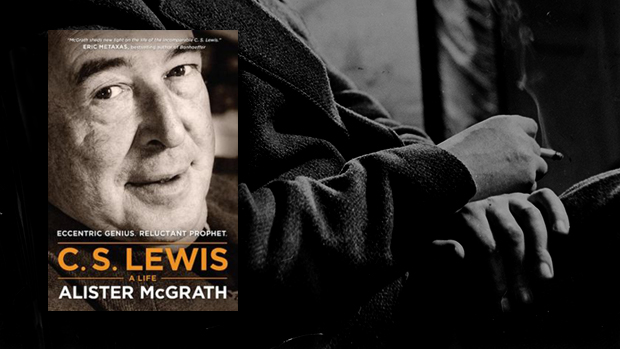
Alister McGrath's biography of C. S. Lewis was highly anticipated. Its release earlier this year raised expectations that the definitive account of Lewis's life had finally arrived.

Very often, when encountering such hype, it pays to be skeptical. J. R. R. Tolkien, quoting G. K. Chesterton, once said that, "as soon as he heard that anything 'had come to stay, he knew that it would be very soon replaced—indeed be regarded as pitiably obsolete and shabby.'" When a biography comes along promising to set the record straight or provide a last word on some prominent public figure, it's easy enough for similar sentiments to arise.
Without a doubt, C. S. Lewis – A Life: Eccentric Genius, Reluctant Prophet has much to commend it to readers' attention. First, McGrath actually read Lewis thoroughly before setting out to write. One doubts whether A. N. Wilson, the British man of letters who wrote another well-known Lewis biography, ever thought to take this precaution. While Wilson goes down smoothly by virtue of his remarkable writing style, inaccuracies seem to appear on nearly every page. By comparison, McGrath leaves no doubt that he knows his subject. He did due preparation by reading everything Lewis wrote in chronological order. McGrath has a well-earned academic reputation, and it's meticulous endeavors of this sort that help explain why.
Second, McGrath helpfully brings his own biographical background to bear on the subject matter. Like Lewis, he is an Irish-born Oxford scholar, though of a different era. This pedigree gives McGrath a unique vantage point on Lewis's own experience as an Ulsterman living in an English academic environment.
Third, McGrath's own writing style is fluid and engaging. And finally, McGrath does uncover some information that's barely known even among Lewis scholars and aficionados. For example, Lewis's conversion to Christianity actually took place several months to a year later than the dates Lewis himself seems to suggest. The chronology of these events reveals how carefully McGrath pays attention to detail. (In this vein, he also brings to light the fact that Lewis nominated Tolkien for the Nobel Prize in literature.)
How much, though, do these (admittedly interesting) details really add to our understanding of Lewis? Certainly, their discovery serves the cause of achieving exact historical accuracy. But they don't count for much when it comes to grasping the big ideas at the heart of Lewis's copious writings. Lewis, at times, does not get his dates right. But that's no more important, in the grand scheme of things, than Einstein's occasional trouble with simple mathematics.
The Importance of Literary Form
So yes, there are strengths to McGrath's biography. But these do not outweigh the many weaknesses. Most troubling, there is a glaring lack of appreciation for how Lewis carefully selected literary genres to suit the material he wished to present.
Lewis reminded readers of The Preface to Paradise Lost that the man who writes a love sonnet loves not only the beloved, but also the sonnet itself. Elsewhere, he wrote that "sometimes fairy stories say best what's to be said." Lewis dabbled in science fiction not out of any interest in technology, but because the genre allowed him to develop themes of romance and longing in a particular way. Authors, he argued, ought to select their literary form as carefully as a sculptor selects his marble.
McGrath's blind spot in this area especially mars his treatment of Lewis's autobiography, Surprised by Joy. Lewis framed the book (subtitled The Shape of My Early Life) as a kind of testimony or personal apologetic. His goal was not to give a comprehensive account of his life, but simply to tell the story of his conversion. That purpose determined what he chose to include and what he chose to leave out. But McGrath seems to interpret Lewis's omissions as signs of dishonesty or attempts to hide things that complicate the preferred narrative. He uses the unfortunate but oft-quoted statement by Dr. Robert Havard (Lewis's personal physician and fellow "Inkling") that Surprised by Joy should have been titled Suppressed by Jack. This comment may be clever, but it does a serious injustice to Lewis's integrity as an author.
McGrath often wonders what Lewis left out and why. There are moments in the book when one senses the real Lewis has dropped out of the narrative, or been replaced by a figment of the biographer's imagination. Based on speculations about what Lewis didn't write, a repressed Lewis emerges, hidden from all until McGrath draws him out of the shadows. He seems to neglect the likelier possibility that Lewis was merely exercising a degree of discretion perfectly proper—and utterly necessary—to the art of autobiography. Telling one's story is a different matter than listing bullet points of biographical detail. It's about weaving together the threads of one's life into a coherent and compelling tapestry.
In one instance, McGrath begins to question why Lewis spends more time discussing his school days than his war years. Had McGrath appreciated Lewis's respect for literary form, he might have made more sense of this. Since Lewis was writing the story of his pilgrimage to faith, extended discussion of his school days enabled him to emphasize his loneliness and isolation. His discussion of the loss of his mother and estrangement from his father allowed for a similar emphasis. This is significant, given that the impulse propelling Lewis toward an eventual conversion experience was his quest to recover some object—comprehended only dimly, if at all—of his deepest longing. Lewis writes less about his war experiences because they occupied a shorter period of time, and in some ways, apart from discovering "Guns and Good Company" and G. K. Chesterton, they were less formative in his pilgrimage to faith.
Everything in Surprised by Joy was purposefully selected (right down to the books Lewis mentions reading) to advance the story of Lewis's road to conversion. Where he left certain details out, it was not to hide them, but because to keep the narrative moving in the way he sought. Lewis discovered God was the object of his deepest desire. Autobiography was the instrument he chose to make that argument.
McGrath wastes our time when he tries to decipher what psychological hang-ups allegedly caused Lewis to avoid salacious details about his much-discussed relationship with Mrs. Moore or mask the personal aftereffects of World War I. Too often, McGrath fails to give us Lewis, and instead tries to piece together what everyone else apparently has missed.
For all the merits of McGrath's biography, it is not the "definitive" version for which the world still yearns.
Jerry Root is associate director of the Billy Graham Center Institute of Strategic Evangelism at Wheaton College. He is the author of C. S. Lewis and a Problem of Evil: An Investigation of a Pervasive Theme (Wipf & Stock) and co-editor of The Soul of C. S. Lewis: A Meditative Journey Through Twenty-Six of His Best-Loved Writings (Tyndale).