





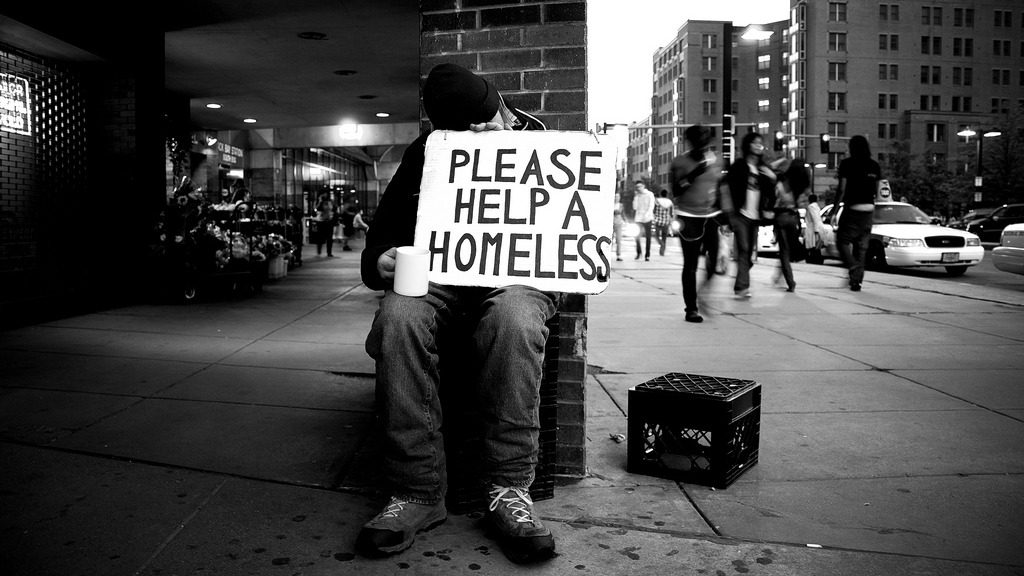
In college, I volunteered with a homeless outreach program. “Just talk to the people on the streets,” the campus minister told us. “Have a conversation with them. Treat them like regular human beings.” In other words, be like the Good Samaritan whose first act was to come near and see. Social service organizations could meet the physical needs of the homeless, but it was our task to provide them with dignifying, caring, and sincere human interaction.
For two years, I built relationships with the regulars that hung out near campus, learning about their families, their Vietnam War service, their professions and hobbies. Most importantly, I learned that I, a young adult at a private university, was not so different from them. Some had once lived lives similar to mine before facing difficult and unexpected turns.
Truth be told, I’ve had trouble holding on to that lesson. As I’ve gotten older and more preoccupied with work and family, I tell myself I don’t have the time or the energy to pay attention to those in need in front of me. But perhaps more accurately, I haven’t had the heart. It’s much easier to go home and make an online donation to a charity serving the homeless than to look a homeless person in the eye and say hello.
Now an educated, married professional, I realize that the social divide between those in poverty and me has grown. It takes more effort to bridge the gap, and my empathy muscles don’t always feel up for the task. When I see a homeless person these days, like many of us, I often walk away and do nothing.
In recent years a significant body of social research has demonstrated that people become less empathetic—less kind, generous, and compassionate—as they grow more affluent and privileged. Even with a keen awareness of Jesus’ teachings to love my neighbor as myself and to give to anyone who asks, I am not immune to this effect.
We don’t need to be particularly rich or powerful to begin treating others with less compassion. This inclination can hold true in any situation in which one person has relatively more social status than the other (as determined by any number of factors, including gender, age, race, ability, education, occupation, social network, or religion).
The ways we express our lack of empathy may be small and subtle—paying less attention, conveying disregard in our facial expressions, looking past the other person—but the result is the same. We act as if we have more value than another and, whether or not we admit it, often end up believing this to be true.
The further we get from poverty, the easier it becomes for us to distance ourselves from the experience of the poor. Today the social divides between us are growing in scope and scale. While the rate of poverty in the US (14.8 percent, or 46.7 million people) has not changed significantly in the last few years, income inequality has ballooned. Since 1979 the wages of the top 1 percent grew by 138 percent, while those of the bottom 90 percent grew only 15 percent. Stagnating middle-class wages and falling lower-class wages aren’t keeping up with inflation. The 1973 average hourly wage of $4.03 actually had more purchasing power than today’s average of $20.67.
Homelessness is a symptom of our income stagnation. The average hourly wage needed to afford a two-bedroom apartment in the US is $18.92, more than two-and-a-half times the federal minimum wage. In no state can a full-time worker earning minimum wage afford a market-rate one-bedroom apartment. “If you are poor, you are essentially an illness, an accident, or a paycheck away from living on the streets,” explains the National Coalition for the Homeless.
The divide is geographical too. A recent study found that economic segregation is on the rise. From 2000 to 2013, the number of people living in neighborhoods of concentrated poverty (where 40 percent or more of the residents fall below the federal poverty line) jumped from 7.2 million to 13.8 million, the highest number ever recorded. Because a greater percentage of African Americans and Hispanic Americans are poor, these neighborhoods are disproportionally occupied by residents of color.
Both science and Scripture tell us that reaching out to those who are less valued by society goes against our human nature. Think of all the times you’ve chosen to ignore a homeless person rather than greet them or give them your change. Even small gestures—a smile, asking someone how he or she is doing, giving away a cup of coffee—may not feel easy. “Simply being with someone is difficult because it asks of us that we share in the other’s vulnerability, enter with him or her into the experience of weakness and powerlessness, become part of uncertainty, and give up control and self-determination,” writes Henri Nouwen in Compassion: A Reflection on the Christian Life.
But our willingness to become “displaced,” as Nouwen calls it, is central to our experience of the gospel and the transformation of our own souls. “Voluntary displacement leads us to the existential recognition of our inner brokenness and thus brings us to a deeper solidarity with the brokenness of our fellow human beings,” he explains. When we do not intentionally move toward someone who is different, or hurting, or in need, our hearts become colder and more closed. Our empathy muscles atrophy.
Our society is desperate for people who will gladly cross the divide. For most of us, practicing such voluntary displacement will likely come in the form of small opportunities to engage and serve and love. For some, the call to step outside of ourselves might be even greater—but that can only come, I believe, if we get in the habit of regularly interacting with those who have less power and status. If I cannot have a conversation with a homeless person, how will I respond when I am asked to do much more? Could I lay down my life for another? Honestly, I don’t know.
But to become a person capable of such self-sacrifice, generosity, and courage, we must begin somewhere. It’s up to me come near and see, start a conversation, offer to buy a meal. Only then can I see imago Dei in another soul, and allow imago Dei to flourish in my own.







