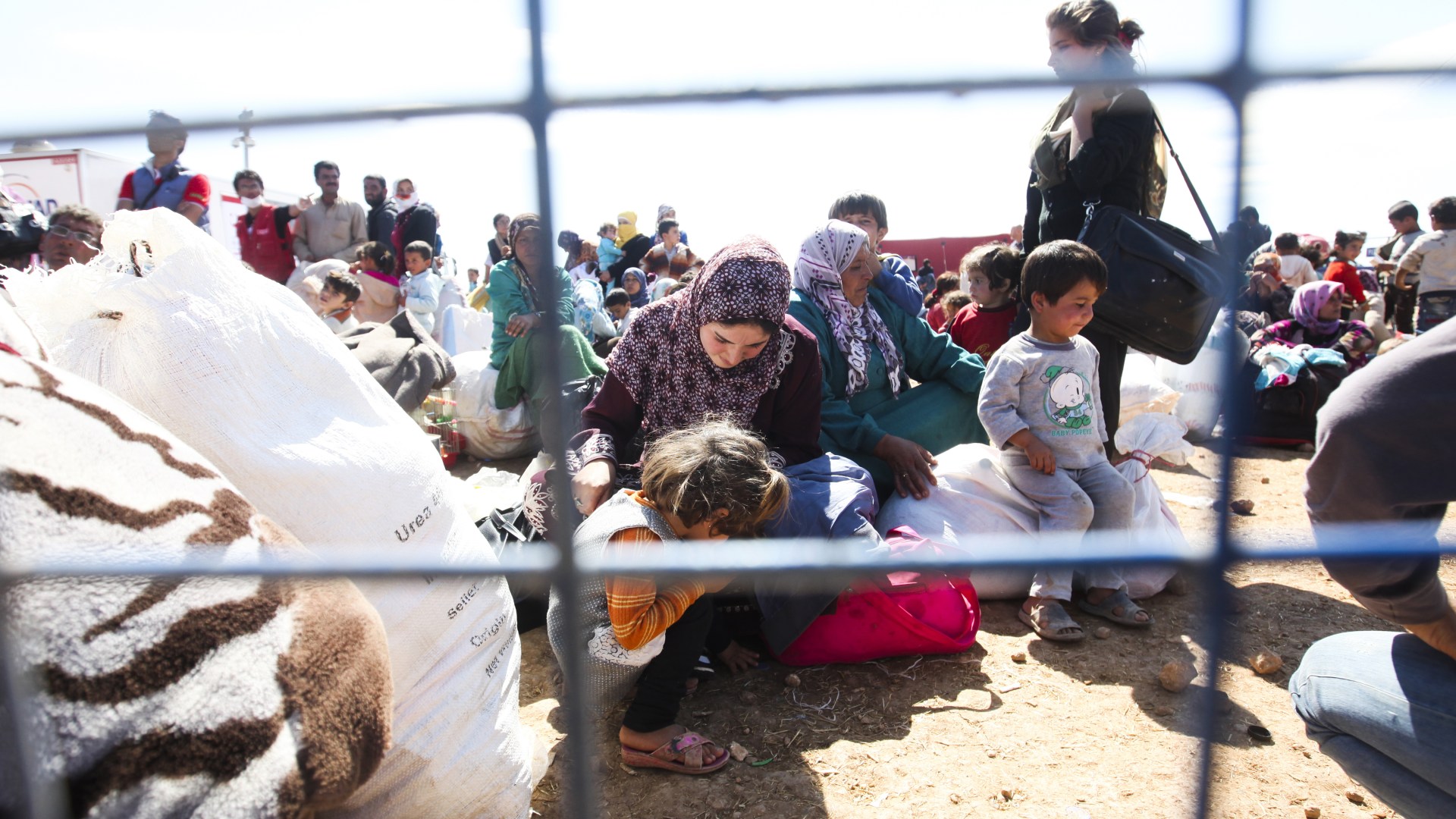

As Christians in Iraq and Syria face what many (including the US State Department) call genocide, world leaders often struggle to summon the right words for the persecution. Too often, officials deal in cautious, equivocating language amid the sprawling horror of leaders assassinated, churches destroyed, businesses bombed for “un-Islamic” tendencies, women and girls raped, hostages taken, and citizens forced to flee.

They Say We Are Infidels: On the Run from ISIS with Persecuted Christians in the Middle East
Tyndale Momentum
352 pages
For clearer insight into this purge of communities from their ancient homelands, we have journalist Mindy Belz to thank. They Say We Are Infidels: On the Run from ISIS with Persecuted Christians in the Middle East (Tyndale) contains reporting from her many trips to the region, during which she faced threats of being stoned, kidnapped, or murdered.
Belz first traveled to Iraq in 2002, when there were few Western visitors. After the US invasion the following year, she returned to find Iraq’s churches reviving and its Christians optimistic. But things changed abruptly. Churches faced a systematic wave of bombings in 2005. That year, many leaders at her church, St. George’s Anglican in Baghdad, were murdered.
By 2008, terror against Christians had so intensified that Belz traveled to Mosul crouching on a car’s floorboards while wearing a veil; her driver wielded a gun in his left hand while steering with his right. Many Christians received threats like, “Be informed that we will cut off your heads and leave your dead bodies with no organs and no heads in your stores and houses.”
Belz writes of Baghdad’s Dora neighborhood, from which tens of thousands of Christians fled overnight, unlikely to return. One resident said that when terrorists learned he had five children, they said, “Fine, three for you and two for us.” Letters (containing bullets) went out, warning, “We know your house and we know your family. We will kill you one after the other. Depart the Muslim areas.”
There were relentless kidnappings for ransom. In Mosul, Belz reports, they were so common that “ransom notes simply demanded daftar, slang which everyone knew meant $10,000.” Some hostages were killed despite the ransom being paid—and ransom-paying relatives were often next on the hit list. One group that has been linked to al-Qaeda, the Mujahideen Shura Council, claimed responsibility for the death of an Assyrian Christian with an Internet statement that Belz calls “typical”: “We eliminated him because this impure crusader offended our noble prophet Muhammad.”
The kidnappings created a climate of fear and trauma, something the State Department’s crude focus on “body counts” can’t capture. One man tells Belz he desperately sought medical help for his son, who, after being kidnapped, suffers memory lapses and PTSD. She meets an eight-year-old who can no longer talk. Another kidnapping victim, a church worker, remains in hiding. Others, like my friend Chaldean Catholic priest Douglas Bazi, turn up more dead than alive after experiencing torture.
In 2014, ISIS took control of Mosul, destroying every Christian community and church within its territory. In theory, paying jizya—the traditional Islamic tax affording the right to live and worship—gave Christian residents a lifeline. In reality, it made no difference (besides imposing ruinous fines). Belz spoke with one Christian who was tortured when he remained in ISIS territory. An 80-year-old woman was burned alive. Counterterrorism expert Alberto Fernandez has summed up ISIS talk of jizya as a “caliphate publicity stunt.”
With her vivid personal accounts, Belz puts a human face on grim statistics. Some of these 21st-century martyrs were her friends. After reading They Say We Are Infidels, no one can deny their suffering.
Nina Shea directs the Hudson Institute’s Center for Religious Freedom. She is co-author of Persecuted: The Global Assault on Christians (Thomas Nelson).