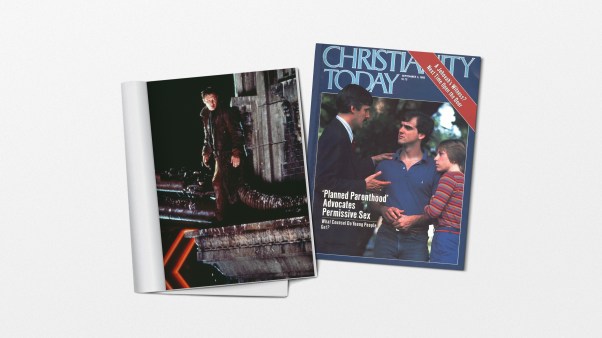

I have written before that, as a seminarian, I quit subscribing to Christianity Today when it relocated decades ago from Washington, DC, to Carol Stream, Illinois. At the time, I thought it irresponsible to leave the corridors of national power, where I believed evangelicals should be if they were to remain relevant to the culture.
In retrospect, moving from DC was wise. Had we remained there, we would have felt increasingly tempted by partisan politics, taking one side or another and along the way self-righteously condemning those who disagreed with our particular political solutions. We would have become Christian Politics Today.

Instead, our calling as a magazine is to speak the truth in love (beautiful orthodoxy!) on all manner of issues, grounded not in political opinion but in the great teaching of Scripture, looking for Jesus not in the halls of Congress but in his work in and through his church, the one institution he promised to remain with.
We do not ignore politics, to be sure. But the climate today is more politicized than ever, and the temptation to be political is ever present. Thus we remind ourselves that the most political thing we Christians do every week happens in worship, when we recognize that Jesus is Lord.
That said, some Christians certainly do need to be in the corridors of power. And that is why locating the Museum of the Bible there is a good move. To have a Bible-centered museum in the same place as the Smithsonian museums, the National Museum of African American History and Culture, and the United States Holocaust Memorial Museum suggests rightly that you cannot understand America unless you are familiar with the Bible. It’s part and parcel of our national heritage.
The founders of the Museum of the Bible are, of course, hoping for more than a tip of the hat to heritage. They believe, as do we, that simple exposure to the Bible is enough to do wonders. It remains “alive and active” (Heb. 4:12), a means by which people encounter the living God.
The Bible enters into nearly every piece in this issue—from an examination of Micah 6:8 to pieces on suicide and antibiotics. Sometimes the connection is obvious and direct. At other times biblical teaching is more or less assumed. In either case, the Bible for us is not a mere museum piece, let alone a stick upon which we raise a partisan political flag. We hope that whenever it is read or referenced in our pages, readers will meet Jesus Christ anew. No matter where our offices are located.