My earliest political memories are about then-President Bill Clinton and the behavior that led to his impeachment. I was too young to understand what, exactly, he was accused of doing. But those specifics weren’t necessary for me to grasp the larger critique from my family and others in our mostly conservative and evangelical community: Character counts, and Clinton is a man of bad character.
“We are aware that certain moral qualities are central to the survival of our political system,” said a representative 1998 statement endorsed by theologians Stanley Hauerwas, John Piper, and many others affiliated with evangelical universities and seminaries. “We reject the premise that violations of these ethical standards should be excused,” the statement continued, “so long as a leader remains loyal to a particular political agenda and the nation is blessed by a strong economy.”
Of course, political loyalties aren’t guaranteed. The character critique reasoned that if a president can’t stay faithful to his wife, how will he be faithful to his voters? The thing about bad character is that its effects aren’t isolated to one arena of life (1 Cor. 5:6–8; Mark 7:17–23). However good a candidate’s policy pledges may sound, we should be wary of her ability to stay true to those words if she does not stay true to the ethics by which she professes to live.
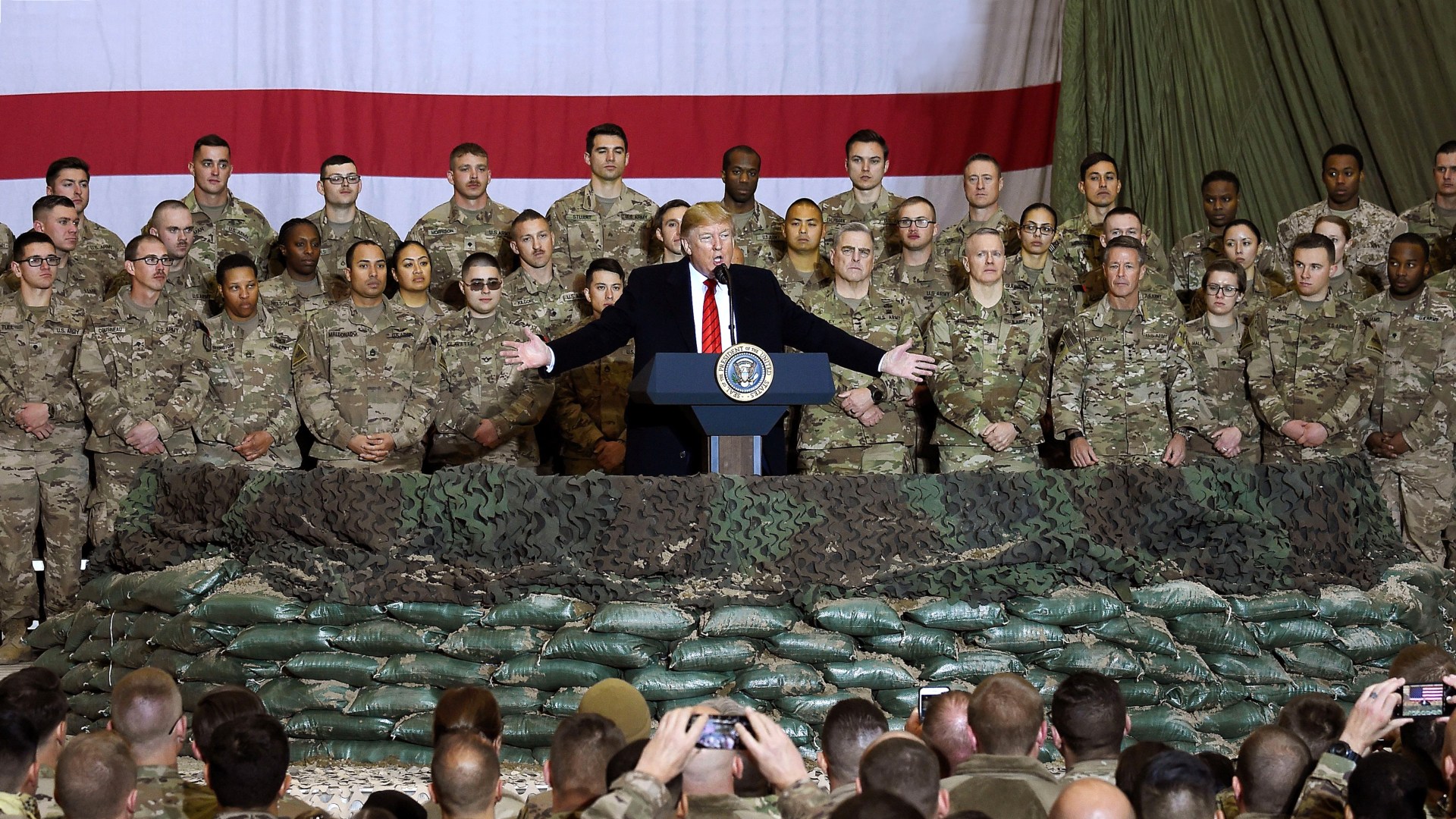
I’ve revisited some of that 1990s thinking on the importance of character in politics repeatedly over the past few years, and I’m reminded of it again as President Trump’s term comes to a close while one of his most important and oft-repeated promises—to end “endless wars,” chiefly the war in Afghanistan—remains unfulfilled.
Afghanistan is a particularly useful issue to consider here. Trump has never so explicitly pledged US departure from other theaters of conflict, like Iraq, and in some, like Yemen, he actively opposes withdrawal despite his general rhetoric about shrinking the US military footprint abroad.
Afghanistan is also unique among policy promises because of its political and legal status. None of the usual political roadblocks were in Trump’s way. Ending this war would be immensely popular with the public: About three in four Americans support withdrawing from Afghanistan, an impressive consensus in this fractured age. Moreover, Trump has clear constitutional authority here. Our Constitution gives power to initiate military conflict to Congress, the idea being that the legislative body’s thoughtful deliberation (don’t laugh) would “facilitat[e] peace” by checking bellicose presidents. But once a war is underway, the president is responsible for prosecuting it and bringing it to a close. Presidents do many things of questionable legality, but ending a war is not one of them. The comparative ease with which Trump could have fulfilled this promise makes its break that much more telling.
Trump also had the benefit of a good argument. He is right that this war needs to end. (Trump has made this case mostly on a pragmatic basis, so that will be my focus here. It would be unfair, discussing character, to hold him to more principled arguments he has not made.) Now approaching the two-decade mark, Afghanistan is the longest war in American history. It has lasted so long there are now active-duty US troops who were born after the September 11th attacks—so long that fathers and mothers and their now-grown children have fought the same fight.
This is a fight the United States cannot win. The initial retributive mission in Afghanistan was accomplished relatively quickly and easily. Then a specious restorative mission creep set in.
And it is a fight the United States cannot win. The initial retributive mission in Afghanistan was accomplished relatively quickly and easily. Then a specious restorative mission creep set in—we were there for nation building, for training the Afghan army, for infrastructure development, for introducing democratic American values to the “graveyard of empires,” and for endless counterterrorism efforts that will always provide a rationale for prolonging this war because you cannot eradicate ideology with bombs.
The last 19 years—in which US deployment topped 100,000 boots on the ground and went through five surges with 19 different commanders—have demonstrated the impossibility of anything that may be fairly dubbed “victory.” After all that, the Taliban controls or has substantial influence over much of the country and civilian casualties are hitting record highs. “U.S. troops have made considerable sacrifices,” observes military historian Ret. Col. Andrew Bacevich. “The Pentagon has expended stupendous sums. Yet when it comes to promised results—disorder curbed, democracy promoted, human rights advanced, terrorism suppressed—the United States has precious little to show.”
That was true when Bacevich wrote it in 2016. It is just as true nearly five years later. At the rate we’re going, it will still be true five years hence.
Trump has called this war a “terrible mistake.” He has tweeted about bringing all US forces home from Afghanistan by Christmas, and he reportedly talked privately about a withdrawal timed for Election Day. It is now evident the Christmas deadline will be met no more than the Election Day one was. Trump will leave office with about 2,500 US troops in Afghanistan, and President-elect Joe Biden plans to keep them (or some similar number) stationed there indefinitely, perpetually holding open a door to re-escalation. It really is an endless war.
Trump was well positioned to change that. He didn’t because he is a man of bad character (Prov. 13:15).
This is not a secret. It is not even an allegation. It is his whole public persona. He has made a name and fortune for himself by being a man of bad character. He is, by his own account, “very greedy” and “always” has been. He boasts of sexually assaulting women. He is repeatedly, publicly unfaithful to his wives. He degrades, well, just about everyone, but especially women and anyone who is not white. He lies about things that could not possibly matter. He lies about things that matter very much, fostering an environment of epistemic chaos. He likes violence, enthuses about torture, and recommends targeted killing of innocents. He embodies the vice ancient Christians called “vainglory,” a disordered desire for public approval, and all the sins Thomas Aquinas taught flow from it: boasting, love of novelties, hypocrisy, obstinacy, discord, contentiousness, and refusal to recognize authority above himself.
This is not the character of a man who can make good on a promise to end a war.
It is true, as some of the president’s supporters have observed, that Trump was elected to be a president, not a pastor. He is not in a role of spiritual leadership, per se. But the qualifications of character that make for good leadership within the church (e.g., 1 Tim. 3:1–13; Titus 1:6–9) are relevant outside it too. The consequentialist notion that means are irrelevant to the ends they produce is a noxious lie. How we accomplish things in politics matters—and lack of character is itself an impediment to practical accomplishments (Prov. 28:18).
Trump‘s failure to extricate the United States from Afghanistan is a perfect, awful case study. As the war rages on, the lesson will be hard to forget.
Bonnie Kristian is a columnist at Christianity Today.