 There’s a downside to going someplace where everyone knows your name.
Author and Bible teacher Beth Moore discovered that reality in the months after making a public break with the Southern Baptist Convention, which had been her spiritual home since childhood.
Whenever she and her husband, Keith, would visit a new church, the results were the same. People were welcoming. But they knew who she was—and would probably prefer if she went elsewhere. Once the very model of the modern evangelical woman, she was now a reminder of the denomination’s controversies surrounding Donald Trump, sexism, racism, and the mistreatment of sexual abuse survivors.
When Moore would no longer remain silent about such things, she became too much trouble to have around. Even in church.
“I was a loaded presence,” she told RNS in a recent interview.
In her memoir, All My Knotted-Up Life, out this week from Tyndale, Moore recounts how the couple ended up at an Anglican church in Houston, largely at the suggestion of Keith Moore, who’d grown up Catholic and felt more at home in a liturgical tradition. When they walked in, the rector greeted them and asked their names.
When she told him who she was, the rector brightened up.
“Oh,” he said, with a smile, “Like Beth Moore.” Then, having no idea who he was talking to, he added, “Come right in. We’re glad to have you.”
After the service, a handful of women who had gone through one of Moore’s best-selling Bible studies, gathered around her. They knew who she was and wanted Moore to know she was safe in that place and that there was plenty of room for her in the community.
“Can I simply ask if you’re OK,” Moore recalls one of the women saying.
In that moment of kindness, Moore says she felt seen and at home in the small congregation, which became her new church. She could just be herself, not defined by the controversies she’d been through.
“Never underestimate the power of a welcome,” she said.
The kindness of ordinary church people has long sustained Moore — providing a refuge and believing in her, even when she did not believe in herself.
Raised by an abusive father and a mother who struggled with mental illness, Moore has long said that church was a safe haven from the chaos of her home life. In her new memoir, Moore gives a glimpse into that troubled childhood and the faith—and people—who rescued her.
Displaying the skills that made her a bestselling author, Moore tells her story with grace and humor and with charity toward the family that raised her, despite their many flaws and the pain they all experienced.
Moore introduces her late mother, a lifelong chain smoker, with: “I was raised by a cloudy pillar by day and a lighter by night.”
She sums up her late father’s abusive behavior in a simple but heartbreaking sentence: “No kind of good dad does what my dad did to me.”
Moore also tells the story of how she and her sister Gay saved their parents’ marriage when their whole world was falling apart. Moore’s mother had long suspected her father of infidelity. He had always denied it and claimed Moore’s mother, who suffered from severe depression, was crazy and unstable.
Then Gay found a love letter from her dad’s mistress taped to the underside of a drawer in his desk. The two girls sprang into action, calling their father’s lover and telling her to stay away. It was an act of desperation, Moore told Religion News Service, born out of fear that the family would break apart and they’d be left homeless.
“More than anything it was a way to exercise what little power we had,” Moore said, who dedicated her memoir to her husband and siblings, including Gay and her older brother Wayne, a retired composer who passed away two weeks before the memoir was due to be published.
That call, which Moore credits to her “fearless” sister Gay, changed the course of the family’s life. Knowing the truth about her father’s infidelity gave her mom confidence after doubting herself for years.
Moore said her mother’s story resonates with people who have experienced abuse in church—or know that something is not right in their congregation—and have faced opposition. In many cases, their suspicions were correct, she said.
“But they were told they were unspiritual—that they were trying to destroy (the church),” she said. “It’s what we know now as gaslighting.”
One of the most gracious parts of her memoir comes when Moore gives thanks to two of her mentors. The first was Marge Caldwell, a legendary women’s Bible teacher and speaker. Caldwell met her when Moore was first starting out—giving devotions while also teaching an aerobics class at First Baptist Church in Houston.
Caldwell told Moore that God was going to raise her up to teach the Bible and have an influential ministry. For years, Moore said Caldwell attended her classes, even though her style was very different from her mentor.
“I would read the expression on her face—wondering, how on earth did this happen?” Moore said, laughing at the memory. “I knew she loved me so much.”
The other mentor was Buddy Walters, a former college football player who taught no-nonsense, in-depth Bible studies in Texas for years and who instilled in Moore a love for biblical scholarship. When she met Walters, Moore was filling in for a women’s Bible study teacher at her church who had gone on maternity leave. Under Walters’s tutelage, what started as a temporary assignment became a lifelong passion for Moore.
“I don’t think he would have picked me as a student,” she said. “It just was that I could not get enough.”
In the memoir, Moore, who has historically been very private about her family life, also opens up about the struggles she and her husband have faced. In the past, Moore had made comments about getting married young, and that they had struggled, but gave few details.
With Keith’s permission, she shared more in this memoir, in particular about a family crisis that was going on behind the scenes as her public ministry imploded. In 2014, two years before his wife clashed with Southern Baptist leaders over Donald Trump, Keith had been saltwater fishing, near the border of Texas and Louisiana.
While hauling in a redfish—also known as a red drum—Keith cut his hand on the fish’s spine. What seemed like a minor injury led to a life-threatening infection. As part of his treatment, Keith had to go off all other medications, including ones he had taken to manage mental illness and PTSD from a traumatic childhood accident in which his younger brother was killed.
That sent him into a tailspin that lasted for years, one the Moores have kept private until now. They decided to disclose it in the memoir, she said, because discussing mental illness remains taboo in churches.
“It’s such a common challenge and a crisis and yet we are all scared to talk about it,” Moore said. “We asked each other, what do we have to lose at this point?”
Despite the challenges of the past few years, Moore said she has not given up on the church, because it had for so long been her refuge. She knows other people have different experiences and have suffered abuse or mistreatment at the hands of fellow Christians, something she remains all too aware of.
Yet, she can’t let go.
“I can’t answer how it was that even as a child, I was able to discern the difference between the Jesus who is trustworthy with children, and my church-going, prancing-around father who was not,” she said. “There were enough people that loved me well, and in a trustworthy way, that it just won out. I can’t imagine not having a community of faith. That was too important to me to let any crisis take it away.”
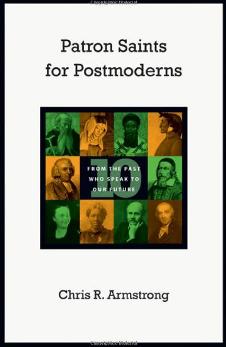
Well, it really exists now. My first book (beyond the dissertation, which is a whole different animal). It’s called Patron Saints for Postmoderns (InterVarsity Press), and it was midwifed by my unfailingly patient and encouraging editor, Cindy Bunch. I will spare readers the usual excited yelps and smug self-back-patting of the first-time author. But CT editor and co-blogger David Neff has invited me to talk a bit about the book this week, so I will.
David said I might ask and answer a question like this: Why do postmoderns need saints?
Well, many of us may not feel like it (many of my students don’t), but we’re all postmoderns, I suppose: We live in a secularized age in which all traditions, commitments, codes of life have been exploded and the bits lie scattered over our psychic landscape. The church hasn’t escaped this holocaust of traditions either, of course, and our church lives have a ramshackle, cobbled-together feel too.
This is one reason, I think, that a small but growing group of young Christians have found the Reformed theological system so attractive. There is comfort in its intellectual coherence, even seamlessness.
I have to confess my own sympathies lie in another direction. For me, it is enough that all things cohere in Christ. I don’t ask to understand how they do. But I do need reassurance that they do. On days when I get up and I have a sinus headache, the bills have piled up, my kids need school supplies that I can’t afford, the words of a recent argument with my wife ring in my ears, and I just don’t feel ready to live out another day, let alone praise God, a theological explanation of Romans 8:28 just won’t do it. Systematic theologians have an important job. (I have to say that: some of my best friends and colleagues are theologians!) But it’s not one I usually feel the need for in my gut, and it’s certainly not one I feel well-suited to do myself.
Where my own existential need lies is in the area, not of intellectual coherence, but of something like “practical” coherence. I need to be reminded repeatedly that my chosen faith has integrity not so much as a thought-system, but as a way of life. And the only way I know to receive that life-giving reminder is through the stories of those both today and long ago who have lived with God—as Paul would say, the “saints.”
I remember as a young Christian attending the Sunday worship service and charging up the faith engines—then becoming progressively unhinged from my faith through the week. What brought me back and energized me without fail was being at a home group or running into someone at a restaurant and hearing one of my new brothers or sisters talk about what God was doing in their lives. Wow. Nothing sorted me out faster.
* * *
I can hear the objection now: what do you need the stories of saints for if you’ve got the Bible?
Well, one answer to this, of course, is that Scripture itself belongs—at least in many of its parts—to this realm of stories. Its 66 books are filled with a riot of tales (true tales!), and those tales have been formative for the historic faith. They ring true to reality in deep ways, and our own stories ring truest when they resonate with them.
But it’s hard, as Dorothy L. Sayers discovered when she set out to rewrite Christ’s life in her stirring serial radio drama The Man Born to Be King, to scrape from the Bible’s stories their encrusted, 2,000-year-old shells of sentimentality, ecclesial coercion, ethical guilt-mongering, theological bludgeoning, and simple ennui-by-overuse. To truly connect with the Bible, especially for those who have spent some years in the faith, seems often to demand some perspective-changing experience or new “filter.”
I am reminded of the testimony of many who were touched by the charismatic renewal in America: their electrifying experiences in the Spirit had as much variety as the Spirit himself. Their own stories were being invaded and changed in radical, life-changing ways that differed radically from person to person. But along with this variety almost always came a common-denominator phenomenon: a new vibrancy in their reading of Scripture. The Spirit, whom they now met in startlingly direct ways, also held out the Word anew and illuminated its reading. Hmmm. Come to think of it, that’s just what Mr. Calvin said would happen . . .
Well, the Spirit comes in many guises and many forms, and I’ve convinced the number one reason why the church always treasured her saints was because their stories made The Story of creation, redemption, and eschatological fulfillment come alive again. The saints’ lives served as amplifiers for The Word. Or to put a sharper point on it: people’s stories meet us in a way analogous to the way Christ himself met us in his brief earthly life—they incarnate spiritual truth in human lives. Yes, yes, I know: there has only ever been one Incarnation. But Paul himself talked in incarnational terms about the church: the church (the saints) = “the body of Christ” in history.
I won’t claim anything so grandiose for the stories I tell in Patron Saints for Postmoderns. But if the Spirit brings Christ more sharply into focus for those who read the lives of Antony of Egypt, Gregory the Great, Dante Alighieri, Margery Kempe, John Amos Comenius, John Newton, Charles Simeon, Amanda Berry Smith, Charles M. Sheldon, and Dorothy Sayers, then I will feel I’ve done something more than shore up my own postmodern doubts. What I really hope for readers is that as they encounter the varied and fascinating people described in this book, they will be drawn, in ways as diverse and wonderful as their own personalities, to follow these ten saints as they themselves followed Christ.