Early Christians used a wide variety of symbols to express their faith. The second-century Christian teacher Clement of Alexandria identified a dove, a fish, a ship, a lyre, and an anchor as suitable images to be engraved on Christians' signet-rings (or seals). Archaeologists have discovered a gold finger-ring from the third or fourth century that depicts an anchor, cross, lamb, shepherd, dove, and the abbreviation for Christ.
One of the best known early Christian symbols, because of its modern revival, is the fish. Some early Christians made the Greek word for fish, ichthus, into an acronym for "Jesus Christ, God's Son, Savior." (See "The Original Christian Bumper Sticker" by Collin Hansen.) Tertullian, a theologian writing at beginning of the third century, interpreted this practice as a symbol of baptism: "But we small fishes, named after our great ICHTHUS, Jesus Christ, are born in water and only by remaining in water can we live."
The symbol of the anchor, with its crossbar, resembles a cross. An anchor and two fish (probably from the third century) occur together on a grave slab in the catacomb of Domitilla in Rome. (Read more about the anchor as a Christian symbol here.)
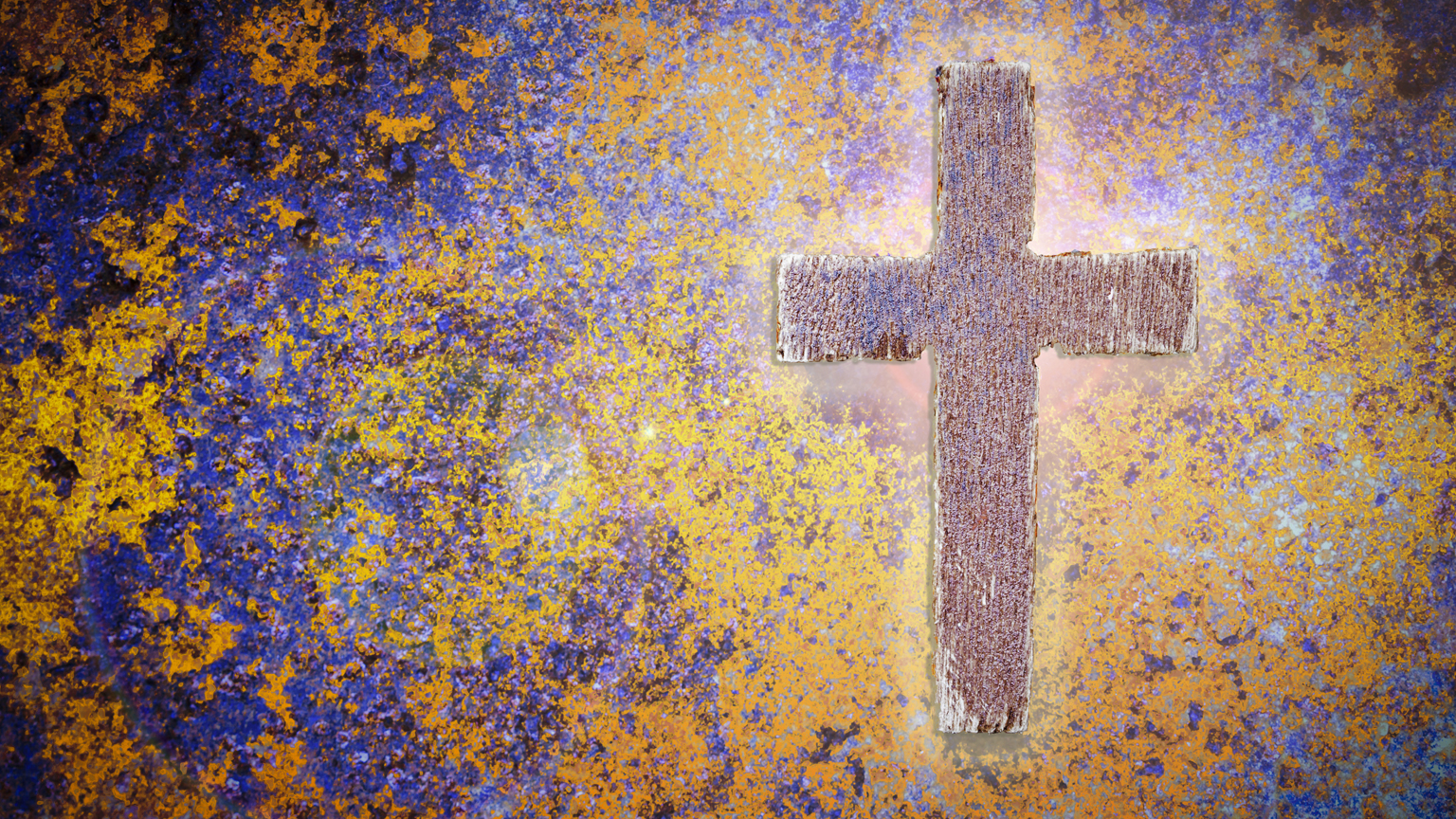
Writings from the early church show how central the cross was to Christian preaching and confession. Moreover, Justin Martyr, a Christian apologist writing in the 150s–160s, argued that God had providentially put the shape of the cross in everyday objects, such as the masts of ships, tools like the plough and the axe, and the standards of Roman legions. Christians would often pray standing up with their arms stretched out in the form of a cross. As early as the 200s, Christians were making the sign of the cross with their hands. The cross was so important that pagans charged Christians with worshipping the cross.
Early Christians took two abbreviations that occurred in non-Christian writings and gave them special meaning. The Greek letter tau (which looks like a plus sign or a T-shaped cross), with the vertical bar curled at the top to represent the letter rho (which looks like a P), was an abbreviation for words beginning tr. The tau-rho occurs in Christian writings dated 175 to 225 in the spelling of the Greek words for "cross" (stauros) and "crucify" (stauroo). Since Christians saw the tau as symbolizing a cross, the superimposed rho may have suggested the head of Christ, making the tau-rho the first visual representation of the crucifixion by Christians.
The second abbreviation Christians used was the chi-rho monogram, composed of the Greek letter chi (which has the shape of an X) intersected by the letter rho. It appears in Christian writings as an abbreviation for Christ (Christos). In 312, according to the early Christian writer Lactantius, Emperor Constantine had the chi-rho marked on his soldiers' shields as they marched on Rome; according to Eusebius, he had the emblem put on a military standard. (See "Constantine's Famous Emblem" by David F. Wright.) After Constantine's victory, the chi-rho cross, often combined with the letters alpha and omega, became the ubiquitous symbol of Christianity.
Christians did not make explicit pictures of the crucifixion for about 400 years after Christ's death. There are various possible explanations for this. A theological reason may be that the early Christians emphasized the resurrection as well as the crucifixion. (The Romans crucified many people, but only one was resurrected. Allusions to the resurrection in early Christian art were also relatively rare but earlier than depictions of the crucifixion.) A more practical reason may be that Constantine's influence so established the chi-rho that no alternative symbol was necessary. It functioned very much like a bare cross does today as an identifying marker of Christianity.
Everett Ferguson is professor of church history emeritus at Abilene Christian University and a member of the Christian History advisory board.
Copyright © 2009 by the author or Christianity Today/Christian History & Biography magazine. Click here for reprint information on Christian History & Biography.