I can’t imagine Calvin would be pleased to know that in 2009 Europeans remember him the way Americans remember Samuel Adams–as a brand of beer.
 Most Protestant churchgoers spend time alone with God at least daily, but there’s a range in what they do in that time and what resources they use.
According to a study by Lifeway Research, nearly 2 in 3 Protestant churchgoers intentionally spend time alone with God at least daily, with 44 percent saying daily and 21 percent saying more than once a day.
Meanwhile, 17 percent of churchgoers say they are alone with God several times a week, and 7 percent say once a week. Others admit to being alone with God a few times a month (5%), once a month (2%), less than once a month (3%) or never (1%).
This time looks different for different churchgoers, but they are more likely to talk to God through prayer than to listen to him through his Word.
Churchgoers most often pray in their own words (83%), thank God (80%), praise God (62%) or confess sins (49%). Fewer than 2 in 5 read from the Bible or a devotional (39%). Fewer repeat a set prayer (20%), consider God’s characteristics (18%) or something else (1%).
But if churchgoers were to read something during their time alone with God, most would read from a physical Bible (63%). Others would read the Bible in a different format such as a Bible that includes additional commentary or devotional thoughts (25%) or Scripture from an app (20%).
Fewer than 1 in 3 say they would read from a devotional book that prints some Scripture (32%), and even fewer say they would read from a devotional book that doesn’t print Scripture (8%). Still, others say they would read a devotional from an app (7%) or read something else (3%).
Quiet time frequency
When it comes to spending time alone with God, women (48%) are more likely than men (38%) to say this is a daily habit for them. Those in the South (49%) are also among the most likely to say they spend time alone with God on a daily basis.
One in 4 Baptists (25%) say they have alone time with God more than once a day. And those with evangelical beliefs (30%) are more likely than those without evangelical beliefs (15%) to say the same.
https://datawrapper.dwcdn.net/Al9n0
Church attendance is also an indicator of quiet time frequency. Those attending worship services at least four times a month (26%) are more likely than those who attend one to three times a month (13%) to say they spend time alone with God more than once a day.
“We see a pattern in Scripture of followers of God withdrawing to spend time alone with him. Jesus Christ himself also did this,” said Scott McConnell, executive director of Lifeway Research. “Most Protestant churchgoers continue this relational interaction with God and use a variety of resources as they do.”
Preferences on prayer
When spending time alone with God, some prefer to pray in their own words, while others would rather repeat a set prayer. Younger churchgoers—ages 18-34 (31%) and 35-49 (26%)—are more likely than those 50-64 (16%) and over 65 (11%) to say they repeat a set prayer during their alone time with God. And those ages 50-64 (85%) and over 65 (89%) are more likely than those 18-34 (77%) and 35-49 (77%) to say they pray in their own words.
“There are many reasons to pray a set prayer. Whether someone is praying the model prayer Jesus gave or repeating the same request to God each day, these can be meaningful,” McConnell said. “At the same time, Scripture also records Psalms and prayers within its narrative accounts that show how personal and forthright we can be when talking to God in our own words.”
Females (86%) are more likely than males (79%) to pray in their own words. And those in the South (86%) are more likely to pray in their own words than those in the Northeast (77%).
Evangelical beliefs and the frequency of church attendance are also factors in how a person prefers to pray. Those who attend worship services at least four times a month are more likely than those who attend less frequently to pray in their own words (85 percent v. 79%). But those who attend a worship service one to three times a month are more likely than those who attend more frequently to repeat a set prayer (24 percent v. 16%).
Those with evangelical beliefs are more likely than those without such beliefs to pray in their own words (92 percent v. 76%), while those without evangelical beliefs are more likely than those who hold those beliefs to repeat a set prayer (22% versus 16%).
Preferences on practice
What it means to spend time alone with God varies from person to person. But there are some indicators of which practices are most important to different demographics of people.
While females are more likely than males to say they praise God (66% versus 57%) or read from the Bible or a devotional (42% versus 36%), men are more likely than women to say they consider God’s characteristics (21% versus 16%) when spending time alone with him.
Older churchgoers—those 50-64 (45%) and older than 65 (42%)—are more likely than those 18-34 (32%) and 35-49 (34%) to say they read from the Bible or a devotional when spending time alone with God. And those over the age of 65 are the least likely to say they consider God’s characteristics (10%).
Evangelical beliefs and church attendance frequencies are also indicators of a person’s preferences in spending time alone with God. Those who attend worship services the most (four or more times a month) are more likely than those who attend one to three times a month to praise God (67% versus 53%), confess sins (55% versus 38%) or read from a Bible or devotional (46 percent v. 28%).
And those who hold evangelical beliefs are more likely than those who do not hold evangelical beliefs to thank God (87% versus 74%), praise God (76% versus 51%), confess sin (64% versus 38%) or read from the Bible or a devotional (52% versus 29%). But those without evangelical beliefs are more likely than those with evangelical beliefs to consider God’s characteristics (20% versus 15%).
“An earlier discipleship study from Lifeway Research showed that praising and thanking God is one of the top five predictors of high spiritual maturity,” McConnell said. “This is a widespread practice among churchgoers when they are alone with God.”
Preferences on resources
Several factors play into what a churchgoer wants to read when spending time alone with God. The youngest adult churchgoers (ages 18-34) are the most likely to read Scripture from an app (40%) and the least likely to read from a devotional book that prints some Scripture (21%). And females are more likely than males to say they would prefer to read a devotional from an app (9% versus 4%).
“Today’s Christians have more resources than ever to aid them in spending time with God and his Word,” McConnell said. “As new resources are created, they can encourage someone who, without that innovation, wouldn’t have spent time with God. But there is also a strong relationship between spending time alone with God’s Word and worshiping frequently with others who may encourage you in your walk with God.”
Those with evangelical beliefs are more likely than those without evangelical beliefs to say they would read from a Bible (78% versus 52%) if they were reading something in their time alone with God. And those without evangelical beliefs are more likely than those with evangelical beliefs to say they would read from a devotional book that doesn’t print Scripture (11% versus 3%) or Scripture from an app (22% versus 17%).
While those who attend a worship service at least four times a month are more likely than those who attend one to three times a month to say they would read the Bible in their quiet time (70% versus 52%), those who attend one to three times a month are more likely than those who attend more often to say they would read a devotional from an app (9% versus 5%).
We hadn’t even planned to visit Geneva on our 2008 spring break tour of Germany, Switzerland, and Italy. With little more than a week to visit several sites, we didn’t want to aggravate our friend, who was gracious enough to drive us around Europe.
But after visiting another friend in Lausanne, we couldn’t resist driv-
ing to the southwest corner of Lac L?man (Lake Geneva).
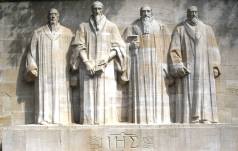
I hadn’t expected to miss much in Geneva. Sure, the city boasts gorgeous views of the Alpine lake, but we could see similar views from Lausanne. Traveling on a tight budget, we knew we couldn’t afford to stay in Geneva, renowned today for its robust banking industry. I wasn’t drawn to visit the international headquarters for the Red Cross or learn about the League of Nations, hosted by Geneva from 1919 to its demise in 1946. What I wanted to see were sites devoted to the legacy of reformer John Calvin, who moved to Geneva in 1536. But the travel books told me not to expect much more than la chaise de Calvin. The International Monument of the Reformation looked neat, but overall it appeared that Calvin’s stature had deteriorated significantly since 1909, Calvin’s 400th birthday and the year construction on the monument began.
Nevertheless, we decided to add a day trip to Geneva. You might imagine my delight when I learned that the International Museum of the Reformation had opened next to St. Peter’s Cathedral in 2005. Inside I learned from a presentation that recounted the issues at stake during the Reformation. In an effort to reach younger audiences, the museum even recreated a dinner debate over predestination between Calvin and several other Genevan theologians. This was my kind of museum. But I’m still not sure why they decided to include Rousseau in the discussion.
My mood dampened when I reached the room devoted to Calvin’s legacy in the 20th century. It would be difficult for me remember anything from that display that Calvin would have endorsed. Then my enthusiasm dipped even further when we reached the gift shop. As a good American tourist, I was primed to buy something that would help me remember this remarkable visit. All I could find were obscure French books and lots of beer – not just any beer, but Calvinus. I’m afraid I’m not truly Reformed, because I don’t drink. But I can’t imagine Calvin would be pleased to know that in 2009, his 500th birthday, Europeans remember him the way Americans remember Samuel Adams.
Indeed, the last 100 years have not been kind to Calvin, nor to the continent’s shrinking Christian churches. Remembering the continent’s Christian heritage through a museum is a positive step. But Europe’s problem isn’t history. I love how Europeans preserve their past amid efforts to accommodate the present. It makes me wish Americans would construct buildings intended to stand longer than 50 years. Still, the American church has been renewed throughout the years by faithful Christians who, like Calvin, sought God’s direction for how to meet contemporary challenges. Perhaps, in this anniversary year, God will begin to raise up a generation of European church leaders who find inspiration in the past, courage for the present, and wisdom for the future.