The 20th anniversary of the Berlin Wall’s fall passed with some fanfare on November 9. Speaking as someone born in the 1980s, I admit that it is difficult to remember much about the divided Europe that this wall symbolized. Stories of the oppressive Communist rule in East Germany strike me as far-removed, not the grim reality for millions as recently as 1989. I remember much more clearly the exultant speeches delivered by Western politicians as Communism collapsed elsewhere in the following years. Today, it is easy for all of us to forget that many millions live in worse conditions than even the East Germans endured. Indeed, the totalitarian government of North Korea imprisons an entire nation that once enjoyed the blessing of revival.
William Blair, a missionary commissioned by the Presbyterian Church in the United States of America, arrived in Korea in 1901 when he was 25 years old. He would go on to serve 42 years in the mission field. One of only two missionaries who saw the 1907 Pyongyang revival begin, he wrote a recollection in 1910 called The Korean Pentecost. As recently as 1865, Koreans had martyred one of the first Western missionaries as he tried to distribute the Scriptures. But the revival helped the number of Christians in Korea grow to 250,000 by 1910. They worshiped in 2,000 churches, nearly all of them self-supporting.
The revival broke out in the aftermath of the Japanese-Russian War, which started in 1904. After winning the war, the occupying Japanese military did not leave Korea. This insult led to surge of Korean patriotism, which sometimes stung the Western missionaries. Nevertheless, church leaders set 1907 as the launch date for an independent Korean Church. Not coincidentally, the first class of Korean pastors were scheduled to graduate that year.
More than 1,500 men gathered on January 6, 1907, at Central Church in Pyongyang for a retreat of prayer and Bible study that would stretch over a number of days. The missionaries were disappointed with how the meetings began, so they cried out for God to send his Spirit. At once the group felt God’s presence, Blair later remembered.
After a short sermon, Mr. Lee took charge of the meeting and called for prayers. So many began praying that Mr. Lee said, “If you want to pray like that, all pray,” and the whole audience began to pray out loud, all together. The effect was indescribable—not confusion, but a vast harmony of sound and spirit, a mingling together of souls moved by an irresistible impulse of prayer. The prayer sounded to me like the falling of many waters, an ocean of prayer beating against God’s throne. It was not many, but one, born of one Spirit, lifted to one Father above. Just as on the day of Pentecost, they were all together in one place, of one accord praying, “and suddenly there came from heaven the sound as of the rushing of a mighty wind, and it filled all the house where they were sitting.” God is not always in the whirlwind, neither does He always speak in a still small voice. He came to us in Pyongyang that night with the sound of weeping. As the prayer continued, a spirit of heaviness and sorrow for sin came down upon the audience. Over on one side, someone began to weep, and in a moment the whole audience was weeping.
Divine conviction and confession characterized the revival. “Man after man would rise, confess his sins, break down and weep, and then throw himself to the floor and beat the floor with his fists in perfect agony of conviction,” Blair recalled.
When the meetings concluded and the men returned home, they took the revival with them. Other communities experienced the same movement of confession and repentance. This was no merely emotional outpouring. Revived Christians sought to make reparations with those they had wronged. “It hurt so to see them grieve,” Blair wrote. “All through the city men were going from house to house, confessing to individuals they had injured, returning stolen property and money, not only to Christians but to heathen as well, till the whole city was stirred.”
Almost immediately following the revival, the Korean church began sending out missionaries. Missionaries from nearby countries, including Jonathan Goforth from China, visited Pyongyang and carried the revival to other lands. South Korea, which now sends out more missionaries than any other country except the United States, remains one of the most inspiring stories of gospel growth in the 20th century.
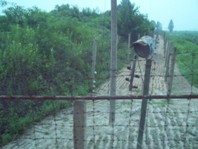
It is impossible to know for sure the state of the church in North Korea today. Once the Communists came to power after World War II, they killed thousands of Christians, particularly church leaders. Many who fled south lost their lives in the Korean War when Communist forces overran nearly the entire peninsula. As we pause to remember how the Berlin Wall fell, we might also pray that God would once more do a mighty work for his people and for his glory behind the barbed wire in North Korea.
* * *
Image of entrance to the Joint Security Area at the Demilitarized Zone between North and South Korea is in the public domain via Wikimedia Commons.