I have been trying to imagine a church without music.
The organ is boarded up. Hymnals are dropped in the paper-recycling bin. Strings are taken off the guitars and pianos; handbells are melted down. No preludes, offertories, or grand hymns. No exuberant choruses. No one is allowed to sing or play an instrument, or listen to one. The Book of Psalms is torn out of the Bible.
I can’t do it. Once I wake from that nightmare, I realize that music has always irrepressibly welled up in the souls of Christians. The first believers sang “psalms, hymns, and spiritual songs, making melody in their hearts to the Lord” (Eph. 5:19). Roman governor Pliny, after investigating the suspicious practices of Christians (in A.D. 111), discovered they met before daybreak each morning and “recited a hymn antiphonally to Christ, as to a god.”
Bishop Ambrose, who helped lead Augustine to Christ, instituted (or reintroduced) hymn singing in Western church services in 386. Gregory the Great, one of the most influential church leaders of all time, wrote “Antiphonar,” a collection of chants, in 600. Charlemagne’s son installed an organ in the palace chapel at Aachen, in 826. Polyphonic music began to develop and, a few centuries later, replaced Gregorian chant. Many of the major advances in musical notation and forms were made by abbots and nuns, eager to praise their God.
But medieval hymns were not sung by the congregation. Martin Luther, who coproduced a hymnal in 1524, helped return hymns to the people, declaring that “I place music next to theology and give it the highest praise.” German chorales continued to be written and were used, for example, among the Pietists and Moravians.
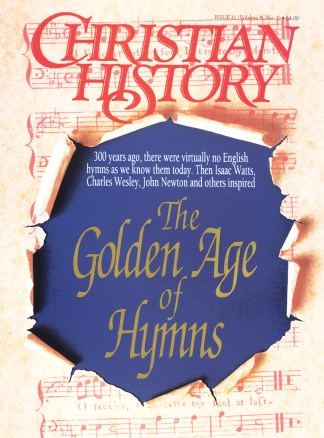
Yet as late as 1700, English-speaking believers lacked a truly vibrant musical expression. Virtually the only musical texts were wooden renderings of the Psalms in verse. As minister Isaac Watts complained, “To see the dull indifference, the negligent and thoughtless air, that sits upon the faces of the whole assembly while the psalm is on their lips, might tempt even a charitable observer to suspect the fervour of inward religion.”
Fortunately, Watts set out to solve the problem. If he did not exactly create a new genre, he “opened the gate,” as Erik Routley put it, for the modern hymn. He gave the church freer, powerful expressions of Christian faith: “Joy to the World,” “When I Survey the Wondrous Cross,” “Jesus Shall Reign,” and many others. Charles Wesley, John Newton, and others soon followed his lead.
In succeeding years, some of the church’s ancient music was recaptured. Gospel hymns were added. And today an explosion of “praise music” is reshaping church worship. But every Sunday we continue to sing those original English hymns written 250 years ago. We wouldn’t want to imagine the church without them.
Copyright © 1991 by the author or Christianity Today/Christian History magazine. Click here for reprint information on Christian History.