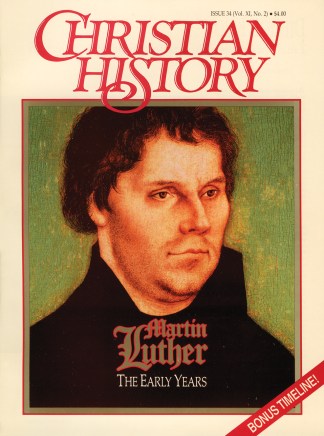
Martin Luther needs no introduction. “In most big libraries,” writes historian John M. Todd, “books by and about Martin Luther occupy more shelf room than those concerned with any other human being except Jesus of Nazareth.”
Historians track gradual and complex processes, so they hesitate to attribute too much significance to any single individual. With Luther, there’s little danger of overdoing it
Consider these statements by historian Kurt Aland: “…with Martin Luther’s posting of the Theses on October 31, 1517, the proud structure of the Western church fell in ruins within a few years”; “…the intellectual life of the modern age would not have come into existence without Luther and the Reformation.”
Time magazine’s Richard N. Ostling calls Luther “the last medieval man and the first modern one….” Think of a significant aspect of modern life—politics, education, religion, family life, media. You can’t discuss any of these without mentioning Martin Luther. Not bad for a “son of a peasant” (as he called himself) who dropped out of law school.
And this barely touches his earthquake-like effect on the church. Pope Leo X called him “a wild boar in the vineyard,” because he uprooted and tore apart longstanding doctrines and practices. Yet many modern Catholic theologians concede that “on the matter of truth, Luther is a lifesaver for Christians.”
Since Martin Luther needs no justification for being featured in Christian History, the real question is one many of you have posed: Why haven’t you covered him sooner?
We’ve had valid reasons about scheduling, but one reason is that we couldn’t conceive of how. How could we capture Luther in a magazine format? It felt like trying to park the Goodyear blimp in a one-car garage.
The situation called for extraordinary measures. We’ve taken them:
• We have expanded our editorial coverage in this issue by a full 20 percent.
• We have included a full-color foldout timeline. Such a timeline costs a lot of money, more than our editorial budgets allow. But we decided to break the bank for the sake of providing you with an excellent visual presentation of Luther’s life.
• For the first time in the magazine’s history, we have decided to devote two full issues to a single person. This issue focuses on Luther’s early years, the critical ones when he broke from Rome. Next year we will publish a companion issue that covers Luther’s later years and his legacy.
We hope you enjoy reading about Luther’s first 40 years, from his birth to the year 1523. Next year we’ll cover the turning points of his marriage (and Peasants’ War) in 1525, his conflicts with other reformers, his impact on worship, and much more. We think you’ll agree that Luther’s story is so interesting, and so significant, that it well deserves a second volume.
Copyright © 1992 by the author or Christianity Today/Christian History magazine. Click here for reprint information on Christian History.