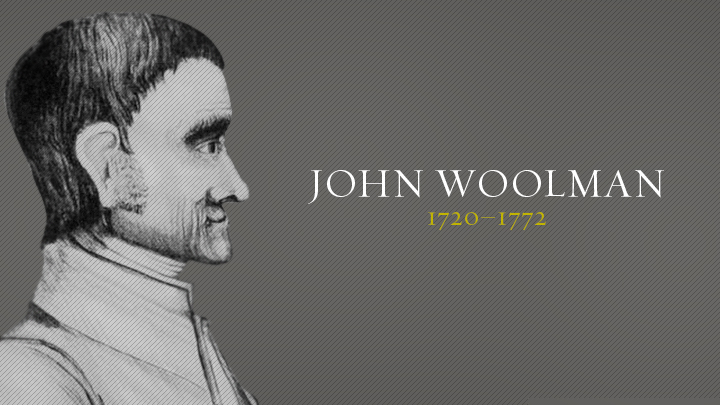
"About the twenty-third year of my age, I had many fresh and heavenly openings, in respect to the care and providence of the Almighty over his creation in general, and over man as the most noble amongst those which are visible."

Two years before his death, John Woolman had a dream in which he heard an angel announce, "John Woolman is dead." When he awoke, he pondered what the dream meant. Then he said, "At length I felt divine power prepare my mouth that I could speak, and then I said, 'I am crucified with Christ, nevertheless I live yet not I, but Christ liveth in me.'"
He wrote in his journal, "I perceived … that language 'John Woolman is dead' meant no more than the death of my own will."
Such dreams and spiritual insights were characteristic of Woolman, who is remembered today as one of America's first abolitionists and most profound mystics.
Woolman was born into a devout Quaker family who lived in a small New Jersey Quaker village. Spiritual experiences came early: "Before I was 7 years old," he later wrote in his journal, "I began to be acquainted with the operations of Divine Love."
At age 21, he was hired out to a merchant, and two years later, began having more spiritual experiences, which he called "openings": "About the twenty-third year of my age, I had many fresh and heavenly openings, in respect to the care and providence of the Almighty over his creation in general, and over man as the most noble amongst those which are visible."
This new appreciation was soon tested when his employer asked him to write up a bill of sale for a black female. Woolman objected, telling his employer he believed "slave keeping to be a practice inconsistent with the Christian religion." Since he also felt duty-bound to honor his master, he did as he was told. But his conscience remained uneasy, and the next time he was asked to write a slave bill of sale, he flatly refused.
Desiring independence, he took up tailoring. Because he felt called to public ministry, he deliberately chose a profession that wouldn't demand an inordinate amount of time. Within a few years, when his business began to prosper, he encouraged customers to go to competitors: "For though my natural inclination was towards merchandise," he wrote, "yet I believed Truth required me to live more free from outward cumbers."
By this time, around age 36 (when he began his journal, a document of his inner journey), he had married. He had also taken two important journeys through the American South, which convinced him more than ever that slavery was "a dark gloominess hanging over the Land," and had predicted "in future consequence will be grievous to posterity."
In 1754 and 1762 respectively, he published the first and second parts of Some Considerations on the Keeping of Negroes, in which he argued for the connection between Christianity and freedom. The idea that men and women are created equal in the image of God leads directly to "an idea of general brotherhood and a disposition easy to be touched with a feeling of each other's afflictions."
Timeline |
|
|
1682 |
William Penn founds Pennsylvania |
|
1687 |
Newton publishes Principia Mathematica |
|
1689 |
Toleration Act in England |
|
1720 |
John Woolman born |
|
1772 |
John Woolman dies |
|
1789 |
French Revolution begins |
His concern about the "extreme oppression of many slaves" also translated into concern for Native Americans. He visited Indian villages on the Pennsylvania frontier and supported Moravian missionary attempts; he sought to curtail the sale of rum to the Indians and worked for a more just Indian land policy.
Woolman maintained a strict manner of life, traveling by foot whenever possible. He wore undyed garments (because he was told dyes were produced by slave labor) and generally abstained from the use of any product connected with the slave trade. Eventually he refused hospitality in homes of slaveholders because he recognized that the luxury the family enjoyed was due to slavery.
His views on slavery were not only unusual for whites in his day, but even unusual among his fellow Quakers. He is a large reason American Quakers abandoned slaveholding voluntarily within 25 years of his death. His method was moral persuasion backed up by consistent practice.
In 1758, for example, he preached a sermon against slavery in a rural community between Philadelphia and Baltimore. He was then taken to the home of Thomas Woodward for dinner. When Woolman determined that the "Negro servants" were actually slaves, he quietly slipped out of the house without saying a word. The owner's conscience was so troubled, the next morning he vowed to liberate his slaves.
In 1772 Woolman visited England to preach, and characteristically he traveled by steerage as a testimony against class distinction. The relatively wealthy and proud London Quakers were at first cool toward the rustic New Jersey preacher, but his sincerity and spiritual maturity eventually won them over. But within a few months of his arrival, he died, at age 52, and was buried in England.