Stopping in Lancaster County, Pennsylvania, was a religious pilgrimage of sorts for me, with its lush farmland, horse and buggies, and large Amish population connecting me to my deep Mennonite roots. (For my husband and children, members of an evangelical Friends church, the adventure was a lark, one they entertained out of kindness more than curiosity.)
Our tour was cut short by a billboard promising Amish pretzels and root beer, served up alongside a souvenir shop filled with Amish kitsch: quilts, cookbooks, toys, and decor. It was the carved wooden signs that caught my attention, their patriotic slogans on flag-themed backgrounds, reminders to pray for our troops and assurances that God blesses America, a clear indication that they could not be authentically Amish.
Although Anabaptists—a religious movement to which Mennonites and Amish belong—have existed since the 16th century, they are a hot commodity in contemporary culture, and even more so among evangelicals.
As Angie Ryg acknowledges in her discussion of Amish romance novels, evangelicals constitute a ready (and large) market for Amish-themed products, drawn to the "plain" lifestyle, the Amish dedication to their faith, and the sense that the Amish view of family fulfills a biblical model about which the rest of us can only dream.
I've long found this idealizing of plain people—in essence, of my people—troubling, if only because Amish products tend to ignore those beliefs that have been central to Anabaptism, and crucial to my own faith, but held uncomfortably, if at all, by evangelicals.
Case in point: those who see no dissonance in a patriotic slogan like God Bless America deemed "authentically Amish." Ever since Anabaptist literature developed a significant evangelical following, I've hoped for an antidote: a text that might interest evangelicals while also expressing the beliefs that have shaped my understanding of Jesus and his ministry. In other words, something truly authentic.
I was thrilled to read Shirley Showalter's recently published memoir, Blush: A Mennonite Girl Meets The Glittering World, about her childhood in Lancaster County. Rather than sugarcoating her upbringing for evangelical audiences, keeping at a safe distance those tenets at the core of Anabaptist thought, Showalter offers an unalloyed view of Anabaptism's deeply held convictions and the ways they shaped her life.
Blush traces Showalter's coming of age as a conservative Mennonite; a child of the '50s and early '60s, Showalter remains grounded in a home and church steeped in Mennonite thought and practice. Her memoir explores the tensions between being in what she calls the "glittering world" and hewing to her Mennonite faith and the traditions that nurtured and raised her.
This tension is especially acute for many Anabaptists, who learn from an early age the significance of being in the world, but not of it (Rom. 12:2). In Amish-themed books, nonconformity to the world is presented as attractive, especially for Christians consumed by the sinful trappings of modernity, but Showalter's Blush refuses to idealize nonconformity. Instead, her narrative explores the many ways separating from the world can be a struggle, especially for young Anabaptists who wanted, as she writes, "to make a splash in the world."
For her conservative Mennonite mother, this meant relinquishing dreams of being a writer and an actor, trading "the glittery worlds of pretty clothes and acting on stage and being popular" for a lifetime of being "plain, wearing both a prayer covering and the cape dress." For Showalter herself (and thousands of other Mennonite women just like her), this means making difficult decisions about whether the demands of religious tradition are inconsonant with her own dreams and goals—with what God is calling her to.
Blush explores the choices she has to make, between her religious tradition and more worldly forms of expression. This tension, and her attempt at resolution, is perhaps best symbolized in the image of Showalter driving a jet black 1960 Studebaker Lark convertible with the top down, her white covering extravagantly pinned to keep both it—and her long hair—in place.
The covering, however, is only one minor marker of a separation from the world; despite what marketers of Anabaptist products might have us believe, a majority of Mennonite women don't wear coverings at all. The Anabaptist separation extends far deeper and wider than just one's dress. It includes a determination to stand apart from all ideologies of the world, including the support of war; allegiance to governments and its symbols, like the flag; and any act that does not attempt to "overcome evil with good" (Rom. 12:21). This is nonresistance, and as Showalter asserts in Blush, this ideal of nonresistance is "one of the twin pillars of Mennonite faith," the other being nonconformity.
Despite its centrality in all Anabaptist sects, most contemporary portrayals of Amish and Mennonites fail to recognize the importance of nonresistance. This aspect of Anabaptist life is not only absent, but misappropriated, as evidenced by the patriotic-sloganed woodcarvings in an Amish souvenir shop. While many Christian evangelicals to whom such goods are marketed might find no incongruence in the idea of civic religion—indeed, the development of the Religious Right seems founded on this impulse—Anabaptists recognize more complexities, their history marked by occasions when the government violently persecuted them.
Blush explores this idea of nonresistance in terms of personal relationship, especially as the young Showalter observes her father's sustained conflict with his father; and later, in church disagreements, resolved when love, rather than rancor, triumphed. Throughout her childhood, Showalter imagines herself as a "mild-mannered Mennonite problem solver and peacemaker by day, ready to transform into Wonder Woman at night," the desire to carry peace to her world so fundamental a part of her faith.
So Blush demonstrates what nonconformity and nonresistance really look like, as well as the challenges that accompany its practices. The memoir also reveals, though, that these challenges are not met head-on by individuals, making singular decisions about their lives, but within the structure of family and also church, guided by religious tradition. Choices about work and schooling, dating, the appropriateness of dress, finances: these are informed by the church community. And when there is disagreement—as when a bishop denies communion to what he believed an improperly dressed teen—the congregation works to restore unity, led in this instance by an 18-year-old Showalter, playing peacemaker by wielding a typewriter.
In this sense, the individualism found in contemporary evangelicalism may seem entirely foreign to many Anabaptists, including the impulse to find a church to fit my needs, or a worship service that meets my style, or even a Bible printed for my demographic. For some, the language about securing a "personal relationship with Jesus Christ" may be discordant, as it was for me when I discovered evangelicalism my first year in college. My relationship to Jesus occurs within the framework of my faith community, not through a one-on-one connection.
For Showalter the community itself becomes the foundation, the home, from which all other journeys outward begin. For Showalter, that journey took her to college and to graduate school, to becoming a professor and then president of Goshen College, a Mennonite school in Indiana. Though she has touched the glittering world she craved, her life narrative shows how she's remained grounded in the Mennonite tradition that first ignited her belief—and which has sustained it through many years.
Certainly, some of Showalter's story will also feel familiar, even comfortable, to those who are intrigued by Amish culture, including the millions who read Amish romances each year. In Blush, there are prayer coverings and cape dresses; angry, dogmatic bishops; Shoofly pies and chow-chow; and low German, spoken by Showalter's parents and many in her community.
But it is not these details that make Blush authentically Anabaptist—any more than they do an Amish romance, marketed to evangelical readers. Instead, it is the ethos of Showalter's story, the deep thrum of Mennonite values running through her life, that have helped me learn a little bit more about my heritage, calling me back as well to a deeper, more authentic faith in Jesus and his nonconforming ministry. Hopefully, Blush can serve the same purpose for evangelical readers, too.
Melanie Springer Mock is a Professor of English at George Fox University, Newberg, Oregon. Her essays and reviews have appeared in The Nation, Christian Feminism Today, Adoptive Families, The Chronicle of Higher Education, and Mennonite World Review, among other places. Her most recent book is Just Moms: Conveying Justice in an Unjust World, published in 2011. She blogs about (and deconstructs) images of women embedded in evangelical popular culture at Ain't I a Woman? and blogs with her journalism class at Writing in the Middle. She lives in Dundee, Oregon, with her husband and two 11-year-old sons.
When NASA launched the Voyager 1 and 2 spacecraft in 1977 on a mission to gather information from the planets, and even beyond our solar system, they included some information about Earthlings – just in case any intelligent life out there intercepted the craft(s).
A recording included some 90 minutes of music from around the world, including a Cavatina from Beethoven as the concluding piece. The next-to-last piece was Blind Willie Johnson’s “Dark Was the Night—Cold Was the Ground,” which a marvelous article in TexasMonthly describes like this:
“[It’s] a largely wordless hymn built around the yearning cries of Johnson’s slide guitar and the moans and melodies of his voice. The two musical elements track each other, finishing each other’s phrases; Johnson hums fragments of the diffuse melody, then answers with the fluttering sighs of steel or glass moving over the strings. Sometimes the guitar jimmies a low, ascending melody that sounds like a man trying to climb out of a mud hole. Then the guitar goes up high, playing an inquisitive, hopeful line, and the voice goes high too, copying the melody. There’s no meter or rhythm. In fact, ‘Dark Was the Night’ sounds less like a song than a scene—the Passion of Jesus, his suffering on the cross, the ultimate pairing of despair and belief. The original melody and lyrics (“Dark was the night and cold was the ground, on which the Lord was laid”) may have originated in eighteenth-century England, but Johnson reinvented them. Occasionally his slide clicks against the neck of the guitar, and you remember that this was just a man playing a song in front of a microphone. You can hear the air in the room. You can hear the longing in his voice. This is what it sounds like to be a human being.
“The slide guitarist and producer Ry Cooder, who used ‘Dark Was the Night’ as the motif for his melancholy sound track to Paris, Texas, once called the song “the most transcendent piece in all American music.” In about 60,000 years, one of the Voyagers just might enter another solar system. Maybe it will be intercepted. Maybe the interceptors will figure out how to play that record. Maybe they’ll hear ‘Dark Was the Night.’ Maybe they’ll wonder, What kind of creature made that music?”
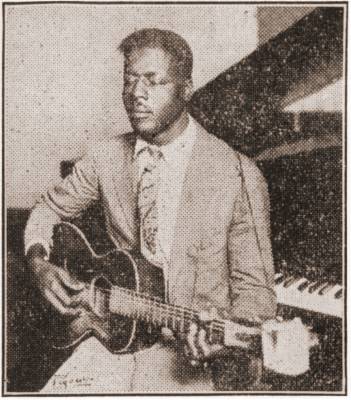
It’s a fascinating profile about a great American musician who was “an utter mystery” because very little has ever been written about him. The Bookman, a New York literary review, once wrote that Johnson was Johnson was “apparently a religious fanatic,” also noting his “violent, tortured and abysmal shouts and groans and his inspired guitar.”
Check out the whole story here, and listen to “Dark Was the Night” below: