When you hear that women make "77 cents for every dollar paid to their male counterparts," what comes to mind—besides anger? Probably you assume that means that, for every male salesman making 0,000, a woman doing the same job is making ,000—a discrepancy owing to sex-based discrimination by men against women.
Believe it or not, that's not what the data show.
That 77-cent figure comes from a report on educational attainment, issued earlier this year by the U.S. Census Bureau, which shows that median monthly earnings in 2009, for those 18 and older, were ,917 for women, ,750 for men. Divide ,917 by ,750 and you get .7778—the basis of the figure. (As a statistics refresher, median means the midpoint of the data set, not the average.)
However, a separate report comparing women's to men's salaries for the same job shows the median woman earning 82 cents for the median man. Half the women in the report, whose work accounted for 61 different jobs, were making better than 82 cents on their male counterpart's dollar. More than a third made between 61 and 81 cents on the dollar. Several of the jobs with the worst pay gaps were managerial in nature or required higher education, yet the educational attainment report shows that women with advanced degrees in some fields make 90 percent of what men do. Overall, both reports show the pay gap varies significantly.
Does this mean employers in some types of work are more discriminatory than others? That's possible, but it's hard to conclude that the only factor is gender discrimination. For one thing, neither report distinguishes similar jobs in for-profit settings from those in nonprofit organizations, which almost always offer lower salaries for similar work, but may also entail less-demanding hours and better work-life balance. The reports are also limited to income, which means they don't factor in the kind of benefits offered and other factors that might make lower-paying jobs more attractive.
After poring over the numbers for a while, I was curious to see how my earnings compared, given that I hold a master's degree in religious studies and work for a nonprofit. According to the education report's chart showing average pretax earnings, based on education level (table 5, which doesn't include sex), I made less per month than both my master's degree– and bachelor's degree-holding peers. But is that because I'm a woman or a nonprofit employee? On the other hand, when compared to peers with degrees in liberal arts, I was earning more than both the median man and woman at both the bachelor's and advanced-degree levels.
How well my earnings compare to others' is therefore complicated. And as a measure of financial welfare, it's incomplete given that none of these figures account for the value of benefits received. According to my employer, salary was only 73 percent of the total value of my compensation in 2009, given that I enjoy a pretty good benefits package. So, again, a straight salary-to-salary comparison may be leaving out a lot of key information regarding the actual welfare of working men and women.
More problematic than all these gaps in the data, however, is the way we typically use figures like salary to determine a person's well-being. A college economics professor once told our class that gross domestic product—"the GDP"—is not the economic health indicator it's often made out to be. Undergo a natural disaster in January that causes billions in dollars of recovery and repairs expenses later in the year, and your country's GDP will surge. But does a catastrophe-driven larger number really translate to better welfare?
Similarly, I'm not convinced that income is always such a good measure of well-being, for those who earn above a certain threshold. (Indeed, a recent study suggests that threshold is ,000.) On my present salary, I can see as many concerts and buy as much beer and yarn as I like, while still giving a decent amount of my money away and chipping away at the debt racked up in my 20s. If I made a lot more money, I'd have to spend more time thinking about what to do with that money. But I'd rather spend my free time writing, cooking, traveling, and hanging out with those whom I love.
With all the things I want to do outside work, it is way more valuable for me to have fairly consistent hours than to make more money. Maybe, if you look at my salary and compare it to those of comparably educated men, I look like I'm not doing as well, but I doubt I'd want to trade places with any of them. The relative autonomy I enjoy and agency over my out-of-work time is worth vastly more to me.
Nor am I entirely alone: according to a recent Wall Street Journal piece, a growing number of single women are choosing less-demanding jobs so they can have more time to lives outside work. It's not that they're doing so because of kids or a husband; they just want to be able to run their errands, see an occasional movie, and meet up with friends. Undoubtedly they've taken pay cuts, but to them it's worth it.
And that's why the unequal-pay claim is flawed. Not only is it based on data that don't entirely support the claim, but it doesn't account for women's agency in the disparity. Undoubtedly, real discrimination happens, which I don't mean to minimize. But it would be just as dishonest to say the pay gap owes completely to discrimination as it would to say there is no discrimination.
Before all we white-collar women get up in arms about the $.23 we supposedly lose compared to our male colleagues, we ought to more closely examine whether that gap exists and what our male peers might be sacrificing for higher salaries. It just might be their well-being. At the same time, we would do well to consider the real and more serious wage challenges faced by our sisters with less education, and the role we play in contributing to that.
Anna Broadway is a writer and web editor living in the San Francisco Bay area. She is the author of Sexless in the City: A Memoir of Reluctant Chastity and a regular contributor to Her.meneutics.
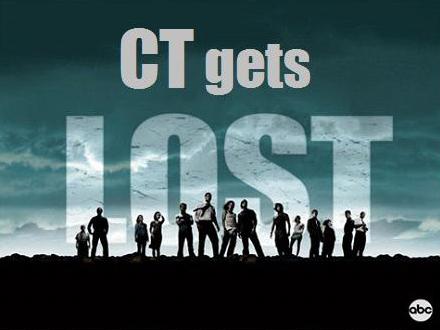
It’s been just a few minutes since the season premiere of Lost’s sixth and final season ended, and I think I’m going to be scratching my head on this one for a while.
(WARNING: SPOILERS AHEAD)
I don’t think we’ve solved the mystery of Locke/The Man in Black/The Smoke Monster yet, but hopefully those answers will continue to unfold in the weeks ahead. This much is certain, though: Nothing is certain. Not on this island, and not in this unpredictable universe. Reality isn’t, unreality is, dead people are alive, and living people are dead, and I don’t even think 1.21 jiggawatts could send me far enough into the future to figure it all out. At least not yet.
Three images/scenes near the end of this episode really caught my attention . . .
I’m intrigued by what these three scenes might mean. (Again, there be spoilers ahead.)
 As a religion professor, I spend my days talking—out loud and on paper—about the really big questions of life. My conversation partners, whether they are students, church members, friends, or family, are living those questions, sorting through inheritances, exploring the gaps, striving to be faithful to what they believe to be true. This profession of mine affords me the privilege of getting to talk about God in ways that are always informed by the questions, claims and wagers of others.
Then cancer came along and interrupted the conversation.
As an expert talker, I suddenly was no expert at all. A novice with a cancer story different from any other I knew. Breast cancer was the diagnosis, but my narrative didn’t include finding a lump, removing a breast or losing any hair. A broken back triggered the stage IV cancer diagnosis and a lousy prognosis: five years out, 80 percent of those who have what I have are dead. My lack of expertise, unfamiliarity with the journey, and fear of what lay ahead conspired against me. Cancer left me tongue-tied, groping for words.
I sought out words from others more familiar with cancer than I. In one cancer memoir I read, the author writes about the scene in the exam room after she learns she has breast cancer. She looks at the doctor through her tears and whispers, “I’m sorry. I just don’t know how to have cancer.” The doctor puts his hand on her shoulder and says, “None of us knows how to have cancer.”
Even the cancer experts don’t know how to talk about cancer.
It’s a humble and humbling claim, one I seek comfort in, both in terms of my own bewilderment over how to cope with cancer in my own life and in the lives of others, as well as the challenge of how to deal with those who mean well but offer little comfort at all.
I don’t want to say it’s all relative when it comes to cancer, but those of us with cancer experience and cope with the disease and its effects in wildly different ways. Some passionately protect their privacy; others are exceedingly public with the details. Some head to work every day during treatment; others’ lives come to a halt. But something we all share is this: the havoc that cancer creates in our lives and in the lives of those who love—or simply interact with—us.
How, then, do you have cancer? And how do you talk about it?
On good days, when someone makes a comment I disagree with or says something insensitive or just plain wrong, I remind myself that none of us knows how to have cancer.
On good days, I realize a person who makes an inappropriate comment overcame the temptation to say nothing at all, which (theoretically) I appreciate. Rather than ignoring my cancer, this person—however awkwardly—is acknowledging cancer’s invasion into my life.
On good days, I attempt to be gracious, even when the comments sting. I’m a professor; I adopt an educative role, explaining why their point of view differs from my own.
Not all days are good days.
In fact, many days with cancer are bad days. On those days, I’m not so magnanimous in my response. Rather than greeting awkward attempts at consolation with gravitas, I get offended, angry, hurt. On bad days, my retorts to off-the-mark comments often offend in return. Close friends and family tell me I have no reason to feel badly about my sharp replies. That it’s not my job to take care of others and their misguided assumptions.
But it’s not that easy: all of us continue to make mistakes when talking about cancer. The mistakes, the imperfections—what Christians might call “sin”—these are the reasons why I, as a Christian, am stuck on hope. As someone who can never quite get it right, I’m always hoping for more in this life—more chances to be gracious, kind, loving. Beyond these basic hopes, new hopes for this life have become important, too: hope for continued inactivity of the cancer in my body and in the bodies of so many others, for psychological and spiritual courage to live with this disease, for the gift of living long enough to see my daughters grow into adulthood.
In addition to hoping for more in this life, I also hope for more beyond. I hope that the promises of God are true: that there is more to life beyond this earthly one; and that in that life beyond there will be no more crying, no more dying, only light, only love, only joy.
I hope and pray that my future includes many more years in this life. But I realize that my future in this life may be brief. I struggle to accept it all with grace: the gifts and the grief. In the midst of the uncertainty, I live in hope: for what’s before me and for the more beyond.
Deanna Thompson is professor of religion at Hamline University in St. Paul, Minnesota, and author of Hoping for More: Having Cancer, Talking Faith, and Accepting Grace, from which this essay is excerpted. Read more at HopingforMore.com.
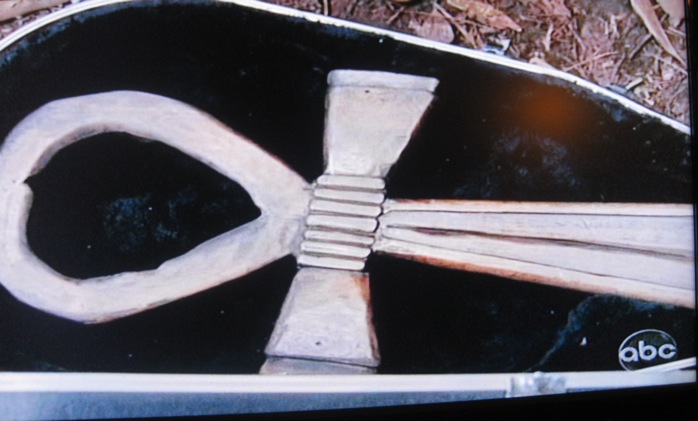
1) When Jacob (alive or dead?) tells Hurley to bring the dying Sayid to the temple to save Sayid’s life, he stresses that Hurley should bring the guitar case. When the guy at the temple opens the guitar case, he finds a large Egyptian symbol called an ankh, which represents new life and/or immortality. The sign is carried by many Egyptian deities in their mythology. Hmm. Jacob seems to have been alive for a long time, Richard never ages, and they’re bringing Sayid to this place to give him new life.
 I picked a heck of a week to eat my first (and second) Chick-fil-A. The first was eaten innocently enough: I found a free coupon that expired that same day. Though I am not a huge fan of chicken sandwiches, I am a huge fan of free things.
https://www.youtube.com/watch?v=LUmoTOujJ7Q
But by the time I got back home and began munching away, I noticed a stream thick with anti-Chick-fil-A sentiment running through my Twitter feed. Chick-fil-A controversy had re-erupted: an old story about Chick-fil-A’s CEO, Dan Cathy, and his donations to and verbal support of organizations advocating for legal marriage between a man and a woman got a fresh coat of ink. People like Billy Graham, Mike Huckabee, and Antoine Dodson (video above) released statements in support of the fast-food chain.
And according to what I read, I had not simply eaten a sandwich. I had made a huge statement: I hated gay people.
Since I do not in fact hate gay people and since I understood why people would be upset with Cathy’s words and donations, I wondered if the crispy, pickle-y yumminess of the sandwich was worth it. Boycotts will be boycotts—they rage and tumble and then wear themselves out—but sometimes they do really matter.
But then it all got messier than a pit bull stepping in spilled Chick-fil-A sauce (not that I know). No sooner had my sandwich digested, it seemed, than the controversy became more than boycott or a “kiss-in.” It became about free speech and totalitarian aldermen and mayors and Rutgers-esque bully-bloggers. And my libertarian streak got twitchy.
Of Cathy’s traditional-marriage stance, Chicago Alderman Proco “Joe” Moreno (1st Ward) wrote in the Chicago Tribune, “There are consequences for one’s actions, statements and beliefs. Because of this man’s ignorance, I will deny Chick-fil-A a permit to open a restaurant in my ward.” Moreno actually says, his decision is “me taking a stand.” It’s a stand that shows Moreno’s frightening ignorance of the Constitution.
I’d love to have written this off as another shining example of idiot Illinois politics, but then the mayor of Boston got into the game, writing a letter to Cathy saying, “I was angry to learn on the heels of your prejudiced statements about your search for a site to locate in Boston … There is no place for discrimination on Boston’s Freedom Trail and no place for your company alongside it.” Well, no place for certain types of discrimination, at least.
And I would love for this to have been a purely political problem but after evangelical writer and speaker Jonathan Merritt publicly defended Chick-fil-A, his friend (or, once-friend) Azariah Southworth—a former evangelical, now agnostic—”outed” Merritt as a gay man based on “the importance of living an authentic and honest life.”
I happen to agree with Southworth on the importance of an authentic and honest life. But I also believe in the importance of living a respectful and kind one, one Southworth apparently does not.
So suddenly eating that chicken sandwich was very much worth it. So the second time I ate Chick-fil-A this week, I knew I was making a huge statement: that I support free speech and the right for anyone to say or not say anything without fear of government reprisal or of attacks for the sake of “honesty.”
And this goes for all of us.
So those who might be cheering on my decision to “eat mor chikin” would do well to Remember the Chick-fil-A, but not as an anti-culture battle cry. Instead, we can harness it as a cry of cross-cultural solidarity and community.
Certainly, we need to Remember the Chick-fil-A whenever anyone’s religious liberties are threatened—whether it’s Christians taking controversial stands on marriage, or whether it’s Catholic institutions defending their right to not provide services they deem contrary to their faith, or whether it’s Muslims seeking building permits from nervous city councils.
But beyond that, we need to Remember the Chick-fil-A when we’re ready to jump on bandwagon-y boycotts or seek to silence or shut down those who offend us or whose beliefs run counter to ours. Remember the Chick-fil-A before refusing to shop stores that say “Happy Holidays” instead of “Merry Christmas.” Remember the Chick-fil-A before asking the Gay Pride Parade to reroute so it doesn’t disrupt church services. Remember the Chick-fil-A before you demand books be removed from high school syllabi. Remember the Chick-fil-A before “outing” another person for whatever through gossip or rumor or prayer request.
Remember Chick-fil-A whether or not you agree with Dan Cathy.
Chicago Tribune columnist Eric Zorn writes, “But to paraphrase the words of Voltaire that are literally carved in stone at Tribune Tower, I’d say this to [Chick-fil-A] owners: I do not agree with what you say, but I will defend to the death your right to sell chicken sandwiches in order to make money to help you say it.”
And I think that’s what Remember the Chick-fil-A is all about, because in many ways, that’s what Jesus’ words about loving our enemies is all about. Enemies aren’t always people who want to kill us or harm us or keep us from marrying or who trample our rights. Sometimes, our enemies are simply people who see the world—or the Bible—differently. So, we Remember the Chick-fil-A as whenever we have opportunities to love our enemies or our neighbors and whenever we discuss our beliefs and differences.
We Remember the Chick-fil-A and give one another some breaks, cut each other some slack, show one another some mercy.
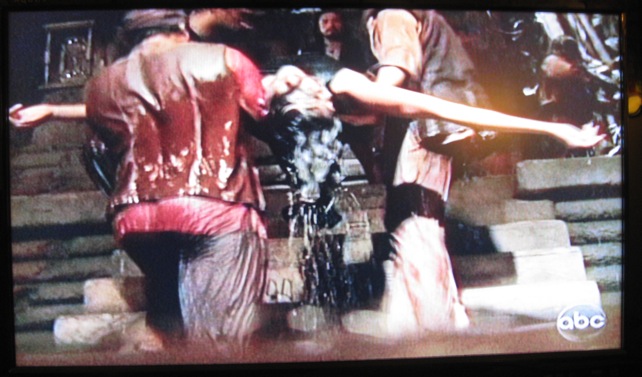
2) When they bring the apparently dead Sayid out of the pool, he is in the position often depicted of Jesus when taken off the cross – prostrate, arms outstretched. I don’t want to read anything too messianic into this imagery, but golly – first a cross-like symbol of eternal life, then sort of a “baptism” in the holy water (baptism represents Christ’s death and resurrection), and then, well, the stunning ending. As Hurley would say, “Dude.”
 Tears slipped down my cheek as I cuddled our one-day-old third-born child—a handsome baby boy.
I couldn’t believe that I was finally holding my baby, but that’s not why I was crying. I was frustrated that one of my birth preferences had not been followed. Most things on my list of birth preferences were important contributions to the health and well being of my baby and me. But my tears were over a truly inconsequential preference. I had even cheerfully told the supportive medical staff that it wasn’t important and it didn’t matter. Nonetheless, my tears were in fact bitter tears, because my idea of the “perfect birth” was “ruined.”
In a moment when my heart should have swelled with unobstructed joy that our child was born, I sulked. In a moment when my eyes should have looked to heaven in wonder that God would be so gracious to me, I wept angrily. My will had not been done, and that bugged me.
“It didn’t happen like I …,” I started to say. Then I recognized the gentle tugging of conviction on my heart.
Just like other idols in my heart, my idol of the “perfect birth” did not just provoke me to feel sorry for myself. It robbed me of the time I could have spent enjoying the Lord, my greatest treasure, and the good gifts he has given me. Having my primary joy be in Christ through the gift of childbirth has always been a struggle for me.
As Rachel Marie Stone recently noted at Her.meneutics, using a midwife has not only become a status symbol, it also has many benefits to respond to American society’s increased medicalization of birth. Two of my three children were born overseas where the options for birth are different. A few examples are that planned homebirths are illegal here and midwives attend all hospital births. In other areas of the world there are even more variables when it comes to birthing options. Some options are less desirable; some are more desirable …
I’ve struggled with envying other mothers for the options they have available to them in childbirth. All too often the posture of my heart has been this: If only I could just have _____ , then I will be happy and this birth will satisfy me. Throughout my pregnancies I’ve had to ask myself: How should my heart consider the good desire for a great birth experience?
As I talked with a Christian doula friend about my struggles, we acknowledged how often we both must pluck the idols of the “perfect birth” off the thrones in our hearts. For instance, here are some indicators we found for when our birth experiences had become idols to us:
… when our egos bloat with pride that other women haven’t had our particular birth experiences.
… when we just can’t see how God’s will for us is still good if our birth preferences aren’t followed.
… when we would rather have our meticulously planned birth experience more than anything else—or else.
… when we evangelize other women with the good news of our perfect birth, yet our joy in our perfect Christ, in whom we are born again, is stagnant.
In the abundance (or scarcity) of options I’ve had regarding the births of my children, I have been tempted to yearn for a perfect birth above everything else. There is nothing wrong in desiring a good thing like a great birth experience. But when I do not see in God’s good gift of childbirth that God himself is most to be desired, then my yearning for a great experience leans toward idolatry.
I need regular reminders that I have a treasure that is preeminent over my ideas about birth, over the joy of my role as a mom, and over the delightful gifts of my children. My greatest treasure is Jesus Christ. My soul’s boast is in the Lord (Ps. 32:4).
Being in Christ is a gift that I don’t deserve to have and could never work hard to earn (Eph. 2:8-9). When I was born again in Jesus Christ, God made me complete in him (Col. 2:10). There isn’t a single birth experience I can have that can bring me more joy than being in fellowship with God. There isn’t a crowning motherhood achievement I can do that can contribute to or take away from my status as God’s beloved daughter.
The gospel is not just a gift to me on my spiritual birthday. It’s a gift to me on my baby’s Birth Day and every single day.
If the Lord blesses us with another child then I want to remember God’s love for me in the gospel and yearn for him above everything else my heart desires. I want the idols in my heart to be expelled by a greater affection for a supremely desirable God.
So let not the wise mother boast in her birth plan, let not the strong mother boast in her pain tolerance, let not the rich mother boast in her health care choices. Let the mother who boasts boast in this: that she understands and knows the Lord who delights in practicing steadfast love, justice, and righteousness (Jer. 9:23-24).
Gloria Furman (@gloriafurman) lives in Dubai with her husband, Dave, a pastor at Redeemer Church of Dubai. They have three young kids. Gloria is the author of Glimpses of Grace: Treasuring the Gospel in Your Home (Crossway 2013) and blogs regularly for Domestic Kingdom.
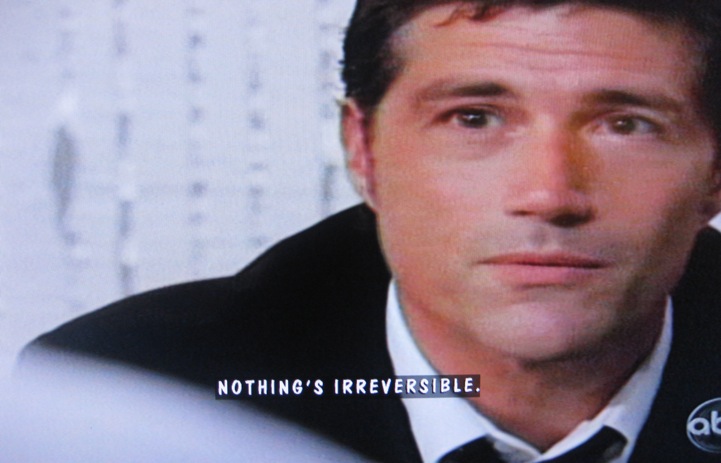
3) When Jack meets Locke in the “alternate reality” (I’m not sure what’s real, and what isn’t) near the end of the episode in LAX, they’re both in the Oceanic baggage claim area, looking for “cargo” that the airline lost on the flight (Jack’s dad, John’s knives). When Jack tells John he’s a spinal surgeon, Locke says that his condition is irreversible. Jack, who has always believed he can fix anything, retorts, “Nothing’s irreversible.” And hoo boy, just a moment later, we find out how true that really is. (Right, Sayid? Dude!)
All three add up to a favorite story about how even death itself isn’t “irreversible,” in certain contexts. When Aslan comes back to life near the end of The Lion, The Witch, and The Wardrobe, Susan and Lucy ask him, “What does it all mean?” In his reply, Aslan tells them of a “deeper magic” that the White Witch (who had killed him) didn’t know about: “Her knowledge goes back only to the dawn of time. But if she could have looked a little further back, into the stillness and the darkness before Time dawned, she would have read there a different incantation. She would have known that when a willing victim who had committed no treachery was killed in a traitor’s stead, the Table would crack and Death itself would start working backward.”
No, Sayid’s no Aslan; he wasn’t a willing victim, and his past life is full of treachery. But I am interested to see what the show’s creators are getting at with all of this imagery, all coming within minutes at the end of the episode. So I echo Susan and Lucy by asking, “What does it all mean?” We probably won’t know for months, and even then, all of our questions probably won’t be answered. But it’s fun to speculate.
What do you think it all means?