Rep. Peter King (R-NY), chair of the Homeland Security Committee, is making headlines for his hearings on the “extent of radicalization in the American Muslim community.” King said that hearings will address both efforts by terrorists to recruit Americans and the reactions by Muslim leaders in the U.S. to these attempts to radicalize American Muslims.
“The danger comes from a small segment within the Muslim community,” said King. “Unfortunately, the issue we are facing is that not enough leaders in the community are willing to come forward when they know an individual is being radicalized. In some cases, these leaders have encouraged individuals to not cooperate with investigations.”
David Gushee of the New Evangelical Partnership for the Common Good is one of several evangelicals who have criticized the hearings.
“It is always a very dangerous thing when one group is singled out in front of the rest. It is humiliating, shaming and stigmatizing, and almost invites average citizens to marginalize and mistreat members of the targeted group. When religion is involved, and a minority religious group to boot, the danger grows exponentially,” said Gushee.
Still, Gushee said that despite his concerns, “I do not dismiss the legitimate fears that lie behind widespread public support for such hearings.”
According to a newly released poll by the Pew Research Center for the People & the Press (Pew), such “legitimate fears” are far more common in evangelicalism than in other religious traditions in America.
Pew asked people if they thought Islam “is more likely than others to encourage violence among its believers” or if it “does not encourage violence more than others.” Among evangelicals, 60 percent said that Islam was more violent than other religions. Other Americans hold the opposite view, with only 35 percent seeing Islam as more violent.
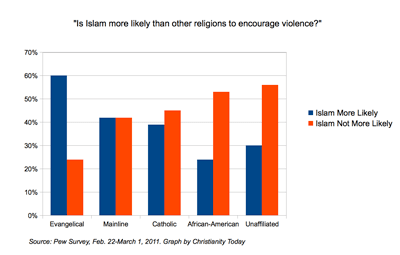
Evangelicals are the only religious tradition that had more people seeing Islam as violent than those who see it as not more violent. Mainline Protestants and Catholics were split equally over the question (statistically speaking). Around four-in-ten of each of these traditions saw Islam as more violent; the same proportion saw Islam as no more violent than other religions. African-Americans and those with no religion were the least likely to see Islam as violent. A majority of each group said Islam was not violent.
This difference between evangelicals and other religions is unlikely due to ignorance about Islam (at least relative to ignorance among other Americans). According to an earlier Pew study, evangelicals were just as likely to know basic facts about Islam as other Americans. Half of evangelicals knew that Ramadan was Islam’s holy month. The same percentage knew that the Qur’an was Islam’s holy book.
A February poll by the Public Religion Research Institute found that evangelicals were more likely to know that Congress was planning hearings on alleged Muslim extremism. One-third of evangelicals had heard of the hearings, comported to around one-fifth of other Americans. The poll found 70 percent of evangelicals were supportive of congressional hearings on alleged Muslim extremism, compared to only half of mainline Protestants. Support, however, was highest among evangelicals who trusted Fox News (84 percent) than those that trust other news sources (60 percent). Evangelicals who trust Fox News were also more likely to say that they felt they feel informed about Islam (70 to 37 percent).
Whether they are driving public opinion or merely reflecting it, American Family Association (AFA) president Tim Wildmon and Family Research Council president Tony Perkins applauded King’s hearings, saying that radicalized, violent Islam is actually true Islam.
In a letter to the House Homeland Security Committee leadership, American Center for Law and Justice chief counsel Jay Sekulow said, “the decision to limit the scope of the hearings to the radicalization of Muslims in the United States—rather than include other religious groups— was not arbitrary, but was a very practical and necessary categorization based upon the recent terrorist activities in the United States.”
Others are remaining mum on their view of the hearings. The Southern Baptist Ethics & Religious Liberty Commission simply tweeted, “staff monitoring Homeland Security subcommittee hearing on Islamic radicalization in America.”
Sojourners president Jim Wallis said the King hearings were based on a “theological mistake” of seeing one side as good and the other as evil.
“Our country is under theological attack every day in the polarized debate of the West vs. Islam, and that narrative must be changed,” said Wallis. “And Congressman King’s hearings are more likely to reinforce, rather than transform that narrative.”
For other religious leaders who are speaking out against the King hearings, see Faith in Public Life’s list of recent statements.