





The U.S. Supreme Court let stand lower court decision ordering the removal of 13 roadside crosses in Utah. Justice Clarence Thomas issued a rare dissenting opinion on the Court’s Monday decision to not hear two cases involving memorials for fallen state police officers. For Thomas—and several Christian legal organizations—the case was a missed opportunity for the court to clarify the standards for judging public display of religious symbols.
 Update (March 4): The head of the Southern Baptist subcommittee tasked with reviewing 10 churches for possible violations of denominational standards regarding abuse resigned on Friday, according to a Houston Chronicle report. Ken Alford cited “controversy and angst” over the bylaws workgroup’s response, but defended their position, saying their small group was not equipped to investigate the churches further.
———–
Conflicting statements from Southern Baptist Convention (SBC) leaders on the denomination’s approach to addressing sexual abuse have left victims, advocates, and pastors themselves with a sense of whiplash—and called into question the fate of proposed reforms to improve accountability among SBC churches.
Those concerned about abuse within America’s largest Protestant body—including the hundreds of cases reported by the Houston Chronicle and San Antonio Express-News—cheered repentant statements and bold plans for policy changes from SBC president J. D. Greear last week, only to see his recommendations largely turned down by part of the SBC’s Executive Committee days later.
Greear called on the Executive Committee (EC), the decision-making body tasked with addressing convention business between annual meetings, to take a harder line against churches that mishandle abuse allegations. Specifically, he wanted the SBC to look into 10 particular churches implicated in the recent investigation to see if the churches still meet denominational standards.
Though Southern Baptists have generally resisted top-down oversight, several prominent SBC leaders, including Greear and Ethics and Religious Liberty Commission president Russell Moore, had begun to say that a commitment to church autonomy could not supersede their responsibility to prevent and address abuse.
But when it came to the 10 churches in question, the executive committee’s bylaws workgroup declared that 7 did not have credible claims of wrongdoing to investigate in the first place, reasoning that the churches didn’t merit further review and admonishing SBC leaders against calling for inquiries without criminal convictions and evidence that churches had knowingly permitted predators in their midst.
“I am deeply grieved at the SBC EC response to JD Greear. The EC has demonstrated the exact problems that lead to the abuse of so many—whitewashing the crimes and coverup, choosing largely irrelevant criteria, and investigating issues they have no training to investigate,” tweeted Rachael Denhollander, an attorney and victims’ advocate who was appointed to an SBC presidential advisory group tasked with studying its response to abuse.
“JD Greear and some leaders have been seeking expert/survivor help and moving forward with firm first steps to change. The EC has undermined and destroyed that effort. I hope these mistakes are due to lack of learning and that they will withdraw, seek help, and remedy these errors.”
After a two-day meeting, the six-person EC subcommittee released a statement last Saturday tempering Greear’s charge. “The Convention, through its Executive Committee, should not disrupt the ministries of its churches by launching an inquiry until it has received credible information that the church has knowingly acted wrongfully,” the subcommittee concluded.
“Although the overwhelming majority of sexual abuse cases remains tragically unreported, in virtually all reported cases, the abuse and cover-up of abuse were criminal acts undertaken by a few individuals within a church,” the group wrote. “The church body rarely knew about these actions and even more rarely took any action to endorse or affirm the wrongful acts or the actors themselves.”
(The three churches the workgroup deemed to require further inquiry included Sovereign Grace Church in Louisville, where concerns of abuse coverup have swirled around former Sovereign Grace Ministries president C. J. Mahaney for years.)
Their remarks sent waves across the SBC, including among fellow members of the executive committee who hadn’t been involved in crafting the response.
Ed Stetzer, executive director of the Billy Graham Center at Wheaton College, called out the bylaws workgroup for hasty decision-making and an “arbitrarily high standard for inquiry.”
“Assessing these situations typically takes months or, in some cases, years. Now, suddenly, a Baptist committee is able to consider six churches in just over 24 hours and declare them all open and shut cases?” wrote Stetzer, former president of LifeWay Research. “You can see why some may not feel that due diligence was done.”
At least three EC members spoke up online to decry the workgroup’s statement and pledged to advocate for victims before the denominational body: EC vice chairman and California pastor Rolland Slade, Florida pastor Rick Wheeler, and Texas pastor Jared Wellman, who tweeted, “I am a member of the EC who supports @jdgreear’s “10 Calls to Action on Sexual Abuse,” and I want to make sure sexual abuse victims’ voice is heard regarding the recent Bylaws Workgroup report.” They fielded emails from SBC abuse victims about their experience and recommendations for improvement.
After condemned the EC statement for “undermining efforts” and “dismissing coverups and abuse brought to light,” Megan Lively said she appreciated Wellman for hearing out stories like hers.
Lively came forward last year to recount how Southern Baptist leader Paige Patterson discouraged her from reporting an alleged instance of rape while she studied at Southeastern Baptist Theological Seminary; Patterson was later fired from his post as president of another SBC seminary.
The bylaws working group statement reflects the concerns of SBC leaders who don’t want to see the convention come to hasty conclusions or presume guilt after every allegation, which they say would be “untenable and unscriptural.”
The voices critiquing the statement want to see an approach that centers more around the victims—trusting their stories and enabling them to come forward so abuse can be addressed.
“The SBC EC has bowed to political expediency over biblical principles in their hasty & unwise decision to minimize & marginalize & reenact the pain of the victims, in order to assuage the wrath of the accused, alleged violators,” wrote SBC pastor Dwight McKissic. “Same mindset undergirded slavery/Jim Crow in SBC.”
Dean Inserra, a member of the ERLC leadership council, quipped: “SBC EC, I’ll help you out real quick with a new response to President Greear’s calls to action: ‘Whatever it takes.’ Try that.”
The unpopular response to Greear’s recommendations reflects differing philosophies within the denomination over whether or how the SBC could improve its response to abuse. Such a split would challenge whether new policies go forward, including a proposed amendment to explicitly call out churches that harbor abuses as grounds for disfellowshiping. (It has to be approved two years in a row to be ratified.)
As the Twitter account SBC Explainer wrote:
The amendment will now go to the Messengers for consideration. The debate will ensue. The Convention will act according to the messengers. What we do in years to come will in large part depend on who shows up, debates + votes this, and votes for president in years to come. #SBC19
Lastly, it really can’t be understated how possible it is that the Convention fails to pass any amendment whatsoever. The 2/3 vote is a purposefully high threshold. What a shame on us all if we fail to act at #SBC19. Public debate needs to start. We need to get on the same page.
Other recommendations from the advisory group appointed by Greear include urging churches, associations, state conventions, and entities to strengthen abuse policies; considering background checks for SBC appointees; and weighing the possibility of a database of offenders.
ERLC executive vice president Phillip Bethancourt, a member of the group, praised the Baltimore Baptist Convention this week for approving ,000 to fund “free criminal and sex offender background checks for every church in our association during the calendar year 2019.”
The Supreme Court denied the case without comment. With thousands of appeals to consider, the Court rarely offers an opinion or explain its reasoning when it denies a case. A justice offers a dissent in a denial in only a handful of cases.
Thomas said the Court should have taken up the case to help clear up the standards for judging whether a public or governmental display religious symbol is constitutional. Lower courts use different standards. In 2005, the Court ruled on two cases involving the display of the Ten Commandments. On the same day, the Court decided that one display in Texas was constitutional; another display in Kentucky was declared unconstitutional. Thomas noted the various standards used by lower courts due to the lack of a clear guidance from the high Court.
“Today the Court rejects an opportunity to provide clarity to an Establishment Clause jurisprudence in shambles,” Thomas wrote.
In previous court cases, Thomas has advocated the position that the First Amendment’s ban on the establishment of religion applies to the federal government only. State and local governments are not restricted in the same way, according to Thomas.
The Court, however, has recently used the so-called endorsement test for religious symbols. A religious symbol can be displayed on public property as long as 1) it is not an endorsement of a religion or 2) a reasonable person could not interpret the symbol as an endorsement. The Utah Highway Patrol did not pay for the crosses, and it is on record as not endorsing the crosses as religious symbols. The question is whether the crosses could still be interpreted as being endorsements of Christianity.
In a decision last year, the Court gave a cross memorial as an example of acceptable religious symbols on government property. “A cross by the side of a public highway marking, for instance, the place where a state trooper perished need not be taken as a statement of governmental support for sectarian beliefs,” wrote Justice Kennedy in the majority opinion. (MoreCT coverage of cross decisions.)
The Alliance Defense Fund (ADF) attorney Byron Babione said, “The Supreme Court’s decision not to hear this case is baffling in light of its comments just last year that individualized memorial crosses honoring fallen troopers do not amount to a government establishment of religion.” Babione and the ADF helped represent those who paid for and maintained the crosses.
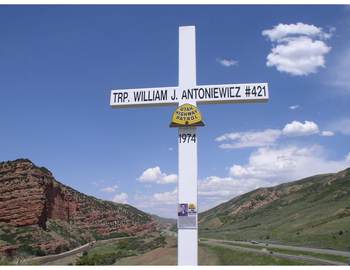
The Utah crosses are not plain white crosses on the roadside. Each cross stands 12 feet high with a six foot wide crossbeam. They each feature the name and rank of the officer, a picture of the officer, and a plaque listing details about the officer and his death. The crosses also include the symbol of the Utah Highway Patrol and some of the crosses are placed on Utah Highway Patrol property, not by a highway. The lower court concluded that a person could reasonably interpret the crosses as endorsements of Christianity.
The decision was criticized by some evangelical legal groups who believe that the endorsement test should be abandoned. The establishment clause, they argue, should allow government endorsement so long as it does not involve coercion.
“Freedom of religion means, in part, that no government should discriminate against those who, using their own funds, wish to erect a non-invasive religious display on public property,” said Family Research Council’s Ken Klukowski.
Even if the endorsement test was adopted, the ADF argued that the crosses could not be interpreted as religious symbols. American Atheists national legal director Edwin Kagin said this argument should be “repugnant” to Christians.
“The attitude that the cross is not a Christian symbol should be repugnant to all of those believers who believe it to be a sign of the son of god [sic] having died on a cross to save everyone who believed in him and that, as he conquered death, so will those who believe this story conquer death. That is what the crosses are to them,” Kagin said.
According to the ADF’s brief, that the crosses were memorials and symbols of sacrifice; they did not represent Christianity.
“The [Utah Highway Patrol Association] chose the cross shape because it is the only symbol, given its historical use, that could simultaneously communicate messages of roadside death, commemoration, and highway safety,” the ADF brief said.
Image used with permission from the Alliance Defense Fund.







