





Those who will likely vote in Iowa’s presidential caucuses remain undecided, a new poll suggests. Those that did report an opinion in the poll admitted that they could still be persuaded to change their vote.
Herman Cain, Ron Paul, and Mitt Romney are leading the pack among likely caucus goers, according to a poll conducted by Iowa State University, The Gazette, and KCRG of 1,256 of registered Iowa voters. Other candidates received single-digit support in the Hawkeye State.
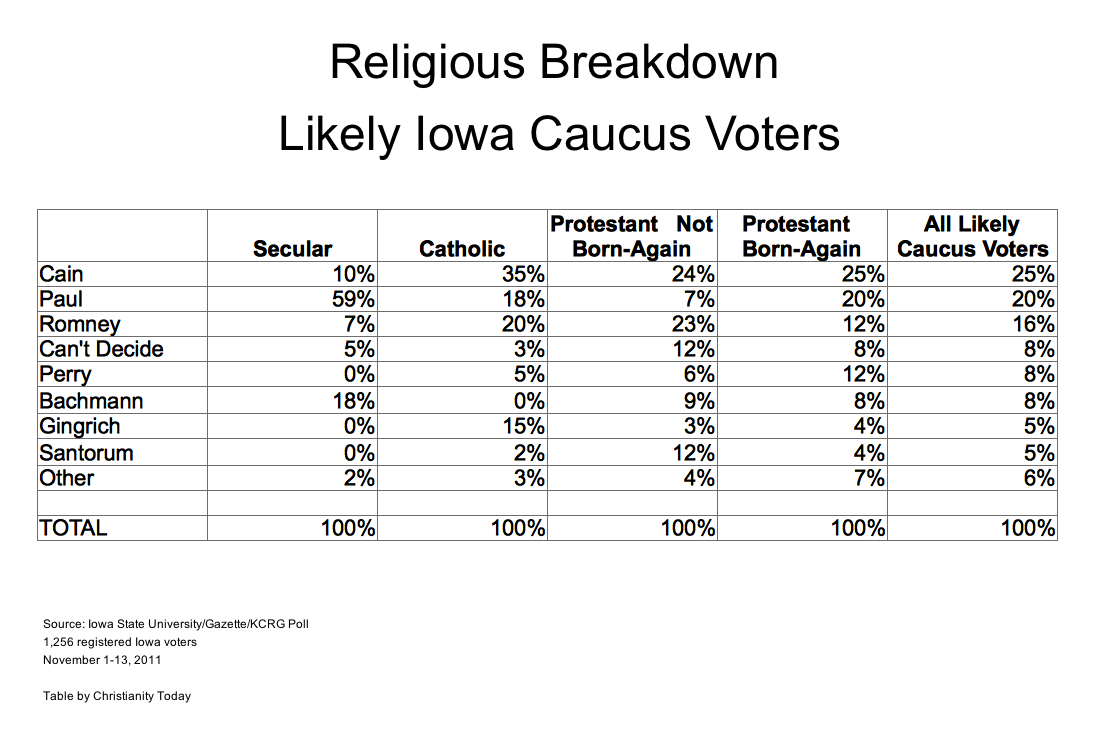
Herman Cain received the most votes among Catholics (35 percent) and Protestant/born-again (25 percent), but he has very little support among secular voters (10 percent). Secular voters represent a small portion of caucus voters, but they are the most unified with six-in-ten of them backing Ron Paul.
Among religious voters, born-again Protestants are the least supportive of Mitt Romney. Only one-in-eight born-again voters support the former governor of Massachusetts, compared to nearly one-in-four support among other Protestants. Evangelicals are twice as likely to support Rick Perry compared to other religious voters.
Michele Bachmann is also trailing in the poll, partly due to her lack of support (0 percent in the poll) among Catholics. Bachmann’s former membership in a Wisconsin Synod Lutheran church in Stillwater, Minnesota, previously drew some attention earlier this year because the Synod suggests that the Catholic Papacy is the Antichrist.
The poll found a high level of fluidity among voters. Dave Peterson of Iowa State said that the race in Iowa is still up for grabs.
“My take away from these results is that voters are still really unsure of whom they will support. Over half of the people are still trying to decide, and another third are merely leaning toward a candidate,” said Peterson, who is interim director of the Harkin Institute of Public Policy. “When asked, people will express a preference for one candidate, but that they will also admit that this is a weak attitude. This is anyone’s race at this point.”
Religious voters appear fairly undecided.
“Religious voters are particularly fluid at this time,” Peterson said. “While only around 16 percent of all voters say they have made up their mind, the rate is even lower amongst voters of faith. 37 percent of secular voters say that they have made up their mind, but less than 10 percent of voters who identify as either Catholic or Protestant have made a firm choice.”
Iowans cast votes for the GOP nomination on January 3.
In this episode of Music & Meaning, host Charlie Peacock offers a narrative trip through the many ways Jesus has been represented in pop music: explicitly, implicitly, genuinely, and in mockery. He discusses Jesus Christ Superstar, the rock opera that brought a contemporary Jesus to a new generation. This leads to a look into the '70s perspective of Jesus as a symbol of authenticity and rebellion, covering tracks from Norman Greenbaum, James Taylor, The Velvet Underground, and Black Sabbath, to name a few. As he moves through the decades, Charlie reflects on the evolving depictions of Jesus in music, from controversial metal bands in the '80s to Tupac Shakur's '90s rap, on to Kanye West's "Jesus Walks" in the 2000s, and much more, including Taylor Swift, The Killers, U2, and Lauren Daigle. In his own words, "I'm just shining a light on the persistent motif of Jesus in pop culture. Some musicians are simply namechecking Jesus. Others have interwoven the Jesus narrative into their music with curiosity and care." The episode wraps up with Charlie sharing his personal ethos regarding the mention of Jesus in music (and he might even be caught singing a little bit). Finally, he leaves us with a 50-song Spotify playlist that highlights a few of these diverse musical critiques of Jesus, the co-opting of his name, as well as tributes, praise, and true artistic reflection. The playlist offers listeners a second opportunity to soak up Jesus's significant impact on pop music titles and lyrics. Contemporary interest in who people say Jesus is, through music and entertainment, is alive and well.
Charlie Peacock is a Grammy Award–winning, Billboard chart–topping music producer, composer, and recording artist. He is a co-founder of the Art House, Wedgwood Circle, and founder/director emeritus of the commercial music program at Lipscomb University. Charlie has produced music for film and television, including A Walk to Remember, Chris Cornell’s “Misery Chain” from the soundtrack of 12 Years a Slave, and “Hush,” the title theme to the AMC drama Turn: Washington’s Spies. Named by Billboard’s The Encyclopedia of Record Producers as one of the 500 most important producers in music history, Charlie is also a three-time recipient of the Gospel Music Award for Producer of the Year. His books include Why Everything That Doesn’t Matter, Matters So Much; New Way to Be Human; At the Crossroads; and a contribution to It Was Good: Making Music to the Glory of God. Charlie is the senior music editor for Christianity Today and host of the CT podcast Music and Meaning. He has been married to writer Andi Ashworth for nearly 50 years and they have two grown, married children and four grandchildren.
“Music and Meaning” is a production of Christianity Today:
Executive Produced by Erik Petrik and Matt Stevens
Produced and Written by Charlie Peacock and Mike Cosper
Original Music and Editing by David LaChance and Charlie Peacock
Mix Engineer: Mark Owens
Show theme, “Sound of the Room,” composed by Charlie Peacock, featuring bassist John Patitucci







