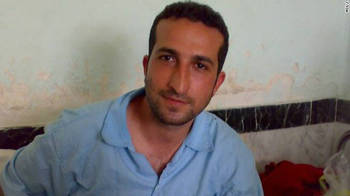
Lawyers for an Iranian pastor awaiting a final decision on his death sentence have not received communication from authorities that their client will be executed, despite reports that his death is imminent.
Rumors of an imminent execution of Yousef Nadarkhani were leaked this week after a source close to one of his lawyers contacted international media, informing them that a lower court had signed Nadarkhani’s execution papers and that his death sentence would be carried out soon, sources told Compass.
 The students at Wheaton College were surprised: Wait, Saint Augustine was African?
Shown the international award-winning Augustine: Son of Her Tears for a freshman seminar that reads his Confessions, they witnessed history brought to life beyond the text, said Sarah Miglio, dean of curriculum.
So did the Muslim actors who depicted the story of the Christian theologian. The cast and creators now want to remind the world—and especially their own people in North Africa—that the church father properly belongs to their heritage.
“The West is more acquainted with Augustine than we are in North Africa,” said Aicha Ben Ahmed, the Tunisian actress who played Monica, Augustine’s long-suffering mother. “We have a wine named after him here, and it is better known than the saint.”
The leading actor, Ahmed Amin Ben Saad, was similarly affected. “Saint Augustine is a very strong and perplexing character,” he told Watani, an Egyptian Christian newspaper. “I felt the reverberation of his struggles in my own psyche.”
Known historically as Augustine of Hippo, the author of the monumental City of God and Confessions was born in 354 in Thagaste (present-day Souk Ahras) in northeast Algeria, 170 miles from Carthage, in present-day Tunisia.
Augustine is the first known effort to film his story on location with all local actors. With the endorsement and co-funding of the culture ministries of Tunisia and Algeria, it was produced by Abdelaziz Ben Mlouka’s CTV, which managed production of Tunisian scenes in Star Wars episodes I and II, and Imed Dabbour, the Tunisian American CEO of Lighthouse AW.
https://www.youtube.com/watch?v=L-y7N43BhzM
Directed by Egyptian filmmaker Samir Seif, Augustine won the audience award at the 2017 Oran International Arabic Film Festival in Algeria and the best artistic achievement award at the Alexandria Film Festival in Egypt last October.
Screened also in Carthage, Algiers, Cairo, and Sfax (when the Tunisian city was designated the Arab Cultural Capital of 2016), the film has captured the attention of the North African elite.
Significant also is that its vision was birthed by a Lebanese Christian.
“Muslim North Africa is anxious for the world to know Augustine was an Algerian,” said Henri Aoun, the film’s official distributor. “It bothers me that the whole world thinks he was Italian.”
Augustine is not Aoun’s first collaboration to better acquaint both Muslims and the West with the original Middle Eastern heritage of Christianity. His Damascus, the first Syrian film telling the story of Paul the apostle, premiered in the capital’s opera house in 2009.
Aoun believes Augustine speaks powerfully to today’s North Africans.
The film covers the theologian’s life from childhood until his conversion to Christianity, focusing on his intellect, his immoral lifestyle, his dalliance with Manichaeism, and above all, the tears of his mother.
A bishop once comforted her: It cannot be that the son of these tears should perish.
At the same time, Augustine is interspersed with the in-film portrayal of Hadi, an Algerian documentary filmmaker, who reads Confessions as he produces his own film.
The fictional director also has a child out of wedlock and, like Augustine, neglects the love of his mother.
“Monica shamed her son [Augustine] for his lifestyle,” Aoun said. “This is how families in our culture honor right living.”
The film’s Muslim participants were impressed—not deterred—by its Christian origins and the faith of its hero.
“I’m an actress, and my job is to play a role,” said Ben Ahmed, named the second-most-beautiful Tunisian in 2011. “But I was influenced by Monica, whose whole life was lived for her son. It is a good message—a message of peace. [It helps us] feel how a person from another religion feels.”
Gregory Lee, an Augustine scholar and associate professor of theology at Wheaton College, praised the historical accuracy of the film.
Beyond showcasing the life and thought of the great church father, it conveys another important lesson: It is plausible that Augustine resembled the Berbers of today.
“Casting Augustine according to what he might have looked like helps us to recognize that Christianity has a wide global heritage,” Lee said. “It was very exciting to watch a film about him in his original geographical context.”
The Cairo premiere screening, held two years ago in a historic downtown theater, was attended by Egyptian entertainment and religious dignitaries.
“The film shows us that when someone’s life is far from God—no matter his religion, Muslim or Christian—at any moment God’s grace can change him,” said Refaat Fekry, media spokesman for the Evangelical Church in Egypt.
“And the involvement of Muslims shows us there is a shared goal in the Arab world to reduce bigotry and hatred and work together for a better way.”
One scene in the film depicts the moment an unconverted Augustine accompanied a Roman legion ready to seize his mother’s church. The local bishop told Christians inside to put down their makeshift weapons and pray; according to tradition, the soldiers stood down, leaving the church unharmed.
“I’m praying this film will be seen by present, potential, and former terrorists,” said Aoun, “who will arm instead with the truth of God.”
As the dynamic former Tunisian minister of culture, Latifa Lakhdar, said, “Creativity is the greatest way to [approach] our battle against those people who would destroy even the most elementary principles of life.”
These are messages the young Augustine, played by then-14-year-old Zechariah Dabbour, wants to give to America.
Dabbour identified himself as the only Christian actor in the film. His father, Imed, a Tunisian producer and TV host, wrote the story.
“I lived with Muslims my entire childhood. It was super normal,” he said. “When my sister and I went to school we didn’t feel scared, or even outnumbered, though maybe a little alone.”
Current plans for Augustine include a Lenten season launch in Lebanese theaters, an April screening attended by Pope Tawadros II of the Coptic Orthodox Church in Egypt, and a possible showing at the United Nations. Negotiations are underway for a Netflix release.
True to its international production, Augustine captures the religious and cultural diversity of Roman Africa, now revived throughout the world.
Then and now, the saint’s Confessions rings true: You have made us for yourself, O Lord, and our heart is restless until it rests in you.
Whether for American or Arab environments, the search for truth is the heart of the film, Aoun said.
“I would love for people to walk away from this movie and say, ‘What does it mean for me today? Where am I in my walk with God?’ ”
Jayson Casper is Middle East correspondent for Christianity Today.
“The lawyer is waiting for confirmation, but he understood from a source that the execution was issued,” said Firouz Khandjani, a member of the council of the Church of Iran, Nadarkhani’s denomination. “Now we are trying to understand exactly what is happening. Because the information came from someone close to the lawyer, he took it seriously.”
Nadarkhani’s case had been sent to Supreme Leader Ayatollah Khamenei for a decision on his death sentence, but legally the lower court still has the authority to issue an execution order, Khandjani said. Khamenei may or may not make a decision, and if the court were to issue an execution order, Khameni would have the authority to block it, Khandjani said.
Though Nadarkhani’s lawyers have not received written confirmation of an execution order, Khandjani said he found it “worrying” that the government has repeatedly disregarded its own law and legal process in its treatment of Christians.
The Iranian government has executed prisoners without prior notice, sources told Compass, though it is not common.
“We are concerned for the safety of Christians in Iran, because the government is not respecting the law or the legal procedures,” Khandjani said. “We are waiting for a confirmation, but we have to take action, because we know of people who were executed without notification.”
Nadarkhani spoke to his wife as recently as Wednesday, according to sources, and Jubilee Campaign reported that the American Center for Law and Justice had confirmed that he was still alive earlier today.
Some sources told Compass they are skeptical of the credibility of information that Nadarkhani’s lawyers received and the certainty with which international press have been reporting his “imminent death.” They say this may be a governmental ploy to gauge international reaction to such a rumor.
Christians in Iran are routinely arrested and interrogated. Most of them belong to networks of house churches meeting in small groups in secret.
In December the head of Iran’s Judiciary, Ayatollah Sadeq Larijani, reportedly ordered the presiding judge over the trial in Rasht to make no moves on Nadarkhani’s case for one year.
In September 2010 Nadarkhani was sentenced to death after a court of appeals in Rasht, 243 kilometers (151 miles) northwest of Tehran, found him guilty of leaving Islam. He has been in prison since October 2009.
The court in Rasht was expected to pronounce a verdict on Nadarkhani’s appeal in October 2011 but instead sent the Christian’s case to the nation’s Islamic authority, Khamenei.
At an appeal hearing in June, the Supreme Court of Iran upheld Nadarkhani’s sentence but asked the court in Rasht to determine if he was a practicing Muslim before his conversion. The court declared that Nadarkhani was not a practicing Muslim before his conversion, but that he was still guilty of apostasy due to his Muslim ancestry.
The Supreme Court had also determined that his death sentence could be annulled if he recanted his faith. The Rasht court gave Nadarkhani three chances to recant Christianity in accordance with sharia (Islamic law), but Nadarkhani refused to do so. The Supreme Court in essence ruled that Nadarkhani could be executed if he did not recant.
“You have to consider that Nadarkhani has been condemned twice,” Khandjani said. “One time by a local court, and then the Supreme Court confirmed the death sentence.”
Authorities arrested Nadarkhani in his home city of Rasht in October 2009 on charges that he questioned obligatory religion classes in Iranian schools. After finding him guilty of apostasy, the court of appeals in Rasht in November 2010 issued a written confirmation of his charges and death sentence.
One of Nadarkhani’s lawyers, Mohammad Ali Dadkhah, also faces charges for “actions and propaganda against the Islamic regime,” due to his human rights activities.
Iranian authorities view Iranian Christians as pawns of the West trying to bring down the regime, sources said. As Christians in Iran are held hostage to the government’s political whims, some Iranian Christians say the key to their freedom is continued pressure from the international community.
“We have to keep praying and sharing information about Christians in Iran, because this is a difficult moment for the people of Iran,” Khandjani said. “The minorities are particularly affected, but Iranians in general are under pressure from the government. Their freedoms are very restricted.”