





Should a country's Christians-to-debt ratio be added to the list of economic indicators worth watching? Or more specifically, its evangelicals-to-debt ratio?
According to a study of more than 100 nations, changes in the percentage of Christians—especially evangelicals—in a given country have a direct correlation to economic well-being.
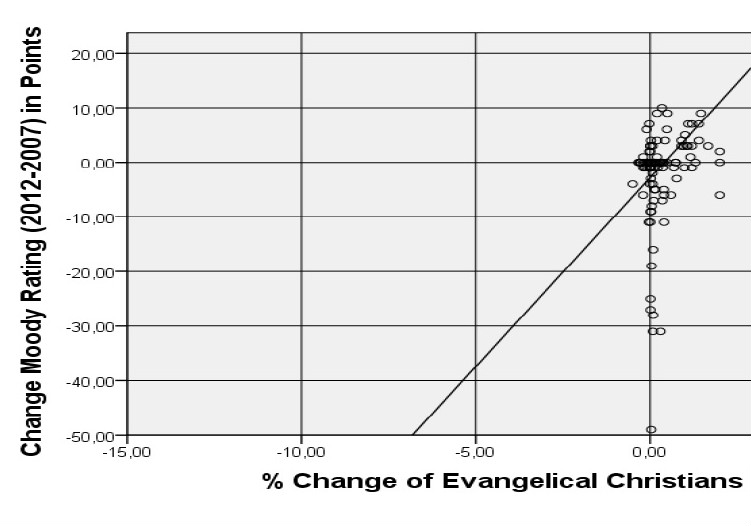
Dutch researcher Dick Slikker wanted to assess the Marxist theory that increases in prosperity lead to decreases in religious practice. So he examined the past decade's worth of data from countries including the United States, Belgium, China, Germany, Iceland, Italy, the Netherlands, Spain, and the United Kingdom. His research used Operation World and the World Religion Database for its data on changes in the percentage of Christians in each country, while studies from Moody's Analytics and Fitch Ratings provided data on changes in the economic status of each country, particularly its sovereign credit rating.
His conclusion: "Changes in the percentage of Christians within a society exert a measurable correlated influence of the economic well-being of that society."
"When using total Christian populations per country, statistically significant positive linear correlations were obtained in seven out of eight combinations of data source, rating agency and either five- or ten-year interval." Slikker notes in his abstract.
Furthermore, within the three subsets of Christianity studied—Protestants, Catholics, and evangelicals—it was evangelicals that proved to have the highest rate of correlation with economic wellbeing.
Slikker told CT, "Four out of the four (100 percent) models for evangelicals are significant, and six out of the eight (75 percent) models for Protestants are significant." By contrast, only 50 percent of the models for Catholics proved significant. The study also noted the correlation in a nation's Muslim population, finding it to have no effect on the economy in all but one case, which was a negative effect.
Slikker's study joins others that have found mixed results on whether the "Protestant work ethic" exists or not. A 2009 Harvard study found no empirical evidence of economic benefit. However, another recent study found that the effects of unemployment hurt Protestant societies more than societies that are less Protestant.







