No sabbatical. No help with counseling. No clear picture of what’s expected.
Hundreds of former evangelical pastors say these were the crucial elements missing from the final churches they led before quitting the pastorate.
A recent study by LifeWay Research points to ways churches can encourage pastors to stay in the ministry, said Ed Stetzer, executive director of the Nashville-based organization.
"Almost half of those who left the pastorate said their church wasn’t doing any of the kinds of things that would help," Stetzer said. "Having clear documents, offering a sabbatical rest, and having people help with weighty counseling cases are key things experts tell us ought to be in place."
LifeWay surveyed 734 former senior pastors who left the pastorate before retirement age in four Protestant denominations: the Assemblies of God, Church of the Nazarene, the Lutheran Church–Missouri Synod, and the Southern Baptist Convention.
Trouble begins early, the survey indicates, with 48 percent of the former pastors saying the search team didn’t accurately describe the church before their arrival.
Their churches were unlikely to have a list of counselors for referrals (27%), clear documentation of the church’s expectations of its pastor (22%), a sabbatical plan for the pastor (12%), a lay counseling ministry (9%), or a support group for the pastor’s family (8%). Almost half say their church had none of these (48%).
Most expected conflict to arise, and it did: 56 percent clashed over changes they proposed, and 54 percent say they experienced a significant personal attack. Yet almost half say their training didn’t prepare them to handle the people side of ministry (48%).
"Many seminary programs don’t even require courses on the people side," said Stetzer. "They’re focused on theology, biblical languages, and preaching, which are important, but almost half of the pastors felt unprepared for dealing with the people they were preparing in seminary to lead and serve."
Though almost two-thirds (63%) spent more than a decade as a senior pastor, they eventually moved on—a narrow majority to another ministry role other than senior pastor (52%), but 29 percent to non-ministry work.
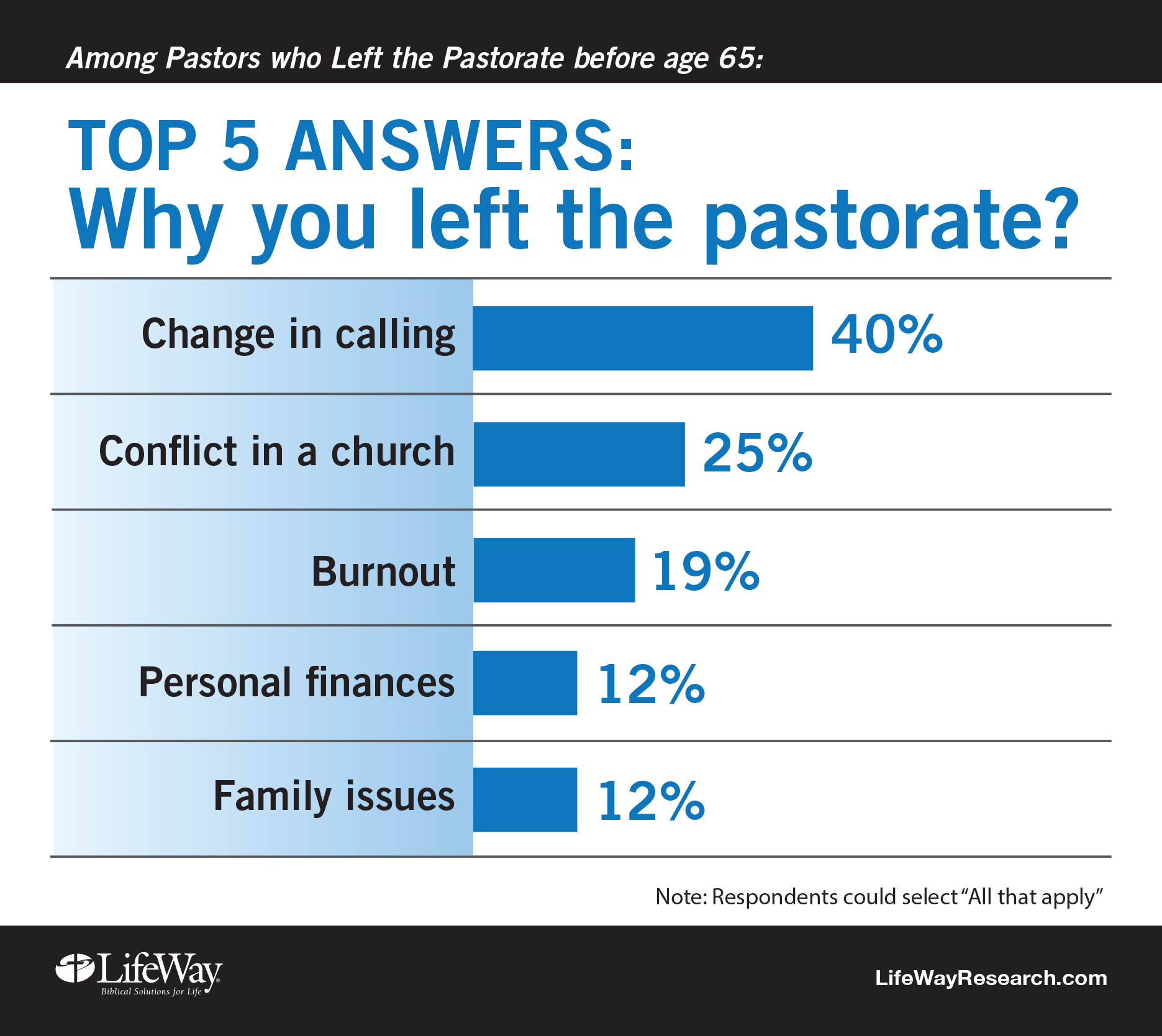
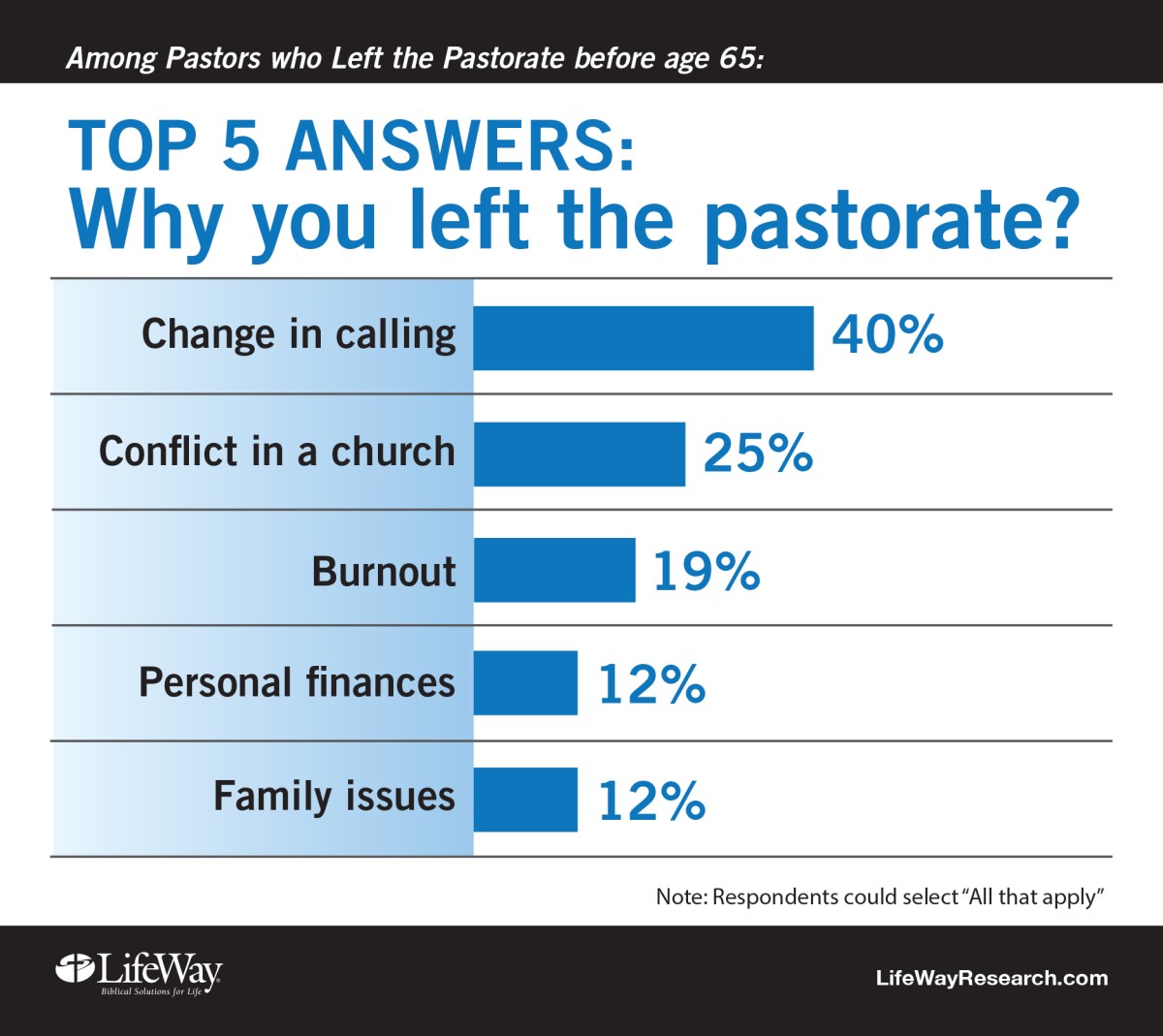
Forty percent say they left the pastorate because of a change in calling. They also cite such issues as church conflict (25%), burnout (19%), personal finances (12%), and family issues (12%).
"These things are interrelated," Stetzer said. "If you’re burning out, chances are when conflict arises you’re not going to respond well, and that will make the conflict worse."
Almost across the board, the former pastors report more negative views than current pastors who answered the same questions several months earlier.
LifeWay Research surveyed 1,500 senior pastors at evangelical and historically black churches in March 2015, and found only 1 percent leave the pastorate each year for reasons other than death or retirement.
Stetzer cautioned the two studies are not directly comparable. The initial study involved all evangelical and black Protestant churches, but only four denominations provided lists of former pastors for the followup survey. In addition, the earlier survey was conducted by phone, while the former pastors were surveyed online.
"Though the populations aren’t identical, we do notice the responses from people who have left the pastorate are worse," Stetzer said. "Either current pastors are painting a rosy picture that doesn’t fully describe reality, or those leaving the pastorate are in a less healthy position. Probably there’s truth to both of those."
Current and former pastors agree the job is demanding: 84 percent of current pastors and 83 percent of former pastors say they feel on call 24 hours a day, while 48 percent of each group say the demands of ministry often feel like more than they can handle.
On other measures, however, the differences can be stark:
- 21 percent of current pastors vs. 49 percent of former pastors believe their church has unrealistic expectations.
- 35 percent of current pastors vs. 62 percent of former pastors report feeling isolated.
- 89 percent of current pastors vs. 68 percent of former pastors feel free to say no to unrealistic expectations.
- 92 percent of current pastors vs. 61 percent of former pastors believe their congregation provides genuine encouragement to their family.
- 94 percent of current pastors vs. 74 percent of former pastors say they consistently protect family time.
Former pastors are also less likely than current pastors to report an enthusiastic spouse, to take a weekly day of rest, and to work at preventing conflict. They are more likely to worry about their family’s financial security and to frequently get irritated with people at church.
The churches in which they serve look markedly different, according to the surveys. Current pastors report their churches are more than twice as likely as those of former pastors to offer a sabbatical plan and a list of counselors for referrals, more than three times as likely to have a lay counseling ministry and a document listing expectations of the pastor, and more than four times as likely to have a pastor support group.
"When we see a number of items all looking a little less healthy, they can add up," Stetzer said. "But many of the gaps are preventable. It’s going to take a combination of the seminaries, academia, denominational folks, and even outside ministries putting their heads together and seeking God on how best to support pastors."
Lisa Cannon Green is senior writer for Facts & Trends magazine.
Methodology:
The online survey of former senior pastors was conducted Aug. 11-Oct. 2, 2015. The sample lists were provided by four Protestant denominations: Assemblies of God, Church of the Nazarene, The Lutheran Church—Missouri Synod, and Southern Baptist Convention. Each survey was completed by an individual who has served as a senior (or sole) pastor but stopped serving as senior pastor prior to age 65. The completed sample is 734 former pastors. The study was sponsored by the North American Mission Board and Richard Dockins, M.D.
[Photo courtesy of hermanturnip – Flickr]