Filipino Christians are mourning at least 20 churchgoers and soldiers as martyrs after terrorists attacked a Catholic cathedral during Sunday mass in a heavily Muslim island in the southern Philippines.
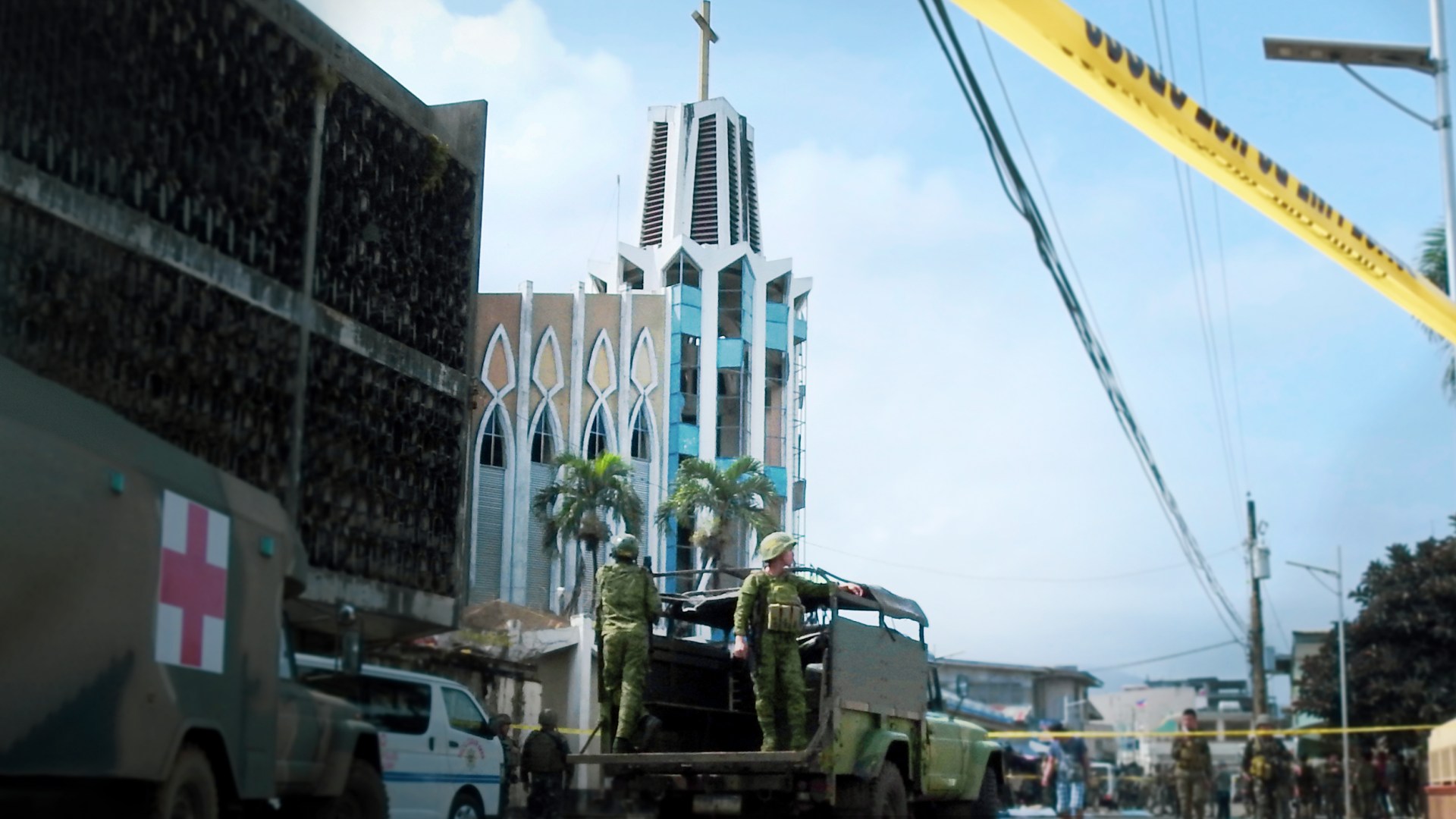
Two bombs went off at Our Lady of Mount Carmel in Jolo within minutes, the first blasting through rows of pews and the second shooting from the entrance to kill scrambling parishioners as well as the guards positioned outside to protect the church week after week.
Mount Carmel’s iconic blue-windowed façade, facing the provincial capital’s town square, was shattered and the streets quiet as officials warned residents against large gatherings in the wake of the bombing. In a region plagued by Islamist violence, it’s not the first attack on the cathedral—but it is the deadliest.
Sunday’s tragedy comes less than week after surrounding islands voted to form an autonomous region among the Muslim strongholds in an effort to end ongoing clashes between Philippine forces and separatists. Muslims in Jolo largely opposed the new Bangsamoro Autonomous Region in Muslim Mindanao (BARRM), but were voted into it anyway.
The terrorists killed at least 15 civilians and wounded at least 90 inside the Jolo church, in addition to the 5 soldiers guarding the service who died. A local priest described the victims as regulars at the 8 a.m. mass.
“They bravely stayed in Jolo in spite of the threats and insecurities. I believe they have died for their Christian faith,” said Romeo Saniel, the city’s apostolic administrator, who noted that personal friends as well as congregational leaders, including the former head of the Parish Pastoral Council, were among the list of those confirmed dead so far.
“No words can describe the sorrow and pain that we feel these days. May they be given justice in God's time. I know that the friends of the victims (both Muslims and Christians) are mourning and in deep sorrow today.”
Parishes from all over the third-largest Catholic country in the world by population posted to Mount Carmel’s Facebook page to share their grief and solidarity.
Though the Philippines is around 80 percent Catholic, Jolo’s province, Sulu, is less than 3 percent. Most of the 31,000 Catholics on the island live in the capital, according to the Catholic News Agency.
One visitor posted on Facebook that Mount Carmel was the only church she’d been to where soldiers surrounded the church, ready for any threat. “Today around 8 a.m., the fear of all had arrived,” she wrote.
The Islamist terrorist group Abu Sayyaf has been operating on the island for decades and pledged allegiance to ISIS, which claimed responsibility for Sunday’s attack.
Over the years, Abu Sayyaf conducted dozens of kidnappings, including of Christian missionaries; Abu Sayyaf also assassinated the bishop of Jolo outside of Mount Carmel in 1997 and bombed the cathedral in 2001.
“The enemies of the state have boldly challenged the capability of the government to secure the safety of the citizenry in that region,” said Salvador Panelo, spokesman for President Rodrigo Duterte. “The armed forces of the Philippines will rise to the challenge and crush these godless criminals.”
The president visited the cathedral on Monday.
The head of the Catholic Bishops Conference of the Philippines shared the government’s concerns for the region, with Bishop Romulo Valles stating they have “observed how the culture of violence has gradually prevailed in our country, and the bombings in Jolo is a further evidence to the cycle of hate that is destroying the moral fabric of our country.”
Two years ago, CT reported on how Philippine forces faced historic opposition on Mindanao, where the Maute group—which stems from a movement called the Moro National Liberation Front—had targeted Christians in an island-wide campaign to kill and capture. Experts feared it was an indicator of efforts to establish a caliphate in the region.
The Moro National Liberation Front is said to benefit from the January 21 referendum to bring autonomy to a region of five majority-Muslim provinces in the Philippines; its name, Bangsamoro, essentially means Moro Nation. The area is expected to transition fully to its own government in 2022, replacing the Autonomous Region of Muslim Mindanao (ARMM).
“Though the region of roughly 4.3 million people won’t keep its own army or restrict entry by other Filipinos, the government is expected to give it enough local control so that Muslims get a sense of the autonomy they have fought for since the 1960s,” explained Voice of America. “Proponents of the move hope the sense of self-rule might in turn stop fighting between armed rebels and government troops, battles that sometimes catch civilians in their net, and let the population develop economically.”
Opponents include Christians and those on the island of Jolo in particular, fearing further violence from Abu Sayyaf.