





Protestantism without Caricature
I’ve never had much appetite for participating in formal or competitive debating. Verbal sparring demands a quick and agile mind. My own brain, which runs on more tortoise-like settings, would probably clench up under the harsh glare of stage lights.
All the more credit, then, to figures like pastor, author, and theologian Gavin Ortlund, who bravely sallies forth into YouTube channels that host spirited conversation on all manner of apologetics topics. Within these arenas, Ortlund has developed a special talent for answering Catholic and Orthodox critics of the Protestant Reformation.
His recent book, What It Means to Be Protestant: The Case for an Always-Reforming Church, takes to heart a core debating principle: You can score cheap points by attacking a weak or distorted version of your opponent’s argument, but true persuasion requires candidly acknowledging the strongest challenges and meeting them head-on.
Reviewing the book—which CT named its Book of the Year for 2024—is Gray Sutanto, an Indonesian-born theology professor at Reformed Theological Seminary in Washington, D.C.
In his judgment, the book “reminds readers that what often passes as ‘Protestant’ in the rhetoric of Eastern or Catholic apologists compares the worst of Protestantism to the best of the non-Protestant traditions.’ Moreover, Ortlund shows ‘how commonly and easily Protestantism is misrepresented, even by Protestants.’
“According to Ortlund, a popular writer and theologian, ‘It is sadly commonplace for Protestantism to be characterized in terms of the street-level practice at contemporary evangelical churches and ministries, rather than in terms of historic, official, confessional doctrine.’ He adds, ‘In many cases, low church, evangelical Protestantism (predominantly Baptist and nondenominational) is equated with Protestantism as a whole.’ As a consequence, ‘many particular Protestant views are mangled by caricature.’
“Misunderstandings like these provide one reason why, to quote the headline of a recent CT piece, some evangelicals are leaving Protestantism for other traditions, like Roman Catholicism and Eastern Orthodoxy. In the view of those making such transitions, Protestantism appears deficient in the areas of liturgical seriousness, historical depth, and institutional unity. And these other traditions, by contrast, seem to offer a more stable, enduring foundation for the Christian faith.
“I think Ortlund’s diagnosis—that Protestants and non-Protestants alike often fail to appreciate the fullness of the Protestant tradition—is exactly right. His book is a welcome remedy to the watering down of Protestantism in the contemporary age.”
Safe Advice for Christian Men
Writing books for Christian men is a tricky proposition. Men who gravitate toward these books naturally desire advice that speaks to the specifics of Christian manhood. But the more deliberate you are about identifying those specifics—holding forth, say, on men’s natural inclinations or God-given vocations—the more you risk getting entangled in simplistic or insulting gender generalizations that color outside the clear lines of Scripture.
For my latest Beckoning Nightstand column, which appears in the January/February issue of CT, I landed on the idea of reading Kent Hughes’s Disciplines of a Godly Man, a popular spiritual guide first published in 1991.
Hughes writes from within a Reformed tradition whose leading authorities sometimes take controversial stances on the Bible’s template for relationships between men and women. I was somewhat surprised, then, to see him largely shying away from questions of headship at home and leadership in the church, among other common gender-role battlegrounds. Indeed, the great bulk of Disciplines of a Godly Man seems plainly, straightforwardly relevant to godly women as well. Who couldn’t benefit from exhortations to diligence in things like prayer, Bible study, and church fellowship?
As I read the book, I often wondered why Hughes was avoiding all the elephants in the room. In the column, however, I explain why it “gradually won me over. For all my frustrations with its commingling of guidance for Christian men and guidance for Christians in general, it sidesteps a more serious pitfall: commingling biblical teaching with cultural dross.
“Sometimes this error takes fairly innocuous (or mildly amusing) forms, as when books marketed to men play up themes of getting fit, grilling meat, and grooming beards. Sometimes it veers off in nastier directions, as with recent polemics like The Manliness of Christ: How the Masculinity of Jesus Eradicates Effeminate Christianity. In hewing closely to Scripture, even at the cost of forsaking more man-centered entreaties, Hughes stays on sure ground.
“I do believe some authors are called to tiptoe onto riskier territory. In an era when men are often confused about our roles and responsibilities—and beguiled by vulgar (or worse) ‘influencers’ online—it behooves us to have comprehensive portraits of biblical manhood in the family, church, and workplace. Hopefully we can draw these portraits with nuance and sensitivity instead of sketching bizarre or demeaning caricatures.
“But Disciplines of a Godly Man holds a counterintuitive lesson: Perhaps the books that best serve men do so precisely by serving the whole body of Christ.”


don’t miss

I was raised in Indonesia as part of a Roman Catholic family. When I first became a Christian, I attended a church in Jakarta with little to no formal liturgy,…

In some ways, all eras of evangelical journalism are remarkably alike. It’s too cynical to conclude, with Ecclesiastes, that there’s nothing new under the sun, but similar issues and challenges…
in the magazine
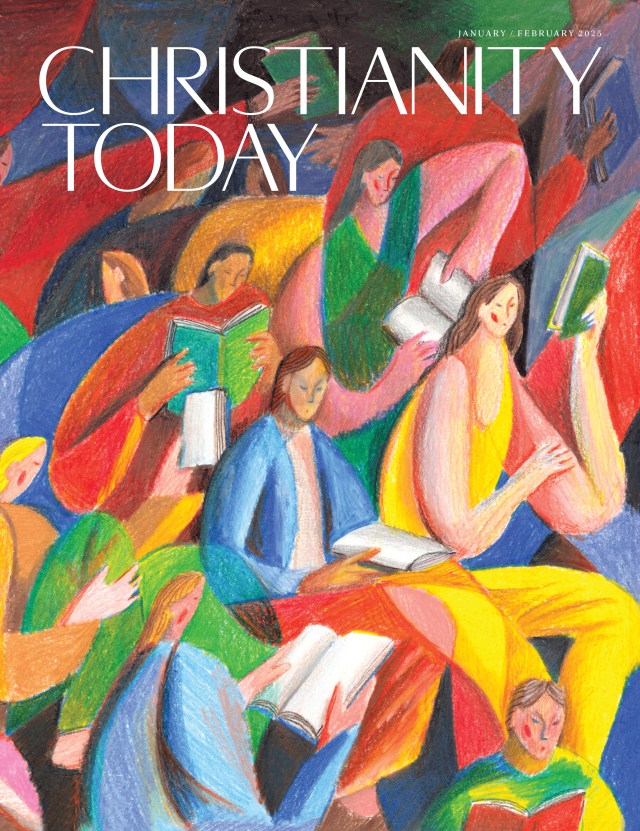
This first issue of 2025 exemplifies how reading creates community, grows empathy, gives words to the unnamable, and reminds us that our identities and relationships proceed from the Word of God and the Word made flesh. In this issue, you’ll read about the importance of a book club from Russell Moore and a meditation on the bookends of a life by Jen Wilkin. Mark Meynell writes about the present-day impact of a C. S. Lewis sermon in Ukraine, and Emily Belz reports on how churches care for endangered languages in New York City. Poet Malcolm Guite regales us with literary depth. And we hope you’ll pick up a copy of one of our CT Book Award winners or finalists. Happy reading!
more from christianity today
related newsletters
CHRISTIANITY TODAY WEEKLY: CTWeekly delivers the best content from ChristianityToday.com to your inbox each week.
CT PASTORS: Each weekly CT Pastors issue equips you with the best wisdom and practical tools for church ministry.
CT books
Each issue contains up-to-date, insightful information about today’s culture, plus analysis of books important to the evangelical thinker.
Delivered free via email to subscribers weekly. Sign up for this newsletter.
You are currently subscribed as no email found. Sign up to more newsletters like this. Manage your email preferences or unsubscribe.




Christianity Today is a 501(c)(3) nonprofit organization.
“Christianity Today” and “CT” are the registered trademarks of Christianity Today International.
Copyright ©2025 Christianity Today, PO Box 788, Wheaton, IL 60187-0788
All rights reserved.