





Hello, fellow wayfarers … What happens if you look away from these shootings in Minneapolis … How I’m grateful for your prayers for my city in the winter storm … Why I confronted Beth Moore twice this week … One, two, three—turn it up for a Birmingham Desert Island Bookshelf … This is this week’s Moore to the Point.
What Happens When You Look Away from the Minneapolis Shootings
In 1981, novelist Walker Percy wrote a column he titled “A View of Abortion with Something to Offend Everybody.” As a Christian, he took on the seared consciences of pro-life people disregarding the poor women who don’t get abortions but can’t feed their babies. As a medical doctor, he took on the seared consciences of pro-choice people who see the unborn child as just a blob of detachable organic matter. His final word was for the ones he assumed would be the winners of the political moment. To supporters of abortion, he wrote, “According to the opinion polls, it looks as if you may get your way. But you’re not going to have it both ways. You’re going to be told what you’re doing.”
What Percy identified here is much bigger than just one issue. It is rather the temptation, present in all places, to make invisible whatever actions trouble one’s own conscience, to make disposable whatever people one’s own tribe deems unworthy. He knew the fellow pro-lifers he was criticizing would not argue that children of poor women deserved their suffering. They would just say, What poor women in my community? And he knew the abortion rights supporters he was criticizing would speak loudly about choice without ever describing what actually happens in such a choice—and to whom.
This month, masked federal government agents in Minneapolis shot and killed two American citizens. With the first shooting, that of Renee Good, those arguing that we should ignore ICE’s culpability said Good was attempting to drive into the officers. Slowed-down video footage convinced many people who saw it that this was not the case, but surely the people waving away this killing thought the officer was justified in his response. The second and more recent killing, that of Alex Pretti, seemed much less ambiguous: A man legally carrying a concealed weapon was thrown to the ground, disarmed, and then shot ten times.
Over the past several days, the president’s language has been much more restrained than that of his vice president and his Homeland Security secretary, and homeland security adviser, who in some cases implied and in other cases stated that these two protesters were domestic terrorists.
If this were a mere question of governance and policy, it would still be of great importance. After all, we can see what happens in other places when armed authorities kill with impunity those who protest. And as I wrote two weeks ago on the meaning of Romans 13, the responsibility for holding such power accountable in America’s system of government is ultimately with all of us. But let’s step back from the civic space for a moment.
Some Christians, wherever they are politically, have said what should be obvious and noncontroversial: The killing of people under the circumstances we saw filmed is evil. But others who profess the name of Christ have said Good and Pretti deserved what they received. And still others throat-cleared their way out of making judgments only after the Pretti video became ubiquitous. Even if these were murders, the argument goes, these people shouldn’t have been where they were when they were. The immoral taking of human life, in other words, should be safe, legal, and rare.
People made the same arguments after the murders of Andrew Goodman, Michael Schwerner, and James Chaney in Mississippi in 1964: Nobody is for killing anybody, but if they had stayed home, they would be alive today. People made the same arguments about John Lewis in Selma when police beat him or about Martin Luther King Jr. when he was assassinated. What has changed are not the arguments themselves; the only thing that has changed is the time.
Jesus warned about this when he said to the religious leaders around him, “For you build the tombs of the prophets and decorate the monuments of the righteous, saying, ‘If we had lived in the days of our fathers, we would not have taken part with them in shedding the blood of the prophets’” (Matt. 23:29–30, ESV throughout).
It is clear, of course, that those who want to cover up conversation about these killings expect that most of us will look away and that those who don’t will quickly move on. In Machiavellian terms, these leaders have good reason to assume our willful forgetfulness. They’ve seen it before, over and over again. Maybe you fit into that category: You don’t want to justify what sure seems to be murder, but you don’t want to get out of touch with your tribe either, so you choose not to think about it at all.
Ask not what will happen to your country—although that’s of great and grave importance. Ask what will happen to you.
What happens to you? If, when Charlie Kirk was murdered, your thought was Well, he shouldn’t have said the Second Amendment was worth the lives that were lost in school shootings or if now your thought is Well, they should have stayed home, and they’d be alive today, do you hear yourself? If that’s your response, you don’t object to murder but to murder of people on your side. It would be disastrous for us as a country if we collectively started to think like that. But a soul is even more permanent than a state.
The searing of a conscience—especially by evaluating in terms of tribal belonging what lives are worth living—leads to easier and easier searing in the future. The power to discern good from evil demands “constant practice” (Heb. 5:14). The next-to-end result is chilling: “They kill the widow and the sojourner, and murder the fatherless; and they say, ‘The Lord does not see; the God of Jacob does not perceive’” (Ps. 94:6–7).
Armed agents doing wrong things can perhaps count on masks to shield them from accountability—or on presidential pardons or legal immunities or even the short attention spans of the American people. But what happens to you when you make moral decisions about the life or death of those made in the image of God? That cannot be hidden, at least not permanently, not to the God who judges the living and the dead.
If the universe is meaningless and good and evil are just categories of power or distinctions between friend and enemy, that’s one thing. But if there is an all-seeing God and Jesus is alive, then the judgment seat is quite different from public opinion. You cannot hide a hardened heart behind the fact that you weren’t the one pulling the trigger. God is not a political hack of any party or movement, and he doesn’t observe the Fifth Avenue rule.
The country is in a dangerous time. You might conclude that defeating your enemies is worth ignoring some lives lost—murders you would have denounced if the “other side” had done the killing. You might conclude that a culture war is worth your conscience. If so, you might win. After all, the United States is only 250 years old, and underestimating human virtue and responsibility is often a safe bet in a fallen world.
But you can’t have it both ways. You will be told what you’re doing.
Nashville in the Storm
Thanks to those of you who have checked in on us during winter storm Fern this week. A sudden ice storm shut down Nashville and the surrounding region. Trees are down everywhere as though in the aftermath of a tornado. Apart from some on and off flickering, we had electricity, but most people we know did not, and some still don’t.
A couple years ago, we had (much less severe) ice, and I had to speak at something at Vanderbilt University. A coastal Mississippian to the last, I could barely get out the front door and certainly could not drive in that. I called our friend David French to see if he could pick me up. David has a truck in a size that carries its own zip code, and he doesn’t even flinch in any kind of weather. When he took me home, I gripped the side of his truck, slipping and sliding on my iced-over driveway. As I got directly behind the truck, I slipped literally under the vehicle (which thankfully he, seeing me, kept it in park until I was out).
This time I stayed home through it all, but lots of people couldn’t. And lots of other people went without medicine they needed or lost property they loved. They could use your prayers.
My Intervention on Beth Moore
I confronted Beth Moore twice this week. No, I am not regressing to my 2007 factory settings.
Beth Moore calls our periodic podcast conversations “Tigger and Eeyore talk about [topic].” She is pointing to her classic Enneagram Seven optimism and my Enneagram Four whatever-you-call-it. This week we were set to talk about Walking with God, which is a new study she’s just published, when she texted me and said, “I also would love to talk about Job.”
Now, dear reader, last episode she wanted to talk about Ecclesiastes. So I held my fire and waited until we were on the air to say, “The two arguably darkest books of the Bible. Who is Tigger and who is Eeyore?” She won the argument, though, because she ended up explaining Job with hope-filled enthusiasm.
This week we talk about why the Bible leaves that big question—how to reconcile a good, all-powerful God with a world of suffering—unresolved; how spiritual growth is about quiet formation with little habits and practices (and how to start them); and what she’s learned in 47 years of marriage (and what things in a married couple’s small group did not help).
At the end I confronted her again—on her repeated references to herself as “an older woman.” You can hear how she shut me down on that one too.
You can listen to the episode here.
Desert Island Bookshelf
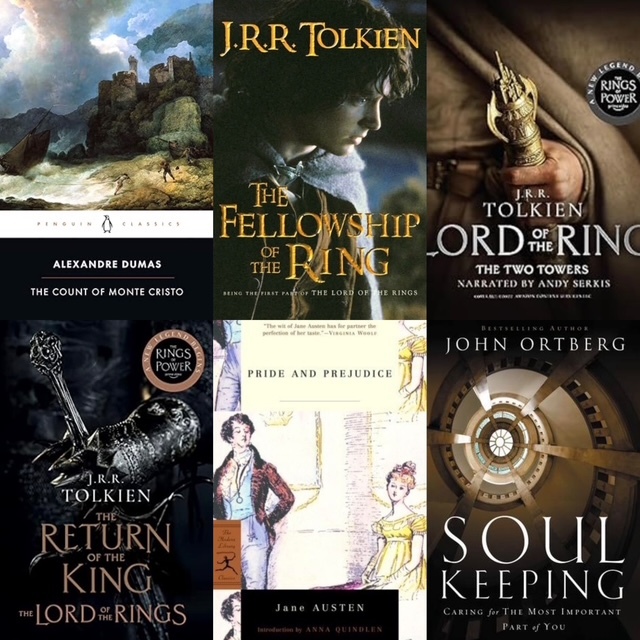
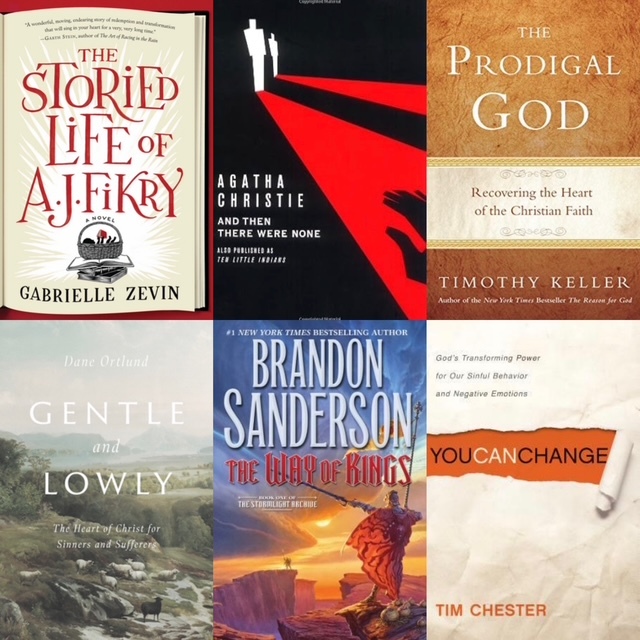
Every other week, I share a list of books that one of you says you’d want to have on hand if you were stranded on a deserted island. This week’s submission comes from reader Chris Martin from Birmingham, Alabama. Here’s Chris’s list:
- And Then There Were None by Agatha Christie because I did not grow up a voracious reader, didn’t hate or love reading. But I remember reading this book and being in complete amazement at the end of the book, and it sparked a love for reading. This book holds a special place in my heart for that.
- The Count of Monte Cristo by Alexandre Dumas because it is a beautiful story about vengeance and forgiveness. Maybe Edmond Dantès’s escape from prison would also give me hope in escaping the deserted island.
- The Lord of the Rings trilogy by J. R. R. Tolkien because it is the best fantasy series ever written. The depth and detail Tolkien put into Middle-earth to make it feel so real. The clear good versus evil. The nobility and courage to stand for what is right in the face of almost-certain destruction. Another book below, The Way of Kings, touches some of the same reasons I picked it.
- Pride and Prejudice by Jane Austen because it’s a beautiful love story with so many endearing and entertaining characters. I relate to Mr. Darcy’s awkward and fumbling ways with his love interests, his misunderstood coldness and seriousness. I admire the close relationship between Elizabeth Bennet and her father and the innocent love between Jane Bennett and Charles Bingley. And finally, Elizabeth’s pride and courage to stand up for herself is inspiring, even though it is misused occasionally. Now, Mrs. Bennet does get on my very last nerve, but I also could never relate to being a mother, much less one in 1812.
- The Storied Life of A. J. Fikry by Gabrielle Zevin because it is so encouraging and beautiful to see how enriching a simple life can be when you allow yourself to be vulnerable and open your heart up to love and family, even after tragedy. It reminds me of what a full life really looks like and how simple it can be.
This story exemplifies a famous C. S. Lewis quote: “To love at all is to be vulnerable. Love anything and your heart will certainly be wrung and possibly be broken. If you want to make sure of keeping it intact you must give it to no one, not even an animal. Wrap it carefully round with hobbies and little luxuries; avoid all entanglements; lock it up safe in the casket or coffin of your selfishness. But in that casket—safe, dark, motionless, airless—it will change. It will not be broken; it will become unbreakable, impenetrable, irredeemable.” - The Way of Kings by Brandon Sanderson is a very good fantasy novel that champions some of similar truths as Lord of the Rings. Good and evil are pretty clear. The characters are very interesting. The story doesn’t get trashy like Game of Thrones. I absolutely love the character Kaladin and his nobility and leadership in the face of slavery and tragedy. The world it is set in was fun to imagine and ponder as well, it doesn’t have the air of being an older time in our world. This world is a very different place.
- The Prodigal God by Timothy Keller because I don’t know of another book that speaks so directly to my sinful pride in my works, like the elder brother in the Prodigal God parable, and it is one of those messages I need to hear over and over again. Tim did such a wonderful job explaining this parable, and this book’s message is so important for anyone who’s been involved in church their entire lives.
- Soul Keeping by John Ortberg because I read this book while on a trip out West by myself to meet up with my retired parents at a national park, and the book really ignited some spiritual growth, healthier spiritual practices, and healthier actions I made toward myself. I think it may have been really good timing to read it when I did, but I really appreciate this book and have returned to it once and will again.
One of my favorite quotes from Soul Keeping: “Every now and then I try to get away to the ocean and spend most of a day alone. It’s a strange thing I don’t fully understand. I have a lot of people in my life who love me and will tell me so, but when I am alone for an extended period of time, all the obligations and expectations and need to perform kind of melt from my mind. I am reminded when I’m alone that God loves me—that there is something about life that is infinitely deeper than all the expectations and roles and performance stuff of my outer life. It changes my body. I can feel it. My soul feels its worth.” - Gentle and Lowly by Dane Ortlund because it speaks to God’s love for us and his grace for us better than almost any other book. This book has been so popular, I feel it almost needs no explanation why it is on my list.
- You Can Change by Tim Chester because it is my favorite book on how to confront the ongoing sins or addictions in our lives that are so hard to shake. Tim makes it very practical with actions to take. I had our men’s small group read this book, and it was great in that use as well. A favorite quote from it I use often: “Love without truth is like doing heart surgery with a wet fish. But truth without love is like doing heart surgery with a hammer.”
Thank you, Chris!
Readers, what do y’all think? If you were stranded on a desert island for the rest of your life and could have only one playlist or one bookshelf with you, what songs or books would you choose?
- For a Desert Island Playlist, send me a list between 5 and 12 songs, excluding hymns and worship songs. (We’ll cover those later.)
- For a Desert Island Bookshelf, send me a list of up to 12 books, along with a photo of all the books together.
Send your list (or both lists) to questions@russellmoore.com, and include as much or as little explanation of your choices as you would like, along with the city and state from which you’re writing.
Quote of the Moment
“The times are difficult. They call for courage and faith. Faith is in the end a lonely virtue. Lonely especially where a deeply authentic community of love is not an accomplished fact, but a job to be begun over and over.”
—Thomas Merton, The Road to Joy
Currently Reading (or Re-Reading)
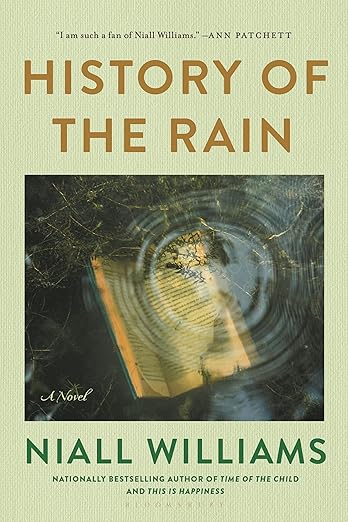
- Niall Williams, History of the Rain (Bloomsbury)
- Niall Williams with Christine Breen, In Kiltumper: A Year in an Irish Garden (Bloomsbury)
- Dorian Lynskey, Everything Must Go: The Stories We Tell About the End of the World (Pantheon)
- John Koenig, The Dictionary of Obscure Sorrows (Simon & Schuster)
Join Us at Christianity Today
Founded by Billy Graham, Christianity Today is on a mission to lift up the sages and storytellers of the global church for the sake of the gospel of Jesus Christ. Subscribe now to get exclusive print and digital content, along with seasonal devotionals, special issues, and access to the full archives. Plus, you’ll be supporting this weekly conversation we have together. Or, you could give a membership to a friend, a pastor, a church member, someone you mentor, or a curious non-Christian neighbor. You can also make a tax-deductible gift that expands CT’s important voice and influence in the world.
Ask a Question or Say Hello
The Russell Moore Show podcast includes a section where we grapple with the questions you might have about life, the gospel, relationships, work, the church, spirituality, the future, a moral dilemma you’re facing, or whatever. You can send your questions to questions@russellmoore.com. I’ll never use your name—unless you tell me to—and will come up with a groan-inducing pun of a pseudonym for you.
And, of course, I would love to hear from you about anything. Send me an email at questions@russellmoore.com if you have any questions or comments about this newsletter, if there are other things you would like to see discussed here, or if you would just like to say hello.
If you have a friend who might like this, please forward it, and if you’ve gotten this from a friend, please subscribe!


Russell Moore
Editor in Chief, Christianity Today
P.S. You can support the continued work of Christianity Today and the Public Theology Project by subscribing to CT magazine.
Moore to the Point
Join Russell Moore in thinking through the important questions of the day, along with book and music recommendations he has found formative.
Delivered free via email to subscribers weekly. Sign up for this newsletter.
You are currently subscribed as no email found. Sign up to more newsletters like this. Manage your email preferences or unsubscribe.




Christianity Today is a 501(c)(3) nonprofit organization.
“Christianity Today” and “CT” are the registered trademarks of Christianity Today International.
Copyright ©2025 Christianity Today, PO Box 788, Wheaton, IL 60187-0788
All rights reserved.